An export of 250 customer records can mix genuine purchasers with duplicate and outdated contacts. Those rows do not all represent the same buying signal. Lookalike Audiences model potential new customers from a chosen source, so source quality changes the signal.
The size slider adds another decision. A 1% setting creates a closer similarity group, while a wider setting increases potential reach, but neither measures buying intent. Automated options may also widen delivery. Singapore advertisers should verify controls and customer-data permissions before spending.
A sound campaign comparison tracks first-time buyers or qualified enquiries against the same acquisition goal. It separates platform metrics from actual sales and tracks full campaign costs. You will be able to prepare the seed, select a defensible test and decide which results justify further budget.
Key Takeaways
- Build source audiences around completed purchases or qualified enquiries that match the campaign’s actual goal.
- Check matched and eligible records, not just the number of rows exported from your customer database.
- Use the Seed-to-Size Matrix as a test-planning tool, never as proof that 1% or 10% will perform better.
- Keep existing customers in a valuable purchaser seed, but exclude them from new-customer campaign delivery where required.
- Review Advantage+ settings because automated delivery may extend beyond an audience you selected.
- Judge prospecting by qualified customers, acquisition cost and gross profit, with consistent reporting windows.
What Lookalike Audiences Do
A lookalike is a modelled group of people an advertising platform identifies as similar to a source audience, often called a seed. A customer list supplies examples of who already buys, while Meta uses information available to its advertising system to find potential new customers. Its explanation of lookalike targeting describes the basic prospecting purpose.
Similarity is not purchase intent. A person can resemble an existing customer and still have no reason to buy today. Offer relevance, advertising content and the landing page remain part of the outcome, which is why a lookalike should be treated as one prospecting option to test.
Custom Audiences, Lookalikes and Retargeting
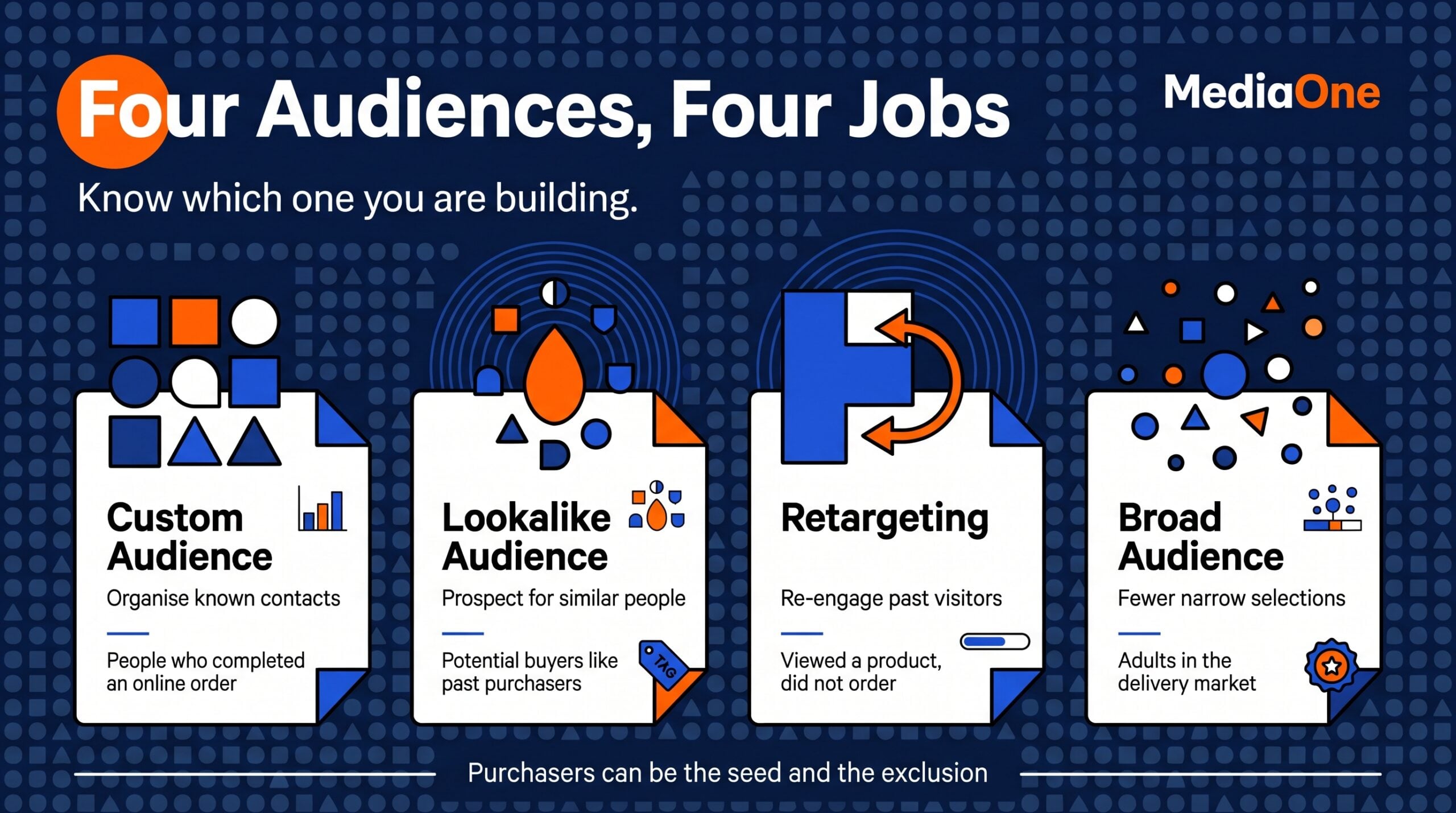
These terms have different jobs. A custom audience can contain existing contacts or people who engaged with a business. A lookalike uses an eligible source to identify other people, while retargeting reaches people who have already interacted with the advertiser.
| Audience Type | Main Purpose | Singapore Example |
|---|---|---|
| Custom audience | Organise known contacts or interactions | People who completed an online order |
| Lookalike audience | Prospect for similar people | Potential buyers resembling completed purchasers |
| Retargeting audience | Re-engage prior visitors or customers | People who viewed a product but did not order |
| Broad audience | Let delivery operate with fewer narrow audience selections | Adults in the retailer’s delivery market |
A purchaser list can be a useful source for a lookalike and also serve as an exclusion in a campaign seeking first-time buyers. Removing buyers from the source would defeat the purpose of modelling the customers the business wants to attract.
Why Seed Quality Shapes the Result
A list of 2,000 newsletter subscribers contains a different signal from 400 customers who placed paid orders. The larger group may reflect interest in free content, while the smaller group records willingness to spend. Neither size alone identifies the winner, and an eligible purchase seed may still have too few matched records.
For a Singapore B2B service firm, qualified enquiries accepted by the sales team can be more useful than every form submission. An enquiry from a company outside its service area, a student researching a topic and a decision-maker requesting a proposal should not all be treated as equivalent conversions.
A valuable source also needs to represent ordinary customers. If a retailer builds its seed entirely from one clearance sale, the model may favour discount seekers. Our audience segmentation guide explains how to distinguish business groups before treating them as one audience.
Check Eligibility Before You Build
Review the source type, number of eligible people, account access and permitted use of the data. A spreadsheet can contain hundreds of rows yet yield far fewer people who match an advertising account. Meta’s exact minimums and available audience controls should be checked in the current Ads Manager interface, because platform rules and account eligibility can change.
Also confirm that the ad account can use the selected source and that tracking is working. A source built from website purchase events is of limited use if those events include duplicate test purchases or fail to record actual orders. The quickest fix is often a data check before any audience creation.
Choosing and Preparing Source Audiences
Choosing the right source is the central decision in the original Seed-to-Size framework. A seed should describe a clear commercial action, contain records that can be used appropriately, and reflect the customers the business wants to acquire next.
Start With the Conversion Outcome
For an online retailer, begin with completed orders, then consider a separate seed of repeat customers if there are sufficient eligible records. For a renovation firm, begin with signed projects or sales-qualified enquiries. For subscription software, trial sign-ups and paying subscribers represent different outcomes and should be evaluated separately.
Avoid combining every interaction into one source simply to reach a larger count. A person watching a video and a person signing a contract have shown different levels of commitment. The campaign objective should determine the source, with a larger and broader seed considered only when the narrower group cannot support a meaningful test.
The time period also needs a commercial reason. A subscription product with frequent orders may favour recent purchasers, while an expensive home renovation service may need a longer history. There is no universal 180-day rule for every business, and an arbitrary cut-off can discard valuable customers.
Clean the Data Before Uploading
Review duplicates, cancelled orders, refunded purchases and employee records before producing the source. Standardise contact identifiers according to the platform’s permitted format and remove fields the upload process does not require. Document how the list was built so the team can repeat it later.
For a Singapore retailer, an export of 1,200 orders may represent 900 individual customers after repeat purchases are grouped. Some records may lack valid contact information, and not every eligible record will match a platform account. Record each stage separately instead of describing the original 1,200 rows as 1,200 matched customers.
When the source is refreshed, use a consistent rule and keep a date-stamped version. A source named ‘SG Purchasers Current Range Q4 2026’ is easier to audit than ‘Best Audience Final 3’. Check that its underlying products and geographic market still match the campaign.
Use Customer Value With Care
A value-based source can distinguish high-value customers when the platform supports the relevant format. Decide what ‘high value’ means before preparing the file. Revenue may not represent profit, especially where discounts, returns or delivery charges make customer contribution uneven.
A hypothetical retailer might have customers spending S$300 each, but one group buys at full price while another purchases only during deep promotions. A source ranked solely by sales revenue could exaggerate the value of the second group. Gross profit or repeat purchases may be better internal checks, even if the platform’s upload requires a different value field.
Create a Lookalike in Meta Ads Manager
The broad workflow is straightforward, although account menus and available options change. Check the current Meta audience help centre and the controls shown in your own account before following an older tutorial.
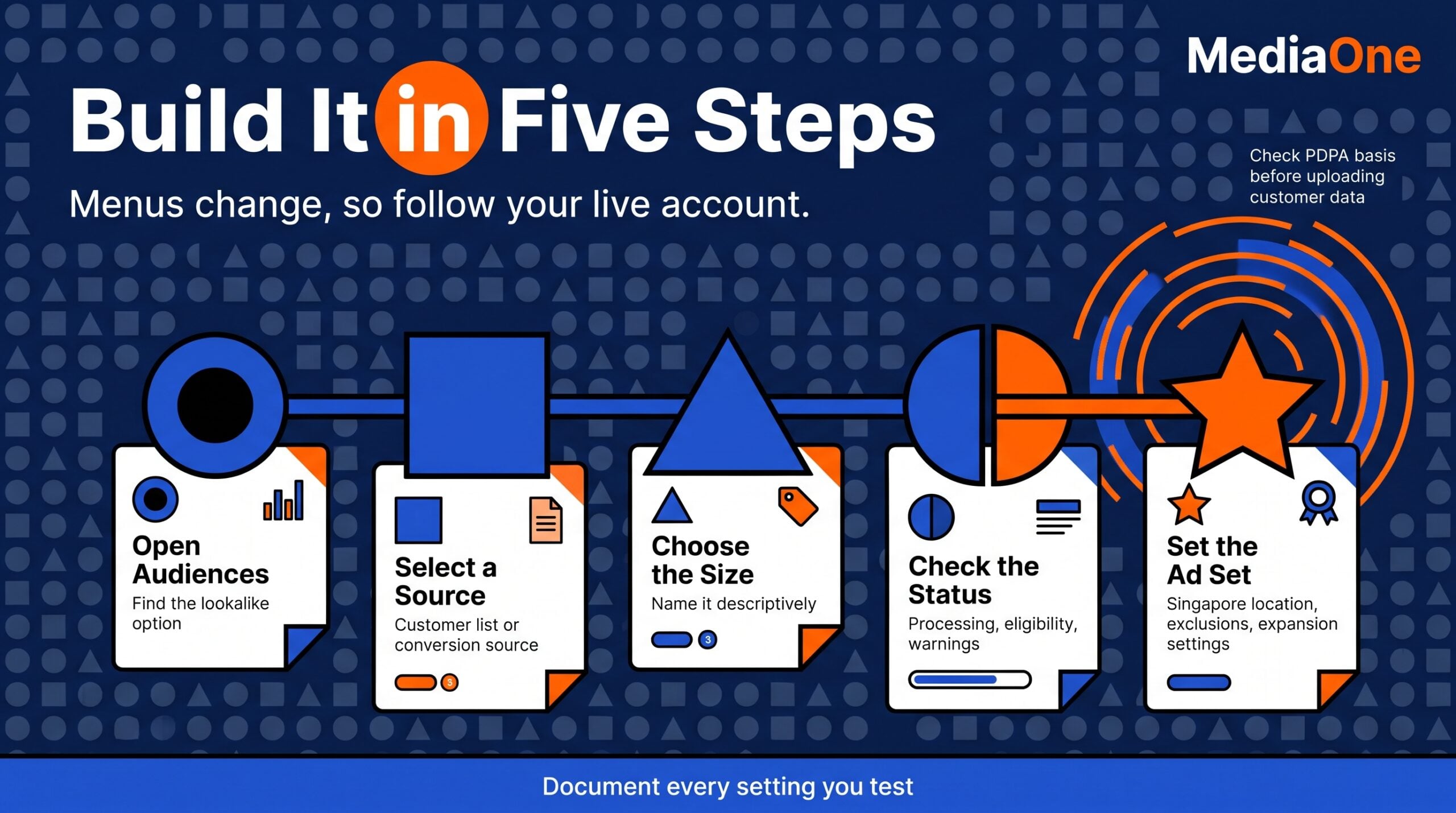
- Open the Audiences area in Meta Ads Manager and find the option to create a lookalike if it is available to your account.
- Select an eligible source, such as a customer-list custom audience or a supported website conversion source.
- Choose the available similarity or size setting, then give the audience a descriptive name.
- Create the audience and check its processing status, match eligibility and any warnings before judging delivery.
- At ad-set level, confirm the Singapore location, customer exclusions, campaign objective and any automated audience expansion settings.
Older tutorials often show a location selector inside the lookalike creation screen. Recent account workflows may set location at ad-set level instead. Follow the controls in your account and document the choices used for the test. Build ahead of the planned launch so audience preparation does not dictate the campaign start date.
Audience Size From 1% to 10%
A smaller percentage generally represents a closer modelled match to the source within the relevant audience population, while a larger percentage widens the prospective pool. These numbers describe a similarity range, not the chance that a person will convert.
A 1% option can be a sensible initial test for a well-defined purchaser seed, but it can constrain reach in a limited market. A wider setting can give delivery more room to find buyers. Results still depend on budget, bidding and the way Meta applies the audience selection within the campaign.
How to Read the Percentage
Do not confuse the lookalike percentage with the source-list size. Adding customers to the seed does not directly add the same number of people to the prospecting audience. The percentage describes the size of the modelled audience relative to the platform’s eligible population for the selected market.
Use the Seed-to-Size Matrix
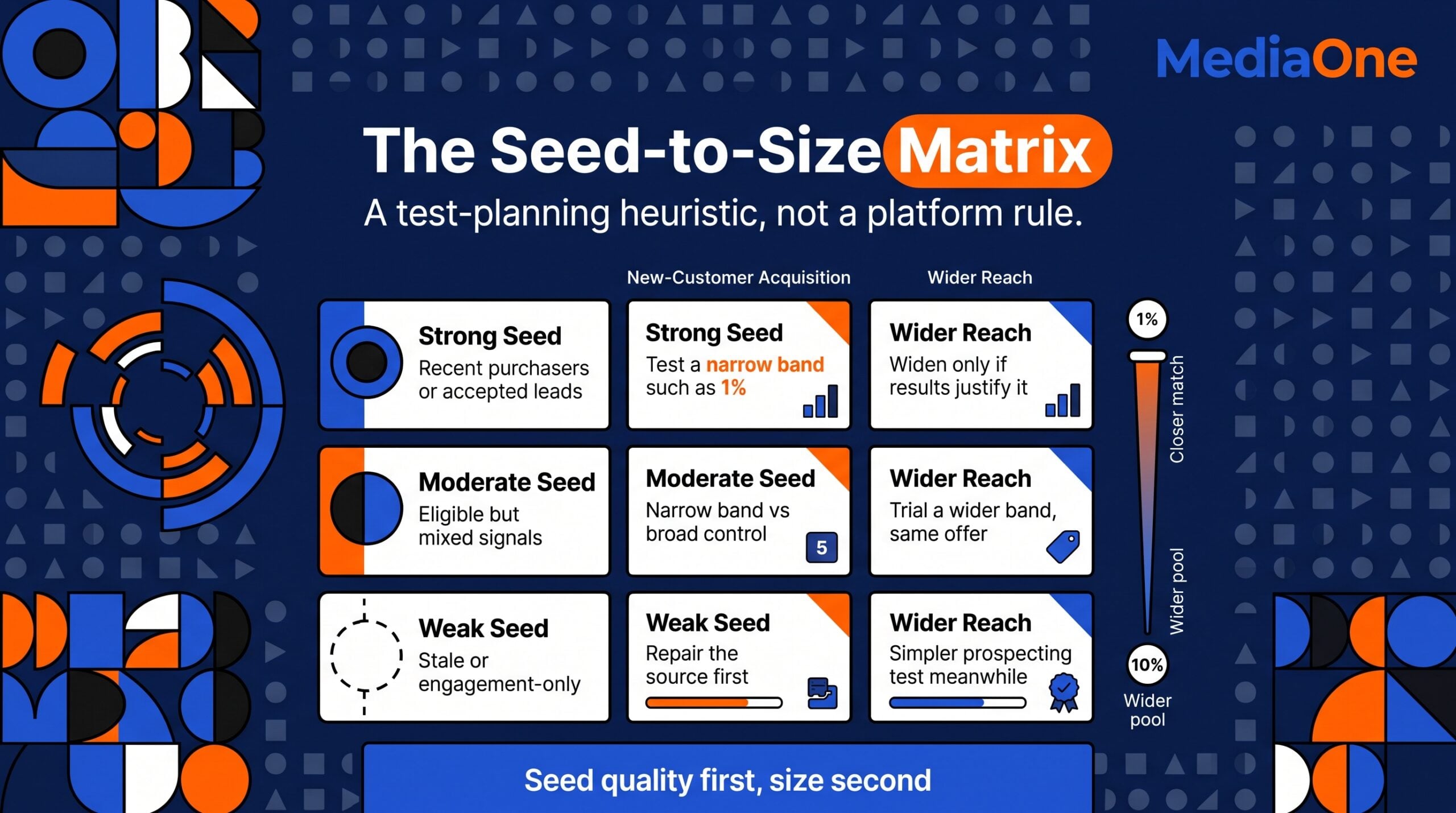
The matrix below preserves the article’s original decision framework. It is an editorial planning heuristic, not a platform rule or a tested performance benchmark. It recommends a starting comparison based on source quality and campaign purpose.
| Seed Quality | New-Customer Acquisition | Wider Reach |
|---|---|---|
| Strong: recent purchasers or accepted leads with consistent records | Test a narrower band such as 1% | Compare a wider band only if acquisition results justify it |
| Moderate: eligible but mixed conversion signals | Test a narrow band against a broad-audience control | Trial a wider band with the same objective and offer |
| Weak: stale, incomplete or engagement-only records | Repair or redefine the source first | Use a simpler prospecting test while improving the seed |
A Singapore Seed-Selection Example
Consider a hypothetical business with 250 Singapore contacts. Of these, 30 bought within the last 90 days and the remainder are older subscribers or enquiries. The 250 contacts should not be described as 250 recent purchasers. A purchase-only source would contain 30 records before matching and might fail account eligibility checks.
The team has two choices. It can extend the purchase window if the buying cycle supports that decision, or it can create a clearly labelled qualified-enquiry source and test it separately. Mixing both without noting the different signals would make any subsequent result harder to explain.
If a sufficiently large, legitimate purchaser source becomes available, test a narrow option against another prospecting method. ### Test Sizes Without Audience Overlap
A 0-1% range sits within a 0-3% range, so two ad sets using those inclusive ranges do not provide a clean comparison. If the platform permits non-overlapping ranges, a 0-1% versus 1-3% comparison removes that particular duplication. Automated expansion can still complicate the boundary.
Another practical option is to compare one lookalike setting with broad targeting using the same creative and conversion goal. Keep the reporting window, campaign offer and budget approach aligned. If Meta offers a suitable randomised A/B test, use it to reduce the risk that two ad sets compete for the same prospects.
Do not judge the winner on cost per click alone. A smaller audience may generate cheap enquiries that never close, while a broader one produces fewer leads but more paying customers. Compare the business outcomes after enough time has passed for delayed sales to appear.
Common Pitfalls, Limits and Platform Changes
The major risks are operational. A good seed can still produce an unhelpful campaign when customer exclusions are wrong, an automated audience option widens delivery, or the team attributes every new sale to the lookalike. A short launch checklist prevents avoidable errors.
Check Source Limits and Processing
Do not plan a campaign around an assumed audience minimum, fixed creation time or fixed allowance of lookalikes per source. These figures have appeared in older Meta guidance, but the official help pages may require a logged-in account and the current settings must be confirmed there. Record the actual error or status shown in Ads Manager.
Check source access before launch, especially when one agency manages the ad account and another team owns the website events. If the selected audience cannot be created, investigate permissions, source eligibility and data quality before changing the campaign goal merely to bypass the issue.
Advantage+ Can Change the Test
Meta’s automated audience products can use advertiser-selected audiences as signals and may reach people outside a narrow lookalike selection. The exact behaviour depends on the campaign setup and controls available in the account. Treat the audience setting as a documented delivery choice, not an assumed boundary.
For a fair experiment, note if the lookalike is an inclusion, an audience suggestion or part of a broader automated delivery system. Compare the actual ad-set settings, not merely the names assigned to saved audiences. Otherwise a supposed 1% versus 10% test may measure automated expansion as much as seed similarity.
Where the objective is first-time customer acquisition, review customer-list exclusions and the treatment of returning customers. A purchaser list belongs in the model when it represents good customers. The exclusion belongs in campaign delivery, subject to the available controls and the objective.
Protect Singapore Customer Data
Uploaded customer records can be personal data. Singapore’s Personal Data Protection Act governs collection, use and disclosure, with consent, purpose limitation and notification requirements subject to applicable exceptions. A list collected for order fulfilment should not automatically be assumed available for advertising uploads.
Before using customer identifiers, check the original notice, applicable consent or other lawful basis, withdrawal requests and the platform’s customer-list terms. Limit the file to required fields and retain records of the team’s assessment. Hashing an identifier for matching does not by itself remove the need to comply with data-protection duties.
LinkedIn No Longer Offers New Lookalikes
LinkedIn discontinued creation of lookalike audiences on 29 February 2024. Advertisers cannot create a new LinkedIn lookalike using the old feature. Existing static audiences may still appear in certain legacy campaigns, but they do not work like a new dynamically refreshed source.
LinkedIn now documents predictive audiences, which use supported source data to predict members likely to take similar actions. The platform has separate eligibility and setup requirements. Do not copy Meta’s percentage rules or source thresholds into a LinkedIn plan.
Measure Customers and Margin
Use one primary commercial outcome. Ecommerce businesses can report first-time orders and contribution after fulfilment costs. B2B advertisers can report sales-accepted leads, opportunities and eventual won revenue, with each stage named clearly. Our lead generation reporting guide provides a useful framework for separating enquiries from completed business.
Customer acquisition cost is total campaign acquisition spend divided by newly acquired customers for the same cohort and reporting method. For example, S$2,400 in advertising and directly attributable production costs that produces eight first-time customers gives an illustrative CAC of S$300. Include the relevant operating costs when comparing that figure with other channels.
A lookalike that produces S$8,000 in revenue is not automatically profitable. Apply gross margin, account for returns and consider the sales cycle. Report both platform-attributed results and reconciled orders or CRM outcomes so leadership understands what the advertising system measured and what the business received.
Review One Variable at a Time
Start with one source and a manageable number of comparisons. Keep the offer and landing page consistent while changing the audience choice, then review results after the agreed window. Change creative in a separate experiment so a winning advert is not mistaken for a winning seed.
Use a short diagnostic table when results disappoint:
| Result | Possible Explanation | Next Check |
|---|---|---|
| Reach grows but sales stay flat | Broader delivery attracts weaker intent | Compare new-customer conversion and lead quality |
| Leads increase but CAC rises | Follow-up or qualification costs have changed | Reconcile CRM stages and acquisition spending |
| One ad set spends little | Overlap, restrictions or delivery learning may limit it | Review audience controls and eligible reach |
| A seed stops performing | Source ages or the customer mix changes | Review source dates, refunds and recent sales |
Log the decision and the business result for each test. If the seed works but conversions remain weak, review our Facebook advertising fundamentals for creative and landing-page checks.
Conclusion Build From Customer Evidence
Lookalike prospecting begins with a customer group that accurately represents the outcome a business wants. Review the seed before choosing an audience percentage, and use the Seed-to-Size Matrix to form a test hypothesis instead of to predict performance.
For Singapore advertisers, the next step is practical: clean one source, confirm its permitted use, check Meta’s current controls and compare a lookalike with a suitable alternative. Review the result through first-time customers and acquisition cost. Keep the audience only when it improves the business outcome under a clear measurement method.
Frequently Asked Questions
How large does a source audience need to be?
Meta has published source eligibility requirements, but the live account should be your reference because thresholds and matching conditions can change. Uploaded rows are different from matched, eligible people. Check the number of genuine customers in the source and confirm its status in Ads Manager before planning a campaign around it.
Should I use a 1% or 10% lookalike?
A 1% setting generally represents a closer similarity match, while 10% offers a wider prospecting pool. Neither guarantees better customer acquisition. Start with a source that reflects your goal, then compare the available settings using matched offers and consistent conversion tracking. In a smaller Singapore market, practical reach may also influence the choice.
Can existing customers be part of the seed?
Yes. Completed purchasers can be the strongest examples of the customers a business wants more of. Keep suitable customers in the modelling source, then review exclusions at ad-set level if the campaign seeks first-time buyers. Source membership and campaign targeting are different controls, especially when automated audience expansion is active.
How long does a lookalike take to build?
Processing times depend on the source, account and platform status. Older guides quote fixed build windows, but these should not be treated as a current guarantee. Create the audience before the campaign launch, check the processing status in Ads Manager and reserve time to correct eligibility or access errors before advertising spend begins.
Are LinkedIn lookalike audiences still available?
LinkedIn stopped allowing advertisers to create new lookalike audiences on 29 February 2024. Its predictive audience feature is a separate option using supported data sources and its own requirements. A Singapore B2B advertiser should follow LinkedIn’s current predictive audience documentation and measure lead quality, instead of applying Meta’s size percentages to LinkedIn campaigns.
How should I measure lookalike campaign performance?
Measure new customers or sales-qualified enquiries first, then calculate acquisition cost over an agreed period. Confirm that the same offer and conversion definition apply to the comparison group. Check gross margin and CRM outcomes alongside platform-attributed results. A low cost per click does not prove a lookalike is bringing profitable business.