Many Singapore brands pick influencers backwards. They start with follower counts and end up with reach but few sales. For a fixed budget, a mix of nano and micro creators often delivers better value than one high-profile partnership. Start with the smaller tiers, budget roughly S$300 to S$1,000 per post for a micro creator, and let the platform your buyers use decide the rest. Used well, influencer marketing in Singapore is a measurable channel, not a gamble on one famous face.
This guide covers how to price and vet creators by tier, and gives a scoring method you can apply to any shortlist before you sign.
Key Takeaways
- Judge creators on outcomes, not follower counts. Singapore benchmarks put nano creators at 3% to 5% engagement and micro creators at 2% to 4%. These are indicative ranges from a single source, and the smaller tiers often beat larger accounts per dollar.
- Spread budget across tiers, weighted toward smaller creators, with one larger partner reserved for a key awareness moment.
- Score candidates on four questions: audience fit, engagement quality, cost per engaged view and platform fit.
- Pick the platform by goal. Instagram and TikTok lead; Xiaohongshu matters for Mandarin-speaking buyers.
- Audit before you sign. Request engagement history and check for inflated reach.
- Measure beyond reach. One agency reports higher lifetime value and retention for influencer-acquired customers — treat it as a hypothesis to test, not a settled fact.
Why Singapore Brands Are Turning to Influencer Marketing
What influencer marketing is
Influencer marketing pays creators with an engaged following to promote a product or message. Creators make content, such as a short TikTok video or a photo post, and reach people who already trust their recommendations. Brands pay per post, per campaign, or based on performance.
That borrowed trust is the product. A recommendation from someone a viewer already follows carries more weight than an interruptive ad, which is why creator work now sits alongside paid and owned channels in brand budgets rather than in a separate experimentation pot.
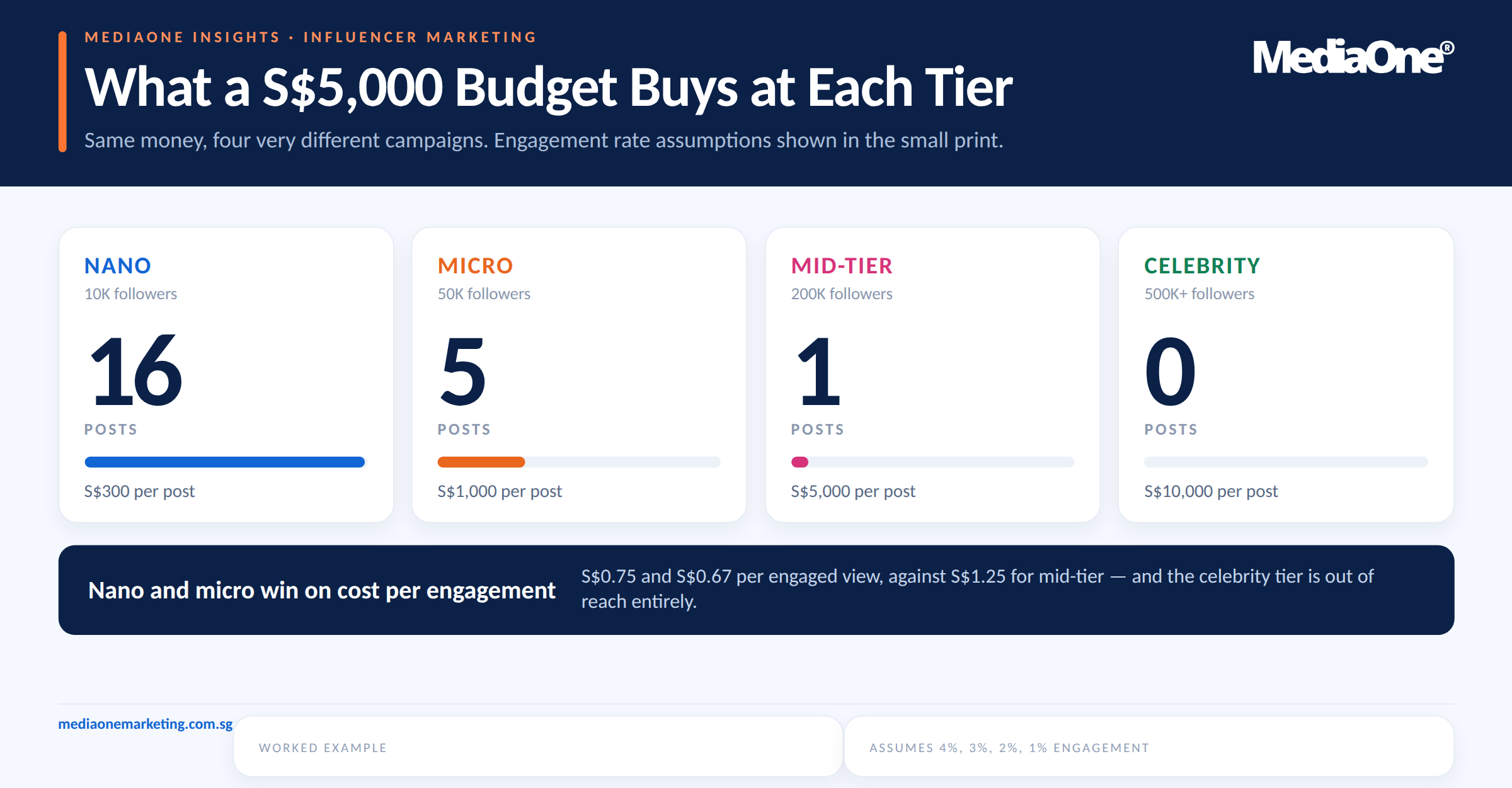
What a S$5,000 Budget Buys at Each Tier.
The business case
The case rests on return and customer quality, not reach alone. GoViral Global’s 2025 Singapore influencer statistics put average campaign ROI at around 5.8 times, with top beauty and fashion campaigns exceeding 11 times. That is one agency’s estimate without a published sample, so treat it as an upper benchmark rather than a guaranteed return. To test your own figure, divide campaign revenue by total campaign cost, then compare it with paid social on the same basis.
The same source reports that influencer-acquired customers carry 28% higher lifetime value and 34% higher retention than paid-social customers. That is the more interesting claim, because it bears on customer quality rather than short-term return — but it is still a single agency’s number, so test it against your own cohort data before you build a budget on it.
The measurement method is set out in this guide to measuring influencer marketing performance.
The market in 2025
GoViral Global estimates Singapore’s influencer marketing spend at SGD 285 million in 2025. Estimates of this kind are built from different methods and rarely reconcile, so use them for direction rather than precision — and note that this figure supersedes the S$250 million that circulates in earlier drafts of similar pieces, including one on this site.

What matters more than the total is where the money goes. Brands that once bought broad media now allocate to creators; audiences are easier to reach on platforms they already use, and tier choice now decides whether spend stands out or disappears into the noise.
How the Singapore Influencer Market Behaves
Singapore is a small, highly connected market. Audiences move quickly between platforms, respond strongly to short video, and expect creators to sound local rather than scripted. Effective influencer marketing matches format and platform to that behaviour, and judges performance on outcomes the business cares about.
Where audiences engage
Brands here lean heavily on a small set of platforms. GoViral Global’s 2025 figures show Instagram included by 87% of brands and primary for 52%; TikTok included by 76% and primary for 28%; Xiaohongshu included by 41% and primary for 11%; YouTube included by 38%; Facebook by 22%.
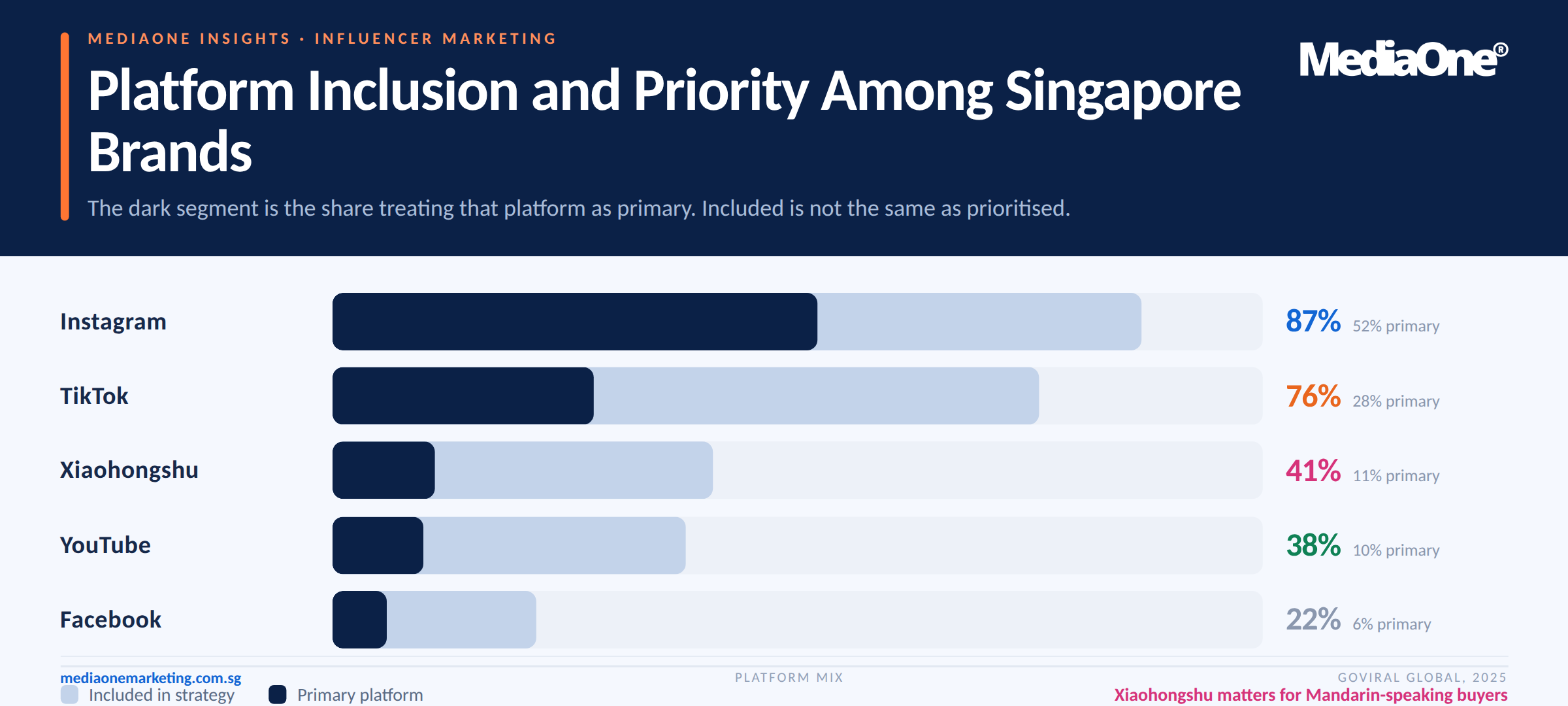
Platform Inclusion and Priority Among Singapore Brands.
The useful question is not which platform is biggest but where your buyer decides to purchase. Check where existing customers actually come from before committing budget, then test one or two platforms first so results can be attributed to a specific channel. The channel-level view is set out in this social media marketing guide for Singapore.
Formats that work
Format matters as much as platform. The same source reports Singaporeans are 49% more likely to engage with influencer-led short video, 45% more likely with interactive ads and 32% more likely with in-game advertising. Brief creators for vertical video under about 60 seconds: show the product in use and let the creator speak in their own voice. Polished, scripted ads underperform, because audiences recognise them quickly and scroll past.
Xiaohongshu and localisation
Localisation extends beyond language. For Mandarin-speaking buyers, Xiaohongshu (Little Red Book) deserves serious consideration — included by 41% of brands and primary for 11%, and especially strong among young urban consumers interested in beauty, fashion, lifestyle and travel. Use Instagram and TikTok for broad reach, Xiaohongshu for considered purchases among Mandarin-speaking buyers, and YouTube for longer explainers.
Types of Influencer by Follower Tier
Tier boundaries vary by source, so the bands below follow the pricing tiers used throughout this guide. The Singapore rate data is quoted against these tiers, which keeps the cost and engagement figures comparable.
|
Tier |
Followers |
Core strength |
Main limitation |
|
Nano |
Under 10K |
Close community trust, high reply rates |
Small reach per post |
|
Micro |
10K–50K |
Strong engagement with niche audiences |
Needs several creators for scale |
|
Mid-tier |
50K–200K |
Reach with credible authority |
Lower engagement, higher fees |
|
Macro |
200K–500K |
Broad reach |
Engagement falls further |
|
Celebrity / KOL |
500K+ |
Mass awareness fast |
Weakest engagement per dollar |
For most Singapore SMEs and mid-market brands, nano and micro creators are the right starting point: their followers tend to know them personally, the content reads as relatable, and the tiers are small enough to test and adjust without writing off a large fee.
Typical Rates per Post
Pricing is where the tier decision becomes concrete. According to GoViral Global’s 2025 Singapore figures, typical per-post ranges are S$300 to S$1,000 for micro creators, S$1,000 to S$5,000 for mid-tier, S$5,000 to S$10,000 for macro, and S$10,000 and above for celebrity or KOL creators. These are indicative ranges from a single agency’s compilation; actual rates move with niche, usage rights and negotiation.
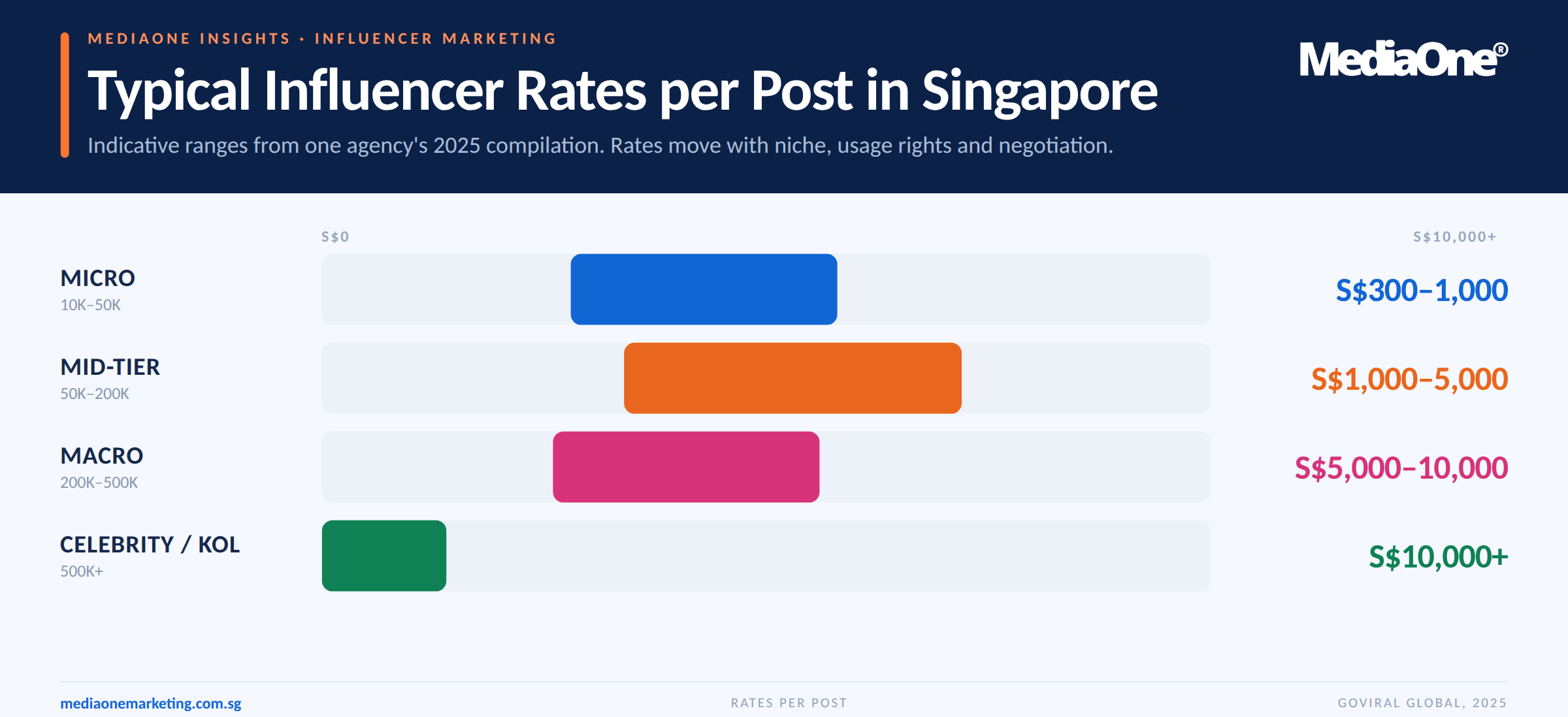
Typical Influencer Rates per Post in Singapore.
Worked example: cost per engagement on S$5,000
The formula is fee per post divided by expected engagements, where expected engagements are followers multiplied by engagement rate.
|
Tier |
Followers × rate |
Fee |
Cost per engagement |
Posts from S$5,000 |
|
Nano |
10K × 4% |
S$300 |
S$0.75 |
about 16 |
|
Micro |
50K × 3% |
S$1,000 |
S$0.67 |
about 5 |
|
Mid-tier |
200K × 2% |
S$5,000 |
S$1.25 |
1 |
|
Celebrity |
500K × 1% |
S$10,000 |
exceeds budget |
0 |
Under these assumptions, nano and micro deliver the lowest cost per engagement, and mid-tier is where cost rises sharply. The engagement rates here match the draft’s ranges; calibrate with your own campaign data before relying on the results.
Follower count versus engagement quality
Engagement rates fall as audiences grow — that relationship is the whole argument for smaller tiers. GoViral’s figures put nano creators at 3% to 5% engagement and micro creators at 2% to 4% in Singapore, with larger accounts routinely below those ranges. These benchmarks come from one agency without a published sample size, so they are indicative bands, not targets.
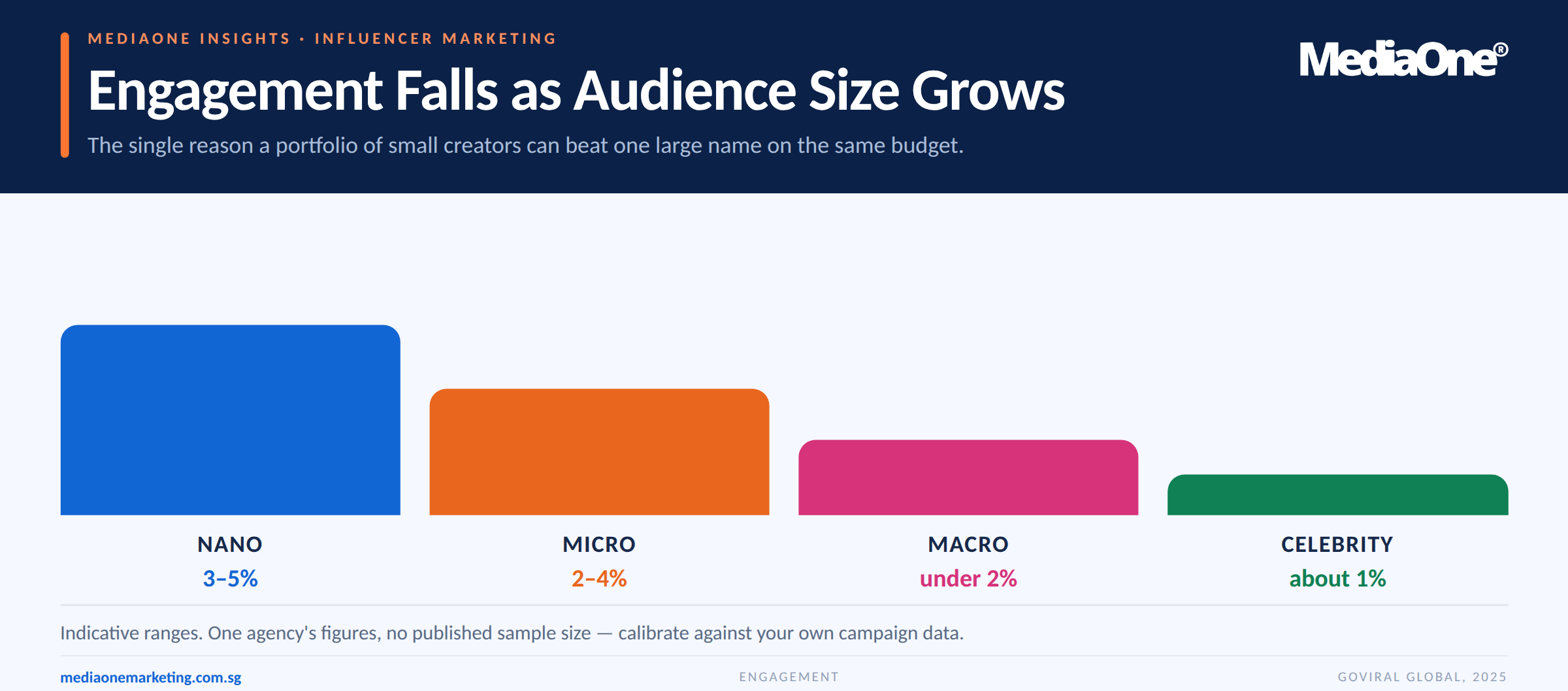
Engagement Falls as Audience Size Grows.
Audience quality matters more than headcount. A macro account with a passive following delivers impressions that never convert. A micro account whose followers share your buyer’s language, interests, and location delivers fewer views and far more purchases. Judge a creator by who engages, not by the follower total.
Vetting Creators: Detecting Fake Followers and Engagement
Follower count is the wrong first filter. A creator with 300,000 followers can look like the obvious choice, yet a large audience says little about whether anyone will buy. Engagement and audience quality are the two signals that matter, and both can be checked before any money changes hands.
Warning signs of an inauthentic audience
Fake followers and bought engagement leave recognisable traces: engagement that does not match follower size, generic or emoji-only comments across many accounts, follower spikes with no viral post or collaboration behind them, and an audience located outside the market you are paying to reach. No single signal proves fraud — the pattern across several does.
An audit you can run in twenty minutes
- Divide average likes and comments by follower count and compare with the tier band. Treat the band as a starting point, not a verdict.
- Fewer than half specific to the content is a warning sign.
- A steady curve with visible campaign spikes is normal. A step change with no corresponding post is not.
- A sharp drop on paid content suggests the audience disengages once it sees a brand, which is the audience you are actually buying.
- Two or more failures take the creator off the list, whatever the follower count.
Why a multi-tier portfolio reduces risk
Putting the whole budget on one creator puts every outcome on one account, and gives you one audience to learn from. Spreading spend across tiers gives you several independent audiences to test, so you learn which creators convert before scaling. Third-party reporting on how often brands mix tiers is thin, so treat multi-tier spreading as a risk-management choice rather than a proven rule.
A Five-Step Influencer Marketing Framework
Most campaigns fail at the start, not the end. The brand picks a creator it likes, sends a brief, and only later asks what the spend was meant to achieve. These five steps put the decisions in the right order, and each ends with a question you can answer for any candidate.
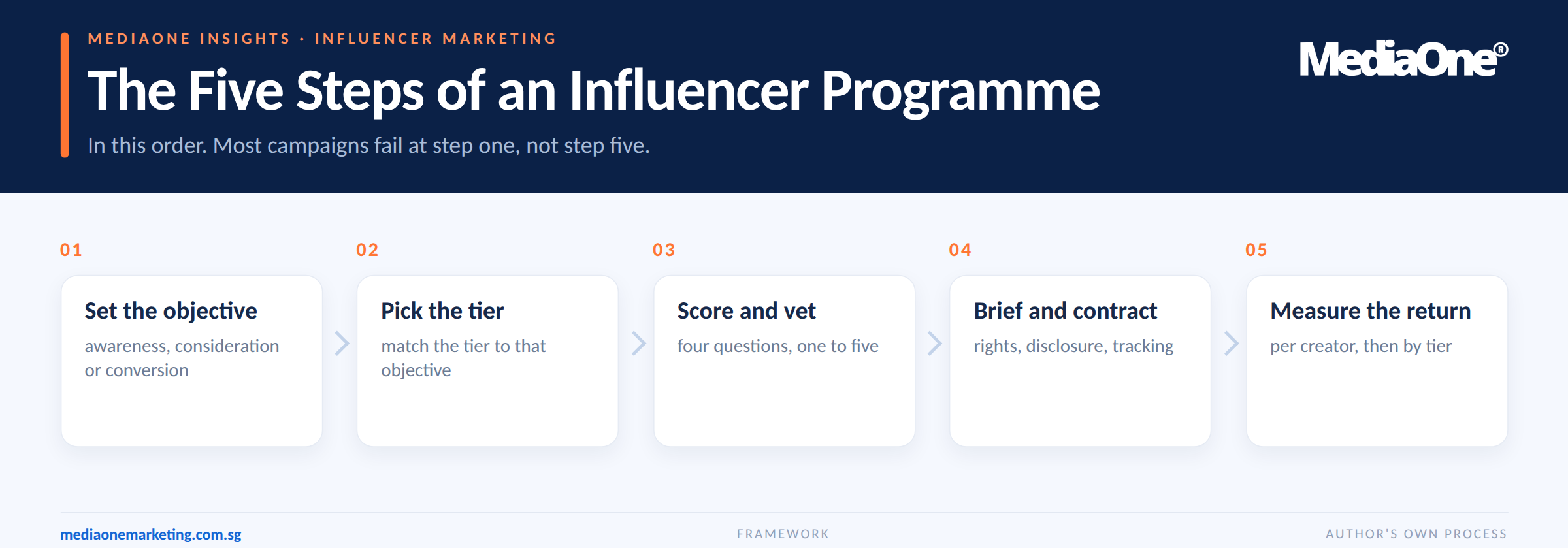
The Five Steps of an Influencer Programme.
Step 1: Define the objective and KPIs
Pick one: awareness, consideration or conversion. Awareness tracks reach and impressions. Consideration tracks engagement rate and click-through. Conversion tracks sales, sign-ups or redemptions, using a unique discount code or tracked link per creator. Two objectives mean two campaigns, not one confused one.
Step 2: Choose the tier that fits the objective
Nano and micro suit consideration and conversion, where trust and specificity do the work. Mid-tier and macro suit broader awareness. Set the budget first, then decide how many creators it funds: on S$5,000, a portfolio of smaller creators reaches more of the right people than one large name, because each audience is more closely matched to your buyers.
Step 3: Shortlist and score
Score each candidate from 1 to 5 on four questions:
- Is their audience the people who buy from you? Audience fit:
- Do followers comment and save, or is the reach inflated? Engagement quality:
- Is the fee divided by expected engagements low for this tier? Cost per engaged view:
- Do your buyers spend time on this creator’s platform? Platform fit:
Drop any creator scoring 2 or below on audience fit or engagement quality, however large their following. Re-score each cycle, because a creator’s audience changes faster than their follower count does.
Step 4: Brief, contract and launch
The brief states the objective, the key message, any mandatory claims and the posting window, and leaves creative execution to the creator — which is the entire point of buying their voice. The contract carries deliverables, usage rights, disclosure requirements and payment milestones. Creators must clearly disclose paid partnerships, in line with platform rules and Singapore advertising standards. Confirm tracking links and codes are live before the first post.
Step 5: Measure return and retention
Measure against the KPIs set in step one, not impressions. Calculate return on spend per creator, then compare across tiers — the tier-level view is what tells you where the next budget belongs. GoViral’s 5.8× average and the 28% lifetime-value premium are single-source figures, but if they hold even partly, they justify spend that looks marginal on first-purchase numbers alone.
Agencies: When to Use One, and How to Judge One
An agency earns its fee when it removes work your team cannot absorb — sourcing creators, negotiating rates, managing contracts, tracking results. For a brand running several campaigns a year, that coordination is usually worth paying for. For a single small campaign, an agency can cost more than the campaign delivers. The planning and pricing side is covered in this guide to Instagram influencer marketing in Singapore, and the paid-amplification mechanics done by digital agencies.
Five questions to ask before signing
- Can you show engagement history for the creators you propose, not just follower counts?
- How do you calculate engagement, and will you share the raw export?
- What share of the budget goes to creator fees, and what share is agency margin?
- Which tiers have you run, and what happened?
- Who owns the content and the audience data after the campaign ends?
Red flags: reluctance to share engagement exports, proposals built around a single celebrity name, and reporting that stops at reach and impressions. Have a legal reviewer read the contract before you sign it.
Scoring an agency
|
Score |
What it means |
|
1 |
Not offered, or refused when asked |
|
3 |
Offered on request, with limited detail |
|
5 |
Offered unprompted, with full detail and evidence |
Apply it to five criteria: transparency (shares engagement exports and fee breakdowns unprompted), tier range, reporting (engagement and cost per engaged view, not reach), ownership terms, and local fit with Singapore audiences and platforms. Weight transparency and reporting most heavily — an agency open about its numbers is more likely to protect your budget than one that promises scale. There is no universal pass mark; set your own based on how many you are comparing.
Influencer Marketing Singapore: Building a Programme That Holds Up
Follower count is a poor guide to choosing creators. For most SME and mid-market budgets, a portfolio of smaller creators delivers more value than a single famous name, because engagement falls as audiences grow and trust does not scale with headcount. A nano or micro creator at 3% to 5% engagement can deliver more per dollar than a celebrity at 1% — though the result depends on the creator and the category, which is why the scorecard matters more than the benchmark.
Score every candidate on audience fit, engagement quality, cost per engaged view, and platform fit before you sign, and re-score each cycle. Track outcomes rather than impressions: return on spend, repeat purchase and retention against a baseline, retiring creators who do not move those numbers.
If you would rather not run sourcing and reporting in-house, a digital marketing agency in Singapore can hold the mix under one contract — but the brief and the measurement should stay with you, because those two things decide whether the programme holds up.
Frequently Asked Questions
How much does influencer marketing cost in Singapore?
Rates follow the creator’s tier. Micro creators (10K to 50K followers) typically charge S$300 to S$1,000 per post, mid-tier (50K to 200K) S$1,000 to S$5,000, macro (200K to 500K) S$5,000 to S$10,000, and celebrity or KOL creators (500K+) S$10,000 and above, per GoViral Global’s 2025 Singapore statistics. These are indicative ranges from one agency, and they vary with niche, usage rights and negotiation. Agency fees are extra.
Are nano or micro influencers better for a small business?
For many small businesses, yes. Nano creators reach 3% to 5% engagement and micro creators 2% to 4%, per the same source. Five micro creators at S$1,000 each can generate more real interactions than one macro creator at S$5,000, and the risk sits across five audiences rather than one.
How do I spot fake followers?
Look for engagement that does not match audience size, generic or repetitive comments, follower spikes with no matching content, and an audience concentrated outside your market. Ask for a 90-day follower history before signing. No single signal proves fraud; the pattern across several does.
How is influencer ROI measured?
Divide the revenue or qualified leads a campaign generates by its total cost, including fees, product and production. Give each creator a unique code or tracked link. Codes leak to non-creator audiences, so treat attribution as an estimate rather than a fact.

Which platform should a Singapore brand prioritise?
Start where your buyers already spend time, then match the platform to the goal. Instagram is included by 87% of brands and primary for 52%; TikTok is included by 76% and primary for 28%. For Mandarin-speaking buyers, Xiaohongshu is included by 41% and primary for 11%.
Do I need an agency to run an influencer campaign?
Not always. A brand with a clear objective, a shortlist and the capacity to manage briefs, contracts and reporting can run a small campaign in-house. An agency earns its fee when you need reach across many creators, rigorous audience vetting, or cross-platform reporting.