
Winning Enquiries In The Singapore Digital Transformation Services Market
Singapore has roughly 300 firms selling some version of digital transformation. The market is not underserved. It is overserved and undifferentiated. In the last 18 months of running B2B campaigns for enterprise IT and SaaS brands out of Changi Business Park and one-north, our team at MediaOne, a Singapore digital marketing agency working across enterprise IT and SaaS, has watched the same pattern repeat. Traffic looks fine. Enquiries look fine. Closed deals look terrible.

The reason is not budget. It is that most vendor marketing in this category still reads like a 2019 pitch deck, and Singapore buyers moved on years ago.
This piece breaks down what is actually working right now for digital transformation services marketing in Singapore, based on live campaign data, published IMDA statistics, and buyer conversations we have sat in on.
Key Takeaways:
- The Singapore buyer already transformed. Marketing to the “why” stage is dead spend.
- Grant queries (PSG, EDG, CTO-as-a-Service) now behave like paid keywords. Own them.
- Failed-project post-mortems out-convert case studies for enterprise buyers.
- LinkedIn from named consultants beats company-page posts by roughly 8x in our tracking.
- Generative Engine Optimisation is now table stakes. Classic SEO alone will not pull enquiries in 2026.
The Singapore Buyer Has Already Transformed
Most vendor sites still open with “why digital transformation matters.” That copy was written for a market that no longer exists here.
IMDA’s Singapore Digital Economy Report 2025 puts SME digital adoption at 95.1%, up from 94.5% the year before. AI adoption among SMEs tripled from 4.2% to 14.5% in a single year. Large-firm AI adoption climbed from 44% to 62.5%.

The buyer walking into your funnel is not asking what is digital transformation for small businesses in Singapore. They already know. They ran a project. It probably underdelivered. Now they are asking why do digital transformation projects fail in Singapore and how to pick a digital transformation vendor that actually delivers.
What has shifted in the buyer’s head:
|
Old buyer question (2019 to 2022) |
Current buyer question (2025 to 2026) |
|
Should we go digital |
Which vendor will not waste our next twelve months |
|
What is cloud, AI, RPA |
Which specific tool fits our tech stack |
|
Can you educate our board |
Can you show three named local projects |
|
What is the ROI story |
What is the sunk-cost story from our last attempt |
The middle of the funnel is where enquiries are being won in 2026. Top-of-funnel education content is oversaturated and mostly written by AI. Bottom-of-funnel case studies are gated and rarely read. Middle-funnel decision content, comparison guides, post-mortems, scoping frameworks, is where buyers spend their time before shortlisting.
If your content library is 80% “what is” articles and 20% “we help you” pages, you are marketing to a stage of the buying process that closed for most Singapore firms three years ago.
Why Digital Transformation Marketing Fails In Singapore
Ask five CIOs in Singapore what they mean by digital transformation and you will get five answers. ERP replacement. Cloud migration. RPA. AI proof-of-concept. A CX platform swap.
This is a marketing problem, not a semantics problem. When a buyer searches types of digital transformation services or digital transformation vs digital modernisation Singapore, and lands on a page that promises everything, they leave. The site that wins is the one that names their specific version of transformation in the H1.
Something we call the Transformation Intent Matrix at MediaOne, developed after auditing 40+ vendor sites in this category, maps how buyers actually describe their problem versus what they end up buying.
|
What the buyer says on the discovery call |
What they are actually shopping for |
Likely search query |
|
Our systems are held together with duct tape |
Legacy system consolidation |
modernise legacy systems Singapore |
|
We are drowning in manual work |
Process automation and RPA |
RPA consultants Singapore SME |
|
Our data is everywhere and unusable |
Data platform build and analytics |
data lake Singapore cost |
|
We need AI but do not know where to start |
AI readiness and use-case scoping |
AI readiness assessment Singapore |
|
Customer experience is broken |
CX platform selection and journey redesign |
best CX platform for Singapore retail |
|
We are moving off on-prem |
Cloud migration and infra modernisation |
AWS Azure migration partner Singapore |
Put this on your services page and half your qualification is done before the first sales call. The buyer selects their own bucket. You stop wasting first meetings running discovery on the wrong problem.
If your firm actually does all six, do not merge them into one “end-to-end” page. Create six landing pages with six sets of case studies. This is where website design services earn their fee for transformation vendors, because the site architecture has to carry six distinct buyer intents without collapsing into a generic capability grid. In our audits, vendors who did this saw enquiry quality lift within a quarter, without changing ad spend.
PSG And EDG Grants As A Marketing Channel
The Productivity Solutions Grant, Enterprise Development Grant, and IMDA’s CTO-as-a-Service scheme are not just funding streams. They are high-intent search queries.
We have seen SME buyers type PSG approved digital transformation vendor Singapore, EDG grant consultant for digital transformation, and can I use PSG for AI adoption Singapore as their first search of the day. These are not top-of-funnel readers. They are checkbook-open buyers looking for a reason to say yes.
Where most vendors go wrong on this channel:
- Grant eligibility buried three clicks deep on a compliance page nobody clicks.
- Vague “PSG-eligible solutions” language with no scheme code and no project examples.
- Over-promising coverage. Buyers who feel misled at the funding stage never come back.
- Ignoring EDG entirely. EDG covers scope that PSG cannot, and mid-market buyers search for it separately.
- No dedicated grants page, which means AI answer engines have nothing to cite when a buyer asks Perplexity about funding.
What a strong grant page includes:
- The exact scheme code and vendor pre-approval reference number.
- A worked example (real numbers) of what a S$40,000 project looks like after PSG offset.
- A named point of contact from the vendor, not a generic form.
- A clear list of what the grant does not cover, written in plain English.
- The submission window and typical approval turnaround from BGP.
MediaOne runs a similar model on the marketing side, and we cover the mechanics of it in our breakdown of SEO services for Singapore SMEs on a tight budget, where the grant conversation is central to how SME buyers frame budget.
Digital Transformation Failure Rates Nobody Names
BCG’s public research places digital transformation failure rates at around 70%. Forbes has quoted figures as high as 84%. Every buyer with a scar knows these numbers. Pretending otherwise on your website is the fastest way to lose credibility with a serious prospect.
The counterintuitive move. Publish a failed-project post-mortem. Anonymised, with the actual trade-offs named. Something like “The ERP rollout we walked away from, and what we would do differently.”
Content like this ranks for why do digital transformation projects fail Singapore, which pulls in exactly the buyer who is about to sign with someone else. It also builds the kind of trust marketing decks cannot buy.
A working post-mortem template we use with clients:
|
Project context: |
Sector, size, budget band, timeline (all anonymised where required) |
|
The original brief: |
What the client asked for in one paragraph |
|
The turning point: |
The specific moment the project went sideways |
|
The three trade-offs on the table: |
No hindsight bias, just what was known at the time |
|
The decision made: |
What the team chose and why |
|
What we would do differently: |
Named, not hedged |
If a vendor cannot name a project they walked away from, they are either new or hiding something. Buyers now assume the latter. Being open about what you do not take on is now a competitive advantage.
3 Content Formats That Pull Digital Transformation Enquiries
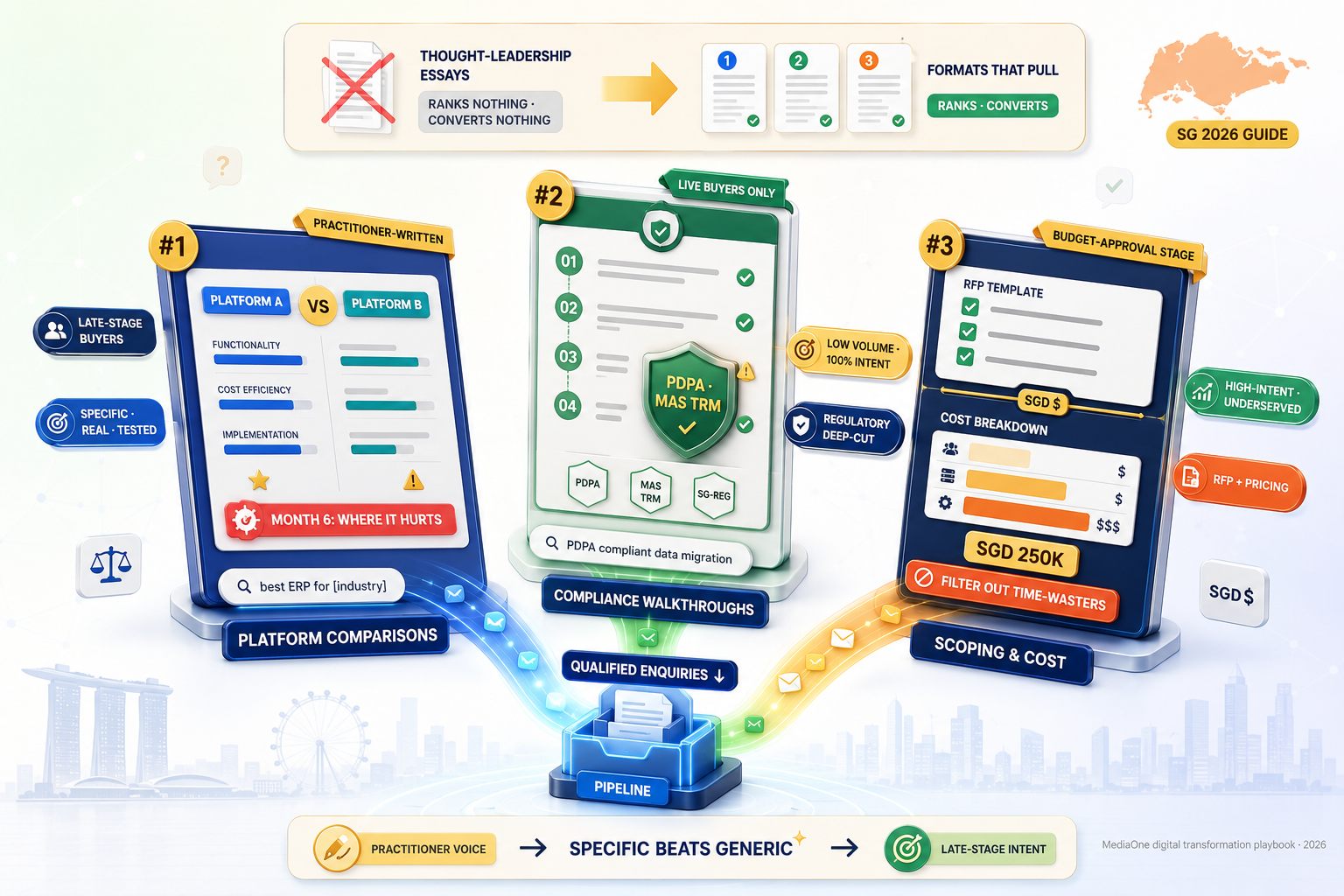
Most vendor blogs publish thought-leadership essays that read like white papers with the branding turned down. They rank for nothing and convert nothing.
Three formats work in this market.
1. Platform comparisons written by a practitioner
Not a listicle. A working comparison of two or three specific platforms your buyer is choosing between right now. Example: “SAP S/4HANA versus Oracle Fusion for a mid-market Singapore manufacturer, and where each one hurts on month six.” This ranks for best ERP for Singapore manufacturers and pulls late-stage buyers.
2. Compliance walkthroughs
“PDPA-safe data platform migration steps.” “MAS TRM implications for your cloud vendor selection.” Low search volume, but every visitor is a live buyer. These pieces answer queries like PDPA compliant data migration Singapore and MAS TRM cloud requirements.
3. Scoping and cost content
“How to write a digital transformation RFP that does not attract time-wasters.” “How much does a CRM implementation cost for a Singapore SME in 2026.” These pull the buyer finalising internal budget approval. The related intent, digital transformation cost Singapore and how much does digital transformation cost for SME, is high-intent and shockingly underserved.
How the three formats compare on effort versus enquiry pull:
|
Format |
Time to produce |
Search volume |
Buyer intent |
Enquiry pull in our tracking |
|
Platform comparison |
8 to 12 hours |
Medium |
Late-stage |
High |
|
Compliance walkthrough |
4 to 6 hours |
Low |
Very late-stage |
Very high per visitor |
|
Scoping and cost |
6 to 8 hours |
Medium to high |
Late-stage |
High |
|
Top 10 trends (avoid) |
3 to 4 hours |
Medium (falling) |
Early-stage |
Near zero |
What does not work anymore is the “Top 10 Trends” post. Google’s Helpful Content system is filtering these out, buyers scroll past them, and generative engines rarely cite them because they contain no original data.
Where Singapore B2B Buyers Actually Research Vendors
LinkedIn is the honest answer. B2B buyers here skim LinkedIn during meetings, and the CIO, COO, and Head of Transformation personas over-index on it. Long-form articles from named senior consultants earn more inbound than company-page posts, which most buyers scroll straight past. We break down the mechanics in our guide to LinkedIn influencer marketing for B2B brands in Singapore.
Search behaviour has also shifted. Buyers now start research inside AI answer engines, ChatGPT, Perplexity, Google’s AI Overviews, before touching a search result page. If your content is not being cited there, you are invisible earlier than you realise. The fix sits with an SEO agency that treats classic ranking and generative citation as one connected discipline, not two teams working from separate briefs.
For firms already ranking on classic search but missing from Perplexity, ChatGPT, and Google’s AI Overviews, the harder work sits with a GEO agency that can restructure existing content into the format generative engines actually cite. Our team walks through the differences in SEO vs AEO vs GEO for Singapore brands, and if you want the deeper theory, how AI is changing SEO rankings and local search covers the shift in more depth.
Channels ranked by return in our 2025 B2B tracking:
|
Rank |
Channels |
Description |
|
1 |
LinkedIn from named consultants |
Strongest inbound signal. Pulls CIO and Head of Transformation traffic. |
|
2 |
Middle-funnel SEO and GEO content |
Slower to compound but the most durable lead source once ranked. |
|
3 |
Closed-door industry roundtables |
Low volume, very high quality. Ten qualified attendees beat 500 webinar registrations. |
|
4 |
Paid search on grant-related keywords |
Underpriced. Most competitors are not bidding. |
|
5 |
Google Display and programmatic |
Weak for enterprise transformation. Works only for retargeting. |
|
6 |
Cold email at scale |
Negative return in our five-client sample last year. Destroys sender reputation. |
|
7 |
Open-registration webinars |
Now dominated by job-seekers, competitors, and consultants running market research. |
Credibility Signals That Move The Shortlist
Two things carry disproportionate weight when a Singapore buyer builds a shortlist.
A named local case study is the first. Not “a leading regional bank.” The actual bank, the actual scope, the actual measured result. In our experience running content programmes for enterprise IT clients, roughly half of clients will agree to be named if you ask the right person about six months after go-live, once the CIO has presented the numbers upward. Ask earlier and you almost always get a no.
A named partner tier is the second. Microsoft Gold, AWS Premier, Salesforce Summit, ServiceNow Elite. Buyers filter shortlists by partner tier, and it is one of the few badges that still carries weight. If your firm is not at a meaningful tier yet, list the individual certifications your consultants hold instead, with names attached. Buyers respond to real humans.
Signals ranked by shortlist influence, from strongest to weakest:
- Named local case study with hard numbers and a client quote.
- Named partner tier at Premier, Gold, Summit, or Elite level.
- Practitioner-written content indexed on the vendor’s own domain.
- Named certifications with the consultant’s photo and LinkedIn.
- Analyst mentions (Gartner, IDC, Forrester, in that order for this region).
- Generic “award-winning” claims (mostly ignored now).
- Client logo walls with no context (viewed as filler).
- Media features that are actually paid placements (buyers can tell).
“Award-winning” without saying which award no longer works. That phrase now reads as filler, and every second competitor is using it. The uncomfortable read for most vendors is that these signals sit outside the reach of any lead generation agency that treats the brief as a form-fill volume problem. Named case studies, named partner tiers, and named consultants are marketing outputs, not lead-gen levers, and the firms that get this order right are the ones building durable pipelines.

Digital Transformation Marketing KPIs That Actually Track
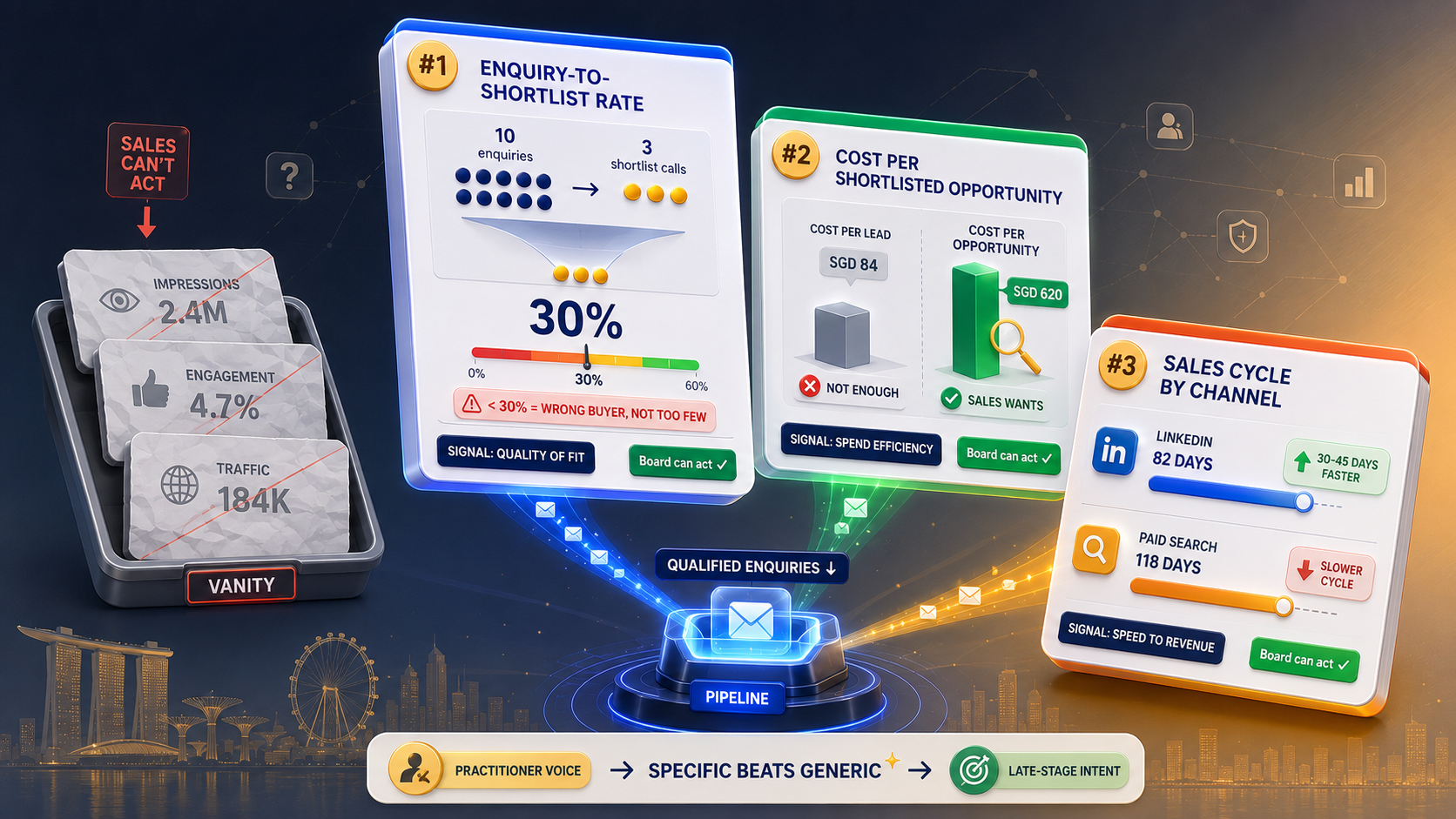
Most transformation vendors report marketing KPIs their sales team cannot act on. Impressions. Engagement. Traffic. The board nods, nothing changes.
Three numbers we track for transformation-services clients.
-
Enquiry-to-shortlist rate
Of every ten enquiries, how many progress to a proper shortlist call. Under 30%, your marketing is attracting the wrong buyer, not too few of them.
-
Cost per shortlisted opportunity
Not cost per lead. Cost per opportunity your sales team actually wants.
-
Sales cycle by channel
In our campaign data, LinkedIn-sourced enquiries close 30 to 45 days faster than paid-search enquiries for enterprise transformation deals. If you are not segmenting cycle length by channel, you are optimising blind.
If your current digital marketing agency in Singapore cannot produce these three numbers on request, you have your answer about the quality of the relationship.
For the deeper mechanics of fixing a broken B2B funnel, our team documented the patterns we see most often in how Singapore businesses can fix hidden funnel gaps and improve lead generation.
A 90-Day Rollout For Digital Transformation Vendors
If you inherited a stalled marketing programme and need a starting sequence, this is the order we run it in for new transformation-services clients.
Days 1 to 30: Diagnose and re-anchor
- Audit the site against the six intent buckets in the Transformation Intent Matrix.
- Rewrite the homepage H1 to name one wedge, not five.
- Move grant eligibility from footer to hero.
- Interview the two most recent won deals and the two most recent lost deals. Look for the pattern.
- Set the three KPI baselines (enquiry-to-shortlist rate, cost per shortlisted opportunity, sales cycle by channel).
Days 31 to 60: Build the middle-funnel spine
- Publish one platform comparison, one compliance walkthrough, and one scoping-and-cost piece.
- Launch one grants page per scheme (PSG, EDG, CTO-as-a-Service) with worked examples.
- Get two named consultants writing on LinkedIn weekly, not the company page.
- Set up entity markup and structured data so AI answer engines can parse the site cleanly.
Days 61 to 90: Prove the channel mix
- Kill the two weakest paid channels based on cost per shortlisted opportunity, not clicks.
- Run one closed-door roundtable with a named regulator or client on the panel.
- Publish the first failed-project post-mortem.
- Ask one recently completed client to be named. If it is a no, ask again at month six.
Ninety days is not enough time to see full pipeline shift on enterprise deals, but it is enough time to see enquiry quality change materially. If it has not by day 90, the marketing model is not the issue. The offer is.
Ready To Audit Your Digital Transformation Marketing?
If you are running marketing for a digital transformation firm in Singapore and the pipeline is not matching the effort, the answer is usually sitting inside three or four fixable decisions on your site, your content library, and your channel mix.
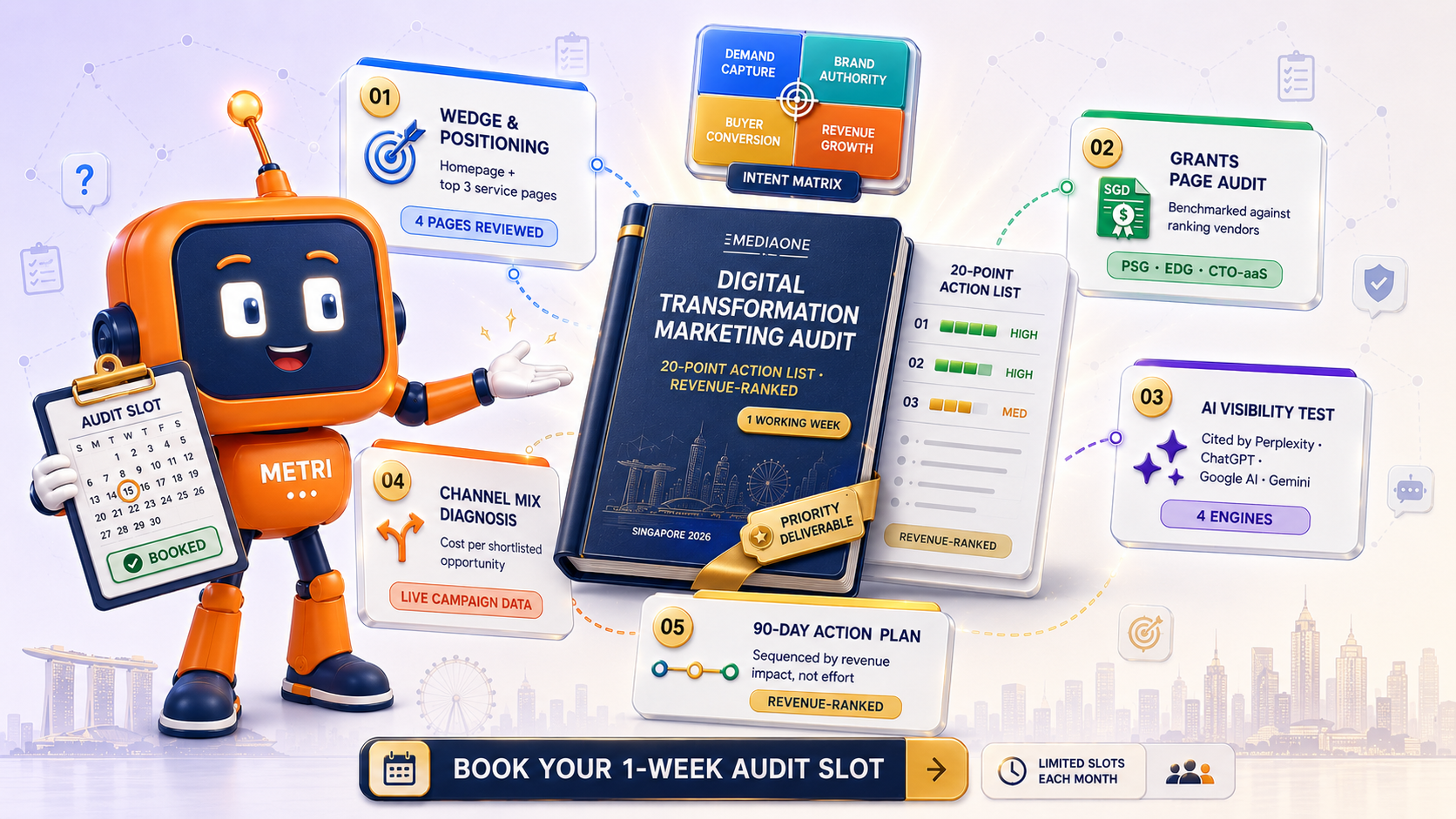
MediaOne runs a Digital Transformation Marketing Audit built specifically for firms in this category. It is not a generic SEO report. Over one working week, our team maps your site against the Transformation Intent Matrix, benchmarks your grant page against pre-approved vendor pages already ranking, checks whether your content is being cited by Perplexity, ChatGPT, and Google’s AI Overviews, and hands back a scored 20-point action list ranked by revenue impact.
What you get at the end of it:
- A wedge-and-positioning review of your homepage and top three service pages
- A grants-page audit against current PSG, EDG, and CTO-as-a-Service listings
- A generative search visibility test across four AI answer engines
- A channel-mix diagnosis with cost-per-shortlisted-opportunity benchmarks from live campaigns we are running in the same category
- A 90-day action plan sequenced by revenue impact, not effort
The audit is free for firms with an annual marketing budget above S$60,000 and an existing website with live traffic. Whoever runs it will have personally worked on transformation-vendor accounts, not a junior on their first month.
If that sounds like the kind of read you actually need on your marketing right now, book a slot with our team and we will come back within one working day with a scoping call time.
Frequently Asked Questions
How do you market digital transformation services to Singapore SMEs specifically?
Lead with grant eligibility, name a single transformation type instead of “end-to-end,” and offer a fixed-price diagnostic under S$5,000. SME buyers here are grant-aware and price-anchored. They will not sign an open-scope engagement. Content that walks them through a PSG-eligible scope pulls higher enquiry quality than any generic capability page.
Is content marketing still worth it for enterprise digital transformation buyers?
Yes, but only when it is opinionated, sourced, and written by named practitioners. Anonymous “insights” pieces are being filtered out by both readers and search engines. A weekly opinion piece from your Head of Delivery outperforms ten ghostwritten essays.
How is AI search changing marketing for digital transformation services?
Enterprise buyers now start research inside AI answer engines before Google. Being cited there is a different game from ranking. It requires structured, sourced, opinion-led content with clear entity signals.
What is the biggest marketing mistake digital transformation vendors in Singapore make right now?
Publishing generic trends content written by AI, then wondering why enquiries dropped. That format no longer ranks and no longer converts. If a piece has no original data or point of view, it is quietly damaging brand authority every time it goes live.
How long does it take for a digital transformation vendor’s marketing to start pulling enquiries?
Realistically 90 days to see enquiry quality shift, six to nine months to see pipeline shift, and 12 months for a full compounding effect on organic and generative search. Anyone promising faster on enterprise deals is either selling paid ads or selling low-quality lead lists.