LinkedIn influencer marketing has become one of the most effective ways for B2B brands to build trust, reach decision-makers, and drive high-quality leads in Singapore. Unlike traditional social platforms, LinkedIn is built around professional identity, which means content shared by credible voices carries more weight and influence in buying decisions.

For B2B companies operating in Singapore’s competitive landscape, this shift toward individual-led influence presents a strong opportunity. Buyers are no longer relying solely on brand messaging. They are turning to industry experts, consultants, and peers for insights before making decisions.
If you are exploring how to implement this strategy but lack the internal expertise or network, working with a LinkedIn influencer marketing agency in Singapore can help you identify the right voices, structure campaigns, and deliver measurable results.
Key Takeaways
- LinkedIn influencer marketing helps B2B brands in Singapore build trust and reach decision-makers through credible industry voices.
- Success depends on relevance, audience alignment, and consistent content rather than follower size.
- Campaigns perform best when tied to clear goals such as authority, awareness, or lead generation.
- Long-term partnerships and authentic content drive stronger engagement and better quality leads.
What Is LinkedIn Influencer Marketing and Why It Matters for B2B
LinkedIn influencer marketing refers to partnering with professionals who have built credibility and an engaged audience on LinkedIn to promote your brand, share insights, or co-create content.
In B2B, influence is not about popularity. It is about authority, relevance, and trust. A niche consultant with 5,000 engaged followers can often deliver better results than a broad influencer with 100,000 passive connections.
This approach matters because B2B buying cycles are longer and involve multiple stakeholders. Decision-makers want validation from people they respect. LinkedIn influencers fill that gap by acting as trusted intermediaries between your brand and your audience.
Why LinkedIn Influencer Marketing Is Growing in Singapore’s B2B Landscape
Singapore has one of the most digitally connected professional populations in Asia. LinkedIn adoption among executives, managers, and business owners is high, making it a natural platform for B2B engagement.
There is also a visible rise in professionals building personal brands. Founders, consultants, and corporate leaders regularly share insights, creating a steady stream of high-value content. This shift suggests that audiences in Singapore increasingly prefer learning from individuals rather than brands, especially when evaluating services or solutions.
As a result, LinkedIn influencer marketing is moving from an experimental tactic to a core component of B2B marketing strategies.
Key Benefits of LinkedIn Influencer Marketing for B2B Brands
One of the strongest advantages of LinkedIn influencer marketing is credibility. When a trusted professional shares your message, it carries more weight than a branded post.
It also improves targeting. Influencers often have clearly defined audiences within specific industries, roles, or seniority levels, allowing you to reach decision-makers more effectively.
Another benefit is lead quality. Instead of generating large volumes of low-intent traffic, influencer campaigns tend to attract prospects who are already interested and informed.
Finally, this approach supports long-term brand positioning. Consistent collaboration with respected voices helps establish your company as a credible player in your industry.
Types of LinkedIn Influencers for B2B Marketing
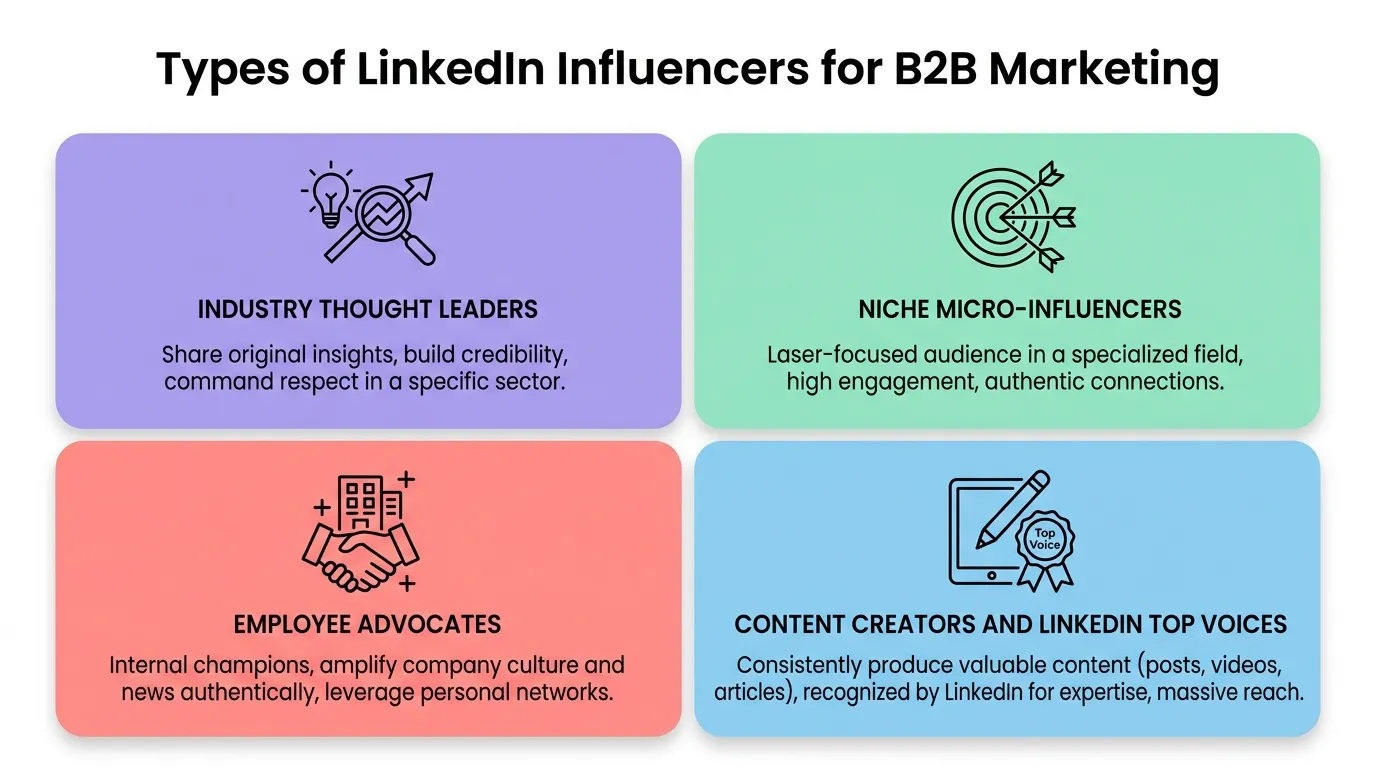
Not all influence on LinkedIn looks the same, and that is exactly why many B2B campaigns underperform. Brands often assume that reach equals impact, when in reality, relevance and credibility carry far more weight in professional networks.
To build an effective LinkedIn influencer marketing strategy, you need to understand the different types of influencers available and how each one contributes to your goals. Some are better suited for authority building, while others are more effective at sparking conversations or driving engagement within niche communities.
Below is a practical breakdown you can use when planning campaigns:
Industry Thought Leaders
Industry thought leaders sit at the top of the credibility ladder. These are experienced professionals. Think senior executives, consultants, advisors, or specialists who have spent years building a reputation in a specific field.
Their influence does not come from volume. It comes from trust. When they share an opinion, it often shapes how others think about a topic. This is particularly important in B2B, where decisions involve risk, budget, and multiple stakeholders.
What makes them valuable in LinkedIn influencer marketing:
- Strong credibility among senior decision-makers
- Ability to simplify complex topics and frame industry narratives
- High trust, even if the posting frequency is lower
- Influence that extends beyond LinkedIn into real-world business networks
Where they work best:
- Thought leadership campaigns
- Market education and category positioning
- High-value services such as consulting, SaaS, or financial solutions
Example use case: A cybersecurity company partners with a well-known risk consultant to publish insights on emerging threats. Instead of promoting the product directly, the content builds urgency and authority, making future sales conversations easier.
Niche Micro-Influencers
Micro-influencers are often overlooked, which is a mistake. While their follower counts are smaller, their audiences are far more engaged and tightly defined.
They usually operate within a specific industry, role, or interest group. As a result, their content feels more relevant and less generic.
In LinkedIn influencer marketing, this often translates into better conversations rather than just impressions.
Why are they effective?
- Higher engagement rates compared to larger influencers
- Strong community trust within a specific niche
- More accessible for collaboration and long-term partnerships
- Content that feels practical and grounded in real experience
Where they work best:
- Targeted campaigns aimed at specific industries or job roles
- Lead generation within defined audience segments
- Product education and real-world application
Example use case: A HR software company collaborates with several HR managers who regularly post about recruitment challenges. Their posts generate discussions among peers, bringing in highly relevant prospects.
Employee Advocates
Many companies overlook one of their most powerful influencer groups. Their own employees. When employees actively share insights, experiences, and perspectives, they humanise the brand. This kind of visibility often feels more authentic than corporate messaging because it reflects real people doing real work.
Employee advocacy also compounds over time. One post may not move the needle, but consistent activity across a team can significantly expand reach.
Why employee advocates matter in LinkedIn influencer marketing:
- Built-in credibility as insiders
- Authentic storytelling based on real experiences
- Cost-effective compared to external influencer partnerships
- Ability to reach multiple networks simultaneously
How to activate this group effectively:
- Encourage subject matter experts to share insights, not promotions
- Provide content direction, but avoid scripting posts
- Highlight employee voices across different roles, not just leadership
- Recognise and support consistent contributors
Example use case: A consulting firm encourages its consultants to share lessons from client work. Over time, this builds a collective brand presence that feels knowledgeable and approachable.
Content Creators and LinkedIn Top Voices
This group focuses on content first. They understand what works on LinkedIn. They know how to structure posts, spark engagement, and keep audiences coming back. Some have large followings, while others are still growing. What sets them apart is consistency and content quality.
However, reach alone is not enough. The most effective creators for LinkedIn influencer marketing are those who maintain relevance to your industry or audience.
What they bring to the table:
- Strong content creation skills
- Ability to translate ideas into engaging formats
- Consistent posting habits that sustain visibility
- Familiarity with LinkedIn’s algorithm and audience behaviour
Where they fit best:
- Brand awareness campaigns
- Content amplification
- Story-driven marketing initiatives
Example use case:
A B2B fintech brand partners with a LinkedIn creator who regularly breaks down financial trends. The creator integrates the brand into educational content, making it feel natural rather than promotional.
How to Choose the Right Type for Your Strategy
Choosing the right influencer type depends on your objective. There is no one-size-fits-all approach.
- If your goal is authority and trust, prioritise industry thought leaders
- If you need engagement within a specific niche, focus on micro-influencers
- If you want scalable and authentic reach, invest in employee advocacy
- If your priority is visibility and content distribution, collaborate with creators
In practice, the most effective LinkedIn influencer marketing strategies combine several of these groups. This creates a more balanced approach in which authority, reach, and engagement reinforce one another.
The key is alignment. Not just with your brand, but with your audience’s expectations and the way they consume information on LinkedIn.
How to Identify the Right LinkedIn Influencers for B2B Marketing
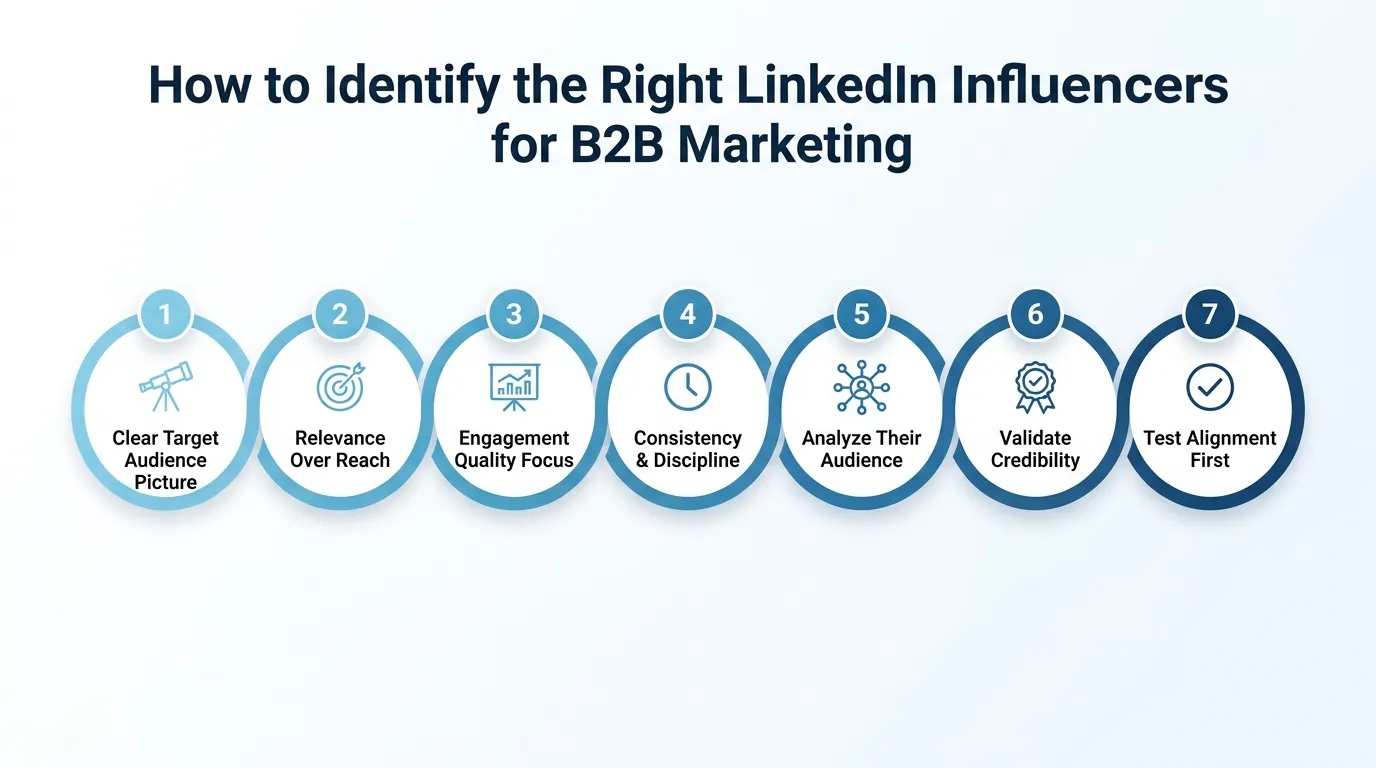
Finding the right partners for LinkedIn influencer marketing is less about reach and more about alignment. The goal is not to borrow attention. It is to borrow trust from people your audience already listens to. That requires a more deliberate evaluation process than simply scanning follower counts.
Below is a practical framework you can use to identify influencers who will actually move the needle for your B2B campaigns in Singapore:
1. Start With a Clear Picture of Your Target Audience
Before you even look at influencers, you need to be precise about who you are trying to reach. Without that clarity, every profile can look like a good fit.
At a minimum, define:
- Industry segments you want to target
- Job roles and functions such as marketing leaders, procurement heads, or founders
- Seniority level, whether you are speaking to managers, directors, or the C-suite
- Geographic focus, especially if your campaigns are Singapore-specific
For example, a SaaS company selling HR software in Singapore should prioritise influencers, followed by HR directors and operations leaders, not general business audiences.
This step anchors your entire LinkedIn influencer marketing strategy. If this is vague, everything that follows becomes guesswork.
2. Prioritise Relevance Over Reach
A smaller, highly relevant audience will outperform a large but generic one almost every time in B2B. Look closely at the influencer’s content:
- Do they regularly talk about topics your audience cares about?
- Are they addressing real problems, or just sharing surface-level opinions?
- Would your ideal customer find their posts useful or insightful?
An influencer who consistently discusses supply chain challenges in Southeast Asia, for instance, will be far more valuable to a logistics company than a broad “business motivation” creator. Relevance also extends to tone. If their content feels disconnected from your brand’s positioning, the partnership will feel forced, and audiences will notice.
3. Evaluate Engagement Quality, Not Just Numbers
High follower counts can be misleading on LinkedIn. What matters more is how people interact with the content. Spend time reading the comments section. This is where you will get a clearer signal of influence.
Look for:
- Thoughtful responses and discussions, not just likes or generic praise
- Comments from relevant professionals, ideally within your target audience
- Ongoing conversations, where the influencer actively engages with their network
If you see senior professionals asking questions or adding their perspectives, that is a strong indicator of credibility. On the other hand, if engagement is shallow or repetitive, it may suggest a less engaged or less relevant audience.
4. Assess Consistency and Content Discipline
Consistency is often overlooked, yet it directly impacts campaign performance. An influencer who posts regularly has:

- A more predictable reach
- A stronger relationship with their audience
- A clearer content style you can work with
Review their posting history over the past few months. You are looking for patterns, not one-off viral posts.
Ask yourself:
- Do they show up consistently in their niche?
- Is there a clear point of view across their content?
- Do they maintain a professional and credible tone?
Reliable creators make better long-term partners, especially if you plan to build sustained LinkedIn influencer marketing campaigns rather than one-off activations.
5. Look Beyond the Profile. Analyse the Audience
Even if an influencer’s content looks strong, their audience still needs to match your target market. While LinkedIn does not always provide full audience analytics, you can still gather useful signals:
- Review who is liking and commenting on their posts
- Check visible profiles of engaged users
- Look for patterns in industries, roles, and locations
If most interactions come from professionals in Singapore or Southeast Asia within your target roles, that is a positive sign. If engagement comes from unrelated industries or junior roles outside your buyer profile, the fit may not be ideal.
6. Validate Credibility and Real-World Expertise
In B2B, perceived expertise is everything. Your chosen influencer should not only create content well but also have real-world experience to back it up.
Check:
- Their professional background and career history
- Whether they have held relevant roles or built businesses
- Any speaking engagements, publications, or recognitions
An influencer with hands-on experience in your industry will naturally create more credible and persuasive content. This is particularly important in Singapore, where audiences tend to value practical expertise over purely theoretical insights.
7. Test Alignment Before Committing Fully
Even after careful evaluation, it is wise to start with a small collaboration before scaling. You might begin with:
- A single sponsored post
- A co-created thought leadership piece
- A webinar or panel discussion
This allows you to assess:
- How well the influencer communicates your message
- The type of engagement generated
- Whether their audience responds in a meaningful way
LinkedIn influencer marketing works best as a long-term strategy, but that does not mean you should commit blindly. Testing helps you refine your approach and build stronger partnerships over time.
Choosing the right influencers is not a quick selection process. It is a strategic decision that directly affects the quality of your leads, your brand’s credibility, and the overall success of your LinkedIn influencer marketing efforts.
If you focus on relevance, engagement quality, and genuine expertise, you will be in a much stronger position to build campaigns that resonate with the right audience and deliver measurable results.
LinkedIn Influencer Marketing Strategies for B2B Brands in Singapore
LinkedIn influencer marketing works best when it is treated as a strategic channel, not a one-off tactic. In Singapore’s B2B environment, where relationships and credibility often determine whether a deal moves forward, the right approach can shorten trust-building timelines and improve lead quality.
Below are the core strategies that consistently deliver results, along with practical context on how to apply them:
Thought Leadership Partnerships
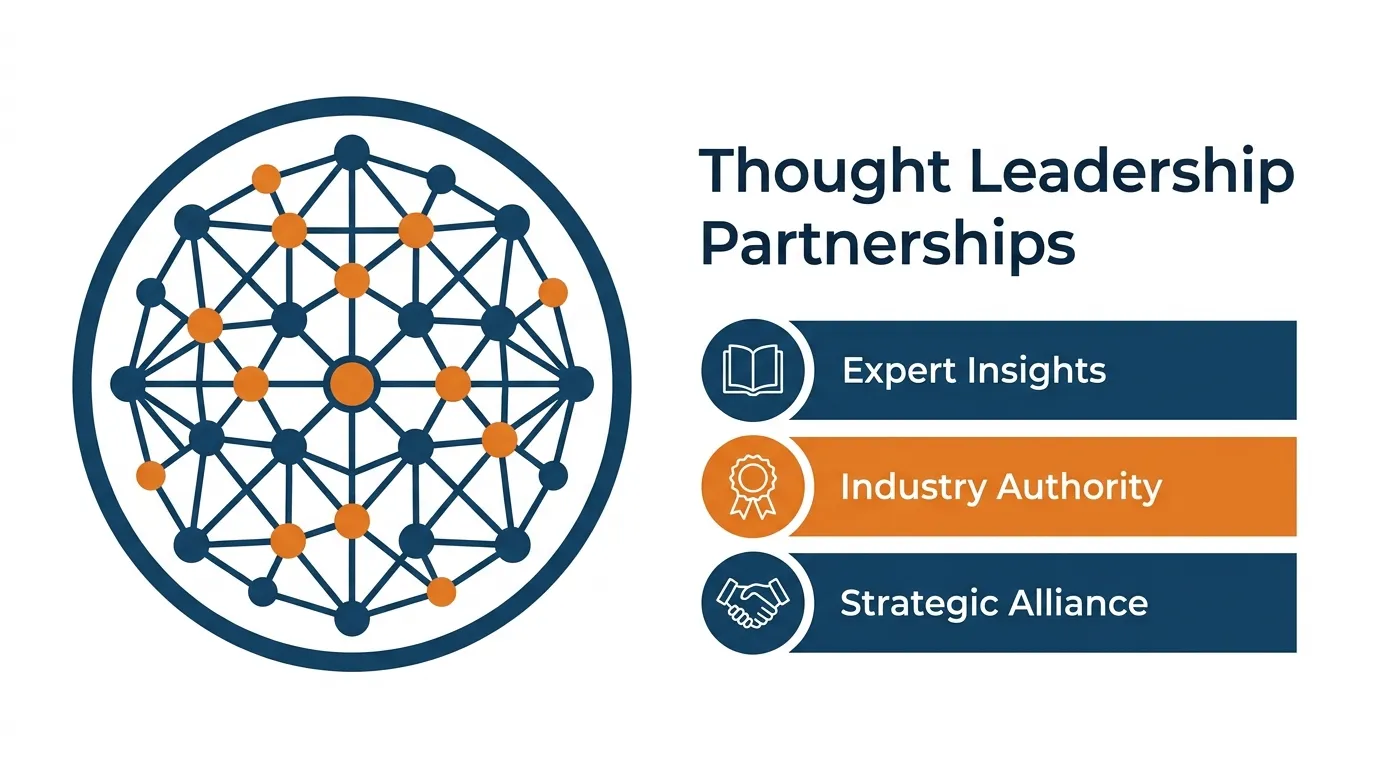
This is often the most effective entry point for B2B LinkedIn influencer marketing. Instead of asking influencers to promote your brand directly, you collaborate with them to create content that educates, challenges assumptions, or offers a new perspective. The goal is not immediate conversion. It is positioning.
A well-executed thought leadership partnership can:
- Associate your brand with recognised expertise
- Place you in relevant industry conversations
- Build trust before a sales conversation even begins
In practice, this can take several forms:
- Co-authored LinkedIn articles on industry trends
- Insight-driven posts that reference real challenges your audience faces
- Downloadable reports or frameworks developed with an influencer
- Panel-style discussions published as multi-post content series
What matters is alignment. The influencer’s voice should remain intact, while your brand’s perspective is naturally integrated. When the content feels like a genuine exchange of ideas rather than a sponsored message, engagement tends to follow.
Sponsored Content Campaigns

Sponsored content is more direct, but it still requires nuance on LinkedIn. In this model, influencers create posts that highlight your product or service. However, the most effective campaigns avoid obvious promotion. Instead, they anchor the message in a real problem or experience.
For example, rather than saying “this tool is useful,” an influencer might walk through a workflow challenge and explain how they approached it, with your solution woven into the narrative.
Strong sponsored campaigns usually include:
- A clear angle that resonates with a specific audience segment
- Personal insight or experience from the influencer
- Subtle but visible integration of your brand
- A natural call to action, such as exploring a resource or attending a demo
It is also worth testing different formats. Some audiences respond better to text-based storytelling, while others engage more with carousels or short-form video. Consistency matters here. A single sponsored post may create awareness, but a series of posts builds familiarity and reinforces credibility.
Event and Webinar Collaborations
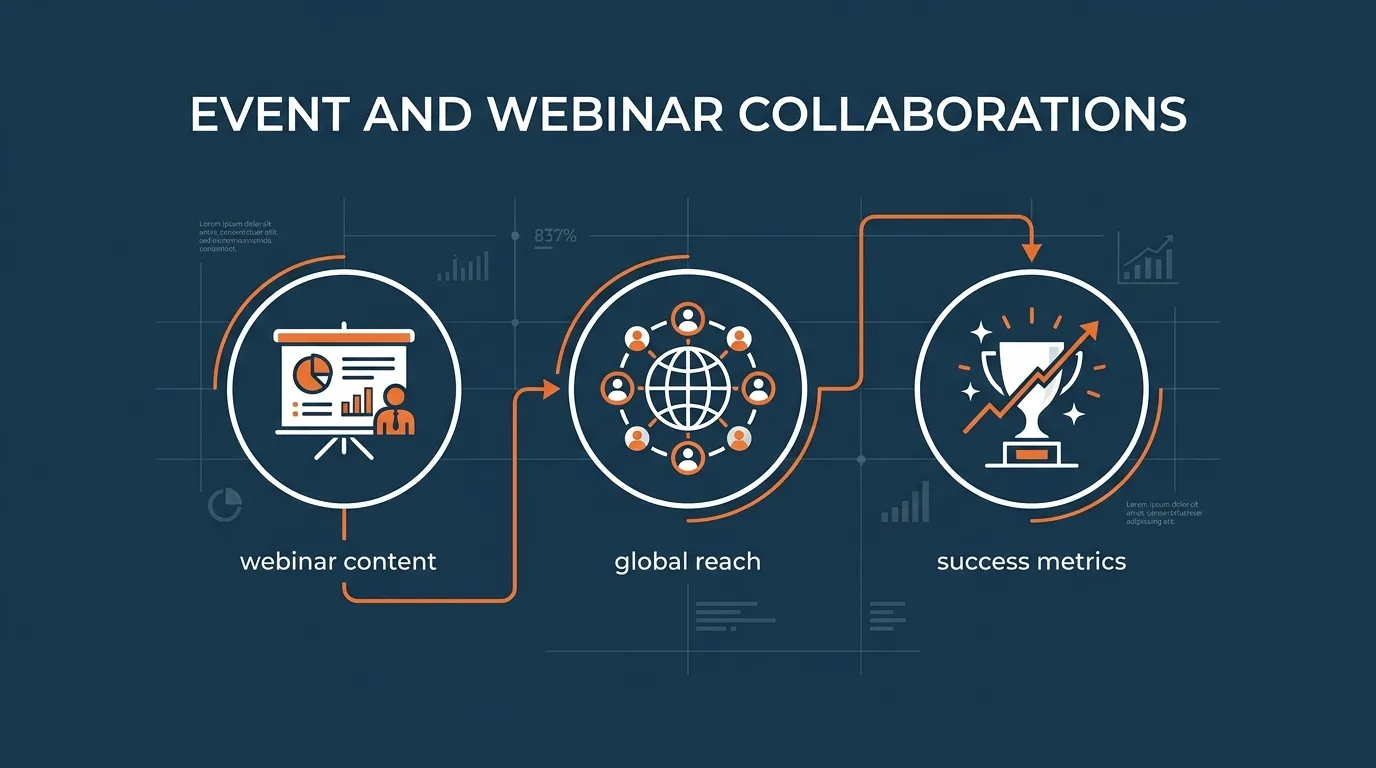
Events remain a core part of B2B marketing, and LinkedIn influencers can significantly increase both reach and perceived value. When an influencer is involved, your event is no longer just a brand initiative. It becomes a shared platform for insights, which often leads to higher-quality registrations.
There are several ways to structure this:
- Invite influencers as speakers or panelists
- Have them co-host or moderate sessions
- Ask them to share pre-event content that frames the discussion
- Extend the conversation through post-event reflections or highlights
The promotion phase is where influencer collaboration has the most visible impact. Their endorsement signals that the event is worth attending, especially if their audience already trusts their judgment.

To maximise results, coordinate messaging across timelines. Pre-event content should build anticipation, while post-event content should reinforce key takeaways and keep the conversation going.
Account-Based Marketing with Influencers

Account-Based Marketing, or ABM, focuses on targeting specific companies or decision-makers. When combined with LinkedIn influencer marketing, it becomes more precise and more credible. Instead of broad campaigns, you work with influencers to create content that speaks directly to the challenges faced by a defined set of accounts.
This might involve:
- Content tailored to a particular industry segment in Singapore
- Insights that address pain points common to a shortlist of target companies
- Posts that subtly reference trends affecting those organisations
When done well, this approach increases the likelihood that your content is noticed by the right people, rather than being lost in a wider feed.
Execution requires careful planning. You need clarity on your target accounts, a deep understanding of their priorities, and influencers who already have visibility within those circles.
This is not about volume. It is about precision and relevance.
Long-Term Brand Ambassador Programmes
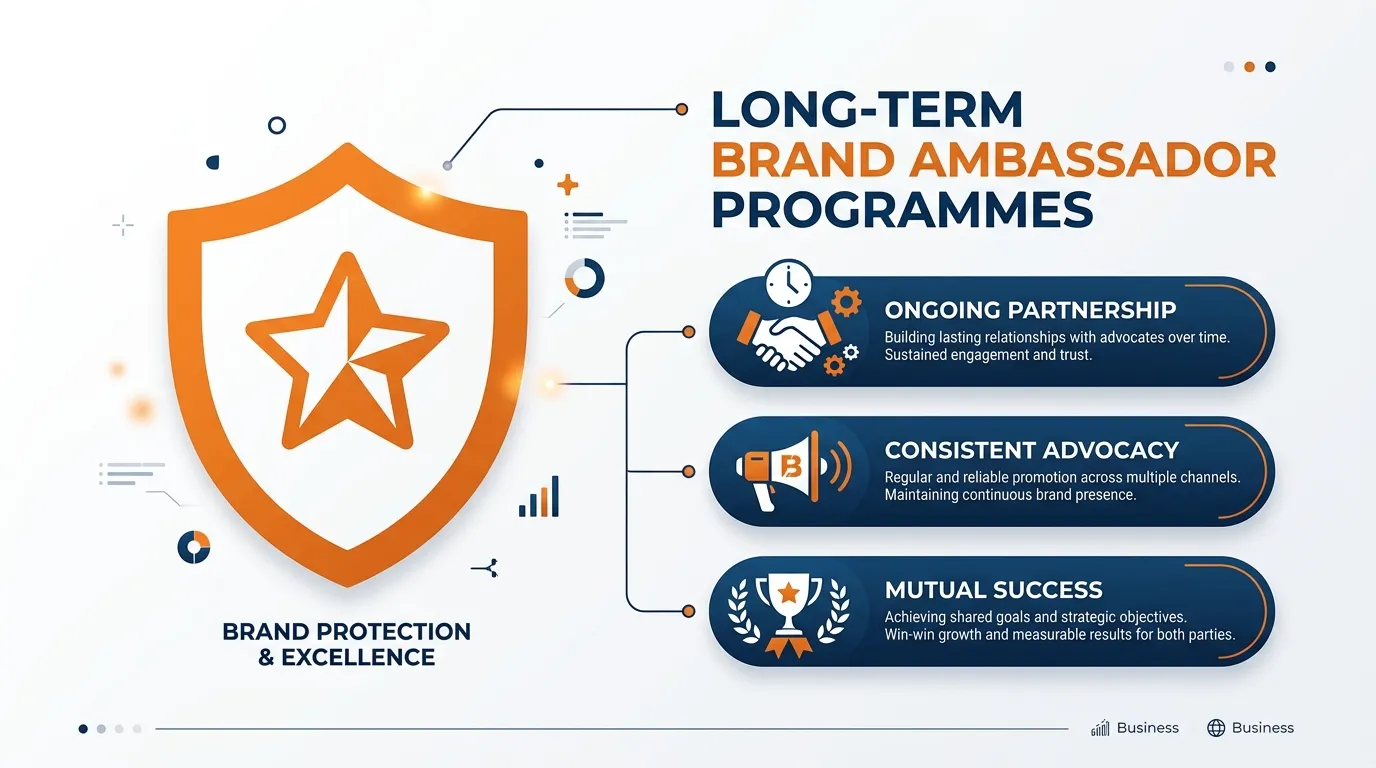
Many brands approach LinkedIn influencer marketing as a campaign-based activity. That can work, but it often limits impact. Long-term partnerships, on the other hand, allow influencers to develop a deeper understanding of your brand. Over time, their content becomes more authentic, more nuanced, and more persuasive.
A structured ambassador programme typically includes:
- Ongoing content collaborations over several months
- Regular touchpoints to align on messaging and goals
- A mix of content formats, from posts to events to co-created assets
- Performance tracking to refine the partnership over time
The benefit is cumulative. Audiences begin to associate the influencer with your brand, which strengthens recall and trust.
It also creates continuity. Instead of starting from scratch with each campaign, you build on an existing relationship that already delivers results.
How to Create a LinkedIn Influencer Marketing Campaign
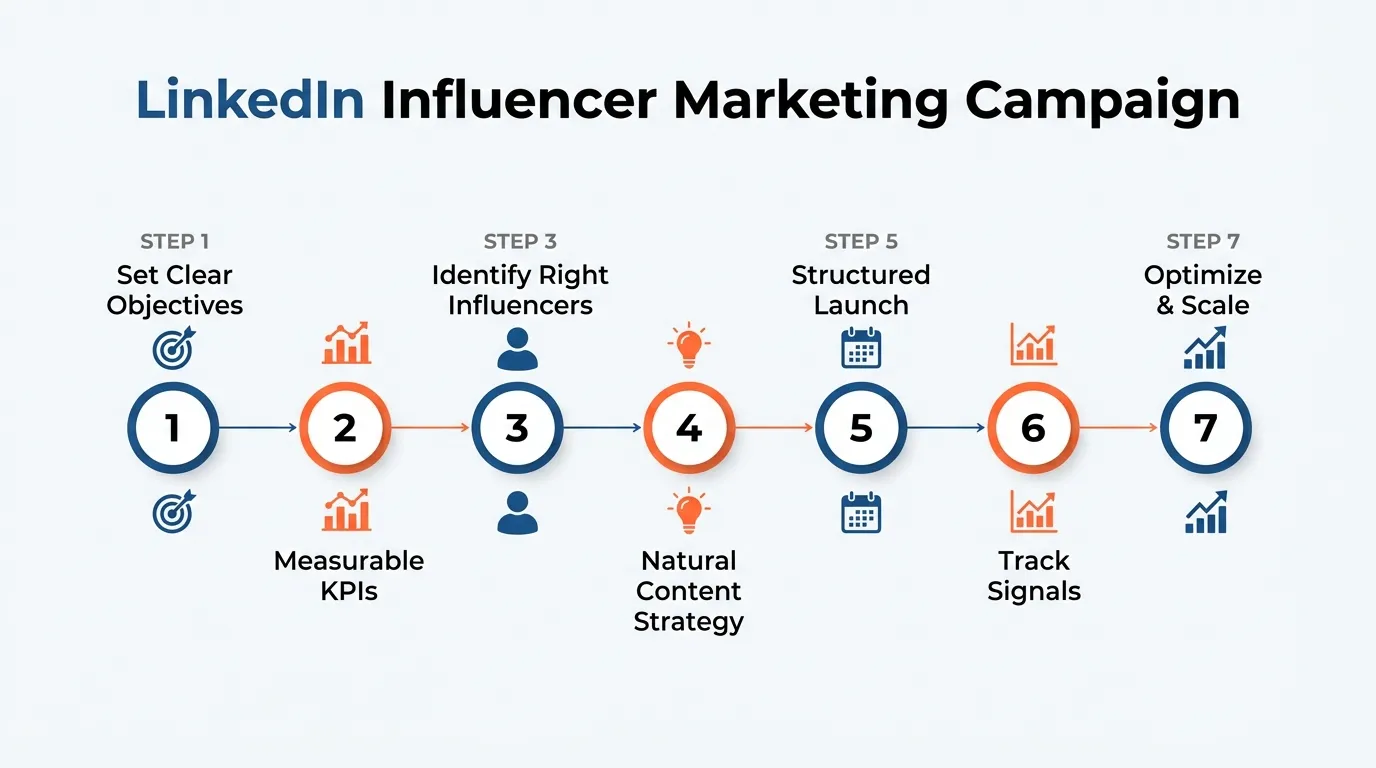
A strong LinkedIn influencer marketing campaign does not start with outreach. It starts with clarity. Brands that see consistent results tend to treat this as a structured marketing channel rather than a one-off collaboration.
Step 1: Set Clear Objectives Before Anything Else
Start by defining what success actually looks like. Without this, every decision that follows becomes guesswork.
In LinkedIn influencer marketing, goals usually fall into three broad categories:
- Brand awareness: Expanding reach among a specific professional audience
- Lead generation: Driving inbound enquiries or conversions
- Authority building: Positioning your brand as a credible voice in your space
It is tempting to pursue all three at once. In practice, campaigns perform better when they have a primary objective supported by secondary outcomes. For example, a campaign focused on authority can still generate leads, but it should not be measured as a direct response campaign.
Step 2: Translate Goals into Measurable KPIs
Once your objective is clear, you need a way to measure progress. This is where many campaigns fall short. They rely on surface-level metrics without connecting them to business outcomes.
Match your KPIs to your goal:
- For awareness
- Impressions
- Reach within your target industry or job function
- Follower growth
- For engagement and authority
- Comments and discussion quality
- Shares and saves
- Profile visits or inbound messages
- For lead generation
- Click-through rate
- Form submissions or demo requests
- Qualified leads, not just volume
It helps to define what a “good” result looks like before launching. Benchmarks will vary by industry, so use past campaigns or initial tests to calibrate expectations.
Step 3: Identify and Shortlist the Right Influencers
Choosing the right partners will shape the outcome more than any other factor. Focus on relevance first, not visibility. An influencer who speaks directly to your audience’s challenges will outperform someone with a larger but less aligned following.
When evaluating potential partners, look at:
- Content alignment: Do they regularly discuss topics related to your industry or solution?
- Audience quality: Are their followers decision-makers, practitioners, or students?
- Engagement signals: Are people responding with thoughtful comments, or just reacting passively?
- Consistency: Do they show up regularly with a clear point of view?
You do not need a long list. A small group of well-aligned influencers often delivers better results than a broad outreach effort.
Step 4: Build a Content Strategy That Feels Natural, Not Forced
This is where many LinkedIn influencer marketing campaigns lose effectiveness. Brands try to control the message too tightly, which results in content that feels like an advertisement.
Instead, treat influencers as collaborators. A good approach is to define:
- Core message: What you want the audience to understand
- Key themes: Problems, insights, or trends to explore
- Desired action: What the audience should do next
Then allow the influencer to shape how that message is delivered. Effective content formats on LinkedIn often include:
- Personal stories tied to industry insights
- Contrarian or opinion-led posts
- Educational breakdowns of complex topics
- Case-based narratives that show real outcomes
The goal is not to “insert” your brand into the conversation. It is to make your brand part of a conversation that already feels relevant.
Step 5: Launch with Structure, Not Just a Single Post
A single post rarely delivers meaningful results. Campaigns need repetition and variation to gain traction. Consider structuring your campaign across multiple touchpoints:
- An initial thought leadership post to introduce the topic
- Follow-up content that expands on the idea or shares examples
- A call-to-action post that directs users to a landing page, event, or resource
Timing matters as well. Spacing content over several weeks allows you to build familiarity without overwhelming the audience.
During the campaign, monitor performance in real time. Pay attention not only to metrics, but also to how people are responding. The tone of comments can often reveal more than the numbers.
Step 6: Track Both Quantitative and Qualitative Signals
LinkedIn influencer marketing does not always produce immediate conversions. Especially in B2B, influence tends to build over time.
Track what you can measure directly:
- Engagement rates
- Clicks and conversions
- Lead quality
At the same time, look for less obvious signals:
- Are prospects referencing the content in sales conversations?
- Are you seeing an increase in inbound enquiries?
- Is your brand being associated with specific expertise or topics?
These qualitative indicators often show early impact before it becomes visible in pipeline metrics.
Step 7: Optimise, Then Scale What Works
After the initial campaign, take time to review what actually resonated. Look at patterns:
- Which topics generated the most meaningful engagement?
- Which influencers drove the highest-quality interactions?
- Which formats held attention and sparked discussion?
From there, refine your approach. This might mean doubling down on a specific content style, deepening partnerships with top-performing influencers, or narrowing your audience focus.
Scaling should be intentional. Instead of increasing volume across the board, expand the elements that have already proven effective.
LinkedIn influencer marketing works best when it is treated as a long-term strategy rather than a short-term tactic. Campaigns that build trust, encourage conversation, and align with how professionals actually engage on the platform tend to outperform those that prioritise reach alone.
If you approach it with structure, flexibility, and a clear understanding of your audience, it becomes a reliable channel for both visibility and growth.
Case Examples of LinkedIn Influencer Marketing in B2B
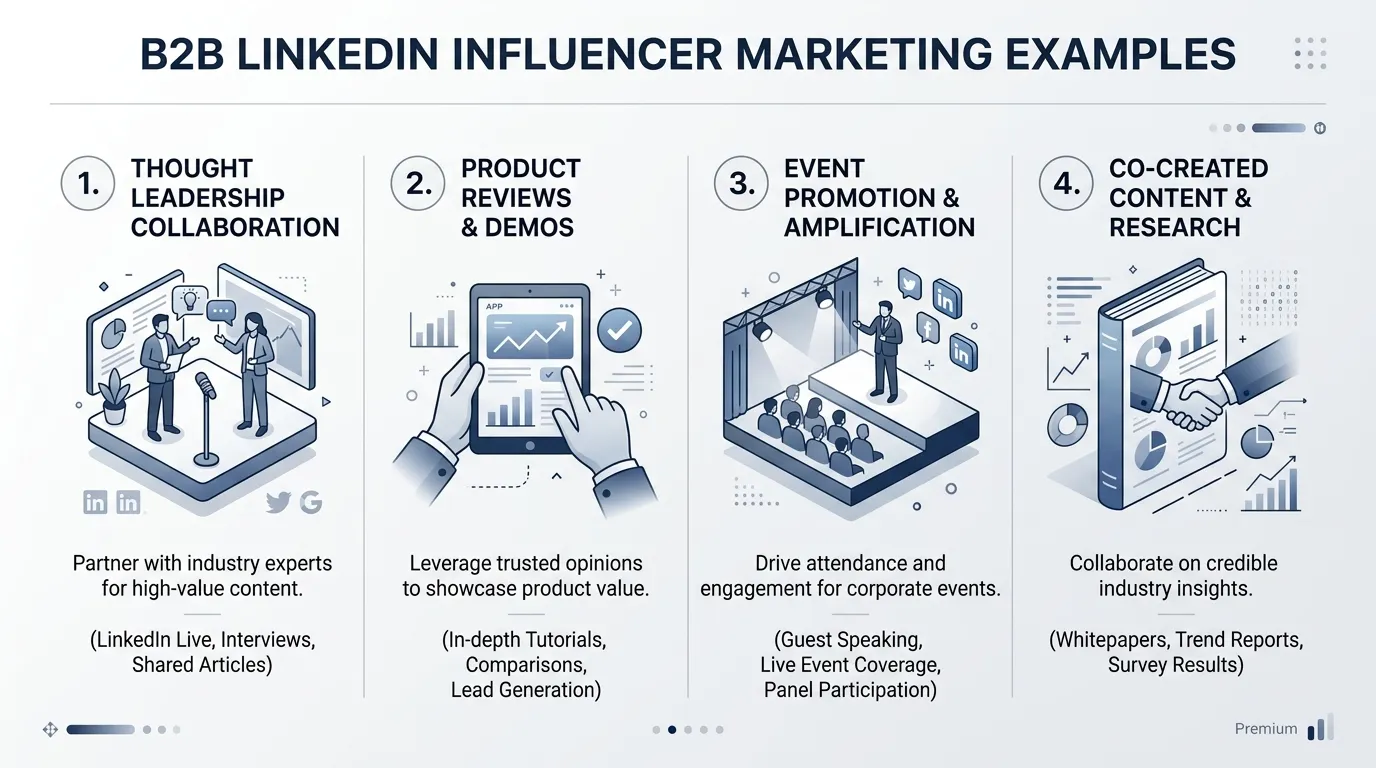
Looking at how LinkedIn influencer marketing is applied in practice helps clarify what actually works. While execution varies by industry, effective campaigns tend to follow a similar pattern. They focus on relevance, credibility, and clear alignment between the message and the audience.
Below are three common use cases grounded in how B2B brands typically operate:
B2B SaaS: Turning Expertise into Demand
Instead of promoting the product directly, the influencer shares insights on operational challenges. This could include inefficiencies in workflows, common mistakes, or emerging trends. The product is then introduced naturally as part of a broader solution.
This approach works because:
- It meets buyers earlier in the decision-making process
- It builds problem awareness before introducing the tool
- It positions the brand within a credible, experience-based narrative

In many cases, SaaS brands also support these posts with gated content, demos, or webinars, turning engagement into measurable pipeline activity.
Consulting Firms: Using Employee Advocacy to Build Trust
Consulting firms rely heavily on credibility. One of the most effective ways to build this on LinkedIn is through employee advocacy.
Consultants and senior team members share:
- Case-based insights drawn from real client work
- Lessons learned from specific industries or projects
- Commentary on trends affecting their clients
This content is not framed as a promotion. Instead, it demonstrates expertise through lived experience.
The advantage here is twofold:
- Audiences tend to trust individuals more than brand pages
- It creates multiple touchpoints across different networks, increasing reach organically
Over time, this builds a strong association between the firm and specific areas of expertise, which can influence shortlisting and vendor selection.
Events and Webinars: Driving Attendance Through Credible Voices
Influencers promote the event by:
- Sharing why the topic matters to their audience
- Highlighting key takeaways or speakers
- Adding their own perspective to make the content more compelling
This tends to outperform standard event promotion because it adds context and credibility. Attendees are more likely to register when the recommendation comes from someone they already follow or trust. In addition, influencers can serve as speakers or moderators, further strengthening the event’s perceived value.
What These Examples Have in Common
Across these scenarios, one factor consistently stands out. The influencer’s expertise aligns closely with the brand’s value proposition.
This alignment shows up in several ways:
- The topics discussed are directly relevant to the audience’s challenges
- The influencer has real or perceived authority in the subject area
- The brand’s solution fits naturally into the conversation
When this alignment is missing, campaigns tend to feel forced and underperform. When it is present, LinkedIn influencer marketing becomes less about promotion and more about credible knowledge sharing, which is what drives engagement and trust in B2B environments.
How to Get Started with LinkedIn Influencer Marketing in Singapore
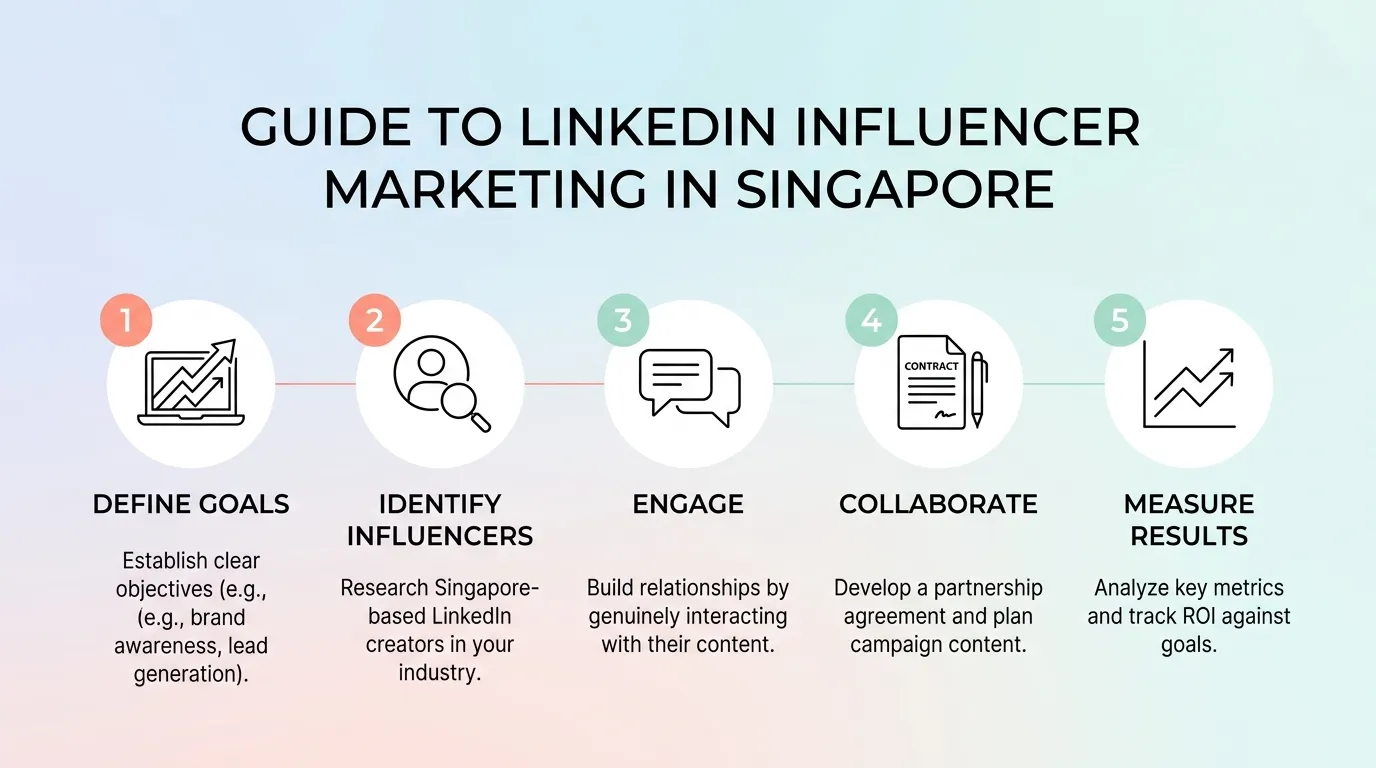
Getting started with this channel does not require a large campaign or a long list of influencers. What matters more is clarity, alignment, and consistency. Begin by identifying where influence already exists within your network. This could be your leadership team, subject matter experts, or trusted industry voices you already engage with.
From there, define a focused objective and test a small campaign built around a single idea or problem your audience cares about. Early results will give you the data you need to refine your approach before scaling.
It also helps to align your efforts with your broader content and SEO strategy. Influencer-led content should not sit in isolation. It should support your positioning, reinforce key topics, and contribute to long-term visibility.
If you want a more structured approach, working with a partner can shorten the learning curve. MediaOne supports B2B brands in Singapore by identifying relevant influencers, shaping campaigns, and connecting activity to measurable outcomes. If you are evaluating your next step, consider speaking with our team to map out a strategy that fits your market, audience, and growth goals.
A well-executed LinkedIn influencer marketing strategy is not built overnight. It is developed through testing, iteration, and strong partnerships with credible voices. Brands that take a deliberate approach tend to see stronger engagement, higher-quality leads, and more sustainable growth over time.
Frequently Asked Questions
How long does it take to see results from LinkedIn influencer marketing?
Results can vary depending on your goals and campaign structure. Awareness and engagement can appear within weeks, especially if the influencer has an active audience. Lead generation and pipeline impact usually take longer due to the nature of B2B buying cycles. Consistent campaigns over several months tend to produce more reliable outcomes.
Is LinkedIn influencer marketing suitable for small B2B businesses?
Yes, it can be effective for smaller businesses, especially when focused on niche audiences. Micro-influencers with strong engagement often provide better value than larger profiles. Smaller brands can start with limited campaigns and scale based on performance. The key is relevance and clear positioning, not budget size.
What type of content works best for LinkedIn influencer marketing?
Content that provides insight or solves a specific problem tends to perform best. This includes thought leadership posts, personal experiences, and practical advice. Audiences on LinkedIn respond well to content that feels authentic and grounded in real expertise. Promotional content without context is less effective.
How do you approach influencers on LinkedIn for collaboration?
A direct but personalised approach works best. Start by engaging with their content before reaching out to build familiarity. When contacting them, be clear about your objective and how the collaboration benefits both sides. Avoid generic messages and show that you understand your audience and content style.
Can LinkedIn influencer marketing work without paid partnerships?
Yes, some brands succeed through organic collaboration and relationship building. This can include co-creating content, featuring influencers in events, or consistently engaging with their posts. However, paid partnerships often provide more structure and predictability. A mix of both approaches is common in B2B strategies.