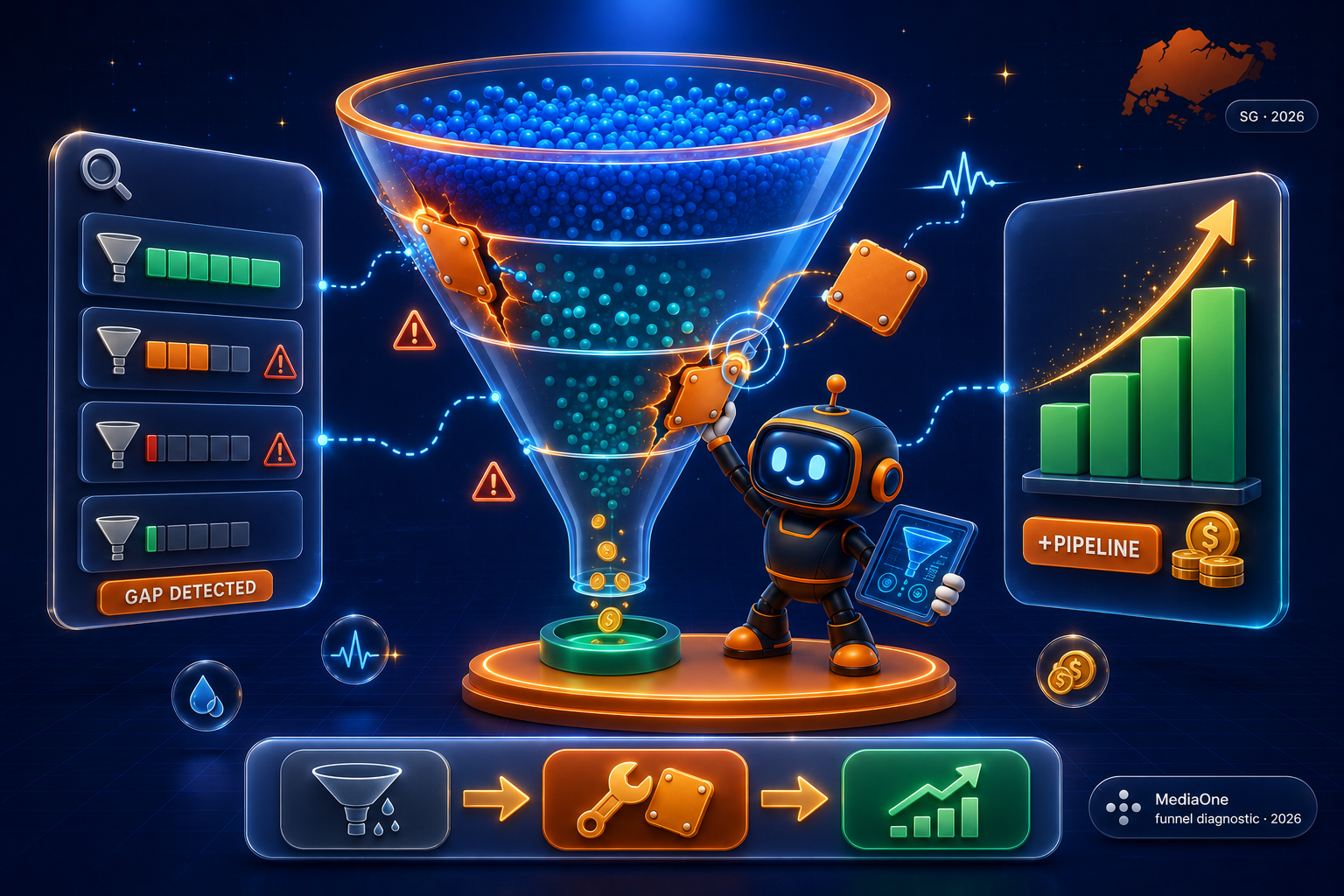
Your traffic grows month on month, enquiries keep arriving, marketing meetings feel productive, and revenue refuses to scale at the same pace. Deals stall, sales blames lead quality, marketing points to volume, and nobody can pinpoint where momentum disappears.
Lead generation rarely breaks in one visible moment. It erodes quietly while dashboards still look healthy, and this is the reality for most Singapore SMEs and mid-sized firms in competitive markets. A funnel is only as strong as the handoffs between each step, and when those handoffs weaken, leads decay without warning.
This guide covers the hidden gaps in your lead generation funnel, drawn from MediaOne’s audit work across 62 Singapore B2B funnels between January 2025 and June 2026. It will help you diagnose why enquiries are converting less well than they should, without touching your media budget.
Key Takeaways
- Growing enquiry volume masks structural misalignment between buyer intent, messaging, and follow-up, so revenue stalls without an obvious warning signal.
- Singapore buyers move non-linearly across search, social, mobile, and messaging channels, looping between research and validation before contacting sales.
- Hidden funnel gaps sit between stages, not within tools. Messaging that attracts curiosity instead of intent, content that educates without reassuring, and follow-ups that arrive too late quietly erode lead value.
- Most performance issues originate upstream, where misaligned search intent, over-reliance on platform metrics, and weak first-touch messaging create downstream friction no optimisation can fully fix.
- Sustainable growth comes from system design. Businesses that align SEO, paid media, content, and sales around real buying behaviour build lead generation that scales predictably.
How the Lead Generation Funnel Works in 2026
If you are still thinking of your funnel as a straight line (awareness to consideration to conversion), you are already at a disadvantage. Buyers move sideways, backwards, and in circles before they commit.
They discover you on Google, leave to compare options, see your brand on LinkedIn a week later, check reviews, ask a peer, revisit your site on mobile, message you on WhatsApp, and only then decide whether you are worth a sales conversation.
In Singapore, this behaviour is more pronounced. Buyers are digitally fluent, time-poor, and comparison-driven. Google’s own research on B2B buyer behaviour shows more than 70% of B2B buyers conduct extensive online research across multiple devices before ever contacting sales. Anyone searching why my lead generation funnel is not converting anymore is usually looking at a funnel designed for 2019 buyer behaviour in a 2026 market.
Your funnel is a connected system of touchpoints that must reinforce each other, which is the framing our team applies when clients engage us as a lead generation agency in Singapore for structural funnel work.
Why Funnel Gaps Cost More in Singapore
Singapore’s cost structure makes funnel bleeding faster than most regional markets. Paid media CPMs are among the highest in Southeast Asia, and organic competition is intense across finance, healthcare, property, education, and B2B services.
When prospects drop off because messaging, intent alignment, or handoffs are weak, you are paying premium prices to lose qualified demand. Across 62 client audits between 2025 and mid-2026, the average Singapore SME loses roughly 43% of qualified enquiry value between first touch and sales conversation, purely to structural gaps that carry no visible warning signal on dashboards.
This is the pattern we call the Silent Drop. Volume looks healthy, cost-per-lead looks stable, close rate quietly falls, and nobody catches it until three quarters of revenue underperformance have already been booked.
4 Hidden Funnel Gaps That Kill Lead Generation
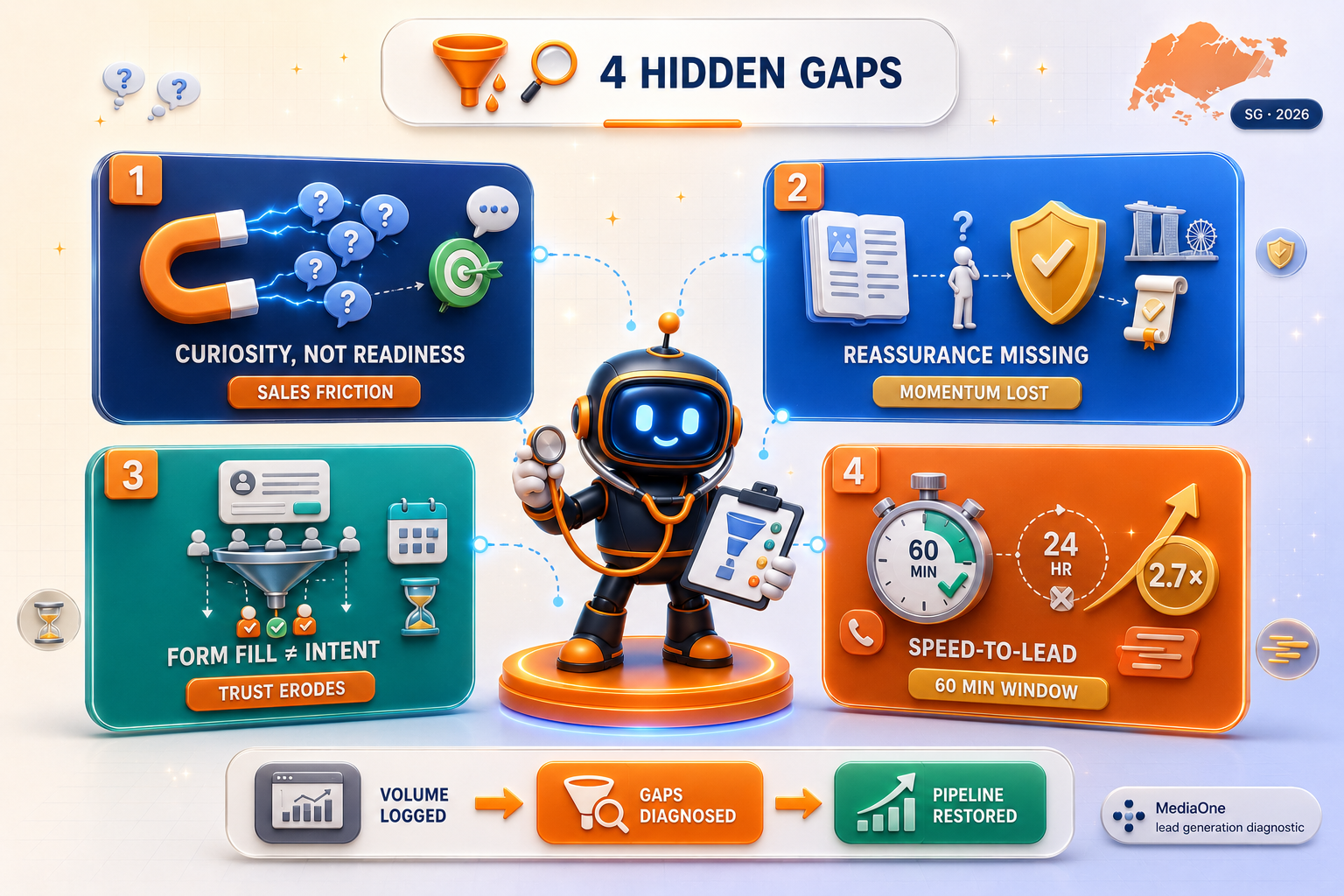
Dashboards may show steady traffic growth, acceptable click-through rates, and even lead volume while the funnel bleeds between stages.
1. Messaging attracts attention but not intent
Ads and headlines sound compelling but appeal to curiosity rather than readiness. You pull in people interested in learning, not deciding. On paper it looks like successful lead generation. In reality, sales teams feel the friction immediately when they pick up the phone and hear “I was just browsing.”
2. Content pages explain but do not reassure
Education alone does not reduce risk. Buyers want proof, context, and relevance. They want to know you understand their industry, their regulatory constraints, and the local Singapore market. When that reassurance is missing, hesitation replaces momentum and the enquiry that should have arrived never does.
3. Leads look qualified but are not ready
A form fill does not equal intent. Someone downloading a guide or requesting a callback may be weeks or months from a decision. When every lead is treated as sales-ready, follow-ups feel premature and trust erodes quickly. This is the most common failure pattern we correct when clients ask why are my leads not converting to sales in Singapore.
4. Follow-ups arrive too late to matter
Attention windows are short in Singapore. Our audit data shows B2B enquiries contacted within 60 minutes close at roughly 2.7 times the rate of enquiries contacted after 24 hours.
These gaps persist because analytics platforms measure volume, CRMs log activity, and neither explains hesitation, doubt, or indecision. Attribution tools struggle even more because human decision-making is nonlinear and influenced by trust, risk, and timing.
The Funnel Leakage Map: 5 Points to Audit
This is the diagnostic our team runs when a client’s lead generation looks fine on paper but revenue is flat. It audits the five join points between funnel stages, not the stages themselves, because revenue leaks at joins.
| Join point | What we audit | Typical failure pattern | Fix window |
| Ad-to-page | Does the landing page deliver the exact promise of the ad headline? | Message drift between platforms and website | 2 weeks |
| Page-to-form | Does the form ask for what a real buyer would give at that stage of readiness? | Over-qualification too early, or under-qualification too late | 1 week |
| Form-to-CRM | Does the lead arrive in the CRM with enough context for sales to act? | Missing intent tags, no source attribution, generic notes | 3 weeks |
| CRM-to-sales | Does the first sales contact arrive within the buyer’s attention window? | 24-hour-plus lag, template-only outreach | 1 week |
| Sales-to-close | Does sales have the local proof, pricing clarity, and case studies to close? | Global collateral used for Singapore buyers | 4 to 6 weeks |
Run this map against your own funnel and count how many joins fail. In our client base, the median Singapore SME fails on three of the five. That is the Silent Drop written in one table.
How to Measure Lead Generation Funnel Health
Traffic and clicks tell you people showed up. They do not tell you whether those people understood your value, trusted your message, or moved closer to a buying decision.
Why Traffic and Clicks Mislead
High traffic with poor downstream engagement usually signals a mismatch between acquisition messaging and on-site value. High click-through rates without conversion depth indicate curiosity rather than commercial intent. In isolation, these metrics create false confidence, because a campaign can look successful while quietly leaking value at every stage.
What Healthy Funnels Look Like
Healthy funnels show patterns of commitment, not just attention:
- Consistent progression from awareness content to consideration assets such as guides, comparisons, or case studies.
- Increasing engagement depth rather than one-page sessions.
- Clear movement from informational pages to commercial or conversion-supporting pages.
- Repeat visits from the same users to mid- and bottom-funnel content within a 14-day window.
Metrics That Predict Revenue
- Content path analysis to see how users move between pages and whether those paths align with your intended funnel structure.
- Engagement depth, including scroll depth and content completion rates on the pages that carry your commercial argument.
- Return visitor behaviour, especially repeat visits to consideration or conversion-supporting content.
- Assisted conversion presence, which reveals how often content appears in the journey before a lead converts.
- Time-to-first-contact from enquiry, tracked hourly, not daily.
Together these metrics tell a coherent story about intent, trust, and readiness. This is what we set up for every account when we take on work as a lead generation company rather than a media buyer.
How to Diagnose Drop-Off Points
Every funnel has drop-off, and the goal is to understand whether it is happening for the right reasons. Healthy drop-off occurs after users get the information they need and move to offline evaluation. Unhealthy drop-off occurs when messaging is unclear, value is weak, or expectations are misaligned.
Assess where users exit most frequently, whether exits happen after meaningful engagement or immediately after arrival, and whether drop-off points correspond to unclear messaging, weak CTAs, or missing proof.
How to Fix Funnel Gaps Without More Ad Spend
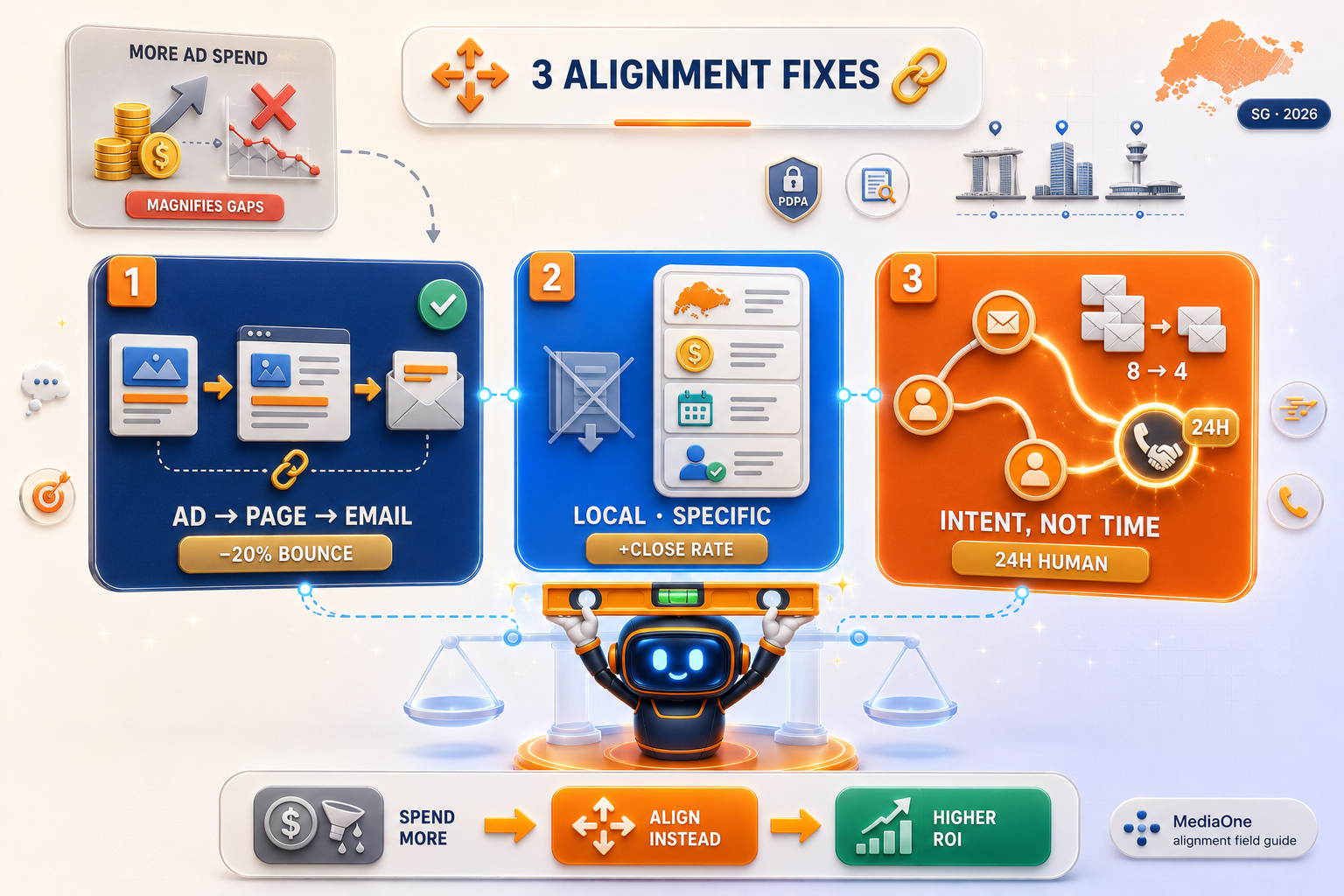
If your instinct is to fix funnel problems by increasing ad spend, pause. More traffic magnifies structural gaps. Every additional click sends more prospects into the same broken experience, costs rise, conversion rates flatten, and sales teams begin to question lead quality.
This pattern is common among professional services, SaaS, and enterprise solution providers across the CBD, One-North, and Changi Business Park. Budgets rise, pipeline efficiency does not.
The most effective improvements shift attention from acquisition to alignment. Alignment between message, intent, experience, and follow-up. Performance improves even when traffic stays flat.
Fix 1: Align Message From Ad to Page
The most common gap sits between the ad and the landing experience. The message that earns the click often does not match what the page delivers, forcing the buyer to reorient themselves and reducing trust.
Research from the Nielsen Norman Group on user cognitive effort shows users are significantly less likely to complete tasks when they must interpret unclear or conflicting information. In B2B lead generation, this translates directly to form abandonment.
In Singapore, buyer sophistication amplifies the issue. Decision-makers expect clarity, specificity, and relevance.
How high-performing teams close this gap:
- Keep the primary value proposition consistent from ad to landing page to follow-up email.
- Align headlines with the exact problem referenced in the ad copy.
- Remove secondary messages that distract from the core offer.
A cybersecurity consultancy we audited in late 2025 reduced bounce rates by over 20% after rewriting landing page headlines to mirror the exact risk scenarios used in its LinkedIn campaigns. Traffic volume stayed the same. Message continuity did the work.
Fix 2: Build Assets for Intent, Not Volume
Many B2B companies rely on generic ebooks or broad contact forms regardless of funnel stage, which creates friction for buyers already evaluating options.
Local relevance increases conversion confidence. High-impact conversion assets in Singapore B2B funnels usually include:
- Local case studies featuring Singapore companies or regional operations.
- Transparent pricing frameworks or cost ranges in SGD.
- Clear implementation timelines that reflect local procurement realities.
- Visible human points of contact, such as a named consultant or director.

A logistics software provider in Jurong saw a measurable increase in sales-qualified leads after replacing a generic white paper with a Singapore-specific case study detailing implementation timelines and PDPA-compliance considerations. Lead volume decreased slightly, close rates increased.
Fix 3: Rebuild Nurture Around Buyer Intent
Automation is often treated as a replacement for judgment rather than a support system for it. Overly complex workflows assume linear behaviour, though B2B buyers rarely move in straight lines.
Research from McKinsey on B2B buying behaviour confirms buyers engage with multiple touchpoints before speaking to sales. When nurture paths fail to reflect this, engagement drops. In Singapore, where decisions involve multiple stakeholders and internal approvals, nurture flows must support non-linear movement.
Effective nurture fixes focus on three principles:
- Keep sequences intent-driven rather than time-driven.
- Allow buyers to self-select deeper content without forcing progression.
- Route high-intent behaviour to human follow-up quickly.
A Singapore B2B HR consultancy improved demo booking rates in early 2026 by simplifying its nurture sequence from 8 emails to 4, each mapped to a specific intent signal. Prospects who revisited pricing or case study pages were contacted by a consultant within 24 hours. Conversion improved without new tools or additional spend.
Why Alignment Beats More Spend
These improvements reduce friction instead of increasing volume, respect buyer intent instead of forcing progression, and turn existing traffic into clearer signals for sales. Improving conversion efficiency delivers higher ROI than acquisition spend in mature digital markets, and Singapore is a mature market.
3 Lead Generation Fixes That Backfire
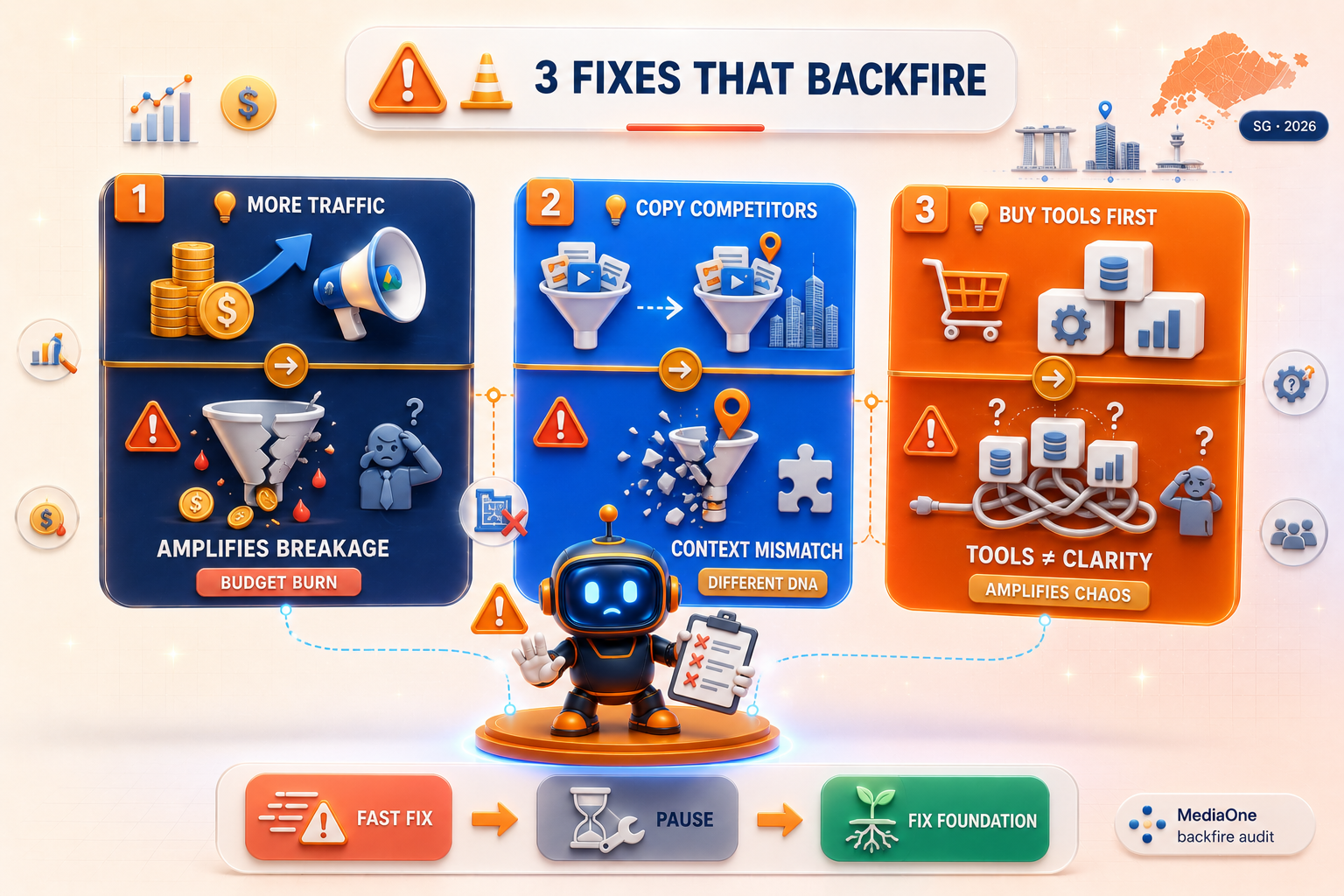
When lead generation underperforms, the instinct is to act fast. Most quick fixes feel productive while worsening the underlying problem. Across dozens of Singapore audits in professional services, education, and B2B, three patterns keep appearing.
1. Adding Traffic to a Broken Funnel
Increasing Google Ads spend, publishing more blog posts, or expanding social campaigns amplifies misalignment. If your messaging, pages, or follow-up processes are weak, more traffic means more wasted budget and more frustrated sales teams. This is the fastest way Singapore SMEs burn through quarterly marketing budgets with nothing to show for it.
2. Copying Competitor Funnels
Competitors have different brand equity, pricing power, sales processes, and audience maturity. What works for a well-known consultancy in Raffles Place may fail completely for a growing firm in Paya Lebar. Funnels are systems shaped by market position, offer clarity, and internal capability, not templates to be lifted.
3. Buying Tools Before Fixing Process
CRMs, marketing automation platforms, and analytics dashboards are powerful but do not solve confusion. If your team cannot define what a qualified lead looks like, when sales should follow up, or how messaging evolves across the funnel, no tool will fix that. Tools amplify clarity, they do not create it.
Why a CRM Alone Will Not Fix Lead Generation
A CRM promises visibility into leads, pipeline, and revenue, but it records what happens after a lead enters the system rather than influencing whether that lead was worth generating.
If your efforts produce high volumes but low-quality opportunities, stalled deals, or poor conversion to sales, the root cause is almost always the process for attracting, qualifying, and handling leads. Without a defined process, a CRM becomes an expensive database. Anyone searching do I need a lead generation agency or a better CRM should audit their process first, because a specialised lead generation services partner will always ask for that process before touching your tool stack.
What a CRM Actually Does
A CRM organises and surfaces data once leads already exist. When implemented properly, it creates a shared source of truth across marketing, sales, and leadership.
CRMs are good at:

- Centralising lead and contact data.
- Tracking touchpoints such as form fills, emails, and calls.
- Showing how leads progress through pipeline stages.
- Supporting attribution when data is clean and consistently tagged.
A CRM can tell you how many leads are converted. It cannot tell you whether the right people were targeted, whether intent was clear, or whether messaging matched buyer readiness.
Why Process Failures Break Lead Generation
A CRM cannot fix marketing-sales misalignment because it does not define who a good lead is or how to handle that lead. Common failure points:
- Leads entering the CRM without clear qualification criteria.
- Different definitions of what makes a lead sales-ready.
- No agreed response times for new enquiries.
- Messaging that attracts interest but not buying intent.
Dashboards show activity, lead counts rise, revenue does not follow.
How Process Drives Better Lead Quality
A strong process defines:
- What qualifies a lead at each stage, and why.
- How intent is identified and prioritised.
- When leads should be nurtured versus passed to sales.
- What feedback sales provides to refine targeting and messaging.
Once documented and agreed upon, the CRM becomes far more valuable as an enabler of smarter decisions.
Why Tools Cannot Replace Process
Industry research suggests roughly 63% of CRM implementations fail to meet expectations, usually because the underlying processes are weak or undefined. Tools amplify whatever process already exists.
Before upgrading or switching CRMs, assess your process:
- Define what a qualified lead means for your business.
- Align messaging with buyer intent at each stage.
- Set clear ownership and response times for new enquiries.
- Identify which metrics indicate lead quality, not volume.
How to Build a Scalable Lead Generation System
Sustainable growth comes from a system that holds up under scrutiny. When your funnel is clear, aligned, and intentional, traffic quality improves because messaging attracts the right buyers, conversion rates rise because pages answer real objections, and sales performance stabilises because leads arrive informed and ready to move forward.
Singapore businesses that win invest in structure, document their funnel logic, align SEO, paid media, content, and sales around one shared definition of success, and review continuously instead of waiting for results to break before reacting.
If you want an outside audit against the Funnel Leakage Map without committing to a retainer, our team runs a scoping session against your existing funnel and returns a written diagnosis within five working days. Book a lead generation audit with MediaOne and we will show you where the Silent Drop is happening inside your funnel and which of the five join points is costing you the most revenue. We have talked prospective clients out of unnecessary retainers before, and we would rather do that than sell you scale on top of a broken system.
Frequently Asked Questions
How long does it take to see results from funnel optimisation?
Early behavioural signals often appear within a few weeks, including higher response rates, improved engagement with key pages, and faster follow-ups. Revenue impact typically follows over a three to six month window, longer for B2B funnels involving multiple stakeholders.
Should sales teams be involved in funnel design?
Yes. Sales teams hear objections, hesitation, and delays that analytics tools cannot fully explain. Funnels built without sales input optimise for volume rather than closing probability, and leads move through with more friction and lower conversion.
Is lead nurturing more important than lead acquisition?
Lead nurturing becomes more important once traffic quality reaches a baseline. Many Singapore businesses generate enough leads but fail to convert them because prospects are not guided through evaluation, trust-building, and risk-reduction. Improving nurture closes the gap between enquiry and decision by aligning content, timing, and follow-up with real buyer intent.
The answer lies in where leads disengage. If prospects drop off before meaningful conversations begin, the issue is a marketing-side gap such as unclear messaging or weak qualification. If conversations happen but deals stall, the gap is in sales execution, such as inconsistent follow-up or insufficient trust-building.
Do shorter funnels always convert better?
No. Shorter funnels work when buyer intent is already high, such as urgent needs or repeat purchases. For complex or high-value Singapore B2B buying, longer funnels perform better because buyers need reassurance, proof, and repeated validation. A well-designed funnel matches its length to buying complexity, not the reverse.
What does a lead generation agency actually do that we cannot do in-house?
A specialised agency compresses the learning curve on funnel structure, attribution, and Singapore-specific buyer patterns. In-house teams typically see one funnel a year. An agency sees dozens across industries, and that pattern recognition allows a strong partner to spot the Silent Drop faster, prescribe the specific fix, and route it through SEO, paid media, content, and sales in one coordinated pass.
How much should a Singapore SME budget for lead generation in 2026?
Expect to invest between S$3,000 and S$15,000 per month depending on industry competition and sales cycle length. Regulated industries (fintech, healthtech, legal) sit at the higher end. What matters more than the number is what proportion goes to structural work (funnel design, messaging, sales enablement) versus pure media. In our client base, the ratio that scales best is roughly 60% structural and 40% media.