Guerrilla marketing is a low-cost, unconventional approach that makes a small business visible where people already are. It is not a cheap replacement for paid advertising. A stunt that gets talked about but never sells anything is an expensive way to be noticed. The campaigns that pay back share one trait: each activation serves a single, measurable goal for a clearly defined local audience, and the team tracks how it performs, including the storage of any data collected.


This guide sets out that view. It explains what guerrilla marketing is, the main tactic types and how to choose between them. It also introduces a scoring checklist, the Guerrilla Fit Matrix, to test any idea before spending money on it. In Singapore, dense public spaces such as MRT interchanges and hawker centres make location the biggest variable, so the advice is written with that in mind, including how non-precise location signals can guide placement without tracking individuals.
Key Takeaways
- Guerilla marketing is not a cheap replacement for paid advertising. It works only when each activation serves one measurable goal for a clearly defined local audience.
- Match the tactic to the goal. Awareness, footfall and lead capture each need a different activation type.
- Score every idea before running it. The Guerrilla Fit Matrix rates goal, reach, legal safety and trackability from 0 to 2 each. Proceed at 6 or more out of 8.
- Get permission first. Most public and semi-public spaces need approval from the venue operator or property owner.
- Track every activation with a unique QR code or promo code. This ties responses to a specific location and date, and shows how long each session lasted.
- Confirm local costs and platform rules yourself. Prices and requirements change.
What Is Guerrilla Marketing? Definition and Origins
Defining guerrilla marketing in plain terms
Guerrilla marketing is a low-cost approach that uses unconventional, attention-grabbing tactics to reach people where they already are. Square describes it as an unconventional, typically low-cost way to advertise a product or service, built on a fresh and creative approach that generates buzz. Typical tactics include stunts, installations, flash mobs, pavement stickers and surprise activations in unexpected places, and many brands use these guerrilla marketing ideas to create buzz for a campaign.
The surprise is the defining feature, but it does not make a campaign work on its own. A guerrilla format must be paired with a specific audience and a specific business goal. A stunt that is filmed and shared but drives no visits has only done half the job.
Where the term came from: Jay Conrad Levinson and the 1984 book
Jay Conrad Levinson popularised the term in his 1984 book, which argued that creativity could deliver significant results without large budgets. EDUCBA credits the book with this framing.

Levinson’s core idea still holds: a small business with a clear goal and an inventive execution can outperform a larger rival that relies on repetition and reach. Activations now extend from the street into phones, QR codes, social shares and user-filmed content, and the same information about each activation can help a team judge which tactics to repeat.
Common features that set guerrilla campaigns apart
Most guerrilla activations share four traits:
- Unexpected placement. The message appears where the audience does not expect advertising.
- Low direct media cost. Spend goes into creative and execution rather than buying space.
- Participation or talkability. The audience is invited to act, photograph or share.
- A traceable response. People act in a way that can be counted, such as a unique promo code or scannable QR code, which shows which activation drove each visit – a unique link per placement makes this straightforward.
The last trait is the one most often missing. Without it, a campaign can be memorable yet impossible to judge.
Types of Guerrilla Marketing: Street, Ambient, Ambush, Projection, Experiential and Viral
Most guerrilla tactics fall into a handful of families. The goal matters more than the family, so each type below is tied to the outcome it tends to serve.
Outdoor and street guerrilla tactics
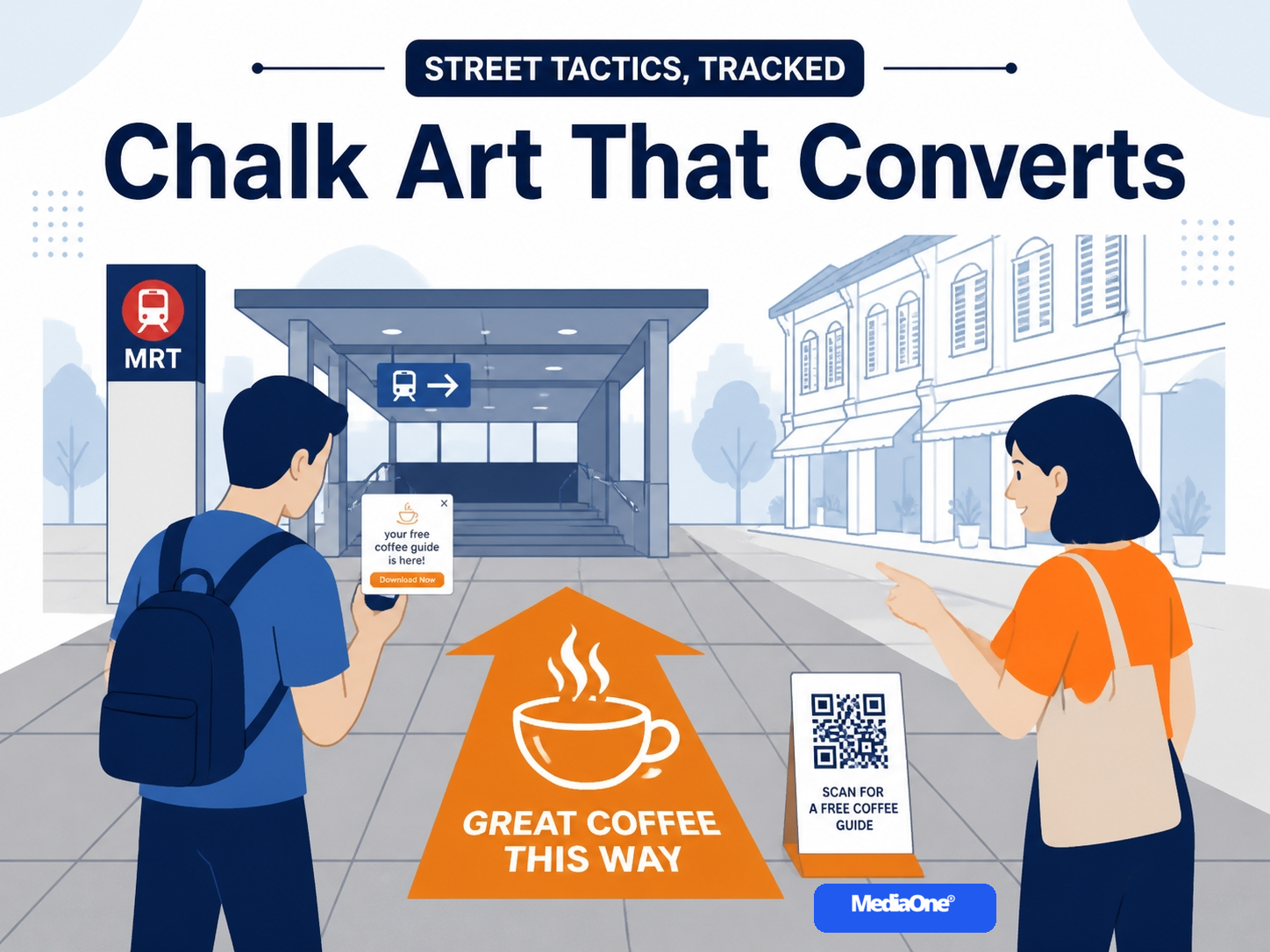
Street tactics put a message where people already walk, queue or wait. Chalk art, sidewalk stencils, floor decals and bus shelter posters are common examples. In Singapore, a chalk or stencil piece near an MRT interchange concourse with a QR code beside it can drive awareness, provided the property owner or venue operator has approved it in writing. Plan from the start how any sign-up details collected will be stored, and keep the retention period for each in view.
Indoor, ambient and ambush activations
Ambient marketing uses the environment as the advert, such as a coffee cup sleeve that wraps around as a poster. Ambush activations place a brand near a crowd gathering it did not organise, which can look opportunistic. An ambush works only where the activation adds to the moment rather than competing with it.
Experiential and projection campaigns
Experiential activations invite people to take part, through a pop-up sampling stand, a demonstration or a game. Projection campaigns beam images onto building facades or walls at night. Both cost more than stencils, but they generate content people share.
Digital tactics run through phones and social feeds, such as a challenge or a QR code on a physical object that opens a landing page. Mobile devices account for roughly two-thirds of web traffic in Singapore, so a QR code is often the simplest way to measure a physical activation, because each scan can be tied to a unique link and a single browser session. Viral reach is unpredictable, so treat it as a bonus rather than the plan.
Matching type to goal
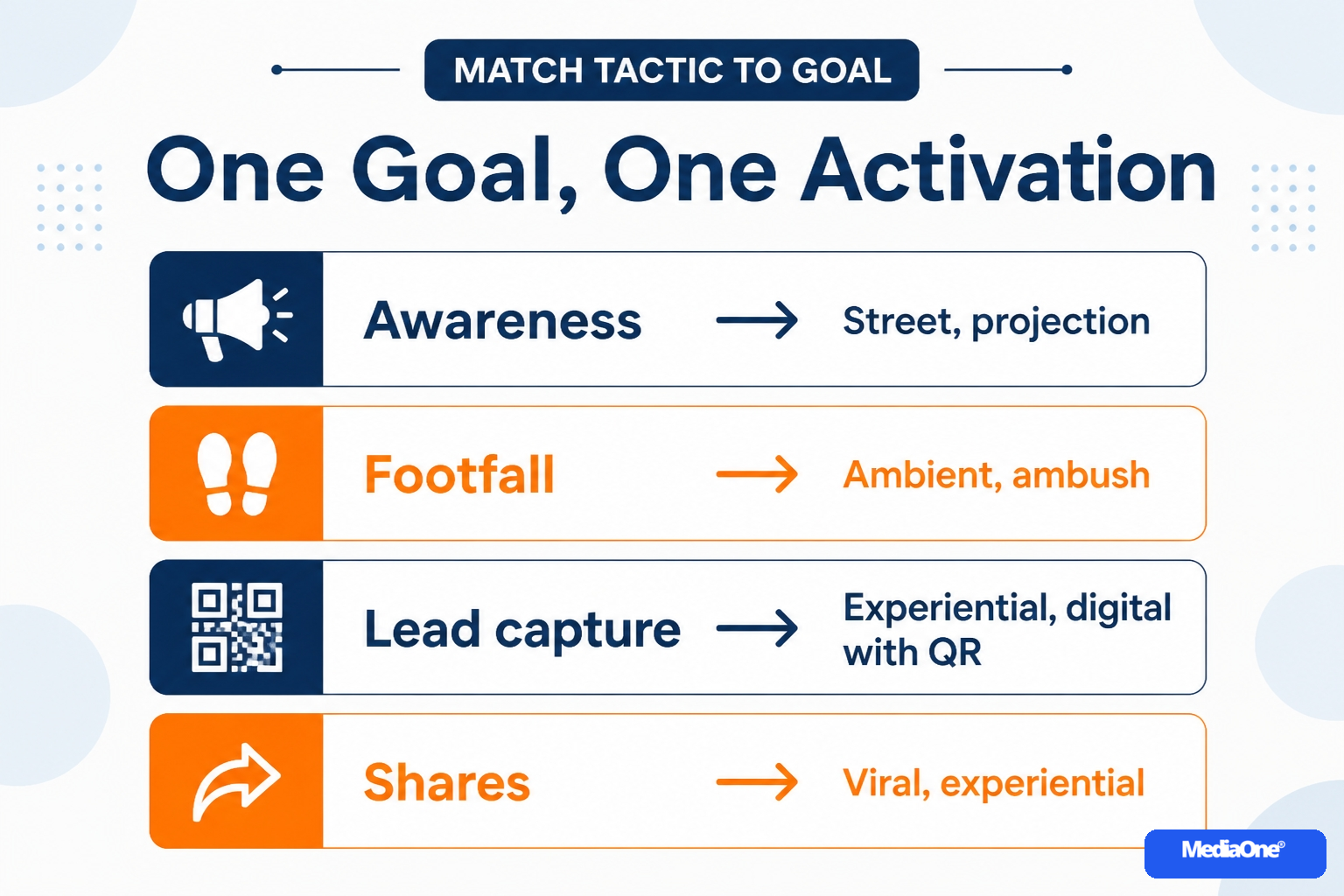
Use this reference as your starting point. Score each candidate with the Guerrilla Fit Matrix before committing, because a tactic that suits the goal can still fail on legality or tracking.
Guerilla Marketing Campaign Examples Worth Studying
Guerilla marketing campaigns that get cited are usually large, global and expensive to copy. The useful question for a business owner is which parts can be rebuilt at a smaller scale, with a measurable goal attached.
Stunts that drove measurable results
Moosend’s round-up of guerrilla marketing ideas includes a film campaign that paired an unconventional activation with influencer marketing. The source reports that the film grossed $785 million worldwide, a figure that has not been independently verified. The author credits part of the result to the influencer work running alongside the stunt, so the success cannot be attributed to the stunt alone. Campaigns like this are one channel among several, and teams often use paid social to amplify the reach, with the duration of each activation planned in advance.
A 2009 flash mob at Liverpool Street Station, London, is another example from the same source. Flash mobs are brief and reach a transit audience, so the clear outcome is social reach, which is hard to tie to sales. Teams planning similar activations often pair them with email marketing so that interest captured on the day can be followed up, and the data collected is used only for that follow-up.
Campaign Refinery’s list of guerrilla marketing examples covers the same pattern across formats, but most entries are judged on buzz rather than conversion.
What the strongest examples have in common
- A single, plain goal. Each campaign knew which number it was trying to move.
- A location where the audience already is. Stations, streets and crowded venues, with location data kept to non-precise locations where possible.
- A reason to share. The activation was built to be photographed or filmed, so people create and spread their own content.
- A mix, not a stunt alone. The strongest results had digital follow-up, with identifiers captured so the response could be measured, and data kept in secure storage for no longer than needed. Where device characteristics are logged, the business should rely on legitimate interest only if it has assessed the impact on the people concerned.
Apply the Guerrilla Fit Matrix to any example before copying it. A flash mob may score well on reach but poorly on legal and location safety for a small firm, and it scores zero on trackable response without a unique QR or promo code.
Counterpoint: Some famous campaigns generated extensive coverage with no clear sales effect. Judge an idea by whether you can measure its return, not by how much it was shared, and by whether the marketing strategies behind it can be repeated for your own service.
Guerrilla Marketing Ideas for Small Businesses in Singapore
Low-budget tactics that suit an SME
Cheap guerrilla ideas cost little to produce, but they are easy to get wrong. Square’s guide frames the appeal plainly: an unconventional, typically low-cost way to advertise that generates buzz, which suits a small business without a large media budget (Square). The saving is real, but it pays off only when each activation has a specific purpose and a measurable goal, tied to a clear plan and a defined session or campaign window. Short-duration activations, such as a single afternoon, are easier to measure and control than open-ended ones.
Tactics that suit a small Singapore business include:
- Sticker and sign placements at a bus stop, lift lobby or café counter, where you already have permission.
- Sampling at a high-footfall stall such as a hawker centre or mall atrium, run for a single afternoon.
- A QR-code poster beside a related product or service, linking to a time-limited offer.
- Pop-up demonstrations in a shared venue such as a co-working space or market.
- Creator collaborations with a local micro-influencer, with the activation filmed and shared on social media.
Current rental, printing and permit rates were not verified for this guide, so confirm them with the venue or authority before budgeting.
Worked example: scoring a sampling stall
Consider a Singapore café planning a sampling stall at a hawker centre near an MRT interchange. The stall’s success can be judged with the scoring matrix below, which the café fills in with its own venue and goal details.
- Goal: A clear, time-bound target such as “Drive first-visit sign-ups at the hawker centre stall within two weeks” earns the top score. A vague aim such as “Get more people to know about us” earns none, because it cannot be measured.
- Audience: If the people walking past the stall closely match the café’s customer profile, the top score applies. If most are simply passing through on their way to the MRT, a middle score is more appropriate.
- Legal and safety: Written permission from the hawker centre operator earns the top score. Permission that is still pending earns a middle score, since the stall should not proceed until it is confirmed.
- Tracking: A unique QR code printed on each cup sleeve earns the top score, as it lets the café link each sign-up to the stall. Running the stall without any tracking earns no score, leaving the café unable to judge whether it worked.
A total of 6 or more out of 8 means the idea proceeds. A sampling stall with no tracking scores poorly on the last question, even if it draws a crowd.
Matching the idea to your local audience and venue rules
Location is the main variable in Singapore. MRT interchanges, hawker centres, shopping malls and Orchard Road draw large crowds, but they are also the most controlled. Before you pick a site, ask three questions:
- Who is in this space at this time of day, and do they match my customer?
- Does the venue operator allow promotions, and what does their policy require in writing?
- Can I run this without blocking people or creating a safety issue?
If any answer is unclear, choose a different site or a lower-profile tactic, and verify local details yourself before acting. Mobile devices account for roughly two-thirds of web traffic in the city-state (industry analysis), which makes QR codes and social-share prompts a natural fit. A poster that sends someone straight to an offer page is easier to track than one that asks them to remember a web address. Where a QR code is scanned, only non-precise location and device characteristics should be collected unless the user has agreed otherwise, and identifiers and local storage should be handled under your own privacy policy.
The Guerrilla Fit Matrix
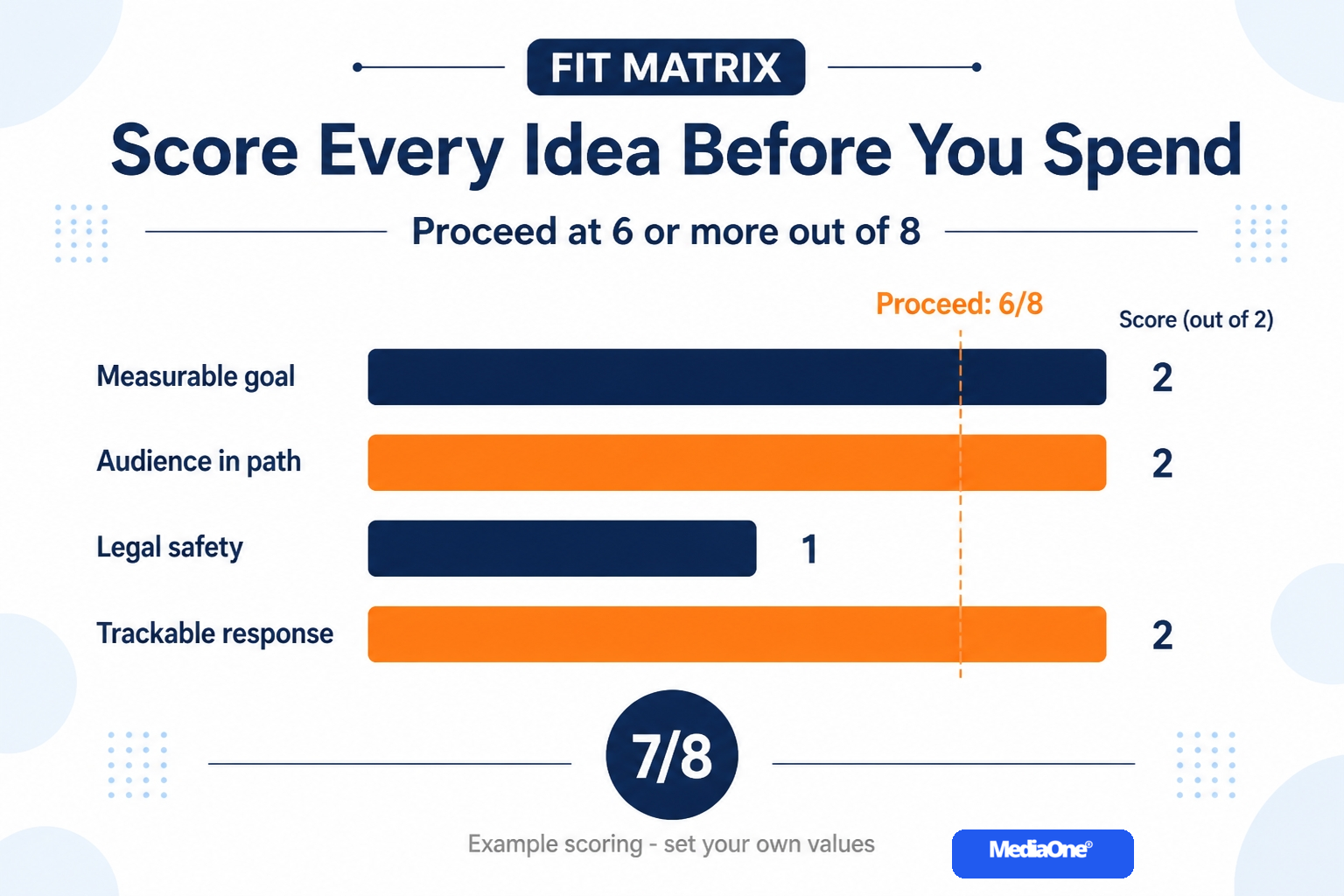
Score each proposed tactic from 0 to 2 on each question. Proceed if the total is 6 or more out of 8:
|
Question |
0 |
1 |
2 |
|
Is the goal specific and measurable? |
No defined goal |
Goal is vague |
One clear, measurable goal |
|
Does the audience already pass this point? |
Not in their path |
Partly in their path |
Squarely in their path |
|
Can it run legally and safely here? |
Unclear or not permitted |
Permission pending |
Permission confirmed in writing |
|
Can you track a response? |
No tracking |
Indirect tracking only |
QR code, promo code or footfall count |
Consider a Singapore café opening a second outlet near a busy MRT interchange. It runs a sidewalk sampling stand with a QR code on each cup sleeve that leads to a first-visit offer, so every scan is a traceable response.
Measurement tools make this practical. Omnisend notes that its integrations let you centralise data from across your tech stack, so an activation can be linked to later purchases rather than judged on reach alone. Teams that also track content performance can then compare which marketing tactics produce repeat customers, not just first visits.
Risks: backlash, cost overruns and brand damage
|
Risk |
Typical cause |
Practical fix |
|
Obstruction complaints |
Stands or props blocking walkways or queues |
Keep a clear walking path; get written permission for the exact footprint |
|
Cost overruns |
Unplanned staffing, printing or permit fees |
Set a budget ceiling and a cost-per-response target before launch |
|
Brand damage |
Shock or humour that offends part of the audience |
Test the concept with people outside the team first |
|
No measurable result |
No QR or promo code attached |
Give every activation its own tracking code |
|
Negative social spread |
Activation filmed in a bad light or misread |
Brief staff on answering questions; prepare a holding statement |
Brand harm is the most serious risk because it outlasts the campaign. Score any idea that relies on shock more strictly, or drop it.
Legality: permits, public space and advertising rules in Singapore
Most activations here take place in malls, hawker centres, transport hubs and pedestrian streets. Each space is controlled by its owner or operator, and public authorities may set further conditions. Rules change, so confirm them directly for each venue. Before any campaign, review your legitimate interest in contacting people and make sure any email marketing follows consent rules. Use the steps below as a working checklist:
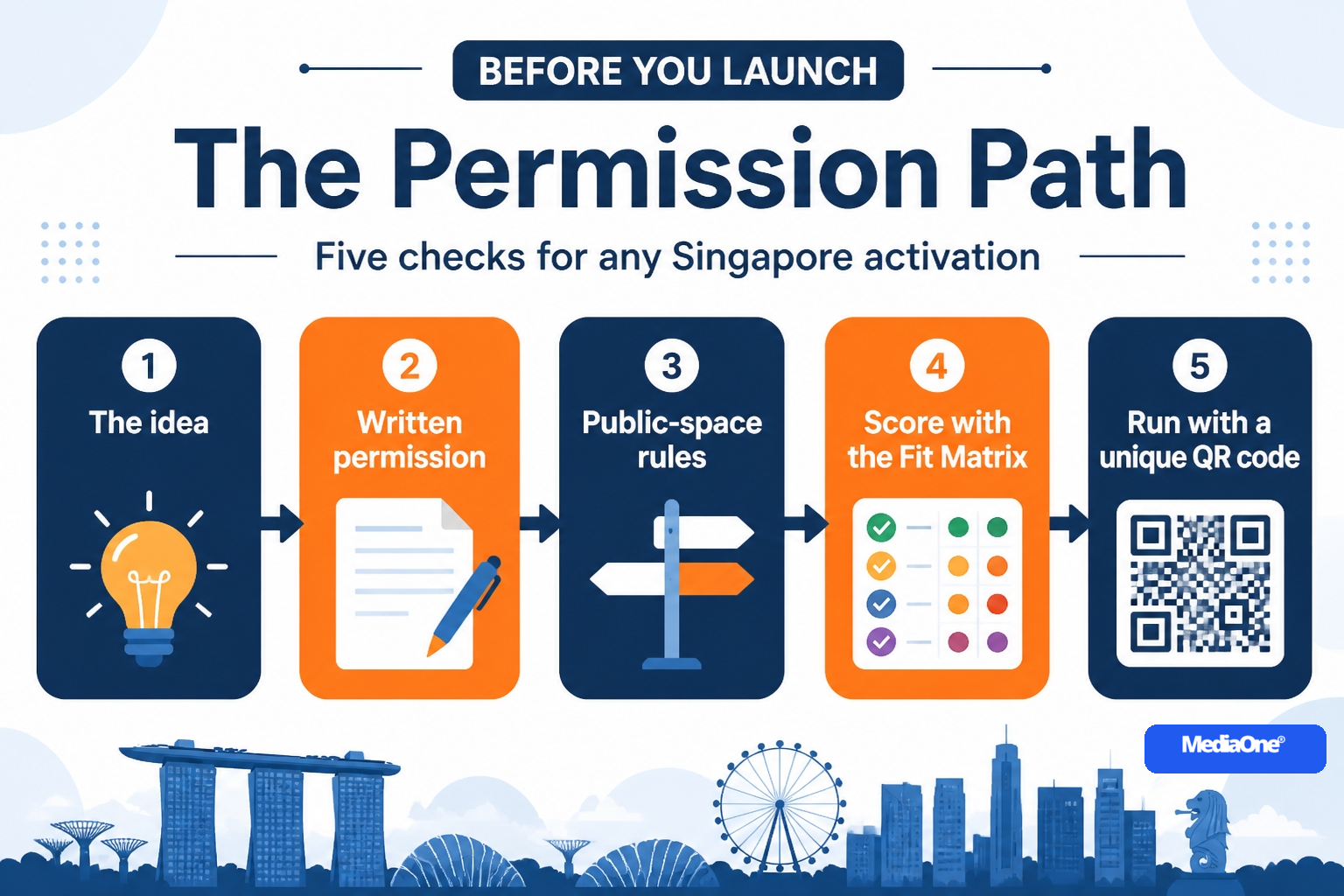
- Get written permission from the property owner or venue operator for the exact location, date, time and footprint.
- Check with the relevant public authority before any street-level promotion, including props, sound or handing out materials.
- Keep the footprint small. Stands, banners and staff should stay clear of walkways, entrances and queues.
- Make sure every offer matches its terms. A QR code or flyer promise must be honoured exactly, and any data collected from scans should be handled under your own privacy policy.
- Keep a file of permissions, approvals and the activation plan in case you are asked to show them.
The same caution applies to third-party guides: Square’s own material is general advice, so verify local details before acting.
Conclusion and Summary
Guerrilla marketing is not a cheap substitute for paid advertising. It works when each activation serves one measurable goal and reaches a clearly defined local audience. Campaigns chosen for shock value alone tend to earn attention without sales. The Guerrilla Fit Matrix asks four questions before any tactic goes ahead: Is the goal measurable? Does the audience meet it where they already are? Can it run legally and safely there? Can you track a response, with the information collected and the duration of each response window recorded?

Score each question from 0 to 2. A tactic scoring 6 or more out of 8 proceeds; anything lower is reworked or dropped. For Singapore SMEs, this usually means small, location-specific activations with a QR or promo code attached, so results can be counted and tied back to the product being promoted.
Frequently Asked Questions
Is guerrilla marketing legal in Singapore?
Yes, but legality depends on where and how you run it. Most activations in public or semi-public spaces need permission first, whether from the venue operator, the property owner or the relevant authority. A campaign that blocks walkways or uses public fixtures without approval can be stopped mid-run. Treat permission as part of the plan from the start, and confirm current rules before you launch, since requirements can change.

How much does a guerrilla marketing campaign cost?
Cost depends on the tactic, the venue and the number of staff involved. A QR-code sticker or small sampling activation usually costs far less than a large experiential stunt with staff and venue fees. The sources used for this guide do not give reliable local rates for rental, printing or permits, so request written quotes from venue operators and suppliers. Set a budget ceiling first, then choose tactics that fit within it.
What is the difference between guerrilla marketing and ambush marketing?
Guerilla marketing is an unconventional, low-cost way to get attention in unexpected places. Ambush marketing is narrower: in the event-sponsorship sense, a brand links itself to an event it did not sponsor, often by placing itself close to a rival’s official sponsor. A guerrilla activation can also be an ambush if it sits near a live event, so check the event’s rules first, as organisers may object.

Can small businesses run guerrilla marketing without a big budget?
Yes, as long as the tactic serves one clear goal and a specific audience. Location-specific activations, such as a sampling table at a relevant venue or a QR code on a product shelf, work well and can be tracked against a single target. Square’s guidance on guerrilla tactics for small businesses is a useful starting point for low-cost ideas.
How do you measure whether a guerrilla campaign worked?
Give each activation its own QR code or promo code, then count redemptions against the goal you set at the start. For footfall, compare visits or sales during the activation window with a normal period. Keep a tracking sheet with the date, location, tactic, target and result for every run, and compare several activations before deciding whether to repeat, scale or stop.
What are the biggest risks of guerrilla marketing?
The main risks are obstruction complaints, brand damage and cost overruns. A stunt that blocks a walkway can generate negative attention and force a quick shutdown. Shock value without a clear goal often produces buzz but no sales. Reduce these risks by getting permission in advance, testing with a small crew, and rejecting any idea you cannot track.