| AI Summary
Geofencing marketing helps Singapore businesses reach potential customers based on their physical location. It uses virtual boundaries around stores, shopping centres and event venues to deliver relevant advertising. Campaign costs depend on the platform, targeting, media spend and management fees. Success requires accurate location data, compliance with Singapore’s Personal Data Protection Act (PDPA) and measurable business outcomes. Businesses should start with a controlled pilot and evaluate incremental visits, sales and return on investment before scaling. |

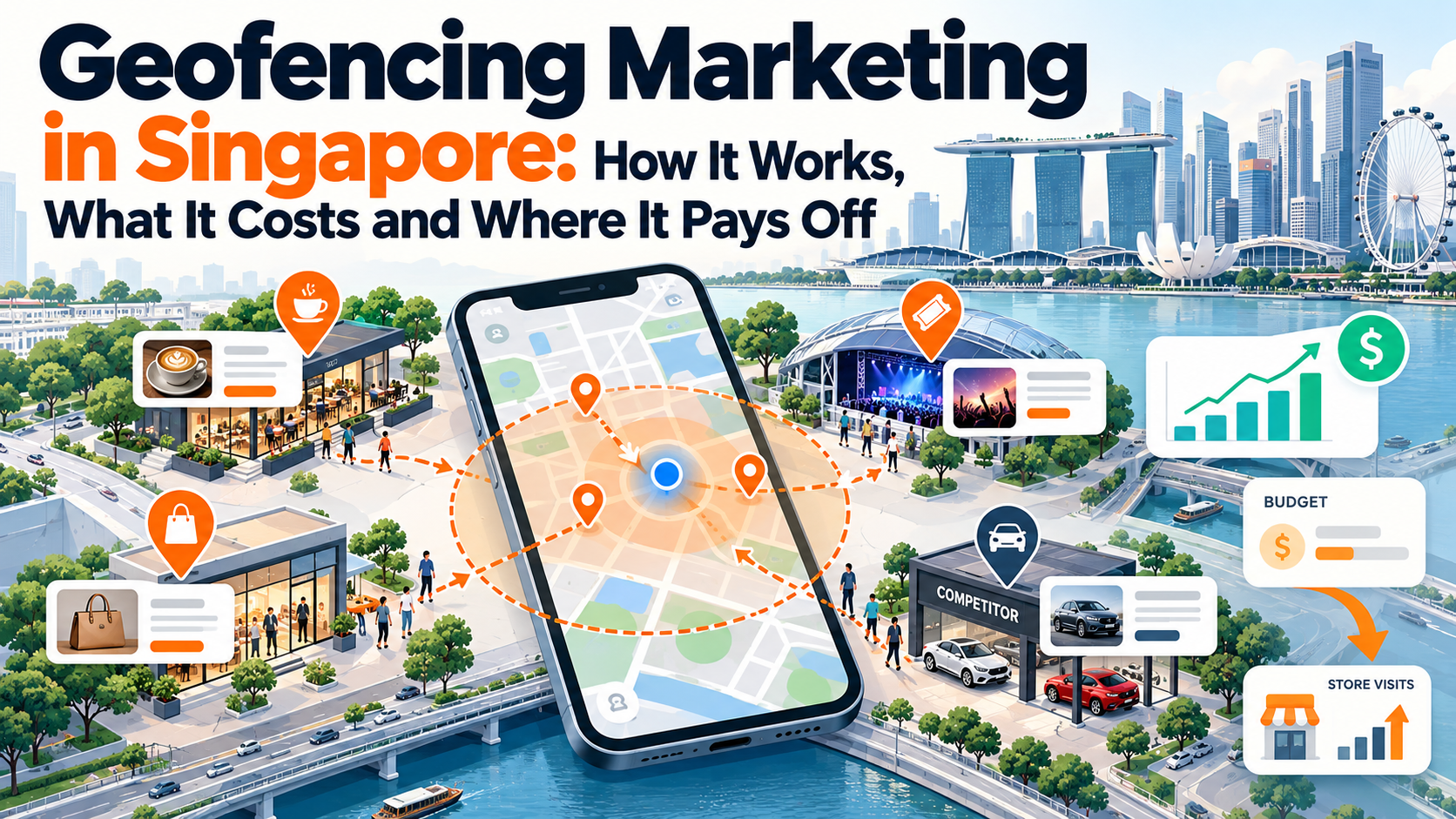
A customer walks past your café during lunch. Another visits a competing showroom. A third arrives near your weekend event. Geofencing marketing can use eligible location signals to connect these moments with relevant advertising or app messages. The aim is to reach people when a physical place makes your offer useful.
For Singapore businesses, the opportunity is real, but precision is often overstated. A boundary on a map does not guarantee instant notifications, access to every nearby phone or additional store visits. Results depend on the location data available, the advertising channel, customer permissions and the strength of the offer.
We recommend starting with one measurable business outcome, then choosing a boundary that supports it. This guide explains the technology, realistic costs, local privacy requirements and a practical way to test whether geofencing deserves your budget.
Key Takeaways
- Geofencing marketing uses virtual location boundaries, but app-triggered alerts and location-based advertising operate differently.
- Boundaries should reflect customer behaviour, access routes and the accuracy of available location signals.
- Google Ads radius targeting is not equivalent to detecting a customer entering a specific shop.
- Costs depend on media, data, platform fees, management and measurement. Compare full proposals in Singapore dollars.
- Singapore’s Personal Data Protection Act (PDPA) may apply when location records identify individuals.
- Measure incremental sales or visits against a valid control, rather than treating attributed visits as guaranteed results.
What Is Geofencing Marketing and How Does It Work?
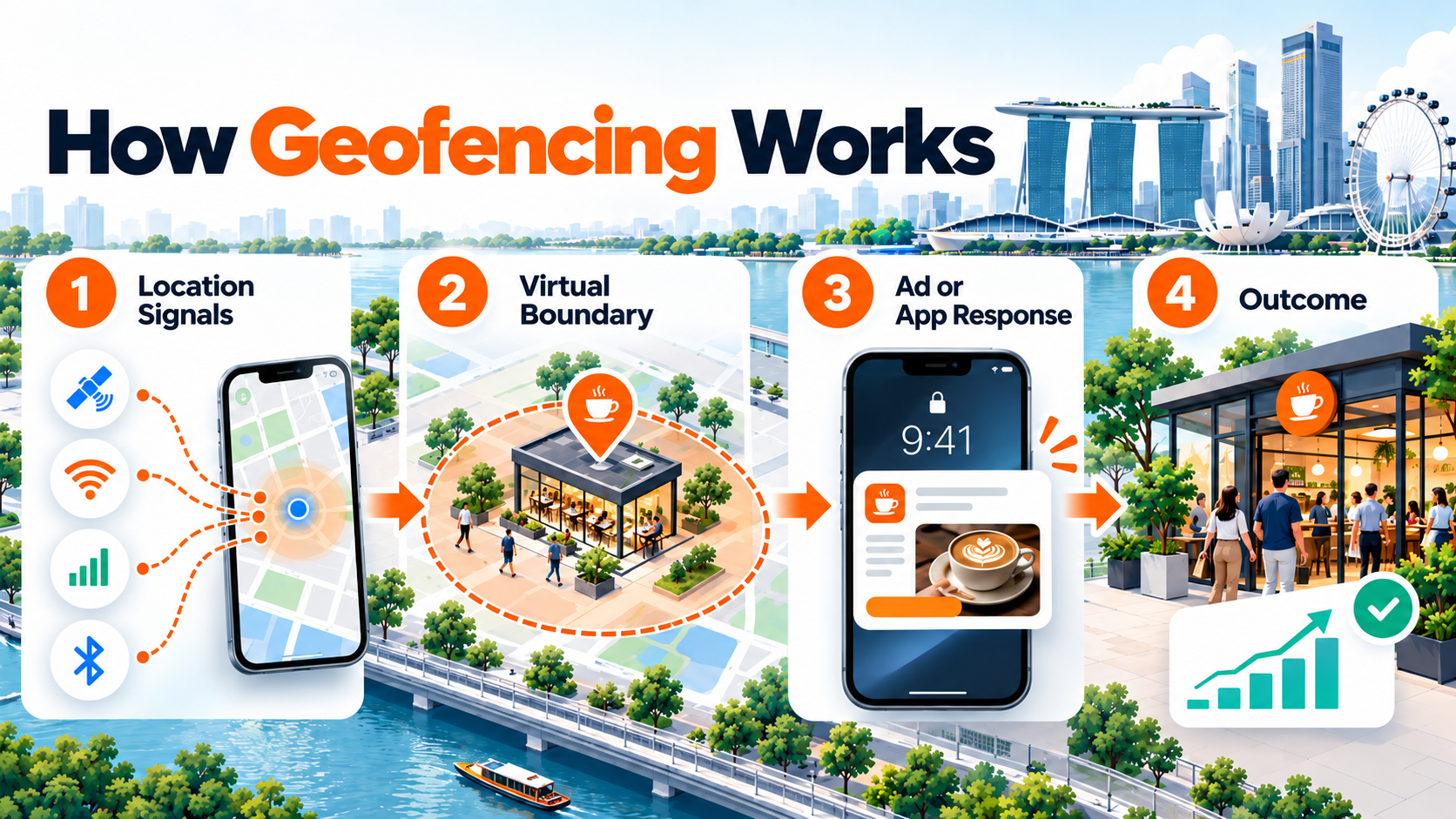
A geofence is a virtual perimeter around a physical location. A business might place one around an event venue, transport interchange, shopping centre or its own outlet. Software then evaluates location information against that perimeter, subject to the system’s permissions and technical limitations.
A location event can support two different marketing approaches. App-based geofencing detects an eligible device entering, leaving or remaining within an area. The app may respond with a notification or unlock an offer. Geofencing advertising uses location-derived signals or audience segments to help decide which ads appear across participating apps and websites. An advert may appear later, not precisely when someone crosses the boundary.
This distinction matters when comparing providers. A company offering display ads to previous visitors is not necessarily providing real-time proximity notifications. We would ask exactly how the audience is created, how recently a location was observed and what action triggers delivery.
Geofencing vs geotargeting vs geoframing
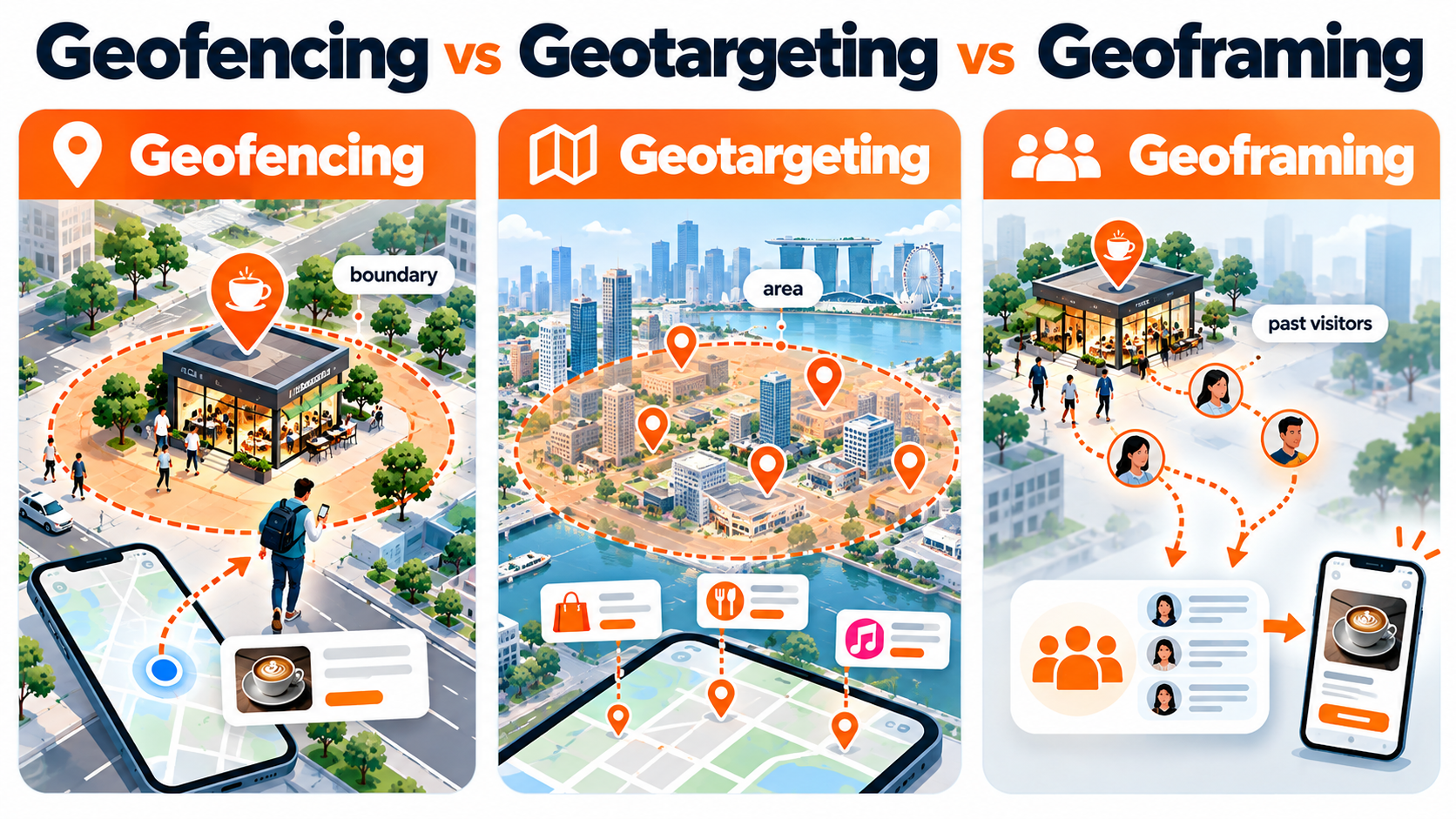
These terms overlap in sales pitches, but they answer different questions.
| Approach | How it selects people | Typical application |
| Geofencing | Uses a defined boundary and eligible location events or location-based audience data | Venue offers, event promotion and nearby-store campaigns |
| Geotargeting | Targets geographic areas using platform signals, such as likely presence or location interest | Advertising across Singapore, a district or a radius |
| Geoframing | Builds an audience from observed visits to specified locations during a lookback period | Reaching past event attendees where data use is permitted |
Geotargeting is not always less precise on a map. Some platforms offer small areas, while their actual matching remains approximate. Google explains that its location targeting uses multiple signals and cannot guarantee complete accuracy.
The Technology Behind a Geofencing Campaign
A phone’s estimated position can draw on satellite navigation, Wi-Fi networks, mobile towers and Bluetooth signals. The operating system combines available information according to device conditions and permission settings.
Global Positioning System (GPS) often performs well outdoors with an unobstructed sky. Tall buildings and covered walkways can weaken positioning. Wi-Fi can improve estimates in built-up areas, while cellular signals may provide substantially broader positioning. Bluetooth beacons can support proximity experiences within compatible apps and venues.
Radio-frequency identification (RFID) is different. It typically uses dedicated readers and tags, rather than serving as a standard smartphone geofencing signal. We would not group RFID with GPS as if both gave advertising platforms the same access to consumer phones.
Android’s geofencing guidance recommends a radius of roughly 100–150 metres for reliable general use. It also explains that alerts can be delayed, particularly when apps operate in the background. Apple’s Core Location documentation likewise describes region monitoring and permission-dependent location services. Neither system promises exact entrance detection at every doorway.
Why Singapore’s dense buildings complicate targeting
Consider a cafe inside a multistorey mall at Orchard Road. An outdoor location reading might place someone within the building without showing which floor they occupy. Underground walkways create further uncertainty.
For this reason, we recommend matching boundary size to the location evidence. Use a wider catchment when the platform’s accuracy is modest. For narrow indoor experiences, assess whether a compatible app, venue integration or beacon installation is viable. Do not pay for claimed unit-level precision without a demonstration in the actual environment.
Choosing the Right Geofence Boundary
The most useful boundary is the one that captures a relevant opportunity without including too many unrelated people. Drawing a smaller circle is not automatically better. The correct shape depends on the visit you want to influence.
Four boundary approaches
- Radius: A circle around a store or landmark. Simple to configure, but it ignores building layouts and walking routes.
- Venue polygon: A custom outline around a venue or site, where the provider supports polygon targeting. It may reduce unrelated coverage, although location error remains.
- Travel-time catchment: A planning area based on realistic walking or driving access. Useful for choosing neighbourhoods, but not necessarily an available advertising-platform fence type.
- Observed trade area: A planning area derived from aggregated customer origins or sales records. It identifies where valuable customers come from, rather than requiring the actual ad boundary to use that shape.
For a suburban outlet near an MRT station, we might examine station exits and pedestrian routes before choosing the target area. For a conference, the venue footprint and event schedule matter more.
The Boundary Fit Scorecard
We use the following 20-point planning heuristic to identify weaknesses before a pilot. It is a proposed decision tool, not a validated industry benchmark. Give each factor a score from one (poor fit) to five (strong fit).
- Customer relevance: Does evidence show that people in this area are plausible buyers?
- Location reliability: Can the provider’s signals support the proposed boundary in this environment?
- Practical access: Can someone conveniently reach the outlet or act on the offer?
- Reach and measurement: Is there enough eligible audience volume to deliver ads and evaluate outcomes?
An individual score of one should trigger a review even if the total is high. Adjust the threshold after obtaining actual results.
Example: A hypothetical Tampines café scores customer relevance 4, location reliability 3, practical access 5 and measurable reach 3. Its total is 15/20. We would test this catchment while checking whether weak indoor accuracy causes wasted impressions. The numbers illustrate the method; they are not campaign results.
Benefits of Geofencing Marketing for Singapore Businesses

The principal benefit is contextual relevance. Someone near a shop, event or service area may have a timely reason to respond. That opportunity is strongest when the message matches the person’s immediate situation and includes a simple next action.
Local demand generation: A shop can promote an accessible offer to an eligible nearby audience. This works best with realistic travel instructions and operating hours.
Event activation: An organiser can offer information, registration or post-event follow-up to consenting app users or eligible location-based audiences. The schedule and audience rules must be clear.
Smarter local media planning: Comparing different catchments can reveal where adverts generate useful enquiries. Results can guide local SEO and other location-specific campaigns without assuming that paid exposure caused every visit.
More relevant messaging: Location can complement timing and audience context. A lunchtime promotion near offices may be useful, while the same message late at night is unlikely to be. We would assess each benefit against a comparable campaign without geofencing before allocating a larger budget.
Where Geofencing Marketing Is Most Likely to Pay Off
Retail stores, cafés and shopping centres
Retail businesses with clear store locations can test nearby offers, product launches or quieter trading hours. A promotion should specify its validity and participating branch. For malls, ask whether reported visits refer to the whole complex or the individual tenant; those outcomes are not interchangeable.
Events, exhibitions and hospitality
Event operators can target eligible audiences around relevant venues or use consented app alerts to share practical information. A hotel might promote a nearby dining package, subject to channel suitability. We favour messages that help someone complete a real task over repeated generic brand reminders.
Showrooms and considered purchases
Car dealers, furniture retailers and property showrooms can use location-informed advertising to support enquiries or appointments. These businesses often have longer buying cycles, so immediate footfall may understate value. Measure qualified bookings and eventual sales where attribution is responsibly possible.
When another channel may work better
A business selling entirely online may gain little from knowing whether someone passed a shopping centre. Likewise, a neighbourhood service with limited margin might reach ready buyers more efficiently through local search. Start by comparing geofencing with Google Ads, organic discovery and existing customer channels. Choose the option that produces profitable actions, not the most sophisticated map.
A Verified Geofencing Marketing Example: Burger King’s Whopper Detour
Burger King’s Whopper Detour is a documented example of an app-based location promotion. In 2018, the brand offered a one-cent Whopper through its US app when users were within 600 feet of a McDonald’s restaurant. The app directed customers to a nearby Burger King to collect their orders.
The campaign’s award entry published by The One Show describes approximately 14,000 geofenced competitor locations and reports more than 1.5 million app downloads over nine days. Those performance figures come from the campaign submission, rather than an independent experiment.
The useful lesson is the connection between place, incentive and action. The promotion offered a clear reason to open the app and complete an order. Its reported results should not be treated as expected returns for a Singapore café.
For a smaller business, the transferable approach is simpler: select a relevant moment, make the offer easy to redeem and record what happens after the customer responds.
How Much Does Geofencing Marketing Cost in Singapore?
There is no single published Singapore market rate for geofencing marketing. Providers may sell managed advertising, self-service media buying, audience data or app infrastructure. Each covers different work, so asking only for a cost per thousand impressions can lead to a misleading comparison.
Typical pricing arrangements include:
- Cost per mille (CPM): Payment for every 1,000 delivered impressions. This does not guarantee 1,000 unique viewers.
- Management or platform fees: Charges for campaign operation, software access or specialist support.
- Data and measurement fees: Additional costs for location segments, verification or store-visit reporting.
- App development costs: Separate engineering and maintenance charges if you need your own app to respond to geofence events.
As one publicly available illustration, US provider GetGeofencing advertises a managed display starter package of US$850 for 100,000 impressions over 30 days. It lists US$8 CPM for qualifying larger display purchases. These are that provider’s advertised US rates, not a Singapore quote or an industry average. Eligibility, inventory and local availability would need confirmation.
An illustrative Singapore-dollar budget
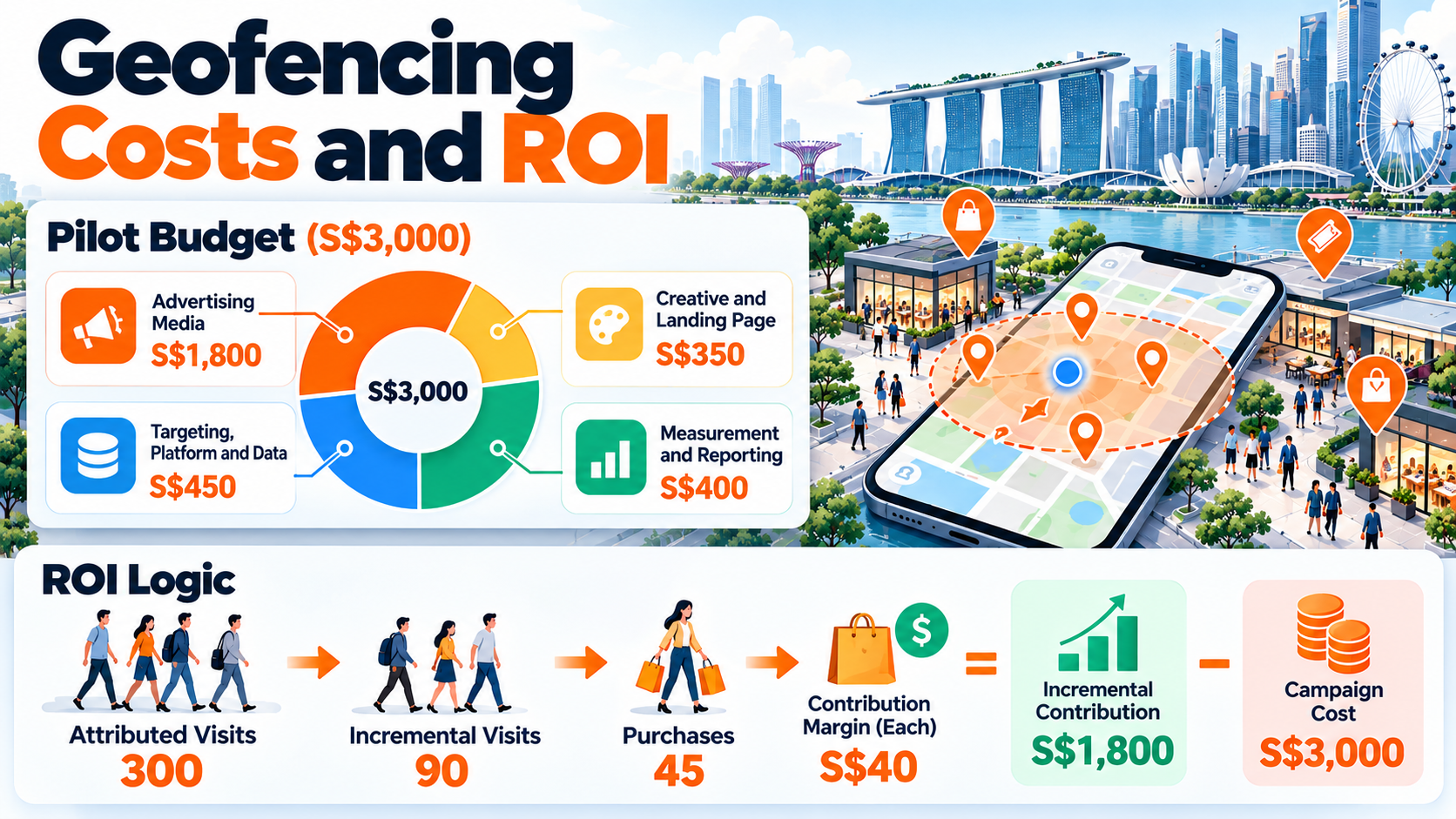
Suppose a retailer considers a S$3,000 pilot. The following allocation is an internal planning example, not a supplier quotation:
| Budget item | Illustrative amount |
| Advertising media | S$1,800 |
| Targeting, platform and data | S$450 |
| Creative and landing page | S$350 |
| Measurement and reporting | S$400 |
| Total | S$3,000 |
If S$1,800 bought impressions at a hypothetical S$12 CPM, the campaign would deliver 150,000 impressions. That is a mathematical scenario, not a forecast of available Singapore inventory.
We would request written proposals showing total spend, platform minimums, reporting methodology, impression estimates, cancellation terms and who owns the campaign data. Ask whether GST applies and whether quoted charges include creative revisions. Compare like-for-like deliverables before choosing a provider.

Calculate Whether Geofencing Can Produce a Return
Impressions and clicks help diagnose delivery, but they do not settle whether a campaign pays off. The business needs a link between incremental customer actions and contribution margin: sales revenue remaining after the variable costs of fulfilling those sales.
Imagine the hypothetical S$3,000 pilot produces 300 attributed store visits. The reported cost per attributed visit is S$10. If only 90 of those visits represent additional customers who would not otherwise have arrived, the cost per incremental visit is about S$33.33. That distinction changes the economics.
Assume those 90 additional visitors generate 45 purchases at S$40 contribution margin each. Incremental contribution becomes S$1,800, leaving the pilot S$1,200 short of its S$3,000 cost. The campaign may still offer valuable learning, but the illustrated first-purchase economics do not justify scaling it unchanged.
We would also examine repeat purchases, provided there is reliable evidence rather than optimistic customer-lifetime-value assumptions. Otherwise, improve the offer, targeting or conversion journey before increasing expenditure.
Singapore Privacy and Consent Requirements
Location information can become personal data when it identifies someone, alone or together with other identifiers. The Personal Data Protection Commission’s guidance on geolocation data explains this principle. A hashed identifier should not automatically be considered anonymous if a person remains identifiable.
Under Singapore’s PDPA, organisations must assess the lawful basis for collecting, using and disclosing personal data. The PDPC’s guidance on key concepts covers consent, notification and appropriate purposes. Permission granted to a device does not, by itself, settle every obligation under the law.
Before launching, we recommend confirming the following with the provider and your data-protection lead:
- Transparency: Explain the purpose of location collection and any marketing use in clear language.
- Permissions: Respect operating-system location controls, notification preferences and consent withdrawals.
- Minimisation: Use the least detailed data needed and define appropriate retention periods.
- Vendor accountability: Check where data originates, whether it is shared and who can access it.
- Sensitive contexts: Apply extra care around healthcare settings, children and places that may reveal sensitive personal information.
Singapore’s Do Not Call (DNC) Registry is also relevant when a campaign sends regulated marketing messages to Singapore telephone numbers, such as promotional SMS. Review the DNC requirements and applicable consent or exemptions. Display advertising and app notifications should not automatically be treated as identical to SMS under these rules.
We would reject a vendor that cannot explain its consent basis, location-data provenance or retention practices.
How to Set Up a Geofencing Marketing Campaign: Seven Steps
A controlled pilot makes it easier to identify what is working. Complete these seven decisions before committing to a multibranch rollout.
1. Define one commercial objective
Choose store visits, appointment bookings, event registrations or incremental sales. Specify the outlet and measurement period. Avoid vague objectives such as increasing engagement when the business needs revenue.
Before choosing the test location, review the previous four to eight weeks of transactions if records are available. Separate weekday and weekend patterns. Check for nearby construction, seasonal closures or major events that could distort footfall. These steps establish a stronger baseline without requiring new personal location histories. We would also ask outlet staff whether they can fulfil the proposed offer during busy periods. A promotion that creates long queues, stock shortages or unprofitable discount use may increase recorded visits while damaging the customer experience.
2. Choose a channel that supports the objective
Decide whether the experience requires an owned app notification, location-based programmatic advertising or ordinary geographic ad targeting. For paid inventory, review the provider’s coverage and supported formats. Our programmatic advertising services provide related context for comparing broader media-buying approaches.
3. Map customer movement and score the boundary
Review aggregated sales catchments, access points, business hours and competing locations. Apply the Boundary Fit Scorecard, then verify which boundary types the chosen platform actually supports. Do not assume a custom polygon or travel-time fence is available everywhere.
4. Validate permissions and audience size
Check that the data source is appropriate for the intended use. Ask how many eligible people can realistically be reached, how often positions update and whether minimum audience thresholds apply.
5. Prepare the offer and destination
Make the advert immediately relevant. State the branch, deadline and customer benefit. Link to a fast mobile page with directions, booking or redemption instructions. A location-aware message loses value if users cannot tell what to do next.
6. Set delivery limits and a control group
Agree on campaign dates, frequency limits, exclusion rules and attribution windows. Where feasible, randomly withhold advertising from a comparable eligible audience. If randomisation is unavailable, use a carefully matched location or time-based comparison and disclose its limitations.
7. Review incremental results before expanding
Examine spend, reach, visit quality, sales and operational feedback. Investigate unusual results before changing several settings at once. Keep the best-performing elements, revise weak boundaries and pause activity that cannot show a credible commercial contribution.
How to Measure Geofencing Marketing Performance
The measurement framework should separate delivery, behaviour and business impact.
| Metric | What it tells you | Main limitation |
| Reach and frequency | How many eligible users saw ads and how often | Reach may be modelled or incomplete |
| Click-through rate | How often impressions led to clicks | Clicks do not equal physical visits |
| Attributed visits | Visits associated with exposed devices | Some visitors would have arrived anyway |
| Incremental visit lift | Difference against an appropriate control | Requires careful experiment design |
| Cost per incremental sale | Total campaign cost divided by additional sales | Sales matching may be incomplete |
A simple exposure-to-visit rate divides attributed visits by exposed users, provided the definitions and time window are consistent. It should not be confused with an incremental conversion rate. Similarly, a conversion zone around an entire shopping centre cannot prove that a visitor entered one particular tenant.
Where sample sizes allow, compare exposed and control groups using the same eligibility and visit definitions. Account for public holidays, promotions, weather disruptions and overlapping advertising. A positive difference is more credible when it is sustained and not driven by a few unusual days.
We would report both the observed figures and the confidence limits of the measurement approach. When a provider cannot supply a defensible control, label outcomes as attributed rather than incremental. That language protects businesses from mistaking correlation for causation.
Common Geofencing Mistakes That Waste Budget
Even a technically functioning campaign can produce little commercial value. These mistakes deserve attention before launch:
- Assuming every nearby phone is reachable. Consent, device settings, data availability and advertising inventory all limit delivery.
- Treating a map boundary as precise indoor tracking. Malls, underground passages and multistorey buildings complicate positioning.
- Using the same advert everywhere. A morning commuter and a weekend shopper may need different messages.
- Confusing attributed visits with incremental sales. Exposure alone does not establish that an advert caused a purchase.
- Ignoring the actual offer economics. Discounts can create visits that produce insufficient margin.
- Buying unverifiable audiences. A low CPM is not valuable if data quality or privacy compliance cannot be established.
Frequently Asked Questions
Is geofencing marketing legal in Singapore?
It can be, provided the campaign complies with applicable privacy, marketing and platform requirements. Businesses must assess the PDPA where location data identifies people and review DNC rules for regulated messages to Singapore telephone numbers.

How accurate is geofencing marketing?
Accuracy varies by device, signal, location and operating-system conditions. Android recommends generally using geofence radii around 100–150 metres; precise shopfront entry should not be assumed from standard location advertising.
Can Google Ads geofence a single retail shop?
Google Ads supports geographic and radius targeting, not app-triggered doorway events. Its location-targeting guidance states that radius targets cannot be smaller than one kilometre.

Does geofencing require a mobile app?
Not always. App-triggered notifications require an appropriate app experience and permissions, while some location-based advertising providers build audiences for ads in other participating apps or websites.
How much should a Singapore business budget?
There is no universal local rate. Request provider quotations that separate media, targeting, management, creative and measurement costs, then choose a pilot budget that can produce enough data for a meaningful decision.
How long should a geofencing campaign run?
The duration depends on audience volume, buying cycle and measurement needs. Use a defined testing period that covers typical trading patterns, rather than declaring success after a single busy day.
Is geofencing better than local SEO?
They serve different purposes. Local SEO helps people discover a business through search, while geofencing can support location-relevant paid messages; compare their incremental commercial results before reallocating spend.
Turn Geofencing Marketing Into Measurable Local Growth
Geofencing marketing is worth testing when a physical location signals meaningful customer intent, the data is suitable and the expected margin can support acquisition costs. A carefully drawn boundary is helpful, but it cannot compensate for weak offers, restricted reach or unreliable reporting.
Our recommendation is to start with one outlet, one specific offer and one clearly defined business outcome. Confirm the data permissions, obtain an itemised quote and establish a credible comparison group. Then judge results by additional customers and contribution margin, not impressions alone.
At MediaOne, we would assess geofencing alongside paid advertising, local search and conversion performance. The right decision may be to refine the boundary, change the channel or stop the pilot. Scale only when the evidence supports it.