A Singapore café can spend hours editing a TikTok, only to watch viewers leave before the main point. Another business can publish a short answer to a familiar customer question and reach people who have never followed its account. The difference often lies in whether the subject connects with the people watching.

TikTok’s For You feed makes personalised recommendations using what people watch, skip and respond to, alongside information about each video and its audience.
That makes the opening worth testing, but an early drop in retention is only one possible explanation for weak reach. A video may be off-topic for the people seeing it, have an unclear caption or be ineligible for recommendation under the platform’s content rules.
Those are different problems with different remedies. Singapore creators and marketing teams can compare watch behaviour, completion, traffic sources and available eligibility notices before changing their production schedule. The useful goal is to earn attention from the right people and turn it into a relevant next action, rather than chase an imagined algorithm score.
Key Takeaways
- Watch behaviour helps explain recommendations. Watching, skipping, likes and shares are signals, but TikTok does not publish a universal formula.
- Completion is useful, not a guaranteed ranking shortcut. Compare videos of similar length and topic before interpreting differences.
- Clear topics and descriptions support relevance. Keywords and hashtags add context; neither promises a boost on its own.
- Five seconds is not a general For You gate. The ‘qualified view’ term belongs to specific Creator Rewards calculations.
- Diagnose before changing your posting schedule. Check retention, audience fit and any content-eligibility notice.
- Private is different from deleted. ‘Only you’ restricts visibility; check which analytics remain accessible before changing settings.
Why the TikTok Algorithm Shapes Reach in 2026
For Singapore brands and creators, the For You feed is an important route to discovery. A video can reach people who have never heard of the account, which gives a small shop in Tiong Bahru a chance to meet a relevant audience outside its existing followers. Recommendations reflect each user’s interests, recent viewing behaviour and other signals; the same clip will not be equally relevant to everyone. TikTok belongs inside a broader social media plan when its audience and content formats support a business goal.
Advice built around a particular sound, a magic posting time or a stack of hashtags skips the harder question of whether the video interests its viewers. The better-supported approach is to focus on watch behaviour and fit with the topic. Consistent subject matter can make an account easier for people to understand, but TikTok has not announced a universal ‘topic authority’ bonus or a fixed qualified-view gate for general reach. Volume and luck also influence results, neither offers a dependable formula.
An account with weak viewing time needs a different edit from one whose posts are marked ineligible for recommendation. Creators should inspect the opening, completion and available TikTok Studio signals before making a decision. A team can then test one change at a time, compare similar videos and use the results to develop content that answers real customer questions. The useful decision is what to change in the next video, based on evidence from the last one.
What the TikTok Algorithm Is and How It Works
TikTok Algorithm Definition and Overview
The TikTok algorithm is the set of recommendation systems that influence which videos appear in a person’s feeds and in what order. Each time someone opens the app, TikTok ranks eligible content according to predicted interest. It learns from likes, shares, follows, what people watch or skip, and video details such as sounds and hashtags. These signals can influence recommendations without any requirement for a creator to use a particular hashtag or sound. Videos on trending topics are still assessed in the context of individual viewer interests.
The important word is ‘continuous’. The algorithm does not assign a public score to a video once and lock in its reach. Its predictions can change as viewers interact with content, including when they watch to the end or skip it. TikTok has not published a fixed sequence of test batches or a guaranteed distribution threshold. A clip can gain attention later, but a slow first hour by itself does not prove that the platform has restricted it.
For a creator or small business owner in Singapore, the practical reading is simple. A large follower count can help a post reach existing fans, but the For You feed can also recommend videos to people who do not follow the creator. Relevant content that suits the viewer gives each post a better chance of earning attention. Keyword-rich captions can clarify the subject, but they are not a shortcut around weak viewing behaviour. The first question is whether the right viewers are staying, not whether a video has reached a supposed point threshold.
How the TikTok Algorithm Ranks and Recommends Content
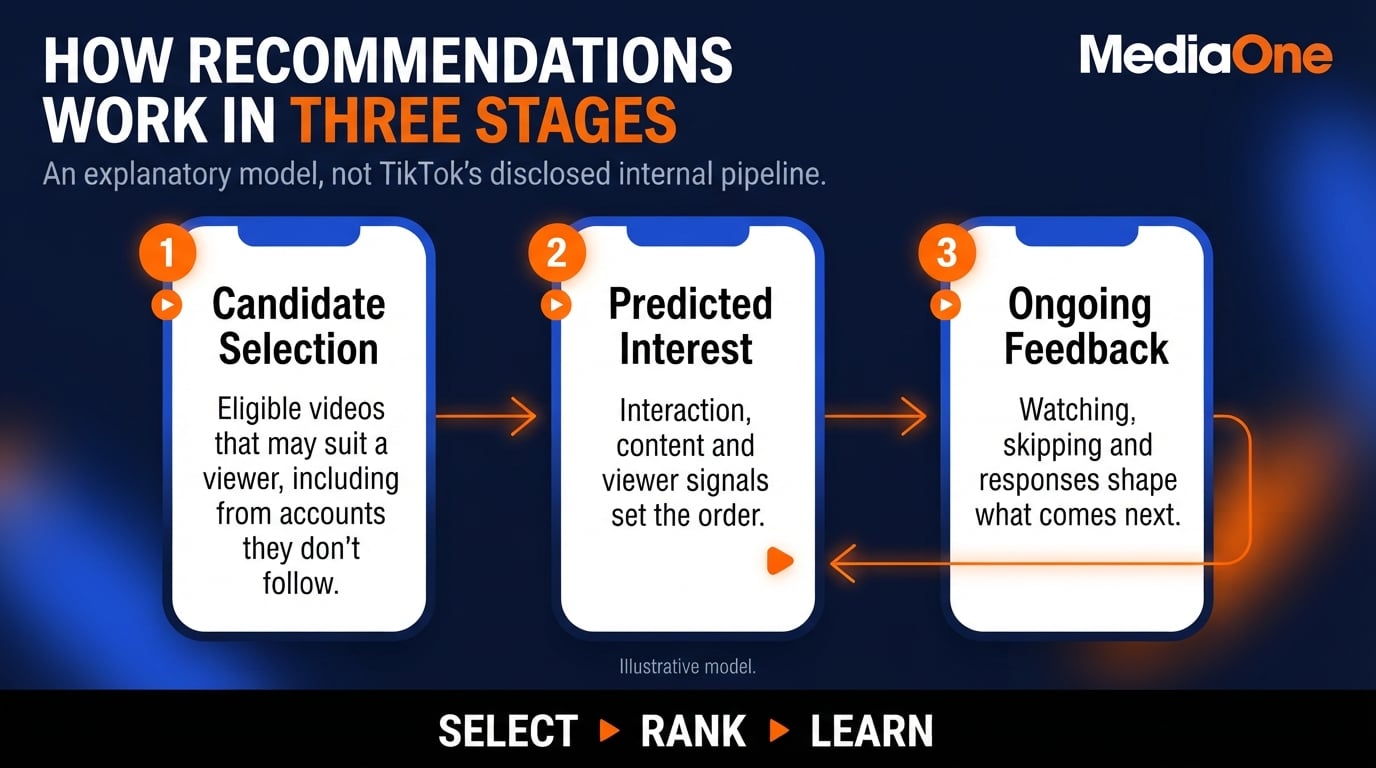
For a practical diagnosis, think about recommendation in three linked stages. This is an explanatory model, not a public description of TikTok’s internal testing sequence.
- Candidate selection. TikTok draws on eligible videos that might suit a person’s interests, including accounts they do not follow.
- Predicted interest. Interaction, content and viewer-context signals shape the order in which those videos are recommended.
- Ongoing feedback. Watching, skipping and other actions can affect subsequent recommendations; future reach is neither automatic nor fixed after one viewing period.
TikTok describes recommendation systems that use numerous signals, not an openly published formula. Its explanation of the For You feed gives one comparison: finishing a longer video is a stronger sign of interest than a viewer and creator merely sharing a country. TikTok has not disclosed exact signal weights or a universal engagement percentage, so claims about precise ranking scores should be treated with caution.
The recommendation model also takes in a user’s expressed interests and negative feedback. TikTok lets people use ‘Not interested’ to shape future suggestions, and it limits recommendations of some posts that fail For You eligibility standards. A video receiving fewer recommendations is not necessarily under a penalty; weak audience fit and an actual eligibility restriction are different diagnoses.
A completed watch can communicate more interest than a quick skip, although TikTok has not published an exchange rate between individual actions. A creator who sees few likes but steady watch time should examine the whole pattern before changing the video. Different symptoms call for different fixes, so begin with viewing behaviour and eligibility rather than one engagement count.
The Three Ranking Signal Groups
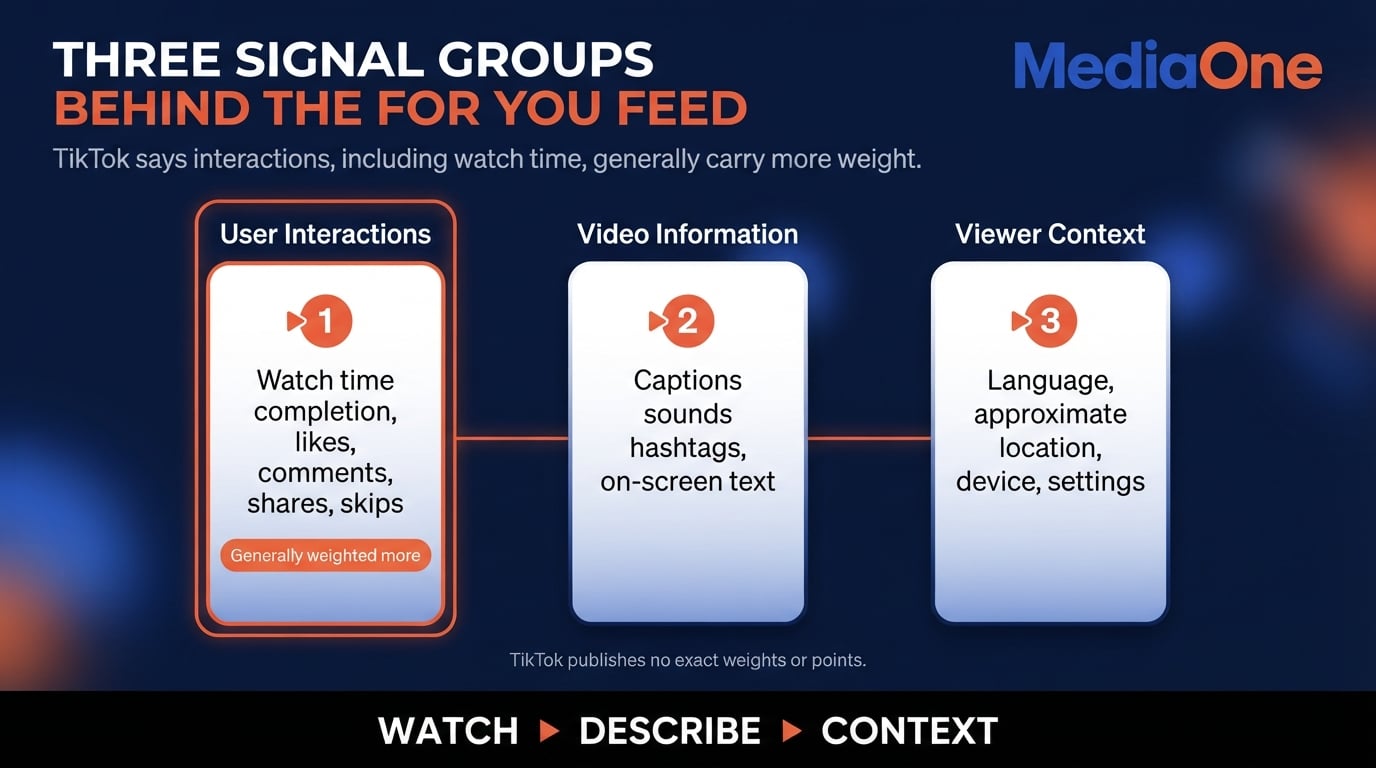
TikTok does not publish a full list of its ranking inputs. It identifies three broad groups: user interactions, content information and user information. TikTok’s current recommendation guidance says interactions, which include time spent watching, are generally weighted more heavily for the For You feed. That distinction helps a social media team decide what it can improve in the video and what depends on the viewer. Watch patterns are useful evidence; a secret ranking score is not.
Interaction signals measure what viewers actually do. Watch time and completion are useful diagnostics because they show whether the content held attention, while likes, shares and comments add other context. You can influence these behaviours through clearer hooks, better pacing and relevant topics, but TikTok does not supply a fixed weighting for each metric.
TikTok says a strong indicator of interest carries more weight than a weak one. Its longer-video completion example illustrates the principle, but it does not establish a formula ranking every like, comment and share. Read the metrics together rather than assigning them invented points.

Likes, comments and shares can all signal interest, but their usefulness depends on the viewer and the video. A comment shows that someone wanted to respond. A share may put the video in front of a new person. When a post gets likes but weak completion, compare it with similar videos before concluding that reactions have failed to help distribution. Creators building a following should prioritise relevant, watchable content and conversations that suit the audience.
These signals come from the content itself. Sounds and hashtags are among the details TikTok says can inform recommendations, and clear captions help viewers recognise a topic. TikTok also lets users search for videos and hashtags, so wording that matches a real question can improve clarity when someone is browsing search results. A phrase such as ‘budget lunch ideas Singapore hawker’ says more about the topic than vague wordplay. It is sensible to test phrases found in actual customer questions rather than treating one keyword as a guaranteed ranking boost.
Sound choice is another creative decision. A relevant track may suit a familiar format and make a video discoverable through its sound page. When a trend fits the topic, the same reasoning applies to using trending content without abandoning your brand. Hashtags can add useful context, especially when they describe the niche and the specific question the video answers. Broad labels such as #fyp do not explain much about the subject. Use captions, audio and hashtags to describe the content honestly, not to disguise a weak idea.
Device, Account and Settings Signals
These signals describe the viewer’s context, including language preferences, approximate location, device type and settings. They can help the system select relevant material, but TikTok says user interactions are generally more influential for For You recommendations. Singapore references may help the right local viewers understand a video; a local reference alone does not guarantee distribution. Compare audience data with your intended market before assuming a video is being shown to the wrong people.
These factors are inputs, not a complete explanation for weak reach. If viewers leave at the opening, inspect the hook, pacing and topic. If the video holds attention but reaches an unexpected audience, review the caption, language and subject. For broader planning, connect those findings to your Singapore social media marketing strategy instead of changing account settings without evidence.
Debunking the Point System Myth and Scoring Reality
Search ‘TikTok algorithm’ and you will find creators describing a hidden point system: a like earns a certain number of points, a share earns more, and videos cross a threshold to reach the For You feed. TikTok has not confirmed such a public points table or a single threshold that applies to every video. Its documentation describes recommendations built from several changing signals. Treat any exact points-per-like claim as unverified.
The myth persists for a reason. Reach can arrive unevenly, and a video may receive more attention long after it is posted. It is tempting to interpret that pattern as proof of a threshold. TikTok’s published material does not confirm a universal step-by-step testing ladder. Multiple signals can change recommendations without any visible counter crossing a line. Videos on trending subjects may show the same uneven growth.
How ranking works in practice
Ranking draws on multiple signals at once. The system considers how users interact with videos, information about the content and details of the viewer’s context. A strong expression of interest can influence recommendations more than a weak contextual match. TikTok does not release a point chart, exact weights or a single creator-facing score. Diagnose what viewers did, rather than reverse-engineering an unverified threshold.
| Model | What it implies | What the evidence supports |
| Point system | One score per video, unlocked by a fixed threshold | No public evidence confirms a universal points table or fixed threshold |
| Multi-signal ranking | Inputs can have different weights by viewer and context | Consistent with TikTok’s own description of personalised recommendation |
The practical implication
Focus on signals available in your account rather than an imagined score. Watch time, audience retention and engagement help locate weak points in a video; an eligibility notice, where available, indicates a different problem. A ‘qualified view’ has a specific meaning under TikTok’s Creator Rewards rules and should not be used as a universal recommendation threshold. Improving the opening and keeping the subject clear will give you more useful evidence than trying to trigger a score nobody can see.
Hook, Retention and Completion: Winning the First Seconds
An opening that gives viewers no reason to continue makes retention harder, especially in a fast-scrolling feed. Viewer behaviour is among TikTok’s stated recommendation signals, so it is worth inspecting where attention drops. A stronger opening may improve the video’s chances with its intended audience, but no hook can promise wider distribution. Relevant TikTok creative and audience planning connects retention work to the people a Singapore business wants to reach.
Hook Strategies for the First Seconds of a Video
A hook is everything that happens before a viewer decides to keep watching. Three useful tactics are opening with a payoff, changing the visual quickly and making the subject clear. Their effectiveness depends on the people watching, so compare similar posts rather than treating any technique as guaranteed.
Open on the payoff or a visible tension. Start with the result, a practical question or a surprising image, not a long greeting. ‘Why is this Tanjong Pagar café charging S14fortoast?’createsareasontokeepwatching;’Hieveryone,hereisacafé’giveslesscontext.TheS14 figure is illustrative, not a verified menu price.
Use a change in the opening visual. A timely cut, informative text overlay or closer view can draw attention without obscuring the subject. The objective is to help viewers understand why the next few seconds are worth watching.
Promise the payoff early. Tell viewers what question the video will answer and keep the delivery proportionate to that promise. Clear expectations can be tested against drop-off patterns; they should not become empty clickbait.
Before you publish, check the following:
- Read the first line of on-screen text aloud. Would you stop scrolling for it?
- Watch only the first 3 seconds with the sound off. Does the subject still make sense?
- Does the hook match the caption and topic? A mismatch loses the viewer.
- Is there one clear idea, not three?
- Could you open the same footage differently? If so, test both.
Video Completion Rate and Viewer Retention
A five-second watch is useful as an editorial checkpoint for very short videos, but it is not a universal gate to For You distribution. TikTok’s Creator Rewards programme uses ‘qualified views’ for its own rewards calculations, with requirements that exclude views shorter than five seconds. That programme’s measure is different from general post views and recommendations. If people repeatedly leave early, test a clearer opening; do not assume you failed an unpublished algorithm threshold.
Completion is another useful signal. TikTok’s published explanation uses finishing a longer video as an example of strong interest relative to weak contextual cues. It does not say that finishing always outweighs every possible like or share. Creators should compare completion and average watch time across videos of similar length, while checking for other causes when reach unexpectedly drops.

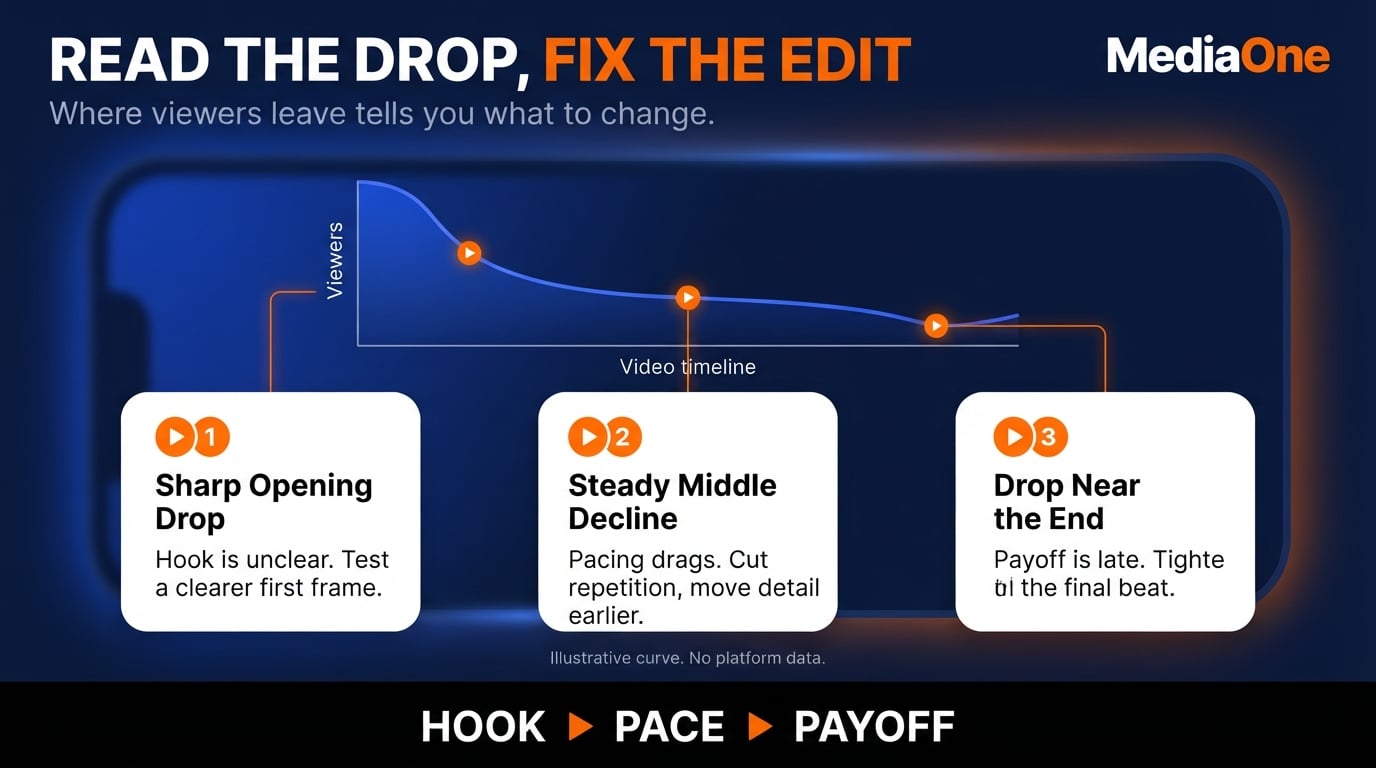
Use completion as a diagnostic, not just a scoreboard. Where your TikTok Studio account provides audience-retention details, look for the sharpest fall in viewing. Different patterns suggest different edits, and some accounts or formats may not display every metric. For a social media marketing campaign, pair retention trends with the action the video is supposed to prompt.
- A sharp drop near the opening may point to a confusing hook. Test a clearer first frame.
- A steady decline through the middle can suggest pacing problems. Cut repetition and move useful detail earlier.
- A drop near the end can signal a delayed or unclear payoff. Tighten the final line or image.
The table below sets out what each retention measure tells you and how to lift it.
| Metric | What it measures | How to lift it |
| Early retention | How many viewers continue past the opening | Strengthen the first frame and the opening message |
| Completion rate | Share of viewers who reach the end | Tighten the middle, move the payoff earlier, end on a clear beat |
| Watch time | Total seconds watched across viewers | Lengthen the video only if the content holds attention; padding lowers completion |
Conclusion and Next Steps
In 2026, the TikTok algorithm recommends content using interaction signals, video information and viewer context, rather than a creator-facing points total. Strong openings and relevant topics can help audiences stay interested, but retention should be judged alongside the subject, source of views and any recommendation-eligibility notice. For Singapore teams, connect those checks to the question each video answers and the customer action it invites.
Open TikTok Analytics, look at your last 20 videos, and work through this four-week plan:
- Week 1: audit hooks. Score the first two seconds of each video. Did it give a reason to keep watching?
- Week 2: measure completion. Note where viewers drop off and fix the cut at that point.
- Week 3: tighten captions. Add the terms people would search for to captions and on-screen text, and include relevant hashtags where they help people find the topic. Search is part of TikTok discovery, not just a feed tactic. Treat your captions and hashtags as part of your social media search strategy, not an afterthought.
- Week 4: set a cadence. Choose a posting rhythm you can sustain, and compare similar uploads without assuming a particular time earns extra ranking points. Review your analytics each week so the next cycle reflects what viewers actually did.
Frequently Asked Questions
Does the TikTok algorithm use a point system?
There is no confirmed public points system in which each like or share has a fixed value. TikTok describes signals that can be weighted differently depending on the viewer, rather than one threshold creators can track. Focus on watch behaviour, relevance and any eligibility notification instead of invented scoring charts.
How long must a viewer watch for a video to count?
There is no published five-second minimum that determines whether an ordinary TikTok video can be recommended. Under Creator Rewards, qualifying views are filtered For You views that meet extra programme rules, including a watch of at least five seconds. Review opening retention to improve the video, but do not treat that rewards definition as a universal reach rule.
Does posting more often guarantee more views?
No. Publishing more often gives a creator more opportunities to test topics and formats, but it does not guarantee more views per post. Set a frequency your team can maintain with strong openings and useful content, then compare retention and audience response over a consistent period.
Yes. In TikTok’s post privacy settings, ‘Only you’ makes an existing post visible only to the account owner without deleting it. TikTok says its view count does not reset when you change a post’s privacy setting. Check and export any analytics you need before changing visibility; do not assume every data view will remain available for every account.
Does TikTok recommend two posts from the same creator in a row?
TikTok has said its For You feed generally avoids showing two videos in succession from the same creator, as part of its effort to vary recommendations. That describes the viewer’s feed, not a rule that creators must space their uploads by a particular interval. Choose post times based on production capacity and audience behaviour, not a supposed protection against consecutive posts.