AI Summary
|

Esports marketing helps brands reach people who follow competitive video games through tournaments, teams, streamers and fan communities. For Singapore businesses, we recommend testing a focused creator partnership or community activation before purchasing a larger sponsorship. Choose the game and audience first, then decide what the brand can contribute.
The commercial opportunity is established, but headline market figures need context. Esports Insider, citing Statista Market Insights lists global esports sponsorship and advertising revenue at USD 791.9 million in 2022 and USD 982.8 million in 2024. These are market estimates, not evidence that an individual campaign will generate sales.
Key Takeaways
- Start with a specific game community, not a generic definition of gamers.
- Give fans a reason to participate; impressions alone cannot demonstrate loyalty.
- Use our Engagement Depth Scorecard to compare formats before signing a contract.
- Check Singapore and Southeast Asian audience data separately from global reports.
- Build tracking, creator disclosures and privacy safeguards into the plan from the start.
Esports Marketing at a Glance
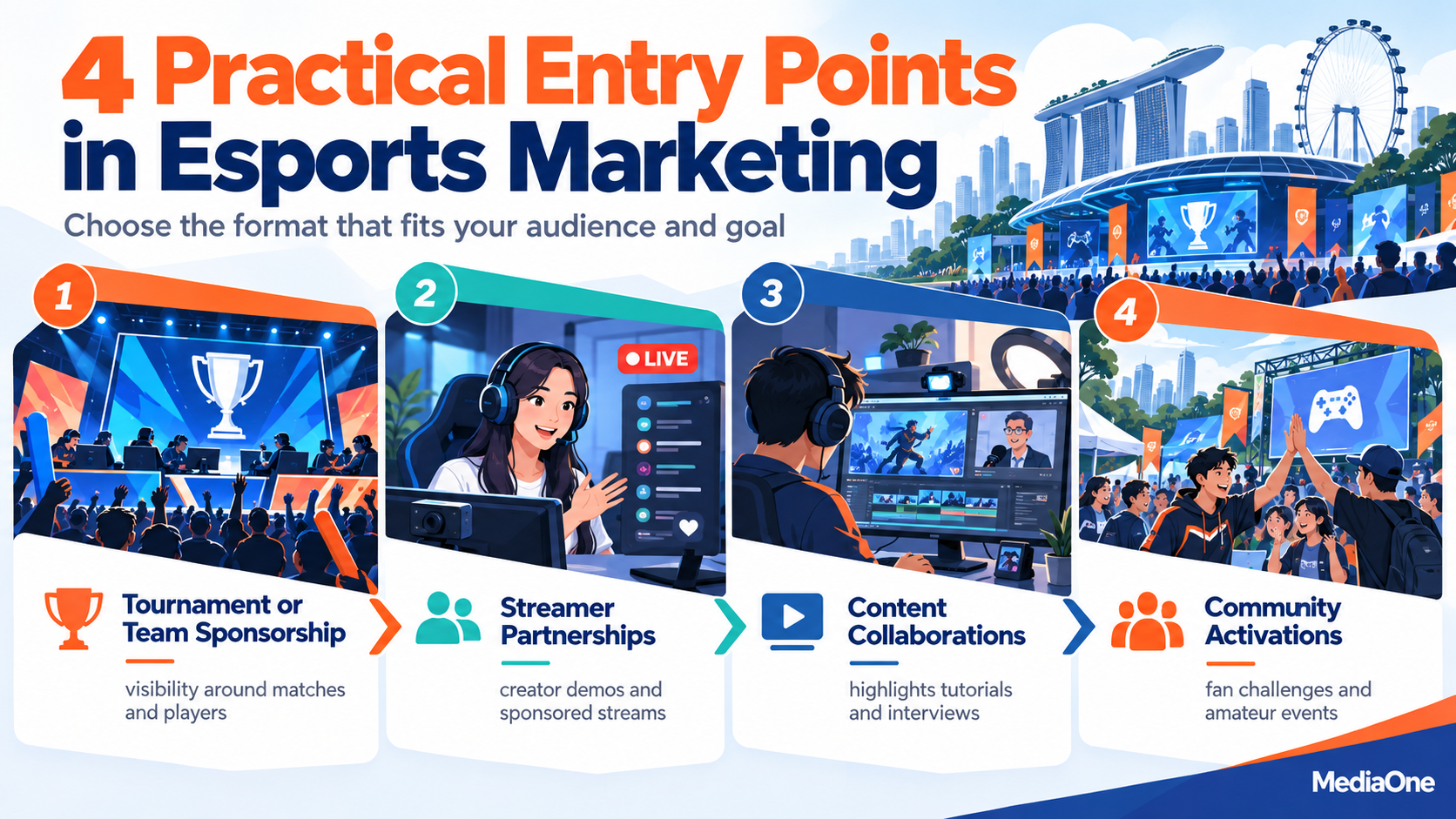
Esports marketing covers paid sponsorships, creator collaborations, tournament experiences and original content tied to competitive gaming. It can build awareness, encourage participation or generate leads, depending on the campaign design. We see four practical entry points for brands. The right choice depends on audience, budget and the outcome you need to measure:
- Tournament or team sponsorship: visibility alongside matches, broadcasts or players.
- Streamer partnerships: demonstrations, commentary or sponsored broadcasts for a relevant audience.
- Content collaborations: highlights, tutorials, interviews or short-form clips that fans want to share.
- Community activations: amateur competitions, fan challenges or experiences with an ongoing purpose.
Understanding the Esports Audience and Where to Find Them
Esports audiences vary by game, language and platform. A League of Legends viewer may behave differently from a Singapore student competing in Mobile Legends: Bang Bang (MLBB). We would assess both before buying media.
Audience Demographics and Age Profiles
YouGov’s Global Fan Profiles analysis reported that interest among people aged 18–29 increased from 27% in the first quarter of 2021 to a peak of 33% in the first quarter of 2024. Regular esports viewership among that age group stayed around 10–12% from early 2021 through mid-2024. The figures describe YouGov’s analysed markets; they are not Singapore-specific audience estimates.
Interest is not the same as purchase intent. Verify the audience mix and use age-appropriate targeting, particularly if minors follow the game.
Singapore and Southeast Asia: Local Context
Local relevance matters because game preferences and competitive structures differ between markets. In 2025, the organiser of MLBB Professional League Singapore Season 9 announced a roving league, weekly community participation and a talent search. These initiatives demonstrate how a local esports property can connect brands with both organised competition and grassroots activity.
Regional reach can also be substantial. Esports Charts’ 2025 analysis recorded 398.8 million hours watched for MLBB across tracked platforms worldwide. That is a global viewing figure, not a count of Singapore viewers or unique people. The platform’s reporting also has coverage limitations, so use it for market context rather than a local sales forecast.
Before budgeting, request a partner’s audience breakdown by country, age, language, average concurrent viewers and repeat attendance. If they are unavailable, start with a small pilot rather than assume global reach will convert locally.
Platforms That Drive Engagement
Choose channels according to the behaviour you want. Live broadcasts can support real-time participation, while edited video extends a tournament’s useful life. Discord and other community spaces need moderation and a reason for members to return.
| Channel | Best campaign use | Useful performance signal |
| Live streams | Match integrations, creator demonstrations and fan interaction | Average viewers, watch time and chat participation |
| YouTube | Highlights, interviews and searchable evergreen videos | Returning viewers and video retention |
| Short-form video | Discoverable clips, reactions and creator-led moments | Qualified engagement and profile visits |
| Discord or community forums | Ongoing discussion, feedback and member activities | Active members and repeat participation |
Build content around an event, then edit highlights for other channels. Use community spaces for discussion, not repeated advertisements.
Why Esports Marketing Is Different From Sports Sponsorship
Traditional sports and esports both sell sponsorship rights, media exposure and access to supporters. The difference lies in how a campaign fits the audience’s behaviour. Esports fans often watch creator commentary alongside official broadcasts, discuss competitive tactics and follow individual players between events.
A stream logo may deliver awareness, but does not establish credibility. A brand that helps fans learn, play or meet others has a clearer reason to appear in the community.


For example, an accessories company could sponsor a locally run competition and supply equipment for players to try. A food brand could collaborate with a creator on a match-day series. Both concepts need audience research and explicit commercial goals before launch.
Choosing the Right Esports Marketing Partnership
We assess three elements before recommending a team, tournament or streamer: audience overlap, the credibility of the activation and the resources needed to execute it. This helps prevent poorly matched sponsorships.
Brand Fit and Credibility Within Gaming Culture
A suitable partnership should answer a simple question: Why would this community welcome the brand? The answer might involve useful products, entertaining content, accessible competition or support for emerging talent. Generic slogans rarely provide that connection.
Review recent videos, chat behaviour and community rules. Check previous sponsorships for negative reactions and look for evidence of genuine audience participation. We also recommend asking creators what their followers routinely request, instead of supplying a rigid promotional script.
Sponsorships, Streamers and Co-Created Activations
A team sponsorship may offer jerseys, broadcast placements and player appearances. A streamer collaboration offers a stronger personality-led format, but audience concentration and reputational risk may be higher. Community competitions demand more operational work, including moderation and fair entry rules.
The choice should follow the objective. We would consider a creator demonstration for product consideration, a tournament partnership for broad awareness and a recurring amateur event for community retention. Record access to players, footage and game assets in the contract.
Case Study: Red Bull Campus Clutch
Red Bull Campus Clutch offers a useful example of participation-led esports marketing. Its 2023 VALORANT university tournament was the event’s third season, with more than 200 national and regional tournaments planned over four months. Red Bull also identified Intel NUC, AGON by AOC and Backforce as event partners.
Red Bull reported 25,000 participants in 2021, not 2023, according to its event announcement. The example demonstrates a repeatable participation format, but published event scale alone cannot establish sponsor return on investment.
Digital Marketing Strategies That Work in Esports
The strongest creative starts with the game and the fan experience. We recommend developing content and activation ideas together, so the audience sees a coherent campaign across streams, clips and the brand’s website.
Content Marketing for Engagement
Useful formats include match explanations, behind-the-scenes preparation, player interviews and accessible tutorials. Short clips can introduce a campaign, while longer videos provide context for fans who want detail. Publish around actual fixtures and community interests rather than forcing a fixed promotional calendar.
Give each piece one purpose: discovery, participation or action. Our social media marketing guide explains how to match formats and campaign measurement to Singapore audiences.
Influencers and Streamers
Choose creators using audience overlap and engagement quality, not follower totals alone. Review average live viewers, content history, language, moderation standards and any conflicting sponsorships. Ask for audience data covering recent comparable broadcasts rather than a single viral clip.
A creator agreement should define deliverables, publishing dates, approval rights, payment terms, reporting and content reuse. Include a cancellation process for missed streams or conduct issues. Confirm permissions for co-streaming and game footage.
Events and Community Activations
A branded event needs a reason for players to enter and viewers to follow the result. Rewards, scheduling and competitive fairness matter as much as presentation. Small, well-run competitions can provide a useful test before investing in a large regional sponsorship.
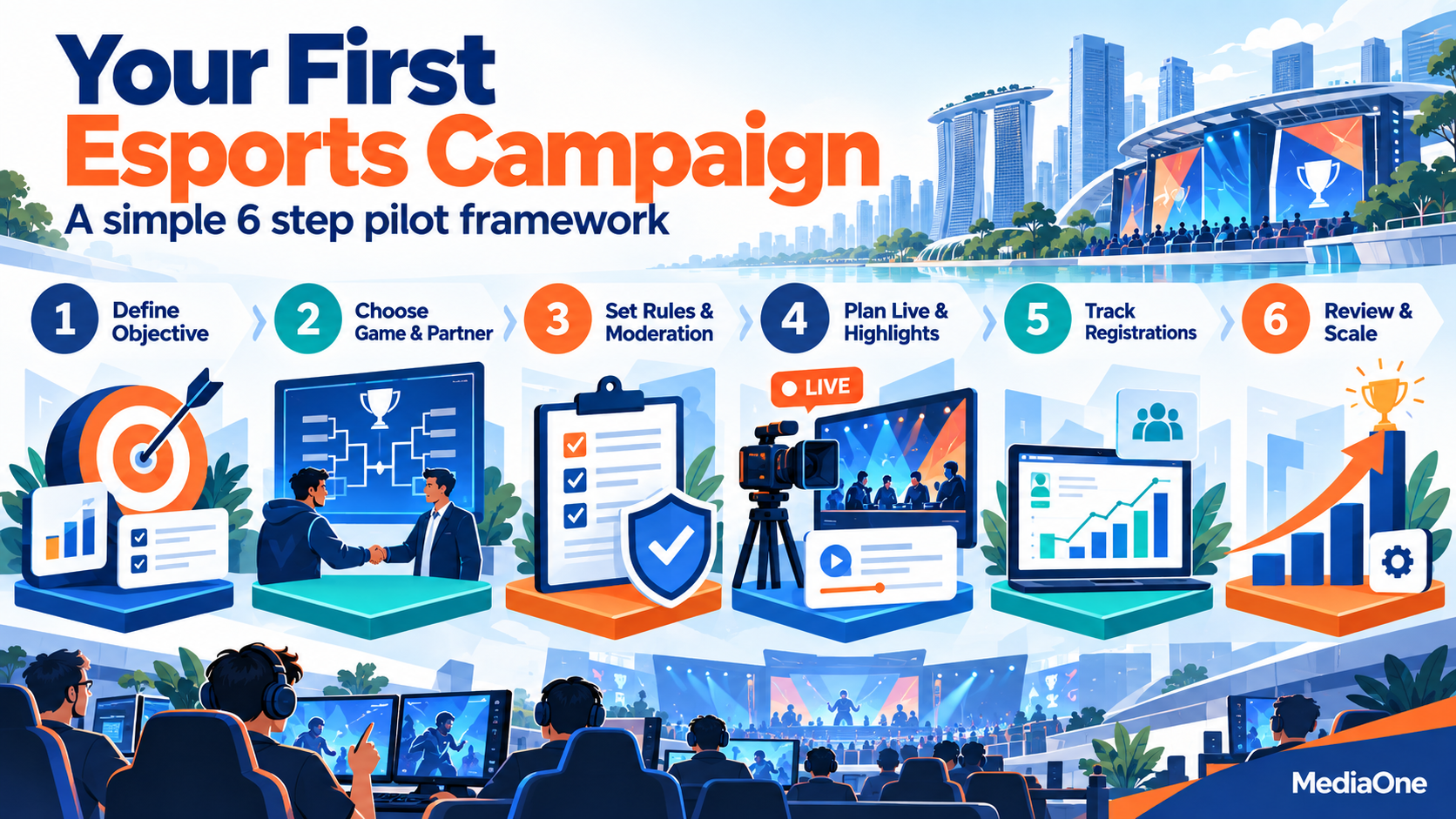
We would use this launch sequence:
- Define the target community and one primary business objective.
- Select a game, format and partner with suitable audience evidence.
- Confirm rules, prizes, permissions, moderation and safeguarding.
- Plan live coverage, highlight clips and follow-up content.
- Set up campaign links, registration tracking and reporting.
- Review participation quality before committing to another event.
The Engagement Depth Scorecard
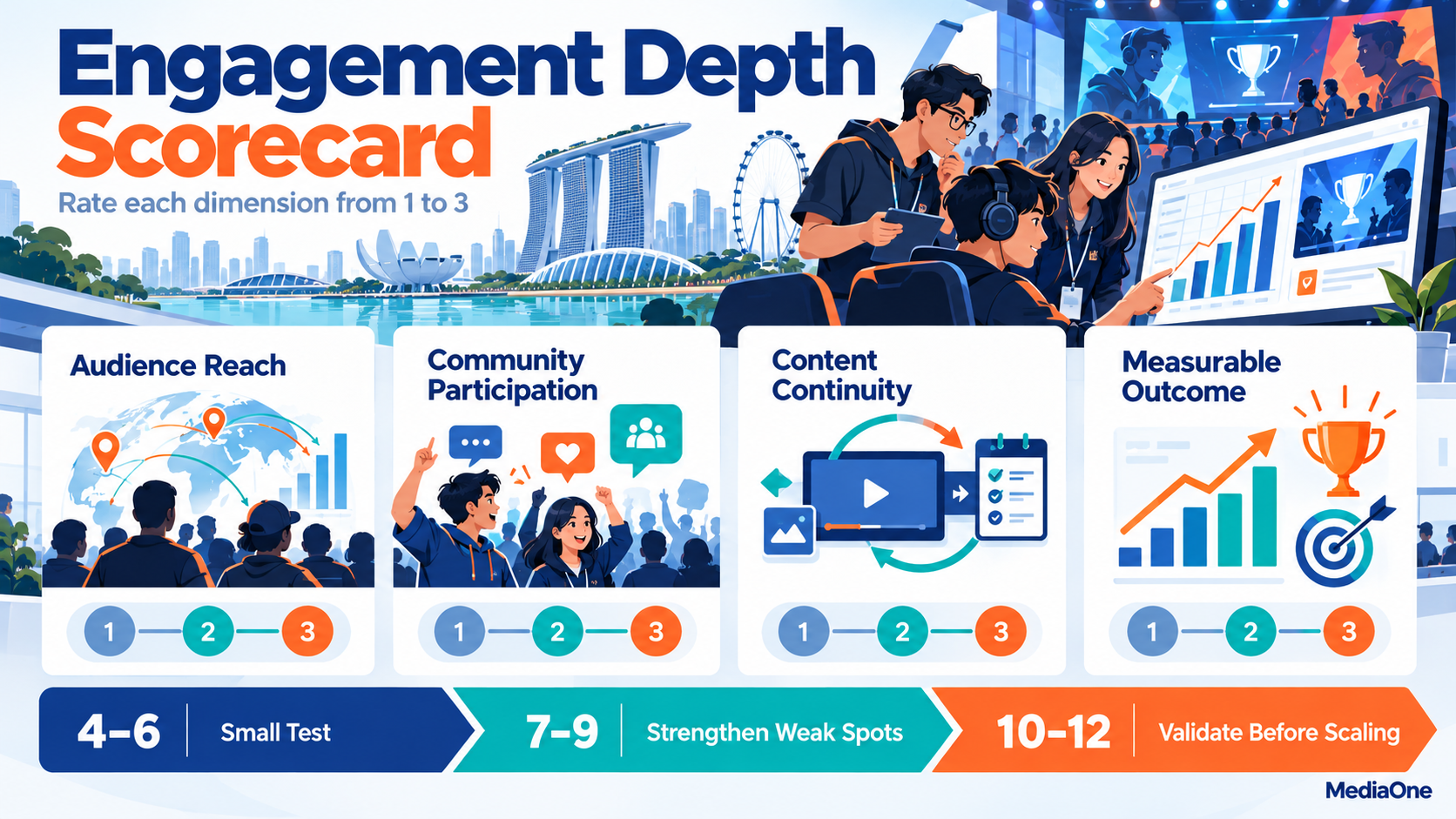
Brands need a consistent way to compare proposals. Our Engagement Depth Scorecard is a practical planning heuristic, not an independently validated industry benchmark. Rate each dimension from 1 (weak evidence) to 3 (strong evidence):
- Audience reach: verified access to the intended market rather than raw global followers.
- Community participation: meaningful actions such as entries, discussion or fan-created content.
- Content continuity: opportunities for repeat engagement beyond a single broadcast.
- Measurable outcome: reliable evidence tied to awareness, leads, sales or retention.
| Total score | Suggested interpretation | Recommended response |
| 4–6 | Limited integration or insufficient evidence | Redesign or run a small test |
| 7–9 | Promising but incomplete | Strengthen the weakest dimension |
| 10–12 | Strong integration potential | Validate commercial results before scaling |
These are judgement scores, not financial results. Document missing evidence.
Worked Example: Red Bull Campus Clutch 2023
Using only publicly available information, we would provisionally score the 2023 event 9 out of 12. Its multi-market tournament structure earns 2 for reach because verified campaign audience delivery is missing. Direct student competition earns 3 for participation, and the third annual season earns 3 for continuity. We give measurable commercial outcomes 1 because sponsor conversion or sales figures were not established by the event sources.
The score is not a verdict on success. Request sponsor-specific results before judging commercial impact.
Measuring Community Loyalty and Commercial Outcomes
Exposure, engagement and revenue answer different questions. We recommend selecting a primary key performance indicator (KPI) before choosing tracking tools, with supporting metrics for diagnosis. A campaign focused on awareness needs a different reporting framework from one designed to sell products.
| Campaign goal | Primary KPI | Supporting indicators |
| Awareness | Target-market reach or brand lift | Viewable impressions and watch time |
| Participation | Qualified registrations or attendees | Repeat entries and community activity |
| Consideration | Relevant site visits or product enquiries | Click-throughs and engaged sessions |
| Sales | Attributed orders or qualified leads | Acquisition cost and conversion rate |
| Loyalty | Repeat participation or purchase | Returning members and repeat orders |
Use Google Analytics campaign tagging to distinguish traffic from creator links, event coverage and paid posts. Unique promotional codes can provide another signal, although neither approach captures every assisted conversion. Where feasible, use pre- and post-campaign surveys to assess awareness.
Review results by creator, game and location. Global views with few qualified Singapore visits suggest the campaign needs adjustment. Do not calculate return on investment using impressions as though they were revenue.
Singapore Disclosure and Data Protection Requirements
Sponsored content should be clearly identified. The Advertising Standards Authority of Singapore’s social media guidance covers commercial relationships and disclosure expectations for marketers and creators. Make these requirements contractual and check the final posts, streams and clips before publication.
When collecting registration details or tracking identifiable users, follow the Personal Data Protection Commission’s data protection obligations. Explain the purposes of collection, establish an appropriate basis under the Personal Data Protection Act (PDPA) and limit access to the data. Do not assume that all browser storage requires the same consent mechanism; assess the actual technology and data use.
How to Plan Your First Esports Marketing Campaign
Start with a contained pilot. We prefer a test that produces usable evidence over a costly sponsorship whose outcomes cannot be checked. Set a budget covering partner fees, production, moderation, prizes, media distribution and measurement rather than focusing only on the headline sponsorship price.

An illustrative six-week pilot could include two weeks for research, two for delivery and two for reporting. Complex tournaments may take longer.

Ask partners to provide a post-campaign report showing promised placements, delivered content, geography, engagement quality and agreed conversions. Retain successful footage and community insights for future activity where rights and privacy requirements permit.
Frequently Asked Questions
What is esports marketing?
Esports marketing promotes a brand through competitive gaming events, teams, streamers and fan communities. Campaigns can include sponsorships, creator content, tournaments and community experiences.
How much is the esports marketing market worth?
Esports Insider, citing Statista Market Insights, reports an estimated US$982.8 million in worldwide sponsorship and advertising revenue for 2024. This figure is a market estimate, not a guarantee of campaign returns or a measure of Singapore spending.
Who is the esports audience?
The audience spans several ages and gaming communities, with strong interest among younger adults in YouGov’s global research. Brands should verify age, location, language and game preference before investing.
Which platforms are best for esports marketing?
Live streams work well for events and interaction, while YouTube and short-form video extend content reach. Discord or similar communities can support recurring participation when there is active moderation and a clear purpose.
How do brands measure esports marketing success?
Use awareness, participation, lead or sales KPIs that match the campaign objective. Track them with platform reporting, tagged links, conversion data and appropriately designed surveys.
Should brands work with streamers or influencers?
Yes, when the creator’s audience and content style match the campaign. Agree on sponsorship disclosure, deliverables, usage rights and performance reporting before launch.
Turn Esports Marketing Into Measurable Business Results
Esports marketing can be effective when the chosen game, creator and campaign objective genuinely align. Market growth is a useful context, but the stronger business case comes from verified local audiences, participation and measurable outcomes. We would start with a focused partnership, use the Engagement Depth Scorecard to challenge assumptions and expand only when the evidence supports it.
For Singapore brands, the immediate decision is whether to test a creator collaboration, support a community event or purchase sponsorship rights. If campaign strategy, content distribution and conversion measurement need to work together, our social media marketing services provide a relevant next step.