| AI Summary
Email open rate measures the percentage of delivered emails recorded as opened, but privacy features can affect accuracy. MailerLite’s 2025 data reported a global median open rate of 43.46% and 32.54% across Asia. Singapore businesses can improve email open rates through audience segmentation, compelling subject lines, list hygiene, sender authentication, and A/B testing. Tracking clicks, conversions, and unsubscribe rates alongside opens provides a clearer picture of email marketing performance. |
Your email open rate indicates how often a campaign is opened, but it does not confirm how many subscribers actually read your message. Privacy settings and list quality affect the result. Interpret it alongside clicks and conversions.

For Singapore businesses, we recommend starting with your own campaign history before comparing industry benchmarks. This guide explains the calculation and how to improve email open rate without chasing misleading numbers.
Key Takeaways
- Measure unique opens against delivered emails. Exclude bounces, and distinguish unique opens from repeated views.
- Treat opens as estimates. Apple Mail Privacy Protection can register an open without a person reading the message.
- Choose relevant benchmarks. MailerLite’s 2025 dataset reported a 43.46% median open rate, but results vary by industry and region.
- Fix delivery problems first. Strong subject lines cannot rescue messages that land in spam or are rejected.
- Improve relevance through testing. Segment your audience, refine sender details and test one change at a time.
- Judge business outcomes separately. Clicks, enquiries and sales establish whether your campaign achieved its purpose.
What Is an Email Open Rate?
An email open rate is the percentage of successfully delivered messages that an email platform records as opened. Platforms typically detect an open when a tiny tracking image, called a pixel, loads. Some infer opens from tracked clicks.
The important word is records. A tracking event does not prove that someone read the content. Likewise, an email can be read without registering an open if images do not load. We use it to identify trends, not count confirmed readers.
How to calculate email open rate
Email open rate = (unique recorded opens ÷ delivered emails) × 100
Imagine a Singapore retailer sends 5,000 promotional emails. Of those, 500 bounce and 4,500 are delivered. If the campaign records 1,035 unique opens, its email open rate is 23%: 1,035 divided by 4,500, multiplied by 100.
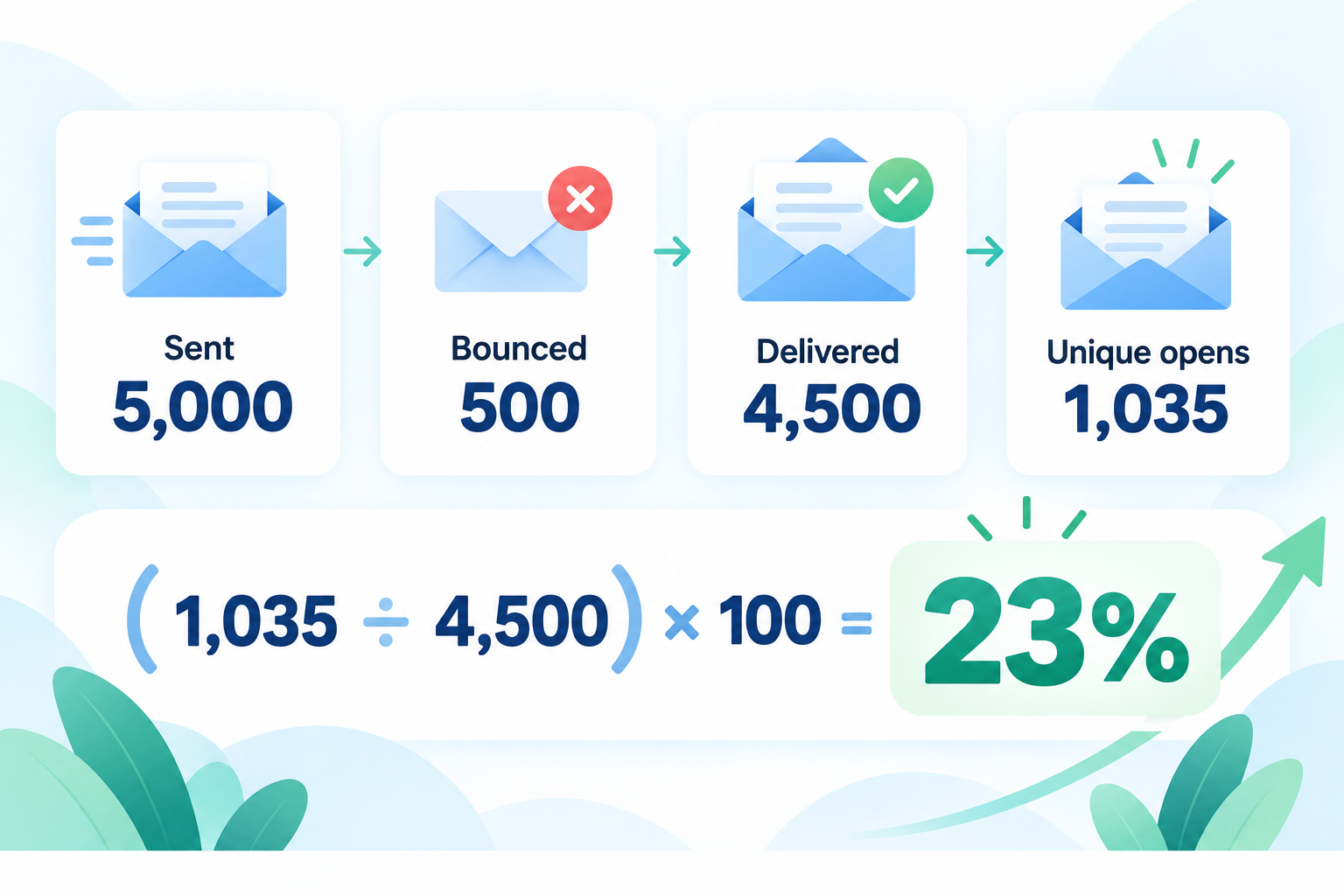
Unique opens count recipients once. Total opens include repeat activity. Check platform definitions before comparing reports. Mailchimp explains its tracking method and why images affect accuracy.
Delivery does not guarantee inbox placement; accepted mail may reach spam. If your email open rate falls, investigate delivery before blaming the subject line.
How Reliable Is Email Open Rate Tracking?
Privacy protection, blocked images and automated security activity can change reported opens without changing readership. This matters when comparing periods.
Apple Mail Privacy Protection can inflate opens
Apple’s Mail Privacy Protection downloads remote email content in the background when the feature is enabled. That can trigger a tracking pixel even when the recipient never views the message. Apple confirms remote content can load upon receipt.
As a result, an apparent increase in opens might reflect changes in the audience’s email applications. Check whether your provider identifies Apple privacy-related activity or offers bot-filtered reporting. Do not assume every recorded Apple Mail open represents an attentive reader.
Gmail image handling works differently
Gmail generally displays external images automatically, subject to user preferences and security checks. Google processes images to improve safety, but this does not mean Gmail routinely records an open as soon as every message arrives. Pixel behaviour and caching can still complicate tracking.
Other recipients may disable images entirely. In those cases, genuine readers can go uncounted. Security scanners may also generate activity that resembles engagement. These limitations explain why open rates should be considered directional rather than exact.
Use the same reporting rules over time
Before comparing two campaigns, confirm that their tracking settings match. Changes in bot filtering, audience mix or email software can make a percentage rise without any improvement in content.
Record reporting changes. After a new privacy filter, start a fresh comparison period.
Email Open Rate Benchmarks: What Counts as Good in 2026?
No universal good email open rate exists. Sector, campaign type and reporting platform affect comparisons. Welcome emails differ from monthly promotions.

For a recent reference point, MailerLite’s email marketing benchmarks for 2026 analyse more than 3.6 million campaigns from over 181,000 approved accounts. They cover December 2024 through November 2025 and report median campaign results. The overall median email open rate was 43.46%.
The same dataset reported 32.54% for Asia, making it a more geographically relevant comparison for Singapore than a worldwide headline. However, Asia includes many different markets. Neither figure represents a verified Singapore-specific average, and Apple privacy activity remains included in the reported opens.
Email open rate benchmarks by industry
These selected 2025 medians come from the same MailerLite dataset, allowing a cleaner comparison across sectors:
| Industry | Median email open rate |
| E-commerce | 32.67% |
| Marketing and advertising | 37.23% |
| Retail | 37.47% |
| Software and web applications | 39.31% |
| Business and finance | 43.34% |
| Restaurants and cafés | 44.32% |
| Consulting | 45.96% |
| Travel and transportation | 30.10% |
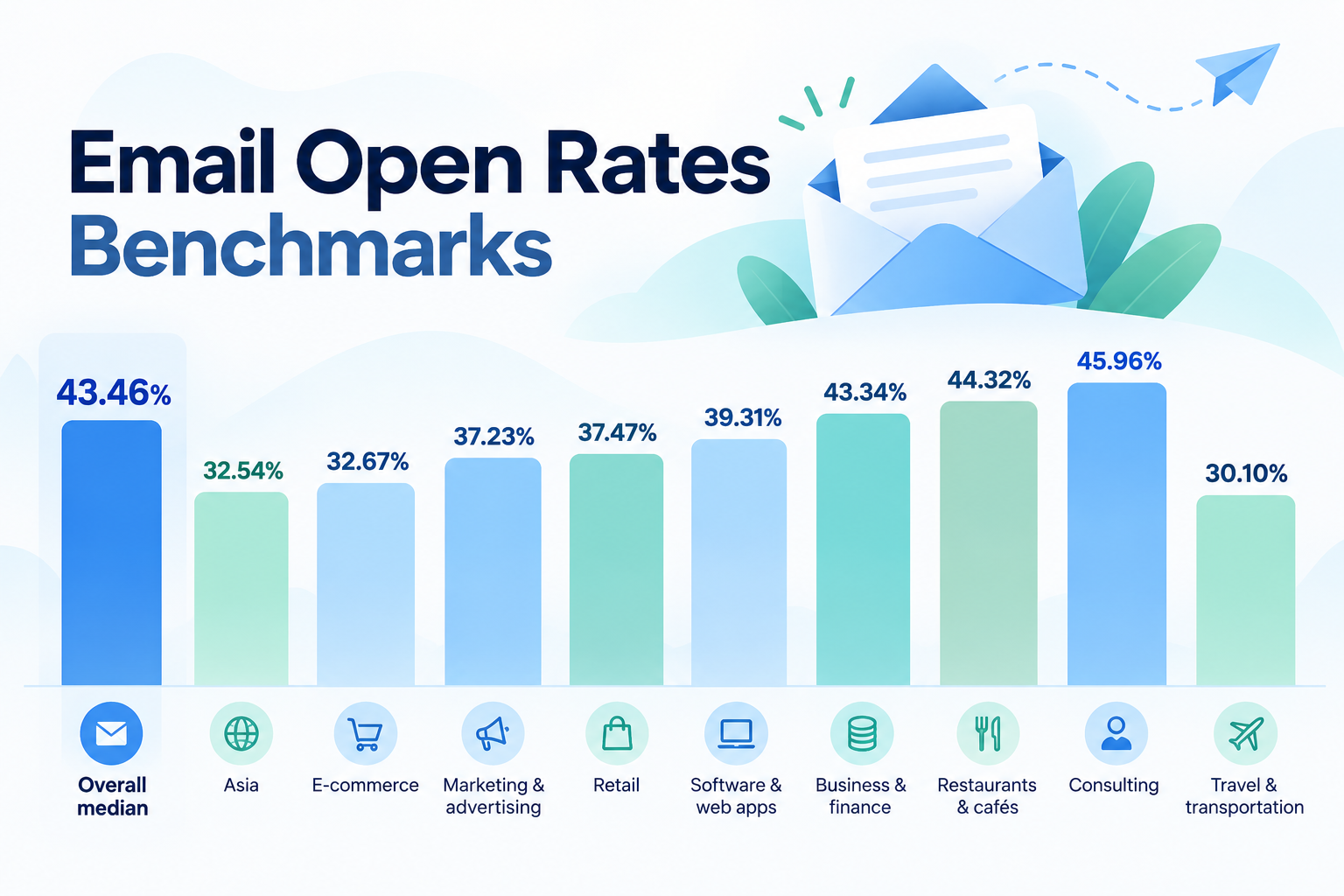
Do not treat these percentages as guaranteed targets. A smaller, highly engaged list may outperform a larger audience even when both businesses operate in the same industry. Different providers also use different customer populations and calculations.
For perspective, Mailchimp’s published benchmarks show an overall open rate of 35.63%, while Campaign Monitor’s 2022 report recorded 21.5% for campaigns sent in 2021. Do not combine datasets from different periods into a 2026 target.
Set a baseline that reflects your audience
We recommend comparing campaigns with similar purposes, subscriber groups and reporting settings. Start with your most recent six comparable sends as a practical working baseline. Six is a review method, not a statistically proven threshold.
Record the median open rate, click rate and unsubscribe rate for those sends. Look for a sustained shift across several campaigns rather than reacting to one disappointing result. Keep promotional emails separate from operational messages such as receipts and password resets. Subscribers expect those messages, so their recorded opens answer a different question. We would not use transactional engagement to set newsletter targets. A two-percentage-point drop is worth investigating in some contexts, but it is not a universal alarm rule.
How to Improve Email Open Rate Without Sacrificing Trust
Begin with audience quality and delivery. Then optimise inbox presentation using your platform’s metrics.
1. Use a recognisable sender name
Subscribers decide quickly whether they recognise the sender. Choose a consistent name that clearly identifies your business, such as “Orchard Home Store” rather than an unfamiliar employee or generic department.
Avoid switching identities between campaigns simply to attract attention. For important customer communications, a named staff member can work when that relationship already exists. Prioritise familiarity over novelty.
2. Write specific subject lines and useful preview text
A clear subject line gives recipients a reason to open. “Your October delivery update” communicates more than “Important news inside”. For promotional campaigns, lead with the relevant benefit instead of unexplained urgency.
Preview text should add information rather than repeat the headline. For example, pair “October offers for returning customers” with “See the products included and when the offer ends”. Avoid invented deadlines or claims that the email cannot support.
Keep mobile inbox space in mind, but do not impose a rigid character limit. Test whether concise, descriptive wording performs better for your particular audience. A subject line should accurately represent the message that follows.
3. Segment subscribers by genuine interest
Sending the same email to everyone can weaken relevance. A retailer might distinguish recent purchasers from people browsing a product category. A business-to-business company might separate new enquiries from existing customers.
Use information subscribers have provided or activity you can lawfully use. Then adapt the offer, examples and call to action to each group. We recommend testing segmentation on a manageable audience before creating a complicated automation system.
4. Keep your email list clean and permission-based
Old addresses generate bounces, while uninterested recipients may ignore or report messages. Remove invalid addresses promptly and honour unsubscribe requests. Do not buy contact lists to increase sending volume.
For Singapore campaigns, review applicable obligations under the Spam Control Act and IMDA guidance. In particular, unsolicited bulk commercial messages have specific identification and unsubscribe requirements. Protecting permission is both a compliance issue and a practical way to improve audience quality.
Do not automatically delete every subscriber who lacks recorded opens. Apple privacy features make activity difficult to interpret. Consider clicks, purchases, recent sign-ups and stated preferences before deciding whether to pause contact.
5. Check authentication and spam complaints
Sender reputation affects whether your messages reach subscribers’ inboxes. Configure Sender Policy Framework (SPF), DomainKeys Identified Mail (DKIM) and Domain-based Message Authentication, Reporting and Conformance (DMARC) with your technical team or email provider.
Under Google’s email sender guidelines, all senders to personal Gmail accounts must meet baseline requirements, while bulk senders have additional authentication and unsubscribe obligations. Google identifies roughly 5,000 messages to personal Gmail accounts within 24 hours as its bulk-sender threshold.
Monitor authentication failures, bounces and spam complaints. Google recommends keeping the user-reported spam rate below 0.1% and avoiding 0.3% or higher. A better subject line cannot fix a damaged sender reputation.


6. Match frequency to subscriber expectations
A subscriber expecting a monthly update may disengage if promotional messages arrive daily. Set a clear expectation during sign-up and provide preference choices where practical.
We would assess both engagement and unsubscribe trends after changing frequency. More frequent sending can increase total opportunities for clicks while reducing the open rate per message. Decide based on your business goal rather than the percentage alone.
7. Test send times in Singapore time
Ignore universal “best time” claims. For a Singapore-focused audience, test relevant Singapore Standard Time windows, such as a weekday morning and an early evening send.
Use comparable segments and repeat the test across several campaigns. If your audience includes overseas customers, schedule by their local time zones where your platform supports it. Judge improvements by clicks and conversions as well as opens.
8. Deliver on the promise after the click
The email body cannot directly persuade someone before they open it, but a disappointing experience affects future campaigns. Make the message easy to scan and ensure the landing page matches the subject line.
Use one clear primary action for campaigns with a single goal. Avoid exaggerated claims and unnecessary visual clutter. Consistent value gives subscribers a reason to recognise and trust the next email.
Diagnose a Falling Email Open Rate Before Changing Everything
A falling email open rate has several possible causes. Match the symptom with supporting evidence before choosing a remedy. This prevents wasted tests.
| Pattern in your reports | What to investigate first |
| Opens and clicks fall after a domain change | Authentication, spam placement and sending reputation |
| Opens fall but clicks per delivered email remain steady | Tracking settings, Apple Mail share or audience differences |
| Opens and clicks decline over several similar sends | List fatigue, offer relevance and sending frequency |
| Opens rise but conversions remain flat | Privacy-driven opens, misleading subject lines or landing-page friction |
| One segment consistently underperforms | Subscription source, customer needs and content fit |
We recommend checking the delivered count and bounce rate first. Next, compare like-for-like audience segments. Only after those checks should you focus on subject lines and timing.
Which Email Metrics Should You Track Alongside Opens?
No single percentage captures campaign value. We track several measures between delivery and outcomes.
- Click rate: The percentage of delivered emails that record at least one tracked click. It is less dependent on image-based open tracking, although automated clicks can still occur.
- Click-to-open rate: The share of recorded openers who click. Use cautiously because inflated opens can distort the denominator.
- Conversion rate: The percentage of recipients or visitors completing your defined goal. Specify which denominator your report uses.
- Bounce rate: The share of attempted deliveries rejected by recipient servers. Separate permanent failures from temporary ones.
- Unsubscribe and complaint rates: Indicators of unwanted frequency, poor relevance or mismatched expectations.
For example, a campaign that records 4,500 delivered emails and 90 unique clickers has a 2% click rate. If nine of those clickers submit an enquiry, the click-to-enquiry conversion rate is 10%. These measures answer different questions, so label them clearly.
For revenue-focused programmes, connect campaign reporting to enquiries, qualified leads or purchases when reliable attribution is available. Open rate remains a supporting metric rather than the final measure of success.
A Practical 30-Day Email Open Rate Improvement Plan
We recommend a controlled sequence instead of changing every campaign setting at once. Low-volume senders may need longer than a month.
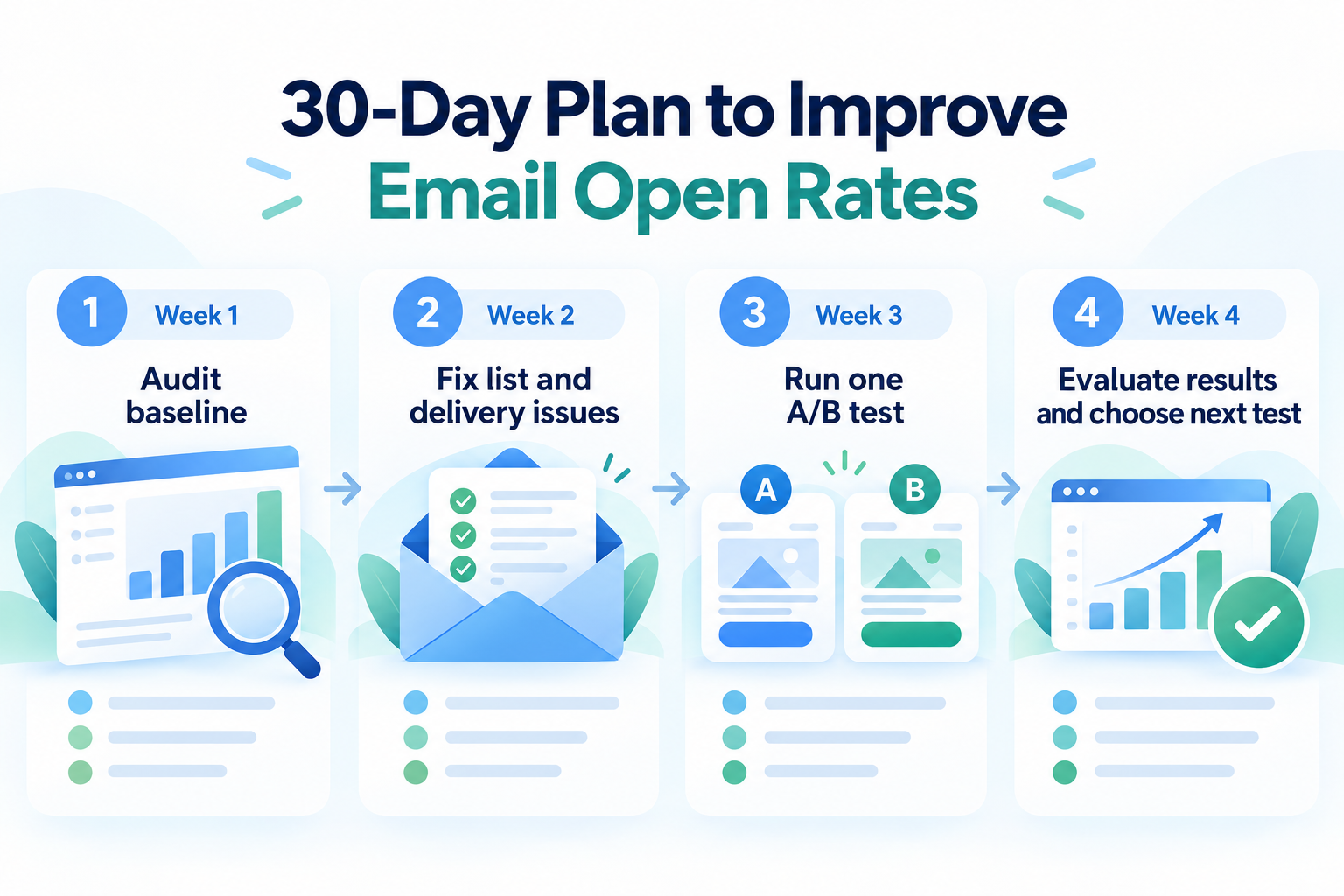
- Week 1 — Audit the baseline. Review six comparable campaigns, email delivery failures, audience segments and bot-filtering settings. Note the main outcome each campaign was supposed to produce.
- Week 2 — Fix list and delivery issues. Remove invalid contacts, confirm unsubscribe handling and review authentication. Keep a record of any technical changes so results remain interpretable.
- Week 3 — Run one A/B test. Compare two truthful subject lines using randomly assigned, comparable recipients. Hold the sender name, audience, offer and send window steady.
- Week 4 — Evaluate and choose the next test. Check opens alongside unique clicks, conversions and unsubscribes. Repeat promising tests before changing the preview text or send schedule.

Avoid declaring a winner from a tiny sample or a minor percentage difference. Your testing tool may provide statistical confidence estimates, but the business impact must also justify adopting the result. We would prioritise changes that improve meaningful engagement consistently.
Frequently Asked Questions
What is a good email open rate in Singapore?
There is no verified universal Singapore average in the benchmark sources cited here. MailerLite reported a 32.54% median across Asia in its 2025 dataset, but compare your results with similar campaigns and audience segments before using that as a target.
Does a 50% email open rate mean half my subscribers read the email?
No. It means the platform recorded opens for approximately half the delivered messages under its tracking rules. Apple Mail privacy activity and blocked images can make actual readership different.
Why is my email open rate high but my click rate low?
Privacy-related image loading may be inflating opens, or the content may not give readers a compelling next step. Examine unique clicks per delivered email and confirm that your subject line matches the offer.
Can changing my subject line increase email open rate?
It may help when recipients already trust the sender and the message reaches the inbox. Test two relevant versions while keeping other conditions consistent, then check whether additional opens lead to useful engagement.
How often should I review my email open rate?
Check each campaign after enough time has passed for your audience to respond, then assess trends across comparable sends. For many businesses, a monthly review is practical, supported by a deeper quarterly audit of delivery, conversions and list health.
Turn Email Open Rate Insights Into Better Campaign Results
A higher email open rate is valuable when it reflects stronger subscriber interest. Begin with reliable delivery and a permission-based list. Then improve relevance, write clear subject lines and test changes against a consistent baseline.
We recommend evaluating the next campaign on three levels: what the platform recorded, what subscribers actually did and what the business gained. If you need help identifying the causes of weak engagement, our email marketing services in Singapore cover campaign audits, list management and performance reporting. Use open rate to guide better decisions, and let clicks, conversions and customer response determine whether those decisions worked.