Many businesses treat email as a calendar of newsletters and promotions, yet existing customers often get the least attention. An email marketing lifecycle approach matches messages to a subscriber’s actions, purchases and periods of inactivity, so each group receives a relevant next step.

Map each subscriber to a lifecycle stage, give each stage one clear job, and let triggers move people forward. A single broadcast misses moments when customers are ready to buy again, such as a Singapore retailer’s replenishment window or a service firm’s renewal date.
A lifecycle plan therefore starts with actual customer events, then works backwards to the timing and content of each email. It should also specify what happens when a customer changes stages before a scheduled send.
Key Takeaways
- Retention deserves its own flows. First-purchase, repeat-purchase and win-back messages address different customer needs.
- Loyal customers need relevant communication. Offer early access, helpful product guidance or referral opportunities without relying on constant discounts.
- Give each stage one job. Map every subscriber stage to one email purpose.
- Use the Stage-to-Job Matrix. Remove any email whose job you cannot state in one line.
- Measure stages separately. Blended open rates can hide problems that stage-level reporting reveals.
- Win back with care. Trigger reactivation from buying behaviour and permission status, not open rates alone.
What Is the Email Marketing Lifecycle?
The email marketing lifecycle is a sequence of emails sent as a subscriber moves from sign-up through first purchase, repeat orders and possible lapse. Messages respond to behaviour or milestones instead of only a calendar. Each lifecycle email needs a clear purpose, entry rule, exit rule and success measure.
Existing customers deserve as much planning as new subscribers. Repeat-purchase and loyalty flows support customers after the first sale. A subscription business may prioritise renewals, while an online shop may track reorder timing.

This guide treats lifecycle email as a revenue system, not a newsletter calendar. Each stage (prospect, first-time purchaser, repeat customer, loyal customer, at-risk customer and lapsed customer) needs one job, trigger and exit condition. These principles also underpin effective email marketing operations.
Singapore SMEs can start small but should keep prospects and first-time purchasers separate: one needs a first-purchase reason; the other needs a reason to return.
Singapore Teams That Benefit From Lifecycle Email
This guide suits Singapore marketing managers, e-commerce operators, SaaS teams and service businesses moving from broadcasts to stage-based flows. The same rules can support appointments and renewals, not only purchases.
The Six Stages of the Email Marketing Lifecycle
Most lifecycle programmes falter when every subscriber receives the same message. The Stage-to-Job Matrix gives each stage one job, one entry or exit trigger and one success measure. Messages should move a customer forward without contradicting other stages.
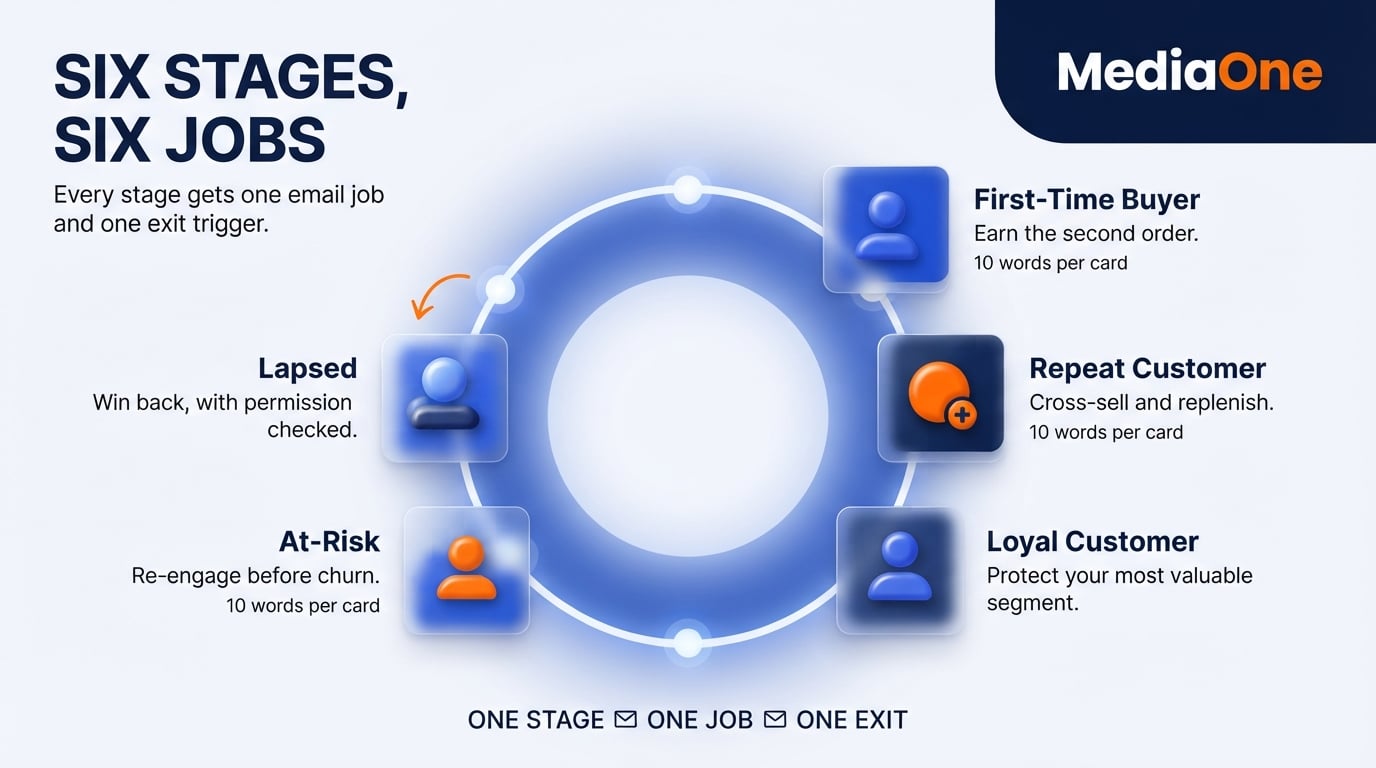
| Lifecycle stage | Single job the email must do | Trigger that moves a subscriber in or out |
| Prospect | Earn the first purchase | Subscribed, no order placed |
| First-time purchaser | Earn the second order | One order placed |
| Repeat customer | Deepen the relationship through cross-sell and replenishment | Three or more orders |
| Loyal customer | Protect the most valuable segment | High order frequency or spend over a set period |
| At-risk customer | Re-engage before churn | No recent purchases or clicks within a defined period |
| Lapsed customer | Win back | No purchase or meaningful engagement beyond the usual buying cycle |
Test the matrix against five recent customer records. If someone buys during a welcome series or returns after being marked lapsed, check that the previous sequence stops before a new one begins. A customer who makes a second purchase while still receiving first-order incentives should move into the repeat-customer flow. Document which rule takes priority when two events happen close together.
Stage 1: Prospect Welcome Emails
A prospect has shown interest but has not bought. Send a welcome message promptly after sign-up, explain why it has arrived and offer one helpful action. A guide may be more relevant than a discount.
Illustrative email: a welcome with one bestselling product and a first-order incentive. Example subject line, not a tested winner: ‘Your first order, sorted.’ Measure first orders within a suitable window, such as 14 days for a short buying cycle.
Stage 2: First-Purchase Follow-Ups
Send onboarding information about delivery and usage, then a second-order reminder near the natural reorder window. Trigger: one order placed. Measure second-order rate, and keep transactional updates distinct from promotions.
Stage 3: Repeat-Purchase Emails
Set a threshold, such as three orders, then match offers to the customer’s buying pattern. Use the median time to the second and third orders to identify a suitable trigger. Match repeat-purchase messages to buying behaviour, not a generic calendar.
Stage 4: Loyalty and Referral Emails
Reward loyal customers with early access, useful advice or referrals rather than constant discounts. Measure referral sign-ups per 100 loyal contacts each month. A service firm might offer priority booking instead of a retail perk.
Stage 5: At-Risk Re-Engagement Emails
Trigger at-risk emails when orders or clicks decline relative to the usual buying cycle. Offer a relevant reason to return, such as a restock alert. After a defined number of unanswered promotional sends, review or suppress the contact. Measure reactivation within an appropriate window; do not rely on opens alone.
Stage 6: Lapsed-Customer Win-Back Emails
A lapsed customer has stopped buying beyond the usual purchasing cycle. Offer a reason to return or ask whether the product is still needed. Abandoned-cart messages belong earlier in the buying process. GST-registered Singapore businesses should display final GST-inclusive consumer prices under IRAS price-display requirements.
Before sending, check the lawful basis for using the address, previous preferences and any consent withdrawal. An old purchase is not unrestricted permission for promotions. Test the message on mobile and retain opt-out records for suppression.
Building Email Lifecycle Segments, Copy and Automation
Agree on stage definitions, data sources and message owners before writing subject lines. Reliable stage rules come before personalisation.
List Segmentation by Lifecycle Stage
Misclassification causes irrelevant messages. Segment by transactions (orders and recency), behaviour (cart actions) and engagement (clicks or replies). Avoid decisions based on opens alone. MediaOne’s audience segmentation methods explain related audience rules.
Assign each contact one primary stage, updating it when purchase data changes. Suppress unsubscribed and hard-bounced addresses, and review persistent inactivity against the buying cycle rather than automatically treating 90 days without an open as disengagement. Record the date and source of each event. If order data is delayed or contact identities are duplicated, check the underlying records before trusting a segment label.
Compelling Email Copywriting for Each Stage
Match each email to its stage. Put the relevant offer and call to action near the start, and check the mobile layout. GST-registered Singapore businesses should quote GST-inclusive consumer prices. Make renewal dates and terms clear for subscription offers.
Use clear subject lines, consistent brand voice and one main action. Test personalisation fields with records that have no name or purchase history.
Check whether purchase and CRM data reach the email platform in time. A delayed sync could send a welcome promotion to someone who has already bought, so recheck stage membership before sending.
Lifecycle Email Delivery Options for Singapore Teams
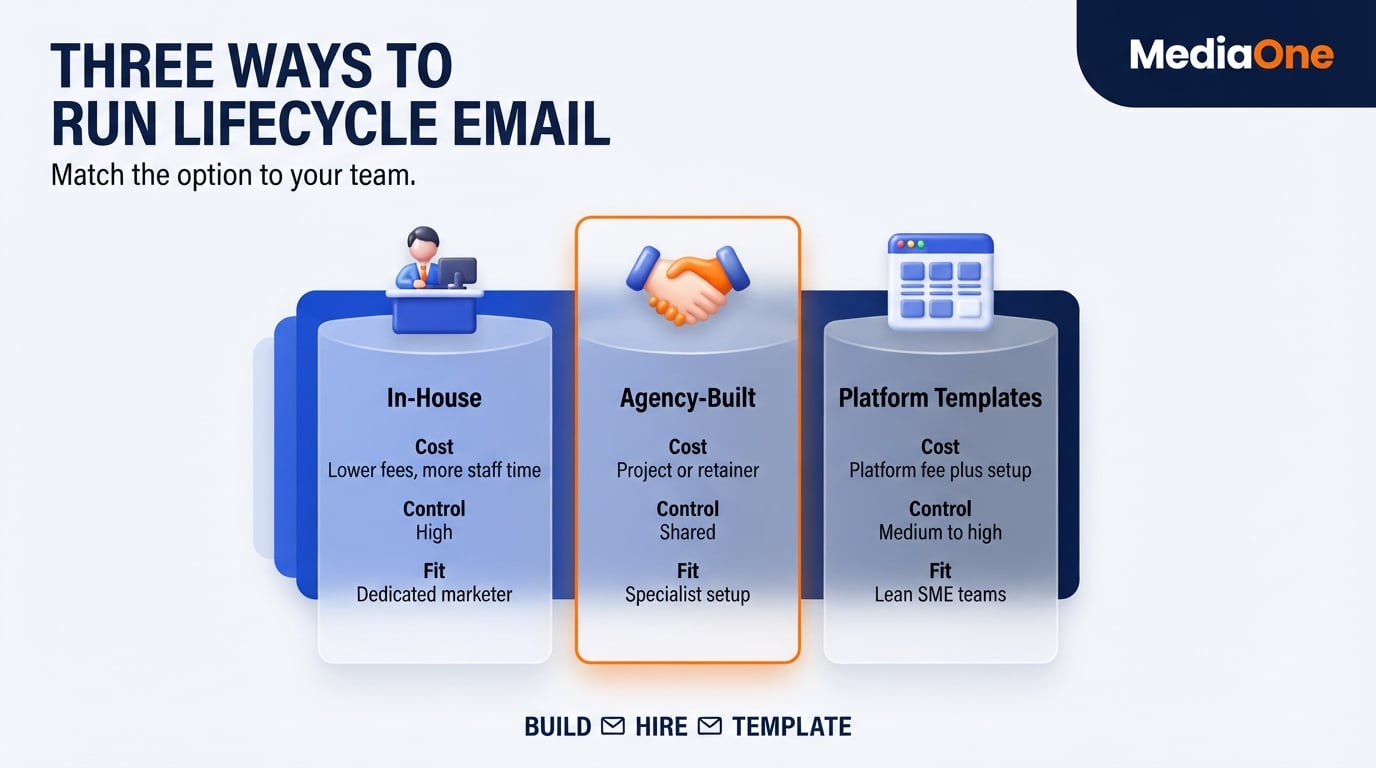
| Option | Cost | Control | Best fit |
| In-house, platform-led | Lower external fees, more staff time | High | Teams with a dedicated marketer |
| Agency-built flows | Project fee or ongoing support | Shared | Teams needing specialist setup |
| Platform-led automation with templates | Platform fee and staff setup | Medium to high | Lean SME teams |
Measuring and Improving Lifecycle Email Performance
The Stage-to-Job Matrix works only when its flows operate as designed. Record entry triggers, exit rules and ownership; test overlapping sequences. Measure whether each stage produces its intended customer action, not just delivery.
Lifecycle Trigger and Exit Rules
- List each stage and its single primary email.
- Write the entry trigger (for example, ‘first order placed’) and exit trigger (for example, ‘second order placed’).
- Set a maximum time in stage so nobody sits in a dead-end flow.
- Test each path with a seed account before launch.
- Check permissions, unsubscribes, bounces and disengagement rules before each promotional send.
- Check sender authentication and unsubscribe facilities against Google’s email sender guidelines.
Keep each flow’s owner, entry rule, template version, send timing and conversion goal documented. Record changes so later reviews can explain results.
Lifecycle Email Performance Diagnostics
Report each stage separately. Apple Mail Privacy Protection limits the reliability of open tracking, so prioritise clicks, orders, enquiries, unsubscribes and complaints. Compare results with an earlier baseline or similar customer group. Define the conversion window before a test begins. A first purchase may happen within days, while a renewal or repeat service booking could take weeks or months.
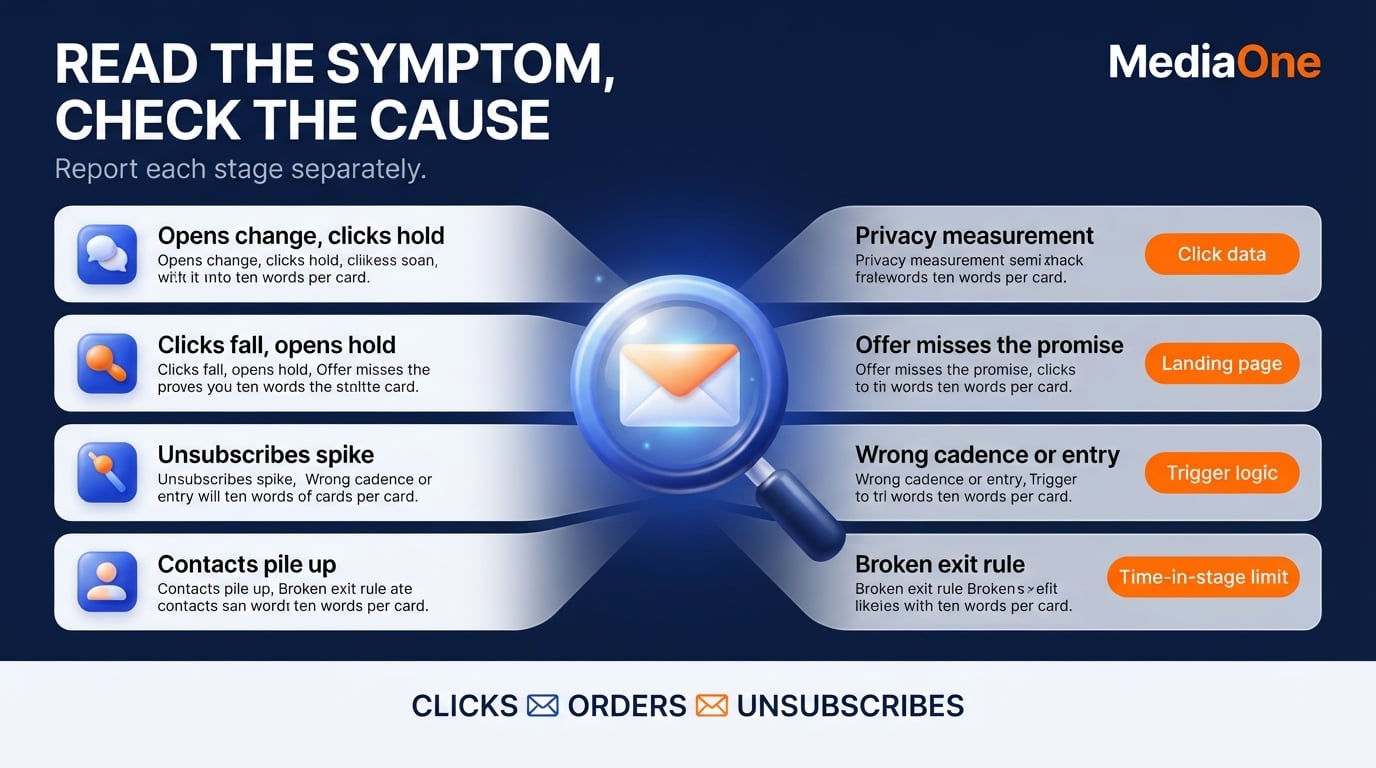
| Symptom | Likely cause | Check first |
| Reported opens change, clicks hold | Privacy measurement or subject line | Click data and reporting settings |
| Click rate falls, open rate holds | Offer not matching the promise | Landing page and CTA position |
| Unsubscribes spike at one stage | Wrong cadence or entry logic | Trigger logic and send frequency |
| Subscribers pile up in one stage | Missing or broken exit condition | Subscribers past the time limit |
Using Lifecycle Email Benchmarks Carefully
Published benchmarks cannot replace your own baseline. Track stage-level conversions and unsubscribes, and note changes in list size or seasonality. MediaOne’s email marketing campaign guide covers related campaign execution.
Email Lifecycle Implementation Checklist
Lifecycle email works when every stage has one job. Check every flow against the Stage-to-Job Matrix and revise or remove messages with no clear purpose. Compare email with other internet marketing channels when planning customer acquisition and retention.

This month, list every active flow, check its entry and exit rules and review persistent inactivity. Use stage-level data to judge outcomes and assign an owner to review rules when products or customer behaviour change.
Frequently Asked Questions
What is the difference between a lifecycle email and a campaign email?
A campaign email goes to a segment at a scheduled time. A lifecycle email responds to an action or milestone, such as a first order or a missed renewal. Map stages before building either type.
How many emails should a lifecycle sequence contain?
Start with one primary email per stage and add follow-ups when behaviour justifies them. A small team could begin with welcome, post-purchase and re-engagement flows. Revise emails without a clear purpose.
When should a lapsed customer be removed from the list?
Stop promotions after an unsubscribe or loss of a valid basis to contact someone. Keep suppression records where appropriate. IMDA’s unsubscribe guidance explains Singapore requirements for covered unsolicited commercial messages.

How do I know whether my lifecycle emails are working?
Measure stage-level outcomes: second purchases, reorders and win-backs. Track clicks, complaints and unsubscribes too. When reported opens fall but clicks hold, check measurement settings before blaming the subject line.
Does lifecycle email suit small businesses in Singapore?
Yes. Start with welcome and post-purchase flows, adding re-engagement later. GST-registered Singapore businesses should show GST-inclusive consumer prices where required. Small teams can run these flows with a limited number of templates if someone owns the contact list, checks the triggers and reviews responses regularly.