| AI Summary
Digital marketing services help Singapore businesses reach customers, turn visits into sales or enquiries, and measure which campaigns work. The main services include SEO, paid advertising, social media, content, email, analytics and website improvements. Published local quotes put one channel at around S$1,500 to S$3,000 per month and several channels at S$4,000 to S$10,000. The right starting point depends on where customers drop out and what the business can track. |
Digital marketing services include SEO, pay-per-click ads, social media marketing, content creation, email marketing, analytics and website improvements. Singapore SMEs can compare options by matching each service to a sales problem, checking the full cost and asking how the provider will measure results.
Key Takeaways
- An ad management fee pays for the agency’s work. The ad budget pays the platform to show your ads.
- A WhatsApp tap can show interest. A reply, qualified enquiry or booked job tells you what happened next.
- An agency case study is easier to judge when it shows the starting numbers, the budget and the time period.
- Your business should retain access to the accounts and files it will need if the contract ends.
A Singapore business can get plenty of website visits and still have a quiet sales inbox. Another can get regular enquiries from referrals but struggle to reach people who have never heard of it. Both might ask for digital marketing help, yet their first purchase should solve a different problem.
The comparison below covers what each service does, what Singapore SMEs can use as a budget starting point, and what to ask before hiring a partner.
What Do Digital Marketing Services Cover?
Digital marketing services cover the work of attracting customers online and helping them take the next step. A service can be as focused as setting up Google Ads for one offer or as broad as running search, social and email together. Each part of the work should have a purpose the business can explain in a sentence.
| Service | What the provider does | When it helps |
| SEO | Improves website pages and helps search engines find and understand them | Customers search for your service, but rarely find your business |
| Paid search | Runs ads for search terms related to your offer | People are searching now and you have a page ready for enquiries or sales |
| Social media | Creates posts, manages replies and runs paid campaigns when needed | Buyers need examples, demonstrations or reviews before they enquire |
| Content marketing | Produces guides, case studies, videos and answers to common questions | Buyers need to understand the offer before they speak to sales |
| Email marketing | Sends welcome emails, follow-ups and reminders to relevant contacts | You have a list of subscribers or customers who opted in |
| Analytics | Tests tracking and links campaign activity to enquiries or sales | Reports show activity, but you cannot tell which campaigns bring customers |
| Website improvements | Fixes pages, forms and checkout steps | People reach the site, then leave before taking the next step |
Search engine optimisation
SEO services can cover technical checks, service page updates and content based on the words customers use. Google’s SEO starter guide explains how page titles, links and site structure help people and search engines understand a site. A provider should be able to show which pages need work and why those pages matter to buyers.
For a business that serves nearby customers, local SEO can also include its Google Business Profile. A salon in Tampines, for example, can keep its hours and services up to date and make booking details easy to find. Google says local search rankings depend mainly on relevance, distance and prominence. A provider can help improve the profile and website, while the searcher’s location also affects what appears.
Google Ads management can put a service in front of people searching for it. A repair firm might run ads for emergency plumbing during hours when someone can answer the phone. The firm can use Google Ads conversion measurement to track actions such as calls, form submissions or sales. The cost of those actions gives the owner more information than the cost of a click alone.
Social media marketing can show the offer before someone searches for it. A furniture shop can show how a table folds away in a small flat. A software firm can use a short product demo to answer a question buyers often ask. Paid social and regular posting involve different work, so an agency quote should spell out whether it covers both.
Content and email marketing
Content marketing helps buyers answer questions that can delay a purchase. A commercial cleaning firm could explain what an office needs to prepare before the first visit, what affects the quote and which tasks take place after hours. The same page can answer questions from search visitors and give the sales team a link to send after an enquiry.
Email marketing helps a business follow up with people who asked to hear from it. A training company might send subscribers a course outline after they request it, then share upcoming dates. An online shop might send a care guide after a sale. Each message has a job, and the sequence can be planned around what the customer has already done.
Analytics and website improvements
Analytics helps a company compare what people do after they arrive. For a service business, a report can show visits, quote requests and booked jobs. For an online shop, the report may show product views, checkout starts and purchases. Google Analytics attribution explains how different models give credit to interactions before an action. A report can help you compare channels, while sales records help you check what people actually bought.
Website improvements make it easier for those visitors to act. A page might need a shorter form, a more visible price or a checkout that works on a phone. An agency may call this conversion rate optimisation, or CRO. The work should start with a specific problem, such as buyers getting partway through checkout and leaving before they pay.
Which Digital Marketing Service Should an SME Buy First?
The best first purchase addresses a problem the business can see and track. A small team can usually start with one service and add work once it has evidence about where customers come from. The choice also depends on whether someone has time to answer enquiries, approve content or make changes to the website.
Find the point where customers drop out
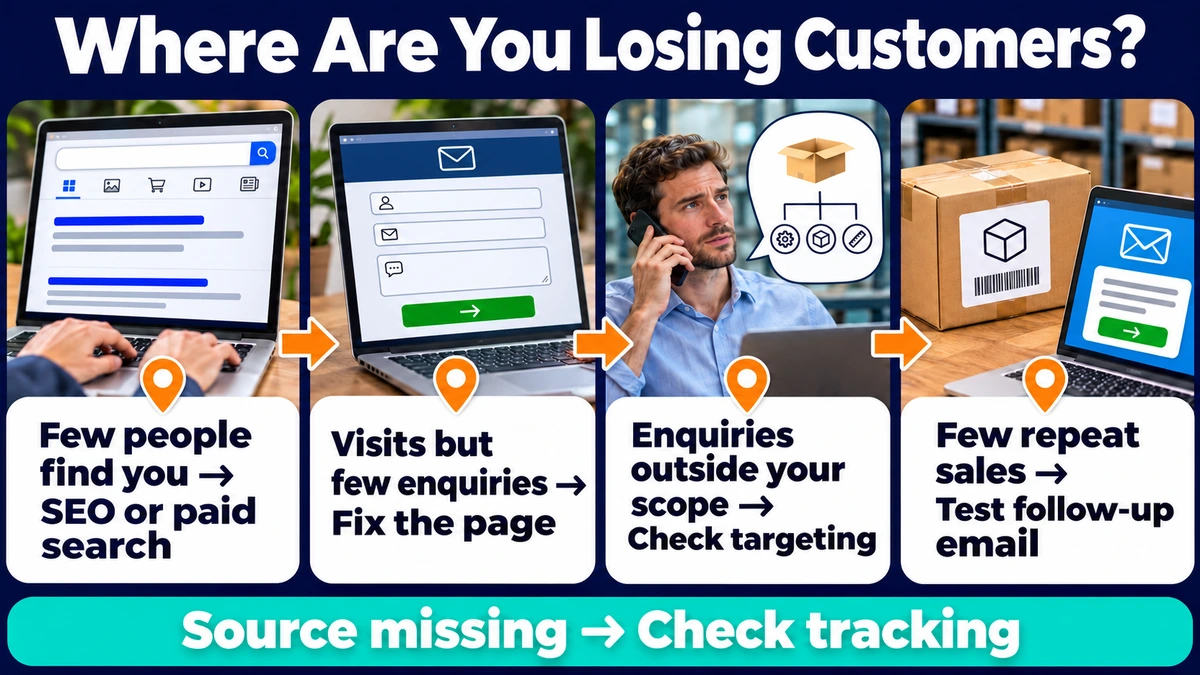
A service business can start with its last batch of calls, quote requests and sales. Those records often show whether the business needs more people to find it or whether it loses people after they show interest. A simple spreadsheet with a row for each enquiry may be enough to spot which question to investigate.
- Few people find the business. SEO can improve search visibility over time. Paid search gives the business a way to reach people who are already looking, with a budget it can set for the test.
- People visit but rarely enquire. Website work can address a difficult form, missing price details or an offer that is hard to understand.
- Enquiries arrive but few qualify. Ad targeting, search terms or page copy may be attracting people outside the service area or budget range.
- Customers buy once and rarely return. A follow-up email may be worth testing if customers have opted in and the product suits repeat sales.
- The team cannot trace sales to campaigns. An analytics review can check what the site records and what the sales team needs to log.
Match the plan to the way customers buy
A neighbourhood air-con servicing business might test paid search for one service and log which calls turn into jobs. A business software firm might start with a page that explains who the product serves and a case study that helps buyers compare options. An online retailer with repeat orders could start with email if it already has an active subscriber list. The first step depends on what the business has in place today.
Several services can work together when each has a role. An office furniture supplier could use search ads to bring people to a page for bulk orders. A case study on that page could show how it handles delivery across several offices. The sales team could then record which enquiries asked for a quote. The agency and the sales team would have a shared view of what happens after the click.
Choose who will do the work
A freelancer can take on a defined job such as testing tracking or updating service pages, with someone inside the business managing decisions. A specialist agency may suit a business that needs one channel run week to week. An agency that handles several channels can help when the same team needs to coordinate ads, content and reporting.
An internal owner still helps in all three cases. The owner can approve pricing and offers, explain which leads the sales team can serve, and flag when work slows down. A short digital marketing project brief gives everyone the same goal, budget and dates before the work starts.
How Much Do Digital Marketing Services Cost in Singapore?
A Singapore pricing guide based on public agency quotes gives SMEs a starting point for comparing fees. The figures below come from published offers compiled in October 2026. The two main bands reflect examples from a published price list, so they serve as planning references for comparing quotes. Your price depends on what the provider agrees to deliver.
| Scope | Published pricing reference | What to check in the quote |
| One channel, such as SEO or Google Ads | S$1,500 to S$3,000 per month | Set-up, included work, reporting and ad spend |
| Several channels | S$4,000 to S$10,000 per month | Which channels get regular work and who manages them |
| Paid media management billed as a percentage | 15% to 25% of ad spend in one published example | Minimum fee and what happens when the budget changes |
| New website, new tracking setup or a one-off audit | Quoted by scope | Pages, tools, testing, revisions and handover |
Compare the full bill
Two quotes may use the same monthly figure and cover different work. One SEO quote might include writing and publishing two service pages a month. Another might cover technical checks and advice only, leaving your team to write the pages. The quotes become easier to compare once both providers say what they will build, who will put it live and what costs extra.
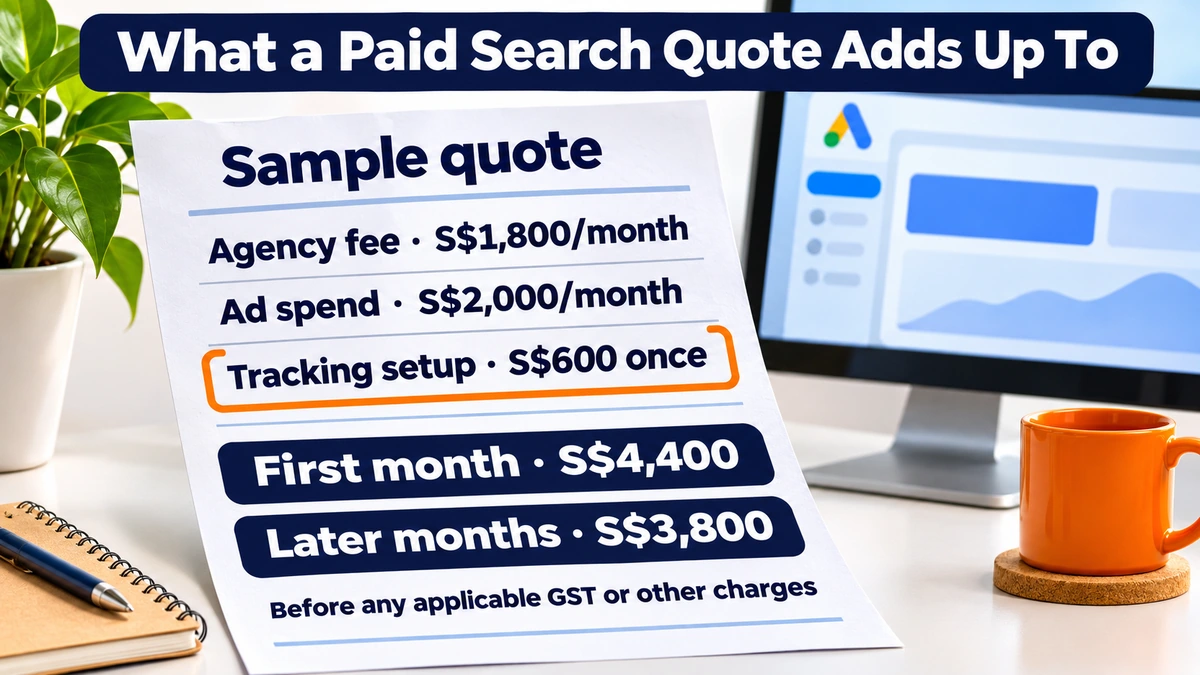
A paid search quote can also split into several charges. Suppose a provider charges S$1,800 a month to manage a campaign, and the business spends S$2,000 on ads. The running cost is S$3,800 per month before any applicable GST or separate charges. A S$600 one-off tracking setup brings the first month to S$4,400 on the same basis.
A three-month test at those prices costs S$12,000 before any applicable GST or other charges. That total gives the owner a figure to compare with the value of booked jobs. The quote should also show which costs continue if the business pauses the ads.
How Should You Measure Digital Marketing Results?
The business and provider should agree on what counts as a result before spending begins. An online shop can count paid orders. A renovation firm may count booked site visits and signed jobs. A company whose buyers call or use WhatsApp can record where the enquiry started and whether the team could serve the customer.
Track what happens after the click
With Google Ads conversion tracking, a company can start with a few actions it can test. An enquiry form should count after a successful submission. A WhatsApp button tap can be tracked separately from a message the team receives. Google also supports different ways to track conversions, including offline outcomes when the business has the records and setup to connect them.
A sales log does part of the work that website tracking cannot do on its own. A staff member can note whether an enquiry came from the service area, asked for work the company does and led to a quote. A weekly review can show whether the ad is bringing the wrong enquiries or whether good leads are waiting too long for a reply.
Compare sales with the cost of getting them
Imagine a campaign costs S$1,200 and brings in 20 enquiries. The cost is S$60 per enquiry. If eight enquiries qualify and four become customers, the cost is S$300 per customer. The same campaign can look affordable at S$60 per enquiry and expensive at S$300 per customer, depending on what each job earns after delivery costs.
Sales cycles also affect the review date. A bakery may see orders from a weekend promotion within days. A commercial supplier may need weeks for a buyer to compare quotes and secure approval. Its first report could focus on qualified enquiries and quotes sent. The team can check signed orders once buyers have had time to decide.
How to Choose a Digital Marketing Partner in Singapore
Each provider should receive the same brief. It can name one goal, who the customers are, what the team can spend and how it currently records leads or sales. A strong proposal should explain where the provider would start, what it needs from your team and how it would check whether the work is paying off.
Review the evidence behind the pitch
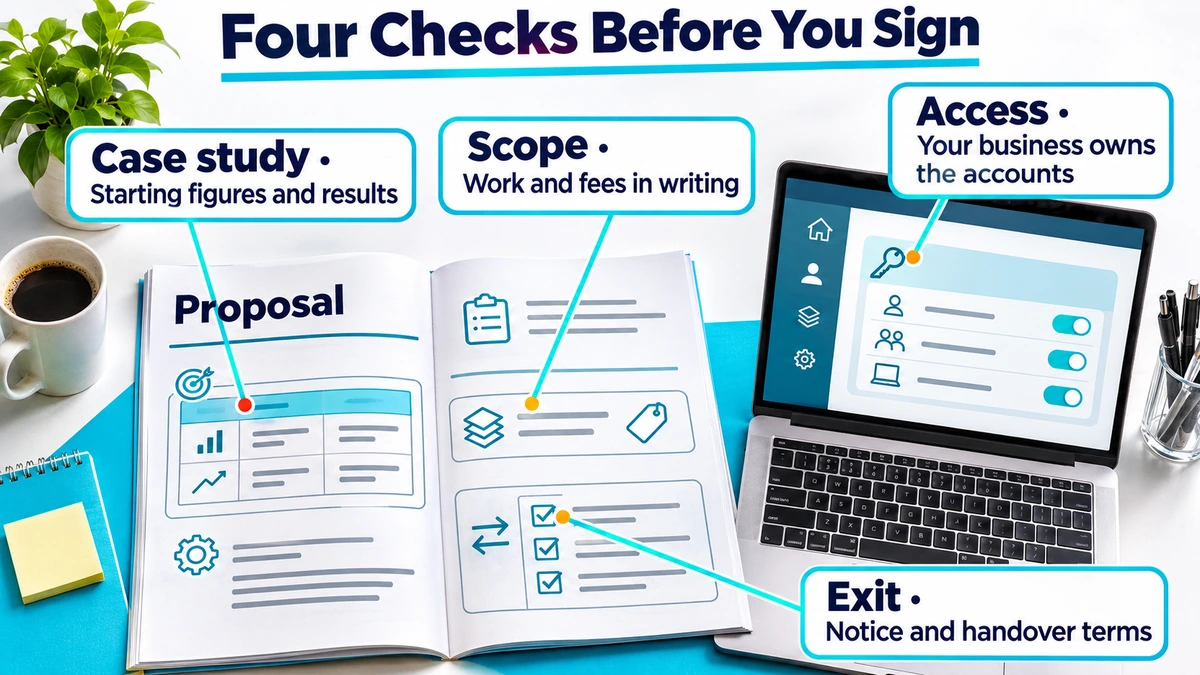
A case study should tell you where the business started and what changed. A rise from 100 to 400 visits is a 300% increase, but it leaves open the question of how many enquiries came from those visits. Ask for an example involving a similar kind of buyer, with the starting figures, timing, spend and outcome. Client details can be removed when the provider needs to protect confidentiality.
An SEO proposal should explain the intended work on your site and the results it will report. Google’s advice on hiring an SEO provider says providers cannot guarantee a top ranking. A more useful promise is a work plan you can check, such as which pages the agency will improve and when it will report changes in qualified search traffic.
Ask what the agreement includes
| Ask each provider | What the answer should cover |
| Who will work on the account? | Day-to-day contact, who checks the work and who covers absences |
| What gets delivered each month? | Pages, ads, posts or reports, with frequency and approval steps |
| How will the team judge the results? | Starting figures, sales goals, reporting dates and the next review |
| What happens if costs or scope change? | Approval before extra work or ad spending |
| Who owns the accounts and files? | Business access to ad accounts, analytics, creative work and website assets |
| How does the contract end? | Minimum term, notice period, handover steps and access after the final invoice |
Check how the agency uses AI
An agency might use AI to draft ad copy, group search terms or prepare a report. The proposal should identify who checks facts, prices and claims before anything goes live. If a provider offers visibility in AI Overviews, Google’s documentation on AI features in Search says the same basic SEO practices apply and there are no extra technical requirements. The agency should name the work it will carry out and explain how it will report what it can observe.
Choose Digital Marketing Services Your Team Can Measure
At MediaOne, we offer digital marketing services across SEO, paid search, social media and content. We can discuss which service suits your business goal, what the work would cover and how to track enquiries or sales.
A consultation with our team can start with one offer, your current monthly spend and the result you want to improve. If you already have campaign or sales reports, those figures can help shape the conversation.
FAQs About Digital Marketing Services
Can an agency work with an existing web developer?
Yes. The agency can identify page or tracking changes while the developer makes and tests them. The brief should say who reviews the changes before release and who checks that forms and tracking still work afterwards.
What should an SME prepare for its first agency meeting?
A list of your main services, service areas and common customer questions gives the agency a starting point. A few examples of good and poor enquiries also help the agency see which customers your team can serve.
Can one campaign target customers in English and Mandarin?
Yes. The budget should cover the work needed to make each version usable, including ad copy, the page it opens and the reply customers receive. Each version can be reviewed against the enquiries it brings. Someone fluent in each language should check the copy before launch.
The agreement should name who replies to routine questions and who handles refunds, complaints or posts that need a manager. The agency can use approved replies for common questions, while your staff can handle cases that need access to order or customer records.
Can an SME run a campaign for one event or product launch?
Yes. A fixed project can cover event ads, a registration page, reminders and reporting. The dates should allow time for approvals and tracking tests before the event. The agreement can also say who keeps the campaign files and who handles follow-up after the event ends.