
A digital marketing certification can cost nothing, a few hundred dollars after government funding, or more than S$10,000.
But here’s something worth understanding before you spend that money: the most expensive qualification isn’t necessarily the one that will help you become a better marketer.
Someone who has completed Google’s free analytics training and built a useful reporting dashboard may be better prepared for an entry-level analytics role than someone who has attended an expensive general marketing programme without doing much practical work.
On the other hand, a career switcher who needs structured lessons, instructor feedback and help building a portfolio may benefit enormously from a longer professional training programme.
The right choice depends on where you’re starting and where you want to go.
Singapore has plenty of options. Universities such as NUS, SMU, SUSS and SUTD offer structured professional learning. Private providers such as Equinet Academy and Vertical Institute offer instructor-led courses. International platforms including Google, Meta, HubSpot and LinkedIn provide certifications that can be completed online.
Some programmes are eligible for SkillsFuture support. Others are completely free.
For this guide, we examined 29 digital marketing certifications and certificate-bearing programmes available to Singapore learners, comparing their syllabi, formats, published prices, subsidies, assessments, instructor information and practical limitations.
We’ll also look at how to choose the right qualification, what employers may expect, and when paying for training makes more sense than learning independently.
Editorial disclosure: This guide is published by MediaOne and written from the perspective of Tom Koh, MediaOne’s CEO. It is an editorial comparison based on publicly available information, not an independently tested ranking of teaching quality or employment outcomes. Prices, reviews, programme availability and funding details were checked against provider and government sources in October 2026. Where information wasn’t publicly established, we’ve identified the limitation rather than making assumptions.
Quick Answer: Which Digital Marketing Certification Is Best in Singapore?
If you’re completely new to digital marketing, I’d start with HubSpot Academy’s free Digital Marketing Certification or the Google Digital Marketing & E-commerce Professional Certificate. Both introduce the fundamentals without requiring you to immediately commit thousands of dollars.
If you want live instruction in Singapore, Vertical Institute, Equinet Academy and OOm Institute offer practical training pathways worth comparing.
If you’re making a substantial career change, look at structured SkillsFuture Career Transition Programmes from NUS, SMU Academy or Nanyang Polytechnic. These require more time, but can provide assessed learning and a broader reskilling pathway.
Already working in marketing? Consider a qualification in the platform or discipline you actually use: Google Ads, Google Analytics, Meta advertising, LinkedIn, email marketing or SEO.
And if you’re moving into AI search optimisation, HubSpot now offers an AEO Fundamentals Certification alongside more specialised implementation training.
My advice: Don’t choose a course simply because the certificate looks impressive on LinkedIn. Choose the one that teaches something you need to do in your next job.
Best Digital Marketing Certifications in Singapore at a Glance
There are two broad categories to consider: structured training programmes offered by local institutions and flexible certifications offered through international platforms.
They’re not interchangeable.
A two-day WSQ course, a postgraduate certificate and a Google advertising exam may all be useful, but they involve different levels of teaching, assessment and practical experience.
Singapore-Based Courses and Professional Certificates
| # | Programme | Format | Published Price / Fees | Best For |
| 1 | Vertical Institute Digital Marketing Course | Online / in-person, 21.5 hours | S$1,650 before GST; from S$643.50 after eligible subsidies, incl. GST | Beginners meeting the entry requirements |
| 2 | Equinet Certified AI-Enabled Digital Marketer | In-person, 40 hours | S$2,319 full fee; S$1,855.20 after bundle discount; from S$556.56 after maximum eligible funding | AI-enabled marketing |
| 3 | SMU Professional Certificate in Digital Marketing | Online / campus, six modules | S$10,464 incl. GST; from S$1,219.20 after maximum eligible funding | Working professionals |
| 4 | NUS Professional Certificate in AI for Excellence in Digital Marketing | Modular, mixed delivery, 42–49 hours | Module-dependent; full certificate fee not publicly confirmed | Managers and business owners |
| 5 | SUSS Graduate Certificate in Digital Marketing | Part-time, minimum six months | Depends on selected modules and eligibility; confirm with SUSS | Postgraduate learners |
| 6 | OOm Institute Practitioner Certificate in Digital Marketing | Three-module pathway | S$424.32 per module after advertised 70% support; complete certificate requires three modules | Practical specialisation |
| 7 | NTUC LearningHub Social Media Marketing Certification | Classroom / live online, 24 hours | S$1,635 incl. GST; from S$190.50 after maximum eligible funding | Social media and guided learning |
| 8 | ClickAcademy Digital Marketing Bootcamp | Instructor-led, two days | S$995 before GST; from S$388.05 after eligible funding, incl. GST | Managers and SME owners |
| 9 | NYP SCTP Certificate in Digital Marketing & Content Curation | In-person, six-month pathway | Full programme fee not publicly confirmed; request current intake pricing | Career switchers |
| 10 | SUTD Graduate Certificate in Digital Marketing | Modular learning | Module-dependent; full certificate fee not publicly confirmed | Technical and analytical marketers |
| 11 | NUS SCTP Bionic Digital Marketer: Enhanced with AI | In-person SCTP, 88.5 hours | S$13,080 incl. GST; from S$1,308 after maximum eligible funding | Structured reskilling |
| 12 | SMU SCTP Advanced Certificate in Digital Marketing | Campus, eight modules | S$20,928 incl. GST; from S$1,478.40 with qualifying Additional Funding Support | Career transition |
| 13 | ASK Training WSQ Digital Marketing Essentials | Classroom, 16 hours | S$981 incl. GST; from S$114.30 after maximum eligible funding | Affordable introductory training |
Pricing checked against official provider pages on 31 October 2026. Subsidised fees represent advertised eligibility-based rates, not amounts guaranteed to every learner. OOm’s S$424.32 is a per-module price, not the cost of its complete three-module pathway. Programme fees and subsidy eligibility may change.
Online and International Digital Marketing Certifications
| # | Qualification | Format | Published Cost | Best For |
| 14 | Google Digital Marketing & E-commerce Professional Certificate | Online, self-paced | Coursera subscription; individual programmes generally advertised at US$49–US$79/month, with Singapore pricing at checkout | Beginners |
| 15 | Meta Social Media Marketing Professional Certificate | Online, self-paced | Coursera subscription; individual programmes generally advertised at US$49–US$79/month, with Singapore pricing at checkout | Social media careers |
| 16 | Google Ads Search Certification | Self-paced / online exam | Free | Search advertising |
| 17 | Google Ads Display Certification | Self-paced / online exam | Free | Display advertising |
| 18 | Google Analytics Certification | Self-paced / online exam | Free | Marketing analytics |
| 19 | Meta Certified Digital Marketing Associate | Certification exam | Exam fee not publicly confirmed; check official booking | Entry-level Meta advertising |
| 20 | Meta Certified Media Buying Professional | Proctored examination | Exam fee not publicly confirmed; check official booking | Experienced media buyers |
| 21 | TikTok Media Buying Certification | Proctored examination | Paid exam; current fee displayed during registration | TikTok advertising |
| 22 | LinkedIn Marketing Strategy Certification | Online exam | Free | B2B marketing |
| 23 | HubSpot Digital Marketing Certification | Self-paced | Free | Broad fundamentals |
| 24 | HubSpot Content Marketing Certification | Self-paced | Free | Content strategy |
| 25 | HubSpot Email Marketing Certification | Self-paced | Free | CRM and lifecycle marketing |
| 26 | HubSpot Social Media Marketing Certification | Self-paced | Free | Organic social marketing |
| 27 | Semrush Academy SEO Certifications | Self-paced | Free | SEO |
| 28 | Digital Marketing Institute Professional Diploma | Online, self-paced | Advertised $1,523 promotional price; $2,175 regular price. Confirm currency and current offer at checkout | Broader professional training |
| 29 | HubSpot AEO Fundamentals Certification | Self-paced | Free | AI search and content optimisation |
International fees may vary by country, currency, subscription, and promotional period. Coursera’s US$49–US$79 range represents its published individual-programme subscription range, not a guaranteed Singapore checkout price for either certificate. DMI displays prices using “$” without an explicit currency label in the reviewed listing. Free certification prices were checked against the providers’ official learning platforms.
Which Certification Should You Choose Based on Your Career Goal?
Before reviewing each provider, here’s how I’d narrow the shortlist.
| Your Goal | Certifications Worth Comparing | What to Prioritise |
| Get your first marketing job | Google Professional Certificate, Vertical Institute, HubSpot Digital Marketing | Broad fundamentals and portfolio work |
| Switch careers | NUS SCTP, SMU SCTP, NYP SCTP | Structured learning and practical assessment |
| Become an SEO specialist | Semrush Academy, HubSpot AEO, OOm GEO & SEO module | Research, technical SEO and content |
| Work in paid advertising | Google Ads Search, Meta Media Buying, TikTok Media Buying | Campaign setup, optimisation and measurement |
| Become a social media marketer | Meta Professional Certificate, NTUC LearningHub, HubSpot Social Media | Content, campaigns and reporting |
| Specialise in analytics | Google Analytics, SUSS, SUTD | Data interpretation and measurement |
| Move into B2B marketing | LinkedIn Marketing Strategy, HubSpot Email Marketing | Lead generation and lifecycle marketing |
| Learn AI-assisted marketing | Equinet, NUS, HubSpot AEO | Practical AI workflows with human review |
| Train SME employees | ASK Training, OOm Institute, ClickAcademy | Relevant tasks and final payable cost |
| Study while employed full-time | SUSS, Coursera, HubSpot and Google Skillshop | Schedule flexibility and realistic workload |
A course isn’t automatically better because it covers more topics. If you already have three years of paid media experience, you may get more value from advanced analytics than from another beginner’s digital marketing programme.
Best Local Digital Marketing Courses and Certificates in Singapore
1. Vertical Institute — Digital Marketing Course
Best for: Beginners, entrepreneurs and career switchers seeking an introduction to several channels.
Format: Live online or in-person; 21.5 hours, including assessment.
Published fees: S$1,650 before GST; example payable fees of S$643.50 or S$973.50 after applicable subsidies.
Provider/contact: Vertical Institute Digital Marketing Course · +65 6950 7023 · contact@verticalinstitute.com
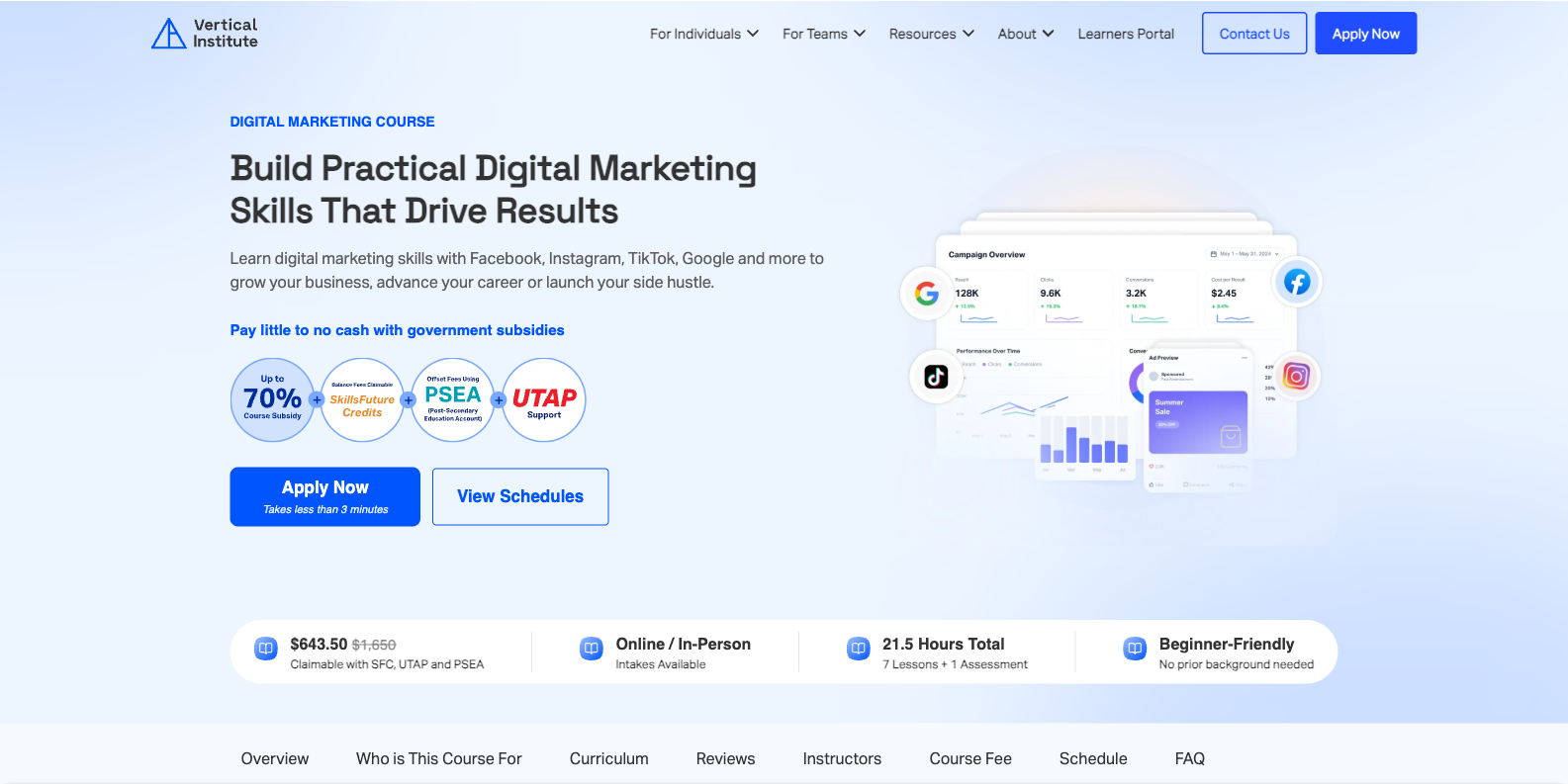
Vertical Institute’s course covers social media marketing, audience research, SEO, Google Ads, email marketing and analytics.
Its practical component includes building content samples, evaluating marketing channels and preparing campaign materials.
That makes it more useful than a course that only explains terminology.
The provider offers online and in-person intakes, which may suit working professionals who cannot commit to a longer programme.
What you receive: A provider-issued Certificate of Completion and an applicable WSQ Statement of Attainment after meeting the assessment and attendance requirements.
Funding: The provider advertises up to 70% course fee funding for eligible learners, with SkillsFuture Credit, UTAP and PSEA support where applicable.
Important limitation: Although marketed as beginner-friendly, its admissions criteria include being at least 21 years old, meeting stated education and English-language requirements, and having at least two years of working experience.
Fresh graduates without that experience should confirm eligibility directly.
Also note that the advertised maximum-subsidy price isn’t available to every applicant.
2. Equinet Academy — Certified AI-Enabled Digital Marketer
Best for: Marketers, business owners and career switchers wanting AI incorporated into practical marketing workflows.
Format: In-person, three modules totalling 40 hours.
Published fees: S$2,319 before discounts; S$1,855.20 after the advertised bundle discount, with a lowest advertised funded amount of S$556.56 under the applicable modular conditions.
Provider: Equinet Academy
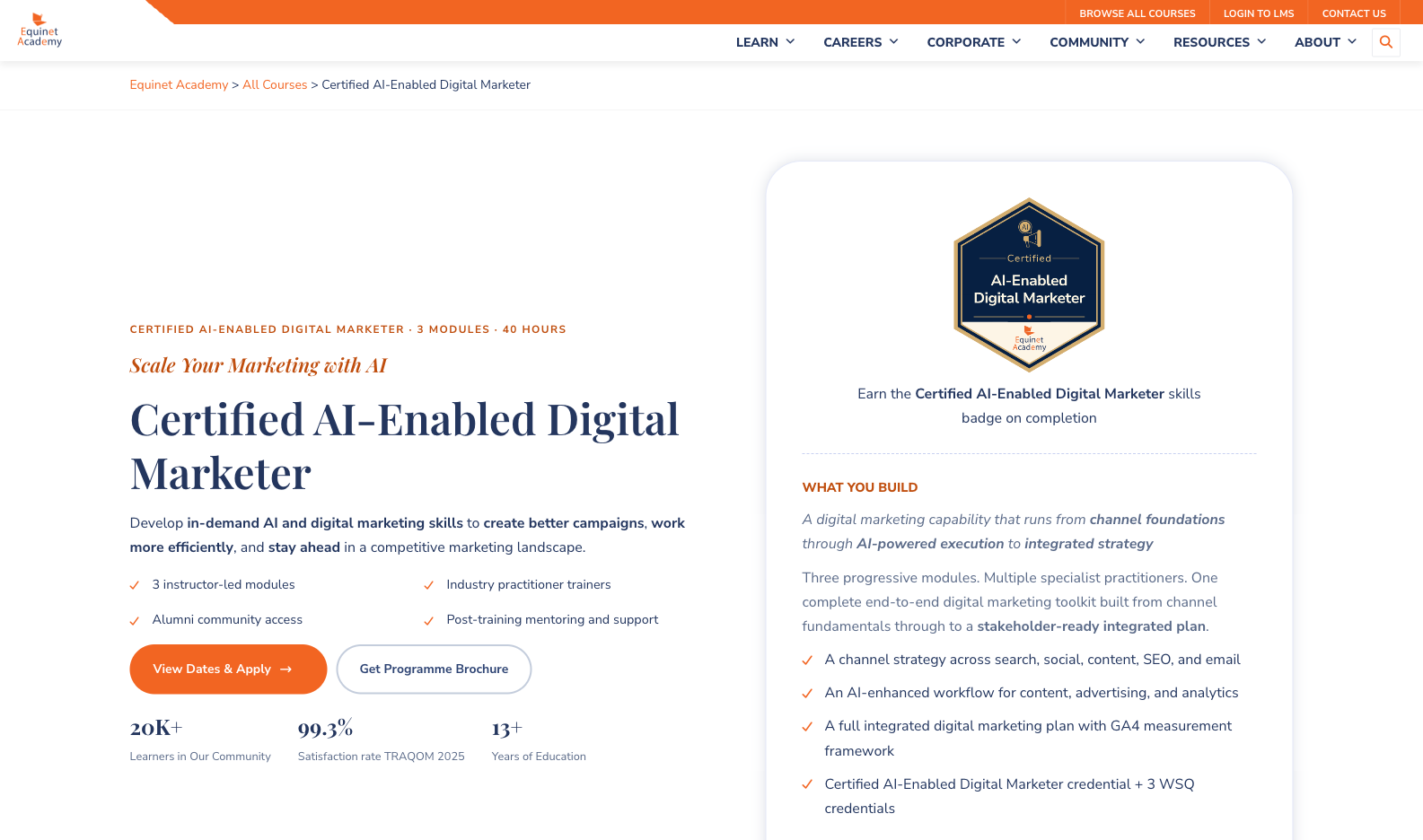
Equinet’s programme combines digital marketing fundamentals, AI applications and integrated strategy.
Learners cover audience research, paid and organic channels, AI-assisted content production, campaign planning and measurement.
The final module focuses on building a marketing plan with objectives, budgets, KPIs and a GA4 measurement framework.
Equinet publishes named trainer profiles, including Ben Huang, who has more than twelve years of performance marketing experience, and Razy Shah, co-founder of 2Stallions.
That helps prospective learners investigate who may teach them, although the assigned trainer should still be confirmed for the selected cohort.
What you receive: Equinet’s Certified AI-Enabled Digital Marketer credential after completing the three modules and assessments, plus applicable module awards.
Funding and reviews: The provider publishes module-specific subsidies, testimonials and a provider-reported 99.3% TRAQOM satisfaction rate for 2025.
Important limitation: Equinet explicitly states that this particular certification pathway does not include a career-placement capstone or dedicated career coaching. Its separate career programmes address those needs.
The advertised bundle discount is also scheduled to end on 31 December 2026.
3. SMU Academy — Professional Certificate in Digital Marketing
Best for: Working professionals, communications specialists, managers and business owners seeking a structured university-backed programme.
Format: Online or campus-based modules, completed within a maximum of three years.
Published full fee: S$10,464 including GST.
Advertised funded fees: As low as S$1,219.20 for eligible learner categories; other profiles pay more.
Provider: SMU Academy Professional Certificate
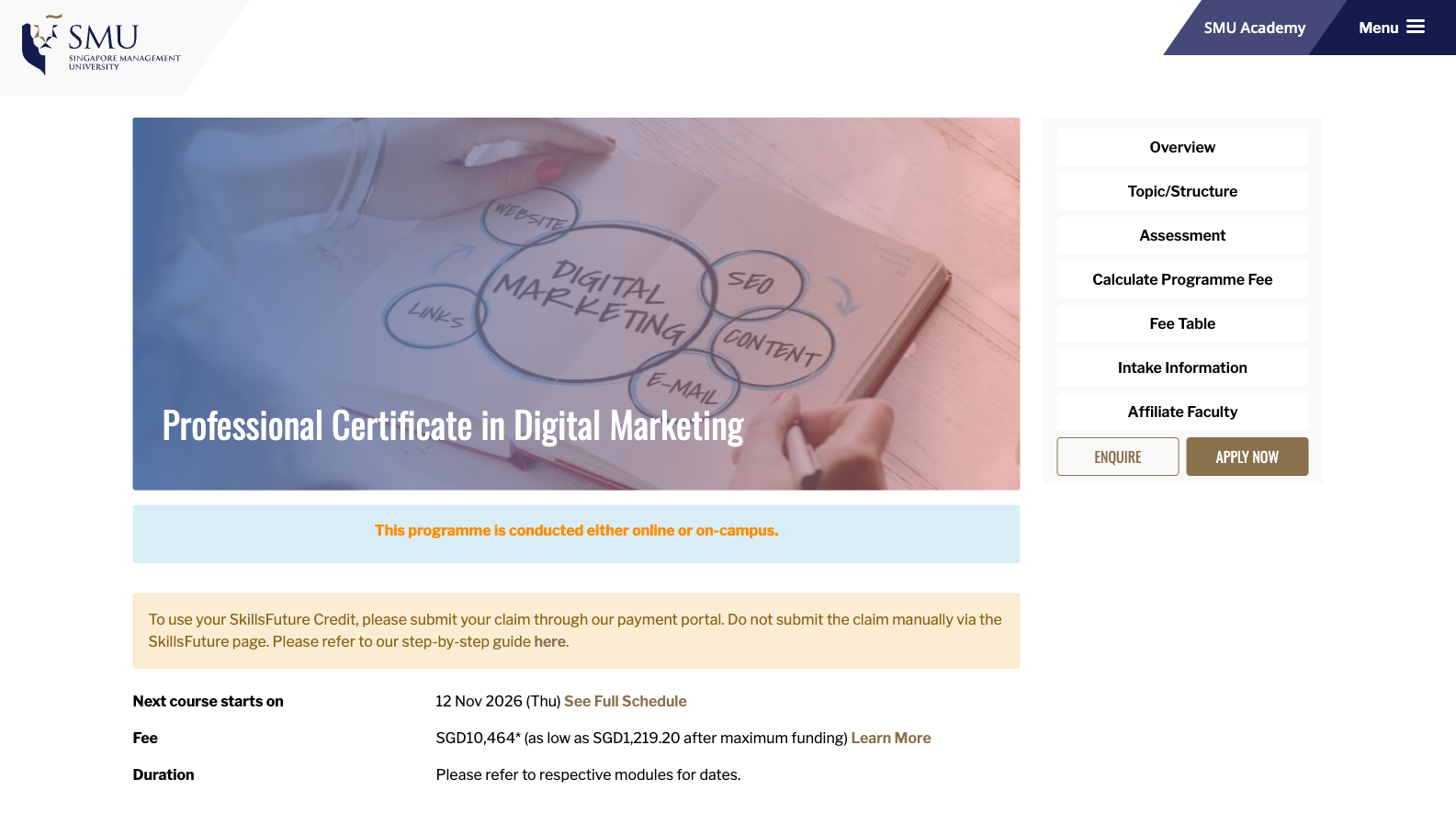
SMU Academy’s certificate requires six modules covering social media, search engine marketing, video, copywriting, email, WordPress and display content.
Assessments may include classroom exercises, group assignments and presentations.
The programme is suited to professionals who want to develop a broader capability across marketing channels while retaining a structured learning environment.
Benefits: Established university provider, modular completion and practical assessment.
Limitations: It’s more expensive and time-intensive than free platform certifications. A participant should confirm the complete timetable and whether modules fit their work commitments.
Also compare the full programme’s subsidised cost with the price of completing only the specific skills modules you need.
4. NUS Business School — Professional Certificate in AI for Excellence in Digital Marketing
Best for: Marketing managers, entrepreneurs and professionals looking to incorporate AI into broader digital strategy.
Format: Selected in-person and asynchronous modules, totalling approximately 42–49 learning hours.
Fees: Based on module selection and eligibility.
Provider/contact: NUS Business School Professional Certificates · +65 6516 7872 · exec_edu@nus.edu.sg
NUS Business School’s professional certificate incorporates AI-enabled marketing topics into a configurable learning pathway.
Instead of assuming every learner needs identical subjects, participants select eligible modules to fulfil the programme requirements.
The approach may suit managers who already understand marketing but want to deepen their skills in digital channels, performance analysis and AI applications.
Benefits: Established executive education provider and flexible selection of relevant learning modules.
Limitations: There isn’t one universal published price for every module combination. Participants should request a complete quotation and confirm the final credential before enrolling.
This is executive professional development rather than a guaranteed entry-level job pathway.
5. SUSS — Graduate Certificate in Digital Marketing
Best for: Working adults seeking postgraduate-level education in digital marketing.
Format: Part-time evening or weekend classes; minimum six months.
Fees: Depend on admission profile and selected courses.
Provider: SUSS Graduate Certificate in Digital Marketing
SUSS requires 15 credit units of coursework and a minimum cumulative GPA of 2.5.
Available subjects include digital branding, SEO, analytics, social media, search engine marketing, content marketing, B2B marketing and generative AI-related content creation.
The programme is stackable toward further SUSS digital marketing qualifications, subject to university rules.
Benefits: Formal postgraduate learning, part-time delivery and a wide range of specialisations.
Limitations: Applicants generally need an undergraduate degree or equivalent recognised qualification. The learning and admission requirements are more demanding than a short training course.
This is worth considering if you want deeper academic and professional development, not simply a quick certificate for your CV.
6. OOm Institute — Practitioner Certificate in Digital Marketing
Best for: SME marketers and beginners who want a modular certificate covering measurement and campaign execution.
Format: Three modules: one compulsory GA4 module and two electives.
Published subsidised fee: Selected modules from S$424.32 each after advertised 70% support.
Provider: OOm Institute Practitioner Certificate
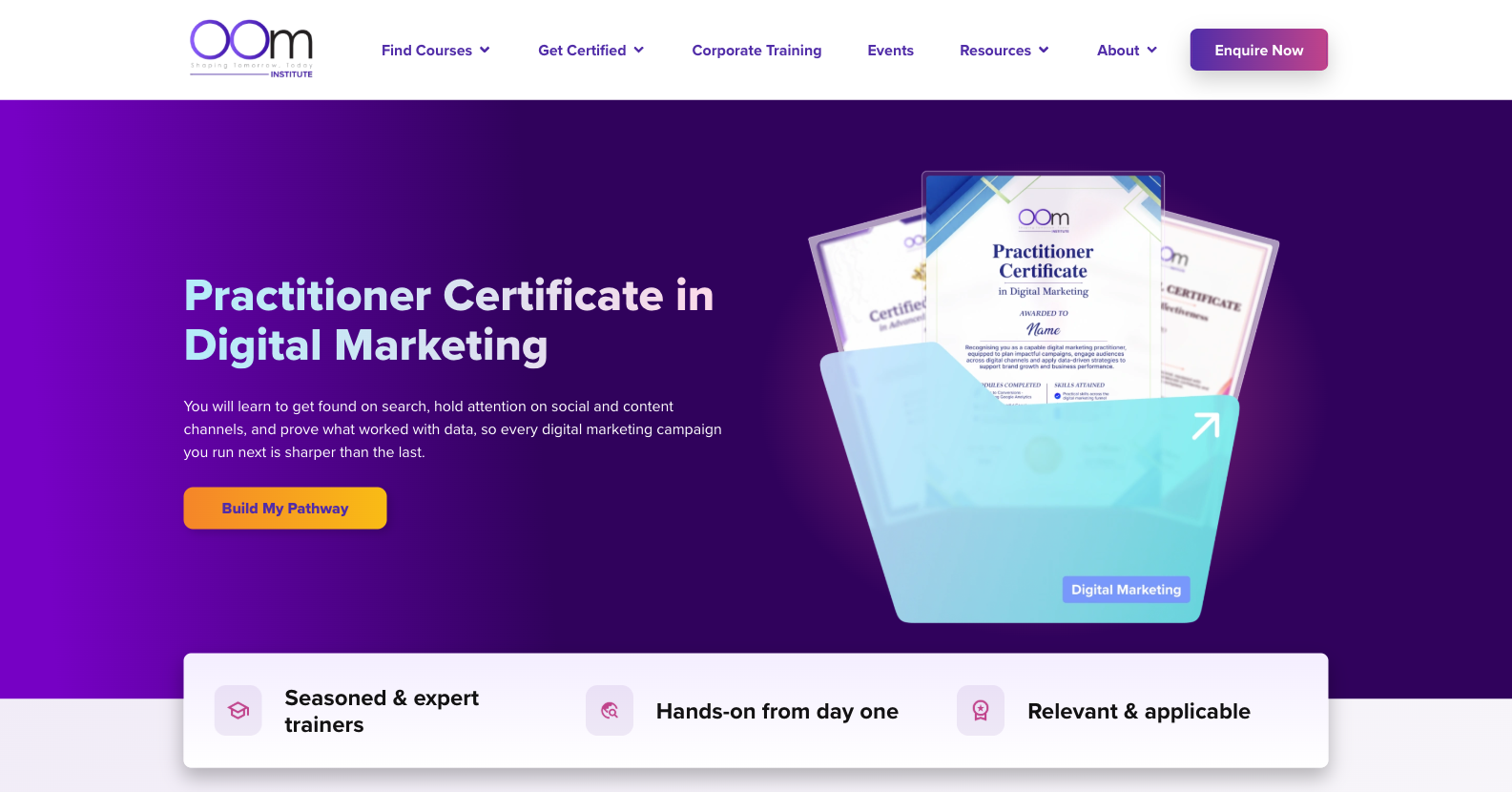
OOm Institute allows learners to build their pathway around Google Analytics 4, search and GEO, Google Marketing, social media, affiliate marketing or short-form video.
This is useful if you want a combination of measurement and a specific marketing discipline.
The compulsory GA4 module helps ensure participants can interpret campaign data instead of focusing entirely on content production.
What you receive: The Practitioner Certificate after completing three modules, along with module completion certificates and applicable WSQ awards.
Important pricing distinction: S$424.32 is an advertised per-module subsidised price, not the cost of the full three-module certificate.
Your total fee depends on the modules selected and your eligibility.
Limitations: Confirm the current trainer, module availability and assessment requirements. The OOm certificate is not automatically equivalent to a Google-issued analytics certification.
7. NTUC LearningHub — Social Media Marketing Certification (Powered by HubSpot)
Best for: Social media executives and learners who prefer guided instruction over independent online videos.
Format: Face-to-face or live online classes; 24 hours.
Full fee: S$1,635 including GST.
Advertised funded fees: S$490.50 for eligible younger self-sponsored citizens and PRs, or S$190.50 for eligible citizens aged 40 and above.
Provider: NTUC LearningHub Social Media Marketing
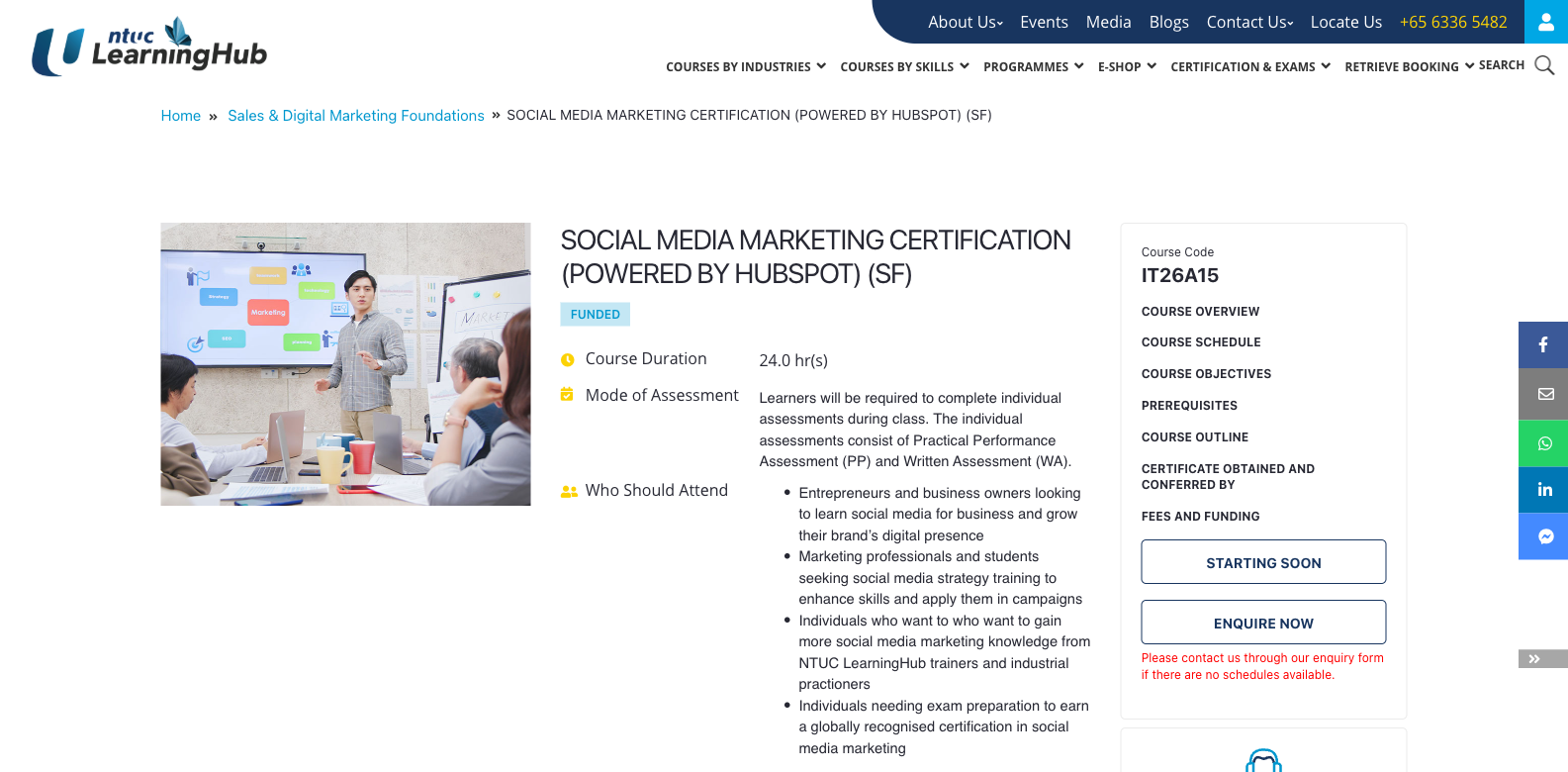
The course covers social media strategy, content planning, community engagement, social advertising, listening and performance analysis.
It includes instructor-led delivery and assessments under the relevant competency framework.
What you receive: NTUC LearningHub’s completion certificate and a WSQ Statement of Attainment after meeting requirements.
Important distinction: The external HubSpot Academy certification is optional and separate. Completing this course does not automatically award that credential.
Limitations: The same underlying HubSpot learning topics may be studied independently for free. The paid programme’s main value is structured instruction, guided practice and local assessment.
Check the detailed Tier 1 funding conditions, as subsidies are subject to eligibility and may be withdrawn if required conditions aren’t met.
8. ClickAcademy Asia — Digital Marketing Bootcamp
Best for: Managers, entrepreneurs and marketers looking for a short overview of digital channels.
Format: Two-day instructor-led programme.
Full fee: S$995 before GST.
Advertised funded fees: S$587.05 or S$388.05 depending on learner category.
Provider: ClickAcademy Digital Marketing Bootcamp
ClickAcademy’s bootcamp introduces customer research, digital channels, content planning and campaign measurement.
It focuses on selecting suitable marketing activities for business objectives, rather than training participants to become specialists in every platform.
The provider also advertises a complimentary refresher class within specified conditions.
Benefits: Short duration, accessible introductory scope and published funding examples.
Limitations: Two days is insufficient for mastering SEO, analytics and paid media. It’s more suitable for understanding how these activities fit together.
Ask for the assigned trainer’s background and the practical output expected from the programme.
9. Nanyang Polytechnic — SCTP Certificate in Digital Marketing & Content Curation
Best for: Career switchers wanting a structured programme covering marketing, content and analytics.
Format: Six-month pathway, consisting of 12 short courses delivered over 15 classroom days.
Fees: Confirm the current course run and funding details.
Provider: NYP SCTP Certificate
NYP’s programme includes digital marketing strategy, data visualisation, video production, storytelling, social media, pay-per-click advertising and analytics.
Classes are delivered face-to-face at the NYP campus, with individual and group assessments.
The longer programme structure may help career switchers develop competence across related tasks without relying on disconnected short courses.
Benefits: Polytechnic provider, structured reskilling and exposure to different marketing disciplines.
Limitations: The programme extends over several months and requires attendance across separate course dates.
Applicants should confirm the next intake, fee, employment-related support and any Mid-Career Training Allowance eligibility. Completing the programme does not guarantee a job.
10. SUTD — Graduate Certificate in Digital Marketing Pathways
Best for: Professionals interested in strategic digital marketing, paid advertising or analytics.
Format: Modular learning.
Fees: Depend on selected modules.
Provider: SUTD Graduate Certificate in Digital Marketing
SUTD offers related graduate certificate pathways in digital marketing strategies, digital advertising and social media marketing.
Subjects include paid search, SEO, web analytics, Google Analytics and digital branding.
The modular structure allows professionals to select a relevant pathway and potentially stack qualifications toward a broader award.
Benefits: University-backed specialist learning and flexible pathways.
Limitations: A quoted module fee isn’t the same as the total cost of completing a graduate certificate. Check the required sequence, prerequisites, fees and assessment methods before enrolling.
11. NUS — SCTP Bionic Digital Marketer: Enhanced with AI
Best for: Professionals seeking structured reskilling in digital marketing and AI.
Format: 88.5 hours across the programme, delivered in person at NUS Business School.
Published full fee: S$13,080 including GST.
Lowest advertised funded fee: S$1,308 for qualifying learners receiving maximum support.
Provider/contact: NUS Bionic Digital Marketer · +65 6601 1314 · yeo.wp@nus.edu.sg
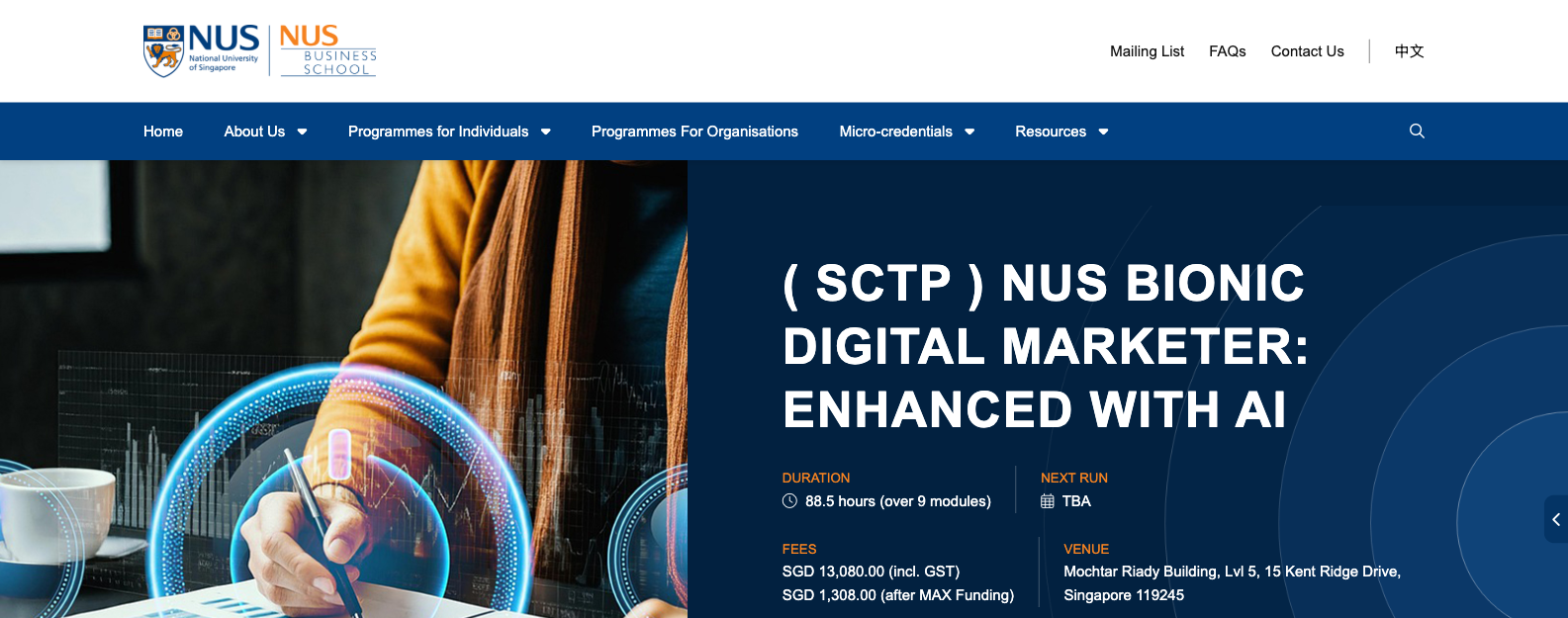
This programme combines digital strategy with practical AI applications.
Topics include consumer behaviour, value-based marketing, branding, search engine marketing, AI-assisted content, online display advertising, ROI and a capstone project.
The programme also identifies faculty members including Eu Gene Ang, Samer Elhajjar and Doreen Kum.
Why it’s worth considering: It goes beyond learning isolated platform tools by connecting campaign execution to strategy and business measurement.
Limitations: The published October 2026 intake began on 13 October, so new applicants should request the next available run. The lowest advertised fee depends on maximum funding eligibility and is not available to every applicant.
Also confirm whether the training format and schedule are realistic if you’re working full-time.
12. SMU Academy — SCTP Advanced Certificate in Digital Marketing
Best for: Career switchers and professionals needing a comprehensive assessed pathway.
Format: Eight on-campus modules, including a capstone project.
Full fee: S$20,928 including GST.
Advertised funded fees: S$6,278.40 for certain younger Singapore Citizens and PRs, S$2,438.40 for eligible citizens aged 40 and above, and as low as S$1,478.40 for qualifying Additional Funding Support recipients.
Provider: SMU SCTP Advanced Certificate
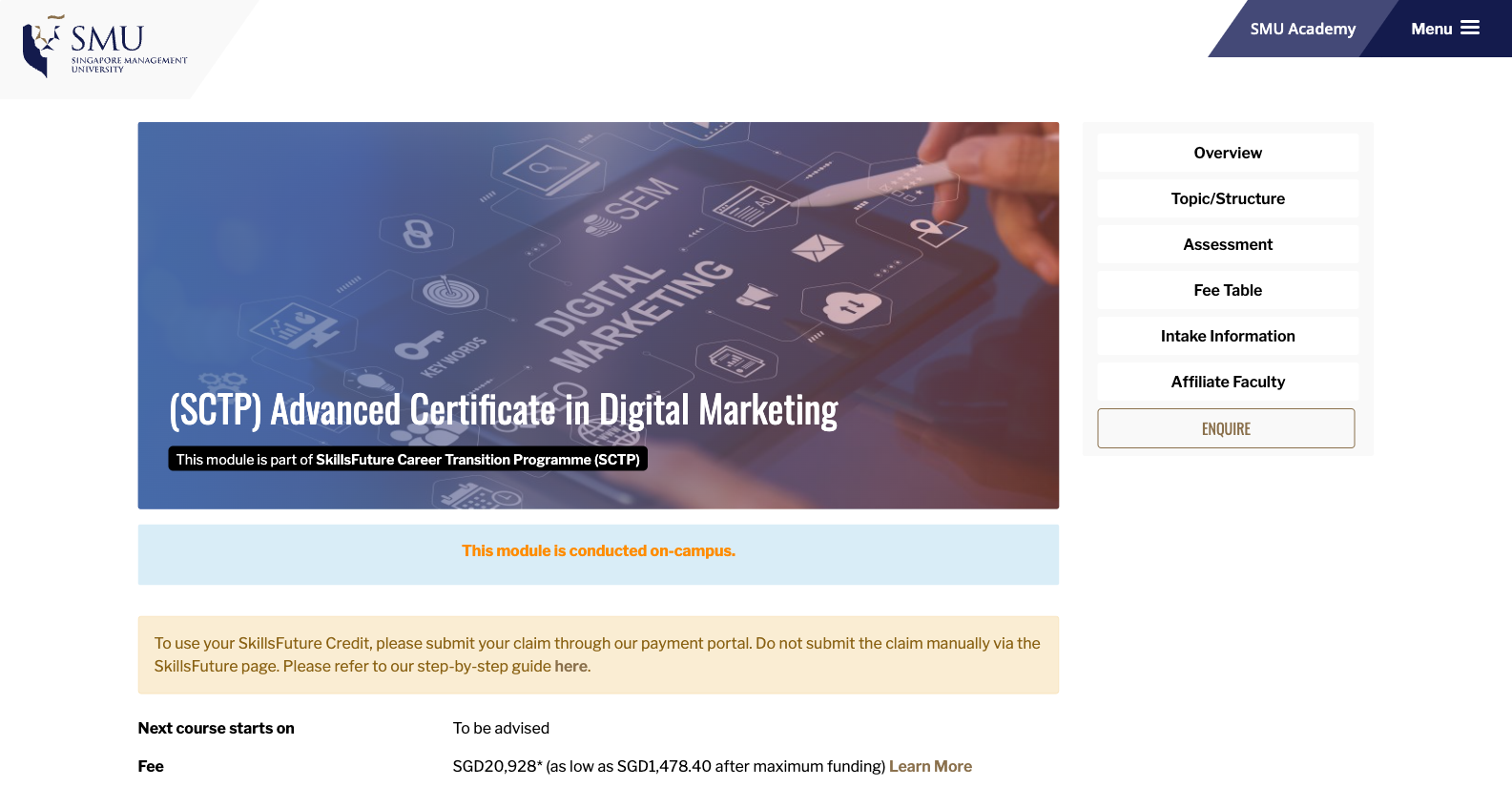
SMU’s programme covers digital strategy, analytics, advertising, social media, content and SEO, website design, marketing automation, personal branding and a capstone project.
The capstone asks learners to apply their knowledge to a business challenge rather than simply memorise concepts.
SMU publishes named trainer biographies, including Kwok Zhong Li, Lin Xuanbin and Kelvin Koo, whose backgrounds span performance marketing, agencies and major brands.
Credential: SMU Academy’s SCTP Advanced Certificate, awarded after completing the required modules and assessments.
Limitations: Applicants need at least two years of working experience, and admission includes an interview and programme commitments. The next intake was listed as to be advised when checked.
Most importantly, the S$1,478.40 figure is for specific learners qualifying for Additional Funding Support, not a general price available to everyone.
13. ASK Training — WSQ Digital Marketing Essentials
Best for: Beginners seeking an affordable, short, locally funded introduction.
Format: Classroom-based, two days or 16 hours including assessment.
Published full fee: S$981 including GST.
Advertised funded fees: S$294.30 for certain eligible learners and as low as S$114.30 for eligible learners receiving 90% support.
Provider: ASK Training Digital Marketing Essentials
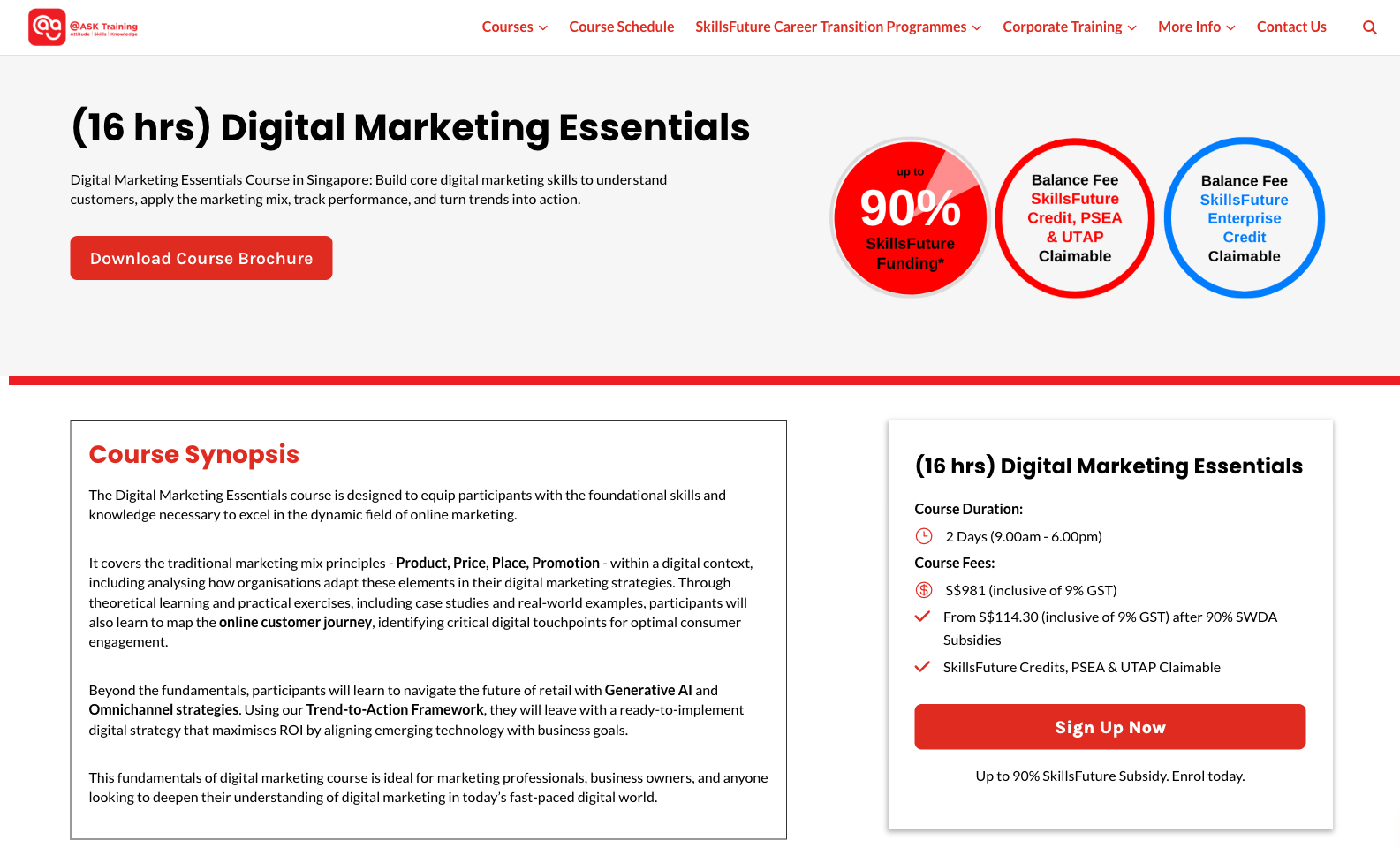
ASK Training’s Digital Marketing Essentials covers digital marketing concepts, the customer journey, basic planning and emerging trends.
The programme includes written assessment and is designed to help learners understand how marketing channels support business objectives.
Its short duration makes it a reasonable starting point for people who want a local classroom experience without immediately enrolling in a longer certificate.
Benefits: Clear full and net-fee tables, short schedule and published SkillsFuture-related support information.
Limitations: This is an introductory WSQ course, not a comprehensive career-transition diploma.
The minimum advertised fee requires the appropriate funding profile. Check the course date, trainer and assessment conditions before enrolling.
Best Digital Marketing Certifications You Can Complete Online
Not everyone needs to attend classes in Singapore.
If you’re comfortable learning independently, international certifications can be an affordable way to develop platform-specific skills.
The main trade-off is the amount of individual instruction, feedback and practical support you receive.
14. Google Digital Marketing & E-commerce Professional Certificate
Best for: Complete beginners seeking a broad introduction to digital marketing.
Format: Eight-course, self-paced programme on Coursera.
Cost: Coursera subscription; check Singapore checkout pricing.
Provider: Google Digital Marketing & E-commerce Professional Certificate
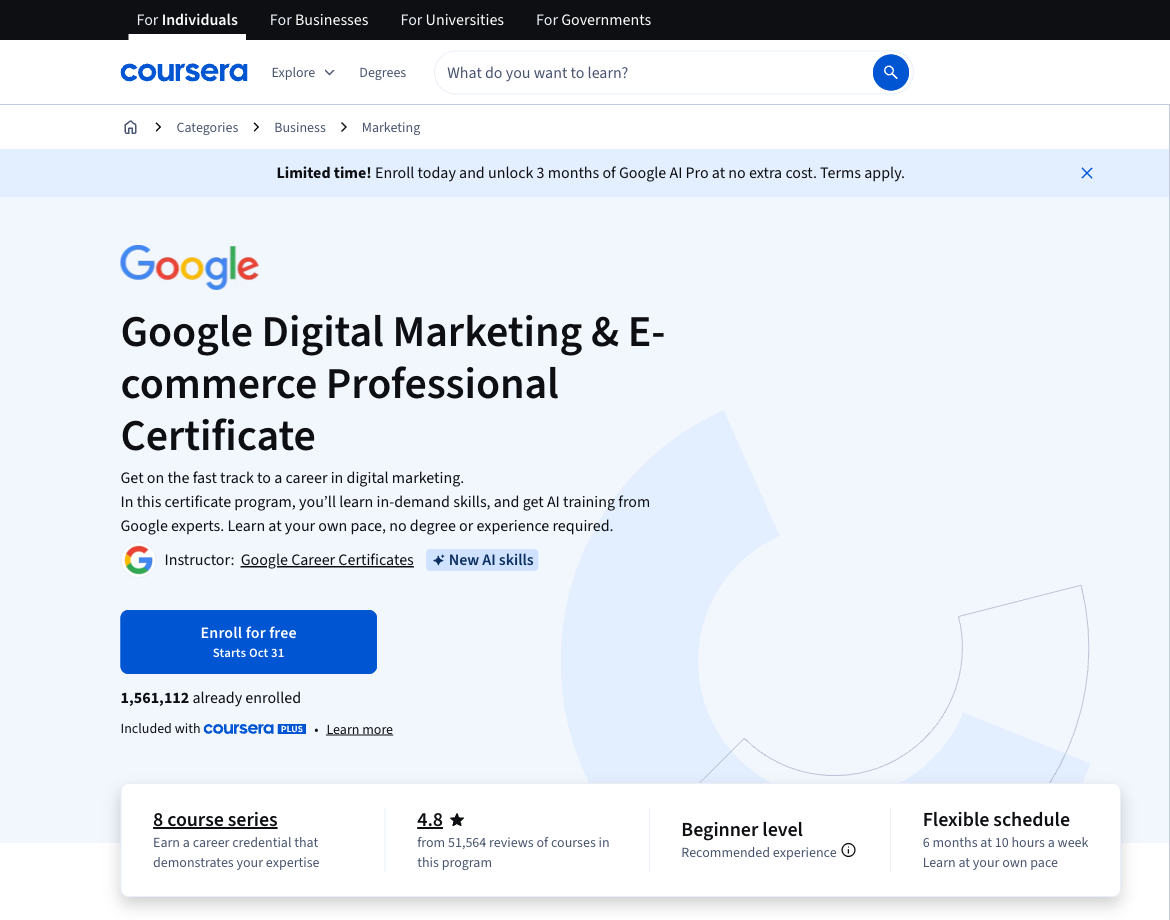
Google’s programme covers search, social media, email, analytics, e-commerce and customer engagement.
It includes practice-based assessments and exposure to tools such as Google Ads, Analytics, Shopify and email marketing platforms.
The course displays an aggregate rating of approximately 4.8/5 from more than 51,000 reviews, although ratings change over time.
Why consider it: Broad entry-level coverage, flexible pacing and applied exercises.
Watch out for: The programme’s career-outcome statistics are based partly on US graduate surveys. Don’t assume the same placement or salary outcomes apply in Singapore.
15. Meta Social Media Marketing Professional Certificate
Best for: Learners interested in social media management and paid social advertising.
Format: Six-course self-paced programme on Coursera.
Cost: Coursera subscription.
Provider: Meta Social Media Marketing Professional Certificate
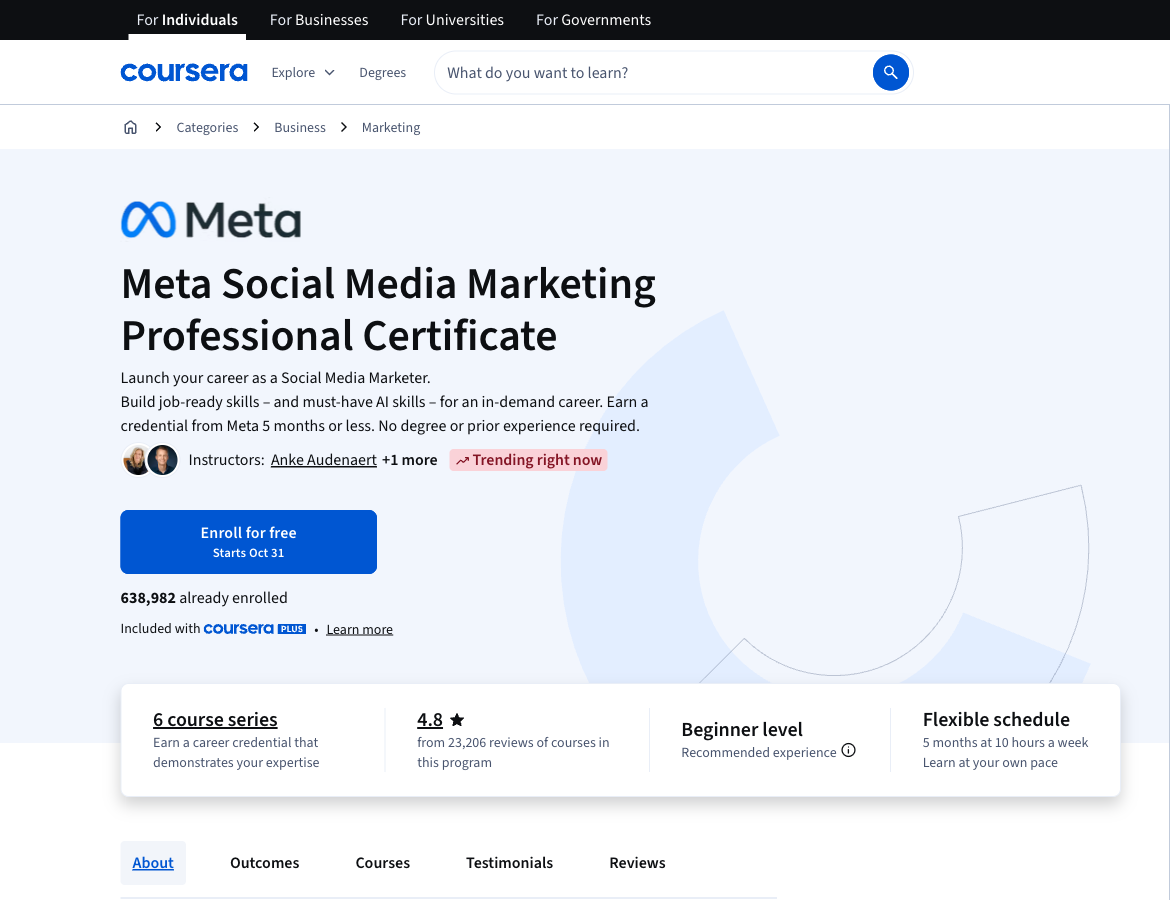
Created by Meta and Aptly, the programme covers social strategy, content, advertising, analytics and a capstone project.
It includes exercises using Meta Ads Manager and introduces AI-related social marketing workflows.
Its official Coursera page identifies instructors Anke Audenaert and Daniel Kob, with a rating around 4.8/5 from more than 23,000 course reviews.
Why consider it: Stronger continuity between organic social learning, paid advertising and a portfolio project.
Watch out for: The Coursera certificate and Meta’s separately assessed Digital Marketing Associate credential should be understood as distinct, even where the programme offers an examination pathway.
16. Google Ads Search Certification
Best for: Paid search executives and performance marketers.
Format: Self-paced preparation and online assessment.
Cost: Free.
Provider: Google Skillshop
This certification covers search campaign planning, bidding, keywords, targeting and optimisation.
It’s one of the most directly relevant credentials for jobs involving Google search advertising.
Main limitation: Passing the assessment proves product knowledge, not that you can manage a profitable real-world campaign.
Pair it with a campaign plan, budget model or reporting exercise.
17. Google Ads Display Certification
Best for: Marketers handling display advertising, audience targeting and awareness campaigns.
Format: Online assessment through Google Skillshop.
Cost: Free.
Provider: Google Skillshop
The Display Certification covers campaign objectives, audiences, creative formats, automated bidding and performance optimisation.
It may be useful for marketers managing brand awareness, remarketing and broader media campaigns.
Main limitation: It is platform-specific and doesn’t independently assess creative design quality or strategic planning across multiple channels.
18. Google Analytics Certification
Best for: Marketing analysts, SEO specialists and campaign managers.
Format: Online learning and assessment.
Cost: Free.
Provider: Google Analytics Academy
Google Analytics training covers tracking, events, reporting, data interpretation and performance measurement.
I’d recommend analytics fundamentals to almost every marketer, regardless of specialisation.
Knowing how to evaluate traffic and conversions helps you decide which activities deserve more investment.
Main limitation: A certificate doesn’t establish that you can troubleshoot complex tracking implementations. Create a sample GA4 reporting project to demonstrate practical ability.
19. Meta Certified Digital Marketing Associate
Best for: Entry-level Facebook and Instagram advertisers.
Format: Meta certification examination.
Cost: Current examination fee depends on the official booking route.
Provider: Meta Blueprint Certifications
The Digital Marketing Associate credential assesses basic Meta advertising knowledge, including campaign objectives, platform capabilities and measurement.
It’s a useful entry-level option if paid social is part of your target job.
Main limitation: It is an examination credential, not necessarily a complete taught programme. Beginners may benefit from preparing through structured coursework first.
20. Meta Certified Media Buying Professional
Best for: Experienced paid social marketers.
Format: Professional-level proctored examination.
Cost: Confirm the fee during official registration.
Provider: Meta Blueprint Certifications
This certification focuses on more advanced campaign management, audience strategies, optimisation and advertising measurement.
It’s more appropriate for someone who already understands Meta Ads Manager.
Main limitation: Not the best starting point for a complete beginner. Professional experience and evidence of campaign decisions remain important.
21. TikTok Media Buying Certification
Best for: Marketers managing TikTok advertising campaigns.
Format: Two-hour proctored examination.
Cost: Confirm current registration fee.
Provider: TikTok Media Buying Certification
TikTok designed this certification for media buyers with at least one year of experience using its advertising platform.
The examination assesses campaign and media buying knowledge, with official study resources available.
Main limitation: This is a specialist qualification rather than a general digital marketing course. TikTok also has recertification requirements.
22. LinkedIn Marketing Strategy Certification
Best for: B2B marketers, demand generation professionals and people managing LinkedIn campaigns.
Format: Online preparation and 60-minute examination.
Cost: Free.
Provider: LinkedIn Marketing Academy
The certification tests full-funnel LinkedIn marketing, awareness, lead generation and campaign planning.
LinkedIn states that the exam has 60 questions, requires a 75% passing score and awards a credential valid for two years.
Main limitation: It focuses on LinkedIn rather than complete B2B marketing operations. CRM integration, attribution and sales alignment require additional skills.
23. HubSpot Digital Marketing Certification
Best for: Beginners exploring digital marketing fundamentals.
Format: Online and self-paced.
Cost: Free.
Provider: HubSpot Digital Marketing Certification
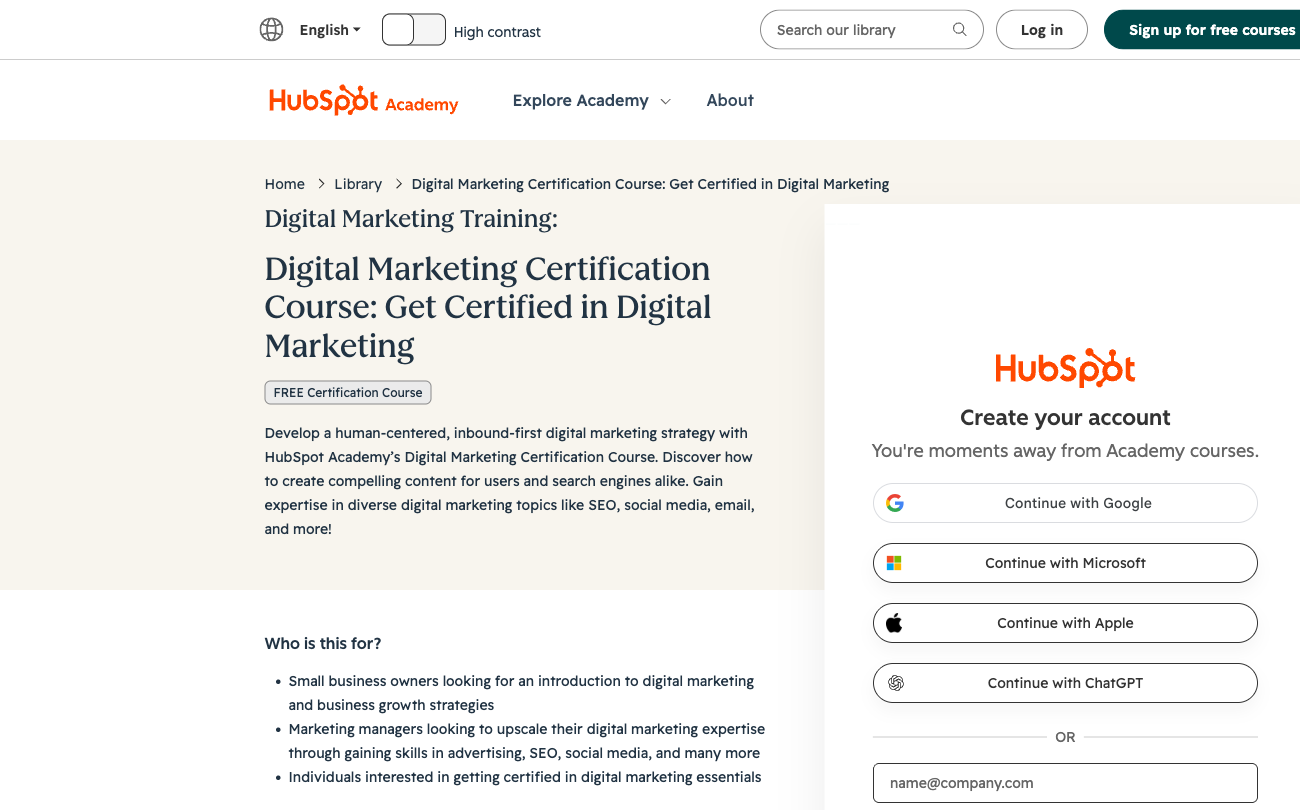
HubSpot’s course introduces digital strategy, SEO, social media, email marketing and digital advertising.
It’s a useful first step before choosing a specialisation.
Main limitation: It’s an introductory programme, not evidence of substantial campaign experience.
24. HubSpot Content Marketing Certification
Best for: Content writers, SEO specialists and editorial teams.
Format: Online and self-paced.
Cost: Free.
Provider: HubSpot Content Marketing Certification
The course covers content planning, storytelling, audience research, distribution and measuring results.
It can help writers understand how individual articles fit into a wider content programme.
Main limitation: The best evidence of content marketing ability is still useful work you’ve produced and evaluated.
25. HubSpot Email Marketing Certification
Best for: CRM and lifecycle marketers.
Format: Online and self-paced.
Cost: Free.
Provider: HubSpot Email Marketing Certification
The course covers segmentation, personalisation, automation, email performance and testing.
It’s relevant for businesses focused on leads, repeat purchases and customer retention.
Main limitation: It won’t automatically prepare you to build complex automation systems or manage large customer databases.
26. HubSpot Social Media Marketing Certification
Best for: Social media executives and community managers.
Format: Online and self-paced.
Cost: Free.
Provider: HubSpot Social Media Marketing Certification
The curriculum includes social strategy, listening, content, community engagement and performance analysis.
It is a reasonable foundation for organic social management.
Main limitation: Watching lessons doesn’t replace working with actual customers, comments, creative testing and platform analytics.
27. Semrush Academy SEO Certifications
Best for: SEO specialists and content marketers.
Format: Self-paced online courses and eligible certification assessments.
Cost: Free.
Provider: Semrush Academy SEO Courses
Semrush Academy offers SEO training in keyword research, technical optimisation, competitor analysis and organic performance.
Its lessons can help learners understand practical SEO workflows.
Main limitation: Some demonstrations naturally focus on Semrush’s own tools. Make sure you learn transferable SEO principles, not only where to click inside one platform.
28. Digital Marketing Institute — Professional Diploma in Digital Marketing
Best for: Professionals seeking broader industry-focused training beyond a short platform exam.
Format: Online, self-paced; the provider advertises 28 hours for its DMI Pro route.
Cost: Paid programme with promotional offers and payment plans. Confirm the final current price at checkout.
Provider: Digital Marketing Institute Professional Diploma
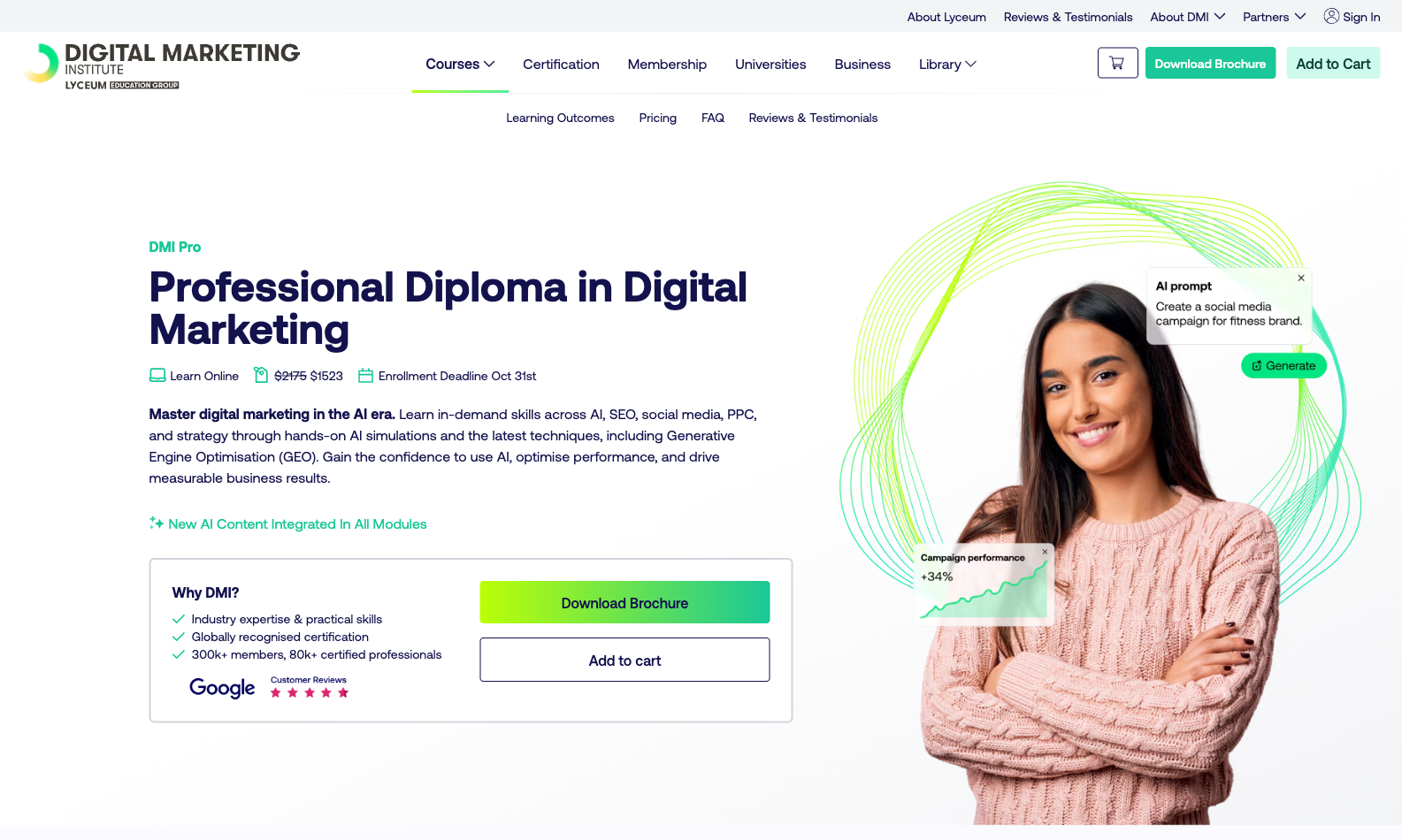
DMI covers digital strategy, SEO, social media, paid advertising, email, analytics and AI-related marketing topics.
Its updated curriculum also includes Generative Engine Optimisation.
DMI publishes information about its industry advisory council and alumni outcomes.
Main limitation: Its website uses dynamically displayed regional prices, so don’t rely on an old promotional figure. Confirm the actual currency, assessment fees, certification terms and what is included.
Provider-published salary and employment surveys are also not guarantees of outcomes for Singapore learners.
29. HubSpot AEO Fundamentals Certification
Best for: SEO professionals, content strategists and marketers preparing for AI-powered search.
Format: Online and self-paced; approximately two hours and twenty minutes.
Cost: Free.
Provider: HubSpot AEO Fundamentals
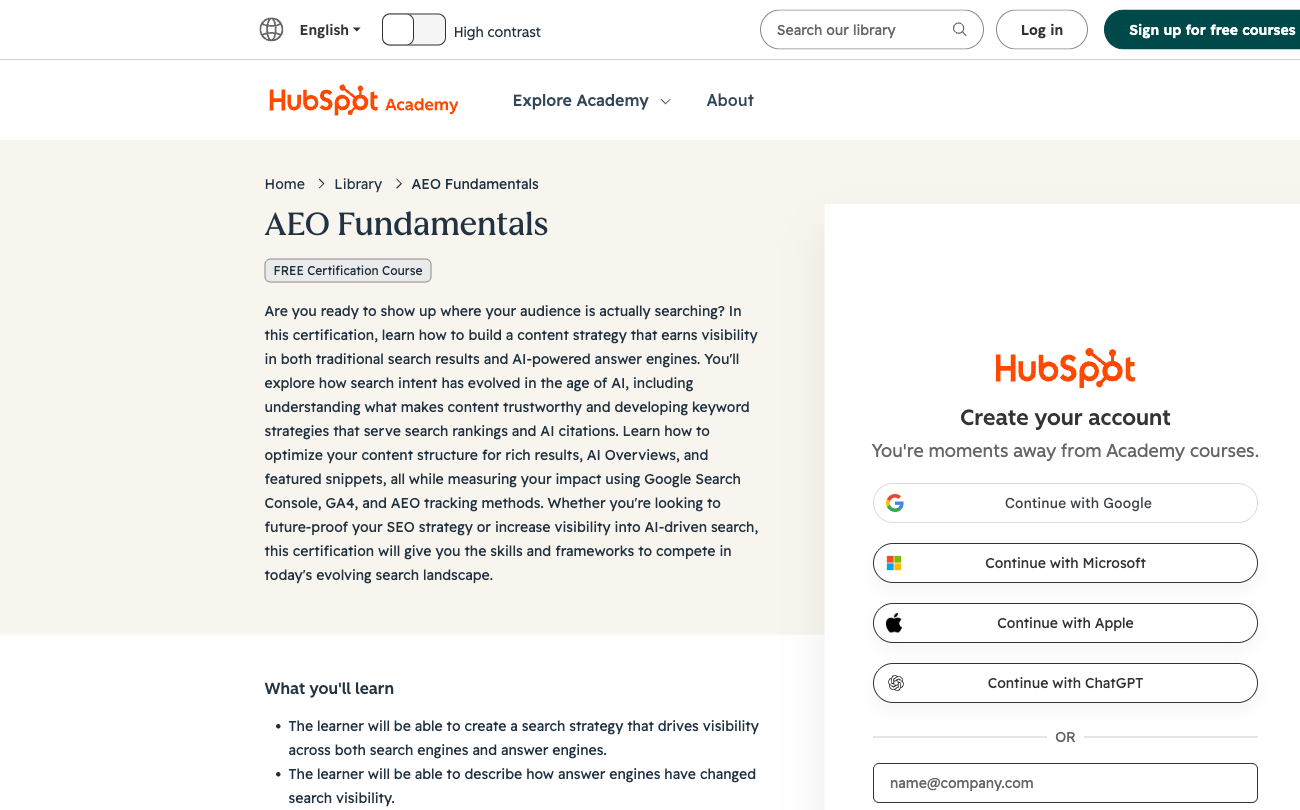
This is one of the more relevant newer qualifications for marketers expanding beyond conventional SEO.
The course covers how answer engines affect search visibility, content trustworthiness, search intent, AI citations and performance measurement.
It includes seven lessons and nineteen videos, with named instructors including Jorie Munroe and Jenn Sanchez.
Why consider it: It addresses AI search specifically rather than simply repeating traditional SEO basics.
Main limitation: This is introductory AEO training. It doesn’t automatically prove you can improve a business’s presence in ChatGPT or Google AI Overviews.
For more implementation-focused learning, HubSpot also offers Implementing AEO With HubSpot, a separate free certification involving its own AEO monitoring tools.
Best Digital Marketing Certifications for Career Switchers in Singapore
Career switchers face a different challenge from experienced marketers.
They don’t just need to learn a new tool. They need enough practical capability to convince an employer that they can perform in a different field.
That’s where a longer SkillsFuture Career Transition Programme may offer advantages over a short online certificate.
NUS’s Bionic Digital Marketer programme combines AI-assisted work with strategy, search, advertising, measurement and a capstone.
SMU’s SCTP Advanced Certificate covers eight modules, culminating in a practical project.
NYP’s certificate focuses on marketing, content production and analytics over a longer learning period.
Those programmes can be useful when you need structure and assessments. But they are also more expensive before funding, and they require substantially more time.
Compare them on three things: what work you’ll be able to demonstrate, whether employment support is actually included, and what you’ll personally pay after confirming eligibility.
A certificate isn’t a job guarantee. The most valuable outcome is evidence that you can perform the tasks required in your new role.
How Much Will You Actually Pay After SkillsFuture Funding?
One problem with course comparison articles is that they often place a full tuition fee beside a maximum-subsidy fee as though those figures are equivalent.
They aren’t.
The table below separates the original published fee from the lowest advertised payable fee.
| Course | Published Full Fee | Lowest Advertised Fee After Funding | Important Condition |
| Vertical Institute | S$1,650 before GST | S$643.50 incl. GST | Learner eligibility and admission requirements |
| Equinet AI-Enabled Digital Marketer | S$2,319 before bundle discount | S$556.56 | Bundle discount and eligible modular funding |
| SMU Professional Certificate | S$10,464 incl. GST | S$1,219.20 | Eligible funding categories |
| NUS Bionic Digital Marketer | S$13,080 incl. GST | S$1,308 | Maximum SCTP funding eligibility |
| SMU SCTP Advanced Certificate | S$20,928 incl. GST | S$1,478.40 | Specific Additional Funding Support eligibility |
| ASK Training Essentials | S$981 incl. GST | S$114.30 | Maximum 90% course fee support |
| NTUC LearningHub Social Media | S$1,635 incl. GST | S$190.50 | Eligible learner and course funding conditions |
| ClickAcademy Bootcamp | S$995 before GST | S$388.05 incl. GST | Eligible enhanced subsidy |
| OOm Practitioner pathway | Three required modules | Individual modules from S$424.32 | Per-module price, not complete certificate |
These are provider-advertised examples, not personalised quotations.
For instance, a Singapore Citizen aged 28 and a Singapore Citizen aged 45 may receive different fee support for the same programme. Other conditions can affect eligibility as well.
Always ask for a written quotation for your actual learner profile.
How SkillsFuture Credit and Training Allowances Work in 2026
SkillsFuture Credit, government course subsidies and training allowances are separate support mechanisms.
They’re often discussed together, but they shouldn’t be treated as interchangeable.
SkillsFuture Credit: S$500 and S$4,000 tiers
According to MySkillsFuture’s official guidance:
| Credit | Who May Qualify | Amount | Eligible Use |
| Opening SkillsFuture Credit | Singapore Citizens aged 25+ | S$500 | Eligible courses listed on MySkillsFuture |
| Mid-Career SkillsFuture Credit | Singapore Citizens aged 40+ | S$4,000 | Selected programmes meeting additional eligibility criteria |
Both credits have no expiry under the current framework.
The additional S$4,000 credit isn’t automatically available for every short course.
For example, an approved university qualification or SCTP may qualify, while a particular standalone workshop may not.
From 1 December 2026, the eligible categories expand to include WSQ full qualifications and selected sector agency-funded courses for qualifying new course runs.
SkillsFuture Mid-Career Training Allowance
Some eligible Singapore Citizens aged 40 and above can also receive financial support while attending selected longer programmes.
According to MySkillsFuture’s training allowance guidance:
- Eligible full-time learners may receive 50% of their qualifying average monthly earned income, subject to a minimum of S300andmaximumofS3,000 monthly.
- Eligible part-time learners may receive a flat S$300 monthly.
- The combined lifetime allowance limit is 24 months.
The actual entitlement depends on age, employment or income history, eligible course selection and attendance.
Don’t assume every six-month programme automatically qualifies.
How to check your eligibility
Before paying a deposit, confirm the course and course-run eligibility through MySkillsFuture, ask the provider for an itemised fee breakdown, and check whether the programme qualifies for the type of credit or training allowance you intend to use.
MediaOne’s SkillsFuture marketing courses guide explains these funding routes in more detail.
Are Google, WSQ and University Certifications Equivalent?
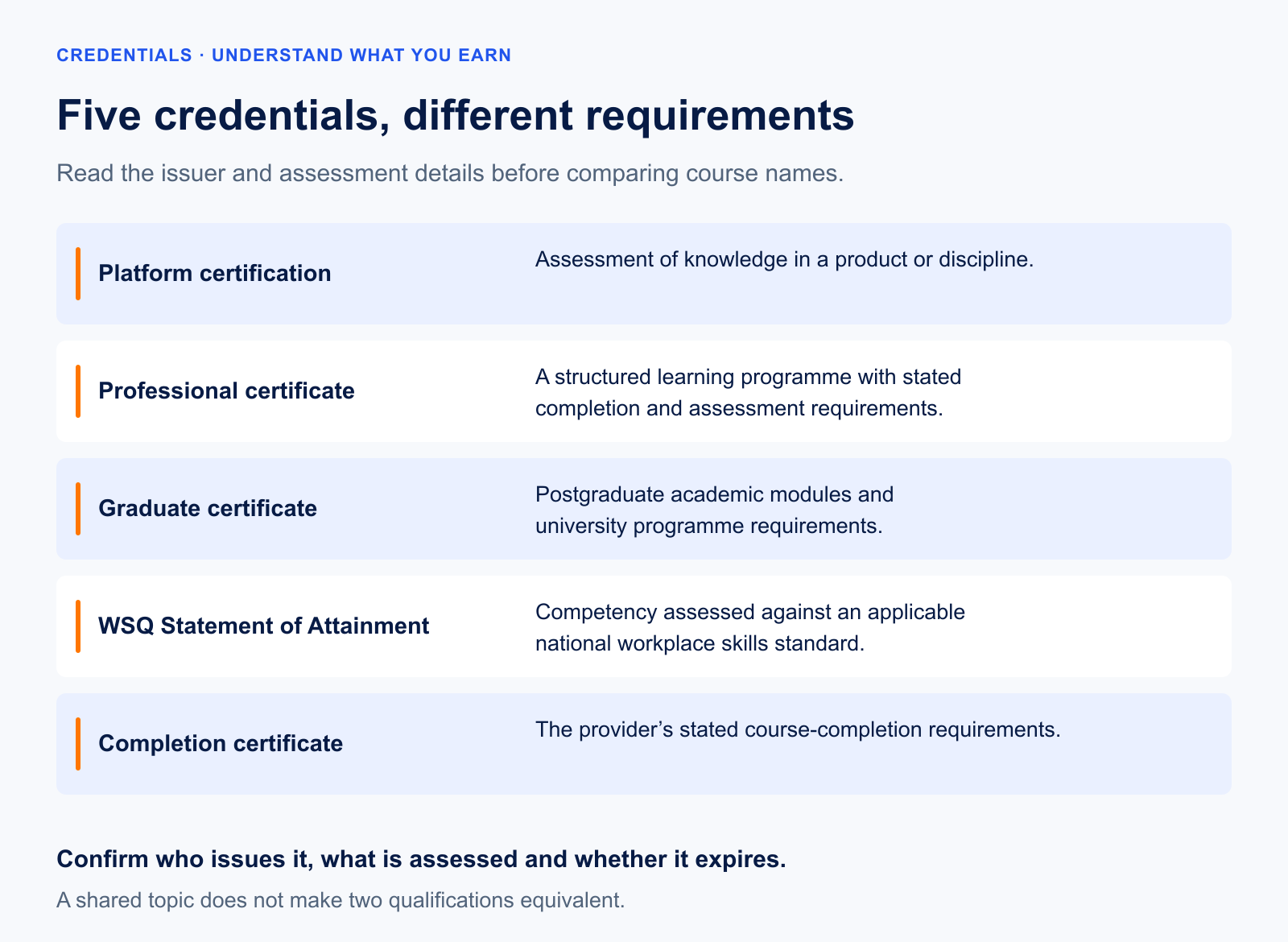
No. They’re different kinds of qualifications.
| Credential Type | What It Usually Demonstrates | Examples |
| Platform certification | Knowledge assessed by the relevant technology provider | Google Ads, Meta Media Buying |
| Professional course certificate | Completion of a defined learning programme | Google Professional Certificate, SMU Academy |
| Graduate certificate | Postgraduate-level academic study | SUSS, SUTD |
| WSQ Statement of Attainment | Competence under an applicable workplace skills standard | Selected ASK Training, NTUC and OOm courses |
| Provider completion certificate | Completion of the provider’s course requirements | Short workshops and bootcamps |
A Google Ads certification may be useful for a performance marketing interview because it concerns a specific advertising platform.
A longer university certificate may provide broader theoretical and practical learning.
A WSQ award provides evidence against an applicable competency standard.
Before enrolling, confirm who issues the credential, what assessment is required, whether it expires and what it demonstrates.
What We Could Verify About Trainers, Reviews and Assessments
Training providers often promote course quality using testimonials, satisfaction scores and trainer biographies.
These can be helpful, but not all evidence is equally meaningful.
| Evidence | Example from Official Sources | What Buyers Should Check |
| Named trainers | Equinet lists Ben Huang and Razy Shah | Confirm who teaches your intake |
| University faculty | NUS lists faculty for Bionic Digital Marketer | Confirm instructional versus academic roles |
| Practitioner backgrounds | SMU SCTP publishes detailed trainer biographies | Check current experience in the subject taught |
| Course ratings | Google and Meta Coursera programmes display large review samples | Read recent comments, not just the average |
| Provider testimonials | Equinet, OOm and other providers publish learner feedback | Distinguish selected testimonials from independent reviews |
| Assessments | SMU SCTP includes a capstone; ASK requires assessment | Ask what learners actually produce |
I’d be cautious about a provider promising that a high satisfaction rating proves its graduates are more employable.
A useful trainer biography establishes experience. A detailed assessment shows what learners are expected to complete. Neither guarantees excellent teaching or employment outcomes.
For an expensive course, ask to see the trainer assigned to your cohort, examples of practical work, recent learner feedback and the programme’s refund or rescheduling conditions.
How to Choose the Right Digital Marketing Certification
This is where I’d spend the most time before enrolling.
1. Start with the job you want
Look at recent Singapore job descriptions for the position you’re targeting.
A performance marketing role may require Google Ads, Meta Ads, GA4 and campaign analysis.
An SEO position may involve technical audits, keyword research, content optimisation and Search Console.
A CRM role may focus on customer segmentation, email automation and lifecycle metrics.
MediaOne’s digital marketing jobs guide provides more context about common roles and career pathways.
The closer the syllabus matches the tasks employers actually require, the easier it is to justify the course.
2. Read the full syllabus
A programme titled “Advanced Digital Marketing” may still spend a substantial amount of time on introductory material.
Ask what topics are covered, how much practical work is required and whether participants learn to interpret results.
A useful syllabus connects planning, execution and measurement.
3. Investigate the trainer
For instructor-led courses, check the trainer’s current professional experience.
Someone teaching paid advertising should be able to explain campaign decisions, budgets, testing and measurement, not simply define advertising terms.
For specialised technical topics, recent experience matters.
4. Look for actual portfolio work
I’d favour courses that require learners to create something useful.
That could be an SEO audit, campaign plan, analytics dashboard, content calendar or performance presentation.
These outputs are particularly valuable for graduates and career switchers.
5. Compare the full cost
Check the original fee, subsidy, GST, registration charges, assessment fees and any subscription costs.
Also consider the number of hours required.
A course that costs less but provides no instructor feedback may be appropriate for one learner and unsuitable for another.
6. Read reviews critically
Look beyond the average rating.
Recent learner comments about instructor clarity, pacing, feedback, practical exercises and administrative support may be more useful than broad statements that a course was excellent.
7. Ask about post-course support
Some providers offer mentoring, alumni access, portfolio reviews or career guidance.
Others provide only course materials and the final certificate.
Ask what support is actually included, how long it lasts and whether any job-related service is guaranteed.
A Practical Scorecard for Comparing Two Certifications
If you’re deciding between several courses, score each against the same criteria.
| Criterion | Question | Score |
| Career relevance | Does the syllabus match your target role? | 0–2 |
| Practical learning | Will you complete meaningful projects? | 0–2 |
| Trainer credibility | Is relevant expertise documented? | 0–2 |
| Credential clarity | Is the issuer and assessment clear? | 0–2 |
| Cost transparency | Can you establish your actual final fee? | 0–2 |
| Learner evidence | Are relevant reviews or results available? | 0–2 |
| Schedule suitability | Can you complete the course realistically? | 0–2 |
| Post-course value | Will you leave with work or support you can use? | 0–2 |
Maximum: 16 points.
This is an editorial decision tool, not an independently validated quality ranking.
If two programmes score similarly, prioritise the criteria that matter most to your situation.
For a career switcher, practical assignments and support may deserve more weight. For a working specialist, syllabus relevance and flexibility may matter more.
What Should You Do With a S$500 Budget Versus S$5,000?
Let’s make this practical.
Suppose you’re a fresh graduate with S$500 available for training.
You could begin with HubSpot’s free Digital Marketing Certification, Google’s free advertising and analytics training, and selected SEO courses.
Then use what you’ve learned to build a small portfolio.
You don’t necessarily need to spend the entire S$500 immediately.
Now consider a mid-career professional with a S$5,000 training budget who wants to switch industries.
A funded SCTP programme with structured assignments, instructor feedback and relevant employment support may be a better fit than independently collecting several platform certificates.
That doesn’t make the more expensive route universally better.
It simply addresses a different problem.
The right budget is the amount needed to close the skills gap, not whatever a course provider can persuade you to spend.
What Should Your Marketing Portfolio Include After Certification?
Don’t stop after downloading the certificate.
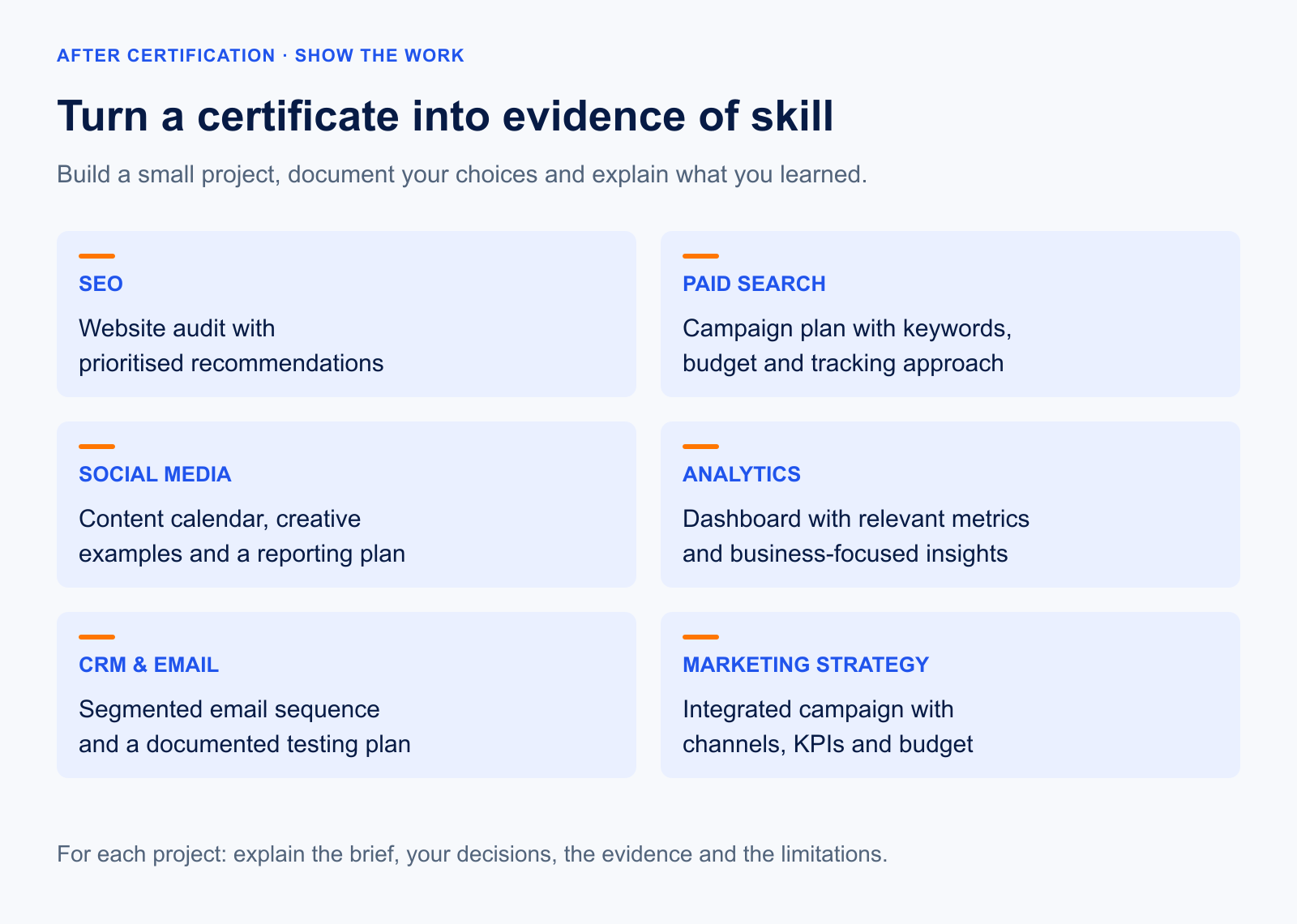
Build a few projects that demonstrate what you can actually do.
| Target Role | Useful Portfolio Project |
| SEO executive | Website audit with prioritised improvements |
| Paid search specialist | Google Ads campaign plan with budget and tracking |
| Social media marketer | Content calendar and performance report |
| Content strategist | Editorial brief, published sample and results |
| Marketing analyst | GA4 dashboard with recommendations |
| Email marketer | Segmented email sequence and testing framework |
| Digital marketing generalist | Integrated campaign plan with KPIs and budget |
Even if you’re not managing a live client account, you can create a clearly labelled practice project.
Just don’t present simulated results as real customer outcomes.
Hiring managers should be able to see your reasoning, assumptions and decisions.
Digital Marketing Skills Worth Learning Beyond 2026
AI is changing how marketers research, create, optimise and measure campaigns.
But I’d be cautious about courses that promise to teach dozens of AI tools without explaining how those tools improve real work.
Three areas are particularly worth understanding.
AI-assisted execution: Using AI for research, drafts, campaign planning and analysis while maintaining human responsibility for accuracy and judgement.
Measurement and first-party data: Understanding GA4, conversion events, attribution limitations and how campaign performance connects to business outcomes.
Search beyond traditional rankings: Understanding how SEO, Answer Engine Optimisation and Generative Engine Optimisation overlap without assuming that anyone can guarantee placement in an AI-generated answer.
MediaOne’s AI marketing in Singapore guide discusses how businesses can evaluate practical AI applications rather than simply collecting tools.
The broader lesson is that the best marketers won’t necessarily be the people with the largest collection of certificates.
They’ll be the people who can learn new systems, evaluate information and make useful decisions as platforms change.
So, Which Digital Marketing Certification Should You Choose?
There isn’t one perfect certification for every Singapore marketer.
If you’re a complete beginner, I’d start with Google’s Digital Marketing & E-commerce Professional Certificate or HubSpot’s free Digital Marketing Certification before committing to an expensive programme.
If you prefer structured local learning, compare Vertical Institute, Equinet Academy, OOm Institute and ASK Training based on the actual skills and assessments included.
For a serious career change, investigate NUS, SMU Academy and NYP’s SkillsFuture Career Transition Programmes. They’re longer commitments, but may be a better match if you need systematic training and practical outputs.
If you’re already working in marketing, I’d usually recommend a targeted qualification in the area you want to improve: Google Ads, Meta advertising, analytics, SEO, email marketing or AI search.
Whatever you choose, don’t stop at the certificate.
Use the course to build something, solve a problem, and demonstrate what you’ve learned.
The best digital marketing certification isn’t necessarily the most expensive or prestigious. It’s the one that helps you perform work you couldn’t confidently perform before.
That’s what makes the investment worthwhile.
Frequently Asked Questions
Which is the best digital marketing certification in Singapore?
It depends on your goal. Complete beginners can start with HubSpot or Google’s broad online programmes. Learners wanting local instruction can compare Vertical Institute, Equinet Academy and OOm Institute. Career switchers may benefit from structured NUS, SMU or NYP programmes.
What is the best free digital marketing certification?
Google Ads, Google Analytics, HubSpot Academy, LinkedIn Marketing Academy and Semrush Academy all offer useful free certification options. Choose based on the discipline relevant to your intended role.
Which digital marketing certifications do Singapore employers recognise?
Employers may be familiar with credentials from Google, Meta, established universities and recognised training providers, but requirements vary by company and role. Practical experience and portfolio evidence remain important.
Can I become a digital marketer without a degree?
Yes. Some employers hire based on skills, relevant experience and demonstrated ability. However, certain positions or postgraduate programmes have formal academic requirements.
How much do digital marketing certifications cost in Singapore?
Options range from free platform certifications to courses costing several thousand dollars. Subsidised local programmes may have significantly lower payable fees for eligible learners.
Can I use SkillsFuture Credit for Coursera?
Selected online subscription arrangements and eligible courses can be supported through SkillsFuture Credit, but not every international course purchase qualifies. Check the approved arrangement through MySkillsFuture before paying.
Are WSQ certifications better than Google certifications?
They demonstrate different things. WSQ awards relate to specific workplace competencies, while Google certifications focus on Google’s products and related knowledge. Neither is automatically better for every role.
Is a SkillsFuture Career Transition Programme worth it?
It can be suitable for someone needing structured reskilling and practical assessment. However, evaluate the time commitment, funding, admissions requirements and support available. A programme does not guarantee employment.
Do digital marketing certifications increase salary?
Not automatically. Salary progression depends on experience, responsibilities, employer demand and demonstrated performance. Treat salary statistics published by training providers as contextual survey findings rather than promises.
Should I learn SEO or paid advertising first?
Choose based on the role you want. SEO is relevant to organic visibility and content strategy, while paid advertising involves campaign budgets, targeting and measurement. Generalists often benefit from understanding both.
What should I check before paying for a course?
Request the syllabus, final payable fee, trainer details, assessment requirements, certificate issuer, timetable, refund rules and available learner feedback.