A Singapore SME’s backlink report can list an industry publication citation and an unrelated footer link as two equal entries. In practice, those placements have different purposes and audiences. At MediaOne, we inspect the referring paragraph before evaluating contextual backlinks, then check the publisher, destination and way the link was obtained.
A third-party authority score can support research, but it cannot turn a weak editorial fit into a useful recommendation. Paid placements also need correct link qualification under Google’s policies. Our SEO team works across technical checks, content and reporting, so we consider the path from a reader’s question to a relevant page and an eventual enquiry.
We want every placement to have an explanation a client can challenge. You will be able to shortlist prospects, approach editors, check redirects and measure outcomes.
Key Takeaways
- Judge links by editorial relevance, real audience fit and useful destinations before comparing authority scores.
- Use a four-part placement check covering topic, surrounding text, anchor wording and publisher quality.
- Earn references through original evidence, trade relationships, useful corrections and carefully pitched contributions.
- Qualify paid links properly and avoid bulk exchanges, link networks and forced commercial anchors.
- Record the live referring page, final destination, referral visits and search trends without claiming one link caused a ranking gain.
Editorial Context Gives a Link Purpose
A contextual link sits within the main text of a webpage, where the surrounding sentences explain the destination. A Singapore accountant cited in a trade article about corporate tax filing has a clear connection to the topic. The same website linked in a generic footer offers less information about why its services are relevant.
Google uses links to help discover pages and assess relevance. Its link and anchor text guidance recommends descriptive wording that fits the surrounding content. Neither a link’s position nor its anchor guarantees a ranking increase. The publisher’s credibility, page quality, destination and wider search competition still influence the result.
We separate editorial links from useful non-editorial references. An accurate listing in a professional association directory can help customers confirm membership and contact details. A supplier profile may support referrals even though its link sits outside an article. We would keep both when they serve a business purpose, while giving editorially relevant articles greater attention in outreach.
One Link Per Article Is No Rule
There is no Google requirement to secure exactly one link from each page. An article covering different sources may reasonably cite several pages from the same organisation. A second link becomes unnecessary when it repeats the first reference without answering another reader question.
We recommend starting with one genuinely helpful citation, then leaving the final decision to the editor. Repeated exact-match anchors and multiple links to the same sales page can make an otherwise useful contribution look manufactured. Compare referring pages and audiences instead of setting an arbitrary links-per-article target.
Score Prospects Before Sending Outreach
Our starting point for contextual backlinks is a practical four-part screening check. It helps teams reject poor opportunities early, before an attractive domain score or a cheap placement quote influences the decision.
| Check | Accept When | Reconsider When |
|---|---|---|
| Topical relevance | The page discusses a problem your resource directly addresses. | Its subject is only loosely connected to your business. |
| Editorial context | The author can explain the reference naturally in the body copy. | The link must be inserted into an unrelated sentence. |
| Anchor fit | Concise wording describes the destination in plain language. | The publisher demands repeated commercial search phrases. |
| Page quality | A real publisher, useful content and an identifiable audience are apparent. | The site exists mainly to sell outbound links or publish near-identical articles. |
These checks are MediaOne’s recommended editorial framework, not an official Google scoring system. A tool’s Domain Authority or Domain Rating can help compare websites, but these are third-party metrics and do not reveal Google’s private assessment of a backlink. A modestly rated specialist publication may reach more relevant buyers than a prominent general-interest site.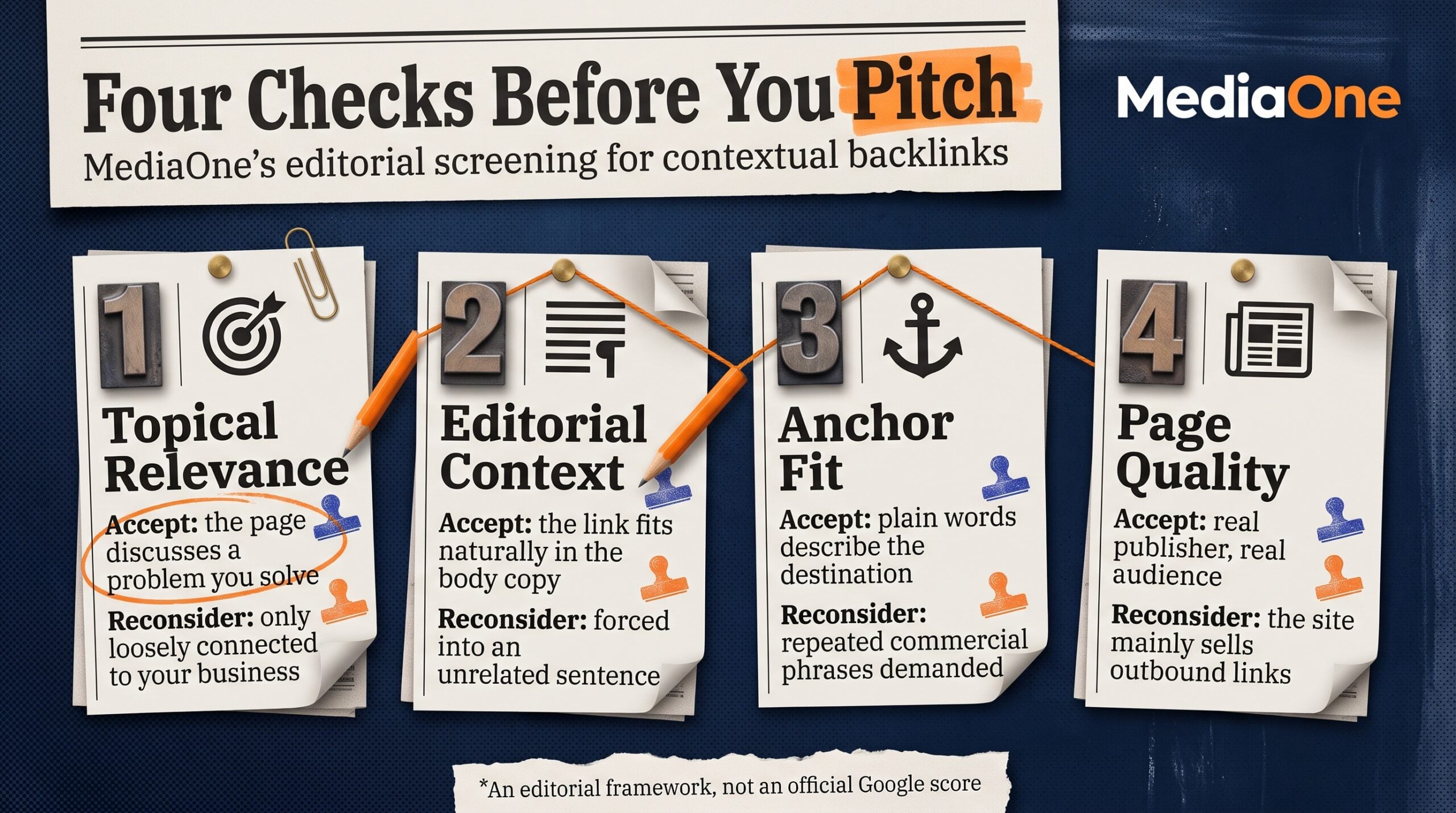
For Singapore firms, look first at sector publications, professional bodies, trade associations and established partners. A logistics supplier may benefit from a freight-industry article, while a tuition provider may find a relevant education resource more suitable. Do not assume a Singapore domain is automatically the right fit, since an overseas specialist outlet may reach the exact purchasing team you serve.
Check the page manually. Review its author and recent content, search for obvious paid-link footprints and confirm the target page can be accessed. The site: search operator can help locate pages, but its results are incomplete and should not be used as a definitive indexing test. For your own site, use Search Console URL Inspection to check indexing details.
Our off-page SEO audit approach for Singapore websites places this editorial review alongside technical checks and brand references. We would reject a topically irrelevant placement even if a vendor promises a high authority score.
Start With References You Can Earn
Free contextual backlinks still require research, useful content and someone willing to edit a page. We advise starting with existing relationships before sending broad cold outreach. A business already mentioned by an industry body has a more credible reason to request a source link than an unknown company asking for an unrelated insertion.
Reclaim Existing Brand Mentions
Search your company name, product names and named spokespeople. Review event recaps, trade write-ups and interviews that already mention your organisation without linking to the resource discussed. Ask politely if the editor would add a relevant reference. Accept the decision if the publisher prefers plain text.
A practical example is a Singapore engineering firm named in a conference recap. A link to the firm’s published technical paper may help attendees find the underlying work. A link to a generic quote-request page would offer less value. Confirm the paper is still accurate before contacting the organiser.
Use Associations and Partner Resources
Check legitimate member directories, professional associations, approved partner lists and event resource pages. These may offer editorial in-text references, directory entries or both. A directory listing is not automatically a contextual link, and its value should be judged on customer usefulness and accuracy.
We would skip mass submission to generic directories. Membership fees can pay for real association benefits, but they do not buy a guaranteed SEO gain. Ask if the listing helps customers assess the business or find a useful publication, then check any link terms separately.
Pitch Original Guest Contributions
Contribute expertise that the host publication needs. A Singapore HR consultant could explain a documented change in local employment procedures, citing official rules and a practical employer checklist. The article should still be worth publishing if the editor removes the author’s promotional link.
Our guest posting guidance for Singapore businesses covers editorial screening and the risks of thin, link-led submissions. We prefer named editors, clear authorship and a readership that overlaps with the client’s buyers. We decline requests for large batches of recycled articles written primarily to carry anchor text.
Create Resources Worth Citing
A publisher needs a reason to reference you. We prefer contextual backlinks that point to stable primary resources. Short-lived campaign pages can expire and leave editors with broken references. Product pages alone seldom answer the research questions in an independent article. Useful source material can include a dated regulatory checklist, a transparent cost comparison, an original analysis of the company’s own data or a technical explanation reviewed by a qualified employee.
Keep the evidence close to the claim. If you publish internal survey findings, state the sample, collection period and method. Do not describe them as representative of all Singapore businesses unless the research supports that inference. Where a local rule changes, link the primary authority and record the date of review.
Our team would favour a smaller resource that answers one difficult buyer question over a long report with little original substance. For a renovation supplier, a checklist explaining approval steps for different property types can be more useful to a trade publisher than a generic company biography. For a software vendor, a documented compatibility reference can serve a similar role.
A worthwhile resource also gives journalists and associations something they can verify without repeating marketing claims. See our digital PR campaign planning guide for developing a verifiable reason for coverage. Pitch the resource’s substance and let the publication choose its wording and placement.
Make Outreach Specific and Easy to Assess
We recommend reading each shortlisted page in full before writing to its author. The email should name the relevant passage, explain the missing or outdated detail and offer the most direct source. A vague request for a ‘high-authority backlink’ gives the editor no reader-focused reason to respond.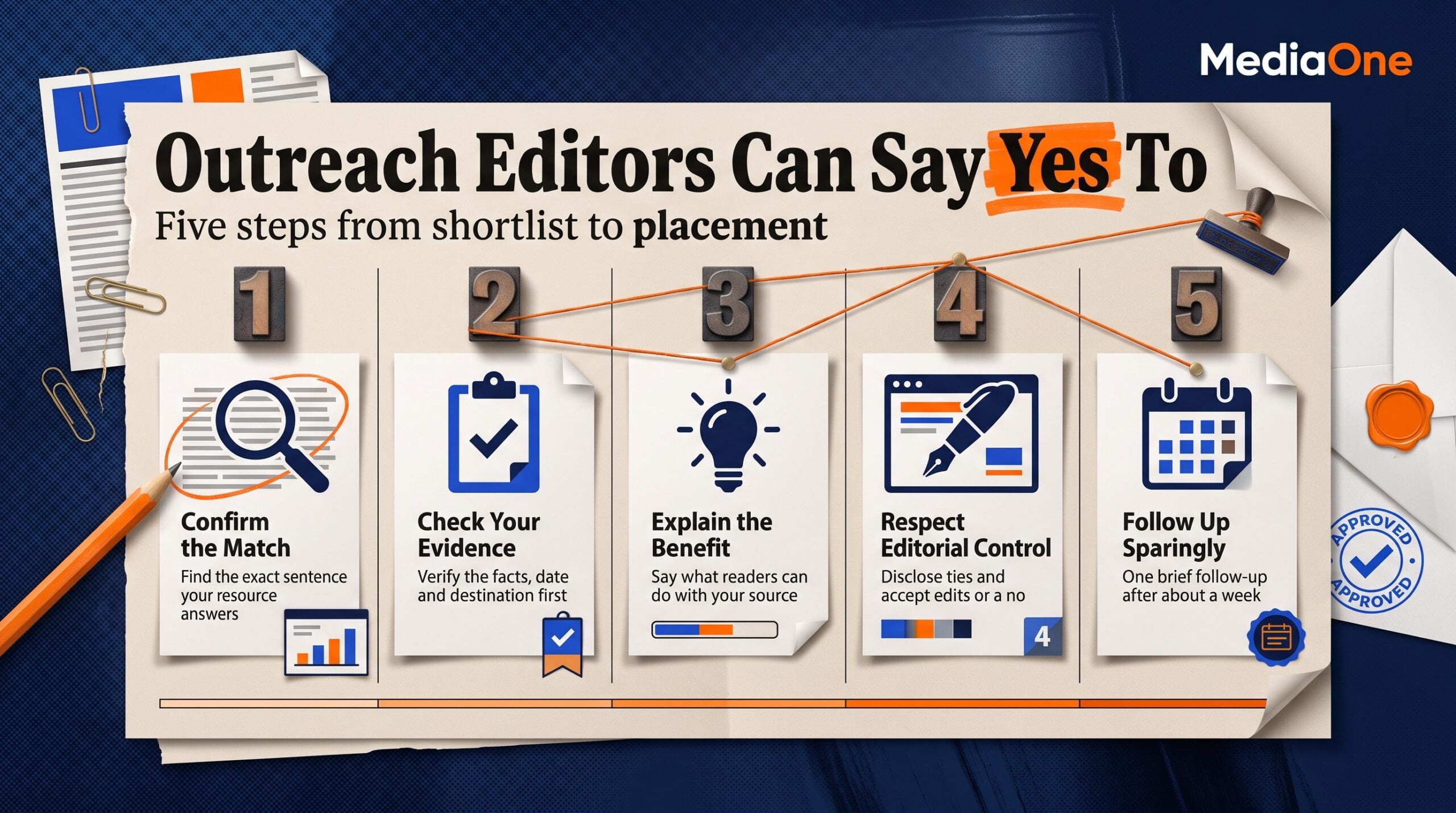
A compact outreach process works well:
- Confirm the match. Identify the exact sentence or section where your resource answers a question.
- Check your evidence. Verify the facts, publication date and destination before approaching the editor.
- Explain the benefit. State what a reader can do with the source, without prescribing keyword-heavy anchor text.
- Respect editorial control. Offer the reference, disclose relevant business relationships and accept edits or rejection.
- Follow up sparingly. One brief follow-up after roughly a week is enough for most straightforward requests.
For example, a local payroll software provider could write: ‘Your section on new-hire administration mentions document checks. Our Singapore employer checklist sets out the steps and cites the relevant government guidance. If it helps readers, please consider it as a supporting source.’ This is a sample pitch, not evidence of an actual MediaOne campaign.
Track pitches, replies, accepted references and the time invested. We would not promise a standard response rate or a fixed number of links per month. Editorial calendars and subject relevance can change the outcome substantially.
Keep Paid Links Separate From Editorial Endorsements
A link can be relevant and still breach Google’s policies if it is purchased to influence rankings. Google’s link spam rulescover paid links that pass ranking credit, excessive exchanges, automated link creation and large-scale guest content with manipulated anchor text.
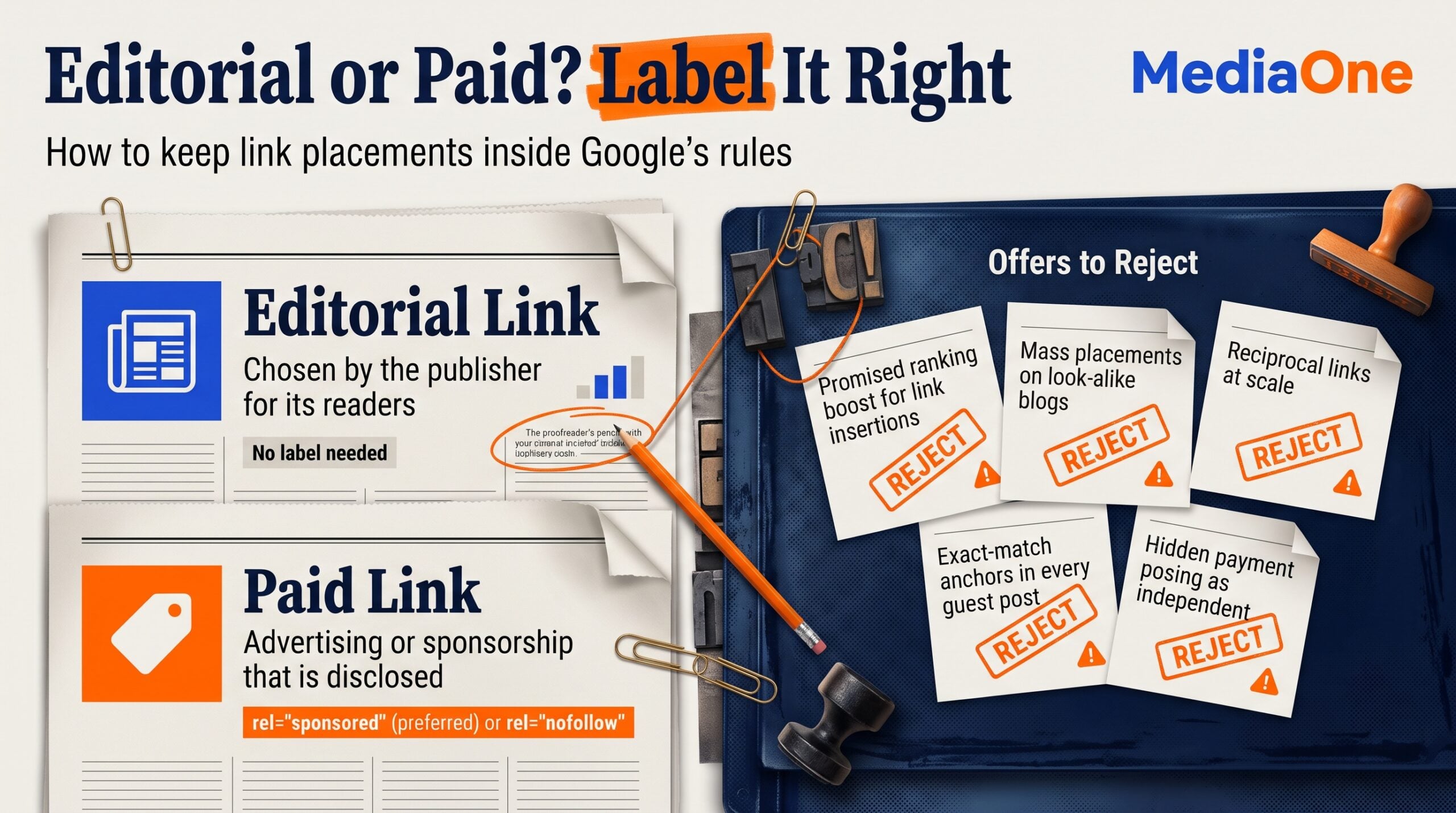
Advertising and sponsorship remain legitimate. Paid links should use rel="sponsored" or rel="nofollow" to disclose the relationship to Google, with sponsored preferred for advertisements. A publisher can also use nofollow when it does not want to endorse a linked page. The presence of a qualifying attribute does not erase the value of a genuine referral visit.
We advise rejecting these offers:
- A seller promises a precise ranking improvement for a package of editorial-looking insertions.
- A network offers large numbers of placements across unrelated blogs with similar templates.
- A partner demands reciprocal links at scale, regardless of reader relevance.
- A guest-post vendor insists on exact-match commercial anchors in every article.
- A publisher hides a payment arrangement while describing placements as independent recommendations.
 If your site has suspicious inbound links, investigate before disavowing anything. Google generally handles many low-quality links automatically. Its Disavow tool is intended for substantial artificial-link problems involving an existing or likely manual action, and mistaken use can remove signals from legitimate references. If a link scheme is under your control, request removal or appropriate qualification first.
Connect Each Link to a Useful Page
The destination for contextual backlinks should answer the question posed in the referring sentence. An article explaining Singapore corporate filing deadlines should reference the relevant, current filing resource. Sending readers to a broad homepage forces them to start their research again. A product page is appropriate when the paragraph is genuinely discussing that product or an authorised supplier.
Before outreach, check the destination’s title, factual accuracy, mobile usability and indexability. Fix broken pages and pages blocked from search before spending effort on new references. Compare the target topic with queries in our keyword research service or your own Search Console data to avoid competing pages with overlapping intent.
Informational pages can still support commercial goals when they provide a helpful next step. A technical checklist may link internally to a related service page where a reader needs specialist assistance. Our internal linking strategy for SEOexplains how to make those connections clear without forcing visitors into a sales pitch.
We would also fix internal links pointing to obsolete URLs. A credible external reference cannot rescue a destination that fails to load or sends readers through a confusing sequence of redirects. For a fuller explanation of internal and external link relationships, see MediaOne’s guide to SEO link equity.
Check Redirects and Tracking Before Reporting
The address recorded by a link tool may differ from the page a visitor reaches. Some click-tracking systems route traffic through intermediary URLs. Certain Google redirect links contain a destination parameter such as url or q, while other services use different structures. Follow the full chain before attributing the reference to a page or domain.
A 301 indicates a permanent move and gives Google a strong canonicalisation signal for the destination. A 302 describes a temporary redirect and does not give the same signal. Both can be followed, but neither is a guarantee of a particular ranking outcome. Redirect chains, blocked targets and conflicting canonical tags complicate the assessment.
Campaign parameters such as utm_source, utm_medium and utm_campaign usually identify visits without redirecting the browser. Keep their original values for analytics, while grouping genuinely equivalent URL variations when counting referring pages. Some query parameters change the actual content, so do not strip them indiscriminately.
For each confirmed placement, record the source page, visible anchor, link attributes, publication date, initial target, redirects and final destination. Recheck high-value references after site migrations. We recommend asking the publisher to update a link to the final page when the old address creates an avoidable redirect, while allowing for legitimate tracking systems.
Measure Referral Value and Search Trends Separately
Earning contextual backlinks is an activity. Qualified visitors, useful enquiries and stronger search visibility are potential outcomes. A link count alone cannot tell you which activity generated value, and a ranking movement after publication does not prove the link caused it.
Check Visits in Google Analytics
In GA4, open Reports > Acquisition > Traffic acquisition and use Session source / medium to review referral sessions. The GA4 Traffic acquisition documentation describes the report and its session-scoped dimensions. Compare referrals with engagement and key events, using a consistent period after the link goes live.
If you need a referring URL, check the Page referrer dimension in an Exploration when that data is available. Browsers, referrer policies, redirects and privacy controls can prevent full source-page details from reaching GA4. Domain-level referral counts will often be easier to interpret than a claim that every click from a particular article was identified.
For a B2B business, a relevant form enquiry or a qualified sales conversation can be more useful than a spike in casual visits. Agree on those outcomes before outreach and avoid assigning all organic growth to the newest backlink.
Compare Search Console Page Trends
Use Search Console’s Performance report to monitor the destination page’s clicks, impressions, search queries and average position. Record the four weeks before publication as a baseline, then review at roughly four, eight and twelve weeks afterwards. These are practical checkpoints, not predicted times to rank.
Account for seasonality, content edits, site migrations and other SEO activity that occurred in the same period. Google’s Links report can help discover linking sites, but it does not provide an exhaustive list of every link and is not a substitute for checking the live page. Track placement status and business enquiries alongside Search Console trends.
Our enterprise SEO measurement approach connects leading indicators such as links and rankings with pipeline and revenue reporting. A smaller company can apply the same principle with a simple spreadsheet and a reliable record of leads.
MediaOne’s People Set the Review Standard
MediaOne began as a Singapore search-focused agency and expanded into content, paid media and AI-supported marketing. Founder and CEO Tom Koh’s background in SEO shapes our preference for demonstrable search value and explainable decisions. Our published client and award record names Canon Singapore, while our SEO services describe a team covering consultants, writers, technical specialists and client success support.
We put people behind the process. In a testimonial published on our SEO service pages, client Nicholas Ng specifically thanked Delphine, Desiree, Celesta and Eugene for responsiveness and support. We see that expectation of clear communication as directly relevant to link building. A client should be able to review the proposed publication, see the published URL and understand why the placement was accepted.
Our work also has independently recorded recognition. MediaOne received Bronze for Independent Agency of the Yearat the 2025 Singapore Agency of the Year Awards. In 2026, COO June Goh received Gold in Women in AI Leadershipat the Asia-Pacific Stevie Awards for work associated with Digimetrics.ai. We mention these awards to identify the people and organisation accountable for our advice, not to suggest an award certifies individual link placements.
Digimetrics.ai supports SEO diagnostics and broader marketing analysis, including backlink-profile reviews described in our published services. We still expect a specialist to read the publisher’s page, inspect the link and judge audience fit. A platform score cannot replace editorial judgement, and we do not describe proprietary tools as independent proof of a Google ranking benefit.
Our SEO programmes pair off-page work with technical checks, content and transparent reporting. That cross-functional setup reflects our preference for accountable decisions over a quota of URLs that nobody has read.
Plan Your Next Quarter Around Quality
Begin by reviewing the links you already have. Export referring domains from Search Console or your backlink tool, inspect the most relevant pages manually and record broken destinations. Identify unlinked mentions and existing partners before approaching unfamiliar publishers. Remove duplicate entries from your working list, not from the original source records.
For the next phase, publish one useful, source-backed resource and pitch it to a manageable set of relevant editors. Record who accepted it, which link attributes were used and the time involved. Add new prospects only when the original shortlist has been checked carefully.
At the end of the quarter, compare confirmed links with referral traffic, qualified enquiries and search visibility. Keep the placements that produce credible audience value, and change the outreach approach when the publisher fit is poor. Do not turn a short test into a claim that every backlink should produce the same outcome.
Review Your Link Strategy With MediaOne
Start with an audit of your current referring pages, link destinations and the evidence behind each proposed placement. If you need support, our Singapore SEO services can help identify useful editorial opportunities and connect the work to leads and search performance. Tell us which pages and customer groups you want to reach, and we can discuss a sensible next step.
Frequently Asked Questions
How many links should a small business earn?
There is no universal target that guarantees stronger rankings. Start with pages that answer a real customer question and publications that cover your sector. A small business may find a handful of relevant references more useful than a long list of unrelated placements. Assess the traffic, editorial fit and effort involved before setting a monthly outreach target.
Do contextual links still help SEO in 2026?
Yes, relevant editorial links can help search engines discover pages and understand their subject, while also bringing visitors directly. The benefit depends on the surrounding content, the linking site and the destination. No individual placement guarantees a ranking rise. We recommend comparing search visibility and qualified referral traffic over time instead of treating all links as equal.
Are free links better than paid placements?
Earned editorial links are generally preferable for SEO because the publisher selects them for reader value. Paid sponsorship can still be useful for advertising or referrals, provided the relationship is clear and the link carries an appropriate sponsored or nofollow attribute. Paying for links intended to pass ranking credit creates policy risk, even when the publication appears relevant.
How can I verify an in-text backlink?
Open the referring page and check that the link appears inside relevant body content. Read the surrounding sentences, inspect the anchor wording and follow the destination through any redirects. Confirm the final page loads and serves the topic promised. Also inspect nofollow, sponsored or other relevant attributes before classifying the reference in your report.
Will a 301 redirect preserve backlink value?
A 301 tells Google that the old address has permanently moved and provides a strong signal to treat the destination as canonical. It does not promise a specific transfer of ranking benefit. Check that the redirect leads to a relevant, accessible page and avoid unnecessary chains. If practical, ask important referring publishers to update links to the final address.