Consumer trends are durable shifts in what people want, buy and value. Singapore’s market has several running at once, but your customers’ purchases should guide which ones deserve attention.

Not every trend deserves a budget.
Test each one against purchase data using the Trend Relevance Scorecard: a total of 14 to 20 is an investment candidate, 10 to 13 calls for a limited pilot, and 4 to 9 belongs on a monitoring list. These are working thresholds, not industry standards.

Key Takeaways
- A consumer trend is a sustained shift in what people buy and value, so check its duration and reach before treating it as a business priority.
- Invest in consumer trends that appear in your own customers’ spending, using repeat orders, basket size and order sources as evidence.
- Score each candidate trend from 1 to 5 on spending evidence, target-market reach, durability and ease of action, and record the evidence for each score.
- Treat scores of 14 to 20 as investment candidates, 10 to 13 as limited pilots and 4 to 9 as signals to monitor without spending.
- Validate promising shifts through first-party data and controlled tests instead of treating social attention or survey preferences as proof of sustained demand.
- Assess digital-first shopping and price-conscious purchasing together because both convenience and value influence purchases.
Major Consumer Trends in Singapore 2026: Where Your Budget Should Go
Digital-first shopping and omnichannel integration
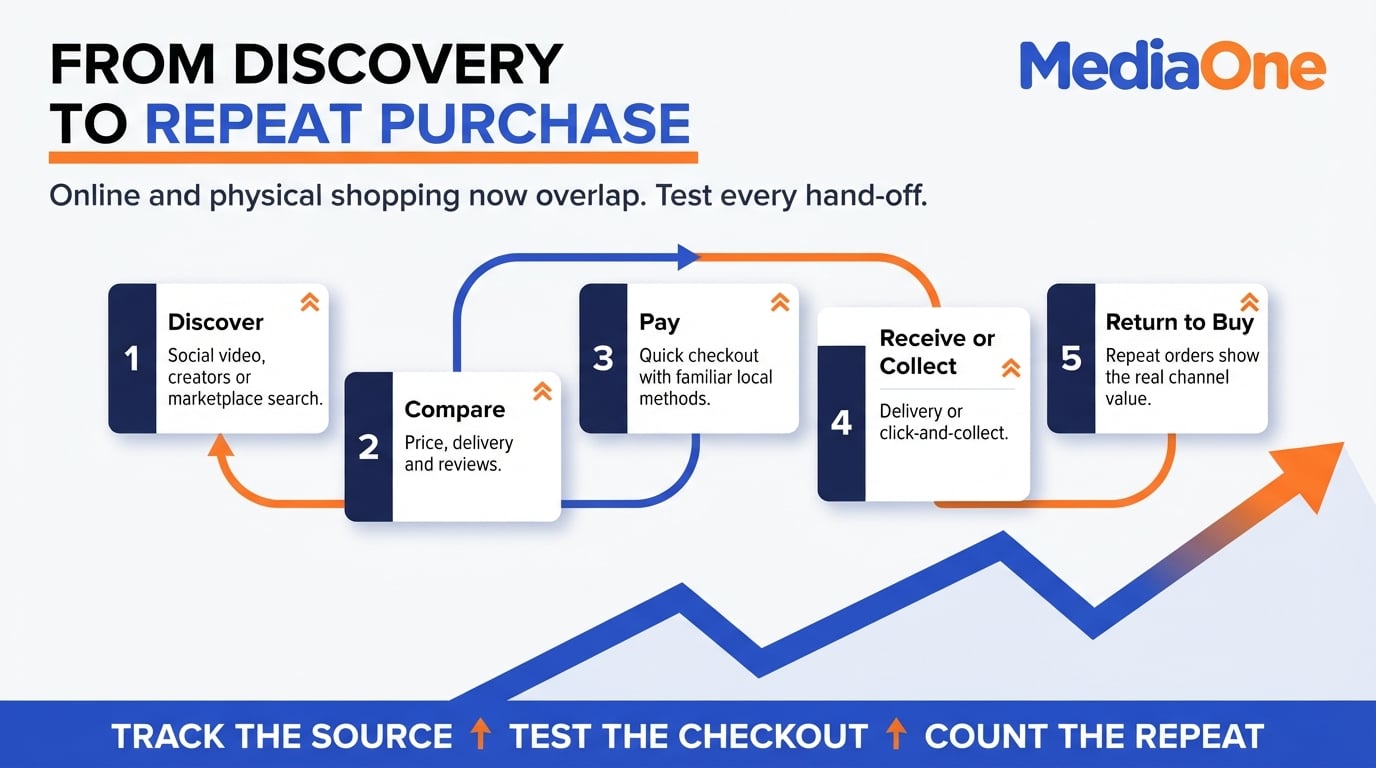
Online and physical shopping overlap, so discovery and collection should work together. The Singapore Department of Statistics’ retail data shows that online sales made up 15.7% of total retail sales in August 2026; that snapshot does not describe every category. Test click-and-collect and whether PayNow or e-wallets reduce checkout drop-off.
Track which channel, including Shopee and Lazada, leads to a repeat order. Before adding a channel, compare fees and buyer intent; MediaOne’s guide to online shopping platforms in Singapore outlines the trade-offs. Choose technology on the strength of repeat sales, not channel popularity.
Social commerce and influencer-led discovery
Creator recommendations, livestream shopping and short-form videos can introduce products to prospective buyers. Judge creators by code redemption and assisted conversions, not reach. High views without attributable orders merit further investigation.

Locally relevant creators can outperform larger accounts, but confirm this for your category. MediaOne’s social ecommerce playbook for Singapore outlines practical buying paths, from livestreams to direct-message orders. Track format-level cost and revenue.
Personalisation and AI-enabled experiences
Personalisation earns its cost only when it lifts repeat purchase or basket size. Test it and stop if customers find it intrusive. Where customer information powers AI recommendations, follow the PDPC’s guidance on personal data in AI systems, including its advice on transparency and consent where applicable.
Value-driven purchasing and price consciousness
When budgets tighten, some households trade down or try lower-priced alternatives. Track trade-down rates and promotion dependence before cutting prices across a category. The expanded phase of Singapore’s unit-pricing pilot began in October 2026 following positive shopper feedback, but does not prove buyers always choose the cheapest item.

Heavy discounts can erode margin, so test whether clear value retains loyalty without a permanent price cut.
Sustainability and purpose-driven consumption
Surveyed interest in sustainable products does not necessarily translate into a willingness to pay more. Test a clearly labelled product at a modest premium and check whether repeat purchase holds. Let repeat sales and margin decide whether it stays.
Subscriptions, loyalty and health and wellness
Subscriptions may suit categories with regular replenishment, including selected food and wellness products. Track churn by cohort after month three, and account for discounts and delivery costs.
Consumer Trends Explained: Definition, Fads and Behaviour
What a consumer trend is
A consumer trend is a sustained change in what people prefer or how they buy. It lasts beyond a single promotion and spreads across a meaningful part of a relevant market. Use two tests: persistence over time and breadth of adoption within the target audience. A change among a handful of early adopters, or one that vanishes after a promotion, is not yet evidence of a durable trend.
Consumer trends versus consumer behaviour
Trends and behaviour answer different questions, so confusing them can lead to a poorly framed research brief.

| Dimension | Consumer trend | Consumer behaviour |
| Scope | Direction of change across a market | What a person does in a given context |
| Time frame | Repeated change across months or years | A purchase or decision at one moment |
| Evidence | Category sales, panels, repeated surveys | Transactions, interviews, session data |
A trend question usually needs repeated measurement across a suitable customer base. A behaviour question may need deeper observation of a smaller group.
Fads versus consumer trends
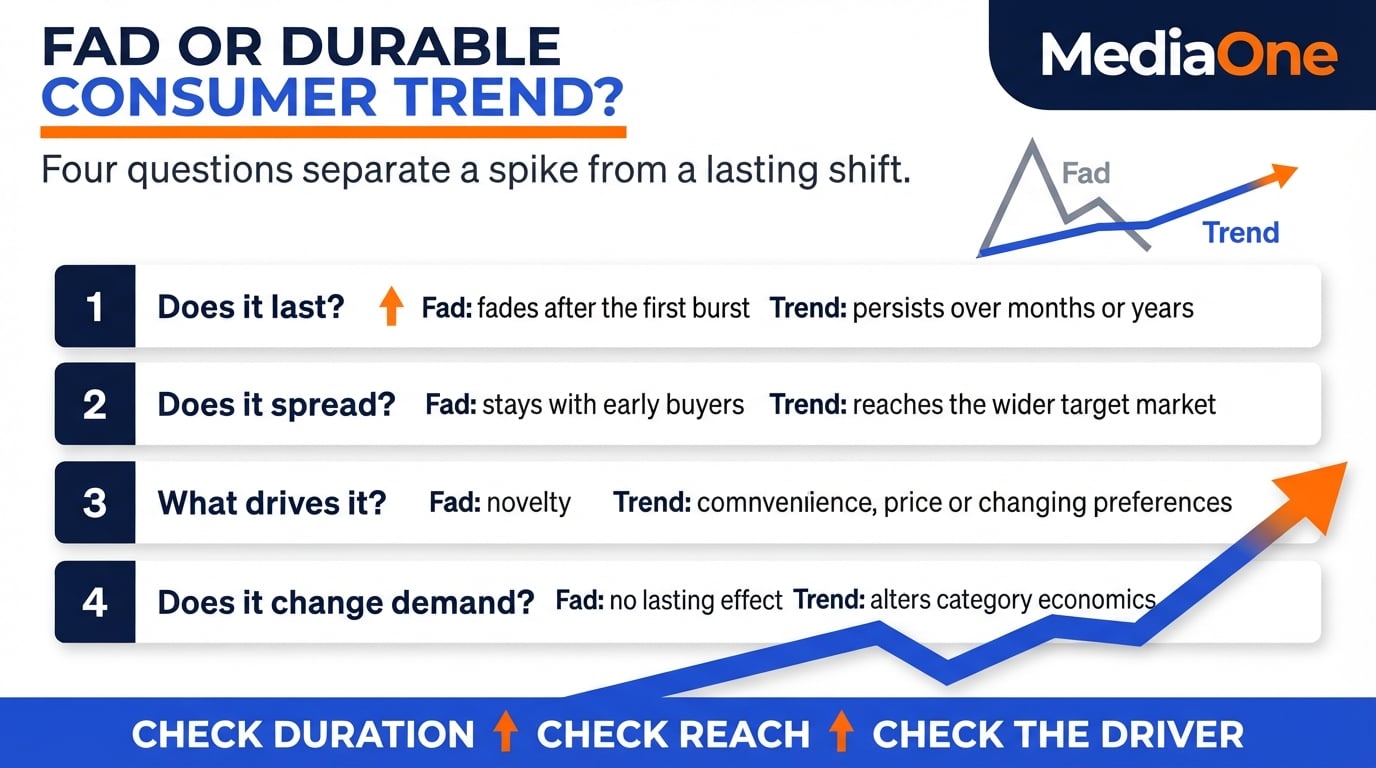
Four questions help distinguish a fad from a trend. Does the change last? Does it spread beyond its initial buyers? What drives it? Does it alter demand or category economics? A fad often fails on duration and breadth, while a lasting trend has reasons to continue after the first burst of attention.
Repeated online food orders may illustrate a lasting shift; a one-week viral drink that disappears illustrates a fad. Both examples are illustrative.
Scoring each trend against your own numbers
Before committing budget, check whether a trend is changing your customers’ spending. Start with repeat purchases, basket size, gross margin and each order’s source to separate demand from attention.
The Trend Relevance Scorecard rates each candidate from 1 to 5 on spending evidence, reach, durability and ease of action. For the final criterion, award 5 points when the trend is relatively inexpensive and feasible to act on, and 1 when action would be costly or difficult.
A total of 14 to 20 supports an investment case, 10 to 13 suggests a small pilot, and 4 to 9 stays on the watchlist. This scorecard is an editorial decision aid, not a validated forecasting model or industry standard. Adjust thresholds to budget and risk.
Start with evidence, because it anchors the decision. If repeat rate or basket value has not shifted since a trend became visible on Shopee, Lazada, Grab or TikTok, it may be real across the wider market but less relevant to your customers. Score by category and keep pilots reversible.
How to Monitor and Act on Consumer Trends: A Step-by-Step Framework
Use this scorecard to turn market information into a clear budget decision.
Step 1: Build a trend watchlist
Combine government statistics, retail panel data, first-party records and social listening. Check recency, sample size and category coverage before adding a signal. IMDA’s Singapore Digital Economy Report 2025 provides context on business digital adoption, but a company’s technology uptake is not proof of changed consumer spending.
Keep six to ten relevant trends, define what would confirm each and review quarterly.
Step 2: Score each trend
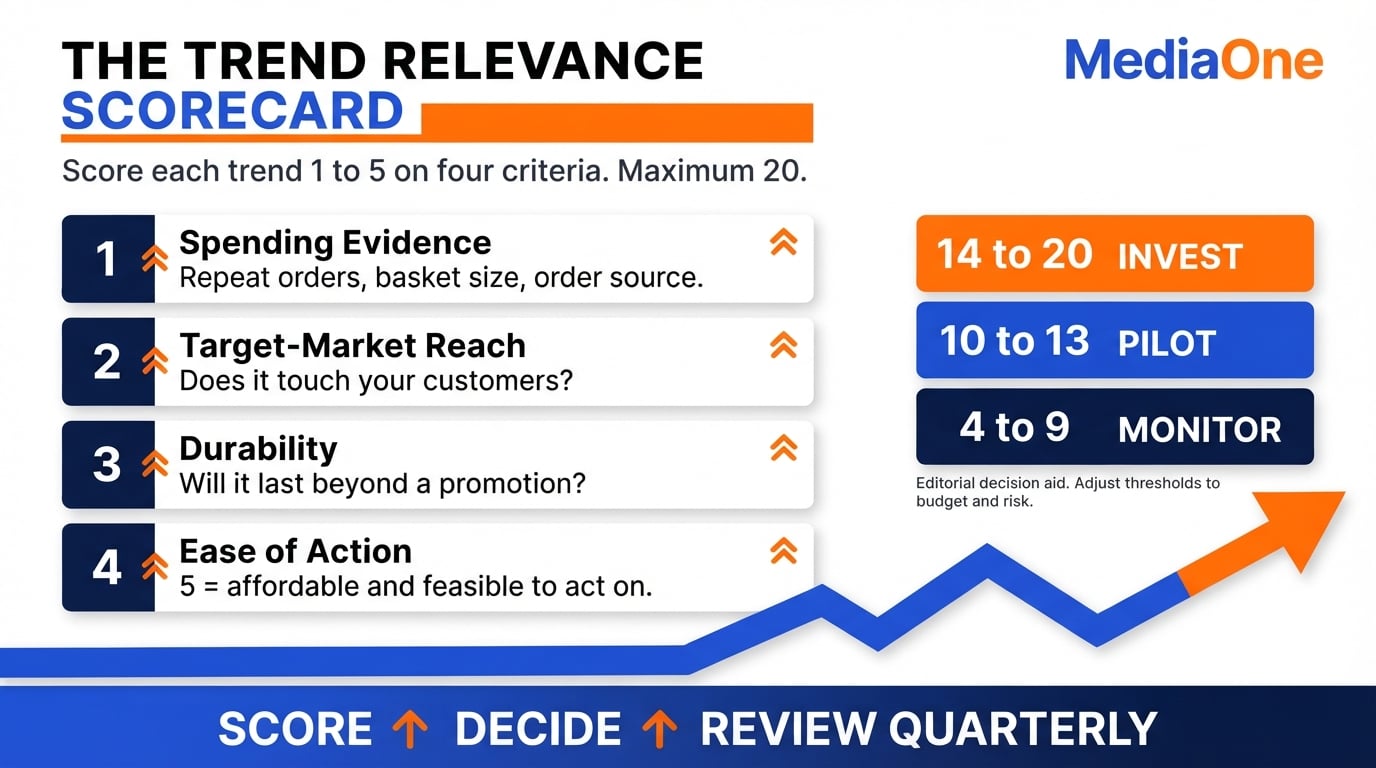
Score each candidate on spending evidence, target-market reach, durability and ease of action, giving each criterion 1 to 5 points. Record the evidence behind each score.
| Total score | Decision | Action |
| 14 to 20 | Invest | Fund a defined opportunity, with tests and an owner |
| 10 to 13 | Pilot | Run a limited test with a clear end date |
| 4 to 9 | Monitor | Revisit during the next quarterly review |
Step 3: Pilot, measure and scale
Test one channel, product line or segment for 8 to 12 weeks as an illustrative planning window, adjusting it to the buying cycle. Set a success metric before launch, compare a control group where possible and scale only on meaningful results.
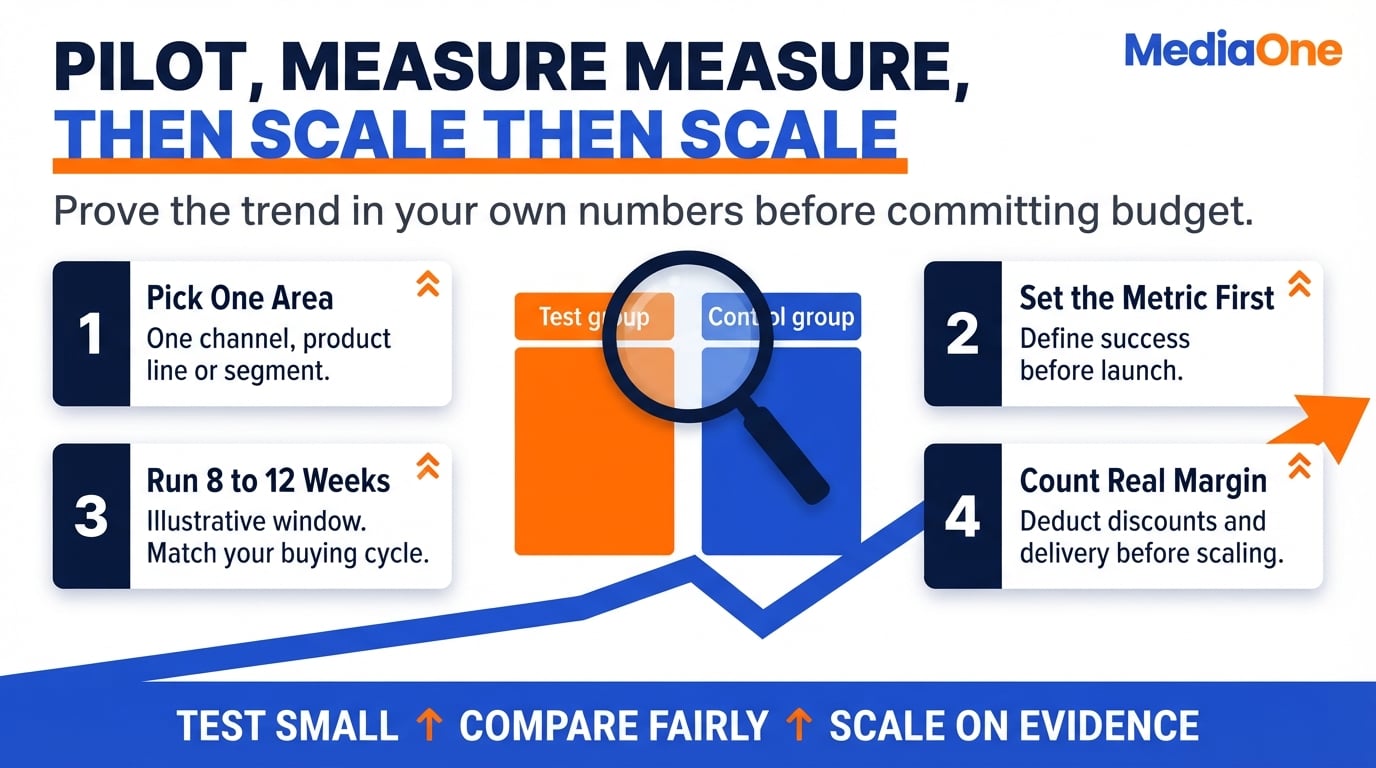
Deduct discounts and delivery costs before scaling. Link results to a content marketing strategy. Use predictive analytics in marketing to test forecasts.
Conclusion: Consumer Trends as a Decision Discipline
Durable trends change what people buy and value over time. Fads are short-lived surges, while individual behaviour depends on context. Treat each as a signal to examine, and direct larger budgets only towards changes supported by evidence.
For Singapore in 2026, three useful starting points are:
- Digital-first shopping with physical redemption: test whether discovery, checkout and collection work together for repeat buyers.
- Value-driven purchasing: try a clear entry-price option before reducing margin across the range.
- Subscriptions and loyalty: track retention, cancellation and profitability by cohort.
The advantage comes from repeating a sound decision process, not from predicting every popular product. Review the Trend Relevance Scorecard each quarter, treat 14 to 20 as investment candidates, 10 to 13 as pilots and 4 to 9 as trends to monitor.
Frequently Asked Questions
What is the difference between a consumer trend and a fad?
A consumer trend persists beyond a promotion, spreads within a relevant market and has a plausible driver such as convenience, price or changing preferences. A fad tends to fade quickly without a sustained change in purchasing. Look for repeat orders over several periods instead of relying on one viral week.
How do consumer trends differ from consumer behaviour?
Consumer trends describe the direction of change across a market over time. Consumer behaviour describes what a person does in a particular situation, such as buying during a marketplace promotion.
How often should businesses review consumer trends?
Review your watchlist quarterly using fresh sales, repeat-rate and order-source data. Run a deeper annual review to retire stalled ideas, reassess your scoring thresholds and add emerging signals.
Which consumer trends are most important in Singapore in 2026?
Digital shopping, creator-led discovery and price-conscious purchasing are sensible areas to examine, while personalisation, sustainability and subscriptions may suit particular categories. The right priority depends on the target customer, profitability and evidence in your own sales records.
How can a small business use consumer trends without a research budget?
Start with your own repeat purchases, average basket size, returns and enquiry sources. Add publicly available market statistics, then test one small change before committing more budget.
Are consumer trends reliable for forecasting sales?
Trends indicate direction and possible risks, not precise future sales. Combine them with sales history, seasonality and controlled tests, and treat any trend-based forecast as a scenario rather than a guaranteed outcome.