AI Summary

Predictive analytics in marketing produces probabilities, not certainties — its value comes from improving a decision, not forecasting the future perfectly. This article proposes a five-stage approach (Question → Data → Prediction → Action → Validation) for deciding when prediction is worth using, and stresses that more data isn’t the goal — reliable, consistent examples of the outcome you’re predicting are. It covers checking prediction windows (a 7-day buyer is different from a 90-day one), choosing between simple rules and predictive models, and why a prediction with no connected action is just another dashboard number.
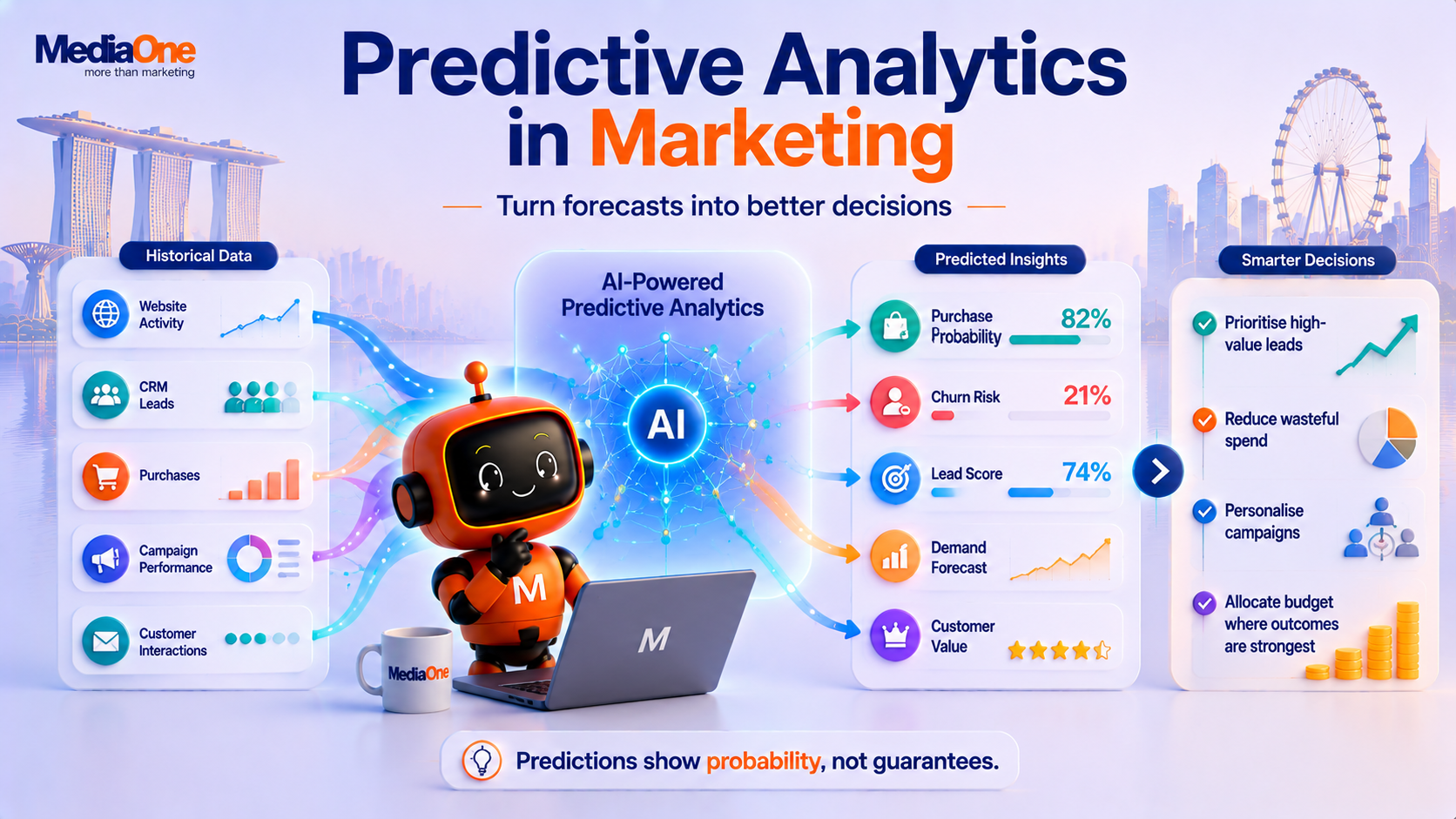
Predictive analytics can tell you which leads are more likely to convert, which customers may leave, where demand could rise and which audience segments deserve more attention.
That does not mean it can tell you the future.
A useful marketing prediction is a probability based on patterns in available data. Its real value comes from helping your team make a better decision than it would have made without the prediction.
That distinction is increasingly relevant for Singapore businesses. IMDA reported that AI adoption among SMEs rose from 4.2% in 2023 to 14.5% in 2024. Among non-SMEs, adoption increased from 44% to 62.5%.
For an SME, though, the goal is rarely to build the most sophisticated prediction model. It is usually much more practical. Which leads should sales call first? Which customers need retention activity? Which products deserve more campaign budget? Where should a limited marketing team spend its time?
We would approach those questions through five stages.
Question → Data → Prediction → Action → Validation
Start with a decision that needs improvement. Check if your data can support the prediction. Generate the score or forecast. Change an action based on it. Then measure what happened.
Key Takeaways
- Predictive analytics estimates what is likely to happen. It does not guarantee an outcome.
- Start with a marketing decision, not an AI product.
- More data does not automatically produce a better forecast. You need reliable examples of the outcome being predicted.
- Prediction windows change the meaning of a score. A likely buyer over seven days is different from a likely buyer over six months.
- A model is useful when it improves a business decision, even if it does not predict every customer correctly.
- Keep checking predictions against actual results because customer behaviour, channels and business conditions can change.
What Predictive Analytics in Marketing Actually Does
Traditional marketing analytics usually starts with something that has already happened. A campaign generated 500 leads. Revenue fell last month. Paid search produced a higher conversion rate than paid social.
Predictive analytics uses historical and current signals to estimate a future outcome.

Google Analytics offers a useful example through its predictive metrics. Purchase probability estimates the chance that a recently active user will complete a purchase within the next seven days. Churn probability estimates the chance that a recently active user will stop being active during the next seven days. Predicted revenue estimates expected purchase revenue during the next 28 days.
The output is a probability or forecast, not certainty.
| Type of Analysis | Question | Marketing Example |
| Descriptive | What happened? | Paid search generated 420 leads |
| Diagnostic | Why might it have happened? | Conversion increased after a landing page change |
| Predictive | What is likely to happen next? | These users have a higher purchase probability |
| Prescriptive | What should we do next? | Give the high-probability audience a different offer |
| Experimental | Did that action improve the result? | Compare the new treatment with the normal approach |
The last two stages are where predictive analytics starts becoming commercially useful.
The MediaOne Prediction-to-Action Test
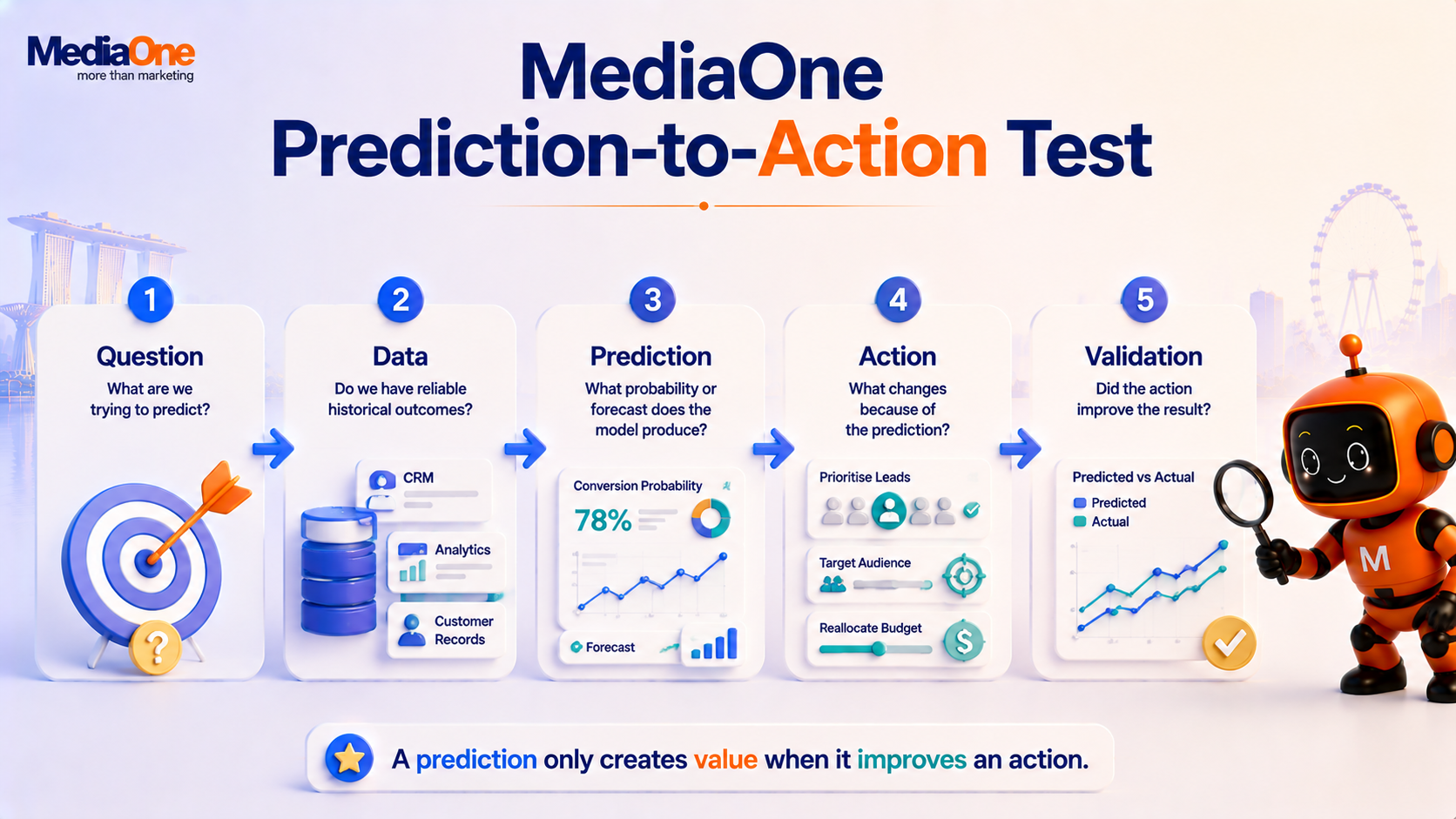
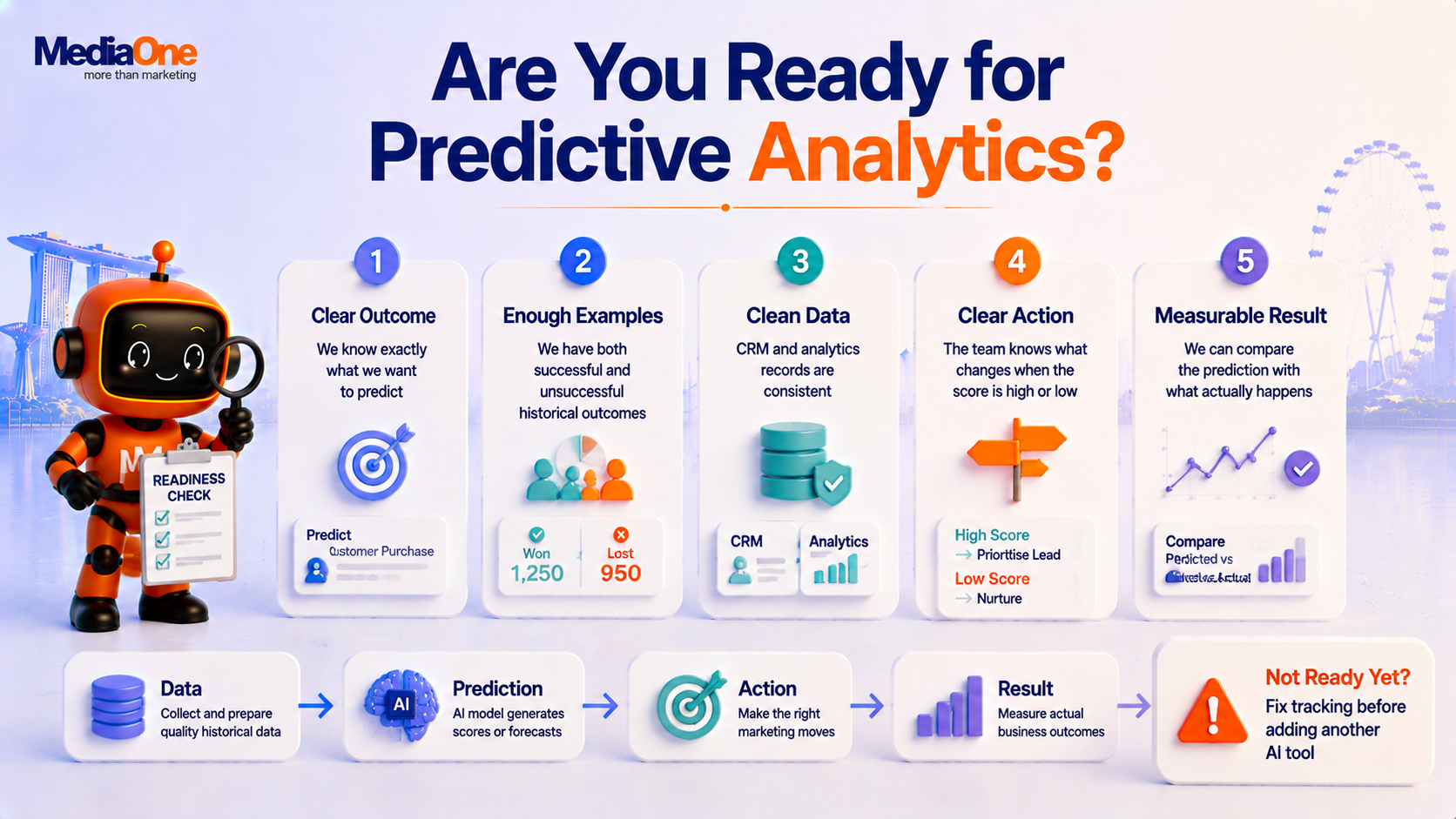
A predictive marketing project should answer five questions.
Question
Define exactly what you want to predict.
“Predict customer behaviour” is too broad.
“Predict which leads are most likely to become qualified opportunities within the next 60 days” gives both the model and marketing team a specific outcome.
Data
Check that you actually record that outcome and the useful signals leading up to it.
If you want to predict closed customers but your CRM does not reliably record which leads became customers, better software will not fix the underlying problem.
Prediction
Define what the system produces. It could be a probability, priority score, revenue estimate, demand forecast or customer-risk category.
The timeframe should also be clear.
Action
Decide what changes when the prediction is high or low.
A high churn probability might trigger retention activity. A strong lead score could change which prospect sales contacts first. A high purchase probability could change remarketing activity.
If nobody changes an action, the prediction is mainly another dashboard number.
Validation
Compare the result with the process used before the prediction.
Did prioritised leads create more qualified opportunities? Did the retention activity reduce cancellations? Did the predictive audience create more profitable sales?
Prediction is only one part of the system. The action taken because of it also needs to work.
How to Start Using Predictive Analytics in Marketing
For most SMEs, starting small is more useful than attempting a large custom AI project.
Begin with one repeated decision that already costs time or money. A sales team with more leads than it can contact is a good candidate. So is an ecommerce company spending equally on visitors with very different purchase intent.
Next, audit the data behind that decision. Check that conversions, customers, qualified leads or another target outcome are recorded consistently.
Then choose the simplest system capable of solving the problem. If your existing analytics or CRM already provides predictive features, test those before building custom infrastructure.
Run the prediction on a limited audience, campaign or team. Connect the result to a defined action and compare the outcome with the process you used before.
If the result improves, expand carefully and keep checking performance.
Do You Have Enough Data for Predictive Analytics
There is no universal number of records that makes a business ready.
What you need depends on the prediction and the system being used.
Google Analytics illustrates this well. To generate its predictive metrics, Google currently requires at least 1,000 returning users who triggered the relevant predictive condition and at least 1,000 returning users who did not during a seven-day period within the previous 28 days. The property also has to maintain sufficient model quality.


That does not mean every predictive model needs 2,000 users. It shows why “we have plenty of data” is not a useful test by itself.
Ask better questions.
Do you have enough examples of successful outcomes? Do you have enough unsuccessful outcomes? Are those outcomes recorded consistently? Does the historical data still resemble how customers behave now?
A CRM with 100,000 contacts can still be poor modelling data if customer status, acquisition sources and sales outcomes are incomplete.
How Trustworthy Does a Prediction Need to Be
Marketing rarely needs perfect prediction.
The better question is if the model helps you make a better decision than your current method.
Suppose a sales team receives 1,000 leads each month but has enough capacity to properly contact only 250. Today, representatives prioritise mainly by recency.
A predictive model does not have to identify every eventual buyer correctly. It can still be valuable if the 250 leads it prioritises consistently contain more qualified opportunities than the 250 selected under the old method.
You should also think about the cost of mistakes.
A false positive occurs when the model identifies a promising lead that never converts. The cost may be wasted sales time.
A false negative occurs when the model gives a weak score to someone who would have bought. The cost could be a missed customer.
The more expensive mistake depends on the business.
Always Check the Prediction Window
“Likely to buy” means little without a timeframe.
Google Analytics uses a seven-day window for purchase probability and a 28-day period for predicted revenue.
HubSpot provides another example. Its predictive likelihood-to-close score estimates the probability that an open contact will become a customer within the next 90 days.
A seven-day purchase probability can support short-term ecommerce targeting. A 90-day closing probability can support longer sales prioritisation.
Neither score is more advanced simply because its timeframe is longer.
Whenever a platform gives you a prediction, ask what event it predicts and when that event is expected.
Where Predictive Analytics Is Most Useful in Marketing
| Use Case | Prediction | Action | Result to Check |
| Lead scoring | Probability of becoming qualified or buying | Prioritise sales follow-up | Opportunities and revenue |
| Churn prediction | Probability of disengaging | Trigger retention activity | Retention improvement |
| Purchase prediction | Probability of buying soon | Adjust targeting or offers | Incremental profit |
| Demand forecasting | Expected future demand | Adjust campaign or stock planning | Sales and inventory efficiency |
| Customer value | Expected future customer value | Adjust acquisition or retention spend | Long-term profit |
| Campaign forecasting | Expected leads, sales or revenue | Adjust budget planning | Forecast error and actual return |
The prediction should always connect to an action and a measurable result.
Predictive Lead Scoring Should Go Beyond Activity
Traditional lead scoring often gives points for actions such as opening an email, visiting a pricing page or submitting a form.
Those signals can help, but activity is not the same as customer fit.
Someone can read ten articles and still be the wrong buyer.
Predictive scoring becomes more useful when historical attributes and behaviour can be connected to real sales outcomes. HubSpot, for example, uses machine learning in its predictive likelihood-to-close model to estimate the chance that an open contact will become a customer within 90 days.
HubSpot has also expanded its scoring tools in 2026 with AI-assisted contact engagement and fit scoring based on a company’s own CRM contact data.
For marketing teams, the useful metrics are still qualified opportunities, close rate, sales time and revenue. The score itself is only an input.
That is also why predictive scoring needs to connect with the wider lead generation process. A better score has little value if lead follow-up and sales qualification remain weak.
Predictive Scoring or Simple Rules
AI is not automatically the better choice.
| Situation | Simple Rules | Predictive Model |
| Little historical sales data | Good starting point | Limited evidence |
| Qualification criteria are obvious | Often enough | Can add unnecessary complexity |
| Many signals interact | Harder to maintain | More useful |
| Scores need simple explanations | Easier | Depends on the platform |
| Large history of wins and losses | Useful | Stronger opportunity |
| Customer behaviour changes frequently | Easy to update | Needs regular validation |
A small B2B company may already know that good prospects are Singapore businesses of a certain size, in a specific sector, with the right decision-maker.
A transparent scoring rule may work perfectly well.
Do not add prediction simply because the software offers it.
Which Predictive Analytics Setup Do You Need
The right setup depends on the decision you are trying to improve.
| Business Need | Good Starting Point |
| Ecommerce purchase or churn prediction | Built-in analytics predictive features |
| Sales lead prioritisation | CRM scoring and predictive lead tools |
| Simple recurring forecasts | Existing analytics or BI software |
| Multiple connected datasets | BI platform or data warehouse with modelling |
| Highly specific prediction problem | Custom model |
| Very little historical outcome data | Rule-based scoring and better tracking first |
This is why a list of the “best predictive analytics tools” is rarely useful by itself.
A business already meeting GA4’s predictive requirements may not need another platform for basic predictive audiences. A B2B company already storing years of clean sales outcomes in its CRM may gain more from predictive lead scoring.
Another business may first need to fix tracking.
Your Data Can Be Large and Still Be Bad
Imagine a CRM where half of lost opportunities have no recorded reason, sales representatives disagree on the definition of a qualified lead and duplicate contacts are common.
A predictive model can still produce a score from that data.
That does not make the score trustworthy.
The same applies to web analytics. If traffic sources and conversions are recorded inconsistently, the model can learn from incorrect acquisition data.
MediaOne’s guide to Google Analytics channels explains how GA groups traffic from organic search, paid search, social, email, referral and other sources. Clean attribution becomes even more important when those records later feed forecasting or predictive models.
Predictive Analytics Data Readiness Checklist
| Area | What to Check |
| CRM | Leads, opportunities and customers are recorded consistently |
| Analytics | Important conversions and traffic sources are tracked correctly |
| Ecommerce | Orders can be connected to customers and campaigns |
| Sales | Marketing and sales agree on qualification definitions |
| Historical outcomes | You have enough wins and losses to compare |
| Action | The team knows what changes when a prediction is high or low |
| Measurement | You can check what happened after taking action |
If several of these are missing, improving the underlying measurement setup may deliver more value than buying another predictive tool.
When Predictive Models Stop Working Well
Historical relationships can weaken.
Suppose a B2B lead model was trained when most customers arrived through paid search. Six months later, partnerships and webinars start producing a large share of new opportunities.
The behaviour associated with successful customers has changed. An older model may now rank good prospects poorly.
Pricing changes, new products, seasonality, new customer groups and sales-process changes can create the same problem.
Predictive models need to be checked against actual outcomes over time. A score does not stay useful simply because it performed well when first introduced.
A Prediction Without an Action Is Just Another Dashboard
Consider a churn score of 82%.
What happens next?
If nothing changes, the score creates no direct marketing value.
If it triggers a retention campaign, there is now an action to evaluate. You can compare retention among customers who received the intervention with the normal process.
The same principle applies throughout predictive analytics.
What will we do differently because of this prediction?
If the team cannot answer that question, the model may be predicting an interesting outcome instead of a useful one.
Worked Predictive Lead Scoring Example
Consider a hypothetical Singapore B2B company receiving 1,000 leads each month.
Its sales team can properly follow up with 250.
Under the current process, representatives mainly prioritise the newest enquiries. Those 250 leads produce 30 qualified opportunities.
The company tests a predictive scoring model trained using historical lead attributes and sales outcomes. It uses the model to select another group of 250 leads.
In this illustrative test, the predictive group produces 45 qualified opportunities using a similar amount of sales time.
The useful conclusion is not that “AI predicted customers accurately.”
The useful conclusion is that the team found more qualified opportunities from the same follow-up capacity.
The company should then look at closed revenue, acquisition cost and repeated test results before expanding the system.
The same principle applies when evaluating financial value from predictive tools. MediaOne’s guide to AI marketing ROI explains how incremental value and total operating costs can be compared before increasing AI spending.
Predictive Marketing and Personal Data in Singapore
Predictive marketing can use customer behaviour, purchase history and other personal data, so Singapore businesses also need to consider their responsibilities under the PDPA.
The PDPC’s guidelines for personal data used in AI recommendation and decision systems cover organisations developing and deploying AI systems that use personal data. They address areas including consent, information provided to consumers and responsibilities involving third-party AI developers.
For marketing teams, the practical point is simple. Do not feed every available customer attribute into a predictive system simply because the model can use it. The purpose of the data and how the resulting prediction affects customers still need consideration.
Common Predictive Analytics Mistakes
One common mistake is predicting something easy instead of something useful. Email engagement may be easier to forecast than qualified sales, but the commercial value can be much lower.
Another is confusing activity with customer fit. A highly engaged prospect can still be the wrong buyer.
Teams can also trust scores without understanding the prediction window, continue using models after customer behaviour has changed or buy predictive software before fixing their CRM and analytics data.
The biggest mistake is confusing prediction with causation.
A model may accurately identify customers who are likely to purchase. That does not prove that showing those customers another advertisement caused the purchase.
Prediction tells you what is likely to happen. Testing helps you determine if your marketing action changed the outcome.
Turn Predictions Into Better Decisions
Predictive analytics in marketing is useful because businesses rarely have unlimited time, attention or budget.
You cannot call every lead first. You cannot give every customer the same retention effort. You cannot spend equally across every audience.
Prediction can help decide where limited resources have a better chance of creating value.
Start with one specific question. Check that your data supports it. Understand what the model predicts and over what period. Connect the result to an action. Then measure if that action performed better than the process you used before.
The goal is not to predict the future perfectly.
The goal is to make a better marketing decision than you would have made without the prediction.
Businesses that need stronger customer and acquisition data before introducing predictive scoring can explore MediaOne’s lead generation services, which connect campaign activity, CRM processes and sales qualification.
Frequently Asked Questions
What is predictive analytics in marketing?
Predictive analytics in marketing uses historical and current data to estimate future outcomes. Common examples include purchase probability, predictive lead scoring, churn prediction, customer value prediction and demand forecasting.
How much data do you need?
There is no universal minimum. Requirements depend on the predicted event and the system. GA4, for example, has specific minimum positive and negative user requirements before its predictive metrics become available.
Can a small business use predictive analytics?
Yes, provided the business has a suitable use case and reliable historical outcomes. A smaller company with clean sales data can be in a better position than a larger organisation with fragmented records.
Is predictive lead scoring better than manual scoring?
Not automatically. Simple scoring rules can work very well when qualification criteria are clear. Predictive scoring becomes more attractive when many signals interact and enough historical outcomes exist to identify patterns.
How accurate should predictive analytics be?
Accurate enough to improve the decision it supports. A model can create value without predicting every customer correctly if it helps marketing or sales allocate limited resources more effectively.
How should predictive models be evaluated?
Compare predicted outcomes with what actually happened and test the business action created from the prediction. Keep reviewing performance as customers, channels and business conditions change.