| AI Summary
Effective cold email best practices for Singapore businesses in 2026 focus on targeted prospecting, relevant personalisation, concise messaging and a clear call to action. Businesses should comply with Singapore’s Spam Control Act and applicable PDPA requirements while protecting email deliverability through proper domain authentication. Use the Send-Worthy Score to assess each message, limit follow-ups and track positive replies and qualified meetings to improve campaign performance. |
Cold email can help Singapore businesses reach buyers who have never heard of them. It can also damage sender reputation when teams chase volume, buy questionable lists or send irrelevant pitches.

Our recommendation is to contact fewer, better-qualified prospects with a specific reason for reaching out. Check Singapore’s rules, authenticate your domain and ask for one simple response. This guide explains the cold email best practices we recommend for business-to-business (B2B) outreach in 2026. We also introduce our Send-Worthy Score, a practical framework for deciding whether an email deserves to be sent.
Key Takeaways
- Start with fit. Identify the business problem, the decision-maker and a credible reason to contact that company now.
- Check the legal context. Singapore’s Spam Control Act regulates bulk unsolicited commercial electronic messages. The Personal Data Protection Act (PDPA) also matters when personal data is involved.
- Protect deliverability. Configure email authentication, verify addresses and monitor bounces, complaints and authentication failures.
- Keep the message focused. Use a clear subject, a relevant opener, a credible benefit and one call to action (CTA).
- Use benchmarks carefully. Published cold email reply rates differ substantially because researchers count replies and messages differently.
- Stop when appropriate. Honour opt-outs promptly, end unproductive sequences and review the quality of meetings generated.
What Is Cold Email, and How Is It Different From Spam?
A cold email is a message sent to someone who has no established relationship with the sender. In B2B sales, its purpose is usually to open a relevant business conversation. Cold outreach differs from permission-based email marketing. A newsletter goes to subscribers who have agreed to receive updates. A cold message typically introduces a product, service or partnership opportunity to a new contact.
Spam is not simply an email someone dislikes. Singapore law specifically addresses unsolicited commercial electronic messages sent in bulk. Even a carefully written message can fall within those rules if its sending pattern meets the legal definition.
We advise teams to apply a stricter practical test regardless of volume. Can you explain why this individual is a plausible buyer? Is the message accurate and recognisably commercial? Can the person decline future contact without difficulty? If any answer is no, reconsider the send.
When cold email is worth using
Cold email suits offers with a clearly defined buyer and a meaningful commercial problem. It is less suitable for broad consumer promotions, products with no identifiable buying role or offers that require extensive explanation before the value is clear. We would use cold email as one component of a lead generation strategy, rather than as a substitute for customer research. A reply is useful only when the prospect could realistically become a customer.
Understand Singapore’s Cold Email Rules Before Sending
Legal compliance is a foundation, not an optional editing check. Singapore businesses must distinguish the Spam Control Act from the PDPA. The rules address different conduct, and complying with one does not automatically satisfy the other.
What the Spam Control Act covers
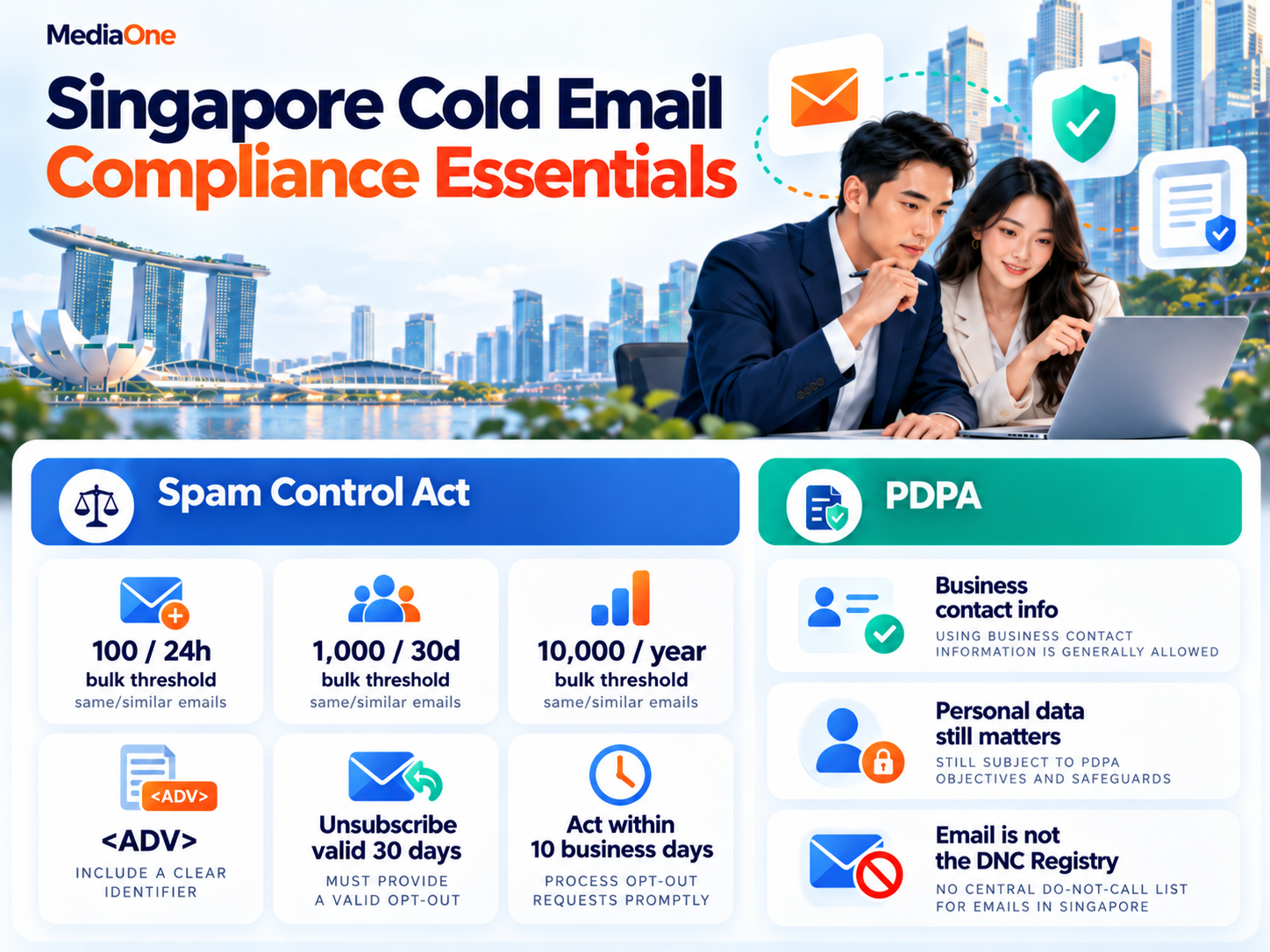
Under Singapore’s Spam Control Act 2007, messages containing the same or similar subject matter are treated as sent in bulk when the sender exceeds 100 in 24 hours, 1,000 in 30 days or 10,000 in one year. The Act applies where the message has a Singapore link, subject to its exclusions.
For unsolicited commercial electronic messages covered by the regime, the Infocomm Media Development Authority’s guidance describes requirements including an <ADV> subject-line label, accurate sender information and a usable unsubscribe facility. The unsubscribe contact must remain valid for at least 30 days. Requests must be acted on within 10 business days.
We recommend checking the Act’s definitions and exceptions before launching any bulk campaign. Personalising thousands of similar messages does not necessarily remove them from the bulk category.
How the PDPA applies to business contacts
Singapore’s PDPA generally governs the handling of personal data. However, the Personal Data Protection Commission’s guidance explains that its Data Protection Provisions do not apply to business contact information as defined by the Act. This can include a person’s work email address and job title when the information was not provided solely for personal purposes.
That exclusion does not mean every address found online is free to use. Personal email addresses, information collected for personal purposes and other data stored alongside a business contact can raise different obligations. The PDPA’s Do Not Call Registry concerns specified marketing communications to Singapore telephone numbers, such as calls, texts and faxes. It is not an email-address opt-out register.
Build compliance into the workflow
Identify the sender honestly. Maintain a central suppression list shared across staff and outreach systems.
We recommend processing removal requests immediately, even where legislation allows longer. If someone replies “not interested” or asks to stop, do not place that person into another automated sequence. For overseas recipients, review local rules separately; Singapore compliance alone is not a cross-border clearance.
Build a Prospect List Around Fit, Not Size
A large database is not a targeting strategy. Start with an ideal customer profile (ICP): the businesses most likely to benefit, the problems they face and the people authorised to address those problems.
For example, a logistics software firm could target freight forwarders that manage shipment reporting across several locations. Its likely buyers include operations directors and technology leaders, not every employee at a logistics company. This distinction keeps research manageable and makes the eventual message easier to personalise.
Use three layers of qualification
- Company fit: Confirm sector, operating model, location and approximate size. Exclude businesses that cannot use or afford the offer.
- Role fit: Find the person responsible for the problem. A finance director may own invoice reconciliation, while an operations manager owns delivery exceptions.
- Timing signal: Look for a recent expansion, hiring advertisement, system migration or publicly announced initiative that makes the problem timely.
A timing signal is evidence, not permission to invent a problem. A new office does not prove the company has payroll difficulties. Write cautiously: “Your expansion may increase reporting complexity” is defensible; “Your team is struggling with reporting” is not unless you know it.
Avoid harvested lists and personal information of uncertain origin. Verify the address before entering it into your outreach system, and document any uncertainty rather than guessing.
Segment before writing
We recommend creating small segments defined by a shared operational problem. A campaign for manufacturers facing supplier visibility issues should not use the same copy as a campaign for professional services firms hiring sales teams.
Each segment needs its own value proposition and qualifying criteria. If a segment contains several unrelated problems, narrow it again.
Set a Useful Goal and Interpret Reply-Rate Benchmarks Correctly
Choose one primary outcome before writing. For most B2B teams, that should be qualified replies or booked meetings with suitable prospects. Total emails sent is an activity measure, not a business result.
Published performance figures need context. In its October 2026 analysis of 30.31 million cold emails, Saleshandy reported a 4.5% average reply rate for campaigns sent from July to October 2026. Its sample came from users of its outreach platform, so the figure is not a national market estimate.
By contrast, Belkins’ 2026 study reported a 0.45% average across 7.5 million emails sent in its 2025 client campaigns. Belkins specifically changed its calculation method to use replies relative to all messages sent, rather than an earlier opened-email denominator. The datasets and definitions are not directly interchangeable. This is precisely why a benchmark needs its denominator and sample explained.
We would not promise a 3% to 5% reply rate to every Singapore business. Neither study establishes a Singapore-wide average. Instead, use the first properly targeted pilot to establish your own baseline, and record exactly how each metric is calculated.
For example, 100 delivered messages producing four replies represent a 4% reply rate. If only one reply expresses genuine interest, the positive reply rate is 1%.
Prepare Your Domain and Protect Email Deliverability
Email deliverability is the ability of a message to reach the intended inbox rather than being rejected or filtered. It requires consistent technical setup and a healthy sending reputation.
Authenticate your sending identity
Configure Sender Policy Framework (SPF), DomainKeys Identified Mail (DKIM) and Domain-based Message Authentication, Reporting and Conformance (DMARC). These records help receiving systems authenticate your messages and reduce impersonation risks.

Google’s sender guidelines require all senders to Gmail accounts to use SPF or DKIM. Senders exceeding its bulk threshold of 5,000 messages per day to personal Gmail accounts face additional requirements, including SPF, DKIM and DMARC. Google also requires appropriate unsubscribe support for qualifying marketing messages.
Google advises maintaining user-reported spam rates below 0.1% and avoiding 0.3% or higher. Yahoo’s sender guidance similarly sets authentication and complaint-control requirements. These are provider rules, distinct from Singapore’s legal bulk-message thresholds.
Establish sound sending habits
Start a new account conservatively and increase activity only when its reputation and response quality remain stable. Automated warm-up networks should not be treated as a shortcut to legitimate engagement.
Before a campaign, verify that addresses are active and correctly formatted. Remove hard bounces immediately. Review repeated temporary failures and avoid repeatedly retrying unwanted mail.
Belkins’ 2026 deliverability study found a 1.71% bounce rate across 7.5 million messages from 2025. That is a comparison point, not a permissible target. We would investigate a rising bounce rate early rather than waiting for it to match a published average.
Avoid unnecessary attachments, large images and multiple tracking links. Test the message in real inboxes, not only in an outreach platform’s preview.
Use the Send-Worthy Score Before Every First Email
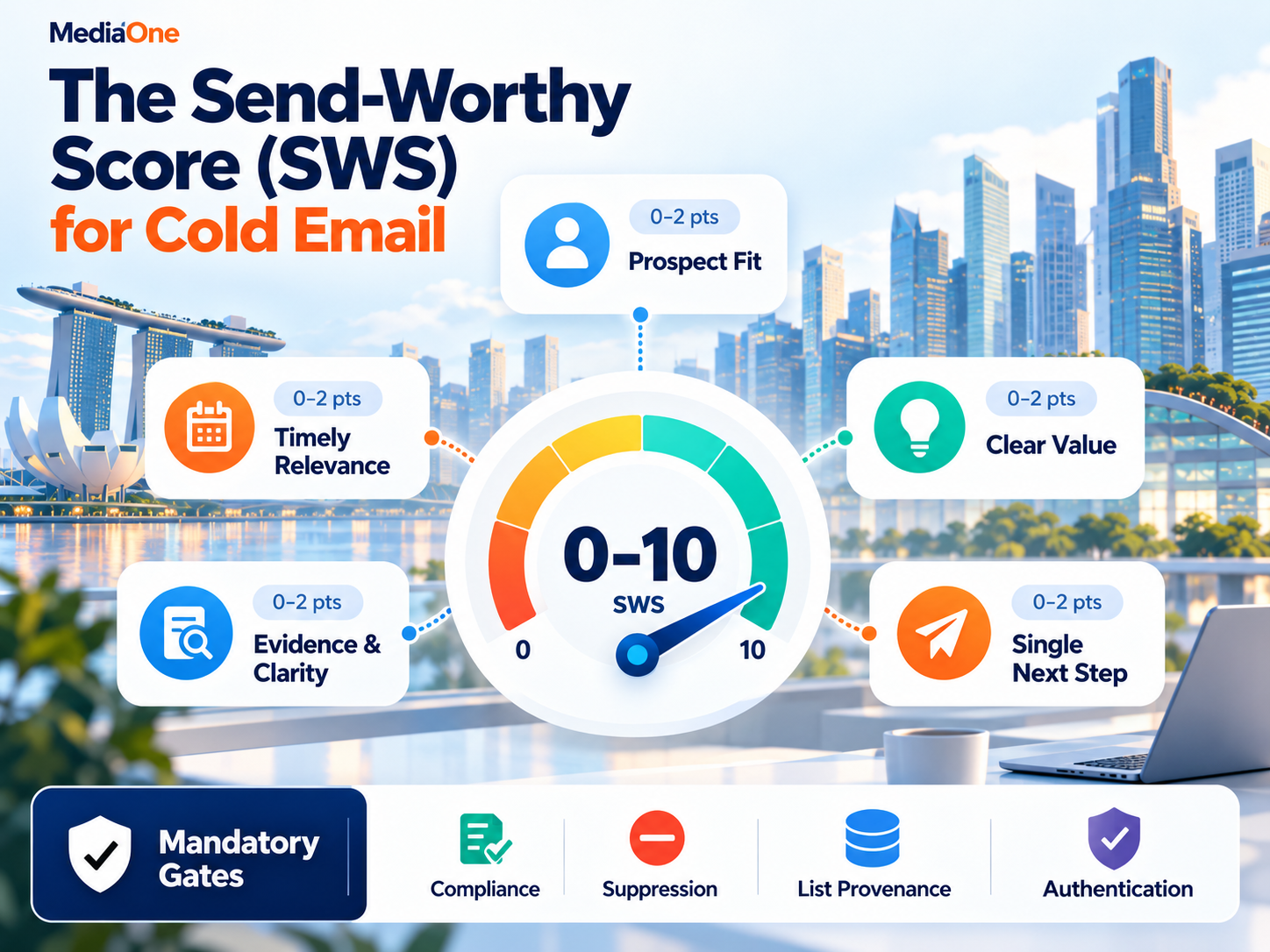
We use the Send-Worthy Score (SWS) as an editorial decision framework for cold outreach. Award zero, one or two points for each criterion. Two points means the requirement is clearly met:
| Criterion | What earns two points |
| Prospect fit | The person’s role connects directly to a verified business need. |
| Timely relevance | A credible company signal explains why contact makes sense now. |
| Clear value | The message offers one concrete, plausible business benefit. |
| Evidence and clarity | Claims are supportable and the subject and body are easy to understand. |
| Single next step | The email asks for one proportionate action that is easy to decline. |
8–10 points: Consider sending after completing the mandatory checks. 6–7 points: Improve the research or rewrite the message. 0–5 points: Do not send until the underlying fit is clearer.
Compliance, contact suppression, list provenance and sending authentication are mandatory gates, not scoreable bonuses. A message scoring ten out of ten still must not go out if it breaches applicable law or a platform’s terms.
Write Subject Lines That Match the Message
A subject line should make the topic understandable without creating a false impression. No fixed subject-line length, including 41–50 characters, is optimal for every audience. Relevance and clarity are stronger starting points than an arbitrary character limit.
We recommend starting with short, specific subjects and testing variations within the same segment. Examples include “Question about regional invoice reporting”, “Shipment visibility across your branches” and “Idea for your new Singapore team”. Each points to a recognisable business issue.
Avoid false urgency, excessive capitalisation and misleading “Re:” or “Fwd:” prefixes on a first email. Do not imply an existing relationship, a referral or a meeting that never occurred. Test the subject alongside the message it accurately describes. An opening rate alone cannot establish success because privacy protections can distort tracking. Prioritise positive replies and meetings, then assess whether the subject contributed to a useful conversation.
Personalise the opener without sounding invasive
Useful personalisation connects a public business signal to a problem the recipient owns. Mentioning a relevant announcement is stronger than praising a stranger’s career. Keep the observation factual and short.
For example: “I saw your company is opening another regional distribution location. That can create new demands on shipment reporting.” This explains why the prospect was selected without claiming knowledge of confidential operations.
Avoid references to family, personal social posts or sensitive details. AI can help organise research and draft variants, but a person should verify each prospect-specific claim before sending.
Structure a Cold Email Around One Business Outcome
A strong first message can usually be read in less than a minute. We recommend roughly 75–125 words as a starting range, not a hard rule. A complex enterprise offer may need a little more context; an introductory partnership email may need less.
Use five elements in a natural sequence: why you chose the prospect, what issue may matter, how you can help, what supports your claim and one clear next step. Keep the emphasis on the recipient.
Example: outreach to a Singapore logistics company
Subject: Regional shipment reporting question
Hi [Name],
I noticed [Company] recently announced plans to expand its regional operations. Reporting across additional locations can make shipment exceptions harder to track.
We help freight teams bring those updates into one reporting workflow. I can share a short example showing how the process works, including the information needed from your existing systems.
Would a one-page overview be useful?
Regards,
[Sender name]
[Company and contact details]
This is a fictional template, not a MediaOne client case study. Replace the expansion detail only when it is verified, and never insert performance figures you cannot substantiate.
Choose a low-friction call to action
The first email often works best when the prospect can respond without accepting a sales meeting. “Would a one-page comparison help?” is easier to answer than a demand for a 30-minute demonstration.
Other suitable questions include “Is this handled by your operations team?” or “Would an example relevant to your industry be useful?” Choose one. Avoid asking for a call, a referral and permission to send material in the same message.
Make the email easy to read on mobile
Use short paragraphs and straightforward words. Keep the sender’s identity visible and place the request before an oversized signature. A simple layout also helps recipients quickly assess what is being offered.
We would generally omit banners, videos and attachments in the first touch. If proof is important, describe it briefly and offer to send the supporting material.
Follow Up with New Value, Then Stop
A good follow-up is a continuation of the business case, not a reminder that the recipient owes you an answer. Each message should introduce a useful detail, a different application or a clearer reason to respond.
Belkins’ 2026 follow-up study found that follow-up steps collectively accounted for 58.6% of replies across the email sequences it examined. It identified three to five total steps as a practical range in that dataset. This supports thoughtful follow-up, not endless automated chasing.
For an initial test, we recommend one first email and two or three follow-ups spaced over several working days. Adjust for buying cycles and recipient feedback. A useful progression might be:
- First contact: Explain the timely business problem and offer a relevant next step.
- First follow-up: Share a specific example, case description or alternative approach.
- Second follow-up: Address a likely objection or clarify the practical benefit.
- Final follow-up: Close the loop politely and confirm you will not keep pursuing the conversation.
Stop immediately after an opt-out, explicit refusal or other clear do-not-contact instruction. Pause on delivery failures, complaints or signs that the targeting is wrong. Do not reset a rejected prospect into a fresh sequence with a new sender identity.
Choose Tools That Permit Your Sending Method
A customer relationship management (CRM) platform, newsletter tool and cold outreach platform can serve different purposes. Before buying, read the provider’s acceptable-use terms and confirm what kinds of unsolicited communication are allowed.
Mailchimp requires express, verifiable permission for marketing contacts and prohibits unsolicited marketing emails through its service. HubSpot’s guidance similarly requires verifiable permission for marketing emails, while distinguishing one-to-one introductory emails. Calling every HubSpot feature unsuitable for cold outreach would therefore be inaccurate.
For carefully researched outreach to a handful of prospects, manual one-to-one sending may be adequate. Larger legitimate programmes may benefit from controlled sequencing, bounce handling, reply classification and centralised suppression.
Choose tools for policy compatibility, data security and reporting quality. Recheck their terms when your sending method changes.
Measure Business Results, Not Vanity Metrics
Cold email reporting should connect the first send to a genuine sales opportunity. We recommend maintaining a consistent definition of a prospect, a delivered message, a human reply and a qualified meeting.
Track the following metrics together:
- Delivery and bounce rate: Reveal list hygiene and technical problems, although delivery does not guarantee inbox placement.
- Human reply rate: Shows whether recipients respond, excluding automated notices where possible.
- Positive reply rate: Counts replies that express genuine interest or request relevant information.
- Qualified meeting rate: Measures meetings with people who fit the customer profile.
- Opportunity and revenue contribution: Connects outreach to pipeline quality rather than activity alone.
- Opt-out and complaint signals: Indicate when targeting or frequency is harming trust.
For a simple illustration, suppose 200 messages are delivered and eight people reply. That is a 4% reply rate. If three replies show interest, the positive reply rate is 1.5%. If two qualified meetings result, the meeting rate is 1% of delivered messages.
Run controlled tests that teach you something
Change one major variable at a time: the target segment, opening angle, value proposition or CTA. Keep the rest comparable. A subject-line test is hard to interpret if the two groups also have different company sizes and buying roles.

Start with a modest, well-verified pilot and record the results. A batch of 50 or 100 prospects can reveal obvious problems, but tiny differences between variants are not statistically reliable. Wait for enough responses before declaring one version the winner.
Review negative replies as carefully as positive ones. “Not responsible for this” suggests a role-mapping problem. “Not a priority” may indicate poor timing. “We already use another provider” offers insight into positioning. Use that feedback to improve the next segment rather than increasing volume blindly.
A 30-Day Cold Email Launch Plan for Singapore Teams
A structured first month gives teams time to check legal requirements before testing the offer. Each stage should have a clear owner.
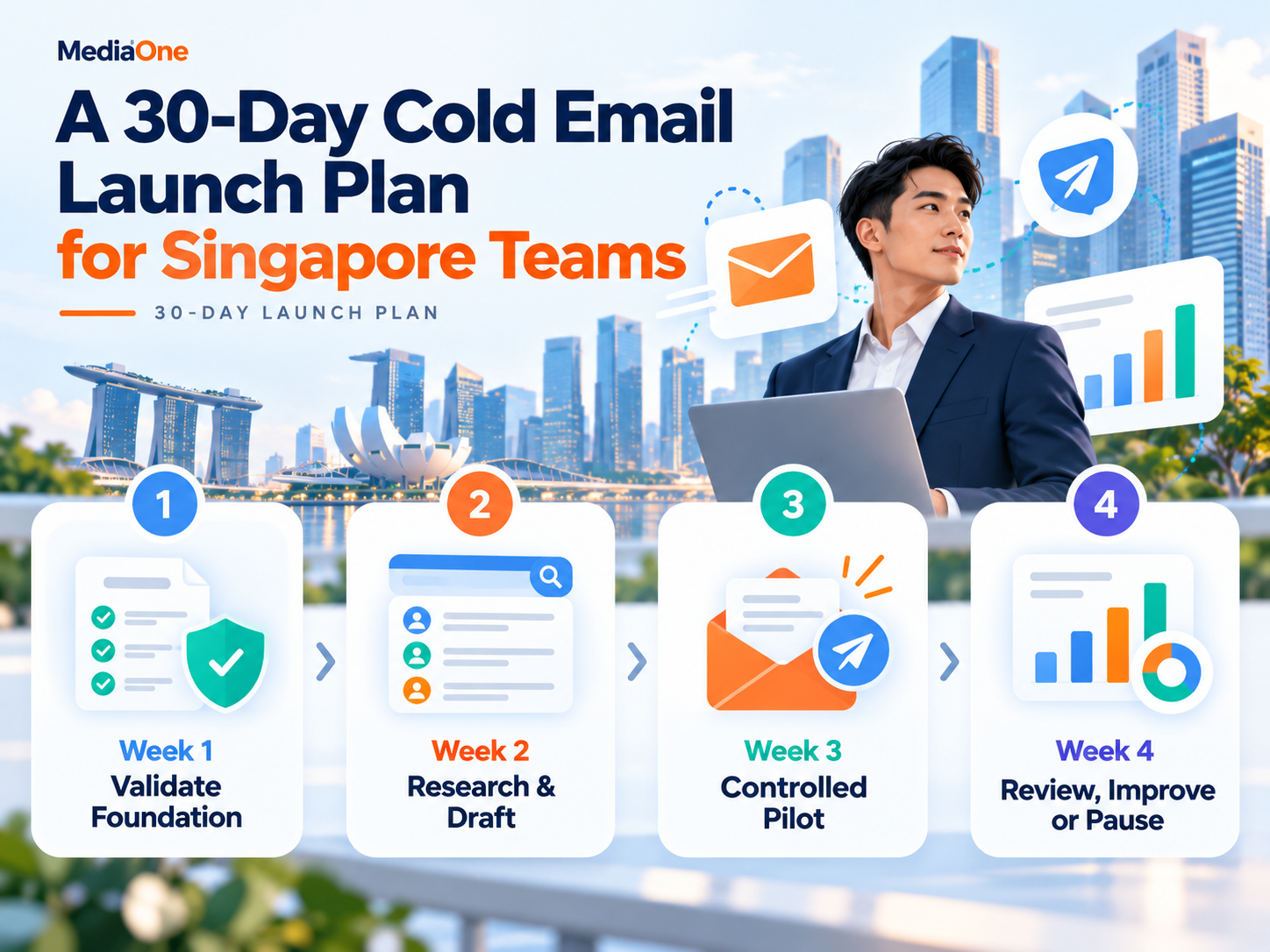
Week 1: Validate the foundation
Define the ICP and choose a single business objective. Review the applicable Spam Control Act provisions, PDPA considerations and any overseas rules. Confirm that your sending platform permits the intended activity.
Set up authentication and a reliable reply address. Establish a suppression process that works across the team.
Week 2: Research and draft
Build a small list with verified business contacts and relevant timing signals. Divide it into useful segments, then write one focused value proposition for each segment.
Draft the first email and the planned follow-ups. Apply the Send-Worthy Score to each first-touch message. Have another team member check factual claims, identity, links and opt-out handling.
Week 3: Send a controlled pilot
Start with a limited group that your systems can monitor properly. Check authentication results and delivery failures as messages go out. Review replies manually so interested buyers are not lost among automated responses.
Look for evidence that the intended buyer understands the offer and sees a reason to engage. Review negative feedback as well.
Week 4: Review, improve or pause
Compare positive replies, qualified meetings, complaints and costs with the original objective. Identify which segment produced genuine opportunities and which message triggered objections.
Keep effective combinations, revise unclear ones and retire segments with weak fit. If the legal, technical or targeting foundation is uncertain, pause until it is corrected. That is a better result than scaling a failing campaign.
Turn Cold Email Best Practices into Qualified Sales Conversations
Cold outreach works best when each send has a defensible reason behind it. Start with a narrow buyer profile, check the applicable rules and protect your sending infrastructure. Then write a concise message offering a useful next step.
Our recommendation is to score drafts before sending, test on a small verified group and judge performance by positive replies and qualified meetings. If the campaign cannot clear those checks, improve the offer or choose a different acquisition channel.
For businesses that need to connect outreach with a broader sales pipeline, our lead generation services bring together targeting, content, campaign measurement and follow-up planning. The decision to scale should follow evidence of genuine buyer interest, not pressure to send another thousand emails.
Frequently Asked Questions
Is cold email legal in Singapore?
Cold email is not automatically illegal simply because the recipient has not met the sender. However, Singapore’s Spam Control Act imposes requirements on qualifying bulk unsolicited commercial messages, and the PDPA may apply to personal data. Check the sending pattern, source of information and applicable rules before launching.
Does the PDPA require consent for every B2B cold email?
No blanket rule applies to every business email address. The PDPA excludes defined business contact information from its Data Protection Provisions, but other personal data may remain regulated. This exclusion does not override spam laws or email-provider policies.
What is a good cold email response rate in 2026?
There is no single reliable rate for every audience. Saleshandy’s October 2026 platform analysis reported 4.5%, while Belkins reported 0.45% for its 2025 campaigns using a different calculation. Measure qualified replies consistently and build a baseline for your own sector.
How long should a cold email be?
We recommend trying 75–125 words for a first introduction. Use enough space to explain the business reason, credible value and one next step. Clarity matters more than hitting an exact word count.
How many follow-up emails should I send?
Start by testing two or three follow-ups after the initial email. Each should add genuine value, and every sequence must stop when the recipient opts out or declines. Adjust the schedule using actual results and recipient feedback.
Should I use Mailchimp or HubSpot for cold email?
Mailchimp requires permission for its email marketing service. HubSpot also requires verifiable permission for marketing emails but distinguishes one-to-one introductions. Check the current rules for the exact feature and account before sending.

What is the best time to send cold emails in Singapore?
Begin with normal working hours in the recipient’s time zone, then test with your own audience. International study averages do not guarantee local results. A relevant message sent at a reasonable time is a stronger starting point than an unverified “perfect hour”.