| AI Summary
Brand differentiation helps businesses stand out by offering customers clear, meaningful advantages over competitors. This guide explains five practical steps to build a differentiation strategy, supported by examples from Singapore and international brands. Learn how to identify your competitive advantage, validate your claims and measure long-term brand performance. |

Brand differentiation gives customers a specific reason to choose your business over comparable alternatives. It might be specialist expertise, product design or a service experience buyers can verify.
We recommend starting with one customer problem, one credible advantage and evidence that connects them. This guide explains how to find that advantage, test its strength and communicate it consistently, with examples from Singapore and international brands.

Key Takeaways
- Brand differentiation starts with a meaningful customer benefit, not a new logo or slogan.
- Distinctive branding helps buyers recognise you; differentiation explains why they might choose you.
- Test proposed advantages for customer relevance, competitive difference, difficulty of imitation and available proof.
- Love, Bonito, Secretlab, Lush and T-Mobile illustrate different ways to build a recognisable proposition.
- Track buyer perception and commercial results. A strong-sounding promise is not evidence of success.
What Is Brand Differentiation?
Brand differentiation is the process of establishing and communicating characteristics that make a business meaningfully different from competing options. It answers a practical buyer question: “Why should I choose you?” The answer needs a concrete benefit, not a generic adjective.

Consider two accounting firms. Both advertise experienced staff and reliable service. One specialises in Singapore ecommerce sellers and provides reports separating marketplace fees, refunds and sales by channel. That specialisation gives an identifiable group a concrete reason to enquire. Its value still requires customer evidence.
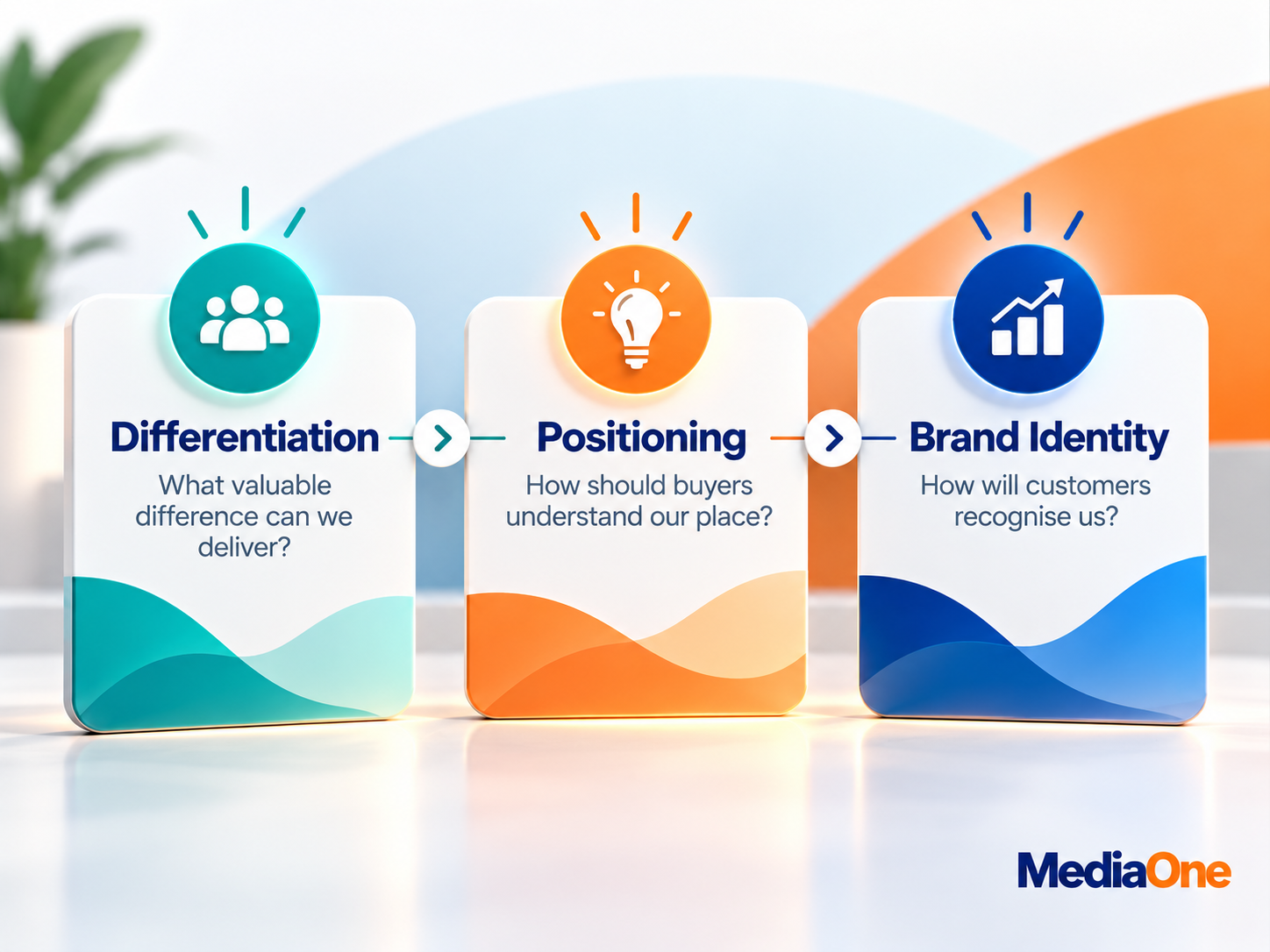
Differentiation, positioning and brand identity are related but separate decisions:
| Concept | Question it answers | Example |
| Differentiation | What valuable difference can we deliver? | Accounting tailored to marketplace sellers |
| Positioning | How should customers understand our place in the market? | The ecommerce-focused accounting partner |
| Brand identity | How will customers recognise us? | Consistent name, visuals and tone |
Distinctiveness also matters. Research by Romaniuk, Sharp and Ehrenberg found that buyers often perceive limited differences between competing brands, yet still purchase them. Their study argues for building recognisable brand associations alongside differentiation. We therefore would not dismiss logos, colours or memorable assets as superficial. They help people identify the business when a product advantage is difficult to explain.
Why Brand Differentiation Matters
Clear differentiation can make customer decisions easier. Buyers can evaluate a relevant advantage against their needs instead of comparing vague promises. It can also support referrals because customers have a specific benefit to describe.
It may improve willingness to pay when buyers value the benefit enough. However, higher prices, stronger loyalty and lower customer acquisition costs are possible outcomes, not automatic results. Competitor responses, distribution, execution and awareness still influence performance. A specialist provider can still struggle to reach buyers.
| Business signal | Weak differentiation | Stronger differentiation |
| Website message | “Quality solutions for everyone” | Names the customer, problem and approach |
| Sales conversation | Explains basic services repeatedly | Demonstrates a relevant advantage |
| Price discussion | Relies mainly on discounts | Connects cost to a valued benefit |
| Customer proof | Generic testimonials | Specific, verifiable outcomes or processes |
For Singapore businesses, proof deserves particular attention. The Competition and Consumer Commission of Singapore’s Guide on Quality-Related Claims advises businesses to make claims that are accurate, clear, meaningful and supported by evidence. Broad statements such as “Singapore’s best” need especially careful substantiation. The same discipline improves marketing credibility.
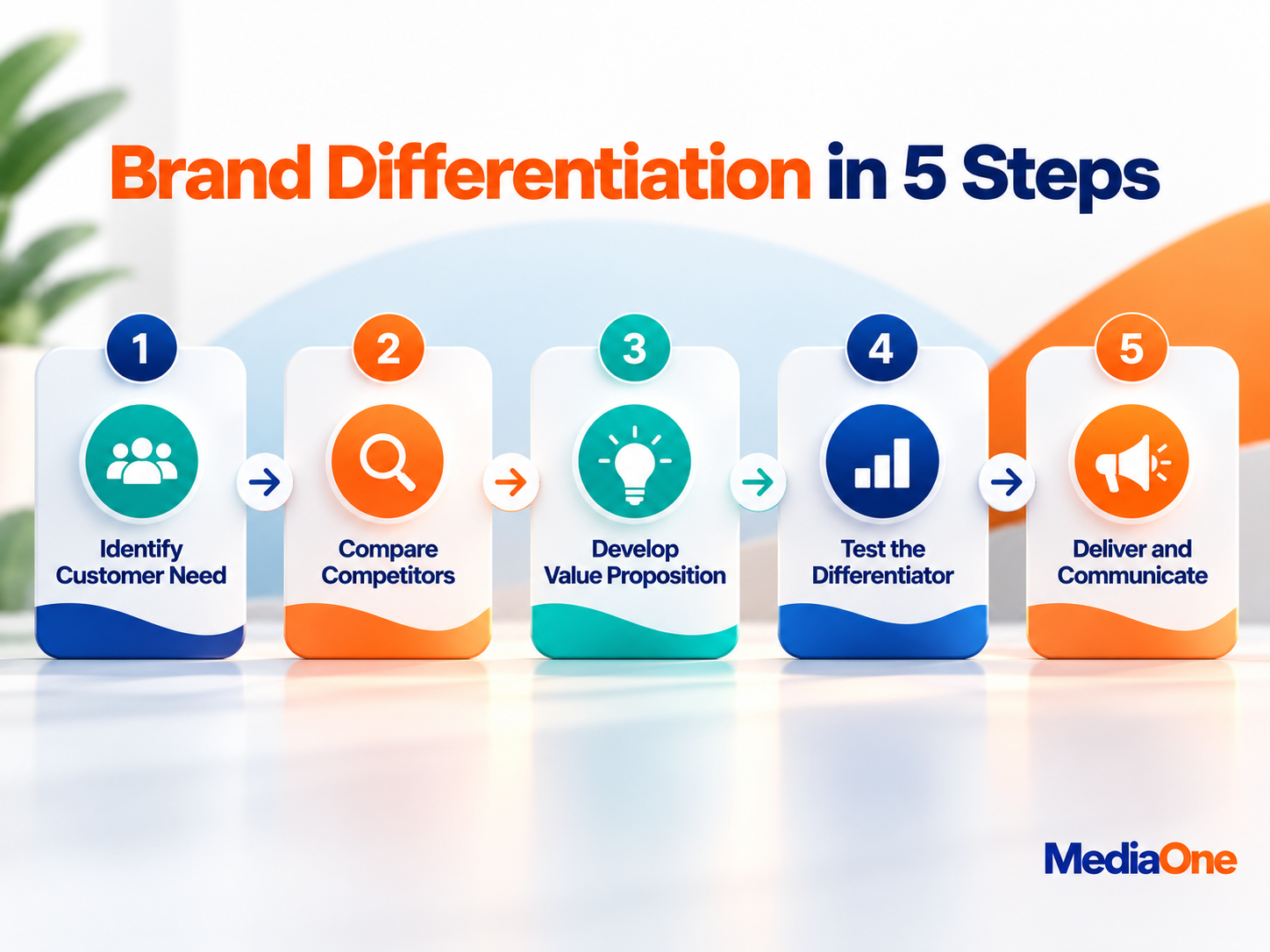
How to Differentiate Your Brand in Five Steps
A useful strategy links customer research to operational delivery. We recommend this sequence to keep teams from choosing a slogan before establishing what the business can deliver.
Step 1: Identify a Specific Customer Need
Begin with the people you serve and the decision they are trying to make. Interview recent customers, review lost sales and examine complaints or recurring questions. Ask what triggered their search, which alternatives they considered and what eventually influenced their choice.
Segment customers by need where possible. A restaurant operator choosing an equipment supplier may prioritise quick repairs, while a multinational buyer may care about compliance documentation. The same supplier should not assume one promise carries equal weight for both.
Step 2: Compare the Closest Competitors
Choose three to five alternatives that buyers genuinely consider. Review their offers, prices, guarantees, customer reviews and delivery methods. Include indirect substitutes where relevant; a customer may solve the same problem without buying your category at all.
Record claims separately from evidence. Compare advertised “24/7 support” with staffed hours and escalation procedures. Do not assume unfamiliar messaging signals an unserved need.
Step 3: Develop Your Value Proposition
A value proposition explains the benefit you deliver to a defined customer. A unique selling proposition (USP) is a concise claim that highlights a particular advantage. Avoid unsupported claims that no competitor offers anything similar.
Use this working formula: For [customer] who needs [outcome], we provide [specific approach], supported by [evidence].
For example: “For Singapore ecommerce retailers managing multiple sales channels, we prepare channel-level financial reports using a documented reconciliation process.” This hypothetical statement needs validation before publication.
Step 4: Test the Differentiator for Durability
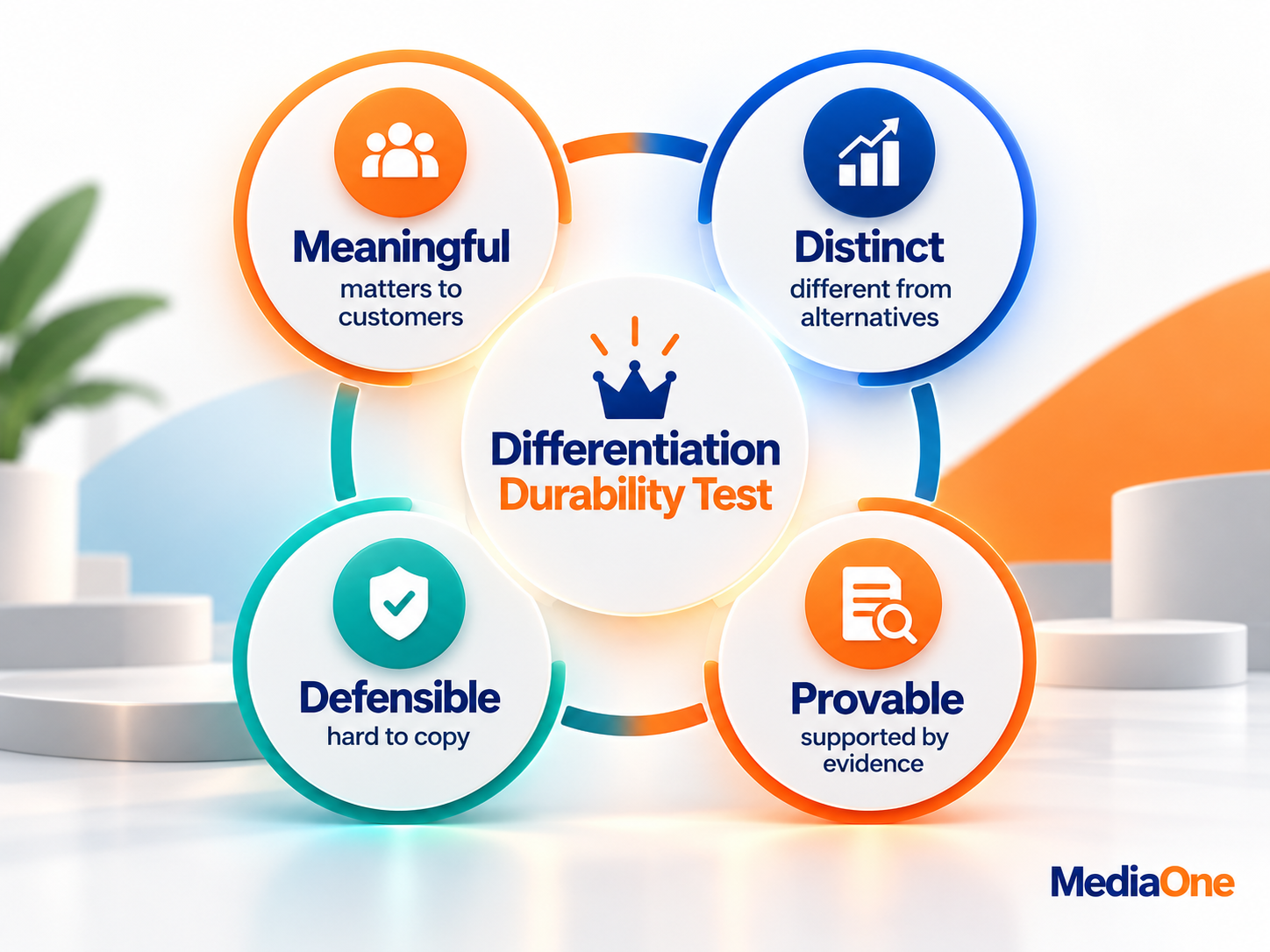
We recommend a four-question Differentiation Durability Test as an editorial decision tool. It is a practical framework, not a published industry standard or a guarantee of competitive advantage.
- Meaningful: Does the benefit influence the intended customer’s decision?
- Distinct: Is the offer recognisably different from the alternatives buyers consider?
- Defensible: Would copying it require capabilities, investment, expertise or sustained execution?
- Provable: Can customers verify the claim through records, demonstrations or credible evidence?
Mark each answer as supported, uncertain or unsupported. A claim with four supported answers is a stronger candidate for a core brand promise. If the claim is relevant but easy to imitate, it may still work as a campaign message. Investigate uncertain answers rather than assigning arbitrary scores.
Step 5: Deliver the Promise and Communicate It
Translate the chosen advantage into service standards, product decisions and staff responsibilities. If your promise is responsive support, define response times, train the team and track actual performance. Advertise only sustainable service guarantees.
Then repeat the same underlying benefit across your website, proposals, packaging and social channels. Tailor the wording to each format without changing the claim. Our brand strategy framework explores how to connect positioning with lead-generation activity.
Brand Differentiation Strategies That Work
Not every advantage needs an original invention. We recommend choosing a strategy your customers value and your organisation can deliver consistently.
Product Design or Specialised Expertise
Differentiate through features, usability, technical knowledge or an approach designed for a particular audience. The strongest claims explain what changes for the customer. “Built for compact apartments” beats “innovative design” when space matters.
A specialist consultancy might differentiate through expertise in a narrow regulatory environment. Its proof could include relevant qualifications, documented methods and properly authorised client examples. Demonstrate expertise rather than declaring it.
Service Experience and Convenience
Customers sometimes choose the provider that removes uncertainty. Useful differences include defined turnaround times, transparent onboarding, accessible support or a well-designed after-sales process.
The limitation is operational capacity. An express delivery promise becomes a liability if staffing cannot support it during busy periods. Pilot the service, measure fulfilment and disclose important restrictions before making it central to your brand differentiation strategy.
Values Backed by Observable Practices
Ethical sourcing, repairs and waste reduction can matter to particular audiences. They become credible when connected to purchasing policies, repair facilities or documented product practices. A purpose statement alone is weak evidence.
For sustainability-related claims, avoid treating “green” or “ethical” as self-explanatory. State precisely what the business does and which products or operations are covered. Singapore’s official guidance on product claims reinforces this need for clarity and substantiation.
Price Structure and Transparency
A lower price can attract buyers, but price alone is often easy to challenge. A clearer fee structure may be a stronger proposition when customers dislike unexpected charges. Publish what is included, what costs extra and how changes are approved.
A premium strategy also requires evidence. Higher pricing does not automatically signal superior quality. Explain the specific materials, expertise, support or outcomes that justify the difference to your intended audience.
Real Brand Differentiation Examples
These examples show how a customer-facing promise can connect to actual decisions. They illustrate strategic approaches; they do not prove that differentiation alone caused any company’s growth.
Lush: Fresh Products and Sourcing Principles
Lush positions fresh, handmade cosmetics as part of its product philosophy. Its fresh cosmetics explanation describes manufacturing practices designed around fresh ingredients. Its animal-testing policy states that the range is 100% vegetarian and 95% vegan, alongside restrictions on animal testing and ingredient suppliers.
The lesson is operational consistency. Product formulation, sourcing and manufacturing help substantiate the brand’s stated principles. These claims should not be simplified into “every product is vegan”, and the company’s practices should not be confused with independently verified financial performance.
T-Mobile: Changing the Service Model
T-Mobile’s 2013 US Un-carrier launch challenged prevailing wireless practices. The company introduced simpler plans without annual service contracts through its retail outlets and separated device costs from the service plan. These were concrete commercial changes, not merely a provocative advertising campaign.
The example demonstrates how pricing and contract structure can become a point of difference. We would assess its current distinctiveness separately because competing operators can subsequently adopt similar terms.
Love, Bonito: Designing Around Asian Women’s Needs
Singapore-founded Love, Bonito focuses its clothing proposition on the everyday Asian woman. Its brand description identifies functional details such as pockets, crease-ease fabrics and designs intended for different life situations. Its communications connect those product decisions to the needs of its audience.
This is a clear example of audience-led brand differentiation. Rather than claiming to serve every fashion shopper, the brand explains who its designs are for and what practical problems they address. Whether individual features remain exclusive requires competitor research.
Secretlab: Research-Led Product Engineering
Singapore-founded Secretlab emphasises chair design and product development. Its technology documentation describes proprietary foam approaches, pressure mapping and product engineering methods. It also discusses user testing and ergonomics research.
The distinctive claim is its engineering-led approach, supported by disclosed methods. We would still separate company descriptions from independent comparative proof. A product’s stated ergonomic features do not establish that it is the best chair for every user.
Applying Brand Differentiation in Singapore
A Singapore business can use the same approach without copying a multinational’s budget. Consider a hypothetical commercial cleaning company serving medical clinics. Its current message is “reliable cleaning at affordable prices”, which many providers could repeat.
After customer interviews, the company discovers that documentation and predictable opening-hour handovers matter most. It could develop a clinic-specific cleaning workflow, train its staff and provide completed checklists. The proposed difference is then service accountability, not a generic quality claim.
Before launching, we would verify three points: whether clinics actually prefer this service, whether competing providers already deliver it, and whether the team can demonstrate compliance with its own procedures. Claims suggesting regulatory certification must not be made unless supported by the appropriate credentials.
For any business, define the customer problem and verify your proposed solution before promoting it.
How to Measure and Maintain Differentiation
A brand promise should be reviewed against customer behaviour and operational performance. We recommend recording a baseline before changing your positioning, then comparing results over a sensible period. No single metric establishes causation.
| Measure | What to examine | What it can tell you |
| Buyer interviews | Reasons for choosing or rejecting you | Whether the advantage matters |
| Brand recall surveys | Recognition without prompting | Whether people remember the brand |
| Branded search queries | Search Console trends | Whether name-based interest changes |
| Qualified enquiry rate | Enquiries that fit your target segment | Whether messaging attracts suitable prospects |
| Promise fulfilment | Delivery times, complaints and service records | Whether operations support the claim |
Ask new customers what they remember about your business before explaining the answer. If they recall only “good service” when you promote a specialist process, your message may be too vague. If buyers understand the promise but complaints increase, fix delivery before spending more on awareness.
Keep Identity and Messaging Consistent
Maintain a short brand brief covering your audience, core claim, supporting evidence, tone and visual identifiers. Create a simple message hierarchy: one main promise, two or three supporting points and proof under each. Customer-facing channels should agree on the essentials.
Consistency does not mean repeating identical sentences everywhere. A landing page can explain the process while an advertisement highlights one benefit.
Review Competitors and Evidence Quarterly
Revisit the market when competitors change offers or customer expectations shift. We recommend a quarterly review for fast-moving categories and additional checks before major campaigns. Update claims when evidence changes.
Use this short checklist:
- Confirm the main claim still matters to customers.
- Compare it with the alternatives buyers currently consider.
- Verify supporting proof and operational performance.
- Check consistency across major customer touchpoints.
- Revise the offer or message where evidence reveals a gap.
Frequently Asked Questions
What is brand differentiation?
Brand differentiation is the process of making a business recognisably different in ways its intended customers value. A useful differentiator describes a specific benefit and has evidence behind it.
How does brand differentiation differ from positioning?
Differentiation concerns the difference a company delivers. Positioning concerns how the company wants buyers to understand its place among alternatives, while brand identity supports recognition.
What if competitors sell almost identical products?
Look at service, convenience, specialisation, purchasing experience and brand recognition. Test whether customers value the proposed difference before investing in new messaging.

Can small businesses build a differentiated brand?
Yes. A small business can focus on a defined audience, a specialist workflow or a service promise it can reliably fulfil. The advantage should fit its resources and customer demand.
How long does brand differentiation last?
There is no reliable universal lifespan. Competitors, customer needs and technology change at different speeds, so businesses should review their evidence and market position regularly.
Make Brand Differentiation a Competitive Advantage You Can Prove
Strong brand differentiation connects a valuable customer need with a credible reason to choose your business. It may come from product design, specialist knowledge, service delivery or transparent commercial terms. A consistent brand identity then helps customers recognise and remember that proposition.
We recommend choosing one priority audience, testing your strongest claim against the four durability questions and gathering proof before amplifying it. Track brand awareness KPIs to assess whether customers recognise your business and remember what makes it different. If the research exposes a weak advantage, improve the offer first. MediaOne’s branding services can help connect your positioning with a consistent customer-facing presence.