B2B telemarketing is the use of telephone calls to reach other businesses to sell a product or service, book a meeting, qualify a prospect or keep an existing account warm. It covers outbound prospecting and inbound follow-up. Put simply, it is a phone-based sales and contact process aimed at companies, not consumers. Its goal is to generate demand and turn leads into customer relationships that last. Teams in many industries use it to reach the right decision-makers at each company.

Used well, telemarketing b2b supports lead generation and demand generation by putting qualified conversations in front of the right buyers, as part of a wider marketing effort.
Key Takeaways
- Qualify before you dial. Judge B2B telemarketing on qualified conversations, not immediate sales.
- Irrelevant outreach costs you. Most buyers avoid suppliers who send it.
- Benchmark realistically. Use current industry connect and success rates from primary sources — and note which year they come from.
- Score campaigns first. Check list fit, access and permission before calling.
- Track each stage. An overall success rate hides where a campaign fails.
- Set a follow-up limit. Know when persistence becomes harassment.
What B2B Telemarketing Still Works?
A campaign needs a defined target profile, a stated purpose for each call, and a record of what happened afterwards. Firms may run the function in-house or buy it from a specialist agency. Both options draw on a range of services and resources, from call scripts to CRM tools. A sensible company keeps a clean, consent-aware contact list alongside its phone data. For teams building that foundation as part of a wider programme, MediaOne Marketing sets out the broader demand-side picture for Singapore businesses.
How B2B Differs from B2C Telemarketing
B2B purchases often involve several people, a budget owner, procurement and a longer evaluation. The table below sets out the main differences.
|
Factor |
B2B telemarketing |
B2C telemarketing |
|
Decision makers |
Several people, often a committee |
Usually one individual |
|
Call objective |
Earn the next conversation |
Often a direct sale |
|
Call length |
Longer, with a qualifying discussion |
Typically shorter |
|
Sales cycle |
Longer, with budget and procurement steps |
Usually shorter |
|
Compliance focus |
Clear caller identity and checks before calling business numbers |
Registry checks and consent for personal numbers |
Relevance matters more in B2B. A Gartner survey of 632 B2B buyers found 73% actively avoid suppliers that send irrelevant outreach. Poor targeting therefore costs more than one wasted call.
Why the Channel Survives in a Relevance-First Market
Telemarketing creates a live, two-way exchange. A salesperson can test fit and ask questions in real time. Used well, B2B telemarketing gives a team the fastest route to a qualified answer. Open with a question about the prospect’s situation rather than a pitch. Let the call build toward case studies that show how similar customers solved the same problem.
Telemarketing works where it qualifies and nurtures. It fails where it is used as a volume tool to chase immediate closes. Judge the channel on qualified conversations, the prospects it moves forward and the pipeline it creates, not same-day sales. The aim is long-term relationships rather than one-off wins.
Benefits and Use Cases of B2B Telemarketing
Core Advantages
Telemarketing’s main advantage over email and social outreach is a live, two-way exchange. A buyer can object, ask questions or explain a problem in real time. A skilled caller can respond before the opportunity cools.
Calls also speed up learning. A week of calls shows which job titles respond, which pain points get a reply and which objections recur. This feeds back into targeting faster than email tests. Sales teams can refine their approach within days rather than waiting for campaign-wide results.
Every call produces a recorded outcome. Track connect, qualification and pipeline separately, because an overall figure hides where the campaign loses people. Well-run B2B telemarketing services make this tracking routine.
Common Use Cases: Lead Generation, Appointment Setting and Account Nurturing
Telemarketing supports three distinct jobs, each needing a different call objective. The approach suits many industries, though each sector needs its own call script and targeting.
- Lead generation identifies companies and contacts that fit your profile and confirms a live need, producing qualified leads for the sales team.
- Appointment setting books a meeting for an account executive, ideally around a specific offer such as a 20-minute review of a named problem.
- Account nurturing keeps prospects warm through short check-ins that surface timing changes, such as a budget cycle or a new hire in the buying group. This supports long-term relationships with each business customer.
Mixing these objectives usually weakens all three. A caller booking a meeting will rush a nurturing conversation.
Where Telemarketing Underperforms
Telemarketing is a poor fit when the buying decision is slow, technical and committee-led, and the first conversation cannot add value. Without a reason to talk in the first 30 seconds, calls mostly end in voicemail or rejection.

It also underperforms with a loosely defined list. In the Gartner survey of 632 B2B buyers, 73% said they actively avoid suppliers that send irrelevant outreach. Poor targeting damages the brand as well as wasting calls.
Judging calls only on same-week conversions also works against it. Ehrenberg-Bass Institute research on B2B buying — including its finding that the large majority of business buyers are not in-market at any given time — emphasises long-term availability over quick wins.
Types of B2B Telemarketing Campaigns
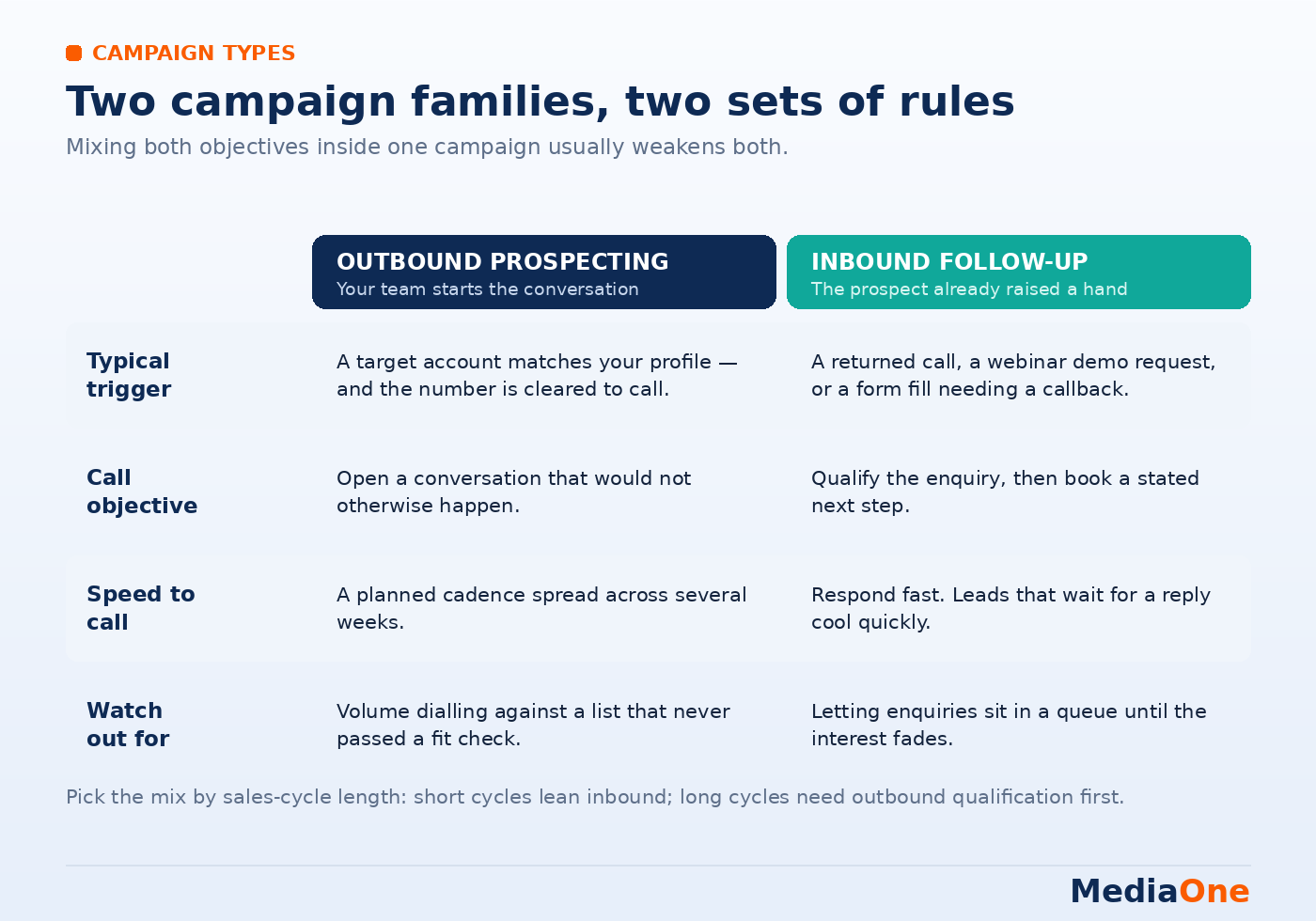
Most B2B telemarketing programmes fall into two families. Outbound campaigns are where your team starts the conversation. Inbound work is where a prospect has already raised a hand. Mixing them up is a common reason campaigns underdeliver, so each family needs its own goals and measures. Good data about each prospect’s status helps your team decide which family a call belongs to, and a clean record of each contact keeps follow-up on track — the same discipline that underpins a sound direct outreach strategy.
Outbound Prospecting Campaigns
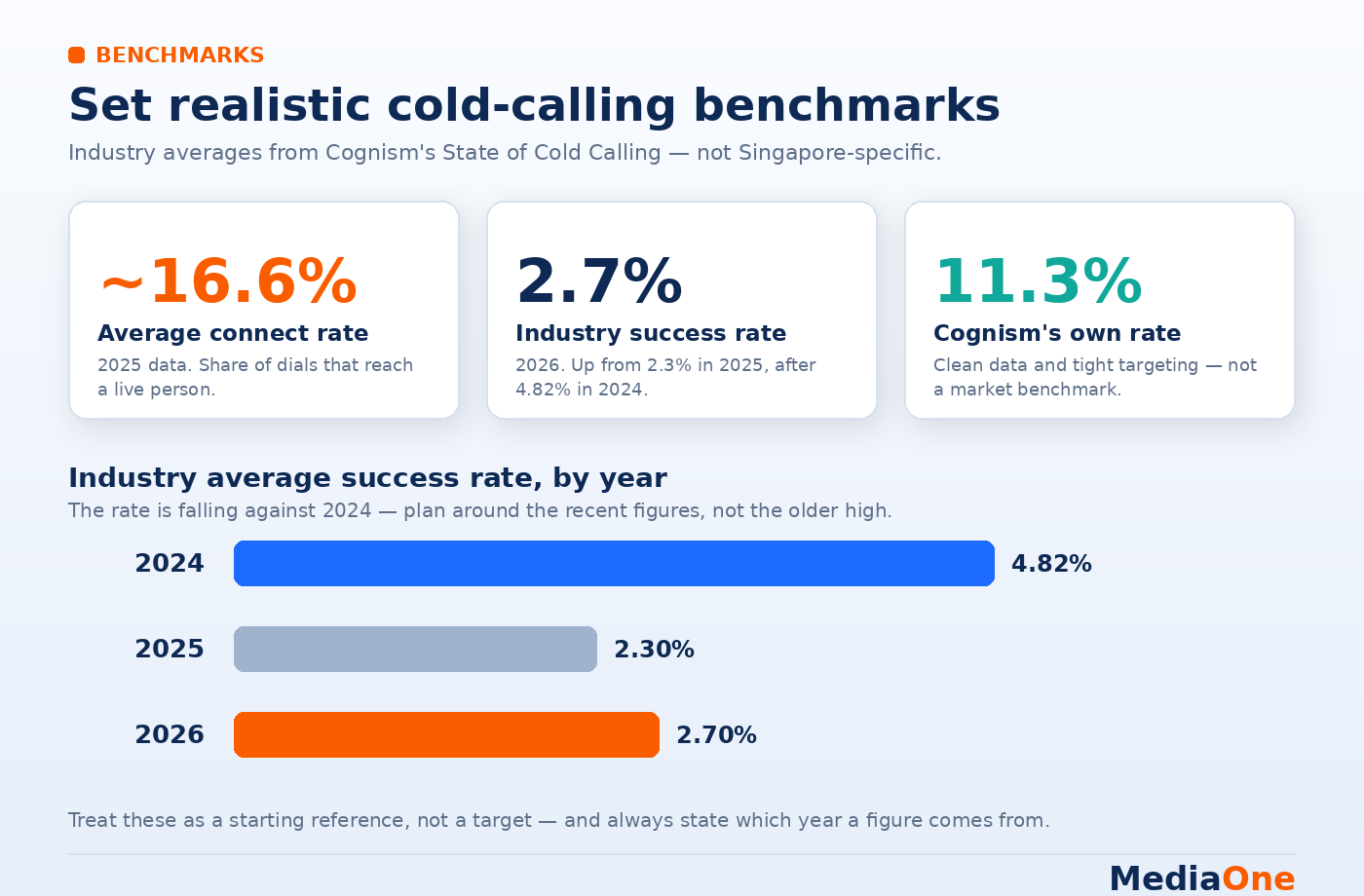
Outbound creates conversations that would not otherwise happen, but plan around modest benchmarks. Cognism’s State of Cold Calling reports an average cold call connect rate of about 16.6% (2025 data) and an industry average success rate of 2.7% in 2026, up from 2.3% in 2025 and down from 4.82% in 2024. These are industry averages across markets, so treat them as a starting reference rather than a target — and always state which year a figure comes from.
Outbound also carries a reputational cost. Run it only against lists that pass a fit check. Confirm the company operates in the industries your offer serves before any call. Done well, outbound telemarketing b2b service work protects the brand while building a qualified pipeline and reaching the right prospects.
Inbound Handling and Follow-Up
Inbound covers calls and enquiries that come to you, such as returned calls, webinar demo requests, or form fills needing a callback. Speed matters most, so set a response-time target and measure against it. Leads that wait too long for a reply cool quickly, and a slow response can cost the business the deal.
Many inbound enquiries are not ready to buy. They need a planned sequence of touches. Treat the first call as qualification, then schedule the next step with a stated reason. Once an enquiry converts to a landing page visit or form fill, what happens on that page determines whether the callback is worth making — see MediaOne on landing page optimisation in Singapore.
Choosing the Right Mix for Your Sales Cycle
The right mix depends on how long your sales cycle runs and how much of your pipeline is already warm:
|
Sales cycle |
Pipeline mostly warm? |
Suggested mix |
|
Short (under 30 days) |
Yes |
Mainly inbound, light outbound |
|
Short |
No |
Balanced outbound and inbound |
|
Long (several months) |
Yes |
Inbound-led, with nurturing outbound |
|
Long |
No |
Outbound qualification first, then nurturing |
For long cycles, nurturing deserves real investment. The Ehrenberg-Bass Institute’s work on how B2B brands grow supports focusing on long-term relationships rather than only immediate conversions. Case studies from similar businesses can also show how each approach performed in practice.
Compliance in Singapore: What Your Calling Team Must Know

Most B2B telemarketing failures come from calling people who should never have been on the list, or from a caller who could not say clearly who was calling and why. Compliance is a qualification step, not a legal footnote. It belongs in the scorecard before the first dial, and it is part of data quality. Before any outreach to prospects, your sales and calling teams should confirm that each number is permitted to be called. Every customer record should carry a clear permission status before it enters a calling list, and that status should support any demand generation activity built on the list.
Calls to Businesses and the Do Not Call Registry
Singapore’s Do Not Call Registry governs telemarketing to Singapore telephone numbers. Screen every number before any campaign. Do not call a registered number for marketing unless you hold clear, recorded consent from the number holder.
Calling a business is not automatically safe. Switchboards, generic enquiry lines and unknown mobiles can all be registered, and a purchased list does not transfer its permissions to you. Treat “it is a business number” as a claim to verify, not an assumption. Every telemarketing b2b campaign needs this check, because formatting errors in exported lists can hide duplicate or malformed numbers. Because the PDPC is the authority on the registry’s exact scope — including how it applies to particular business lines — confirm the current position in the PDPC’s DNC guidance before you dial, and note that liability sits with your organisation even when a third-party aggregator performs the check.
Misrepresentation Rules and the FTC Context
Some agencies cite the US Federal Trade Commission when describing B2B calling rules. The FTC did extend its prohibitions on misrepresentations to business-to-business telemarketing in a 2024 update to its Telemarketing Sales Rule, alongside new call-detail recordkeeping requirements. That is a US rule, and it does not govern calls to Singapore numbers.
The principle still transfers well. Build three checks into every script: the caller names themselves and their organisation at the start, the offer is described accurately, and no false urgency or invented referral opens the conversation. For sector-specific rules, such as those in financial services, check with the relevant Singapore regulator, for example the Monetary Authority of Singapore (MAS), or with your compliance adviser.
Building a Consent and Suppression Process
Consent and suppression need a written process, owned by one person, with a record for every decision:
- Source record. Note where each contact came from: a referral, an existing relationship, a public listing, or a purchased list.
- Registry check. Screen every number against the Do Not Call Registry before it enters a dialling queue.
- Do-not-call list. Log every “do not call again” request, bounce and complaint, and remove those numbers from all lists, including those shared with agencies.
- Re-check cadence. Re-screen the active list each time it is reloaded, because registry status and contact details change.
Warm lists built from referrals and existing relationships usually carry the least risk and the highest connect quality. Cold lists can work, but they need the same screening and do-not-call discipline. Teams can draw on PDPC’s guidance on personal data obligations when setting up these records; for the equivalent discipline applied to email lists, see MediaOne’s guide to bulk email marketing compliance in Singapore.
Setting Up a B2B Telemarketing Campaign Step by Step
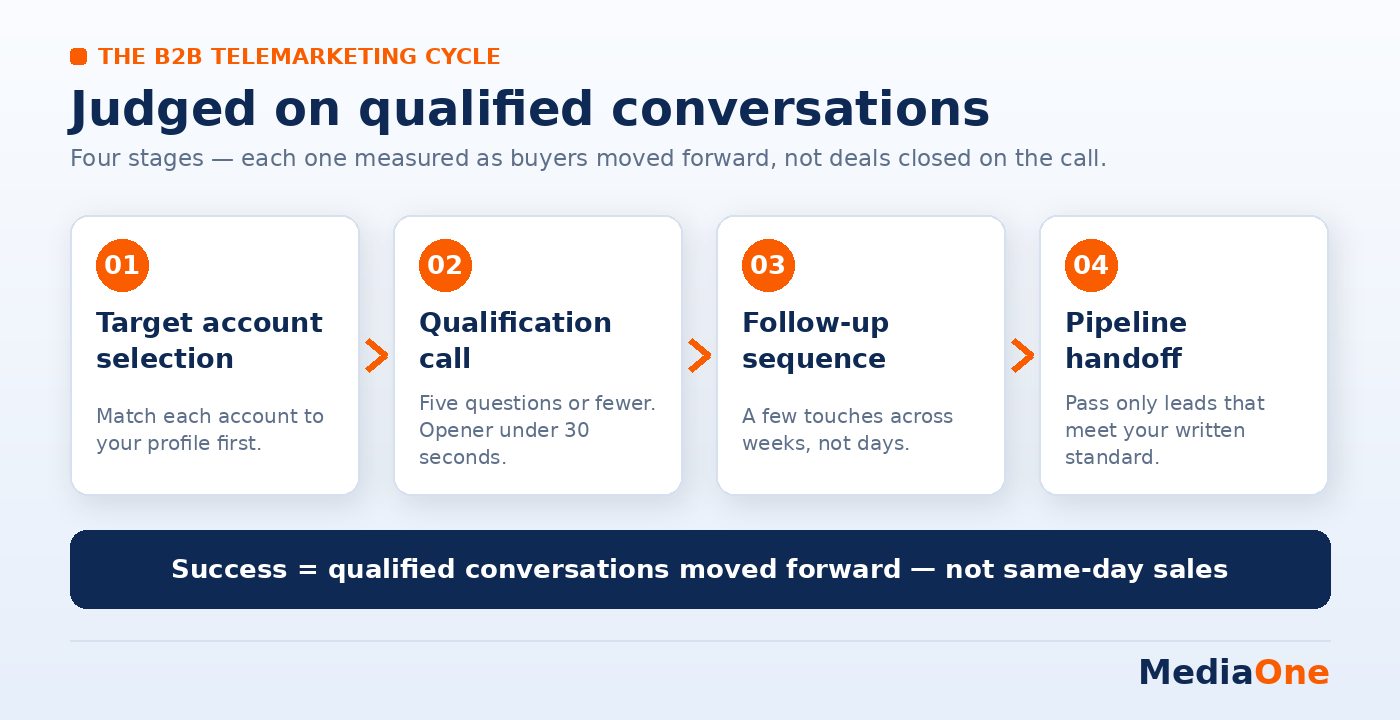
Most campaigns fail before the first call. The list is too broad, nobody has agreed what a good outcome looks like, and the script is written for volume rather than for a buyer. A short pre-launch check prevents most of this. Marketing and the sales team should agree the check together, so that the list, the script and the handoff all reflect the same definition of a good outcome, and so that the leads passed to sales are ones the team would genuinely want to work.
Defining Goals and Target Accounts
Start with one goal per campaign: booked meetings, qualified opportunities, or a list to follow up later. Each goal needs a different script and a different measure of success.
Then define the target account profile in terms you can check against a list: industry, company size, location, and the role that owns the problem your services solve. The list determines the connect rate more than any script does. Confirm that the companies on it genuinely match the businesses you can serve well, and that the contact data is current. Where a campaign covers several industries, define the profile for each one separately rather than as a single broad group.
The Call-to-Pipeline Scorecard
Before dialling, score the campaign against five criteria, each rated 1 to 5. A criterion passes only when the evidence behind it is confirmed; check each against its pass mark, and fix any criterion that does not meet it before you dial.
|
Criterion |
Question to ask |
Pass mark |
|
List fit |
Does each account match the target profile? |
Confirmed on enquiry |
|
Decision-maker access |
Is a named role reachable, or only a switchboard? |
Confirmed on enquiry |
|
Permission status |
Is there an opt-in, an existing relationship, or a documented business-contact basis? |
Confirmed on enquiry |
|
Qualification questions |
Is there a written set of questions that defines a qualified conversation? |
Five or fewer questions, all agreed in writing |
|
Follow-up cadence |
Are the number of touches and the stop rule written down? |
Defined in writing before launch |
Fix any criterion that fails its pass mark before dialling. It is far cheaper to learn that the list is wrong on paper than on the phone.
Lead Qualification Criteria and Scoring
A qualified lead meets your written criteria. Agreeing to a call does not make someone qualified. Keep the question set to five or fewer so callers can ask them naturally.
Cover four areas: whether the prospect has the problem, whether they own or influence the decision, whether there is a timeline, and whether budget or an approval process exists. Record each answer as yes, no or unknown.
Treat a lead as qualified only when the problem and decision-maker answers are both yes. Timeline and budget can be unknown and still justify follow-up, but they should be lower priority. Review the standard after the first 50 conversations, and check whether the prospect data behind each answer is accurate.
Script Structure and Call Quality Checks
A good B2B call script is a framework, not a word-for-word reading. It has a short opener, one qualifying question and a clear next step. Keep the opener under 30 seconds, and let the prospect speak more than you do.
Check call quality with a short weekly review. Listen to a sample of calls, score them against the qualification criteria, and update the script, not the individual, when the same problem recurs. Note any recurring customer objection so the next version of the script answers it.
Call Timing and CRM Logging
Timing and records decide whether follow-up happens at all. Schedule calls in the windows when your target role is most likely to pick up, and avoid the first and last hour of their working day. Log every call outcome in your CRM within the same working day, with the answer to each qualification question, the next step and the agreed follow-up date. A call that is not logged cannot be followed up, and a missing note often turns a warm prospect into a repeat cold call. For data on when Singapore recipients are most responsive, see MediaOne’s breakdown of the best times to reach B2B and B2C contacts in Singapore.
Caller Training
Train callers on your services, the target profile and the qualification questions before they dial. Role-play the opener, the objections and the handoff to a salesperson, and make training ongoing with monthly reviews. A caller who knows the stop rule and the do-not-call handling is far less likely to create a complaint.

Setting a Follow-Up Cadence and a Stop Rule
Decide the cadence before launch. A workable sequence spreads a small number of touches across several weeks, mixing calls with a relevant follow-up such as an email or a useful resource. Patient, long-term follow-up beats immediate pressure — the pattern the Ehrenberg-Bass Institute’s B2B research describes.
Set specific limits. Callbox’s published sales-cadence examples include one built of 12 touchpoints spread over 22 days, balancing follow-up frequency with breathing room — a useful reference point, though its exact day-by-day schedule should be checked against the current page. Callbox also publishes a Singapore-specific view of cadence planning. End contact at once if a prospect asks not to be called, and add that number to your do-not-call list.
Measuring Success: Connect Rates, Conversion and Cost per Meeting
A single overall figure hides where a campaign breaks down. Track three stages separately:
- Connect rate: the share of dials that reach a live person who can hear the pitch.
- Qualification rate: the share of connected conversations that meet your standard. If connects are healthy but qualification is low, the list or the questions are the problem.
- Sales pipeline yield and cost per meeting: the share of qualified conversations that become meetings or opportunities, and total campaign cost divided by meetings booked. This shows whether the channel pays.
Keep connect rate separate from conversion. A strong connect rate with no pipeline points to the message or targeting, not call volume. Review the three figures weekly for the first month, then monthly. For a framework that carries this discipline beyond the phone, see MediaOne on building a data-driven marketing framework.
Outsourced or In-House: Which Model Fits?
Keep qualification criteria and follow-up decisions in-house, as they reflect your product knowledge. Outsource high-volume dialling if you lack the staff or calling discipline to sustain it. Estimates of outsourcing savings vary widely and usually come from cross-industry studies rather than telemarketing-specific research — for example, a 2018 outsourcing study reported savings of 10% to 25% for 62% of companies surveyed. Treat that as a general industry finding, not a guaranteed saving for your business.
Use this checklist before deciding:
- Compare the fully loaded cost of an in-house caller (salary, management, tools, training and idle time) with the agency fee, quoted per meeting or per campaign.
- Outsourcing tends to make sense when you cannot keep a dialling team fully occupied, or when call volume is too spiky to justify permanent headcount.
- Keep it in-house when the qualification conversation needs deep product knowledge that an agency cannot learn quickly.
- Check that any agency will share call recordings, logs and the do-not-call list back to you.
- Review the choice after one full quarter of data.
Conclusion and Next Steps
B2B telemarketing earns its place in a Singapore sales stack as a qualification and follow-up channel for company accounts, not a volume tool. A clear next step, a documented permission basis and timely follow-up beat a hundred dials aimed at the wrong prospects. The Gartner survey found 73% of buyers avoid suppliers sending irrelevant outreach.
Start with one campaign:

- Pick one segment across your target industries and list no more than a few hundred accounts.
- Confirm the permission basis for every number and every email address.
- Score the campaign on the five scorecard criteria and fix any weak one.
- Use the Cognism benchmark as a reference, not a target.
- Set a follow-up cadence and a stop rule for non-responders, and log every contact interaction, so qualified leads and demand generation data stay visible to sales.
- Review the numbers after one month, then decide whether to scale.
If you would rather run the programme with a partner, talk to MediaOne about how telemarketing fits alongside your wider search, content and paid activity.
Frequently Asked Questions
Is B2B telemarketing legal in Singapore?
Yes, but it is regulated. Check every number against the Do Not Call Registry before dialling. Identify your organisation and yourself on every call, and keep a do-not-call list of opt-outs. Regulated sectors such as financial services may have additional rules, so confirm these with your compliance team — or with the MAS — before launching.
What is a good connect rate for B2B cold calling?
Cognism’s State of Cold Calling reports an average connect rate of around 16.6%, with the industry average success rate at 2.7% in 2026 (2.3% in 2025; 4.82% in 2024). Cognism reports its own success rate at 11.3%, more than four times the industry average — a useful illustration of what clean data and good targeting can produce, not a market benchmark. These figures are not Singapore-specific, so treat them as a starting reference, and always cite the year. The connect rate depends heavily on list quality, so fix the list before changing the script.
How much can outsourcing telemarketing save?
Published estimates vary and are rarely telemarketing-specific. One widely cited 2018 outsourcing study reported 10% to 25% savings for 62% of companies surveyed, with higher savings for the remainder. Treat this as a claim to test, not a guarantee. Compare the fully loaded cost of an in-house caller with the agency fee.
How long should a B2B call script be?
Keep the opening under 30 seconds and aim for the prospect to speak more than you do. Scripts should be frameworks, not word-for-word readings. If your script runs past two pages, it is likely selling rather than qualifying.
Should we build an in-house telemarketing team or outsource?
Keep qualification criteria and follow-up decisions in-house, as they reflect your product knowledge. Outsource high-volume dialling if you lack the staff or discipline to sustain it. Score both options against the same Call-to-Pipeline Scorecard and review after one full quarter of data.