
Search now asks whether a business is a recognised entity, and AI assistants answer questions about it in their own words. Your AI entity footprint is the record of how machines identify your company, what they associate with it, and what they say when asked.
This guide shows how to measure and correct it, using a four-layer scorecard you can complete in an afternoon. The scorecard is the author’s model, built for this guide. It is not an industry standard. Each layer receives a score from 0 to 3, and the audit section below shows the three test prompts used.
Key Takeaways
- Your AI entity footprint is a verifiable record of how machines identify and describe your business, so audit it before generative search summaries define it for you.
- Search has shifted from keywords to entities, starting with Google’s 2012 Knowledge Graph.
- Reviews feed the footprint: 95 percent of consumers read reviews before they buy a product.
- Score four layers (core definition, machine-readable structure, third-party corroboration, AI output accuracy) from 0 to 3.
- Address the lowest-scoring layers first, since they shape AI summaries before traditional listings.
- Record fixed prompts over time, as assistants do not publicly document their sourcing.
Who Runs the Audit, How Long It Takes, and What Passing Looks Like
A marketing or operations lead can run the audit alone, though a second person checking the Layer 4 answers reduces bias. The first three layers take about an hour for a single-location business, and Layer 4 test adds roughly the same time per monthly run. A passing score means every layer scores 2 or higher, with Layer 4 answers accurate on all three prompts across the assistants you tested and the brand’s digital footprint consistent in every area it covers.
Why the Footprint Matters Now
Search engines used to match words. Google’s Knowledge Graph, launched in 2012, treats a search as a question about things: people, places and organisations with defined attributes and relationships. Large language models appear to draw on similar entity logic, though each assistant’s sourcing is not publicly documented. Your AI entity footprint is the record these systems hold of your business, whether you manage it or not, and it starts with the definitions that sources give of your name, category, and location. The digital identity these sources build is only as accurate as the data they hold.
Reputation is now a machine problem as well as a human one. If sources disagree on your name, category, or location, assistant summaries will disagree too, eroding trust in your brand. Deloitte’s 2026 marketing trends analysis predicts that the gap between the promise and reality of AI will narrow in 2026, which raises the stakes for the information these systems draw on. Deloitte also notes that AI is becoming the operating system of marketing. Your brand content, directory listings and social profiles all feed that system, and they shape how companies are found and judged.
This article shows how to measure that footprint, decide what to fix first, and identify which parts you cannot control. Singapore businesses, for example, are often described through local directories, Google Business Profile and regional review sites, so those are the sources worth checking first. Teams that also audit their digital marketing channels together usually find the fastest gains in this area. Consultants can also help clients map which sources feed their entity records, and read the results earlier in the process.
What Makes Up Your AI Entity Footprint
Your AI entity footprint has four layers, each of which can be scored from 0 to 3. The table below defines what each score means, using criteria you can check yourself.
| Layer | Score 0 | Score 1 | Score 2 | Score 3 |
|---|---|---|---|---|
| 1. Core definition | No consistent name or description anywhere | Name matches, but category or description varies | Name, category and description match on most sites | Identical legal name, category and one-line description everywhere you control |
| 2. Machine-readable structure | No structured data; address or phone missing or different | Some schema or identifiers, but gaps or conflicts | Organization schema with address and phone, few gaps | Complete schema with @id and sameAs linking to every official profile |
| 3. Third-party corroboration | Few or no reviews or listings | Listings exist, but reviews are sparse or below four stars | Reviews on two or more platforms, mostly consistent | Active reviews on several platforms with consistent details and ratings |
| 4. AI output accuracy | Assistants describe the business incorrectly or not at all | Partly correct, with outdated or mixed details | Mostly accurate, with minor gaps | Accurate on all three test prompts across assistants |
The first layer is your core definition: legal name, category and one line describing what you do. If that line differs across your website, business registry and directory listings, they have to guess which version is true. The second is a machine-readable structure, including schema markup and consistent address and phone details. The third is third-party trust across Google Business Profile, Yelp, Bing Places, Apple Business, Facebook, the Better Business Bureau and trade directories, where verified reviews can back up your claims. The fourth is what AI assistants say about your brand when asked. Working professionals who review these four layers each quarter can spot drift early, before it reaches the assistants they rely on. Ideally, this check runs on your operating system of record so that humans and machines read the same facts.
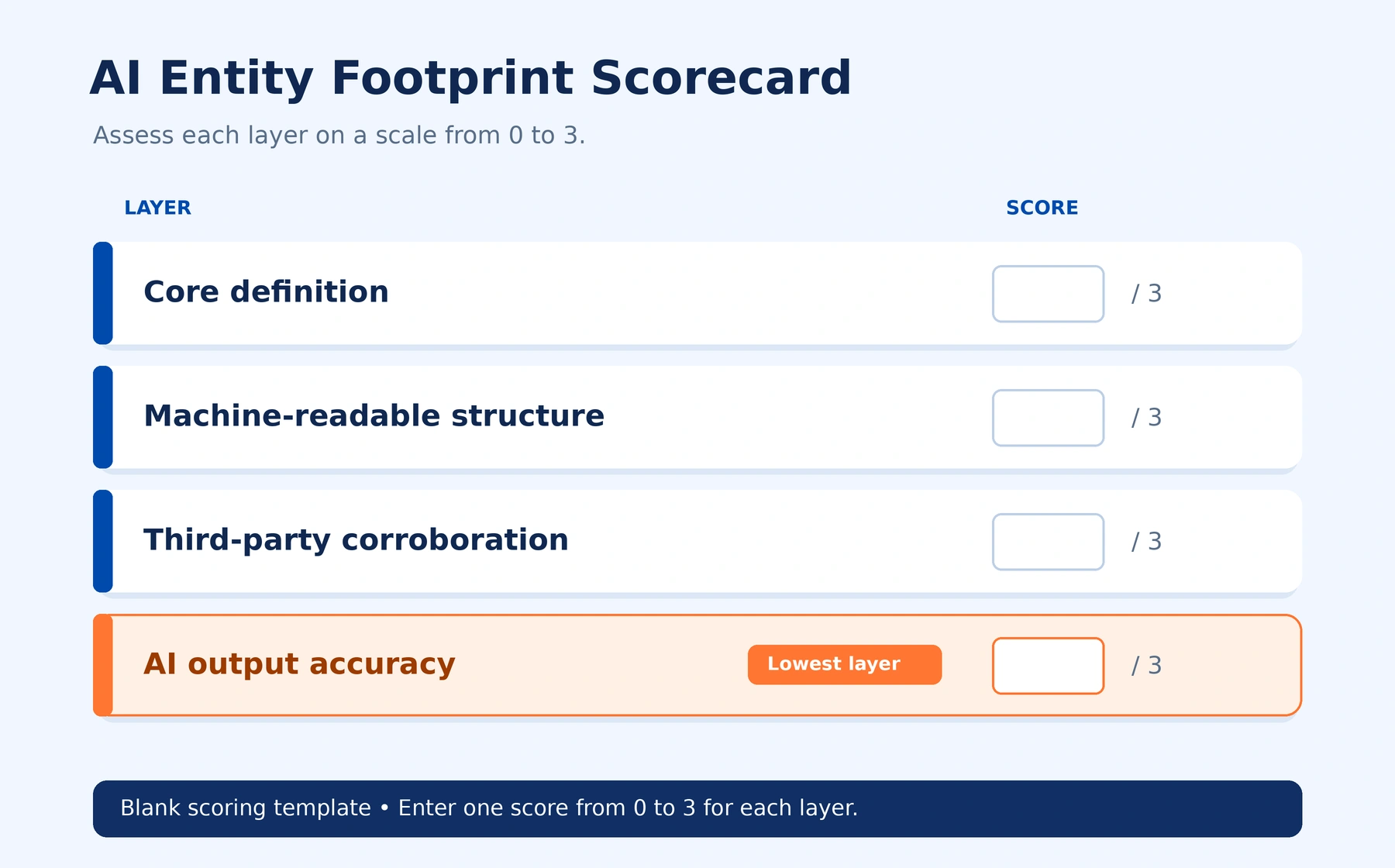
Reviews carry particular weight. A survey cited by Ebo reports that 96 to 97 percent of consumers read online reviews, and 92 percent hesitate to buy from businesses that have none. Firms that track this research can see the lowest total across the four layers, which shows where to start fixing. Every audit starts with a clear baseline, so the definitions in each layer stay the same across teams and years. Teams that compare against an earlier baseline can see whether a layer is actually improving.
Mapping Entity Relationships
An entity is more than a name. It sits in a network of relationships: a parent company, its locations, its products and the people who run it. Knowledge graphs store these links as connected facts, so a missing or contradictory link can detach a product from its brand or a branch from its head office. List each relationship you want machines to hold, ensure that every platform states it the same way, and identify any missing links.
Building Entity Clarity for AI Systems
AI systems identify your business by matching your name against a known entity, and that match is only as strong as the description attached to it. Google’s Knowledge Graph moved search from matching strings to recognising things, and the same logic now fuels large language models. When your name, category and description differ across your website, directories and social profiles, a system has to pick one version. Write one canonical definition that includes your legal name, primary category, and a sentence on what you do, and use it everywhere you control.
Pick one category term and one service vocabulary to use across all platforms. A “marketing agency” on your website and a “creative studio” on LinkedIn read as two different businesses to both humans and machines.
Schema.org markup for Organisation and LocalBusiness specifies your name, address, phone number, and profile links in a format that parsers can read without interpretation. Pair it with the @id and sameAs properties so the entity links to its profiles. The schema.org documentation defines these properties, and platform documentation such as Google’s structured data guidelines describes how each search product reads them.
Keep the “about” paragraph identical to the structured data an assistant ingests. Divergence between the two is where inaccurate AI summaries start.
Managing Visibility and Reputation Risk in Generative Search
Generative search judges a brand on whether its entity is described accurately, not just whether its page ranks. Answers are built from attributes that can be corroborated, so thin or contradictory signals across the digital identity can produce a wrong description or none at all.
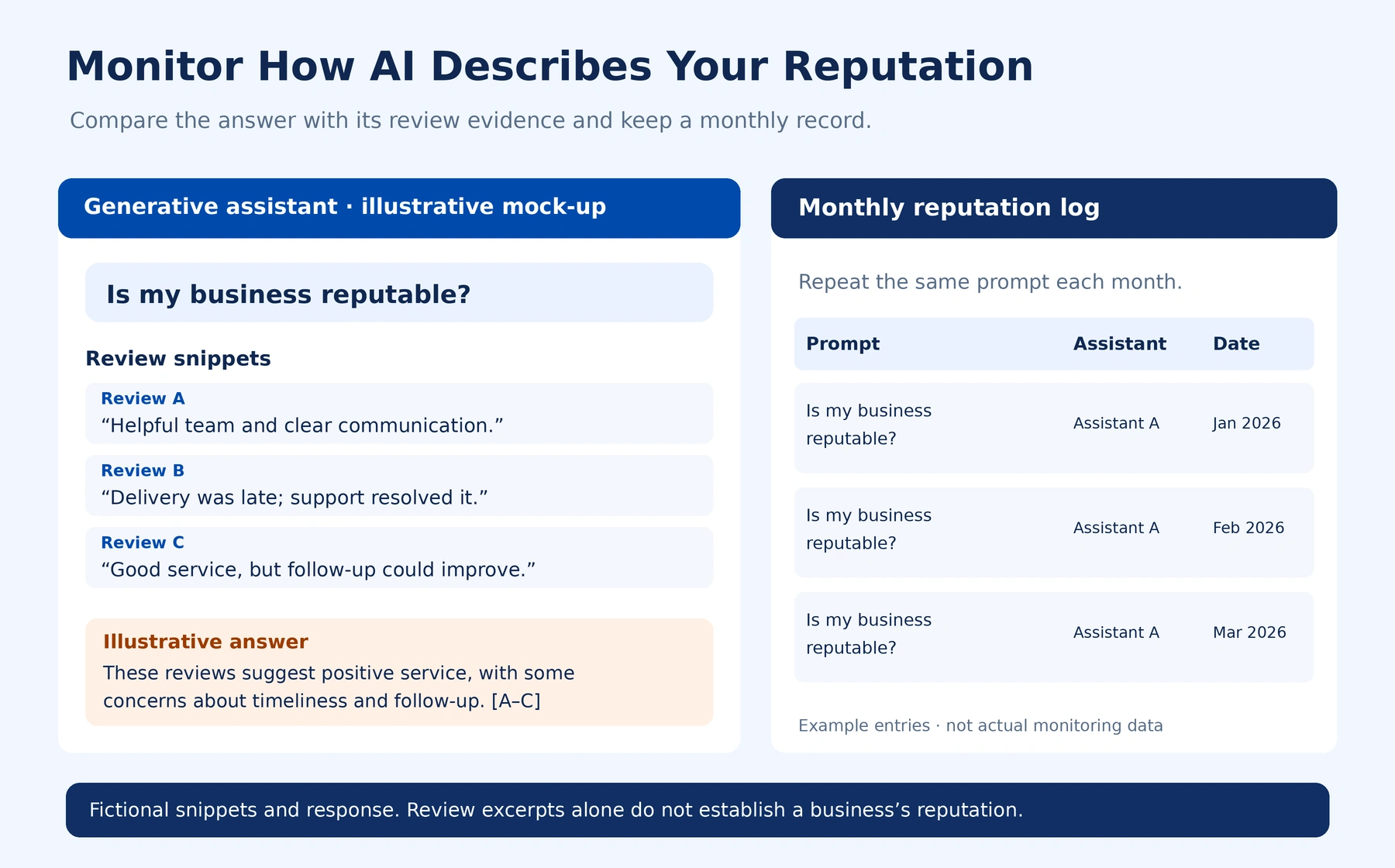
Summaries reflect what the model found. Inconsistent descriptions of your category, location, or offer across sites and social profiles carry over into the answer, and prospects may never reach your site to correct them. Keep the description consistent across every channel so that the answer engine and human readers see the same firm entity, and monitor how competitors and companies in your category are described alongside you.
Reviews act as third-party evidence that builds trust, though the public does not document how much each assistant weighs them. Reviews on Google Business Profile, Yelp and the Better Business Bureau shape both human and machine impressions. Test visibility monthly with the same three prompts and record the output, and compare it with earlier results to spot shifts in how your content and brand are represented.
Running a Digital Footprint Audit
A digital footprint audit tests how machines describe your business today, then compares that output against the facts you want them to hold.
Start by scoring the first three layers from the table above. Check your canonical definition against your website, directories and profiles, confirm your schema markup and identifiers, and count your reviews and their ratings. Correct any layer scoring 1 or below before testing Layer 4, because weak definitions distort every answer an assistant builds on them. Use only verified company details in each profile so the information stays consistent across listings, and ensure every brand description matches your canonical definition.
Then run the Layer 4 test. Query two or three assistants with the same three fixed prompts, such as “What does it do?”, “Is it reputable?”, and “Who are the best providers in?” Record every answer in a log like the one below, then compare the results against your canonical definition.
| Prompt | Assistant | Date | Result (accurate, partly accurate or wrong) | Notes on the error |
|---|---|---|---|---|
| Not confirmed | Not confirmed | Not confirmed | Not confirmed | |
| Not confirmed | Not confirmed | Not confirmed | Not confirmed | |
| Not confirmed | Not confirmed | Not confirmed | Not confirmed |
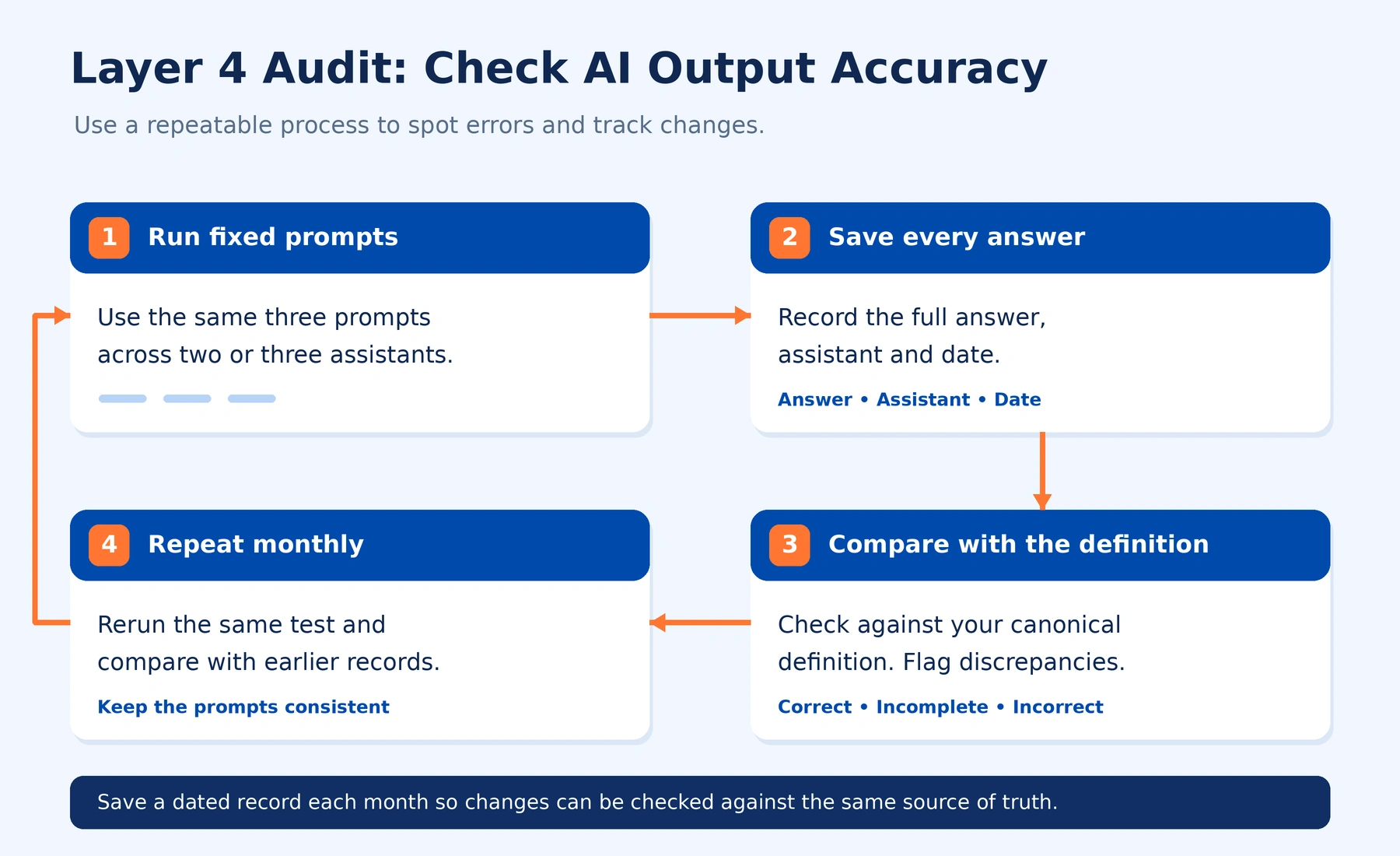
Assistants do not always agree. In one informal run of the same three prompts, two assistants described the same firm differently, and the gap traced back to a stale category in one directory. Logging the assistant’s answers lets you see that divergence instead of averaging it out. Treat the test as a check on your data sources, not on the assistant’s internals, since the sourcing behind each answer is proprietary.
For corroboration, review counts matter. Research cited by Ebo reports that nearly half of consumers avoid businesses with fewer than twenty reviews or a rating under four stars. If your profiles fall below that level, prioritise review generation on Google Business Profile, Yelp, LinkedIn and the Better Business Bureau, since trust builds where reviews are visible. Repeat the full audit monthly to confirm that fixes are holding.
Conclusion: Treat Your Entity Footprint as Infrastructure
Most businesses still treat their online presence as marketing collateral. An AI entity footprint deserves a different standard. It is the record that machines use to decide who you are, what you do, and whether they can trust you.
Deloitte’s 2026 forecast predicts that the gap between AI’s promise and reality will narrow in 2026. Accuracy in your entity record is therefore a business asset.
Score each layer of the four-layer table from 0 to 3, fix the lowest total first, and repeat the audit on a fixed schedule.
Frequently Asked Questions
What is an AI entity footprint?
An AI entity footprint is the set of facts machines use to identify your company and describe it: your name, category, location, reviews, citations and structured data. Search engines and large language models build their answers from these attributes. Auditing the footprint shows how machines currently describe your brand and where that description is wrong or incomplete. Our digital marketing services can help you review it.
How is an entity footprint different from a digital footprint?
A digital footprint is everything published about your company. An entity footprint is narrower: it is how machines resolve and describe your business as one distinct thing. Audit them separately, because many mentions don’t guarantee machines identify you correctly.
Does schema markup help AI systems understand my business?
Yes. Schema markup labels your name, address, category and identifiers in a format machines read without guessing. It only works when the same details also appear consistently on your website, your Google Business Profile, and on Bing Places, Apple Business, Yelp, Facebook, BBB and trade directories.
How often should I audit my AI entity footprint?
Run a full audit at least twice a year, and check core listings after any change in name, address, services or ownership. Record a fixed set of prompts for AI assistants each quarter to see how their summaries shift. Monitor review counts monthly. 33% of consumers would not consider using a business with a star rating lower than four, so that rating is worth watching closely.
Can reviews affect what AI tools say about my company?
Yes. Reviews are third-party corroboration, and AI summaries often draw on them when describing reputation. Customer reviews factor into the buying decisions of 97% of participants in one reported survey, and 47% of consumers will use businesses that don’t bother to respond to reviews. Build review volume and response quality on the platforms your buyers use, then recheck assistant outputs once changes take effect.