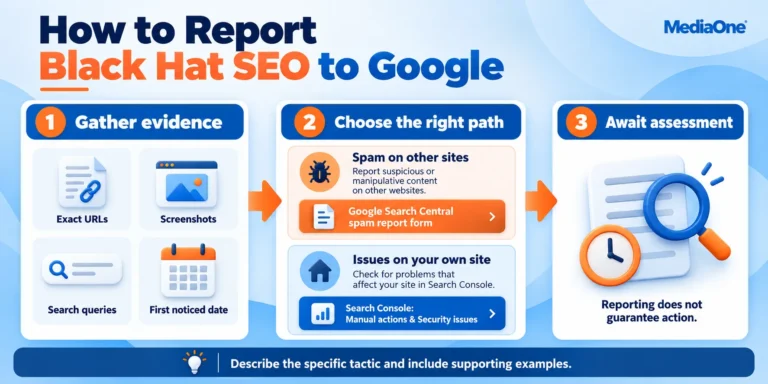
To report black hat SEO, first check whether your site or a competitor’s site is compromised. Spam injection and manipulative tactics often share the same weak points as malware. Check, document, and report, then clean up.


Two situations call for two different responses. To report a competitor, use Google’s spam report form. To fix your site, use Google Search Console to see whether a manual action or a security issue is affecting it, then clean up the site and request a review.
Key Takeaways
- Black hat SEO is primarily a security and reputation issue.
- Malware and spam injection often exploit the same weak points as manipulative tactics.
- Check for compromise before penalties; damage can build while rankings hold steady.
- Triage by impact, then investigate, contain and clean.
Why Black Hat SEO Is Now a Security Problem
Black hat SEO is primarily a security and reputation issue. Tactics such as keyword stuffing, hidden text and paid link networks can lead to malware, spam injection and credential theft. Rankings can hold while damage builds over time, so check security before you report black hat SEO.
Google’s search quality guidance rewards good content and penalises unethical practices. Because the penalty risk is real, many businesses check their search results and sites regularly rather than waiting for a traffic drop. A sudden drop after a core update can signal that a site’s links or content need review.
Triage Workflow: Compromise First, Then Manual Actions
Check for compromise first, then for manual actions, then for backlinks.
| Problem type | Typical signs | Response |
|---|---|---|
| Security compromise | Injected spam pages, unfamiliar admin users, redirects | Contain the site, clean the files, harden access, then request a review |
| Manual action (policy violation) | Manual Actions report lists a spam policy | Fix the violating content or links, then submit a reconsideration request |
Spam action timing and outcomes vary, so treat any expected review window as uncertain.
How to Spot Black Hat SEO on a Live Page
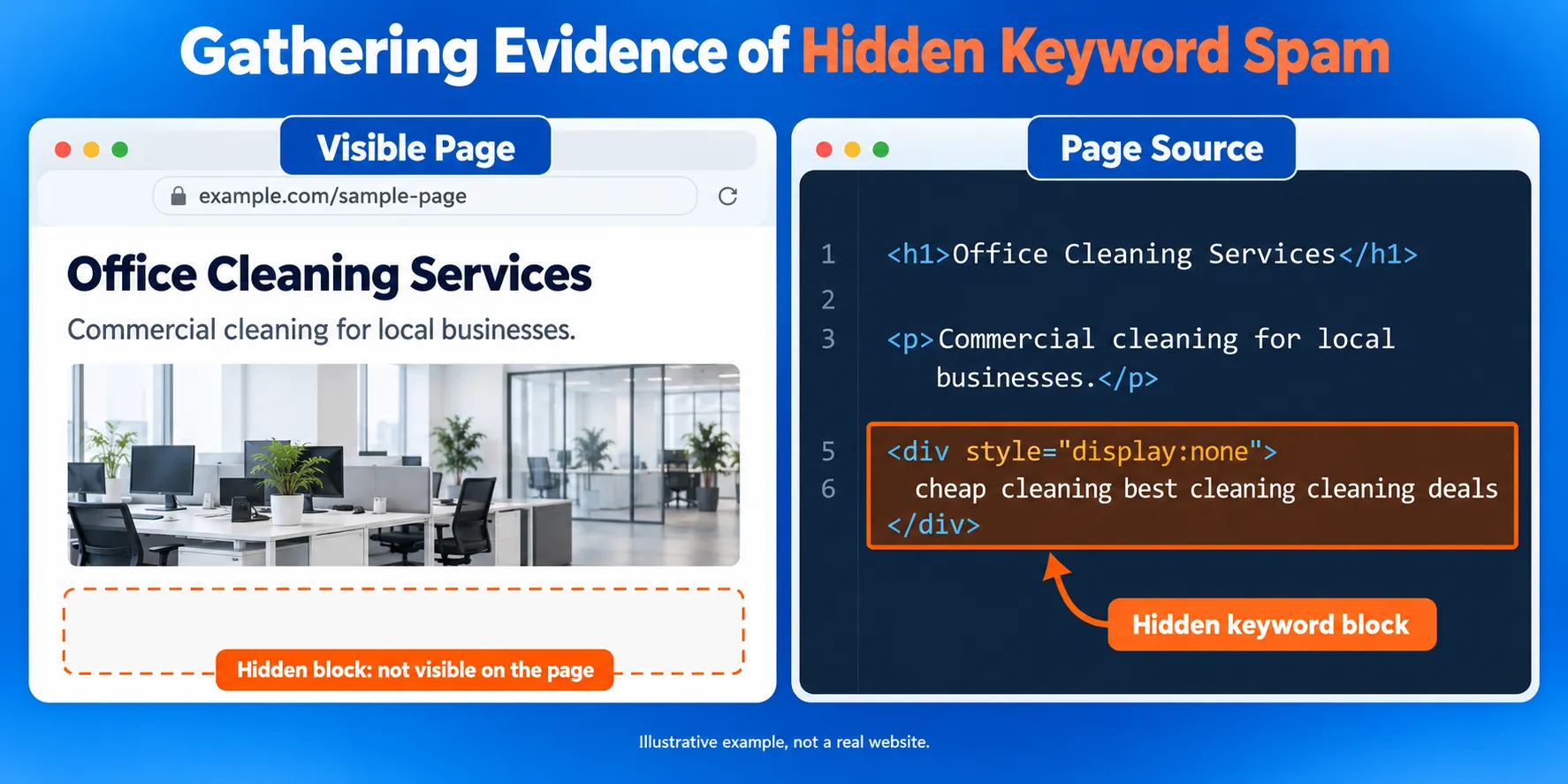
Black hat tactics appear on live pages in recognisable ways. Keyword stuffing is the practice of filling a web page with keywords or numbers to manipulate rankings in Google Search, which also damages user experience and violates Google’s search engine guidelines. Hidden text is text or links that visitors cannot see but search engines can, such as white text on a white background or text hidden behind an image. Cloaking shows search engines one page and visitors another, a clear departure from white-hat SEO practice.

Off-site, a private blog network (PBN) is a collection of websites controlled by one owner or organisation, which is used to publish content that includes links to target websites. Link networks like this often feature unrelated topics, thin content, and sudden link spikes from domains with no real audience. Some sites also publish AI-generated content at scale with little editing, a pattern worth noting during an audit. The duration of a Google penalty varies, and manual penalties last until you fix the identified issues and Google approves a reconsideration request. A core update can also shift rankings for sites that rely on these tactics, so audit your backlink profile and disavow toxic links you cannot remove.
When you need to report black hat SEO, check these signs first:
- Text that differs between crawler and browser views
- Keyword lists in footers or hidden blocks
- Backlinks clustered from unrelated sites
Deciding Which Backlinks Are Toxic
Judge each link against clear criteria:
- Topical mismatch: an unrelated niche, such as a casino page linking to a plumbing site, is a strong red flag.
- Anchor patterns: repeated exact-match anchors across many domains suggest a manufactured campaign.
- Site quality: thin content, identical templates and no real audience point to a network.
Disavow clearly manipulative sites you cannot get removed. Request removal first when a real site simply has poor judgement.
Gathering Evidence Before You Report
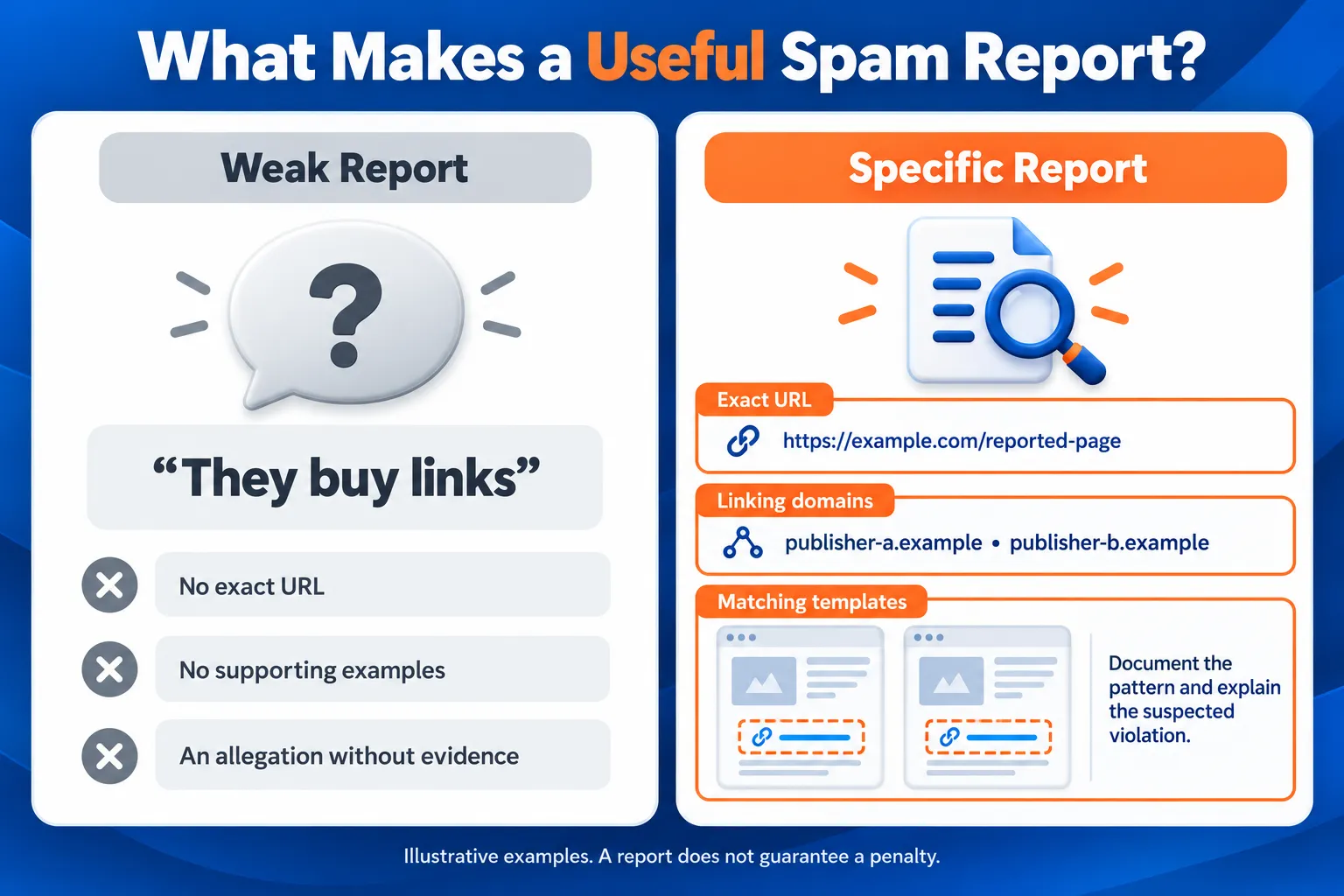
Before you report black hat tactics, gather proof. Google’s spam report form relies on evidence: exact URLs, screenshots of spam content or hidden text, the search queries where the page appears, and the date you first noticed it.
A Worked Example: Compromise or Manual Action?
Suppose organic traffic drops. Open Search Console and check the Manual Actions and Security Issues reports. A spam policy listed under Manual Actions means a manual action. Injected pages listed under Security Issues, with no manual action, point to a compromise. Injected spam URLs missing from your sitemap also suggest a compromise.
How to File a Spam Report with Google
To report black hat SEO, open Google’s spam report form, select the spam type, paste the URL and describe what you saw factually. Include one line per URL, the exact tactic, screenshots, and the date first noticed. Search Console will tell you the exact problems that triggered a manual action and on which pages those problems appear.
You will not receive a reply unless Google has further questions. The Search Central documentation explains the spam policies reviewers apply.
Security Compromises That Come Before Penalties
Security breaches often precede ranking penalties. Outdated CMS software, weak admin passwords or compromised plugins can let attackers inject spam pages or hidden redirects. On e-commerce stores, card skimmers can copy payment details at checkout. Check the CMS core, plugins and admin users first, and remove anything unrecognised.
Cleaning Injected Spam and Removing Toxic Backlinks
Clean in this order so a backdoor cannot reinject spam:
- Back up the site and database, then enable maintenance mode.
- Update the CMS core, plugins and themes. Remove unused ones.
- Delete unrecognised admin accounts and reset the remaining passwords.
- Check cron jobs for entries you did not create.
- Search files for unfamiliar changes, including PHP files in upload folders.
- Delete injected spam pages and hidden redirects, then confirm none remain.
- Export the backlink profile, request removal of toxic links, and disavow the rest. Toxic links can trigger algorithmic penalties from the search engines, so remove the worst first.
For agencies managing several sites, our SEO services include routine audits that catch these issues early. If you run a business website in Singapore and want a second pair of eyes, Media One Marketing offers SEO support you can speak to directly.
Monitoring Search Results for Injected Pages
Check Search Console’s page indexing report to see which pages Google can find and index on your site, and look for unexpected URLs. Repeat the review after a few days.
Conclusion
Report black-hat SEO after checking for compromise, documenting each finding, and cleaning the site before any recovery work. A compromised site cannot regain trust through content or link work alone.
Next-Step Checklist
- Check Manual Actions and Security Issues in Search Console.
- Check the page indexing report for unexpected URLs.
- Update the CMS, plugins and themes.
- Reset admin passwords and verify cron jobs.
- Audit backlinks and disavow the remainder.
- Report competitor violations with URLs, screenshots and dates.
Frequently Asked Questions
How do I report black hat SEO to Google?
Use Google’s spam report form in Search Central. Describe the specific tactic, such as hidden text, doorway pages or paid links, with example URLs and search queries. For problems on your site, check the Manual Actions and Security Issues reports in Google Search Console. Reporting does not guarantee action, and you will not receive a reply unless Google has further questions.
Does reporting a competitor actually lead to them being penalised?
Not always, and not quickly. A report is one signal among many, and Google cannot comment on individual actions. Specific, documented violations give reviewers evidence they can act on.
Frequently Asked Questions
What is considered black hat SEO?
Black hat SEO uses deceptive tactics to manipulate search rankings. Examples include keyword stuffing, manipulative link schemes, cloaking and hacked content. Google may lower a violating site’s rankings or remove it from results.

No. Hidden text can serve legitimate purposes, such as accessible labels or expandable content. The issue is text hidden specifically to manipulate rankings, including concealed blocks of repetitive keywords.

What evidence should I gather before reporting suspected spam?
Record the exact URLs, relevant search queries and what you observed. Save dated screenshots and source-code excerpts where useful. Describe the suspected violation clearly, and exclude personally identifying information from your submission.
Will reporting a competitor lead to their website being penalised?
Not automatically. Google evaluates suspected violations and uses reports to improve its detection systems. A report may contribute to manual action, but it does not guarantee a penalty, removal or better rankings for your website.
How can I spot injected pages on my website?
Search Google using site:yourdomain.com and look for unfamiliar page titles, URLs or offers. Also check Search Console’s Security Issues report. A site: search is useful for spotting problems, but it is not a complete inventory of indexed pages.
What should I do if I discover hacked or injected content?
Remove the unauthorised content and fix the vulnerability that allowed it. Review Search Console’s Security Issues report for further examples and instructions. If a security review is required, request it after completing the cleanup.
Can Search Console remove injected URLs immediately?
Its Removals tool can temporarily hide URLs from Google Search on a site you control. It does not remove the underlying content or repair the breach. You still need to clean the website and address the cause.
Should I report phishing and malware through the spam form?
Use Google’s dedicated phishing or malware reporting routes for those threats. The search spam form is intended for issues such as ranking manipulation and spammy pages. Choose the route that matches the problem.