A domain name can be available, affordable and still be a poor choice for your business. A low first-year price may conceal a higher renewal fee. A name that sounds original could resemble a registered trade mark. And a .sg address has administrative requirements that are easy to overlook. Discovering these problems after launch can mean moving your website and changing business email addresses.

Before you register a domain name, compare more than the figure at checkout. Can customers spell it after hearing it once? Is another company in your sector using a similar name? Does the extension suit a Singapore-focused business or one selling abroad? Check the registrar’s renewal, transfer and security terms alongside the introductory fee.
Work through five checks covering availability, trade mark risk, .sg eligibility, total cost and account security. The steps below also cover verification, DNS and email setup.
Key Takeaways
- Check the name before the price. An available domain can still create a trade mark dispute or brand confusion.
- Compare the total cost across the first two years, including renewal charges and optional services.
- Choose .com for a broad international audience, or consider .sg for a recognisable Singapore connection.
- Foreign applicants may register .sg domains through an authorised local administrative contact.
- Keep control of the registrar account, verification email and renewal settings, even if someone else builds the website.
- Before paying, check availability, trade marks, eligibility, costs and account protection.
What Is a Domain Name and Why Businesses Need One
A domain name is the address people enter to reach a website, such as yourbusiness.sg. The Domain Name System (DNS) directs requests to the relevant server. DNS records also direct email, so the website and inbox can use separate providers.
A registrar handles the registration, a registry maintains the official records for the extension, and a web host stores or serves the website. Some companies package all three services together, but you are not required to buy them from one company. MediaOne’s guide to domain names and how they work explains those roles in more detail.
For Singapore businesses, a domain also becomes part of the identity shown on invoices, email signatures, packaging and advertising. Choose an address that customers can remember and that the business can keep using as its products or services change. A very narrow keyword name may become awkward after an expansion into new markets.
Changing domains later means updating links, configuring redirects and possibly moving email. Search performance can fluctuate during the move.
Understanding Domain Extensions: .com, .sg and Others
The extension is the ending after the final dot. A .com address is widely recognised internationally, while .sg identifies a Singapore country-code domain. The extension communicates something about the business’s intended audience, although it cannot establish the quality or trustworthiness of the company on its own.

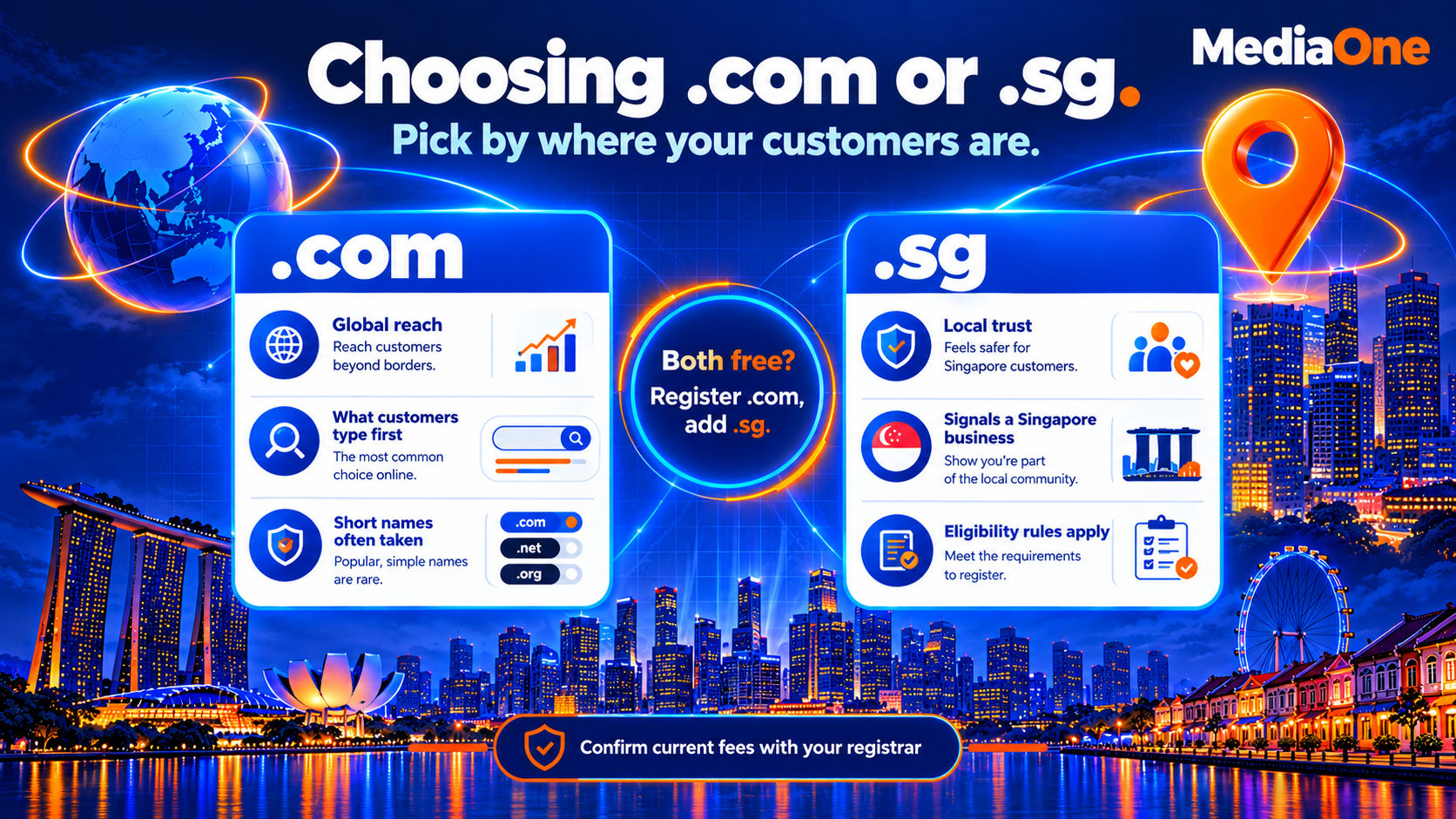
Use .sg for a Singapore-focused identity and consider .com for international customers. Registering both may reduce confusion but adds renewal costs.
Neither a .com nor a .sg extension guarantees higher Google rankings. Google’s SEO Starter Guide explains that the keywords in a domain have little ranking effect on their own. Pick an extension for the audience and business need rather than expecting a ranking shortcut.
| Extension | Typical use case | Typical annual cost |
|---|---|---|
| .com | Global reach, brand recognition, international customers | Varies by registrar; confirm current fee |
| .sg | Local trust for Singapore-focused businesses | Varies by registrar; confirm current fee |
Costs are indicative and change over time. According to ReadySpace, standard domain names range from $10 to $20 annually.
Checking Domain Availability and Avoiding Conflicts
Availability is only the first of five checks. A registrar can show a name as available even though another business is using a confusingly similar name in the same market. Check both the technical availability and the commercial risk before adding a domain to your cart.

Search the Name and Its Close Variants
Use a registrar’s availability search to check the name under .com and .sg. Next, search for the exact business name on Google and relevant social platforms. Repeat the search with the industry and Singapore added, then check common spelling variations, plurals and hyphenated versions.
A one-letter variation of a competitor’s name can create confusion. An availability result is not legal clearance.
Ask someone unfamiliar with your business to spell each shortlisted name aloud before paying.
Check Trade Marks Before You Pay
Search the exact name and similar marks through the IPOS guidance and trade mark search service. Look beyond identical spellings: marks covering related goods or services can present a conflict even when they are not word-for-word matches.
Domain registration does not grant trade mark rights. Seek professional advice about a plausible conflict.
Complete these checks before paying:

- The exact domain is available under the chosen extension.
- Searches reveal no confusingly similar name in the same market.
- Relevant registered trade marks and close variants have been reviewed.
- The search results and date have been saved for your records.
Reject names with serious conflicts before paying.
Eligibility and Documents for a .sg Domain
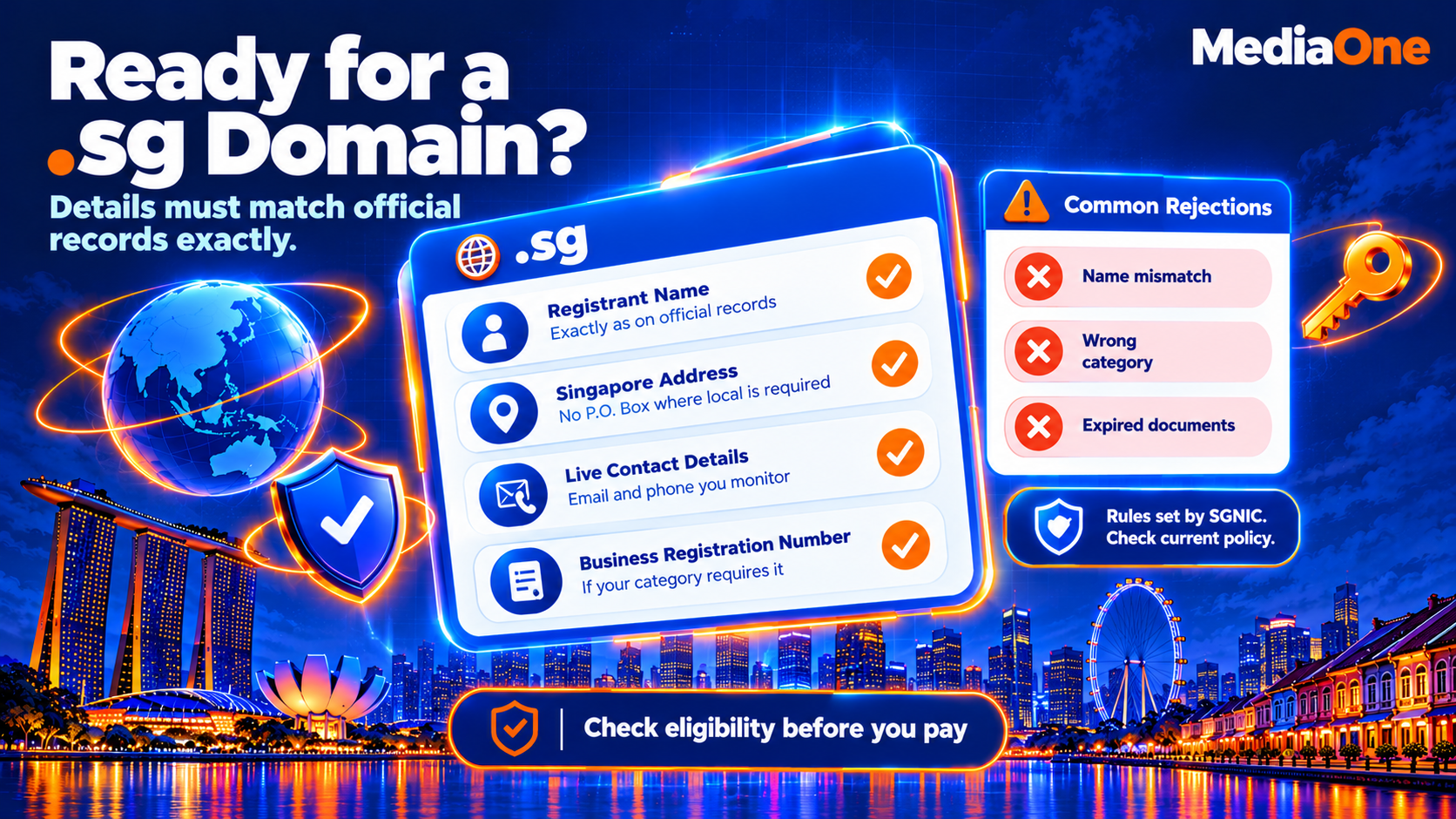
Eligibility depends on the extension. The Singapore Network Information Centre (SGNIC) administers .sg names, while .com.sg and certain other categories have separate requirements. Confirm the applicable category with the registrar before paying for a name.
Who Can Register a .sg Domain?
Foreign applicants can register .sg domains if they appoint and authorise a local agent as their administrative contact. SGNIC’s .sg category rules also describe additional conditions for categories such as .com.sg. Do not assume that an overseas founder must choose .com or that every Singapore entity qualifies for every .sg category.
For overseas applicants, document who acts as the local administrative contact and how that person will complete verification. Keep ownership and administration responsibilities clear.
Details and Verification to Prepare
You may be asked to provide the legal registrant’s name, a valid contact email and telephone number, the administrative contact’s Singapore details, and an entity registration number where relevant. Some categories require supporting documents. Enter details exactly as they appear on the corresponding records.
The administrative contact may have to complete SGNIC identity and contact verification shortly after registration. Missing a required verification deadline can interfere with use of the domain, so check the confirmation email and registrar notifications immediately.
Before submitting, confirm the category, contact and documents. Ask the registrar for written instructions if an outside agent is involved.
Choosing a Registrar and Comparing Costs
Choose a registrar that supports your extension, publishes renewal prices and offers useful DNS and registration support. For .sg, check SGNIC accreditation.
Compare renewal charges, privacy, DNS management, account recovery, transfer terms and support, not only the first-year promotion.
Compare the Two-Year Total
Compare first-year fees, renewal and extras over two years. Confirm the currency, taxes and extension are comparable.
| Example cost item | Registrar A | Registrar B |
|---|---|---|
| First-year fee | S$18 | S$29 |
| Renewal for year two | S$43 | S$32 |
| Optional annual privacy add-on | S$0 | S$0 |
| Illustrative two-year total | S$61 | S$61 |
Illustrative figures, not live quotes. Actual prices vary by extension, registrar and offer.
Ask for a breakdown when hosting, email or extra protection is bundled into one quote.

Keep the registration under the business’s control. MediaOne’s guide to website design costs in Singapore explains how to separate domain fees from website project costs.
How to Register a Domain Name: Step by Step
Once the preferred name passes the five checks, completing the order is usually straightforward. Follow this sequence and keep the confirmations for future renewals or transfers.
- Shortlist two or three names. Choose options that are short, easy to spell and suitable for a growing business.
- Check availability and conflicts. Search the registrar, the web, social platforms and relevant IPOS trade marks.
- Confirm extension eligibility. For .sg, arrange the appropriate administrative contact and check category rules.
- Compare registrars. Review registration, renewal, add-on and transfer costs for the same extension.
- Choose the registration term. Select a term available for the extension and your budget; confirm the expiry date.
- Create a business-controlled account. Use a monitored email address, a unique password and two-factor authentication where available.
- Enter registrant details. Match the legal name, contact information and any required business identification exactly.
- Review optional services. Add only privacy, protection or DNS services the business needs.
- Pay and verify. Save the receipt and complete all contact or identity verification steps.
- Connect the domain. Set website and email DNS records, test both services and enable renewal reminders.
Registration does not create a website or email inbox. If you use a website builder service, check who manages DNS and renewals.
Store registration and expiry records somewhere other than the new domain’s inbox.
WHOIS Privacy Options
Domain registries and registrars hold registration data. Privacy or redaction arrangements may limit the personal contact information available in public lookups, but they do not hide the registrant’s details from the registrar, registry or parties with lawful access. Coverage differs by extension and provider.
For generic domains, ICANN’s registration data guidance describes RDAP, the system used to access registration information. Check which information your chosen registrar and extension make public rather than assuming a paid ‘WHOIS privacy’ add-on is always necessary or available.
Protect the registrar login with two-factor authentication, restricted access and current recovery details. Consider a transfer lock.
Keep renewal reminders independent of the domain being renewed. If domain-based email stops working when a registration expires, it may not receive warnings sent during recovery. Set calendar reminders, confirm automatic renewal settings and keep a valid payment method on record.
Connecting Your Domain to Web Hosting
After you register a domain name, point it to the website host. Ask your hosting provider whether you should change nameservers or edit individual DNS records. These are different approaches, so follow the provider’s instructions rather than changing both without a plan.
| Connection method | When to use it | What to verify |
|---|---|---|
| Change nameservers | The hosting or DNS provider manages the DNS zone | Both nameserver entries are correct |
| Edit A or AAAA records | You keep DNS management with the registrar | Records point to the correct server addresses |
| Add a CNAME | The host supplies an alias for a subdomain | Hostname and destination are entered correctly |
| Add MX and authentication records | Business email uses a separate provider | Email routing and SPF, DKIM or DMARC follow provider instructions |
Back up existing DNS settings, apply the host’s values, then test the website and email separately. Cached records may delay changes.
Do not replace nameservers or delete mail records until you know which provider currently manages business email. A website can load correctly while messages bounce because MX records were removed. If another supplier handles hosting, provide it with the required access without sharing your primary registrar password.
See MediaOne’s web hosting guide for Singapore businesses for setup choices. Our website design services in Singapore include domain and hosting assistance.
Choosing Domain Names with SEO in Mind
A domain should be built around a name customers can recognise rather than a list of search terms. Keyword-rich addresses can become difficult to explain when a business expands its products or locations. A clear brand name is usually more flexible, and it is easier to use consistently across email, social profiles and printed material.
A neighbourhood bakery might later sell nationwide. Avoid names that unnecessarily restrict future products or locations.
An extension cannot substitute for useful content and technical SEO. Keep brand spelling consistent across the website and business listings.
Do not buy an exact-match keyword domain solely because you expect it to rank. Check trade marks, branding, renewal costs and the audience first. Once the site is live, focus on the pages, information and experience that visitors actually need.
Conclusion
A domain registration often takes only a short time, but a weak choice can affect a business for years. Shortlist names your customers can spell, check existing brands and trade marks, choose the right extension, and confirm the registrar’s total cost and ownership terms before payment.
Complete the five checks, record the registration and test the website and email. Keep the account secure and set renewal reminders.
Frequently Asked Questions
How Much Does It Cost to Register a Domain Name in Singapore?
Prices vary by extension, registrar and promotional period. Compare the first-year charge with the renewal price in SGD, then add any optional privacy, protection or DNS services. The two-year total is more useful than the lowest advertised introductory fee.
Can I Register a .sg Domain If I Do Not Live in Singapore?
Yes. SGNIC allows a foreign applicant to register a .sg domain if the applicant appoints and authorises a local agent as administrative contact. Check the category rules and verification requirements with the registrar before submitting the application.

How Long Should I Register My Domain For?
Choose an available term that suits the budget and business plans. SGNIC permits one-, two- and three-year terms for new .sg registrations, while other extensions may offer different choices. A longer term does not replace renewal reminders or current payment details.
Does WHOIS Privacy Protection Cost Extra?
It depends on the extension and registrar. Some services include public-contact redaction or a privacy option, while others charge separately or do not offer the same protections. Review what information is actually public before paying for an add-on.
How Do I Check Whether a Domain Name Is Already Taken?
Search for the exact address using a registrar’s domain search. Then review similar business names and trade marks, because availability alone does not confirm that a name is safe to use. Save the search date and the alternatives you checked.
How Do I Link My Domain to Web Hosting?
Use the nameservers or DNS records supplied by your host and update them in the service that currently manages DNS. If business email uses another provider, preserve or add its required MX and authentication records. Test both the website and email after the changes take effect.