Choosing between pay-per-click (PPC) advertising and search engine optimisation (SEO) is an important marketing decision. Both strategies can bring potential customers to your website, but they differ in cost, speed, long-term value and the level of control they offer.

PPC advertising allows businesses to appear in sponsored search results by paying for clicks on their ads. It is particularly useful for companies that need immediate visibility, want to generate enquiries quickly or need to test which keywords attract paying customers. SEO, on the other hand, focuses on improving a website’s visibility in organic search results through relevant content, technical improvements and ongoing optimisation.
The choice between PPC vs SEO depends on your business goals, available budget, industry competition and how quickly you need to generate leads or sales. A new business in Singapore may benefit from PPC while building its organic presence, whereas an established company with strong search rankings may prioritise SEO for sustained traffic.
Key Takeaways
- PPC and SEO can support one strategy. Use paid search for quick demand testing, then build organic visibility where the economics support it.
- Organic visibility can reach buyers without a per-click media fee, although producing and maintaining SEO content still costs money.
- PPC data reveals which keywords convert, guiding SEO priorities.
- Start urgent, high-intent terms with PPC; informational terms with SEO.
- Build SEO pages for proven PPC terms, then assess whether paid coverage still adds incremental conversions.
- Set a test budget in S$ per channel and review against clear thresholds.
PPC vs SEO Search Visibility and Cost
Most Singapore businesses do not need to pick a side. Both channels put your business in front of people searching for what you sell, but they work differently. SEO earns visibility in organic results through useful content, technical health and other ranking signals, without paying for each organic click. PPC competes for paid placements in search results, and cost-per-click campaigns charge when someone clicks.
The real question is which channel brings the audience you need at a cost you can sustain. Whether to choose SEO or PPC depends on your timeline, budget and how fast you need results within your wider digital marketing plan. Search engine optimisation and paid search also feed each other’s data, so the choice is rarely permanent.
For campaign setup, SEM campaign planning can connect these decisions. Combining the two may improve performance when each has a clear role and measurable return.
Organic search can reach buyers at several points in the purchase process, so ignoring it may leave relevant demand untouched. Paid advertising reaches demand that organic may not yet reach, especially for new products or competitive terms. Paid listings and organic results may reach the same searcher, so compare their combined contribution.
SEO trades time and ongoing investment for the potential of a lower long-term cost per visit. PPC trades money for speed and control. Each channel covers the other’s weakness. Paid social may also add reach, but judge its contribution separately from search performance.
Why SEO Needs Time to Earn Rankings
Search engines such as Google use many ranking systems to assess useful and relevant pages. A strong position may keep earning clicks without a per-click charge, whereas paid visibility usually stops when the budget is exhausted or campaigns are paused. This only holds if you maintain the content. The Google Search Essentials describe technical requirements and core search practices, without promising placement. For timing differences, review SEO timeline and expectations.
Position affects organic visibility, but click share varies by query, device and search features. Judge SEO by qualified organic traffic and conversions, not just whether a page reaches the top three.
SEO Benefits for Organic Traffic and Trust
SEO offers benefits distinct from paid search. First, organic traffic brings visits without an advertising fee per click. Second, useful, relevant pages can build brand familiarity over repeated searches. Third, a successful page may spread its production cost over more visits, although upkeep still requires resources.
When Singapore Businesses Should Prioritise SEO
Choose SEO as your lead channel if:
- Your sales cycle is long and buyers research online before they contact you.
- Your target terms are informational or long-tail, with lower competition.
- You can wait several months; the time needed for useful SEO results depends on your site and competition.
- You can commit to publishing and maintaining content over the long term. Use an SEO services buying guide to assess that commitment.
PPC Search Ads for Singapore Lead Generation
Paid search works through auctions. The Google Ads Ad Rank documentation explains how bids, ad quality and search context affect ad eligibility and placement. An approved campaign can begin showing for relevant queries quickly, but visibility, conversions and cost vary by competition and device. Test those outcomes using your own account data.
The catch is cost. Competitive, high-intent terms such as ’emergency plumber Singapore’ can attract costly clicks, so a small budget may be exhausted quickly. Consider tightly targeted phrase and exact-match keywords, set a daily budget, and review the available search terms report to see which queries convert. A sound strategy pairs this short-term visibility with a view of how paid and unpaid search compare over time.
Singapore Renovation PPC Example
In this illustrative scenario, a Singapore renovation firm does not yet rank for ‘HDB renovation contractor’. Its PPC test suggests ‘HDB renovation contractor Singapore’ produces enquiries at a lower cost than broader terms. That finding suggests where to invest next: a dedicated service page and supporting articles. Keep or reduce PPC based on combined lead volume and cost, rather than an automatic top-three ranking rule.
PPC Cost per Acquisition Threshold
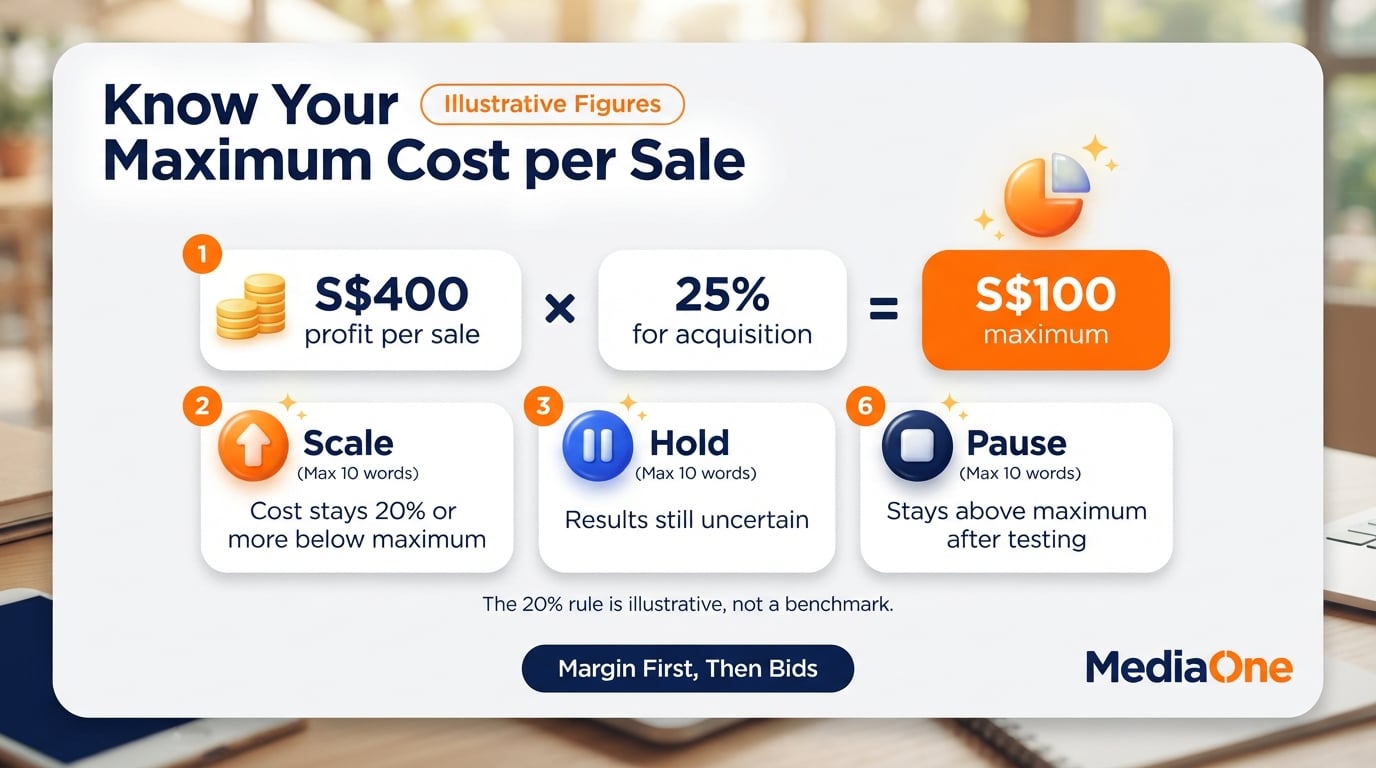

Maximum cost per acquired customer = Average profit per sale × Share of profit allocated to acquisition
For example, if average profit per sale is S400and25%ofthatprofitisavailableforacquisition,themaximumcostpercustomerisS100. If the tracked conversion is a lead, multiply that S$100 by your expected lead-to-sale rate to estimate a lead threshold.
This simplified calculation assumes profit after direct delivery costs and excludes customer lifetime value. The 20% threshold below is an illustrative decision rule, not an industry benchmark.

Compare this with your actual acquisition cost after collecting enough conversions to make a useful judgement. Thirty clicks alone may be insufficient:
- Scale the term cautiously if its cost stays at least 20% below your maximum and lead quality is acceptable. This is an illustrative rule.
- Pause or revise the term if it remains above your maximum after a meaningful test.
- Hold the term if results are uncertain, and review again after more conversion data.
When Singapore Businesses Should Prioritise PPC
- You need leads or sales within weeks, not months.
- Your target terms are commercial and competitive, and you can afford a clear cost per conversion.
- You want to test offers, landing pages or keywords before committing to content.
- You can track conversions accurately, so you know what each click is worth.
PPC vs SEO Costs, Timing and Control
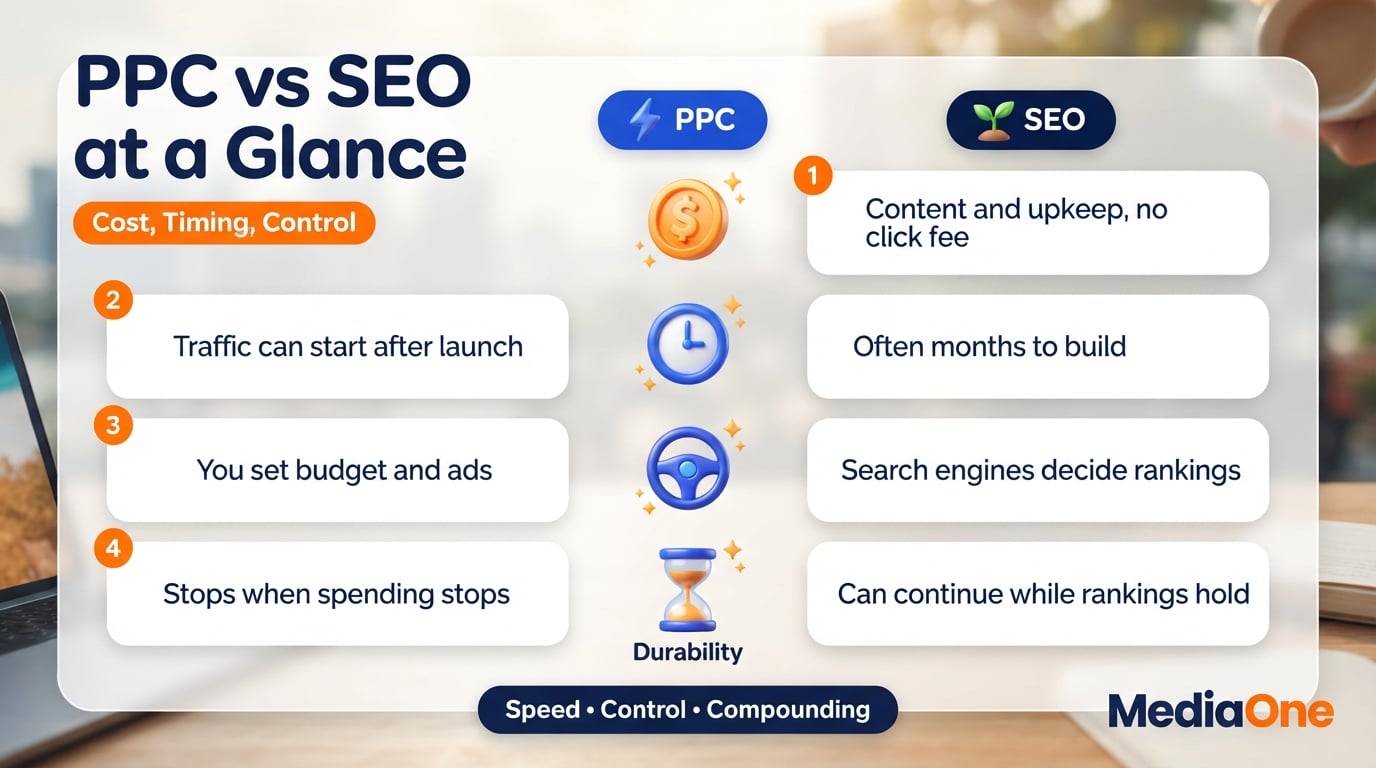
| Factor | SEO | PPC |
| Cost structure | Content, technical work and upkeep, without per-click media fees | Per-click ad costs plus management |
| Timing | Often months for meaningful growth, varying by site | Traffic may begin after launch; profitability depends on conversions |
| Control | Search engines determine organic rankings | Control over budget and ads, not auction placement |
| Durability | Visibility may continue while rankings hold, with upkeep | Paid visibility usually ends when spending stops |
Compare the channels using a Google Ads and SEO return on investment assessment. Measure SEO against ranking movement, organic clicks and assisted conversions over months. Measure PPC against cost per acquisition and search query reports within the first few weeks. Use early PPC data to decide which SEO content to build first, since paid queries show which terms already convert, and which search results pages are worth ranking higher.
PPC and SEO Integration for Singapore Campaigns
PPC can give your SEO work useful performance data. The Google Ads search terms report guidance explains how reports show performance for many queries that triggered ads, while withholding some low-volume terms. Review them monthly, and build organic content for converting terms first, since they already carry proven buyer intent. Treat organic SEO and paid search as parts of one site-wide plan rather than isolated budgets.
Organic rankings can also inform PPC decisions. Where you already rank well, test whether reducing bids changes combined conversions before making permanent cuts. Social media audience data can also show which messages resonate before you commit to either channel.
A 90-Day PPC and SEO Test Plan
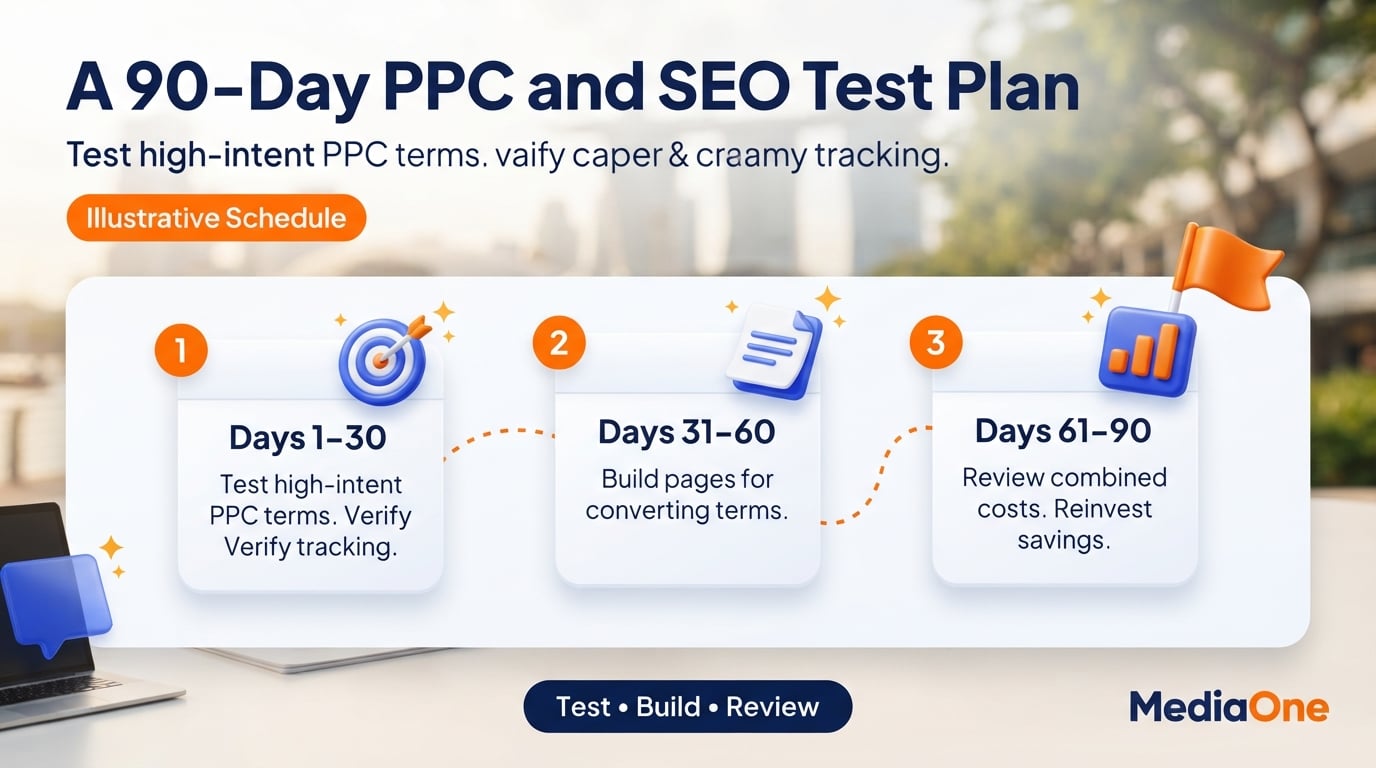
- Days 1 to 30: As an illustrative schedule, test a focused set of high-intent PPC terms and validate conversion tracking.
- Days 31 to 60: Build landing pages for promising terms and test bids where organic rankings are strong.
- Days 61 to 90: Review combined acquisition costs and reinvest confirmed savings in new tests.
SEO returns vary by business, measurement period and the cost of producing and maintaining organic content. Compare acquisition costs and profit instead of relying on an industry-wide ROI range.

Choosing PPC or SEO for Your Singapore Business

For Singapore businesses needing quick feedback, paid search can come first, followed by organic content for proven demand. Pay-per-click (PPC) advertising suits high-urgency, high-intent terms, where you need enquiries now. Organic search engine optimisation suits informational and long-tail terms, where you can wait for compounding returns. Test paid terms first, measure cost per lead against margin, and then build organic pages for the terms that convert.
Use data from both channels to strengthen your blog and website. A sound digital marketing plan reviews them together, while search results and buyer intent guide what to build next. Treat PPC vs SEO as complementary channels: paid search can help validate topics, while organic pages may keep earning visits over time.
Frequently Asked Questions
Is SEO or PPC better for a new business in Singapore?
For a new business needing immediate visibility, PPC may be the faster starting point once ads are approved. SEO can build longer-term visibility, but its timing depends on competition and the website’s starting position.
How long does SEO take to show results?
Allow several months for meaningful SEO growth, although some improvements appear sooner and competitive terms can take longer. Review progress against indexing, impressions, qualified organic visits and conversions.
Can PPC hurt SEO rankings?
No. The Google Search Central guidance confirms that buying ads does not change organic rankings. Compare paid and organic reporting carefully so changes in channel mix do not distort the assessment.
Do paid ads improve organic rankings?
Not directly. Paid search reports can identify useful queries for organic pages, but running ads itself gives no organic ranking advantage.
How much should a small business spend on PPC?
There is no fixed figure. Set a test budget you can afford to lose, run it long enough to gather conversion data, and review cost per lead against your margin before scaling.
Should I run SEO and PPC at the same time?
Often, if the budget supports both. Use PPC for faster demand testing and SEO for longer-term visibility; review combined cost and incremental conversions before reducing spend on terms with strong organic rankings.