SEO doesn’t work like paid advertising. You can’t buy your way to the first page of Google next week. If you’re starting from scratch, expect to wait 3 to 6 months before seeing meaningful results on low-competition keywords. Competitive terms can take 12 to 18 months or longer.


The real problem with the question “How long does SEO take?” is that it has no single answer. A local plumber targeting “plumber near me” will move faster than a software company fighting for “SaaS pricing.” Your domain age, budget, content quality, and the keywords you’re chasing all shift the timeline significantly.
This article cuts through the hype. You’ll learn the actual phases of SEO work, see real timelines by industry, identify what’s slowing your progress, and get concrete steps to start seeing results this week.
Key Takeaways
- First page rankings for low-competition keywords typically take 3 to 6 months. High-competition keywords can take 6 to 18+ months. The timeline depends on your starting authority, keyword difficulty, and budget, not just effort.
- Expect 3 to 4 weeks before seeing any movement in Google Search Console.” Appearing in search results” (weeks 6 to 8) is different from “ranking in the top 10” (months 4+). Both are real progress.
- Progress compounds over time. Month 1 feels slow; month 12 builds on 11 months of cumulative gains. A new domain starts from zero. An established site with existing authority moves faster.
- Track the right metrics early. Indexed pages, crawl error resolution, and appearing keywords (even at position 50+) indicate you are on track. Organic traffic and conversions follow rankings, not the other way around.
The Honest Timeline: Why There’s No One-Size-Fits-All Answer
Most SEO agencies pitch a clean story: “You’ll see results in three to six months.” What actually happens in the field is messier, slower, and far more variable.
The disconnect begins with what “results” means. Ranking for something on Google’s first page in a month is possible, but only if you target uncompetitive keywords your competitors have ignored. Ranking for keywords your business actually needs to convert is a different question entirely. Sustainable organic traffic that compounds month on month? That takes years, not quarters.
Here’s the gap: first-page rankings for competitive terms almost never happen in weeks. Sustainable growth almost never finishes in three months. Yet both happen in the same 12-month cycle, which is why the timeline question is so difficult to answer without context.
How SEO Actually Progresses in Phases
The real framework is not a single deadline but SEO phases. Each phase has its own duration, deliverables, and what looks like progress.
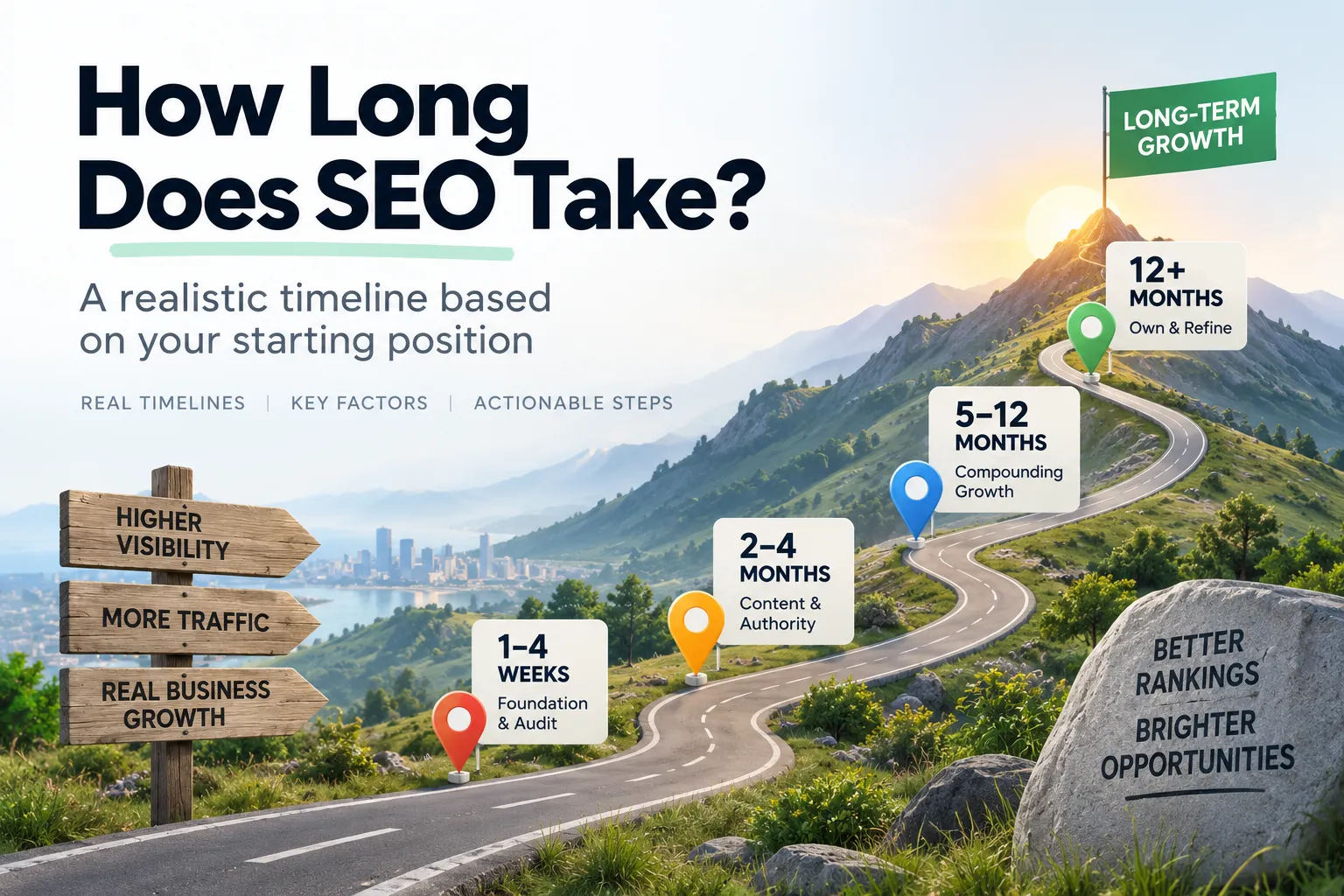
In phase one (weeks 1 to 4), you fix crawl errors, improve site speed, and ensure Google can index your pages. No rank gains yet. Search Console shows you are live; that is the win.
In phase two (months 2 to 4), you will publish content and earn your first backlinks. By weeks 8 to 12, you will probably rank for something. But it is often the low-hanging fruit: brand modifiers, tiny-volume long-tail terms, or queries you were not targeting. Traffic from these is minimal. Most clients feel invisible at this stage because they expected to rank for their main keywords.
In phase three (months 5 to 12), cumulative effort kicks in. Backlinks compound. Content ages into authority. This stage is where month-on-month growth becomes visible and feels real.
In phase four (month 12+), you stop chasing rankings and start owning them. Updates to content are refinements, not rescues. The timeline shifts from “how long until we rank” to “how do we stay ranked?”
The honest answer depends entirely on where you sit in this cycle and which phase you are funded to reach.
Why Your Competitors’ Results Don’t Match Yours
A plumbing business in Singapore targeting “emergency plumber near me” and a global SaaS company targeting “best project management software” are both asking, “How long does SEO take?” But the realistic timelines are months apart.
Domain age matters immediately. A ten-year-old domain with existing Google trust will rank for low-competition keywords faster than a brand-new domain, all else equal. Established sites borrow authority from their history. New domains have zero to prove.
Industry saturation compresses timelines for some and extends them for others. A niche B2B SaaS product competing against fifty companies might see first-page entry in 6 to 8 months. A roofing contractor in a small city might rank in 8 to 12 weeks because local competition is fragmented across dozens of small operators rather than consolidated. E-commerce for mainstream products (trainers, fitness trackers, vitamins) runs 12 to 18 months or longer because Google heavily weights established retailers and user reviews.
Current search visibility is predictive. If you are already ranking for 50 keywords in positions 11 to 30, you will move them into the top ten faster than you would build positions from zero. You are compressing the middle phase. If you are completely absent from search, every ranking is fighting upstream against sites with more authority.
Budget determines content velocity. A company that publishes eight pieces monthly will accumulate backlinks and rank for more keywords faster than one that publishes only one piece monthly, assuming quality remains consistent. More output does not guarantee faster first-page entry for competitive terms, but it guarantees more ranking keywords overall sooner. Someone spending USD 500 per month on SEO will see a different progress curve than someone spending USD 5,000 per month.
To set your timeline, benchmark against the top three ranking sites for your keyword. Check their domain age in Whois, estimate their content volume, and look at their referring domains in Ahrefs or Semrush. If they are five years old with 500+ pieces of content and 200+ backlinks, and you are new with 20 pieces and zero backlinks, your honest timeline is not six months.
The Four Phases of SEO and What Happens in Each
Understanding SEO as a four-phase process, rather than a single timeline, is what separates realistic planning from disappointed expectations. Each phase has specific deliverables, measurable progress indicators, and different success criteria. Think of it like building a house: you cannot install the roof before the foundation is set, and the foundation phase does not look like progress if you are expecting to move in.
Phase 1: Foundation and Audit (Weeks 1 to 4)
This phase feels the slowest because there are no ranking gains yet. Nothing visible appears in Google Search results. But this is where the work that enables rankings happens.
In weeks 1 to 4, you are running a technical audit to identify crawl errors, fixing site speed bottlenecks, ensuring pages are structured for search engine interpretation, and confirming Google can actually access your content. Common fixes include removing duplicate pages, adding XML sitemaps, fixing broken internal links, ensuring mobile responsiveness, and patching redirects.
What you will see during phase 1: pages appearing in Google Search Console as discovered and indexed (not ranking yet, just indexed). Crawl errors resolving. Core Web Vitals scores are improving. These are the invisible foundations. A site with crawl errors or poor mobile speed will not rank well later, no matter how excellent the content is.
This phase is non-negotiable. Skip it, and you will waste months on content and link-building only to discover technical difficulties blocking your progress in month 6. The investment here, usually 2 to 6 weeks of technical work, is the prerequisite for everything that follows.
Expect 60 to 80% of your sitemap to be indexed by the end of week 4. If fewer pages are indexed, you have technical problems to solve before moving forward.
Phase 2: Content and Authority (Months 2 to 4)
Once the foundation is solid, phase 2 begins in parallel or slightly after phase 1 finishes. This is where you create and publish content, build internal linking architecture, and start backlink outreach.
Content publication should target low-competition keywords first. A 2,000-word guide on “long-tail keyword strategy for fintech” ranks faster than “best fintech software” because fewer competitors are publishing on the former. You are building topical clusters here: create a pillar page on a broad topic, then add 4 to 8 supporting pages that link back to it, all connected internally.
Backlink outreach also begins in phase 2, but results lag. You might reach out to 50 relevant sites in month 2, but you may only land 2 to 4 links by month 4. This pattern is normal. Links take time.
By weeks 8 to 12 of phase 2 (roughly month 3), low-competition keywords will start ranking. You will see them appear in Google Search Console under “Queries”, pages showing up on pages 2 to 3, getting 2 to 5 impressions per week, and CTR around 5 to. The page is appearing in search results, which is different from ranking in the top 10.
A critical distinction: in SEO, ranking means appearing anywhere in search results. But if your page is at position 25 for a keyword, you are getting almost no traffic. Top 10 is the realistic threshold for meaningful clicks. The top 10 typically appear 4 to 8 weeks after the first appearance, assuming you optimise for CTR by improving title tags and meta descriptions.
Expect 4 to 12 keywords to appear in search results by the end of month 4. Expect 0 to 3 of those keywords to be in the top 10.
Phase 3: Scale and Refinement (Months 5 to 12)
Phase 3 is where compound growth becomes visible. You are no longer building; you are scaling.
By month 5, you have published 12 to 20+ pieces of content. You have earned 8 to 15 backlinks. Internal linking is mature. Now you expand topic clusters with more supporting content, accelerate backlink outreach (more link prospects identified, more pitches sent), analyse which pages and topics are gaining traction and double down on those, and identify competitor content gaps to fill.
Month-on-month organic traffic growth is accelerating here. Months 1 to 4 might feel flat (5 to 10 sessions per month). Months 5 to 8 compound (sessions double or triple month-on-month). This is partly due to cumulative ranking gains (more keywords ranking, more pages in the top 20) and partly due to improved CTR, as older content gets refined and better titles and schema markup drive higher click rates.
By months 8 to 12, most sites see 40 to 60% of their target keyword portfolio ranking on pages 1 or 2 (positions 1 to 20). Organic traffic is material enough to track trends and identify seasonal patterns.
Organic sessions should grow 20 to 50% month over month during months 5 to 12, assuming consistent effort. If flat, you have a content gap, link-building gap, or keyword targeting problem.
Phase 4: Maturity and Maintenance (Month 12+)
Month 12 onwards is not the end. It is the shift from getting rankings to owning them.
By this point, you have 40 to 80 pieces of content, 30 to 100 referring domains, and 200 to 500 ranked keywords. The low-hanging fruit is harvested. Now you are maintaining what you have built and slowly expanding it.
Mature SEO involves monitoring rankings for fluctuations and responding (if a page drops after a Core Update, refresh the content), adjusting for seasonality, capturing new ranking opportunities (new variations of your target keywords and related product launches), and optimising for search features (featured snippets, People Also Ask, and knowledge panels). You might also begin optimising existing content with schema markup to capture rich results and drive a higher CTR.
Many sites plateau here without active maintenance. If you publish nothing and build no new links for six months, rankings gradually decline as competitors pass you. Mature SEO requires 4 to 8 hours per week of ongoing optimisation, content refreshes, link-building, and competitive analysis. It is not a one-time project.
Organic traffic should stabilise, with seasonal ups and downs expected. If it declines without changes, competitors are outpacing you. If your traffic remains flat despite your efforts, it means you have saturated your current keyword opportunity and should target new verticals.
Factors That Speed Up or Slow Down SEO Results
Not all SEO campaigns move at the same pace. Your timeline depends less on effort than on the conditions you are starting from. Understanding these accelerators and headwinds helps you predict realistic progress and spot where you might be slowing yourself down.
Accelerators: When You Will See Faster Progress
Existing domain authority is the single biggest accelerator. A five-year-old domain with a clean history ranks faster than a new site because Google already trusts it. Search engines treat aged domains like established businesses: they are less risky to promote. If you are building on an existing property rather than starting fresh, expect 20 to 30% faster entry into top rankings.
Low-competition keywords compress your timeline dramatically. Long-tail keywords, such as “best vintage leather jacket for men over 50,” face far fewer competing pages than “leather jacket.” You can rank for low-volume, niche terms in 6 to 12 weeks, whereas a brand term might take a year. Local keywords (e.g. “plumber in Adelaide”) also rank faster, as competition fragments by geography.
Abundant budget for content and links accelerates scale, though not overnight. Money does not buy faster rankings; it buys higher output. A team publishing four in-depth posts per month instead of one, coupled with professional link-building outreach, compounds gains faster. With proper execution, such an approach might compress your timeline by 20 to 30%, not double it.
High-quality starting content or existing brand search volume acts as a runway. A company with existing customers already searching for their name has built-in organic traction. Google sees brand mentions and user behaviour signals immediately. You are not starting from zero trust.
Fresh, uncompetitive niches see results quickly because few publishers have staked territory yet. Early adopters in emerging categories often rank within weeks because there is simply less competition for attention.

Headwinds: When Results Will Take Longer
Brand-new domains with zero authority start with the heaviest handicap. Google does not know if you are trustworthy. Your first keywords will not rank for weeks. Even after months of work, you are still climbing uphill against established competitors. Budget an extra 2 to 3 months compared to an aged domain.
High-competition keywords (national terms, transactional intent) pit you against sites with years of authority and hundreds of backlinks. “Buy running shoes online” has massive competition and commercial intent. New sites cannot compete here for 12 to 18 months, or even longer. You must target easier keywords first to build authority, then move upmarket.
Thin starting content or domain history issues multiply the timeline. If your site launched six months ago with five thin pages, or if your domain was previously used for something unrelated (SEO spam, parked domains), Google applies extra scrutiny. You are fighting reputation debt.
Limited budget forces trade-offs. You can publish one post per month instead of four. Your backlink growth crawls. You skip tools that accelerate research and tracking. With tight constraints, add 30 to 50% to your timeline estimate.
Google Core Updates reset progress without warning. Google performs major algorithmic shifts two to four times yearly. Sites that benefited from outdated tactics can lose 30 to 50% of traffic overnight. After an update, recovery takes 2 to 4 weeks, extending your original timeline. There is no way to predict Core Updates, but you can prepare by building content on fundamentals: topicality, user intent alignment, and earned credibility (backlinks, brand mentions).
A weak technical foundation compounds everything. If your site has crawl errors, indexation problems, poor Core Web Vitals scores, or duplicate content, you will spend the first 4 to 8 weeks just getting back on track before you see any meaningful ranking progress. A site audit often reveals technical debt that you must fix first.
The interplay matters too. A new domain (headwind) targeting long-tail keywords (accelerator) with a five-person team (accelerator) in a niche industry (accelerator) can still rank faster than an aged domain (accelerator) in finance (headwind) with a limited content budget (headwind). Assess your position honestly across all factors to estimate realistic timelines.
Real-World Timelines by Industry and Keyword Type
The timeline for SEO results varies dramatically depending on what you are trying to rank for and which industry you are in. A local plumber in Singapore competes in a fundamentally different SEO environment than a SaaS company selling enterprise software globally. Understanding these differences lets you set realistic expectations and allocate budget to the fastest wins first.
Local SEO
Local SEO moves faster than almost any other search category. You can typically expect first-page rankings within 6 to 12 weeks if you execute citation and review signals correctly.
The speed boost comes from how Google treats local searches. Competition is fragmented by geography, so you are not competing nationally or globally. A plumber in the Bukit Timah area of Singapore only needs to outrank other plumbers in that region, not every plumber in the country. Google My Business optimisation becomes your primary ranking factor, not backlinks from high-authority sites.
What accelerates local results: consistent business citations across directories like ThinkBusiness Singapore, Whitepages Asia, and industry-specific platforms (for example, healthcare directories for medical practices). Customer reviews accumulate faster in local search because local customers generate them. A dental practice in Singapore with 40 verified reviews will rank higher than one with five reviews, regardless of content quality.
A concrete example: A home cleaning service in Singapore optimises its GMB profile (name, address, phone, service areas, hours), publishes 6 locally targeted pages (one per service area: Orchard, Marina Bay, Sentosa), and collects 15 reviews in the first 8 weeks. By week 10, it ranks in the top 3 for “home cleaning Orchard” and “house cleaning Marina Bay.” That same business, if competing nationally, would take 6+ months.
Timeline for local SEO: 6 to 12 weeks for first-page entry. If your citations are scattered or missing, add 4 to 6 weeks.
Informational Content
Informational keywords (how-tos, guides, definitions, comparisons) rank faster than commercial keywords because they attract less competition and fewer backlinks.
These queries do not represent immediate purchase intent. A reader searching “how long does SEO take” is in the research phase, not ready to hire an agency. Google returns articles, guides, and educational content rather than product pages or brand homepages. Far fewer businesses are willing to invest heavily in ranking for informational keywords, so the competitive backlink environment is thinner.
If your site has baseline authority (some existing organic traffic, a few referring domains, and regular content publication), you can expect first-page rankings in 8 to 16 weeks. The keyword “how long does SEO take” itself has moderate volume and moderate difficulty. A focused article with 2 to 4 referring domains from relevant sites (digital marketing publications, SEO news outlets) can enter the top 10 in 12 weeks.
The catch: if you are starting from zero domain authority (brand new site, no referring domains, no organic history), add 8 to 12 weeks. You will still rank faster for informational content than for transactional keywords, but you will need more time to build the baseline trust signals.
Timeline for informational content: 8 to 16 weeks with existing authority; 16 to 28 weeks from a new domain.
Transactional Keywords
Transactional keywords signal purchase intent. Someone searching “buy project management software” or “SaaS pricing comparison” is closer to buying than someone reading a how-to guide. Google prioritises established brands and trust signals for these searches because search experience suffers if a new, untested vendor ranks above established market leaders.

Expect 6 to 18 months to rank competitively for transactional keywords, and longer if the category is saturated (for example, accounting software and email marketing platforms). Google prefers sites with brand mentions in press articles, customer reviews across third-party platforms, and established backlink profiles. New entrants struggle here because they have not earned these signals yet.
A new project management software startup ranking for “best project management software” faces competitors with thousands of reviews, years of brand coverage, and hundreds of referring domains. The startup can build a strong article, but ranking in the top 5 takes 12 to 18 months of sustained effort: content, brand-building, customer review generation, and earned press mentions.
Transactional ranking is slower but often more valuable per visitor. A user searching “SaaS pA user searching for “SaaS pricing” is pre-qualified and closer to conversion than one searching for “what is SaaS.”onal keywords: 6 to 18 months for meaningful first-page entry. Budget for 12+ months if you are new to the category.
Technical and B2B Keywords
Technical keywords (for example, “OAuth 2.0 implementation”, “REST API rate limiting”) and B2B keywords (for example, “enterprise resource planning costs,” “managed service provider Singapore”) sit in their own niche. Search volume is lower, but intent is extremely high. Backlink competition is lower because fewer content marketers chase these terms.
Progress is slower, typically 12 to 18 months, because you are building authority in a narrow vertical rather than a broad category. However, the payoff is higher: a visitor searching “REST API authentication methods” is likely a developer making a technical decision. They convert to customers or influence purchasing decisions at their organisation. One such visitor is worth 50 casual how-to readers.
The lower competition can work in your favour. Technical documentation and specialist articles face fewer ranking competitors. If your engineering team writes authoritative guides on topics in your product ecosystem, you can rank for these keywords with fewer backlinks than you would need for mainstream keywords.
A managed service provider (MSP) in Singapore that ranks for “enterprise IT support Singapore” faces regional competition, but only within a technical niche. Ranking typically takes 12 to 16 weeks if the company has case studies, technical content, and backlinks from IT industry publications. Ranking for the same term nationally, competing against global IT services firms, takes 18+ months.
Timeline for technical and B2B keywords: 12 to 18 months. Lower search volume but high conversion intent and lower backlink competition offset the slower timeline.
| Keyword Type | Industry / Example | Expected Timeline | Key Ranking Factors | Budget Impact |
|---|---|---|---|---|
| Local | “Best plumber Singapore” | 6 to 12 weeks | GMB optimisation, citations, reviews | Low; citations are free or cheap |
| Informational | “How long does SEO take” | 8 to 16 weeks | Content quality, baseline authority, internal links | Medium; content creation only |
| Transactional | “Buy project management software” | 6 to 18 months | Brand authority, reviews, press mentions, backlinks | High; requires content plus brand-building |
| Technical and B2B | “REST API authentication” or “MSP Singapore” | 12 to 18 months | Technical expertise, documentation, specialist backlinks | Medium-high; fewer but higher-intent visits |
Choose your initial targets from the local and informational categories. These move faster and build momentum. Reserve budget for transactional and technical keywords as you grow your domain authority.
How to Measure Progress While Waiting
The hardest part of SEO is not the work. It is the waiting. You have published content, fixed your site, and built links. Nothing ranks yet. So how do you know if you are on track or wasting time?
The answer is tracking the right metrics at the right time. Most people check rankings too early. Some never check the signals that actually predict rankings. This section shows you what to measure each month and when to worry.
Months 1 to 2: Track Foundational Health
Ranking data means almost nothing in weeks 1 to 2. Google has not crawled everything. Your content has not aged into trust. Instead, focus on technical health and visibility.
Indexed pages in Google Search Console: Aim for 80% of your sitemap to be indexed within 4 weeks. If you have 100 pages and only 20 are indexed by week 3, crawlability is broken. Check the coverage report in Search Console. Look for crawl errors (server errors, soft 404s, redirect chains). Address these first; they are prerequisites.


Crawl errors resolved: Every crawl error is a page. Google cannot access or understand. Resolve server errors immediately. Resolve redirect chains (a page that redirects to another page that redirects again). Submit your sitemap directly to Search Console and request a re-crawl.
Pages appearing in search results: By weeks 6 to 8, your new pages should show up when you search for “site:yoursite.com keyword”. They will not rank yet. They will be on page 30. But appearing in search results at all means Google has indexed the content and considers it relevant enough to show. The result is progress. Track this in Google Search Console under Performance. Filter by new pages or low-performing pages to see what is crawled.
Core Web Vitals scores improving: Page speed does not directly rank you, but slow sites get penalised. Use Google PageSpeed Insights to track Largest Contentful Paint (LCP), First Input Delay (FID), and Cumulative Layout Shift (CLS). Aim to move from ‘needs improvement’ to ‘good’ within four weeks. A 2-second LCP improvement is visible progress.
In these first two months, report on Google Search Console metrics, not rankings. Stakeholders should see “87% of content indexed, zero crawl errors, 12 pages appearing in search results, and LCP improved from 3.2s to 2.1s.” This is real data that predicts future ranking success.
Months 2 to 4: The First Wins
By week 8, some keywords will enter the top 100. Not top 10. Top 100. But this is the first ranking signal that SEO is working.
Keyword position tracking: Use a rank tracker (Semrush, Ahrefs, or SE Ranking). Log your target keywords weekly. Look for movement into the top 100, then the top 50, then the top 10. Do not obsess over your exact position yet. Watch the trend. If a keyword moved from position 87 to 64 to 51, you are climbing. If it is stuck at position 45 for 2 weeks, it is stalled (it probably needs more backlinks or content refinement).
The first-page entry usually happens in months 3 to 5 for low-competition keywords, months 6 to 12 for medium competition, and months 12 to 18+ for high competition.
Organic sessions: Refer to Google Analytics under Acquisition and Organic Search. In months 1 to 2, you will see almost no traffic. By month 3, expect 5 to 20 sessions for new pages, mostly from low-volume, long-tail keywords. This number should compound. Month 4: 20 to 40 sessions. Month 5: 40 to 100 sessions. If you see zero organic sessions by month 4, your content isn’t resonating or optimised for search.
Click-through rate (CTR) improvements: Go to Google Search Console and click Performance. You will see your average CTR. If your title or meta description is weak, you will appear in search results, but users will not click. Rewriting a title or meta can lift CTR by 20 to 40% without changing your ranking position. This often happens in weeks 4 to 6 and shows that on-page optimisation is working.
Backlink growth: Check your backlink profile in Ahrefs, Semrush, or Monitor Backlinks. New links should accumulate weekly if you are doing outreach. Track referring domains (the number of unique sites linking to you), not just total backlinks. One link from an authority site is worth more than 10 from low-authority sites. By month 3, you should have 3 to 5 new referring domains. By month 4, 8 to 12.
These are the signals that matter in months 2 to 4. They predict rankings 4 to 8 weeks later.
Month 4 and Beyond: Compounding Growth
After month 4, the data becomes clearer.
Month-on-month organic traffic increase: This figure is your primary metric. Organic sessions should grow 20 to 50% each month if you are executing well. Month 4: 100 sessions. Month 5: 130 sessions. Month 6: 180 sessions. If month-to-month growth flatlines, you need to audit: Are new pages ranking? Are you accumulating backlinks? Did a Core Update hit?
Keyword rankings moving into the top 10: By month 4 to 6, you should see keywords entering the top 10 (usually pages 2 and 3 first). Track how many keywords are in the top 10, top 20, and top 50. If you are at month 6 and still have zero top-10 keywords, your content or link profile needs work.
Average ranking position improving across tracked keywords: If you are tracking 30 target keywords, calculate the average position. Month 2: position 73 (average). Month 3: position 68. Month 4: position 54. Month 5: position 38. This curve should bend downward (lower numbers are better). If the curve is flat, you need to adjust your strategy.
Pages entering featured snippet candidates: Featured snippets appear above organic results. If your page appears in positions 2 to 5 for a question-type keyword, you are a featured snippet candidate. Please reformat your answer as a clear definition, list, or table. Some sites see featured snippet traffic in months 5 to 8. This is bonus traffic on top of organic rankings.
Diagnostic Framework: When Are You On Track?
Use this table to sense-check your progress. It shows what you should see at each stage and what to do if you are off track.
| Stage | Expected Signal | What It Means | If You Are Behind | Action |
|---|---|---|---|---|
| Weeks 1 to 4 | 50%+ pages indexed; zero critical crawl errors | Google can crawl your site | Fewer than 50% indexed | Fix robots.txt, server errors, and redirect chains. Submit the sitemap. |
| Weeks 4 to 8 | Pages appearing in search results (position 50+); CTR improving | Content is discoverable | No pages appearing by week 8 | Check GSC performance report. Keyword targeting may be off (too generic, wrong intent). Rewrite titles and meta. |
| Weeks 8 to 12 | Keywords entering top 100; 5+ organic sessions | SEO is gaining traction | Still zero organic sessions by week 10 | Audit content quality vs. top-ranking pages. Compare the word count, structure, and backlink profile of competitors. You may need to rebuild content or earn more links. |
| Months 3 to 4 | Keywords moving toward top 50; CTR 2 to 4%; 10+ backlinks | Ranking momentum building | Keywords stuck at position 60+; minimal backlink growth | Increase link-building activity. Identify easier keywords to target first (lowest competition wins). Audit on-page factors: internal links, headers, and keyword density. |
| Months 4 to 6 | First top-10 keywords; 50+ organic sessions per month | First real wins appearing | No top-10 keywords yet; organic traffic under 30 sessions | Reassess keyword difficulty. You may have chosen keywords that are too competitive. Shift to long-tail variants, local modifiers, or problem-specific queries. Alternatively, consider increasing your link velocity by acquiring more backlinks each month. |
| Months 6 to 12 | Top-10 keywords for 30%+ of targets; 100+ sessions per month; month-on-month growth | Compounding returns | Growth flatlined; top-10 keywords stuck below 5 | Likely competitors are outpacing you on links. Audit top-ranking pages. Run a backlink gap analysis in Ahrefs to see which domains link to competitors but not you. Plan targeted outreach to close the gap. |
Find your current month in the left column. Check whether you are seeing the expected signal. If yes, you are on track. If not, check the “If You Are Behind” column to diagnose the issue. The “Action” column tells you what to fix next.
For example: “It is month 5. I have 15 organic sessions but zero top-10 keywords. According to the table, I am behind. It says keyword difficulty may be too great. I should shift to easier keywords.”
This prevents you from spinning your wheels on impossible targets.
Real-World Diagnostic Example
Let us say you are in month 5. You check your metrics:
- 250 pages indexed (good)
- 12 keywords in top 50
- 3 keywords in the top 20
- Zero keywords in top 10
- 45 organic sessions this month
- 8 referring domains
Are you on track? Partially. Your keyword position is climbing (top 50 is progress). Organic sessions are real. But you should have at least 2 to 3 top-10 keywords by month 5 if you are executing well, and you have none. This suggests one of two things:
- Your target keywords are too competitive for your domain age and authority.
- You are not accumulating enough backlinks (8 referring domains by month 5 is slow for medium-competition keywords).
Next steps: Run a backlink gap analysis. Find the top-3 ranking pages for each of your top-20 keywords. How many backlinks do they have? If the top-ranking page has 45 backlinks and you have 3, you know why you are at position 22 instead of position 8. Plan to acquire 20+ more backlinks in the next 4 weeks. Or shift to lower-competition keywords where 8 backlinks are enough to rank.
This diagnostic approach saves months of wasted effort. You are not waiting and hoping. You diagnose specific gaps and fix them.
When to Pivot vs. When to Stay the Course
Stay the course if you are seeing steady movement in keyword position, organic sessions compounding, and consistent backlink growth. You are following the curve in the diagnostic table. Patience is your advantage here.
Pivot if you are at month 6 with zero top-10 keywords and no backlink growth. Your chosen keywords are likely too competitive. Alternatively, your content quality may be lower than that of the top-3 ranking pages. Run a content audit: compare word count, structure, freshness, and search intent match against the pages currently ranking. If you are 30% shorter or less comprehensive, rewrite the page with more depth, more examples, and better structure. If competitors have 50+ backlinks and you have 3, backlink velocity is your constraint, not content quality.
Common Reasons Why SEO Takes Longer Than Expected
Every SEO campaign encounters delays. The gap between expected and actual timelines usually comes from a small set of repeated mistakes. Knowing these helps you avoid them.
Targeting Keywords That Are Too Competitive
This is the most common reason timelines slip. You choose your target keywords based on business value (what would convert), not difficulty (what you can realistically rank for given your authority). A new SaaS company picks “project management software” because that is their primary market. But that keyword has national competition, thousands of articles, and top-ranking pages from established brands with hundreds of backlinks.
The math is simple. If your domain has 2 referring domains and the top-ranking pages have 80, you are 40x behind on just one factor. Content quality, topicality, and age might close some of that gap, but probably not all. You will spend 18 to 24 months fighting for a keyword that requires 12 to 18 months under ideal conditions.
Solution: Start with low-competition keywords (long-tail variants, geographic modifiers, and problem-based queries). Build 20 to 30 quick wins. Accumulate backlinks and domain authority. Then attack the competitive keywords with a mature domain and real link profile.
Content That Does Not Match Search Intent
You publish an article on “best project management software”, but you write it as a technical deep dive into task assignment algorithms. Visitors arrive, realise the content is not what they searched for, and leave in 10 seconds. CTR is high (you rank for the keyword), but bounce rate is 85%. Google notices the mismatch, and your ranking drops. You spent effort for zero return.
Search intent comes first. A searcher typing “best project management software” wants a comparison table, not API documentation. A searcher typing “how to implement project management” wants a tutorial, not a software review. Your content must match the expectation built into the query.
Solution: Before writing, open Google, search your target keyword, and read the top 5 results. What format do they use (list, comparison, tutorial, or definition)? What angle do they take? What length? Copy the successful pattern. Adapt your angle to add value (e.g., if all competitors focus on price, you focus on features; if all focus on ease-of-use, you focus on integrations). But match the intent first.
Insufficient or Low-Quality Backlinks
You publish great content but earn zero backlinks. Your backlink profile stays at 2 to 3 domains for 6 months. Meanwhile, competitors accumulate 30 to 50. Backlinks are a ranking signal. Without them, you will plateau at position 15 to 25, regardless of content quality. You can have the most comprehensive, well-written article on a topic, but if it has no backlinks and competitors have 20, you will not rank above them.
Backlink growth requires active outreach. It is not automatic. You need to identify relevant sites (industry publications, resource pages, niche communities, and competitor backlink sources), pitch them your content, and ask for a link. Most pitches fail. You need to send 50 pitches to get 2-3 links. That is the reality.
Solution: Budget 5 to 10 hours per week for backlink outreach, or hire a link builder. Create linkable assets: original research, comprehensive guides, tools, and data visualisations. Find 20 to 30 sites that could link to you (not competitors, but complementary topics). Pitch relentlessly. Track which pitches work. Repeat what works. Expect 20 to 40% of your first-page keywords to have backlinks by month 6 if you execute these steps.
Technical Issues Blocking Indexation
Your site has a robots.txt rule blocking your content from Google. Alternatively, pages may not be indexing because of redirect chains, canonicalisation issues, or noindex tags accidentally left in place. Google crawls the site but cannot index new pages. Months pass. No rankings. You think SEO does not work. Actually, Google never saw your content.
This is why the Phase 1 audit is non-negotiable. If indexation is broken, everything downstream fails. Fixing it in month 2 costs you just 2 weeks. Discovering it in month 6 costs you 6 months.
Solution: Run a full technical audit in week 1. Use Digimetrics.ai to crawl your site. Check the Google Search Console Coverage report. Ensure robots.txt allows crawling, canonical tags are correct, and no unintended noindex directives exist. Verify mobile-friendliness and page speed. Resolve all critical issues before publishing content.
Publishing Thin Content or Content That Is Shorter Than Competitors
You publish a 1,200-word article. The top-ranking page is 3,500 words. Yours covers the topic, but less comprehensively. Google sees the difference. Your article enters search results at positions 25 to 40. It doesn’t reach the top 10 because it isn’t as thorough. Length is not the ranking factor; comprehensiveness is. But on average, comprehensive content requires more words.
Solution: Analyse the top 3 ranking pages for your target keyword. Calculate the average word count. Aim for that length or 20% longer. Structure your content to be more useful: more examples, more step-by-step sections, more data, more visuals. Do not pad with fluff. Add substance that competitors are missing.
Inconsistent Publishing or Long Publishing Gaps
You publish 4 articles in month 1. Then, there is nothing for 3 months. Publish 2 articles in month 5. Google sees irregular activity. You are not building topical authority; you are publishing randomly. Topical authority compounds over time. Consistent monthly publication (4 pieces per month) builds faster than inconsistent publication (4 pieces, then a 3-month gap, then 2 pieces).
Solution: Commit to a sustainable publishing schedule. 2 to 4 pieces per month is realistic for most teams. Stick to it. Create an editorial calendar for the next three months. Batch-create content when you have the time. Repurpose and update old content during slow months to maintain momentum.
FAQ
1. Can I rank for a competitive keyword faster than 12 to 18 months?
Only in rare cases. If you have an aged domain with high authority, a giant budget for content and link-building, and the competitor landscape has a gap you can exploit, you might compress the timeline to 8 to 12 months. But 18 months is more realistic for genuinely competitive keywords. The alternative is targeting easier keywords first, building authority, then moving upmarket.
2. Does paying for SEO tools speed up results?
Tools (Digimetrics.ai, Semrush, Ahrefs, and SE Ranking) speed up your workflow and help you make better decisions faster. They do not speed up Google’s ranking timeline. A rank tracker tells you your position week to week instead of checking manually, but Google still takes 4 to 12 weeks to move a keyword from position 50 to position 10. Tools save time and reduce errors; they don’t compress the fundamental timeline. They are worth the investment if budget allows, but not essential.
3. What if I hire an SEO agency? Will they speed it up?
An experienced agency will help you avoid common mistakes, which prevents timeline delays rather than accelerating the process. A competent agency will execute faster (more content, more links, more strategy work per month) and more efficiently (better targeting, better link sources). This approach can compress your timeline by 20 to 30%, but it does not eliminate it. If a vendor promises first-page rankings in 3 months for a competitive keyword, they are lying. Realistic timelines apply regardless of who is doing the work.
4. Why does my competitor rank faster than I do, even though we started around the same time?
Most likely reasons: they are targeting easier keywords (long-tail, local, less competitive), they have more budget for content and link-building, they have accumulated backlinks from industry connections or press coverage, or they are borrowing authority from an existing brand (e.g., a new product from an established company). Run a backlink analysis on them. Review their keyword targets. Review their content volume. Most ranking differences trace to one of these factors.
5. When should I expect to see organic revenue or conversions from SEO?
Organic traffic lags rankings by 2 to 4 weeks. Conversions lag traffic by another 4 to 8 weeks. So if you rank for your first keyword in month 5, you will see meaningful traffic in months 5 to 6, and conversions in months 6 to 8. Revenue usually arrives in months 6 to 12. Do not expect revenue in months 1 to 4; that is normal. If you see zero conversions by month 8, your traffic is coming from non-intent keywords (searchers not ready to buy), or your website is not converting visitors (funnel problem, not SEO problem).
6. Is it true that new domains take longer to rank? How much longer?
Yes, new domains (less than 6 months old) typically take 20 to 30% longer than aged domains to reach first-page rankings. Google applies extra scrutiny to new domains because they do not have a history to evaluate. This “sandbox” effect is real but often overstated. A new domain targeting low-competition keywords will rank in 6 to 12 weeks. An aged domain on the same keywords will rank in 4 to 8 weeks. The difference is weeks, not months, if you are executing well.
7. What happens to my rankings after I stop doing SEO?
Your rankings do not disappear immediately, but they slowly decline. If you were at position 5 for a keyword and you stop updating content, building links, and optimising, competitors will gradually pass you. Within 3 to 6 months, you will drop to positions 8 to 12. Within 12 months, you might be on page 2. SEO is not a one-time project. You need ongoing maintenance to hold your rankings: monthly content updates, seasonal optimisations, new link-building, and competitive monitoring. Budget 4 to 8 hours per week for mature campaigns.
8. Do Google Core Updates affect my timeline?
Yes. A major algorithm update can reset your rankings overnight. A site at position 8 can drop to position 25 after a Core Update if the update favours different ranking factors. Recovery typically takes 2 to 4 weeks, and your original timeline extends by that amount. You cannot predict Core Updates, but you can prepare by building content on fundamentals: user intent alignment, content comprehensiveness, topical authority, and earned backlinks. Avoid tactics that exploit outdated signals.
9. Is SEO worth the wait, or should I use paid advertising instead?
Both. Paid advertising (Google Ads, Facebook Ads) works immediately and stops the moment you pause spending. SEO takes 6 to 12 months to mature but compounds indefinitely. A dollar spent on SEO in month 1 continues to generate returns in month 24. A dollar spent on ads in month 1 stops generating returns in month 2 if you pause. For sustainable growth, combine both: use paid ads for immediate revenue while SEO builds. Shift budget to SEO as it matures. Most profitable companies use both in parallel.
10. Should I target many keywords or focus on a few?
Start narrow, expand wide. Target 10 to 20 related keywords in your first 3 months (all in the same topic cluster: “project management software”, “best project management tools,” “project management software for small teams”). Rank for these faster than trying to rank for 100 scattered keywords. Once you have 5 to 10 top-10 keywords from your first cluster, you can expand to adjacent topics. This strategy builds topical authority faster than broad, unfocused targeting.
Conclusion: The Real Timeline
SEO takes 3 to 6 months for low-competition keywords, 6 to 12 months for medium-competition keywords, and 12 to 18+ months for high-competition keywords. But “takes” is misleading. You are not waiting idle. You are publishing content, building backlinks, analysing performance, and optimising relentlessly. Progress compounds. Month 1 feels invisible. Month 12 looks like overnight success. It is not.
The timeline is fastest when you target easy keywords first, execute consistent publishing, accumulate backlinks, and maintain technical excellence. The timeline stretches when you chase competitive keywords, publish sporadically, ignore backlinks, or have technical debt.
Use the diagnostic framework in this article to measure progress at the right moments. Track indexation and crawl health during weeks 1 to 4. Watch keyword entry and organic sessions from months 2 to 4. Monitor month-on-month growth from months 4 to 12. Adjust the strategy based on data, not hope.
SEO is not a quick fix. It is durable. The companies that dominate organic search in their categories did not get there in 6 months. They committed to 2 to 3 years of consistent effort. They learned what works and what does not. They compounded small wins into large ones. If you do the same, your timeline is realistic, and your results will last.