Most PPC accounts are not short of clicks. They are short of conversions that anyone can trace back to revenue. A PPC campaign can bring in cheap traffic all month and still lose money, because the team cannot say which keywords, PPC ads or landing pages produced a sale or a qualified lead. These PPC Marketing Strategies start from that problem.
The main point is simple: fix measurement and the match between ads and pages before you spend more. For smaller businesses with a clear search market, broad display buying can wait until search ads have reliable conversion data. Display attribution may be harder at small budgets.
PPC can put a business in front of people already searching for its services, but reach alone says little about profitability. Popularity is not the same as profit, though. The sections ahead walk through a four-part audit for diagnosing weak ad groups, then set out a fix order that stops you raising budget before the basics work. Many of the first checks require no additional media budget, such as reviewing conversion tracking and search term reports.
Professionals who manage a paid search budget can use those same free reports to judge each campaign and website landing page before adding any new spend.
Key Takeaways
- Diagnose before you scale. Raising bids or budget on a weak campaign only buys more unconverted clicks at a higher total cost.
- Score every ad group on four checks: intent match, landing page match, conversion signal and efficiency against a stated target. In this working audit, anything under 6 out of 8 is investigated first.
- Track conversions tied to revenue or qualified leads. A cheap click with no measured outcome adds cost without adding growth.
- Budget brand and non-brand keywords separately, since they serve different intent and different goals.
- Set targets in Singapore dollars, such as cost per acquisition or return on ad spend, and check them against search volume in the locations you serve. Treat these targets as provisional when your account has thin data.
Why the Intent-to-Conversion Audit Comes First
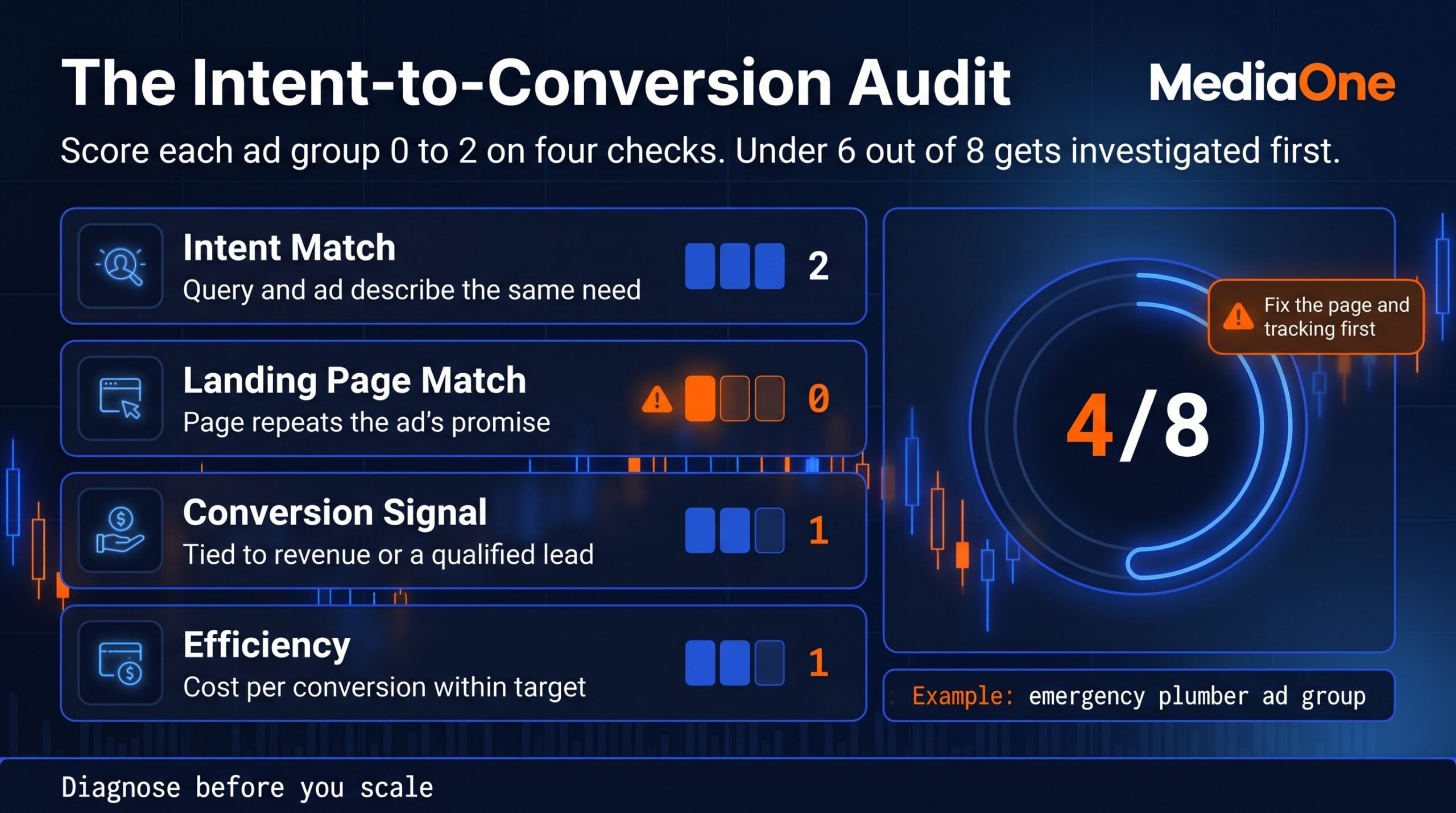
A common cause of underperformance is that the search, the ad, the landing page and the conversion tracking do not describe the same buyer. Before you change bids or budgets, check whether your PPC campaign ads, keywords and landing pages line up with what the buyer is looking for. The Intent-to-Conversion Audit scores each ad group on four checks, each on a 0 to 2 scale. The same four checks can be adapted to a website or channel, so you can run this working audit in a spreadsheet without buying another tool:
- Intent match: Does the search query signal the same need the ad and keyword promise?
- Landing page match: Does the page deliver what the ad promised, quickly and clearly?
- Conversion signal: Is a conversion tracked and tied to revenue or a qualified lead?
- Efficiency: Is the cost per conversion within the target you set in Singapore dollars?
Run the audit before you add budget to an ad group. As a working rule, an ad group scoring 6 or more out of 8 is a candidate for closer scaling review if its actual CPA or ROAS is acceptable. Anything below 6 gets investigated before you add budget. This threshold is not an industry benchmark. Test the threshold against your own accounts and outcomes.
Compare PPC Marketing Strategies against revenue and lead quality, not scores alone.
A worked diagnosis. Take a hypothetical ad group for a local plumbing service. The keyword is ’emergency plumber’, the ad promises a 24-hour callout, and the landing page is the company’s generic home page. Intent match scores 2, since the query and ad both signal urgency. Landing page match scores 0, because the visitor has to hunt for the callout offer.
Conversion signal scores 1 if calls are counted but not labelled as booked jobs. Qualified-lead tracking can connect ads to later offline outcomes. Efficiency scores 1 if cost per call sits near target but swings week to week. The total is 4 out of 8, so the fix is the landing page and the call tracking, not a bigger budget.
| Check | Score 0 | Score 1 | Score 2 |
|---|---|---|---|
| Intent match | Query and ad describe different needs | Partial overlap, some broad terms | Query, ad and keyword match closely |
| Landing page match | Generic home page or unrelated page | Relevant page, weak message match | Page repeats the ad’s promise and offer |
| Conversion signal | No conversion tracked | Conversion tracked, not tied to value | Conversion tied to revenue or qualified lead |
| Efficiency | Cost per conversion far above target | Near target, unstable | Within target over a stable period |
Copy this table into a spreadsheet, add one row per ad group, and total the scores to decide what to fix first.
How PPC Campaigns Actually Work: Auctions, Bids and Targeting
Most PPC budgets get spent on mechanics few advertisers can explain. Before you touch a bid or add an audience, you need to know what the platform decides each time someone searches. Free tools inside the ad platforms show much of this. A business that understands the mechanics can spend its PPC ad budget more deliberately across search engines and other paid channels.
Auction rules differ by platform.
The ad auction and what determines your position
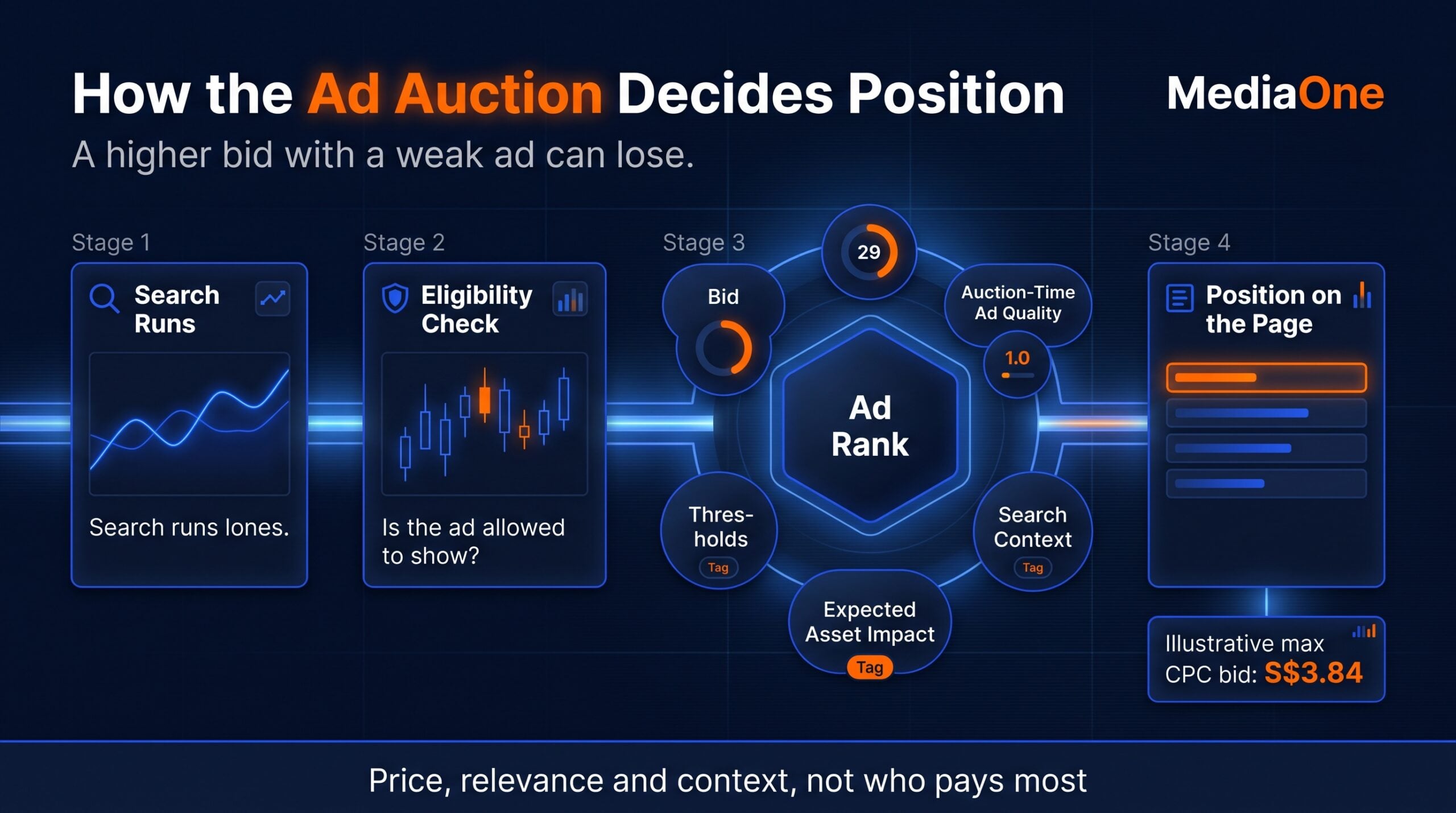
Every time a search runs, the search engine checks which advertisers are eligible to show. Google Ads and Microsoft Advertising, two of the most popular PPC advertising platforms, then rank those eligible ads in a real-time auction. Your Ad Rank depends on your bid, auction-time ad quality, thresholds, the context of the search and the expected impact of assets. A higher bid with a weak ad can lose to a lower bid with a strong one.
Auction-time ad quality, not the displayed Quality Score, can affect Ad Rank. Position is a trade-off between price, relevance and context, not a contest of who pays most. Google explains these factors in its Ad Rank and placement guidance. Brand campaigns also face auctions, while relevant landing pages help users who click.
Quality Score explained: expected CTR, ad relevance and landing page experience
Quality Score is a diagnostic rating that Google Ads shows for each keyword. It has three parts: expected click-through rate (the estimated likelihood of a click), ad relevance (how closely your ad matches the search) and landing page experience (how useful and fast your page is once they click). Google Ads reports the diagnostic score on a scale from 1 to 10. Treat it as a warning light, not a grade.
A low score can signal weaknesses worth investigating; the displayed number itself is not an auction input. The components concern Google Search keywords.
Check each keyword’s score in the platform, then diagnose the weakest part:
- Low expected CTR: the ad copy may not be compelling for the query. Test headlines that reflect the searcher’s need.
- Low ad relevance: the keyword theme may be too broad. Split mixed intent into tighter ad groups.
- Weak landing page experience: the page may load slowly or fail to deliver the ad’s promise. Improve its speed, content and path to enquiry.
A well-built website with fast, relevant pages supports a stronger landing page experience across the whole account. For specialist support, Google Ads management can cover tracking and landing pages.
Bidding strategies and when to use each one
Choose the bidding model to match the data you have, not the one you hope for. Google Ads offers manual and automated bidding options; check the current settings and goals before changing strategies:
| Strategy | Use it when | Main risk |
|---|---|---|
| Manual CPC | You are learning an account and want direct bid control | Time-consuming and uses fewer auction-time signals |
| Maximize clicks | You want traffic while assessing intent and tracking | Clicks without conversions |
| Target CPA | You have enough conversions and a known acceptable cost per lead | Volume can drop if the target is set too low |
| Target ROAS | Revenue per conversion varies and you track order value | Needs reliable value tracking |
Automated bidding can begin without historical conversions, but new accounts may see more volatility while Google gathers data. Check tracking before judging CPA or ROAS. Set cost-per-acquisition and return-on-ad-spend targets as starting points only. With thin data, a CPA or ROAS target can swing widely, so revisit it after the account has a stable run of conversions.
Audience and geographic targeting controls
Location settings decide where your ads can appear, so set them to the markets you actually serve. Choose ‘Presence’ targeting where appropriate, which is intended to reach people in or regularly in your target area rather than including everyone who has merely shown interest in it. Location signals are estimates. Audience segments can inform who sees ads, but how they apply depends on campaign type and bidding strategy.
For search, use them alongside keyword intent rather than assuming you can always adjust automated bids manually. Define your target audience before you layer on these controls, then review search terms regularly to exclude irrelevant geographies and audiences.
Choosing the Right PPC Channel and Campaign Type
Picking the wrong campaign type wastes budget before a single bid is placed. The same product can be bought through search, shopping, display or Microsoft Advertising, and each channel reaches buyers at a different stage of readiness. Many small and mid-sized businesses with existing search demand can start with search and add other channels once they have a clear conversion goal and enough data to assess results. An audit of your current campaigns can show where budget is already leaking before you add anything new. Many teams nurture paid leads by email.
Compare Performance Max and Search when choosing formats. A clear digital marketing strategy should decide which channel leads and which supports. Judge PPC Marketing Strategies against each channel’s role. Review your ppc ads and the analytics tools that track them together, so budget decisions rest on the same data.
Search ads: intent-driven, search-result placements
Search ads appear when someone types a query into a search engine, so the buyer has already stated what they want. That declared intent can make search effective when people are ready to act. Relevant keywords tied to a specific need can produce stronger results than generic searches. Results also depend on the offer, page and tracking.
For businesses with enough high-intent search demand, the first test budget often belongs in search. A well-structured PPC campaign is a practical starting point for a digital marketing plan, and paid search can sit at the core of acquisition planning for this reason. Start here, prove the results, then expand. Ad copy and landing pages should speak directly to the target audience’s stated need.
Display, shopping and Microsoft Advertising: when each earns its place
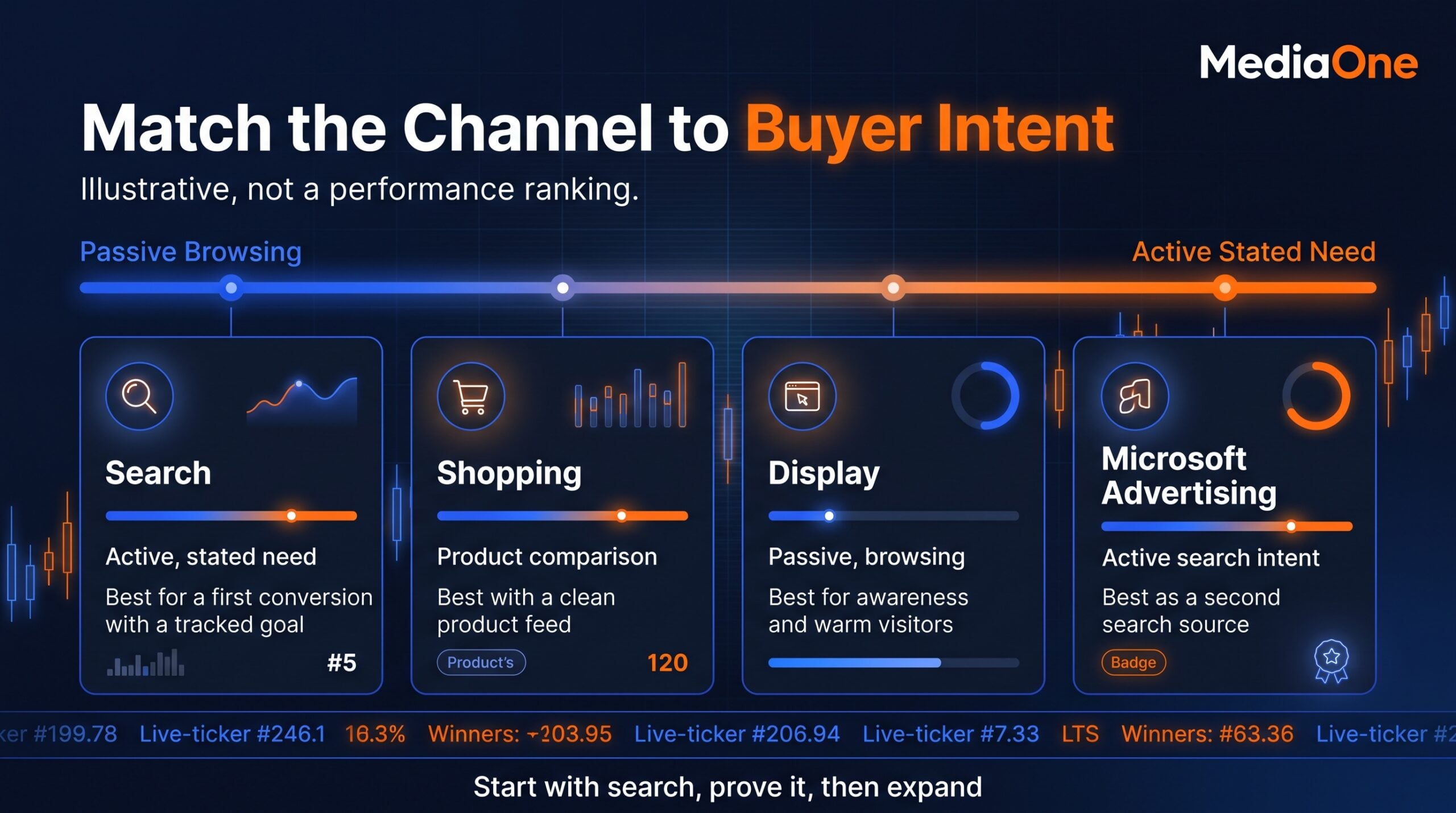
These channels suit different jobs, and treating them as interchangeable is a common error. Google lists their intended uses in its campaign-type guidance. Each reaches a different audience, so each needs its own goals and budget. Targeting also differs: search targets the query, while display can use audience and content signals.
| Channel | Buyer intent | Best used when |
|---|---|---|
| Search | Active, stated need | You need a first conversion and have a tracked goal |
| Shopping | Product comparison | You sell priced products with a clean product feed |
| Display | Passive, browsing | You are building brand awareness or re-engaging warm visitors |
| Microsoft Advertising | Active search intent | You want a second source of search clicks |
Shopping works best when product data is accurate. Display is weak as a first channel because it earns attention rather than answers. Microsoft Advertising can be tested once search measurement is stable, since it offers keyword-based search advertising with its own reach and auction conditions. Test each channel before expanding.
A decision framework for matching campaign type to business goal
Run three checks before choosing a channel:
- Goal: Is the target a sale, a lead or awareness? Search serves sales and leads; display can support reach, remarketing and sales.
- Readiness: Do you have a tracked primary conversion and a landing page that matches the query? If not, fix that first, whichever channel you pick. Your website should load quickly and match the ad’s promise.
- Demand: Is there enough search volume in your target locations to justify a sensible daily budget? If volume is thin, shopping or display may reach more people at a workable cost.
If the goal is leads and buyers actively search for the service, start by testing search. If search already converts and you want brand reach, add display. If you sell priced products, consider shopping once the Merchant Center product data is accurate.
Some advertisers jump to display because impressions look cheaper. Cheap impressions from people who never intended to buy can produce a cost per conversion that is hard to recover, so check the search opportunity before expanding reach spend.
Building a Keyword and Budget Foundation
Some underperforming PPC campaigns were weak before the first bid was set. The keyword list was too broad, the goal was vague, and the budget was a round number chosen in a meeting. These three decisions determine how easily you can diagnose problems later. Set the financial target before you choose the budget. Teams that document them can explain performance changes to stakeholders with far less guesswork, and a clear record shows whether the paid channel supports broader brand awareness and email marketing.
See lead generation campaign planning for sales-pipeline links.
Keyword research for PPC: match types, negatives and search intent
Keyword research for paid search is about intent more than volume. ‘PPC agency’ and ‘what is PPC’ may share a topic, but the first searcher is close to buying and the second is still learning. Paying for both in one ad group gives your ad a promise that suits neither. Group terms by intent so each set of campaigns speaks to one audience, and send each group to a matching landing page on your website. Each landing page should match a single intent group.
Match types control how loosely keywords trigger ads. Exact match is the tightest and suits high-intent terms you have already proven. Phrase match can trigger searches that include the meaning of the keyword, even without identical wording or a fixed order. Broad match lets the platform interpret meaning and use more signals; test it against reliable conversion tracking and query reports.
Negative keywords matter just as much. Review the search terms report each week and add irrelevant queries such as ‘free’, ‘jobs’ or ‘salary’ as negatives if you sell paid services. Google’s keyword match-type documentation explains how positive matches behave; negative keywords use different rules. Check each exclusion against customer intent.
Ad assets, ad copywriting and remarketing
Ad copy must match the intent group it serves. Lead with the buyer’s stated need, state one specific benefit, and close with a clear action. A strong headline echoes the query, so searchers see their own words in the ad. Use ad assets such as sitelinks, callouts and structured snippets to add pricing, service areas or contact options without lengthening the headline.
Limited-time wording can draw attention when it is true. Phrases such as ‘sale ends in 24 hours’ should be used only when the offer is real and the deadline is accurate. Test urgency against benefit-led copy using conversions.
Remarketing reaches people who have already visited your site. Because they have had previous contact with the brand, their intent may differ from cold audiences, but cheaper conversions are not guaranteed. Keep remarketing lists relevant, exclude recent converters when appropriate, and use frequency controls where the campaign type supports them. Respect applicable privacy requirements.
Setting campaign goals and measurable targets
Set the target before the budget. For lead generation, that is a target cost per acquisition (CPA). For ecommerce, it is return on ad spend (ROAS). ROAS is ad-attributed revenue divided by ad spend, so a ROAS of 4 means S$4 of revenue for every S$1 spent on ads.
There is no universal ROAS target that suits every sector, and ROAS alone does not measure profit. The right ROAS depends on your margin, so calculate your own break-even point rather than adopting an industry figure. Exclude or account for refunds consistently.
Keep two figures apart. Total ad revenue is what the platform reports as sales from ads, while PPC-specific spend is what you pay for the campaigns being measured. Only the second belongs in your ROAS calculation. Track a small set of metrics consistently: click-through rate, conversion rate, cost per click (CPC), CPA, ROAS and impression share.
CPA and ROAS targets are only as reliable as the data behind them. For accounts with thin conversion history, treat any target as provisional, since a handful of conversions can swing the figure sharply.
Work backwards from margin. For example, if a customer is worth approximately S$1,536 in gross profit and you want acquisition cost at no more than a third of that, your target CPA is approximately S$512. Every later decision, from bid strategy to whether to scale, is judged against that number.
Budget allocation and how to set a defensible daily spend
A defensible daily budget comes from three inputs: target CPA, expected conversion rate and available search volume. Estimate the conversions you need per month, multiply by target CPA, then divide by 30. Twenty conversions at an approximately S$512 target CPA gives approximately S$10,240 a month, or S$337 as an average daily budget using Google’s 30.4-day budgeting convention. For many Google Ads campaigns, daily spend can reach twice the average daily budget, subject to the monthly spending limit of 30.4 times the average daily budget.
This is an illustration, not a forecast.
Split the budget by purpose. Brand keywords often cost less and convert well, but they mainly capture people already searching for you, so measure them separately from new-customer growth. Non-brand keywords cost more and carry the acquisition load. Put most of the budget into non-brand terms with proven intent, and keep a smaller reserve for testing.
Do not raise the budget until the ad group passes the earlier audit and its actual CPA or ROAS supports a larger test. PPC Marketing Strategies work best when brand, non-brand and experimental spend have distinct goals and reporting.
Conclusion: The Strategies That Compound
Measurement, intent and landing page relevance should improve before budget grows. Audit weak points, record each test and compare CPA or ROAS against your targets.
For a Singapore business, check lead quality, separate branded search and confirm service areas. Expand only where data supports the spend.
Frequently Asked Questions
What is a good return on PPC ad spend?
A good return exceeds your break-even point after costs. Industry averages hide differences in margins and attribution, so use your own sales data.
A 2.5x ROAS means S$2.50 of revenue for every S$1 spent on ads. At a 40% contribution margin, that return only breaks even before other costs. Set your target from margins and customer lifetime value.
How much should a small business budget for PPC?
Set the budget from a target, not a guess. Work out how many conversions you need each month, divide by your expected conversion rate to get the clicks required, then multiply by your realistic cost per click. Start with a budget that produces enough data to judge performance. Avoid spreading small sums across many campaigns that never reach a reliable sample.
How long does it take for PPC campaigns to show results?
Clicks and impressions appear within hours of launch, but reliable conversion data takes longer. Some accounts need multiple conversion cycles before automated bidding and reported CPA become reliable; the timing varies with volume and conversion delay. Judge early results on click-through rate and cost per click, and hold judgment on cost per conversion until the sample is large enough to trust.
What is the difference between PPC and SEO?
PPC buys paid placements, while SEO builds unpaid search visibility through content, technical quality and authority. SEO takes ongoing work even without per-click media charges; PPC can test converting keywords and messages quickly. MediaOne compares the channels in its Google Ads versus SEO guide.
Should I manage PPC in-house or hire an agency?
Manage in-house if you have someone who can own tracking, landing pages and weekly optimisation, since those can drive results beyond bid tweaks. Hire an agency if you lack that capacity or need a faster ramp-up. Either way, insist on account access and on reporting tied to revenue or qualified leads, not clicks. This applies whether your PPC Marketing Strategies are run internally or by an external partner.