| AI Summary
Paid ads on social media help Singapore businesses reach potential customers, generate leads and increase sales. This guide explains how to choose among Facebook, Instagram, TikTok, and LinkedIn, plan advertising budgets, measure campaign performance and improve return on investment. It also covers common advertising mistakes, retargeting strategies and Singapore’s data privacy requirements. |
Paid ads on social media help Singapore businesses reach potential customers, generate enquiries and increase sales. However, successful campaigns require clear objectives, suitable platforms and accurate performance tracking.
For most consumer-facing businesses, we recommend testing Facebook and Instagram first. TikTok is worth considering for video-led campaigns, while LinkedIn is particularly useful for business-to-business (B2B) marketing.
This guide explains how to choose advertising platforms, estimate costs, plan campaigns and measure return on investment (ROI). We also cover common mistakes and practical ways to improve results.
Key Takeaways
-
Choose platforms based on your customers. Facebook and Instagram suit many consumer campaigns, while LinkedIn supports professional targeting.
-
Define one primary campaign objective. Focus on purchases, qualified enquiries or another measurable outcome.
-
Set an affordable acquisition cost. Calculate how much your business can spend to gain a customer.
-
Test before increasing budgets. Compare advertising messages, visuals and audiences using measurable results.
-
Track actual business outcomes. Compare advertising reports with confirmed enquiries, transactions and revenue.
-
Monitor advertising fatigue. Review frequency, engagement and conversion costs before replacing creatives.
What Are Paid Ads on Social Media?
Paid ads on social media are sponsored promotional messages displayed across platforms such as Facebook, Instagram, TikTok and LinkedIn. Businesses pay to reach selected audiences through feeds, stories, videos and other advertising placements.
Unlike organic social media marketing, paid advertising allows businesses to allocate budgets and select campaign objectives. Advertising systems then use targeting information and delivery algorithms to determine which eligible users see the ads.
Common formats include:
-
Image ads: Promote products, services or offers using a single visual.
-
Video ads: Demonstrate products, explain services or share customer experiences.
-
Carousel ads: Display multiple images or products in one advertisement.
-
Lead generation ads: Collect enquiries through platform forms or websites.
-
Collection and shopping ads: Help customers discover products and browse catalogues where supported.
Advertising does not guarantee sales. Results depend on audience relevance, creative quality, pricing and the experience after someone clicks.
Singapore has a highly connected digital population. According to DataReportal’s Digital 2026 Singapore report, the country had approximately 5.78 million internet users at the end of 2025, representing 98.4% internet penetration.
The report also identified 5.33 million social media user identities in October 2025. These figures describe digital adoption, although social media identities do not necessarily represent unique individuals.
This creates opportunities for businesses to reach local customers. However, competition for relevant audiences makes careful targeting and budget management important.
For example, a Singapore tuition centre might target parents researching enrichment programmes. An online fashion retailer could promote seasonal collections, while a corporate consultancy might use LinkedIn to reach business decision-makers. The right approach depends on the customer’s needs and purchasing journey.
Choosing the Best Platforms for Paid Ads on Social Media
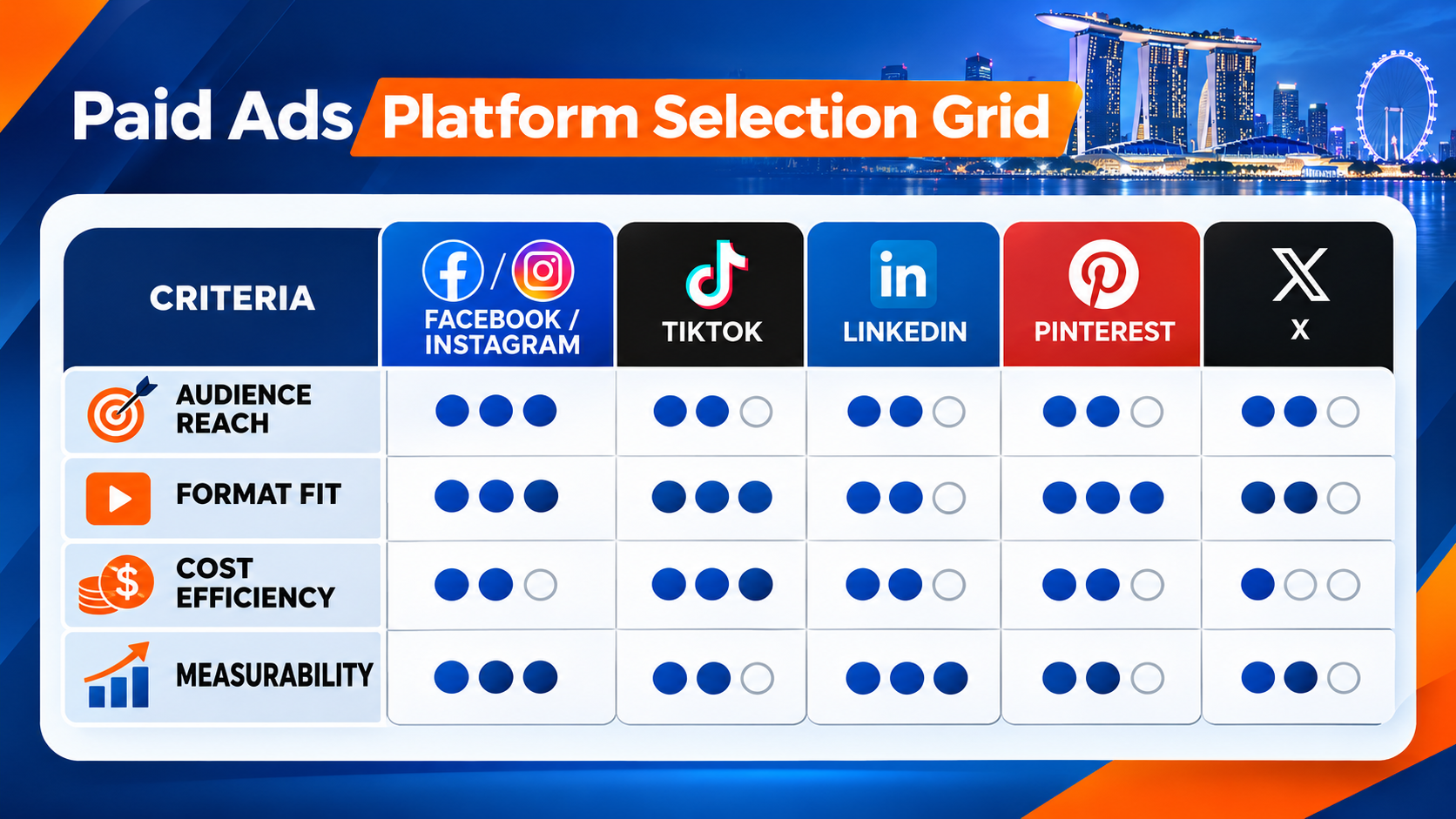
Each social platform offers different advertising formats, targeting capabilities and audience behaviours. We recommend comparing platforms against your business objectives before allocating spending.
Facebook and Instagram advertising
Facebook and Instagram advertisements are managed through Meta’s advertising ecosystem. Businesses can create campaigns for objectives such as awareness, traffic, engagement, leads and sales.
Facebook can support local service providers, retailers and businesses targeting established communities. Instagram is useful for visually appealing products, hospitality, beauty and lifestyle brands.
We recommend testing both placements when your target customers use both platforms. Avoid assuming that one will always deliver cheaper conversions.
Meta’s advertising auction explanation confirms that ad delivery considers advertiser value and ad quality. Consequently, the highest bid does not automatically secure the best advertising placement.
TikTok advertising
TikTok suits businesses that can demonstrate products or communicate ideas through engaging short-form videos. Its advertising options include traffic, video views, lead generation and sales campaigns. According to TikTok’s lead generation documentation, advertisers can collect enquiries through instant forms, websites and supported messaging destinations.
Singapore retailers can use demonstrations, tutorials and customer-focused videos to introduce products. We recommend preparing several video concepts before launching. A clear opening, relevant message and visible product benefit can help attract attention.
LinkedIn advertising
LinkedIn is particularly relevant for B2B companies, recruitment services, professional training providers and organisations selling complex business solutions. Advertisers can target professional audiences using attributes such as industry, job function and seniority, subject to available targeting options.
LinkedIn also provides Lead Gen Forms containing pre-filled professional information. Its lead generation guidance explains how businesses can collect enquiries without requiring users to complete lengthy external forms.
We would prioritise LinkedIn when the value of a qualified business enquiry supports the potential acquisition cost.
Pinterest and X advertising
- Pinterest can suit home improvement, interiors, fashion and other products involving visual inspiration or purchase planning.
- X may be relevant for brands involved in technology, news and active industry conversations.
Neither should automatically receive advertising budget. We recommend confirming audience fit, campaign objectives and tracking capabilities before testing either platform.
How to compare platforms
Score each prospective platform against four criteria:
-
Audience relevance: Are your potential customers active there?
-
Creative suitability: Can you produce content suited to the platform?
-
Commercial potential: Can the campaign generate affordable enquiries or sales?
-
Measurement: Can you connect results to meaningful customer actions?
Start with the strongest one or two options. Expand after performance data supports further investment.
How to Plan a Paid Social Media Advertising Campaign
Effective campaign planning starts with identifying the customer and the business outcome. The advertising objective, message and destination should support the same action.
1. Set clear campaign objectives
Choose a measurable objective before creating advertisements.
For example, a local renovation company might aim to generate 30 qualified enquiries monthly. An ecommerce retailer might focus on purchases, while a training provider could prioritise course registrations.
Select the corresponding objective within the advertising platform. TikTok’s campaign objective guidance distinguishes awareness, consideration and conversion goals.
We recommend measuring outcomes that connect directly to your business. Website visits and video views can be useful indicators, but they should not replace sales measurements when revenue is the goal.
2. Research and define your audience
Identify your ideal customer’s location, interests, purchasing needs and decision-making behaviour.
For Singapore campaigns, geographical targeting might cover the entire country or specific service areas. A neighbourhood restaurant may prefer customers who can conveniently visit its premises.
Avoid making audiences unnecessarily narrow. Excessive targeting restrictions can limit delivery and reduce opportunities for advertising systems to identify suitable customers.
Create audience segments only when they represent meaningful differences in customer needs.
3. Develop suitable advertising creatives
An effective advertisement should communicate its main benefit quickly.
Use clear visuals, concise copy and a specific call to action (CTA). The advertising message must also match the offer shown on the landing page.
We recommend testing different approaches:
-
Problem-focused: Explain the customer’s difficulty and introduce your solution.
-
Benefit-focused: Highlight the practical outcome customers can expect.
-
Product demonstration: Show how a product works.
-
Social proof: Feature authentic reviews or testimonials with appropriate permission.
Change one meaningful element at a time where practical. This makes it easier to understand which variation contributes to better results.
4. Prepare landing pages and enquiry forms
Advertising performance depends partly on what happens after someone clicks.
A useful landing page should explain the offer, answer common questions and provide an obvious next step. It should also load properly on mobile devices.
For lead generation campaigns, request only the information necessary to qualify and contact prospects. LinkedIn’s Lead Gen Form best practices recommend using three or four fields where appropriate to reduce submission friction.
How Much Do Paid Ads on Social Media Cost in Singapore?
There is no universal advertising rate that applies to every Singapore business. Social advertising costs depend on audience competition, campaign objectives, advertising quality and available inventory. Platforms generally use auction-based delivery systems rather than fixed prices for every click or impression.
Understanding advertising pricing models
Common pricing and measurement terms include:
| Metric | Meaning | Main use |
|---|---|---|
| Cost per click (CPC) | Advertising spend divided by clicks | Evaluate traffic costs |
| Cost per mille (CPM) | Cost per 1,000 impressions | Evaluate exposure costs |
| Cost per lead (CPL) | Advertising spend divided by leads | Evaluate enquiry acquisition |
| Cost per acquisition (CPA) | Spend divided by defined acquisitions | Evaluate conversion efficiency |
| Return on ad spend (ROAS) | Revenue attributed to ads divided by ad spend | Evaluate advertising revenue |
These metrics serve different purposes. A low CPC does not necessarily indicate a profitable campaign.
Building a realistic advertising budget
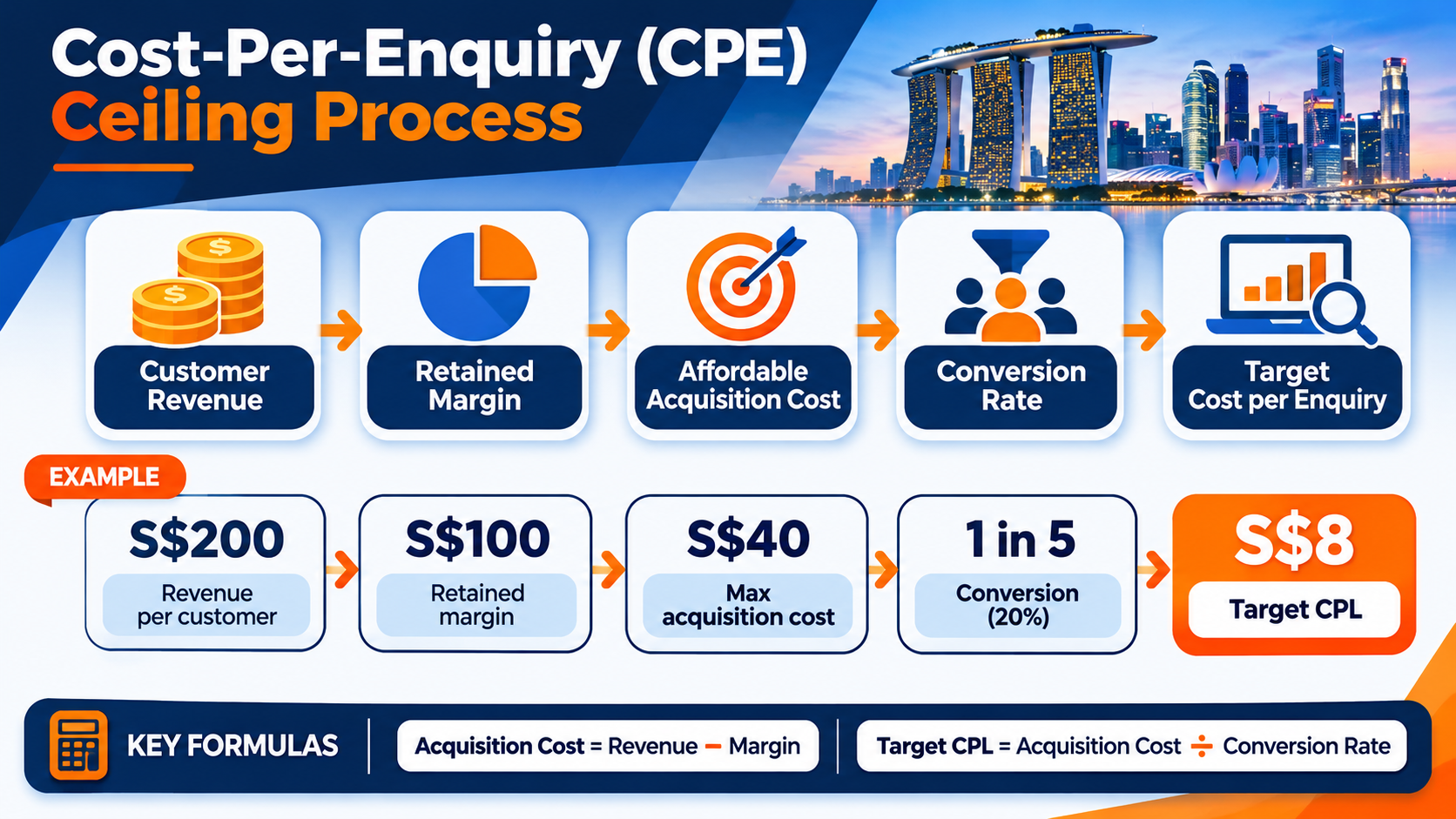
We recommend calculating an affordable acquisition cost before deciding how much to spend.
Consider a business that earns S$200 in revenue from each new customer. After direct fulfilment costs, it retains S$100 before advertising and other expenses.
If the business decides it can afford S$40 to acquire a customer, that becomes its initial acquisition-cost target. Suppose one in five qualified enquiries becomes a paying customer. The corresponding target CPL would be S$8.
This is an illustrative calculation, not a Singapore advertising benchmark. Actual figures must come from your margins and conversion data.
Example monthly advertising budget
A business allocating S$1,500 monthly could initially plan:
| Expense | Illustrative allocation |
|---|---|
| Advertising media | S$1,000 |
| Creative production | S$250 |
| Landing page and tracking | S$150 |
| Reporting and optimisation | S$100 |
| Total | S$1,500 |
Actual production and management expenses may differ significantly.
Check platform spending requirements before committing. For example, TikTok’s budget documentation specifies minimum budget requirements, including amounts exceeding US$50 at campaign level and US$20 daily at ad group level for the configurations described.
We recommend checking current account requirements and billing currency directly in each advertising platform.
Measuring Paid Social Media Advertising Performance
Reliable measurement helps businesses identify which campaigns contribute to genuine commercial results. Start by defining the conversion event, then confirm that tracking records it correctly.
Track the metrics that matter
For lead generation, monitor qualified enquiries, CPL, appointment bookings and customer acquisition cost. For ecommerce, monitor purchases, conversion rate, revenue and ROAS. Include refunds and product margins when evaluating actual profitability.
Awareness campaigns require different indicators, such as reach, frequency and audience response. These metrics are useful when visibility is the intended outcome.
Google Analytics 4 (GA4) allows businesses to mark important customer actions as key events. Google’s key event documentation explains how these actions support marketing performance analysis.
Compare platform reporting with business records
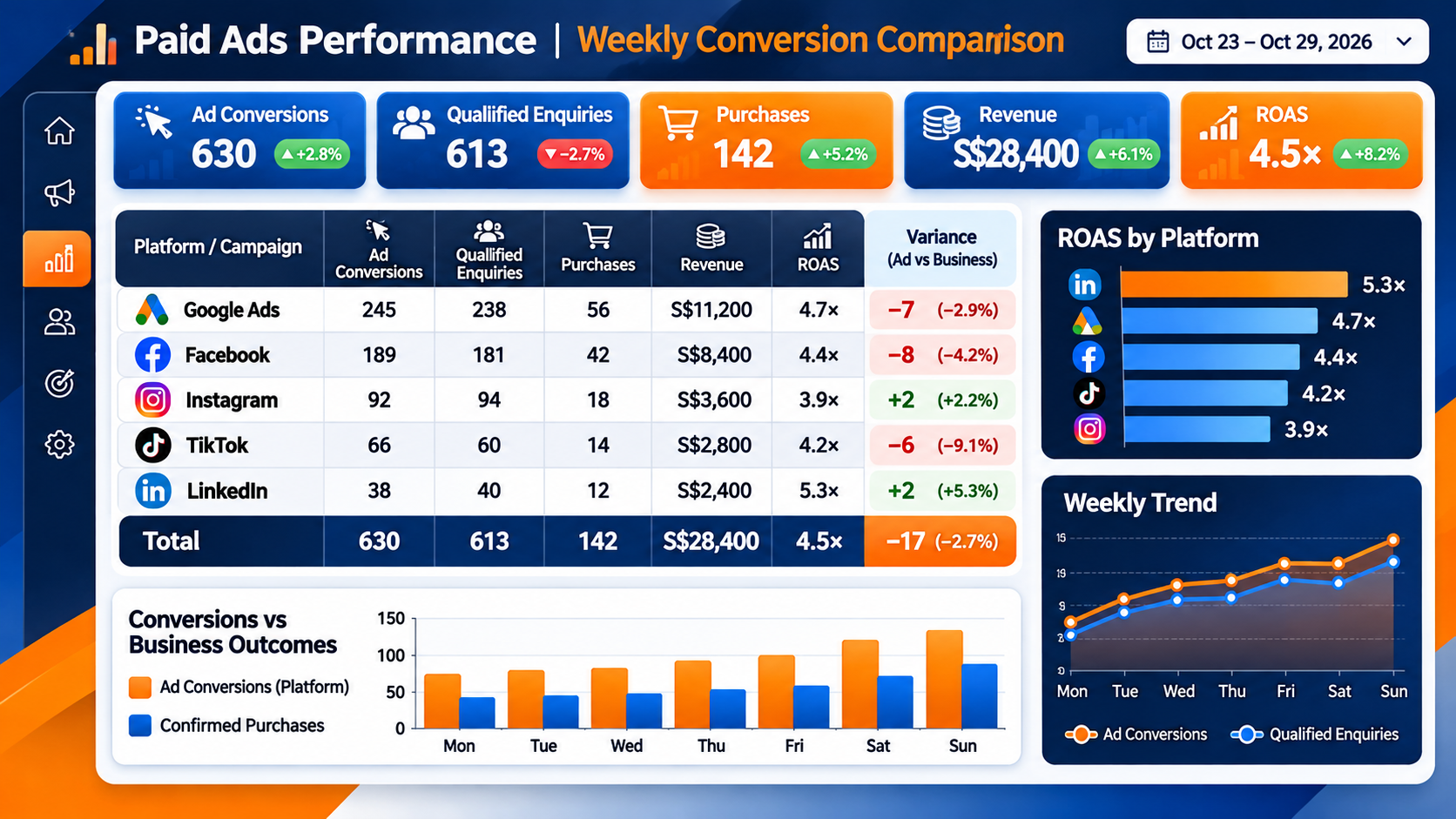
Advertising dashboards and analytics tools can report different conversion totals because they use different attribution methods and measurement windows. One purchase may involve several interactions before completion. Multiple platforms may therefore claim credit for the same customer journey.
We recommend comparing advertising reports with confirmed orders, customer relationship management (CRM) records and actual revenue. Investigate major discrepancies before increasing spending. Do not automatically assume every platform-reported conversion represents an additional customer.
Evaluate lead quality
Not every enquiry has the same commercial value. A campaign generating 100 enquiries may perform worse than one generating 30 if most of the larger group are unqualified.
Track whether prospects meet your service requirements, respond to follow-ups and eventually purchase. For businesses with longer sales cycles, assess opportunities and closed sales rather than relying exclusively on immediate form submissions.
How to Optimise Paid Social Media Campaigns
Campaign optimisation should follow measured evidence rather than frequent, unplanned changes.
Test advertising messages and formats
Compare variations of headlines, visuals, offers and calls to action. For example, an education provider could test a course-benefits advertisement against one highlighting upcoming enrolment dates.
Allow sufficient delivery and conversion data before judging performance. Avoid changing multiple settings simultaneously when doing so would make results difficult to interpret.
Manage advertising frequency and fatigue
Advertising fatigue can occur when users repeatedly encounter similar creatives and become less responsive. Monitor frequency alongside click-through rate, conversion rate and acquisition costs.
However, high frequency alone does not prove that an advertisement is ineffective. Some campaigns require repeated exposure before customers act.
Frequency controls also vary by platform, campaign type and placement. Where direct caps are unavailable, review available delivery settings and refresh creatives when performance justifies it.
Use retargeting carefully
Retargeting allows businesses to advertise to eligible people who previously interacted with their websites, applications or other supported business assets.
A retailer might promote relevant products to previous website visitors. A service provider could reconnect with users who viewed an enquiry page but did not submit a form.
However, small retargeting audiences may limit delivery. Assess audience size and eligibility before assigning substantial budgets. Exclude recent purchasers where appropriate to avoid unnecessary spending.
Scale campaigns gradually
Increase budgets when campaigns consistently achieve acceptable acquisition costs and produce sufficient conversion data. Scaling too quickly can change delivery conditions and weaken performance.
We recommend reviewing profitability after each meaningful budget adjustment. Maintain room for further testing instead of transferring all spending to one successful advertisement.
Common Mistakes to Avoid When Running Social Media Ads
Several avoidable mistakes can reduce advertising effectiveness.
-
Choosing traffic instead of conversions: A traffic objective may attract visitors without generating enough sales or enquiries.
-
Targeting everyone: Broad targeting without a clear customer offer can waste spending. Balance audience reach with relevance.
-
Ignoring landing pages: Poor mobile usability, confusing offers and lengthy forms can prevent conversions.
-
Making constant campaign changes: Frequent adjustments can disrupt delivery and make performance comparisons unreliable.
-
Scaling without checking profitability: Revenue growth does not guarantee that advertising remains profitable.
-
Using identical creatives everywhere: Adapt formats and messaging to each platform while maintaining brand consistency.
We recommend reviewing the complete customer journey before blaming the advertising platform. Weak results may come from the offer, landing page, follow-up process or targeting strategy.
Data Privacy and Advertising Compliance in Singapore
Businesses collecting customer information through social advertisements must consider Singapore’s Personal Data Protection Act (PDPA).
The Personal Data Protection Commission (PDPC) explains that the PDPA may apply when cookies collect, use or disclose personal data. Not every cookie requires consent, and the applicable obligations depend on its purpose and the circumstances.
Review the PDPC guidance on cookies and personal data before implementing advertising trackers.
Businesses should explain relevant data collection purposes, protect customer information and review consent requirements. Customer lists uploaded for advertising must also be handled appropriately.
We recommend including privacy compliance in campaign planning rather than treating it as an issue to address after launch.
How to Turn Paid Ads on Social Media Into Profitable Growth
Successful paid social advertising requires disciplined testing, accurate tracking and a clear understanding of customer acquisition costs. For many Singapore consumer brands, Facebook and Instagram provide a practical starting point. TikTok suits businesses with compelling video content, while LinkedIn deserves consideration when targeting professional buyers.
Start with one measurable objective and a budget your business can sustain. Track qualified enquiries, confirmed purchases and profitability before expanding.
At MediaOne, we recommend aligning paid advertising with your wider digital marketing strategy. Consistent messaging, effective landing pages and reliable analytics help turn advertising investment into measurable business outcomes.
Frequently Asked Questions
Organic social media uses unpaid posts to engage audiences through platform distribution. Paid social media advertising involves purchasing placements to reach eligible audiences and achieve defined campaign objectives. Both can support brand awareness and customer acquisition.
Facebook and Instagram are practical starting points for many consumer businesses. TikTok is suitable for video-led campaigns, while LinkedIn offers professional targeting for B2B advertisers. We recommend choosing based on customer fit and measurable performance.
There is no fixed amount suitable for every business. Calculate your affordable customer acquisition cost, then allocate a test budget that meets platform requirements and supports meaningful measurement. Include creative production and management expenses.
Campaigns need sufficient delivery time and conversion data for meaningful assessment. The appropriate period depends on budget, campaign objective and customer purchasing behaviour. Review early indicators regularly, but avoid judging profitability from only a few clicks.
Common causes include unclear objectives, unsuitable audiences, weak creatives, ineffective landing pages and poor conversion tracking. We recommend identifying where customers abandon the journey before changing campaign settings or increasing budgets.