| AI Summary
Near me SEO helps Singapore businesses attract nearby customers through Google Search and Maps. Google determines local rankings using relevance, distance and prominence. Businesses can improve their visibility by optimising their Google Business Profile, maintaining accurate business information, building useful location pages and earning genuine customer reviews. Mobile-friendly websites and clear contact options also help convert local searches into enquiries, bookings and visits. A structured 90-day SEO plan can help businesses identify weaknesses, improve their local presence and measure results through website clicks, calls and qualified leads. |
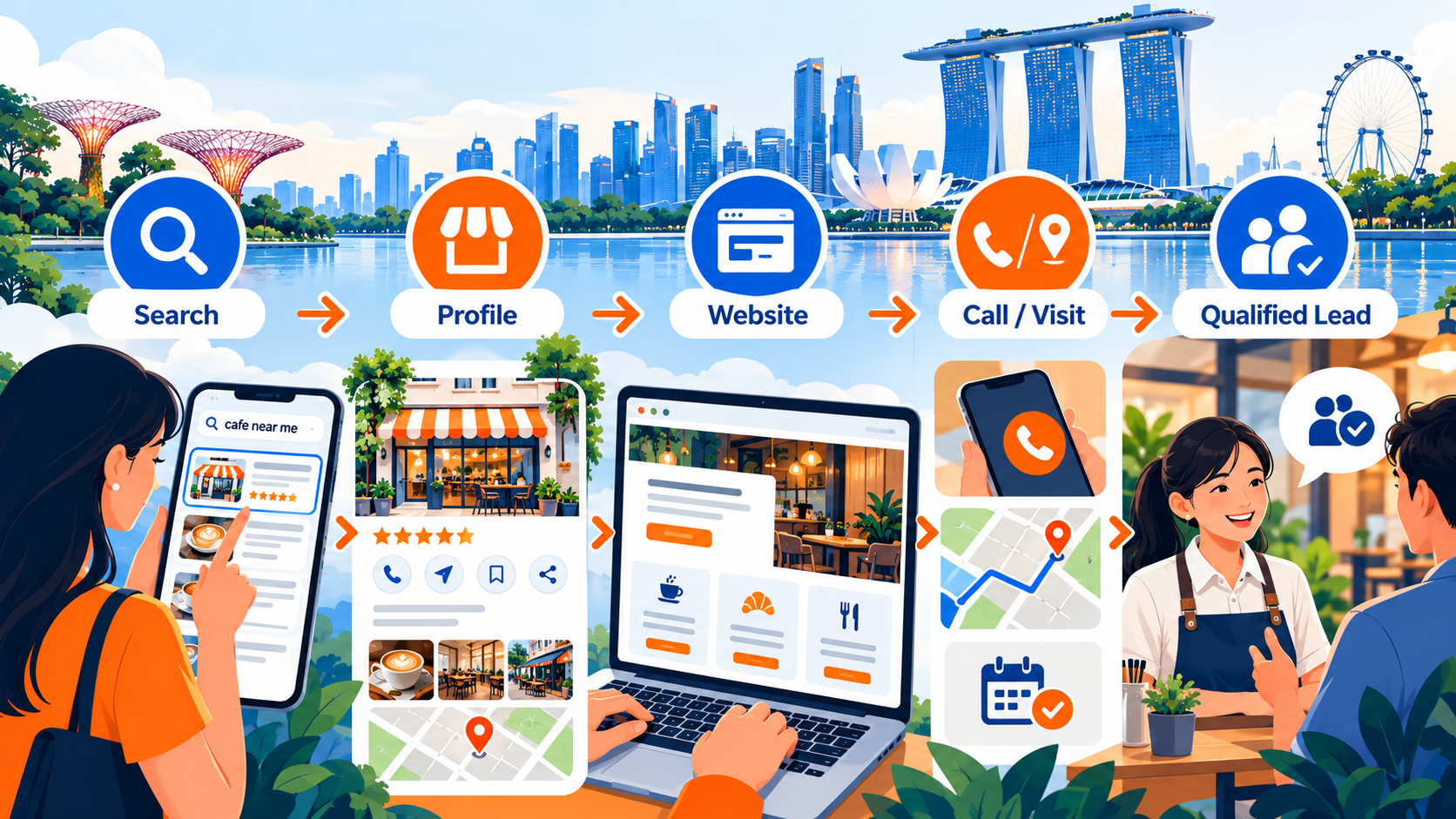
Someone searching for “dentist near me” or “aircon servicing near me” usually has a practical decision to make. They want a suitable provider, a convenient location and a straightforward way to get help. Near me SEO helps eligible Singapore businesses appear when Google interprets a search as local. The work starts with accurate business information, but it should end with a measurable enquiry, booking or visit.

At MediaOne, we recommend building your strategy around the customer’s next action rather than chasing a single Maps position. This guide explains how to choose the right local presence, improve your Google Business Profile, support it with useful website pages and measure what nearby searchers actually do.
Key Takeaways
- Location changes the results. Google considers relevance, distance and prominence when choosing local businesses. Your ranking can vary between Orchard, Tampines and Jurong East.
- Eligibility comes before optimisation. A staffed shopfront, a business visiting customers and an online-only company do not qualify for the same Google Business Profile setup.
- Accurate details reduce lost enquiries. Categories, opening hours, contact options and genuine photos help customers assess a business quickly.
- Your website still matters. Useful service and location pages can answer questions that a short Business Profile cannot.
- Measure actions, not just visibility. Calls, direction requests, website clicks and qualified enquiries reveal whether local discovery is working.
What Near Me SEO Actually Means
Near me SEO is the process of improving visibility for searches with local intent. Some contain the phrase “near me”, such as “physiotherapist near me”. Others name an area, such as “physiotherapy clinic Bishan”. A query may also be local without naming a place. Google can interpret “coffee shop” as a nearby-business search using available location information.
These searches can surface a map, a group of local business results or ordinary website listings. The formats differ. A Google Business Profile primarily helps customers discover and evaluate a real business on Search and Maps. Website optimisation helps individual pages appear for relevant searches and gives customers the detail needed to choose.
That distinction matters. A cleaning company may earn a call from its Maps listing, while a customer comparing treatment prices might visit three clinic websites first. We plan for both journeys instead of assuming every nearby search ends with an immediate visit.
Local intent is not always immediate purchase intent
Someone searching “24-hour locksmith near me” may need urgent help. Someone searching “tuition centre near me” may be gathering options for next term. Both are local searches, but their content needs differ.
Start by grouping your target queries into urgent needs, planned appointments and comparison searches. An urgent service needs a working phone number and clear availability. A planned service benefits from pricing guidance, qualifications and booking information. A comparison query needs evidence that explains why the business fits the customer’s requirements.
How Google Selects Businesses for Nearby Searches
Google’s local ranking guidance identifies three main factors: relevance, distance and prominence. It does not publish a formula that assigns a guaranteed percentage to each. Nor can a business buy a better organic local ranking directly from Google.
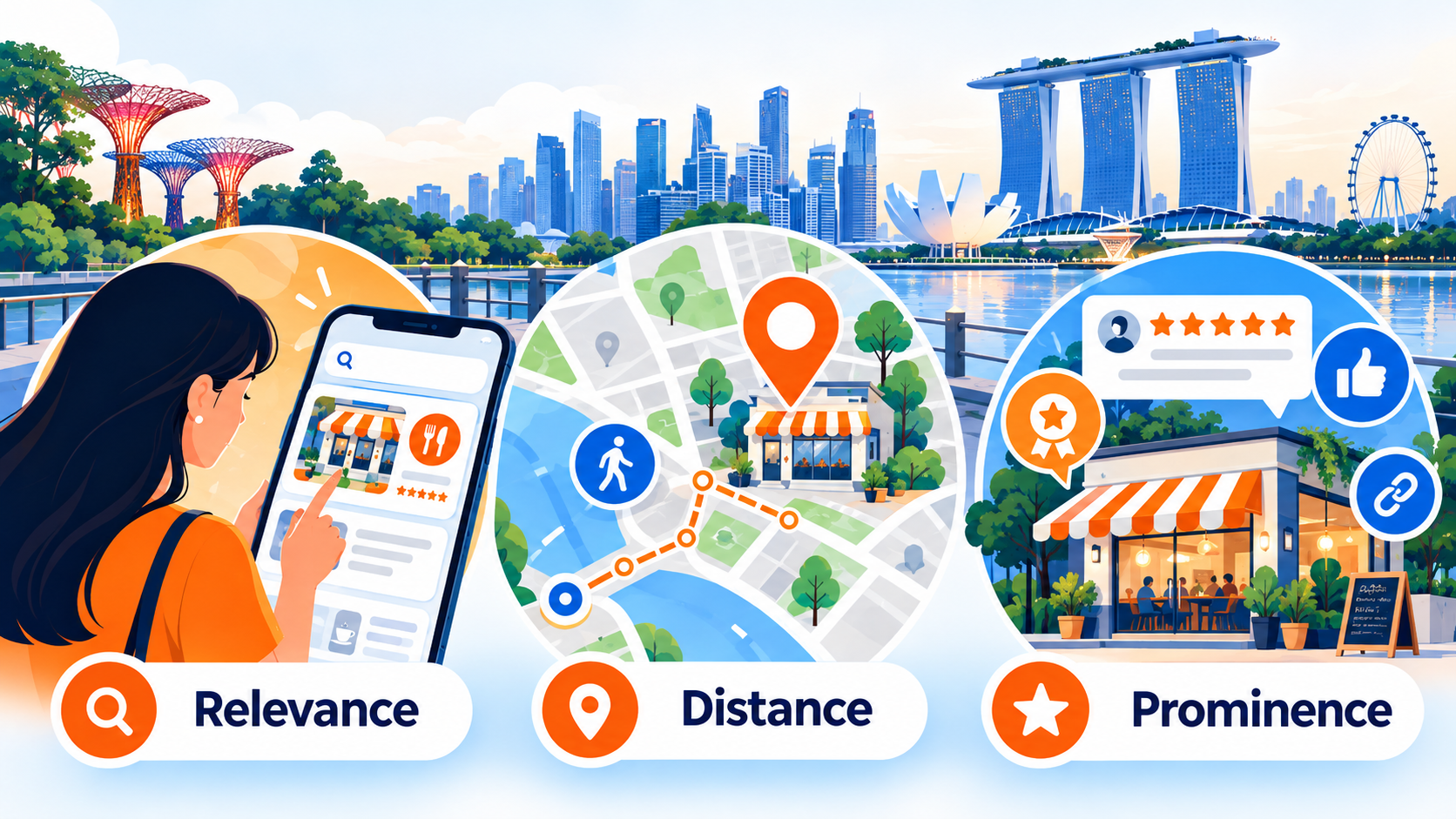
Relevance: Does your business match the request?
Relevance concerns the match between the search and a business’s information. Choose the most accurate primary category, describe the services you genuinely provide and keep the details current. A dental clinic should not choose unrelated categories simply because those searches attract traffic.
On the website, explain the actual service in the language customers use. A page about emergency dental appointments should tell readers whether the service is available, what to do next and how to contact the clinic. Repeating “near me” throughout the copy does not replace useful information.
Distance: Where is the searcher?
Distance depends on the business location and the location Google knows or estimates for the searcher. Results may differ even across neighbouring MRT stations. A business cannot make itself physically closer by adding extra neighbourhood names to its profile or website.
This is particularly important for Singapore businesses covering the whole island. A plumbing company based in the east may travel to western estates, but stating islandwide coverage does not guarantee visibility for every western search. Make service claims accurate, then use location-relevant pages to explain where you genuinely operate.
Prominence: Is the business established and recognised?
Prominence concerns how well known a business is. Google mentions information such as links, reviews and ratings in its explanation. A credible online presence may include relevant local coverage, genuine customer feedback and references from organisations connected to the business.
Choose the Right Google Business Profile Setup
Before editing keywords or photos, check whether your operating model qualifies. Google’s Business Profile guidelines distinguish customer-facing locations from businesses that travel to customers. A wrong setup can create verification problems or put the listing at risk.
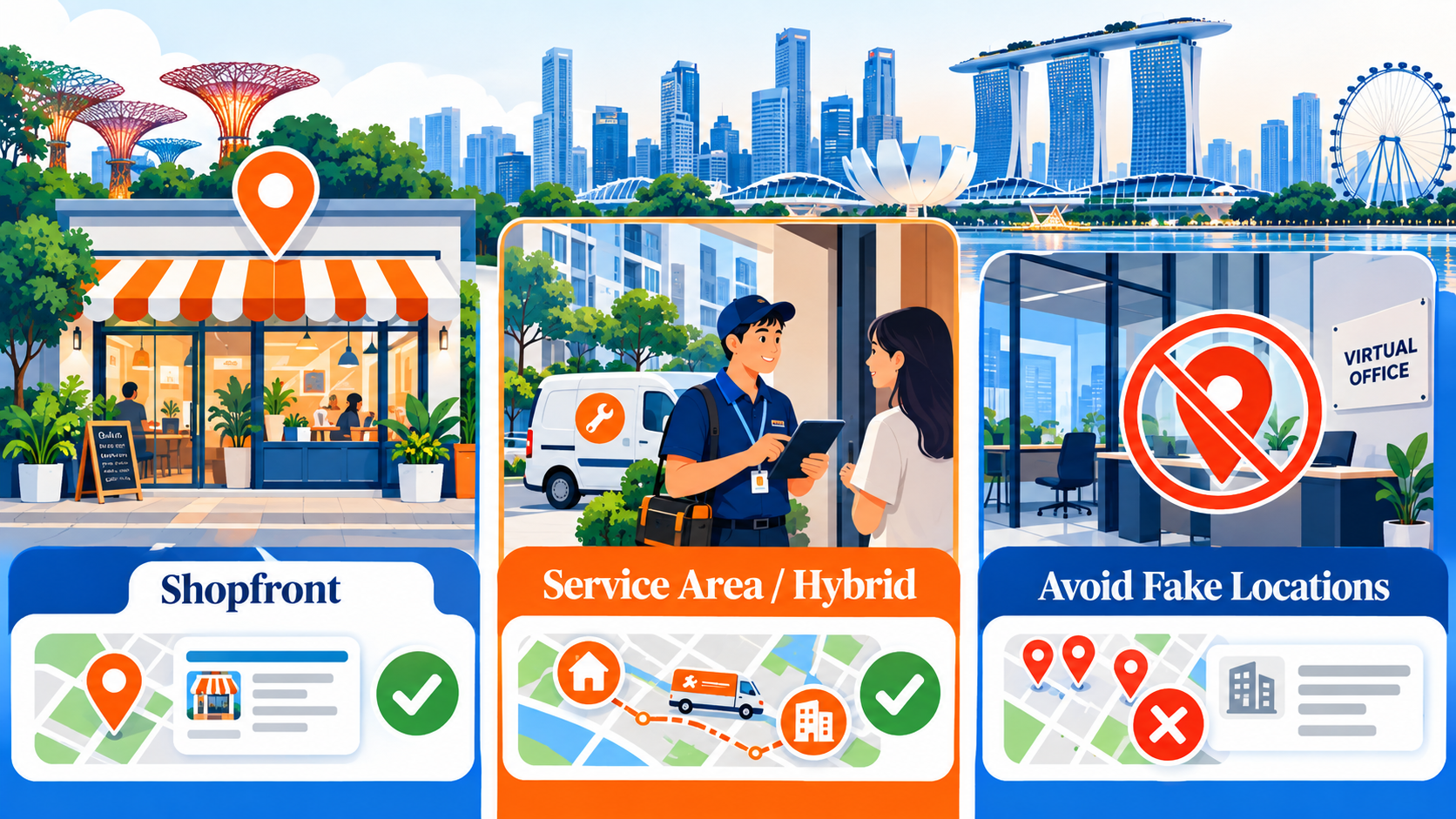
Shopfront businesses
A shopfront receives customers at its stated address. Examples include a neighbourhood bakery, clinic or repair counter. The address should identify the real location, and the business must meet Google’s requirements for an eligible customer-facing premises.
For a shop in a mall or mixed-use building, check the unit number, correct map pin and actual entrance. Customers may reach the building yet struggle to find the shop. Directions, parking instructions and landmarks belong on your website where they can be explained clearly.
Service-area and hybrid businesses
A service-area business travels to customers and does not receive them at its business address. Think of a home-cleaning team that operates from a private office. Google says qualifying businesses of this type should hide an address that customers cannot visit. A hybrid business can show its eligible shopfront and define areas where it also provides services.
Google’s service-area instructions allow areas to be specified using places or postal codes, with up to 20 service areas. They do not offer a distance-radius setting for new edits. List places you actually serve; the setting describes coverage rather than overriding Google’s distance calculation.
A virtual office is not automatically an eligible business location. Google restricts listings at virtual offices and coworking sites that lack the required staffing, signage or customer-facing arrangements. Likewise, a mailing address does not establish a real branch.
Do not create several profiles for the same operation simply to target different Singapore neighbourhoods. An online-only business without an eligible customer-facing or customer-visit operation generally should not invent a storefront listing.
Make Your Business Profile Worth Choosing
Completeness should answer practical questions, not just satisfy a dashboard. We examine what a customer sees on a phone before deciding which improvements deserve priority.
Select categories and describe real services
Use a specific primary category that represents what the business is. Add secondary categories only when they genuinely describe the operation. Google’s guidelines advise choosing categories that complete “this business is a”, rather than turning the category list into a catalogue of every feature.
Then fill in applicable services, contact details and the business description. Explain important specialisations plainly. A repair workshop may specify the equipment it accepts. A clinic may identify available consultations without promising treatments it does not provide.

Keep operating hours accurate
“Open now” is useful only when the listed hours reflect reality. Review public holiday hours, seasonal closures and appointment-only arrangements.
Assign responsibility for updates. The person managing the premises may know schedule changes before the marketing team does. Establish a simple process so customer-facing information changes promptly across the profile and website.
Use authentic photos and straightforward contact links
Upload clear images of the real premises, staff where appropriate, products or completed work. Google recommends genuine representations and publishes photo and video requirements. Stock imagery that looks like a different premises can make a local listing less useful.
Check every action link on a mobile device. Google supports certain business links for appointments, reservations and orders, but options depend on business type and availability. Do not promise Reserve with Google or direct payments unless the relevant feature and provider integration are actually supported.
Build Local Website Pages That Solve Real Problems
A Business Profile has limited space. Your website can explain services, eligibility, prices and next steps. For near me SEO, its strongest pages help visitors decide whether your business suits their needs in a specific place.
Give each real location a useful landing page
A business with genuine branches can create a page for each one. Include its address, local contact number where applicable, opening hours, services available at that branch and practical arrival details. Link to the relevant appointment or enquiry process.
A Tampines clinic page might explain which consultations are offered there, whether appointments are required and which entrance patients should use. A Jurong East branch may have different hours or facilities. Those differences justify separate pages because they help customers.
Avoid publishing near-identical pages for every MRT station while directing everyone to the same generic form. Google’s spam policies warn against doorway pages created for similar geographic queries without distinct value.
Support mobile visitors with clear next steps
Place the phone number, booking link and location information where visitors can find them quickly. Make buttons usable on small screens. Describe fees or quotation processes if they influence the decision. An “Enquire now” form without any explanation may deter someone who simply wants to confirm availability.
Also check the technical basics: pages must be crawlable, important information should appear in readable text and internal links should lead to the relevant service. Google’s Search Essentials recommends helpful content and crawlable links. Fast, usable pages support conversions even though page speed alone will not make a distant business win a local pack position.
Add structured data where it fits
LocalBusiness structured data can help Google understand business details on a website. It may include a genuine business address, opening hours and other supported properties. Google’s LocalBusiness documentation explains the requirements and validation process.
Markup must reflect visible, accurate information. It does not create a Google Business Profile, prove that a virtual office is eligible or guarantee a rich result. We treat it as a technical clarity measure, not a substitute for good location pages.
Plan Content Around Singapore Neighbourhood Decisions
Singapore’s compact geography does not make every local search identical. A customer in Tiong Bahru may prioritise walkability. Someone booking home repairs in Punggol may care about service coverage and available time slots. Those are plausible customer needs to validate, not assumptions about Google’s ranking algorithm.
Research queries by service, neighbourhood and intent. Compare phrases such as “aircon servicing Bedok”, “emergency aircon repair Singapore” and “aircon servicing near me”. They may warrant a service page, an urgent-contact section or a carefully explained service-area page rather than three interchangeable articles.
Good local content answers questions that generic competitors overlook:
- Which neighbourhoods can the team visit, and are there any call-out restrictions?
- What does the starting price cover, and when is a quotation required?
- What should customers prepare before an appointment or delivery?
- Where is the correct entrance, pickup point or nearest practical access route?
- Can customers book online, call directly or request a callback?
Only publish answers the business can maintain. The objective is to remove doubt during the decision, not to insert every estate name into every paragraph.
Earn Trust Through Reviews and Local Recognition
Reviews influence how people compare nearby options. Google also says review quantity and positive ratings can help local rankings. That does not mean you should chase a particular star average or expect replies alone to move a listing upward.
Ask customers for honest feedback after a real interaction. Google permits review requests using a link or QR code but prohibits incentives offered in exchange for posting, changing or removing reviews. Do not screen customers so that only happy ones receive a review invitation.
Reply when a response provides useful context. Thank satisfied customers without repeating sales phrases. For complaints, acknowledge the concern and suggest an appropriate private channel if the matter involves personal details. Do not reveal appointment information or customer records in a public reply.

Local recognition can also develop through genuine partnerships, community events, professional associations and relevant coverage. Choose opportunities because they connect the business with real customers. Any links or mentions are a secondary benefit, not a reason to manufacture endorsements.
Measure Enquiries, Not Just Map Visibility
A profile that attracts views but produces no suitable customer actions needs investigation. We recommend joining Business Profile data with website analytics and the enquiry records your team already maintains.
Google’s Business Profile performance reporting can show available searches, profile views, direction requests, call-button clicks and website clicks. Not every metric is available to every category. Importantly, a click on the call button is not proof that a call connected or became a sale.
Use Google Search Console to inspect the queries and pages attracting organic website clicks. Pair that with website events and confirmed lead records. If the customer contacts the business offline, ask how they found it where appropriate and record the answer consistently.
| Measurement | What it tells you | What to verify next |
| Profile searches and views | Whether people encounter the listing | Which terms and locations matter |
| Call-button clicks | Intent to telephone | Answered calls and suitable enquiries |
| Direction requests | Interest in visiting | Footfall or appointment attendance |
| Website clicks | Movement from profile to website | Bookings, form submissions and page usability |
| Qualified local leads | Commercial value from local discovery | Revenue, lead quality and follow-up time |
For example, imagine a hypothetical clinic receives 120 profile website clicks in one month. Its booking system records 12 completed appointments from those visitors. The observed booking rate for that tracked group is 10%, assuming attribution is reliable. Improving the booking journey may be a better next move than increasing profile views alone.
Do not compare periods without context. Public holidays, weather, promotional campaigns, staffing changes and seasonality can change enquiry volume. Record important operational changes beside your monthly report.
A Practical 90-Day Near Me SEO Plan

Use the first three months to establish reliable information, test customer journeys and identify changes tied to real demand. This sequence differs from a generic weekly listings audit because it connects each task with an operational result.
Days 1–30: Confirm eligibility and remove friction
Verify ownership of eligible profiles. Correct the business model, category, address or service areas as needed. Review phone routing, holiday hours and appointment availability. Test the mobile website from the perspective of a first-time customer.
Establish a baseline of available profile interactions, organic traffic and confirmed enquiries. Write down the three most common problems customers report when contacting or finding the business.
Days 31–60: Improve service and location relevance
Update priority service pages with actual availability, useful answers and clear calls to action. Build location pages only for genuine branches or clearly differentiated service needs. Add appropriate internal links and accurate structured data where useful.
Begin a consistent, policy-compliant review request process. Collect new photos from real operations when they add information customers need. Review the same representative local searches used in your baseline.
Days 61–90: Evaluate and invest selectively
Compare customer actions and qualified leads with the baseline. Identify whether the main obstacle is discovery, mismatched service information, unanswered calls or a weak booking path. Fix the obstacle most directly connected to lost business.
If direction requests rise but visits do not, investigate signage, access and opening hours. If call-button clicks rise without booked work, investigate call handling and service fit. Continue the changes that have credible commercial evidence rather than expanding activities simply because competitors appear busy.
Frequently Asked Questions
Is near me SEO different from local SEO?
Near me SEO focuses on searches where proximity is explicit or implied. It sits within local SEO, which also includes broader location-based discovery through websites, Maps and business information.
Do I have to put “near me” in my website title?
No. Write titles that accurately describe the service and location where relevant. Google can recognise local intent without repeated use of the phrase “near me”.
Can a home-based Singapore business create a Google Business Profile?
It depends on the operating model. A qualifying business that visits customers may be eligible as a service-area business and should hide an address where customers are not received. An online-only business without an eligible local operation generally should not create a storefront listing.
Will more reviews guarantee a top-three Maps ranking?
No. Google considers relevance, distance and prominence. Reviews can contribute to prominence, but no particular rating or review count guarantees a position.
Do I need separate pages for every Singapore neighbourhood?
No. Create pages where you have genuinely different location information or useful service details. Repetitive pages built only to capture geographic keyword variations can create doorway-page problems.
How long does near me SEO take to work?
There is no guaranteed timeline. Profile corrections may become visible sooner than broader website improvements, while commercial results depend on competition, demand and customer response. Use an initial 90-day measurement period without treating it as a ranking promise.
Turn Near Me SEO into Measurable Local Enquiries
A successful near me SEO strategy gives the right customer a credible answer and a clear next step. Start by confirming that the business is eligible to appear as represented. Then improve the information customers use to choose: genuine services, accurate locations, opening hours, reviews and a working contact path.
At MediaOne, we recommend prioritising the obstacle closest to a lost enquiry. A hidden phone button may matter more than another blog post. An incorrect mall entrance may matter more than another citation. A thin branch page may need useful customer information before it needs additional keywords.
Review performance using verified profile interactions alongside completed enquiries and bookings. Keep the work that produces meaningful outcomes, and revise what does not. That is how near me SEO becomes an accountable local marketing activity for Singapore businesses.