| AI Summary
Multi-level marketing (MLM) is generally prohibited in Singapore, although certain direct-selling arrangements qualify for legal exclusions. This guide explains how MLM works, its legal requirements, potential earnings and financial risks. It also covers refund protections, common warning signs and practical checks to help you assess an MLM opportunity before joining. |
Multi-level marketing (MLM) promises flexible working hours, commission-based earnings and the opportunity to build a sales network. These offers can appeal to Singaporeans seeking additional income. However, the business model carries financial and legal risks that recruitment presentations may not explain.
Singapore generally prohibits multi-level marketing schemes, although certain direct selling, insurance and franchise arrangements qualify for exclusions under the law. Even where an arrangement is permitted, participants must assess whether product sales can cover their expenses.
This guide explains how multi-level marketing works, Singapore’s legal requirements, realistic earnings expectations and the checks we recommend before joining.
Key Takeaways
-
Singapore generally prohibits MLM schemes. Certain arrangements qualify for exclusions under the Multi-Level Marketing and Pyramid Selling (Prohibition) Act.
-
Recruitment alone cannot generate commissions under the relevant direct-selling exclusion. Rewards must arise from qualifying sales activities.
-
Most participants in the MLM companies reviewed by the US Federal Trade Commission earned little or nothing. Those findings are not Singapore-specific.
-
Singapore’s direct-selling exclusion requires a full refund or buy-back guarantee, exercisable on reasonable commercial terms for at least 60 days.
-
Company registration does not establish MLM legality. Evaluate the compensation plan, participation requirements and actual business practices.
-
Calculate net profit before joining. Include operating expenses, product purchases, training, travel and the time required to generate sales.
What Is Multi-Level Marketing and How Does It Work?
Multi-level marketing is a sales model that uses networks of independent distributors to market products or services. Participants may earn commissions from their own sales and qualifying sales generated by other distributors within their networks.
Unlike conventional retail businesses, MLM companies generally rely on distributors rather than operating all their sales through company-managed outlets. Distributors introduce products, find customers and maintain relationships with buyers.
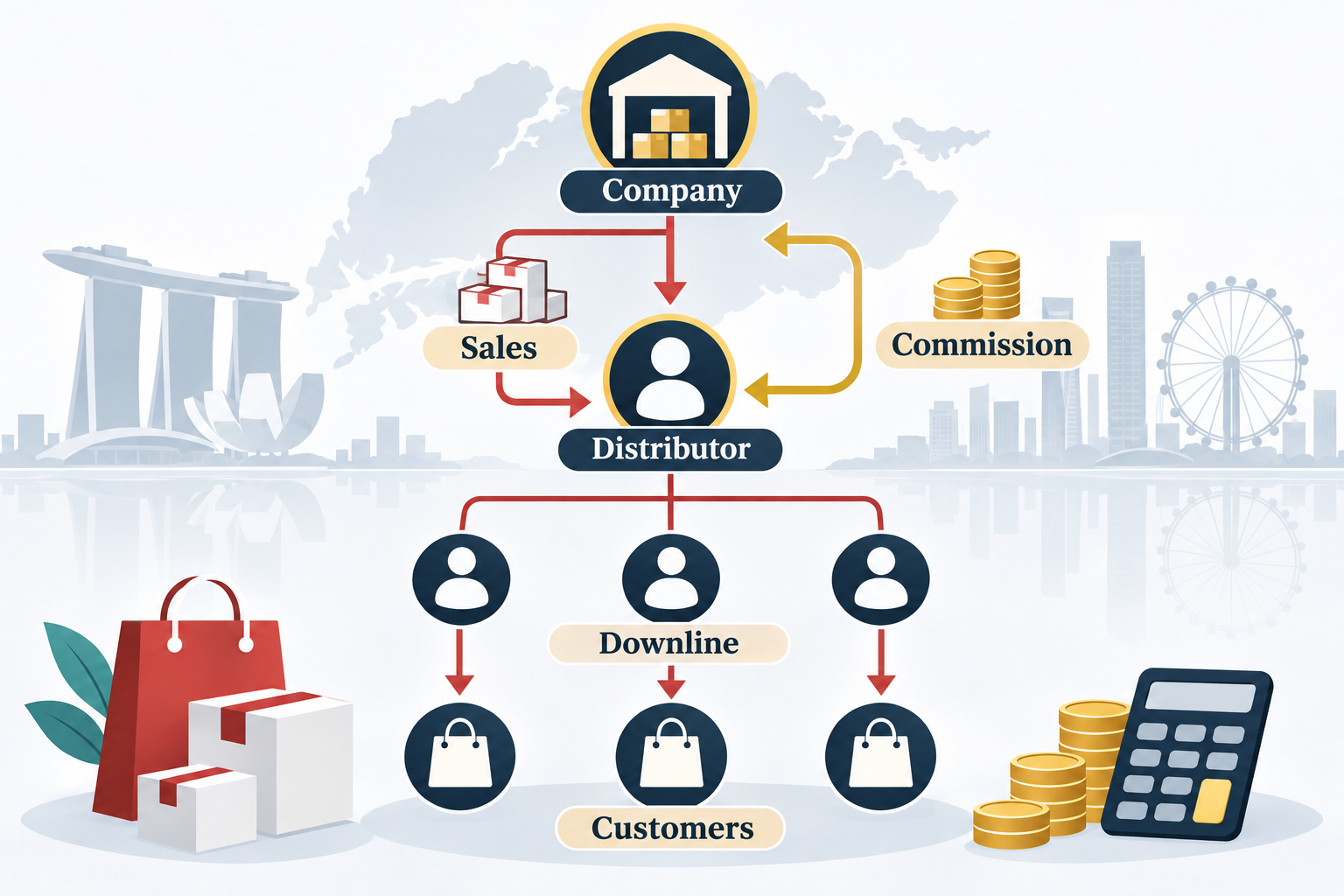
The arrangement typically involves three roles:
-
Company: Supplies products, manages orders and establishes the compensation structure.
-
Distributor: Markets products and earns eligible sales commissions.
-
Sales network: Includes other distributors whose qualifying sales may contribute to commission calculations.
The model is also called network marketing. However, direct selling is a broader category that includes single-level arrangements without recruitment-based networks.
Understanding upline, downline and sales volume
Several terms appear repeatedly in MLM compensation plans. Upline refers to the distributor who recruited a participant and other distributors above them in the network. Downline describes the distributors recruited beneath a participant, including people recruited by those distributors.
Sales volume measures eligible product transactions. Companies may express this through monetary sales, points or another internal measurement system.
For example, Distributor A sells products directly to customers. Distributor A also introduces Distributor B, who develops a separate customer base.
Under a qualifying compensation arrangement, Distributor A may receive commissions linked to Distributor B’s eligible product sales. The commission cannot arise merely because Distributor B joined. This distinction matters in Singapore, where the relevant exclusions prohibit benefits based simply on introducing additional participants.
How MLM distributors earn commissions
Compensation plans differ, but common arrangements include direct retail commissions, sales-volume bonuses and payments linked to qualifying network sales.
Consider a hypothetical example:
A distributor sells S$1,000 worth of products and receives a 20% sales commission. That produces S$200 before expenses.
If the compensation plan also permits a 5% override on S$2,000 of qualifying sales generated by another distributor, the additional commission is S$100.
The distributor’s total gross commission becomes S$300.
However, these figures do not represent guaranteed earnings. Actual payments depend on contract terms, customer transactions and applicable legal requirements.
Network commissions should not be confused with passive income. Distributors may need to find customers, provide support and maintain sales activity. Their earnings may decline when customers stop buying.
Is Multi-Level Marketing Legal in Singapore?
Singapore has a stricter legal framework than many countries. The Multi-Level Marketing and Pyramid Selling (Prohibition) Act 1973 generally makes it unlawful to promote or participate in a multi-level marketing or pyramid selling scheme.
However, the legislation allows specified arrangements to be excluded from the prohibition. The Ministry of Energy, Trade and Industry explains that these exclusions cover qualifying insurance and financial advisory arrangements, master franchises and direct-selling structures that satisfy the applicable conditions.
Which MLM arrangements are permitted?
The Excluded Schemes and Arrangements Order sets out the relevant requirements. For qualifying direct-selling arrangements, important safeguards include:
-
No mandatory participation payment. Participants cannot be required to provide a benefit or purchase products to join, apart from permitted demonstration materials sold at no more than cost.
-
Sales-based compensation. Benefits must arise from qualifying product or service transactions rather than recruitment alone.
-
Accurate earnings records. Promoters making earnings representations must maintain audited records covering specified earnings measures.
-
No misleading promotion. Promoters must avoid false claims, material omissions and prohibited pressure tactics.
-
Full refund or buy-back protection. Participants must receive the guarantee required by the exclusion, including written information on how to exercise it.
What are the penalties for illegal MLM activities?
Under the Act, promoting or participating in a prohibited scheme can result in:
-
A fine of up to S$200,000.
-
Imprisonment for up to five years.
-
Both penalties.
The legislation also provides for additional financial penalties in certain circumstances. Importantly, individuals who participate in prohibited schemes may face legal consequences even when they did not establish the business.
We recommend seeking independent legal advice if a company’s compliance explanation is unclear. A recruiter’s assurance that the business is legitimate does not establish compliance.
Does an MLM company need a special licence?
Singapore does not issue a general special MLM licence for businesses operating under the applicable exclusions.
A qualifying business must satisfy the relevant legal conditions. Certain regulated activities, including insurance and financial advisory services, have separate licensing requirements.
A registered company is not automatically authorised to operate any compensation structure it chooses. This distinction is critical when assessing recruitment offers.
Multi-Level Marketing vs Pyramid Schemes: What’s the Difference?
Both multi-level marketing and pyramid schemes can involve networks of participants. Their economic incentives and legal treatment can differ significantly.
The central question is what participants must do to receive compensation.
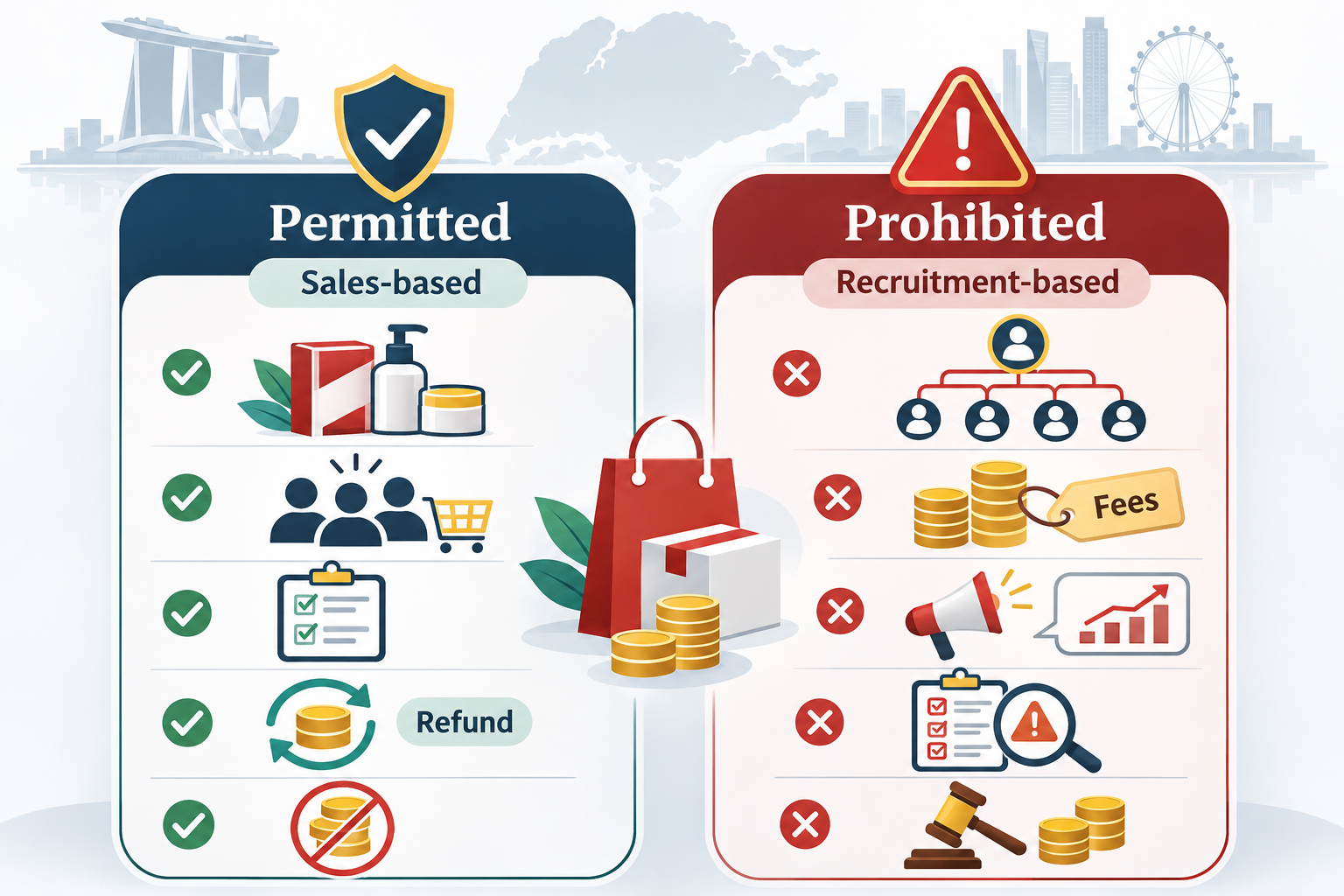
| Factor | Qualifying direct-selling arrangement | Prohibited pyramid-style arrangement |
|---|---|---|
| Main activity | Selling genuine products or services | Expanding participation and funding the scheme |
| Joining payment | No compulsory payment, subject to permitted exceptions | Often requires fees or compulsory purchases |
| Commission source | Qualifying product or service sales | Recruitment or payments linked to new participants |
| Product demand | Supported by genuine customer purchases | May depend heavily on purchases by participants |
| Earnings claims | Subject to applicable recordkeeping and conduct requirements | Often emphasise rapid or unusually high earnings |
| Legal position | Must satisfy the relevant exclusion | Prohibited under Singapore law |
A company can sell genuine products and still operate an unlawful arrangement. Product availability alone does not prove legality. Likewise, earning commissions from multiple sales levels is not automatically prohibited when the arrangement satisfies the relevant exclusion. Singapore’s rules focus on the actual structure and conditions.
Why recruitment-driven schemes eventually struggle
Suppose each participant must recruit five additional members to qualify for substantial earnings. After five recruitment levels, the network would require:
| Level | New participants |
|---|---|
| 1 | 5 |
| 2 | 25 |
| 3 | 125 |
| 4 | 625 |
| 5 | 3,125 |
This hypothetical network requires 3,905 participants across five levels. Continued expansion becomes increasingly difficult because the supply of potential recruits is finite.
When rewards depend on recruitment payments, later participants can struggle to recover their initial spending. The presence of expensive starter packages, mandatory purchases and aggressive recruitment targets therefore deserves close examination.
How Much Can You Really Earn From Multi-Level Marketing?
There is no reliable universal earnings figure for every MLM company operating internationally or under Singapore’s exclusions. Compensation varies according to actual sales, commission rates, expenses and the number of active customers. However, independent research highlights the importance of assessing typical participant outcomes instead of relying on exceptional success stories.
What independent earnings research shows
In September 2024, the US Federal Trade Commission (FTC) published findings from its review of 70 publicly available MLM income disclosure statements. The review found that:
-
Many participants received no payments from their MLM companies.
-
The vast majority received US$1,000 or less annually.
-
Most reviewed disclosures excluded certain participants with little or no income.
-
Many disclosures did not account for expenses.
-
High earnings among a small group of participants received disproportionate attention.
The figures represent the companies examined in the United States and should not be presented as Singapore-specific earnings statistics. These findings also explain why gross commission figures can mislead prospective distributors.
Someone receiving S$500 in monthly commissions may appear successful. If maintaining those commissions costs S$600, the activity produces a monthly loss.
Why top-earner testimonials are unreliable benchmarks
Recruitment presentations sometimes feature distributors receiving substantial bonuses, luxury trips or executive-level incomes. Such stories may describe actual outcomes, but they do not necessarily represent typical participants.
A distributor who joined several years earlier may have an established customer base and a large sales network. New participants cannot assume they will reproduce those conditions.
We recommend requesting figures showing:
-
The total number of participants during the reporting period.
-
Median earnings, not just average earnings.
-
Participants who received zero commissions.
-
Earnings by distributor level.
-
Typical operating expenses and net profit.
-
The proportion of participants who remained active.
Singapore’s relevant direct-selling exclusion includes audited recordkeeping requirements covering maximum, minimum, median, average and mode benefits when earnings representations are made. If a promoter highlights impressive earnings but refuses to explain the underlying figures, consider that a serious warning.
The Hidden Costs of Joining an MLM Business
Flexible working hours do not eliminate business expenses. Even permitted direct-selling arrangements may involve operating costs that participants choose to incur. These can reduce profitability considerably.
Product purchases and inventory
Some distributors purchase products to demonstrate their features or supply customers. The financial risk increases when products have limited shelf lives, uncertain demand or restrictive return conditions. A distributor holding unsold skincare products, for example, may struggle to recover the purchase cost if customer demand falls.
Training and promotional activities
Participants may spend money on training events, presentations, promotional materials or online tools. Travel costs can also accumulate when meetings and recruitment activities take place regularly. Before paying for optional programmes, determine whether they directly improve customer sales or mainly encourage deeper involvement in the network.
Digital marketing expenses
Online selling introduces additional costs. Distributors may pay for social media advertising, websites, product photography or marketing software.
Advertising can generate enquiries without producing purchases. Its profitability depends on the relationship between acquisition costs and actual sales margins. For example, spending S$100 on advertising to generate S$80 in commissions creates a loss before other expenses.
The value of your time
Time is another important consideration. A distributor spending 40 hours monthly on customer enquiries, content creation, deliveries and sales meetings should calculate earnings against that commitment.
S$200 in net monthly profit across 40 hours equals S$5 per hour. Although this is not an employee wage calculation, it provides a useful comparison with other income opportunities.
Buy-Back and Refund Rules: What Singapore Distributors Should Know
The original article’s claim that companies should buy back at least 80% of unsold inventory is not the applicable Singapore legal requirement. For arrangements relying on the relevant direct-selling exclusion, the law requires a full refund or buy-back guarantee exercisable on reasonable commercial terms within a period of at least 60 days from distribution.
Participants must also receive written information explaining the guarantee and how to exercise it. This protection helps reduce the financial exposure associated with unsold products.
What to check in the refund policy
Before purchasing inventory, request the full written policy and verify:
-
Refund amount: Does the policy provide the full refund or buy-back required by the relevant exclusion?
-
Eligibility period: Can the guarantee be exercised for at least 60 days?
-
Product conditions: What reasonable commercial conditions apply to returned goods?
-
Refund procedure: Where must products be returned and what documents are required?
-
Processing arrangements: How and when will the company issue the refund?
We recommend retaining purchase invoices, return instructions and correspondence. A company offering a shorter return period or refusing to explain its guarantee deserves further scrutiny. Do not assume that a general retail return policy satisfies the specific requirements for a qualifying direct-selling arrangement.
How to Evaluate a Multi-Level Marketing Company Before Joining
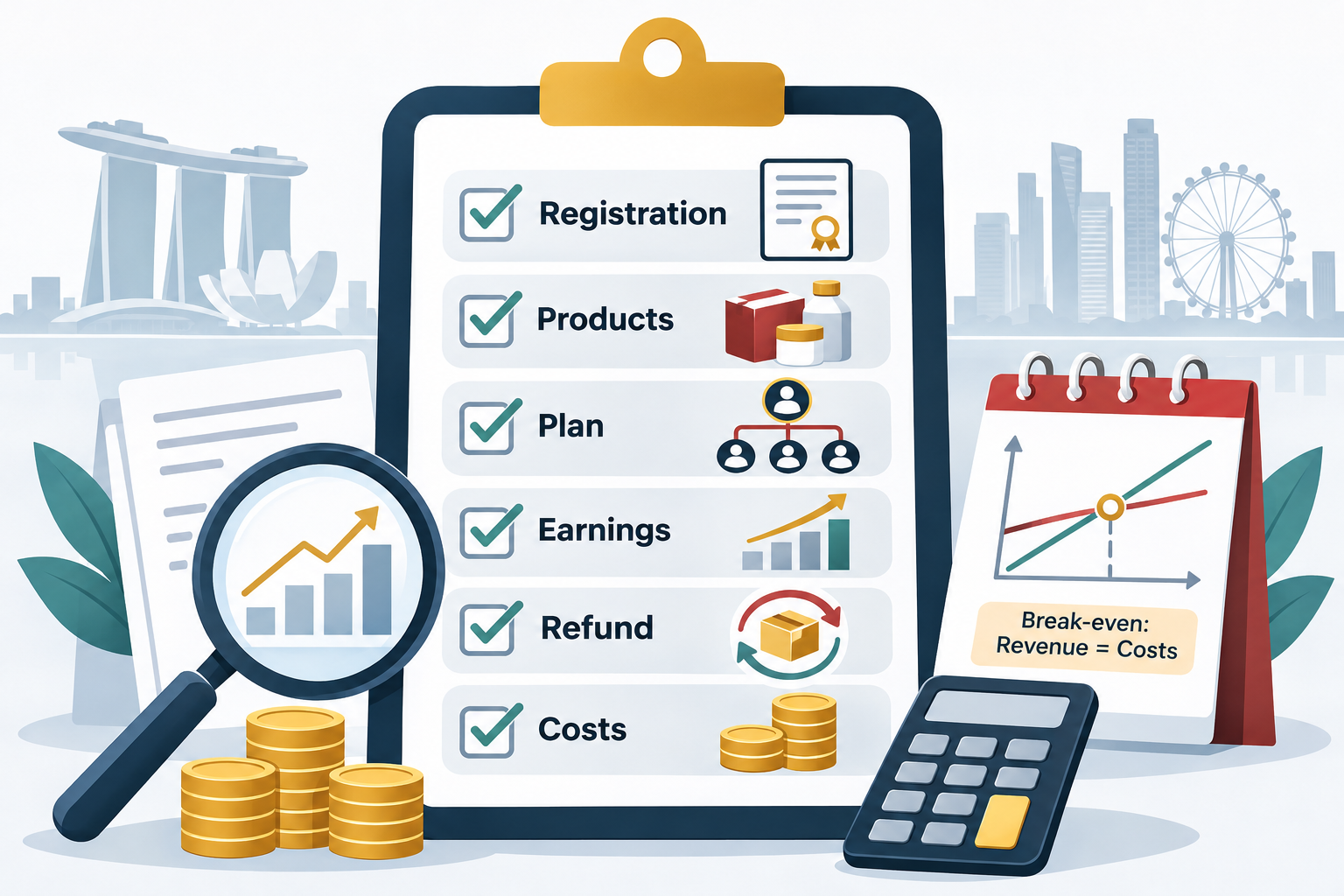
We recommend completing the following due-diligence checks before signing an agreement or spending money.
Step 1: Verify the company’s registration
Search for the business through the ACRA Bizfile portal. The Accounting and Corporate Regulatory Authority (ACRA) provides an entity search that can help confirm a company’s registration status and registered address. Use the business name or Unique Entity Number (UEN) supplied by the promoter.
ACRA also explains how business information can support basic risk assessments. However, a live registration status does not prove that the MLM compensation arrangement complies with Singapore law.
Step 2: Examine the products and customers
Ask whether customers would purchase the products without joining the network. Compare prices against similar products from established retailers. A genuine product should have practical value independent of the income opportunity.
Look for repeat purchases by actual customers. Be cautious when most sales discussions focus on recruiting distributors rather than meeting consumer needs.
Step 3: Study the compensation plan
Request the complete compensation plan in writing. Identify exactly which transactions produce payments and whether recruitment triggers rewards.
Check how sales volume, distributor levels and commission eligibility are calculated. Pay particular attention to arrangements that encourage participants to purchase products primarily to maintain their commission status. If the recruiter cannot explain how earnings arise from genuine sales, do not rely on verbal assurances.
Step 4: Request audited earnings information
Ask for evidence supporting the earnings claims presented during recruitment. Review the reporting period, participant numbers and typical payouts.
Check whether figures include participants earning nothing. Also determine whether quoted amounts represent gross commissions or net profit after expenses.
Step 5: Review mandatory and optional payments
Distinguish between permitted demonstration materials and other payments. Under the relevant Singapore exclusion, participation cannot require purchasing products or providing benefits, apart from the specified exception for demonstration equipment or materials. Question any arrangement requiring expensive inventory, subscription fees or training packages as a condition of joining.
Step 6: Assess customer acquisition costs
A viable selling activity needs customers who can be reached profitably. Estimate how many genuine purchases you can generate through your existing network and marketing channels.
Avoid assuming that social media followers automatically become customers. Calculate the cost of advertising, fulfilment and customer support before estimating profits.
Step 7: Speak with former distributors
Current members may have incentives to present the business favourably. Former participants can provide another perspective.
Ask why they left, whether they recovered their costs and how the company handled unsold inventory. Individual experiences cannot establish company-wide performance, but consistent complaints can identify issues worth investigating.
The MLM Legitimacy and Profitability Checklist
Use this checklist to organise your findings.
| Assessment | Question | Expected evidence |
|---|---|---|
| Legal compliance | Does the arrangement meet an applicable exclusion? | Written explanation supported by the legal requirements |
| Recruitment | Are rewards independent of recruitment alone? | Detailed compensation plan |
| Participation | Are compulsory joining payments prohibited as required? | Written joining terms |
| Product demand | Do genuine customers purchase the products? | Verifiable sales information |
| Earnings | Are claims supported by appropriate audited records? | Relevant earnings documentation |
| Refund protection | Is the required guarantee provided? | Written refund or buy-back policy |
| Profitability | Can realistic sales cover all expenses? | Cash-flow calculations |
| Transparency | Can the business explain its operations clearly? | Contracts and supporting documents |
Do not use a total score as proof of legality. A scheme may be prohibited even if several commercial indicators appear favourable.
Treat a failure to satisfy an applicable legal requirement as a reason to stop and seek qualified advice. If the arrangement appears legally compliant but the expected profit remains small, compare it with other business opportunities before committing.
Worked Example: Calculating MLM Profit and Loss
Consider a hypothetical distributor evaluating a six-month selling opportunity. The distributor purchases demonstration materials and products while spending additional money on marketing.
Assume the following figures:
| Expense | Six-month amount |
|---|---|
| Initial materials and purchases | S$300 |
| Additional product purchases | S$900 |
| Marketing and transport | S$180 |
| Total cash outflow | S$1,380 |
| Sales receipts and commissions | S$700 |
| Cash shortfall before inventory adjustments | S$680 |
The distributor has spent S$1,380 and received S$700. However, the S$680 difference is a cash-flow shortfall, not necessarily the final accounting loss.
Unsold inventory may retain value, and qualifying returns may produce refunds. The calculation should also distinguish stock purchased for resale from personal consumption. If the distributor later receives a S$500 refund, the remaining cash shortfall falls to S$180.
This example is illustrative. The purchases are not presented as compulsory joining conditions, and actual refund eligibility depends on the applicable terms.
Calculating the break-even point
The next step is determining how much additional sales activity is needed.
Suppose a distributor has S$300 in fixed operating costs and earns a 20% contribution margin on sales after variable costs.
The break-even calculation is:
The result is S$1,500 in sales.
A distributor who cannot reasonably generate that sales volume should reconsider the business plan.
We recommend calculating conservative, expected and optimistic scenarios. Use actual customer demand rather than recruitment projections.
Common Multi-Level Marketing Red Flags
Certain practices deserve immediate attention, especially when several appear together.
Promises of easy or guaranteed income
- Claims that anyone can earn substantial income with minimal effort should be questioned.
- Selling requires customers, repeat purchases and ongoing work.
Request evidence supporting any earnings representation.
Pressure to join immediately
- Limited-time bonuses and urgent recruitment deadlines can discourage careful evaluation.
- A legitimate opportunity should withstand reasonable scrutiny.
Avoid transferring money before reviewing the contract and relevant legal requirements.
Excessive emphasis on recruitment
- Recruitment may form part of a sales network, but rewards under the relevant direct-selling exclusion cannot arise merely from introducing participants.
- Be wary when presentations spend little time discussing products or customers.
Expensive products with weak demand
- Products may exist primarily to support payments circulating within a network.
Compare their price, quality and usefulness with alternatives. If the strongest reason to purchase is maintaining eligibility for commissions, investigate further.
Unclear refund procedures
- Written refund guarantees are particularly important when distributors purchase inventory.
- Refusal to provide the policy should stop the evaluation.
The same applies when promises made during recruitment contradict the written agreement.
Is Multi-Level Marketing Suitable for Part-Time Income?
A qualifying direct-selling arrangement may offer flexible sales work, but suitability depends on the participant’s circumstances. Working professionals should consider their available hours, sales skills, customer access and financial tolerance.
People with an existing customer base may find product distribution easier than someone starting without an audience. However, established relationships do not guarantee purchases.
We recommend comparing MLM participation against other income models.
| Income model | Main activity | Primary challenge |
|---|---|---|
| Qualifying network marketing | Selling products through a distributor network | Commission structure and customer demand |
| Affiliate marketing | Referring buyers through tracked links | Traffic generation and conversion |
| Freelancing | Providing services directly to clients | Finding and retaining clients |
| Conventional retail | Purchasing and reselling products | Inventory, pricing and operating costs |
These options carry different risks and obligations.
Someone experienced in marketing may prefer offering services directly to businesses. Another person may prefer product sales without managing a downline.
The better choice depends on realistic profitability, legal compliance and personal capabilities.
Tax Considerations for MLM Distributors in Singapore
Income earned through regular product sales or commission activities may be taxable. The Inland Revenue Authority of Singapore (IRAS) identifies direct sellers and commission agents among individuals who may be considered self-employed. Self-employed individuals generally need to calculate their business income and report it according to applicable tax-filing requirements.
Participants should maintain records of:
-
Sales receipts and commission payments.
-
Purchases made for business purposes.
-
Advertising, transport and other relevant expenses.
-
Refunds, returned products and remaining inventory.
Not every expense is necessarily tax-deductible. IRAS rules determine allowable business expenses.
A distributor operating part-time should also assess whether income from the activity must be reported alongside employment income. These obligations are separate from determining whether the underlying sales arrangement is lawful.
What to Do If You Suspect an Illegal MLM Scheme
If a recruitment offer appears unlawful, avoid making further payments or recruiting other people. Preserve evidence before contacting the relevant authorities. Useful records include the compensation plan, payment receipts, recruitment messages, presentation materials and written earnings promises.
Report suspected illegal activities
Singapore’s Commercial Affairs Department (CAD) investigates suspected pyramid selling offences. The Ministry advises people who suspect breaches of the MLM legislation to lodge a police report. You can find reporting information through the Singapore Police Force.
For consumer disputes involving purchases, refunds or business practices, the Consumers Association of Singapore (CASE) may provide relevant consumer assistance. However, a consumer complaint is not a substitute for reporting suspected criminal activity.
Do not assume that an informal refund request will protect you from further losses. Where substantial money is involved, consider independent legal advice.
Frequently Asked Questions
Is multi-level marketing legal in Singapore?
Singapore generally prohibits multi-level marketing schemes under the Multi-Level Marketing and Pyramid Selling (Prohibition) Act. Certain insurance, financial advisory, franchise and direct-selling arrangements qualify for exclusions when they satisfy the applicable requirements.
Is multi-level marketing the same as a pyramid scheme?
Not necessarily. Qualifying direct-selling arrangements can compensate participants for genuine sales activity, while prohibited schemes may reward recruitment or impose unlawful participation conditions. Singapore’s legal exclusions determine which arrangements are permitted.
Do most people make money from multi-level marketing?
The FTC’s review of 70 MLM income disclosures found that most participants in the reviewed companies received US$1,000 or less annually, often before expenses. These findings are not Singapore-specific, so prospective distributors should request earnings evidence from the company they are evaluating.
What is the difference between an upline and a downline?
An upline consists of the distributor who recruited you and the distributors above that person. A downline includes distributors recruited beneath you, directly or through other participants.
Can MLM companies charge joining fees in Singapore?
Under the relevant direct-selling exclusion, participants cannot be required to provide benefits or purchase products to join, apart from permitted demonstration materials sold at no more than cost. Other excluded arrangements have their own applicable conditions.
Does an MLM company have to buy back unsold inventory?
For arrangements relying on the relevant direct-selling exclusion, a full refund or buy-back guarantee must be exercisable on reasonable commercial terms for at least 60 days from distribution. Participants must also receive written information explaining the guarantee.
Can I participate in multi-level marketing part-time?
Part-time participation does not remove Singapore’s legal requirements. A person considering a qualifying arrangement should evaluate customer demand, operating expenses, earnings evidence and any tax obligations.
How can I check whether an MLM company is legitimate?
Start by verifying its registration through ACRA Bizfile, then examine its business structure against Singapore’s MLM legislation. Check the compensation plan, joining requirements, earnings records and refund terms, and obtain legal advice where necessary.
Is Multi-Level Marketing Worth Joining in Singapore? Make the Numbers and Legal Requirements Decide
Multi-level marketing can appear attractive because of flexible working arrangements and potential sales commissions. However, Singapore’s strict legislation makes legal compliance the first consideration.
Before joining, confirm that the arrangement qualifies for an applicable exclusion. Review how commissions are generated, examine the required refund protections and request evidence supporting earnings claims. Then calculate the income you could realistically earn after expenses.
Our recommendation is straightforward: do not join an arrangement you cannot independently evaluate. If the company cannot explain its legal position, provide transparent financial information or demonstrate genuine customer demand, the potential earnings do not justify the uncertainty.
For businesses assessing sustainable customer acquisition, MediaOne’s digital marketing services provide a starting point for exploring search visibility, customer acquisition and measurable marketing performance.
The strongest business opportunity is one built on lawful operations, genuine customer demand and a financial model that remains viable without continuous recruitment.