Last month’s ad spend and confirmed enrolments belong on the same page for a Singapore tuition centre. Google Ads may report form submissions, Instagram may show messages, and the front desk may record trial bookings that never became customers. A marketing plan connects those records to a named target, an affordable budget and a decision date.
At MediaOne, we begin by checking the sales and enquiry definitions before recommending channels. Our SEO, paid media, content and lead generation specialists work from the same commercial goal, then assign actions to people who can deliver them. For a lean team, we favour a one-page Goal-Tactic-Budget-Check sheet over a report that is rarely opened. After reading, you can identify your best customers, choose channels, calculate spending limits and review results each month.
Key Takeaways
- Start with a commercial outcome such as qualified enquiries, sales or repeat purchases, then assign a deadline and owner.
- Record each tactic on a one-page Goal-Tactic-Budget-Check sheet so spending decisions can be traced to a goal.
- Set acquisition budgets from affordable customer costs and margins, including the cost of creative work and staff time.
- Select channels based on buyer behaviour and team capacity, not platform popularity or follower counts.
- Review results monthly, reset priorities quarterly and check marketing data against real sales records.
Keep Strategy, Plans and Campaigns Distinct
A strategy states which customers the business wants and why they should choose it. A marketing plan turns that direction into a budget, activities, accountable people and review dates. A campaign is a time-limited piece of execution within that plan.
| Decision Level | Purpose | Illustrative Singapore Example |
|---|---|---|
| Strategy | Set the audience and competitive position | A cake shop focuses on reliable office celebration orders in the CBD. |
| Plan | Assign goals, spending and responsibilities | The owner funds local search and email, with monthly checks on corporate orders. |
| Campaign | Run a defined promotion | A six-week launch promotes a corporate cake selection. |
That difference becomes useful when an enthusiastic colleague proposes a new platform. Before approving it, we ask which customer group it serves, which existing activity would lose budget and what result would justify keeping it. Our Singapore digital marketing strategy framework covers the longer-term choices behind these decisions.
Build a One-Page Decision Sheet
We recommend a one-page Goal-Tactic-Budget-Check sheet, or GTBC, before writing a long document. It forces the team to connect the outcome, work, cost and review method. Use a marketing plan with supporting pages only when a complex operation needs more detail, such as separate product lines, regional markets or approval stages.
| GTBC Field | What to Record | Illustrative Catering Business |
|---|---|---|
| Goal | Measurable outcome and deadline | Increase qualified corporate enquiries from 20 to 30 a month by the end of the quarter. |
| Audience | Buyer and purchasing need | Singapore office administrators ordering team meals. |
| Tactic | Activity linked to the goal | Improve local search pages and test high-intent search ads. |
| Budget | Total spend, including production | S$1,500 a month, subject to the firm’s margins and cash flow. |
| Owner | Person who can act on results | Marketing lead, supported by the sales manager. |
| Check | Metric, source and review date | Qualified enquiries from CRM records, reviewed monthly. |
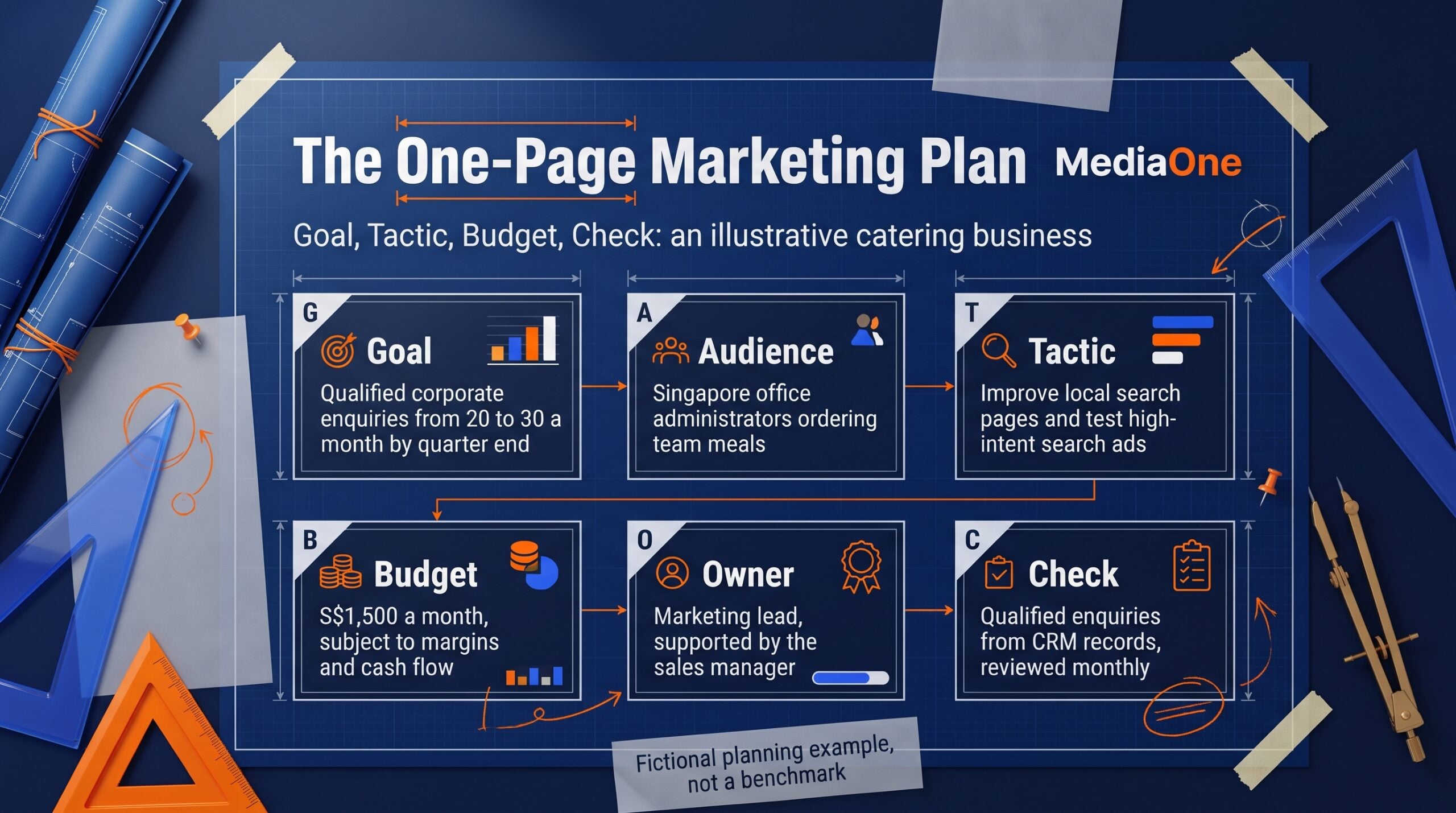
These amounts and goals are fictional planning examples, not MediaOne client results or Singapore benchmarks. Add a short executive summary for leadership, but write it last after the budget and actions are settled. A small team can keep its entire operating plan in this sheet and one supporting calendar.
Set Goals From Revenue and Margins
Set one primary SMART goal and at most two supporting goals. Each should be specific, measurable, achievable, relevant and time-bound. ‘Increase Instagram followers’ is weak if the business needs bookings. ‘Increase qualified renovation enquiries from 15 to 25 per month by 30 June’ gives the team a clearer decision, provided the target is grounded in current performance and sales capacity.
We begin by separating activity from business outcomes. Reach, impressions and follower growth can describe awareness, but purchases, qualified leads, repeat orders and gross profit are closer to the owner’s actual objective. Our marketing objectives and SMART goal guidance can help teams state a target and the measures behind it.
Check the numbers with finance before promising growth. A clinic with full appointment books may need higher-value bookings or retention before more enquiries. A retailer with slim margins may need to improve conversion or average order contribution before buying additional traffic. Record the baseline, target, deadline and person accountable for each goal.
Choose Buyers and a Defensible Offer
Use order history, enquiry notes and customer conversations to identify who buys, what problem prompts the purchase and what makes the offer credible. Build two or three buyer profiles only if they reflect different buying decisions. A generic persona such as ‘young professionals’ is less useful than ‘HR coordinators arranging workplace health checks for teams’.
A quick SWOT review can expose weak assumptions. Note one genuine strength, one constraint, one opportunity and one external threat. For example, a Singapore catering company may have a reliable weekday delivery operation but no staff to manage live chat. That constraint should rule out an unstaffed chat campaign until the business changes its processes.
Check the four Ps together: product, price, place and promotion. A premium service should explain the evidence behind its price, such as response times or specialist knowledge, instead of leading every advertisement with a discount. Promotions may still be useful when they protect margin and match the audience.
Do not apply the 80/20 rule as a claim that exactly 20% of customers deliver 80% of revenue. Inspect your own transaction data, repeat purchases and profitability first. The marketing plan should reflect your best customer segments, even if the actual distribution is very different.
Price the Work Before Choosing Channels
Estimate how many new customers the business needs and the most it can sustainably spend to acquire each one. This is the starting calculation for a marketing plan, followed by a check on operating margin and non-media costs.
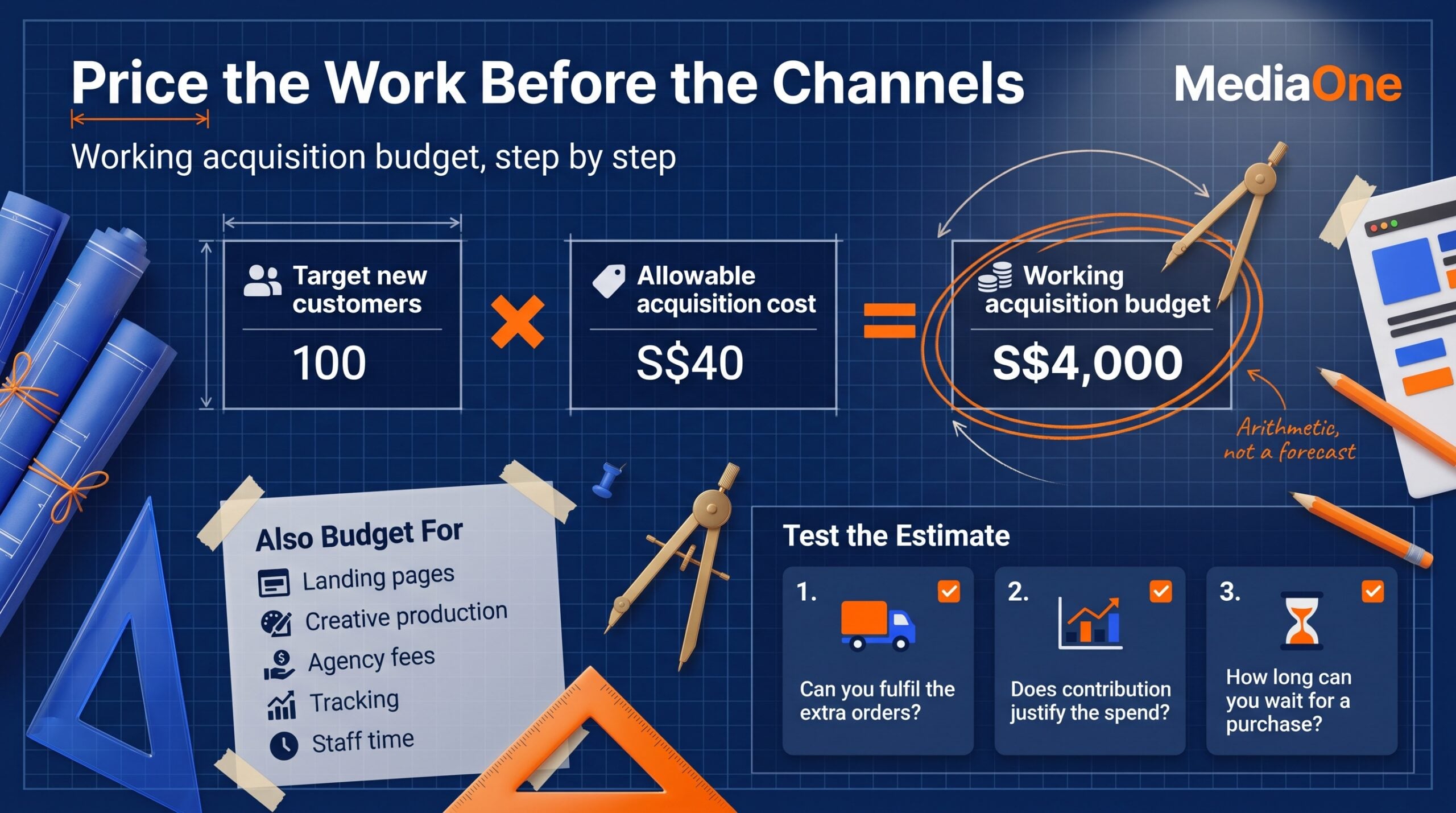
Working acquisition budget = Target new customers × Allowable customer acquisition cost
For example, 100 new customers at an affordable acquisition cost of S$40 each imply a working acquisition budget of S$4,000. This is arithmetic, not a forecast of customers delivered. The final spend may also need to cover landing pages, creative production, agency fees, tracking and staff time.
We recommend testing the estimate against three questions. Can the business fulfil the additional orders? Does the expected contribution after direct costs justify acquisition spend? How long can it wait for a purchase or repeat order? A business with long payment cycles should also plan for cash flow.
Avoid a universal rule that every business must reserve 10% for experiments. Keep a test allowance only if the core channels and essential production work are funded first. If the available budget cannot support reliable measurement across several platforms, start with fewer channels and make them work properly.
Match Channels to Buyers and Capacity
Choose channels according to customer intent, the stage of the buying process and who can operate them. Search advertising may capture people ready to make enquiries, while educational content can help buyers comparing options. Social media can create demand and support relationships, but a large audience does not automatically produce qualified sales.
| Channel Type | Suitable Jobs | Main Trade-Off |
|---|---|---|
| Paid | Search ads, paid social and retargeting | Spending can bring immediate exposure, but paid traffic usually falls when ads stop. |
| Owned | Website content, landing pages and consent-based email | Greater control, but creation and maintenance take time. |
| Earned | Referrals, independent coverage and customer reviews | Can support trust, but publication and timing are outside your control. |
We often recommend combining SEO support for high-intent searches with Google Ads campaign management when a business needs to serve existing demand while building its own search presence. For a visually driven consumer offer, social media marketing services may deserve a larger role. These are channel options, not a recommendation that every SME should buy all three.
Content earns its budget when it answers a real buyer question or supports conversion. Our content marketing servicesconnect useful information with search intent and sales needs. Email can support retention, but only when the list is suitable for the purpose and messages are planned around customer value.
For a B2B supplier using phone calls, forms and WhatsApp, link the campaign to actual sales follow-up. Our lead generation services cover landing pages, nurturing and CRM handovers. A button click is an initial signal, not automatically a qualified lead.
Track Decisions Without Losing Customer Trust
A useful dashboard starts with consistent definitions. Agree with sales on what counts as a qualified enquiry, how duplicates are handled and when an opportunity becomes a customer. Assign each KPI a data source, an owner and a review date. We usually start with three to five meaningful measures instead of presenting every number available from an advertising platform.
| Goal | Primary KPI | Supporting Check |
|---|---|---|
| Win new customers | New paying customers and acquisition cost | Qualified leads and sales conversion rate |
| Grow ecommerce orders | Revenue and contribution margin | Conversion rate and average order value |
| Improve retention | Repeat-purchase rate | Customer value and email engagement |
| Increase qualified enquiries | Accepted sales leads | Source quality and response time |
GA4’s Traffic acquisition report helps identify which channels bring sessions to a website. It does not replace records of paid invoices, booked appointments or accepted opportunities. Platform attribution and reporting windows can differ, so use the business’s sales system as the reference for confirmed revenue.
Singapore businesses must also check how they use personal data in outreach and measurement. The PDPC’s Do Not Call guidance explains obligations relevant to specified marketing messages sent to Singapore telephone numbers. Review other applicable PDPA obligations for email lists, customer profiles and tracking. Do not upload personal contact data into reporting tools without a proper basis and suitable controls.
Put MediaOne’s People Behind the Process
MediaOne was founded in Singapore in 2013 as a specialist search agency. We have since expanded into paid media, social, content, web and AI-supported marketing. Our stated values include accountability, transparency, continuous improvement and respect for people. Our team culture encourages campaign reviews and knowledge sharing across disciplines. For planning work, those values mean that clients should know who approved a budget, what was measured and why a campaign was changed.
Our CEO and principal SEO consultant, Tom Koh, brings search experience to the agency’s leadership. Our published work includes Canon Singapore, illustrating the mix of specialist SEO and broader business needs our teams handle. A published client review from Nicholas Ng also recognises Delphine, Desiree, Celesta and Eugene for their responsiveness and support. We take that feedback seriously because a plan is only useful when people can explain it and act on it.
MediaOne received Bronze for Independent Agency of the Year in the 2025 Agency of the Year Singapore results. That recognition is a record of the agency’s work, not proof that any individual budget recommendation will succeed.
Our proprietary Digimetrics.ai technology supports marketing research and performance diagnostics. We still rely on specialists to review assumptions, customer needs and campaign data before deciding where money goes. You can read more about MediaOne’s history, people and values. We recommend the same accountability for a business working with its first marketer as for one managing several agencies.
Review Monthly and Reset Priorities Quarterly
Book the first review before launching a campaign. The monthly meeting should compare results with the agreed baseline and record one decision for each active channel. Every quarter, revisit customer demand, costs, competitive changes and staff capacity. The marketing plan should be updated when evidence changes, not preserved simply because it was approved in January.
Keep leadership reporting short. A useful update states the goal, actual results against target, the likely drivers and the action needed. In an illustrative case, a campaign might deliver 12 qualified enquiries against a target of 20. The response is to inspect lead quality, sales follow-up and search intent before buying more impressions.
Stop tactics without an owner or a commercial purpose. Do not automatically scale an advertisement because its platform reports a cheap lead. A sales team may be rejecting those enquiries, or the business may lack capacity to fulfil them. Equally, do not cut a slower SEO or content programme solely because its first-month sales are lower than paid search.
Our preferred rhythm is a concise monthly performance meeting and a quarterly decision on budget allocation. Record what changed, who approved it and when you will judge the result. That gives the next review a genuine record of learning.
Put Your First 90 Days Into Action
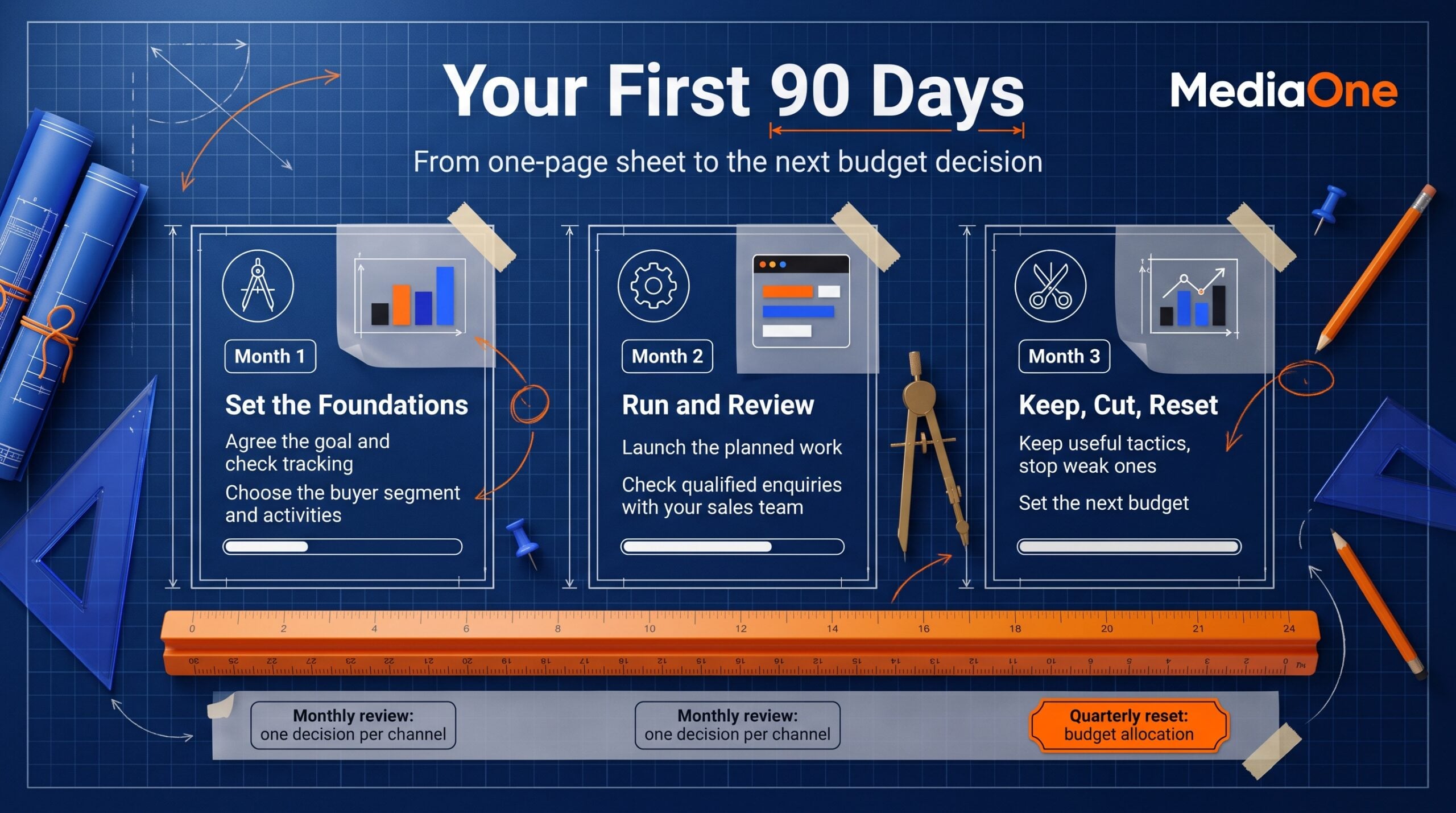
Start this week with the one-page sheet. In the first month, agree the goal, check tracking, select the buyer segment and choose a realistic set of activities. In the second, run the work and review qualified enquiries or sales with the people handling customers. In the third, keep the useful tactics, stop weak ones and set the next budget.
If you need an outside review of your priorities, MediaOne can help assess channel fit, measurement and spending through our digital marketing services in Singapore. Bring your current numbers and the decision you need to make, and we can discuss a practical starting point.
Frequently Asked Questions
How long should the document cover?
An annual direction with quarterly priorities is a sensible starting point for many Singapore businesses. A launch or seasonal retailer may need shorter campaign cycles, while a business with a long sales cycle may track outcomes over several quarters. Record review dates in advance and keep the operating sheet current even when the broader strategy stays the same.
How is strategy different from execution?
Strategy identifies the customers you want, the value you offer and the reason to compete in a particular market. Execution turns those decisions into campaigns with budgets, owners and deadlines. A six-week search promotion is an activity within the broader programme. When an activity cannot be linked to a stated audience and goal, reconsider it before spending.
What budget suits a small Singapore business?
There is no reliable fixed percentage for every SME. Estimate the number of new customers needed, the acquisition cost your margin can support and the expense of producing and managing campaigns. Include the sales team’s capacity and cash-flow timing. Start with channels you can measure properly, then adjust the amount using qualified leads, purchases and contribution margin.
How often should the team review progress?
Review active channel performance monthly and revisit major budget choices quarterly. A high-spend campaign may need more frequent operational checks, especially if tracking fails or acquisition costs change sharply. The review should end with a named action, owner and date. Recording why a tactic was kept, changed or stopped makes the next decision easier to defend.
Which KPIs should the owner track?
Choose measures tied to the commercial objective, such as qualified enquiries, new customers, revenue, repeat orders or allowable acquisition cost. Use impressions and follower growth as supporting indicators when they help diagnose performance. Check the same definitions each month and compare advertising dashboards with invoicing or CRM records. A short, trusted scorecard beats a crowded report of disconnected metrics.