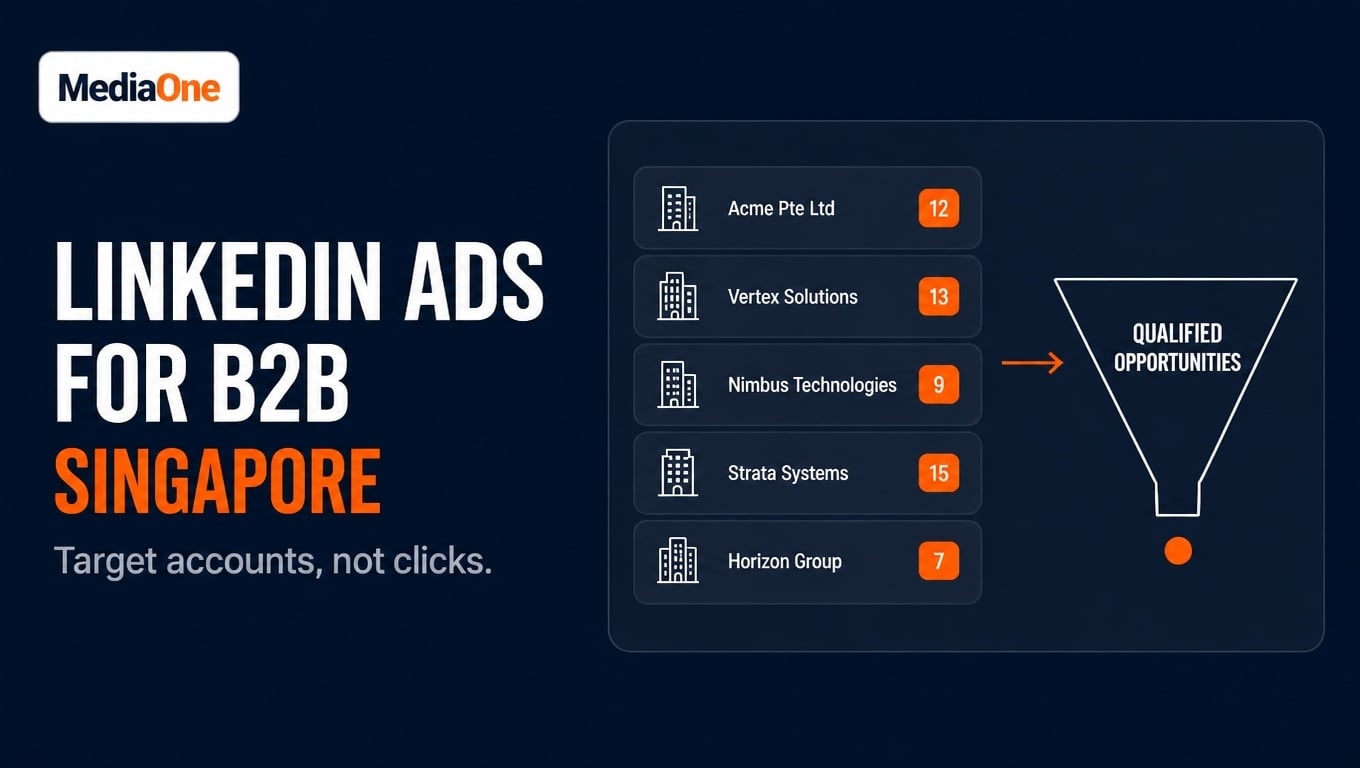
LinkedIn ads are one of the few paid channels built for business buyers. The platform now has more than 1 billion members worldwide, including senior decision-makers in almost every Singapore industry. Yet the platform is also expensive per click, and that is where many Singapore firms go wrong. They buy cheap clicks from broad audiences, then wonder why sales teams call the leads and find nothing useful.
This guide takes a different view. LinkedIn ads are worth the premium only when campaigns are built around account-level targeting and a tracked path from lead to revenue. Cheap clicks without that structure produce expensive, unqualified leads.
Below, you will find a practical setup process, a scoring method for choosing which companies to target, guidance on formats and budgets, and a way to measure cost per qualified opportunity rather than cost per click. For the channel context, see our B2B social media strategy guide for Singapore.
Key Takeaways
- Start with accounts, not job titles. Company-level targeting, including account lists of up to 300,000 companies confirmed by LinkedIn, suits Singapore’s B2B mix of finance, logistics and regional HQs.
- Score every target account. The Account-Fit Scorecard rates five factors from 1 to 3, and accounts scoring 12 or above earn account-based campaigns.
- Judge cost per qualified opportunity, not cost per click. Cheap clicks from unqualified leads are the most expensive mistake in B2B LinkedIn advertising.
- Use message ads for lead capture. LinkedIn’s own data shows lead gen forms convert around 13% on average, which makes them a strong option for capturing leads.
- Budget for agency fees realistically. A common benchmark is 10 to 20% of spend, often with a monthly minimum.
- Give tests time before judging them. Track results over several weeks before scaling budget.
Why LinkedIn Ads Work for Singapore B2B Growth
Most B2B marketers already know LinkedIn is where their buyers spend time. The harder question is whether paying for that reach beats cheaper channels. The answer depends on how precisely you can reach the right people, so this section looks at audience precision first, then the evidence, then how LinkedIn compares with Facebook and Google Ads.
For a broader view of the platform beyond paid, see our guide to LinkedIn marketing in Singapore: company pages, content and ads.
Reaching decision-makers by role and company
LinkedIn’s strength for B2B is structural: the platform holds job title, seniority, industry and company data for each member, which is why its advertising can target by the company itself. Company targeting lets you filter by company name, industry, size and followers, and you can upload a list of up to 300,000 company names, per LinkedIn’s Campaign Manager documentation, to reach employees at specific organisations.
For a Singapore firm selling to regional headquarters or professional services groups, this matters. Your ad can reach the finance director at a named target, rather than anyone who happens to match a broad profile.
What the evidence says about conversion and purchase intent
The evidence is encouraging but should be read carefully. LinkedIn reports that brands have seen a 33% increase in purchase intent from ad exposure on the platform. That is a platform-published figure across many advertisers, so treat it as directional rather than a guarantee for your campaign.
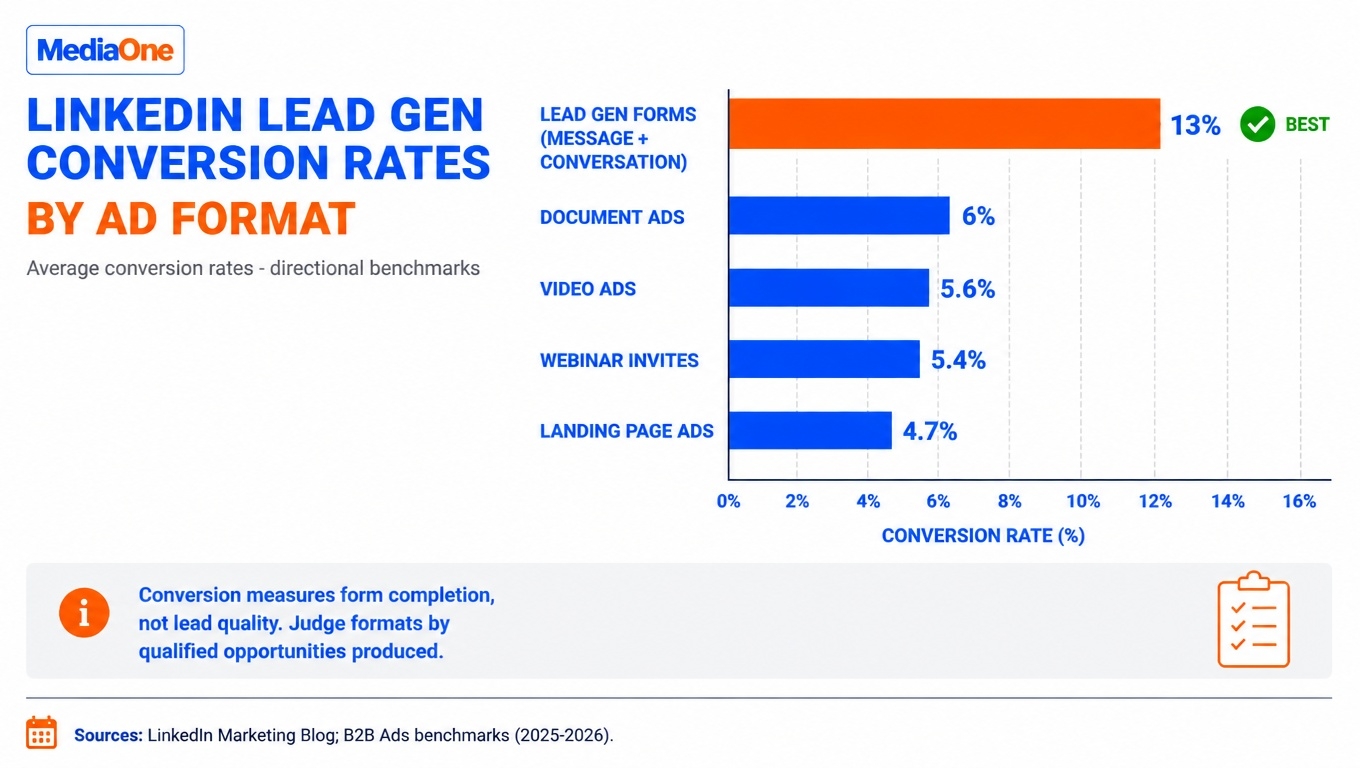
Lead form format also affects results. LinkedIn’s own data shows lead gen forms convert around 13% on average, against roughly 4.7% for ads that send people to a landing page, according to the B2B Ads benchmark, which suggests a low-friction ask converts better than a long one.
Where LinkedIn sits against Facebook and Google Ads
Google Ads captures existing search demand, while Facebook is strongest for consumer reach. LinkedIn holds job-related data such as job title and the company you work for, which is why its cost per click runs higher. The right comparison is cost per qualified opportunity, not cost per click.
If you are weighing platforms, our ChatGPT Ads vs LinkedIn Ads comparison covers how the newer AI-ad channels change that calculation.
Setting Up Your First LinkedIn Campaign
Most LinkedIn campaign problems start before a single ad goes live. The objective, structure, and pre-launch checks decide whether the budget reaches the right accounts or simply buys clicks.
Choosing a campaign objective
Pick the objective from the action you want the buyer to take, not from the metric you find easiest to report. Awareness suits brand building with a long sales cycle. Lead generation suits a specific offer, such as a consultation or a whitepaper, where you need a name and contact details. Website conversions suit firms that want prospects to act on their own site.
For most Singapore B2B firms with a named list of target accounts, lead generation is the right starting point. It keeps the buyer on LinkedIn, which means fewer drop-offs between the click and the form.
Creating the campaign structure step by step
- Create one campaign per audience type, such as a named-account list or a job-title group. Mixing them makes results impossible to read.
- Set the audience for each campaign using the targeting method that matches its purpose.
- Assign one or two ad formats per campaign, so you can compare them fairly.
- Write at least two creative variants per format, differing in offer or headline.
- Set the budget and bidding method, then submit for review.
Pre-launch checklist
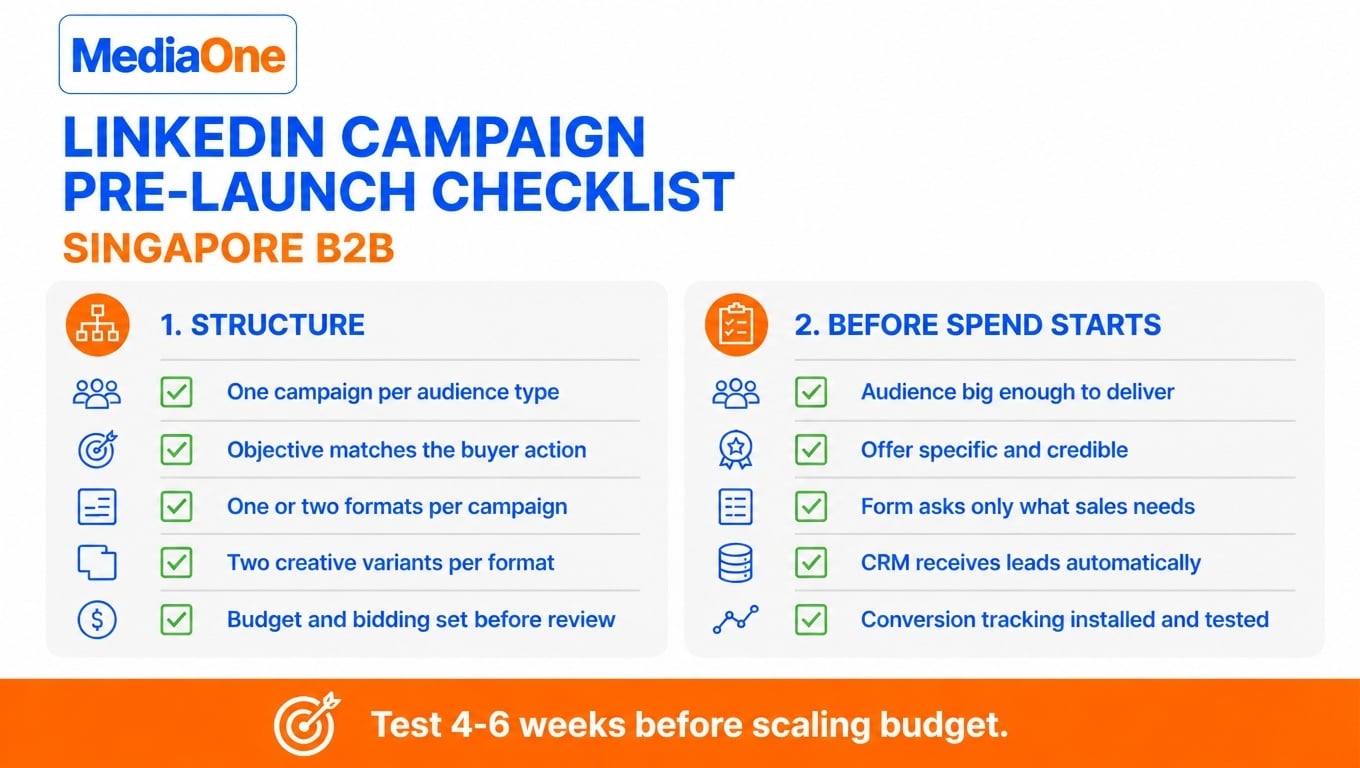
- The audience size is large enough to deliver impressions without being so broad that targeting means nothing.
- The offer is specific and credible, since buyers here expect a concrete reason to respond.
- The lead form asks only for what your sales team needs to qualify the lead.
- Your CRM receives leads automatically, and someone owns the follow-up within a set time.
- Conversion tracking is installed and tested before spend starts.
Targeting Options and Audience Selection
Choosing who sees your ad matters more than almost any other setting in a LinkedIn campaign. As noted above, LinkedIn supports company lists of up to 300,000 organisations, and for account-based marketing that list is the core asset.
Most ranking guides stop at listing these options. The harder question is sequencing. Start with company lists when you already know which firms you want to win, such as a shortlist of regional headquarters or logistics operators. Start with job titles when your offer suits a role (for example, finance directors) across many industries. Mixing both from day one usually muddies results.
Scoring accounts before you spend
Before building a list, score each candidate account on five factors: ideal company size, industry match, decision-maker seniority, existing relationship and deal size potential. Give each factor 1 to 3 points, for a maximum of 15.
- 12 or above: add to a named-account list for account-based campaigns.
- Mid-scorers (7 to 11): reach them through broader job-title campaigns.
- Below 7: exclude them.
This turns targeting into a repeatable, auditable step rather than guesswork.
Narrow enough to matter, broad enough to deliver
Stacking every filter shrinks your audience until delivery stalls. Check the estimated audience size before launch, and avoid running two campaigns that reach the same people, which inflates your cost.
Ad Formats and Creative Best Practices
Choose formats based on the funnel stage and the type of lead you need, not a checklist. Sponsored content is the workhorse for awareness and consideration. LinkedIn videos perform best at 5 to 30 seconds for awareness. Shorter clips suit cold audiences who have never heard of you, while longer explainers work for prospects already comparing options.
Sponsored content and video length guidance
Keep the first two seconds specific. A Singapore finance buyer scrolling on the MRT will not wait for a brand story. Lead with the problem, the named client outcome or the offer, then the call to action.
Message ads and conversation lead generation forms
For direct response, message ads and conversation lead gen forms deliver the strongest results. As cited above, LinkedIn’s published average for lead gen forms is around 13%, against roughly 6% for document ads and around 5.6% for video, per the B2B Ads benchmark. These figures come from a single benchmark, so treat them as directional and test before committing budget.
The format rewards a concrete offer. Local buyers rarely reply to a generic “book a demo” message, so name the specific deliverable, such as a cost review or a shortlist of accounts. Use lead forms when you want volume and speed, and landing pages when the decision needs more explanation.
Creative tips that lift response
- Match one format to one funnel stage and one lead type.
- Write a single, specific offer per ad rather than several.
- Test one variable at a time: hook, image, or call to action.
- Judge a creative only after enough impressions to read the submit rate.
Budgets, Bidding and Cost Management
Setting a daily and lifetime budget
Budget determines how fast a campaign spends, so set it based on the number of qualified opportunities you need, not a vague monthly figure.
A daily budget caps spend per day and suits always-on lead generation. A lifetime budget caps total spend over a fixed window and suits a time-bound push, such as an event or a product launch.
In practice, start with a daily budget and track cost per qualified opportunity over at least four weeks before raising it. Scaling too early on cheap clicks is the most common way B2B budgets go to waste.
Bidding strategies compared
LinkedIn offers cost-per-click and cost-per-impression bidding, with automated bidding available to let the platform chase your goal. Cost per click suits lead generation because you pay only when someone engages. Cost per impression suits brand awareness, where reach matters more than clicks. Judge bidding by the figure your sales team cares about: cost per qualified opportunity, not cost per click. A cheap click that never reaches a salesperson is an expensive lead.
Agency costs in Singapore and how to judge them
A common benchmark is 10 to 20% of spend, and it’s consistent with what agencies published across 2025 and 2026. Judge a quote by what it includes: account-list building, creative testing, lead-quality reporting and handoff to sales. A fee that buys only campaign setup will not fix a weak targeting structure.
Measuring Performance, ROI and Optimisation
Most Singapore B2B teams judge LinkedIn ads on cost per click, which is the wrong number. The figure to manage is cost per qualified opportunity, because a cheap click from the wrong account costs you the same sales time as an expensive one.
Metrics that matter for lead generation
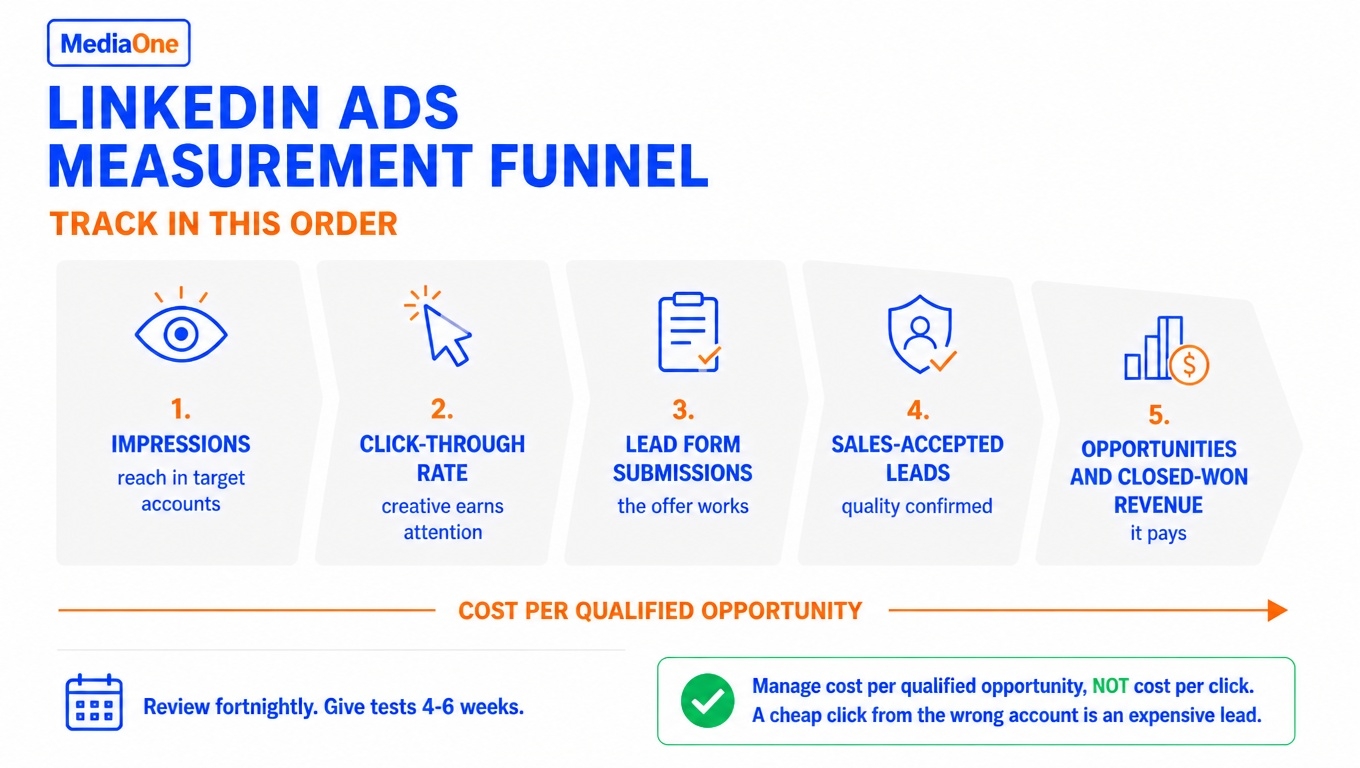
Track the funnel in order: impressions, click-through rate, lead form submissions, sales-accepted leads, opportunities and closed-won revenue. Clicks and form fills tell you whether the ad works. Opportunities and revenue tell you whether it pays.
The lead form submit rate also matters. As cited above, LinkedIn’s published lead-gen-form average is around 13%, well above webinar invites at 5.4% per the B2B Ads benchmark. A low submit rate usually points to a weak offer, not a weak channel.
Calculating return on ad spend
- Add up closed-won revenue attributed to LinkedIn over a fixed window.
- Divide by total LinkedIn ad spend for the same window.
- Compare the result with your target return on ad spend.
Attribution is the weak point. Tag every form with a campaign code, and ask sales to record the original source in the CRM. A reported ROAS is only as reliable as that tagging.
A reporting and optimisation routine
- Check cost per qualified opportunity against your target.
- Pause ad variants that have spent well past your threshold with no leads.
- Review lead quality with sales each month, not just lead volume.
- Change one variable at a time, and give each test at least four to six weeks before judging it.
A Singapore bank cut its cost per conversion on LinkedIn ads from over S$100 to S$12 through repeated testing, as reported by its agency. That case could not be independently verified, so treat it as evidence that testing works, not as a result you should expect on day one.
Your Next Steps to Setting Up LinkedIn Ads
LinkedIn ads earn their premium for Singapore B2B firms only when the campaign is built around account-level targeting and a tracked path from lead to revenue. Cheap clicks without that structure produce expensive, unqualified leads, so the cost per click is the wrong number to manage.
Start with the Account-Fit Scorecard. Score each target account from 1 to 3 on ideal company size, industry match, decision-maker seniority, existing relationship and deal size potential. Accounts scoring 12 or above go into a named-account list for account-based campaigns. Mid-scorers go into broader job-title campaigns, and low scorers are excluded. The scorecard makes targeting repeatable and auditable instead of guesswork.
Then measure cost per qualified opportunity, not cost per click. Hand leads to sales with a shared definition of “qualified”, because most lead quality problems start at that handoff.
Your next step: this week, list the 50 companies you most want as customers and score them on the five factors. Use the results to decide which accounts receive a campaign and to set a test period of at least several weeks before you judge results.
If you want a partner to run the paid channels instead, start with our PPC management service.
Frequently Asked Questions
How much should a Singapore business spend on LinkedIn ads?
There is no single right figure, but a useful starting point is the cost of a qualified opportunity, not the cost of a click. For agency support, the benchmark noted above is 10 to 20% of spend, often with a monthly minimum. Set your budget by working backwards from the number of deals you need, then check whether the spend can reach enough named accounts to produce them.
How is LinkedIn advertising different from Google Ads?
Google Ads captures people who are already searching for a solution. LinkedIn lets you reach people by job title, seniority, company and industry, whether or not they are looking. That makes LinkedIn better suited to account-based marketing, where you choose the companies first. It is typically more expensive per click, so it only pays off when targeting is tight.
Which LinkedIn ad format converts best for lead generation?
For lead generation, message ads and conversation ads with lead gen forms convert around 13% on average per LinkedIn’s published data, compared with around 6% for document ads and around 5.6% for video, per the B2B Ads benchmark. Conversion measures form completion, not lead quality, so judge the format by the qualified opportunities it produces.
Do I need an agency to run LinkedIn ads?
No, but you need someone who can manage targeting and the sales handoff. An in-house marketer can run campaigns if they have time to build account lists, review lead quality with sales each week and test creative. An agency adds value mainly when your team lacks that capacity. Whichever route you take, ask for reporting on cost per qualified opportunity, not only click and lead counts.
How long before LinkedIn ads show results?
Give a test at least four to six weeks and a fixed budget before judging it. Early results often show high cost per lead and weak lead quality while the algorithm learns and your sales team works through the first leads. Decide in advance which metric will trigger a change, and avoid scaling spend until cost per qualified opportunity holds steady.