| AI Summary
International marketing helps businesses reach customers across national borders by adapting their offer, messaging, website and channels. A practical approach starts with market research and scoring, followed by localisation and a measured launch. Results should show whether each market brings customers at a cost the business can sustain. |
International marketing means planning how to promote and sell your products or services in another country. Your business needs to understand who will buy, what they expect and how it will serve them after the sale.
An English-language website can support expansion, but a shared language does not mean shared buying habits. A business entering the United States may still need different product terms, prices, delivery information and customer support hours.
The sections below connect those decisions, from choosing a market to measuring its results. Our international SEO services support the search side of that work, helping businesses connect regional website content with the audiences they want to reach.
Key Takeaways
- Market selection starts with evidence. Demand, competition, delivery costs and customer expectations help determine which country deserves a launch test.
- Market scores need supporting research. A planning score helps compare options, while unresolved delivery or legal requirements need separate attention.
- Localisation covers the buying experience. Product descriptions, prices, payment options, forms and support should work together for the target audience.
- Website structure follows operating needs. Subdirectories, subdomains and country domains involve different management demands; none guarantees stronger rankings.
- Expansion decisions need commercial results. Qualified enquiries, acquisition costs, returns and contribution show whether a market can support further investment.
What Does International Marketing Include?
International marketing connects customer research with the decisions needed to sell abroad. Those decisions affect the offer itself as well as the advertising around it.
For example, a software company entering the US might retain its core product while changing its sales demonstrations, billing information and support coverage. A furniture retailer would also need to account for shipping, dimensions, assembly instructions and returns.
The decisions behind an international launch
A launch plan should answer six connected questions:
| Decision | Question to answer |
| Audience | Which customers have a problem your offer can solve? |
| Positioning | Why would they choose you over available alternatives? |
| Offer | What product, service or package will you sell? |
| Experience | Can customers understand, buy and receive it? |
| Channels | Where will those customers discover and assess you? |
| Measurement | What results would justify further investment? |
These answers give each team a shared brief. Marketing can then promote an offer that sales, operations and customer support can deliver.
What stays consistent across countries?
Your brand can keep the same purpose and quality standards while adapting how it explains them. A promise of easier installation, for instance, may remain relevant across countries even when instructions, measurements and demonstrations change.
A shared message guide helps protect that consistency. Each market team should know which claims require evidence, which terms describe the product accurately and which parts of the wording they can adapt.
How Do You Choose an International Market?
Market selection starts with a customer group and a commercial reason to enter. A large population alone tells you little about demand for your particular offer.
A narrower starting point makes research more practical. “Independent US dental practices buying appointment software” gives your team a more specific audience to assess than “American businesses”.
Research demand and buying conditions
Your first research sheet should bring together:
- Demand evidence: Relevant searches, enquiries, interviews and existing overseas orders.
- Customer spending: Typical prices and the purchasing process.
- Competition: Direct alternatives, established suppliers and substitute solutions.
- Delivery requirements: Shipping, installation, onboarding or service coverage.
- Operating costs: Localisation, payment processing, support and returns.
Government resources can help establish market context. The International Trade Administration’s Country Commercial Guides provide country research, while US Census data can support research into American populations, households and businesses.
Those sources provide background. Customer interviews and purchase behaviour help establish whether your offer addresses a problem people will pay to solve.
Compare the alternatives customers already use
Your competitors abroad may differ from those at home. A buyer could compare your product with a local supplier, an online marketplace or a manual process that costs little to maintain.
A competitor review should record:
- The audience each alternative serves.
- Its main benefits and supporting evidence.
- Prices, contract terms and delivery promises.
- Common complaints in customer feedback.
- Questions that competing pages leave unanswered.
Those findings should influence your opening offer. If buyers repeatedly complain about slow onboarding, a documented onboarding process may deserve more attention than another general claim about quality.
How Can Market Scoring Support Expansion Decisions?
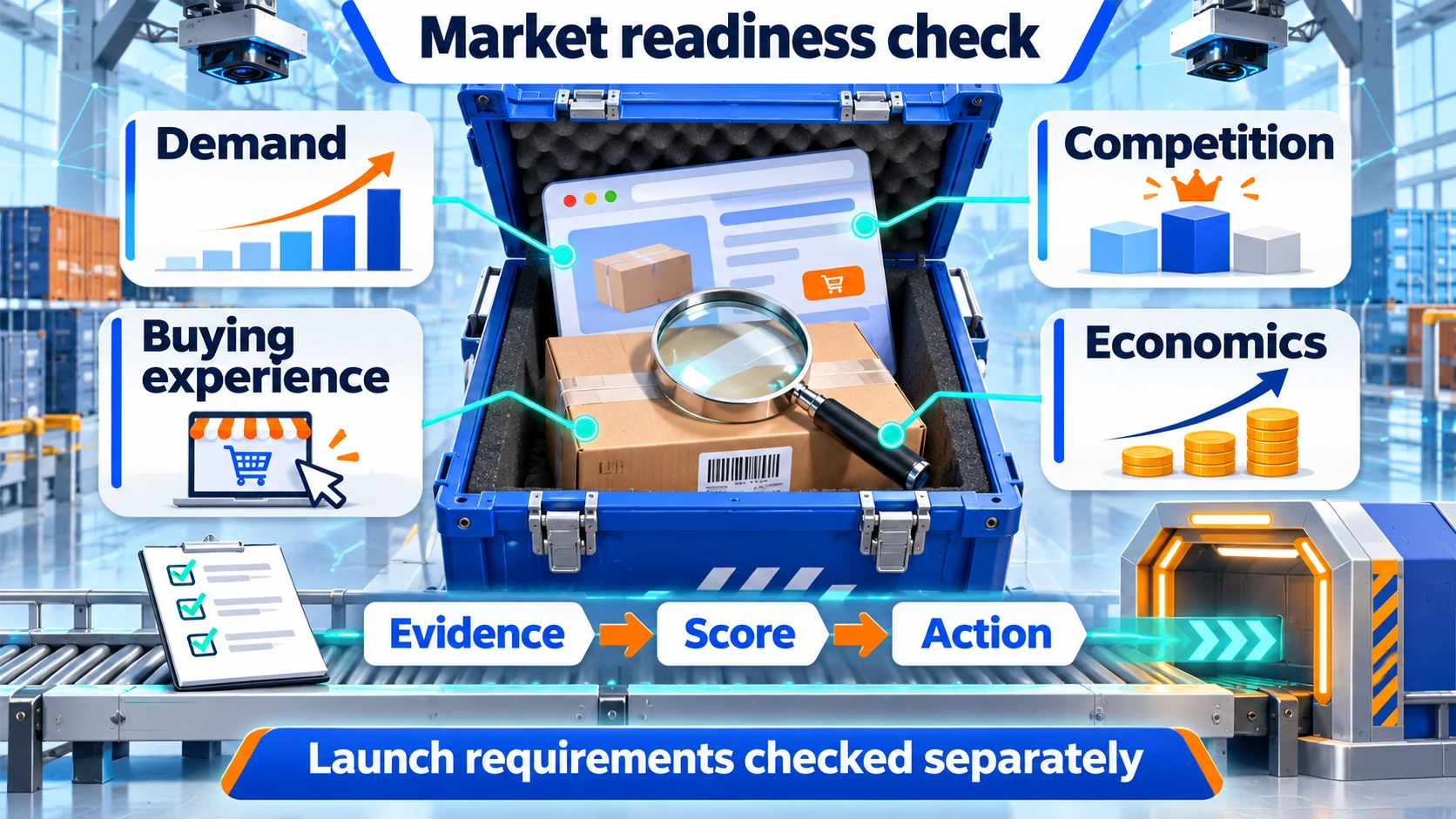
Market scoring turns research into a comparison your team can discuss. The score should summarise evidence, with notes showing where the evidence remains weak.
The example below is a planning method for this guide. Its numbers do not predict success, and it has no universal launch threshold.
A practical market-scoring worksheet
Each factor receives a score from one to three:
| Factor | 1: Major gaps | 2: Partial evidence | 3: Stronger readiness |
| Demand | Little evidence of relevant buyers | Interest exists; purchase intent needs testing | Enquiries, interviews or orders support demand |
| Competitive position | Few reasons to choose the offer | Some benefits need stronger proof | Distinct benefits have supporting evidence |
| Buying experience | Important purchasing steps are missing | Most steps work; gaps remain | Purchase and support have been tested |
| Commercial viability | Delivery costs or margins remain uncertain | Costs are estimated | Test results support workable economics |
A total helps compare shortlisted markets, but the notes explain the work required. A score of two for demand should name the missing evidence, such as interviews with purchasing managers.
Some requirements sit outside the total. A business cannot use a strong demand score to offset an inability to deliver the product or meet an applicable requirement.
What should happen after scoring?
The worksheet should end with an action, an owner and a review date. That makes it a working launch document.
For an illustrative software business, US demand might look promising while support coverage remains incomplete. Its next step could be a limited pilot with published support hours, followed by a review of response times and customer feedback.
The comparison below shows how evidence becomes a decision.
How Should You Research Local Search Behaviour?
Search research explains how customers describe their needs. That language helps shape product pages, advertisements and supporting content.
Even markets that share English use different terms. A UK homewares business entering the US may encounter “comforter” alongside “duvet”, with different product expectations behind each search.
Research the words customers use
A practical research process combines:
- Search terms from existing customer enquiries.
- Keyword estimates filtered to the target location.
- Search results for buying and comparison phrases.
- Product terms used by relevant competitors.
- Feedback from people who know the market.
Our keyword research services connect that language with commercial goals. A phrase earns a place in the plan when the business can provide a relevant answer or offer.
Search volume needs context. A smaller phrase describing a specific buying need may be more valuable than a broad term attracting people outside your audience.
Connect each search with the right page
The page should match what the searcher is trying to do:
| Search need | Suitable content |
| Understanding a problem | An explanation or practical guide |
| Comparing options | A comparison with decision criteria |
| Assessing a supplier | A service page with evidence and process details |
| Buying a product | A product page with price and delivery information |
| Checking compatibility | Specifications or a compatibility guide |
This mapping prevents the content plan from becoming a list of unrelated articles. Each page contributes to a buying decision, while internal links connect questions that naturally follow one another.
What Should You Localise Before Launch?
Localisation adapts the experience to the audience’s language and buying expectations. Translation becomes part of that work when the audience needs another language.
Your first priority is the content people need to make and complete a purchase. A translated blog library offers limited help if the product page or checkout still causes confusion.
The minimum buying experience
A launch review should cover:
- Offer pages: Accurate descriptions, specifications and availability.
- Pricing: Currency labels, billing frequency and relevant charges.
- Forms: Address formats, telephone fields and required information.
- Purchase steps: Payment, delivery or onboarding details.
- Support: Contact options, operating hours and response expectations.
- Policies: Accessible information about cancellation, returns and data use.
A US buyer should be able to identify whether a displayed dollar price means US dollars. A service customer should also know which time zone applies to an appointment or support window.
Adapt examples and evidence
Examples work best when the reader recognises the situation. A payroll software demonstration for US employers should use a relevant workflow, supported by product capabilities the company can verify.
Customer evidence deserves the same care. A genuine overseas case study can show experience, while a new market may initially require demonstrations, product documentation and a limited pilot.
Our content marketing work connects those explanations across buying stages. The aim is to answer the next question a reader is likely to ask.
Build a review process
A localisation brief should explain the audience, intended action, approved terminology and claims requiring evidence. A reviewer familiar with the target market can then assess meaning and context.
The review needs to continue inside the website. Buttons, error messages, automated emails and downloadable documents should agree with the main page, so customers receive consistent information throughout the purchase.
Which Website Structure Should You Use?
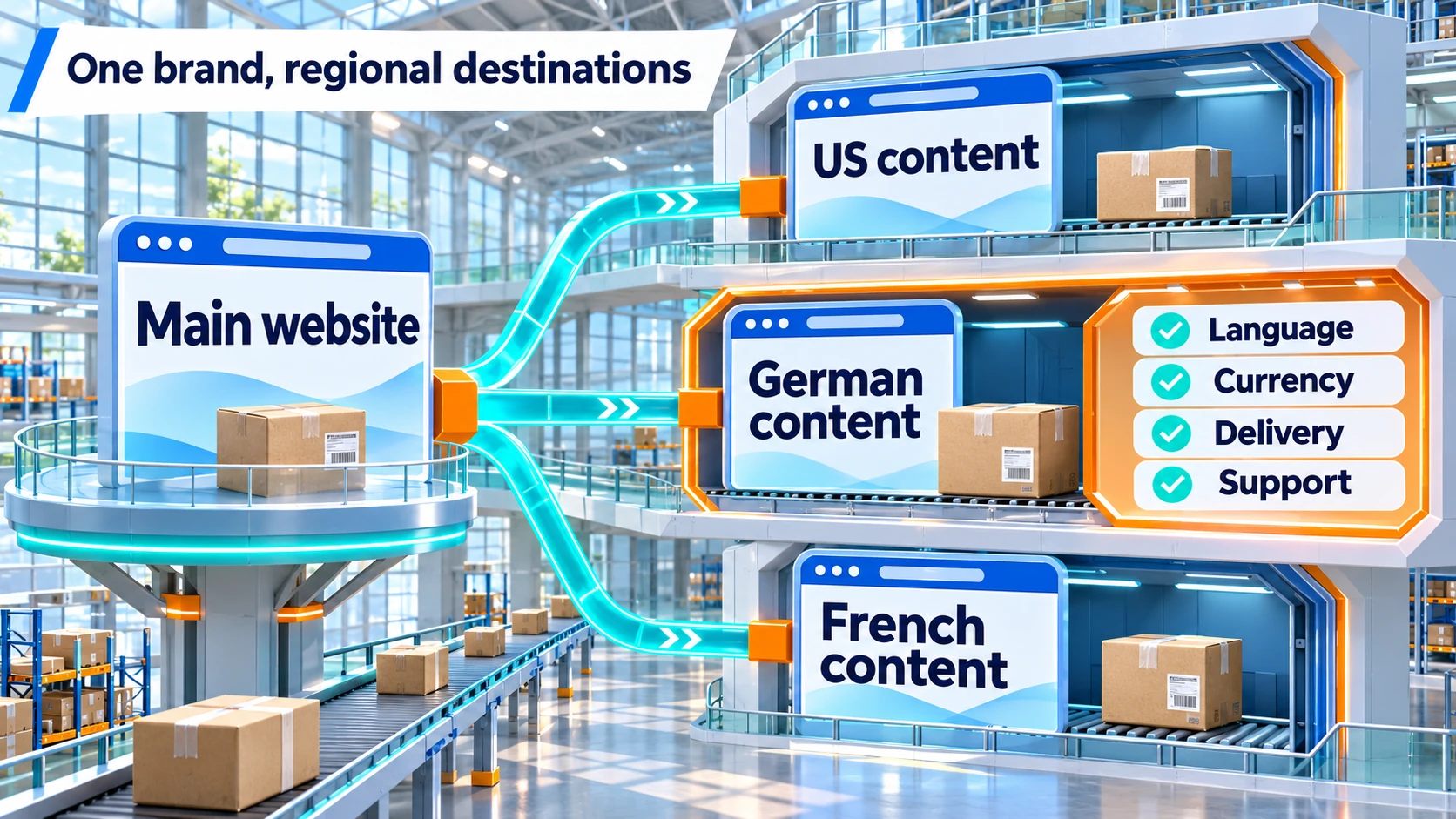
International websites can organise regional content through subdirectories, subdomains or separate country domains. The decision depends on ownership, systems and the resources available to maintain each version.
Google’s multi-regional website documentation describes these structures and their trade-offs. A country domain provides a geographic signal; other arrangements can also support regional content.
Compare the management demands
| Structure | Example | Practical consideration |
| Subdirectory | example.com/us/ | Regional content shares the main domain and often the same publishing system |
| Subdomain | us.example.com | A regional team can operate a separate technical setup |
| Country domain | example.de | A separate domain requires its own administration and ongoing maintenance |
A subdirectory can be practical when one team manages the website. Separate systems may become necessary when regional teams have different product catalogues or operating requirements.
The decision should include future updates. Someone needs responsibility for each region’s content, security, analytics and purchase process.
Help search engines identify regional versions
Google’s localised-page documentation explains how hreflang annotations identify related language or regional versions. For example, en-US identifies an English-language version intended for US users.
A technical review should check that:
- Each regional URL is accessible.
- Alternate-page references point to the intended equivalents.
- Language and region selectors work.
- Links keep visitors within their selected version where appropriate.
- Search engines can reach the content.
Regional selectors also give customers control when they travel or buy for another country. Automatic location assumptions can send those visitors to an unsuitable version. The structure becomes easier to understand when each region has a labelled place within the website.
How Do You Test the Website Experience?
A launch test should follow a customer from the first click to the final confirmation. Testing individual pages can miss problems between systems.
Our website design approach considers how page structure supports user actions. For international expansion, that includes region selection, readable information and forms that accept customer details correctly.
Test complete customer tasks
A small group of target-market users can attempt tasks such as:
- Finding a product that meets a stated need.
- Checking the final price.
- Confirming delivery or service availability.
- Completing a purchase or enquiry.
- Finding help after receiving confirmation.
Their questions reveal missing information. A buyer who repeatedly searches for return costs has identified a content gap, even if every button works.
For retailers, our e-commerce website development work connects product information with purchase steps. That connection becomes especially important when regional catalogues, currencies or fulfilment terms differ.
Separate speed checks from location testing
Google’s PageSpeed Insights documentation distinguishes controlled laboratory tests from real-user field data. Field data requires enough observations and may be unavailable for a new page.
A PageSpeed report should therefore sit alongside target-market testing. Your team can compare actual devices, payment completion and user feedback before deciding which technical changes deserve attention.
Which Marketing Channels Should You Launch First?
Channel choice follows buying behaviour. A customer actively searching for software pricing needs a different approach from someone discovering a household product through a demonstration.
A limited launch becomes easier to assess when each channel has a defined job. The first combination might include one source of new visitors and one way to continue conversations with interested buyers.
Match channels with customer needs
| Customer behaviour | Channel to assess | Initial outcome |
| Searches for a supplier | Search advertising and SEO | Qualified enquiries |
| Needs to see a product working | Social demonstrations or creators | Product interest and sales |
| Compares complex solutions | Expert content and sales follow-up | Suitable sales conversations |
| Returns before deciding | Email sequences | Completed enquiries or purchases |
Our search engine marketing services connect search demand with paid campaigns. A US launch can test a defined product category or service area before committing to wider coverage.
Campaign planning should also connect the advertisement with the landing page. A price-led advert needs a destination that explains the price and conditions without making visitors search again.
Our Google Ads management focuses on campaign setup and performance measurement. International campaigns also need location settings, language choices and reporting boundaries that match the intended audience.
Social activity serves a different role when customers need demonstrations or reassurance from familiar voices. Our social media marketing services connect creative production with campaign goals and conversion tracking.
Each channel should contribute evidence. Search queries can reveal buying questions, while social comments can expose objections that the website needs to answer.
Assess creators and follow-up messages
Creator selection starts with audience relevance. A creator’s location alone does not establish where followers live or whether they buy the category.
Our influencer marketing work includes audience assessment and campaign planning. For US-facing endorsements, the Federal Trade Commission’s disclosure guidance explains how relevant brand relationships should be disclosed.
After initial interest, an email marketing lifecycle can connect messages with customer actions. US commercial email planning should also account for the FTC’s CAN-SPAM requirements, including accurate sender information and an accessible opt-out process.
How Should You Manage International Marketing Risk?
Launch preparation should identify which promises the business can support. Marketing, fulfilment and customer service need to agree before those promises reach customers.
US-facing campaigns can use the FTC’s advertising and marketing resources to review general standards for truthful, evidence-based claims. Product-specific requirements need separate assessment.
Assign ownership before spending increases
A launch record should name who owns:
- Product claims and supporting evidence.
- Delivery, onboarding and returns.
- Customer information and access controls.
- Advertising approvals and creator briefs.
- Complaints and urgent public responses.
Those responsibilities help prevent contradictory messages. If delivery slows, the fulfilment owner can notify the campaign team before advertisements continue promoting an outdated arrival date.
A privacy review should similarly start with the information the business collects and how it uses it. Requirements depend on the jurisdictions, activities and data involved; one consent rule should not be assumed to cover every market.
How Do You Measure International Marketing Results?
A market report should connect spending with customers and delivery costs. Traffic and engagement help explain behaviour, but commercial results determine whether expansion can continue.
The reporting period also needs to reflect the purchase cycle. A business selling annual software contracts may need more time to assess sales than a retailer selling everyday products.
Define results before launch
The launch brief should establish:
| Measure | Decision it supports |
| Qualified enquiries | Whether campaigns attract suitable prospects |
| Completed purchases | Whether interest becomes revenue |
| Acquisition cost | Whether customer recruitment is affordable |
| Refunds and cancellations | Whether expectations match delivery |
| Contribution after direct costs | Whether sales support continued investment |
| Repeat purchases or renewals | Whether customer value continues |
An illustrative campaign costing US$2,000 and producing 20 new customers has an advertising acquisition cost of US$100 per customer. That figure excludes other acquisition expenses unless the report adds them.
Profitability needs a separate calculation that includes relevant product, fulfilment and support costs. A campaign can generate sales while leaving too little contribution to continue.
Turn findings into the next test
A review should identify the largest supported problem. Strong clicks with few enquiries may justify checking the offer and landing page; suitable enquiries with few sales may require a closer look at pricing or follow-up.
A focused test then changes one major element and records what happened. The result informs the next spending decision. The launch cycle below shows how those decisions connect.

Build an International Marketing Plan Around Buyers
International marketing connects market evidence with an offer people can understand and buy. A researched audience, tested buying experience and measured launch give your team a sound basis for deciding where to invest next.
At MediaOne, we connect international SEO, content and paid campaigns around customer needs. Our team can discuss your expansion goals and help identify the marketing work required for your target market.
FAQs About International Marketing
Does international marketing require a local office?
A local office is one operating option. Some businesses serve overseas customers through remote teams, distributors or fulfilment partners. The decision depends on customer expectations, service delivery and applicable registration or establishment requirements. Marketing claims about local presence should accurately reflect the arrangement the business operates.
Separate accounts can help when languages, offers and customer conversations differ enough to justify ongoing local publishing. A shared account may remain practical when audiences use the same language and receive similar information. The decision should include staffing, response coverage and the content each account can maintain.
Can a distributor manage international marketing?
A distributor can contribute market knowledge, customer relationships and local promotion. The brand still needs agreed responsibilities for claims, creative approvals, customer data and reporting. A written agreement should also explain account ownership and access, so both parties understand how marketing assets will be managed throughout the relationship.
Can artificial intelligence translate international marketing content?
Artificial intelligence can produce a starting draft, especially when the team supplies approved terminology and context. Human review remains important for meaning, product accuracy and sensitive claims. A reviewer familiar with the target audience should assess high-impact content before publication, including offers, purchase instructions and customer communications.
Who should own international marketing inside a business?
One accountable lead should coordinate the plan across marketing, sales, operations and support. Regional contributors can advise on customer expectations while central teams maintain brand standards and shared systems. Defined decision rights help resolve disagreements about pricing, messaging and launch timing before they delay delivery.