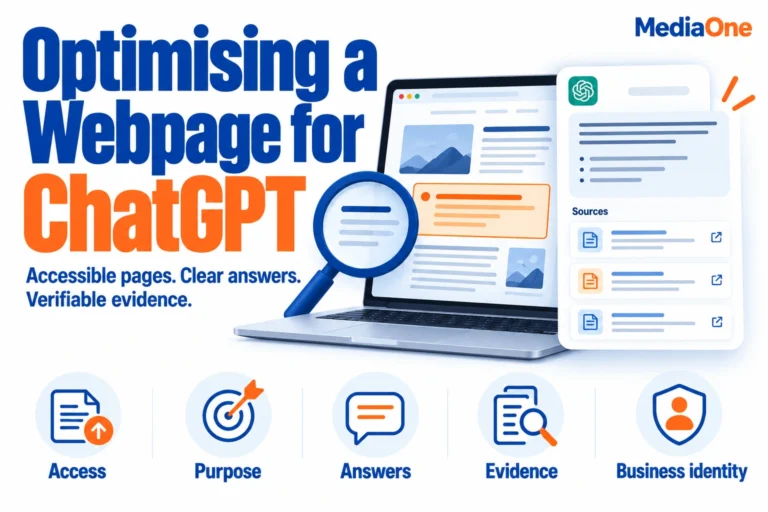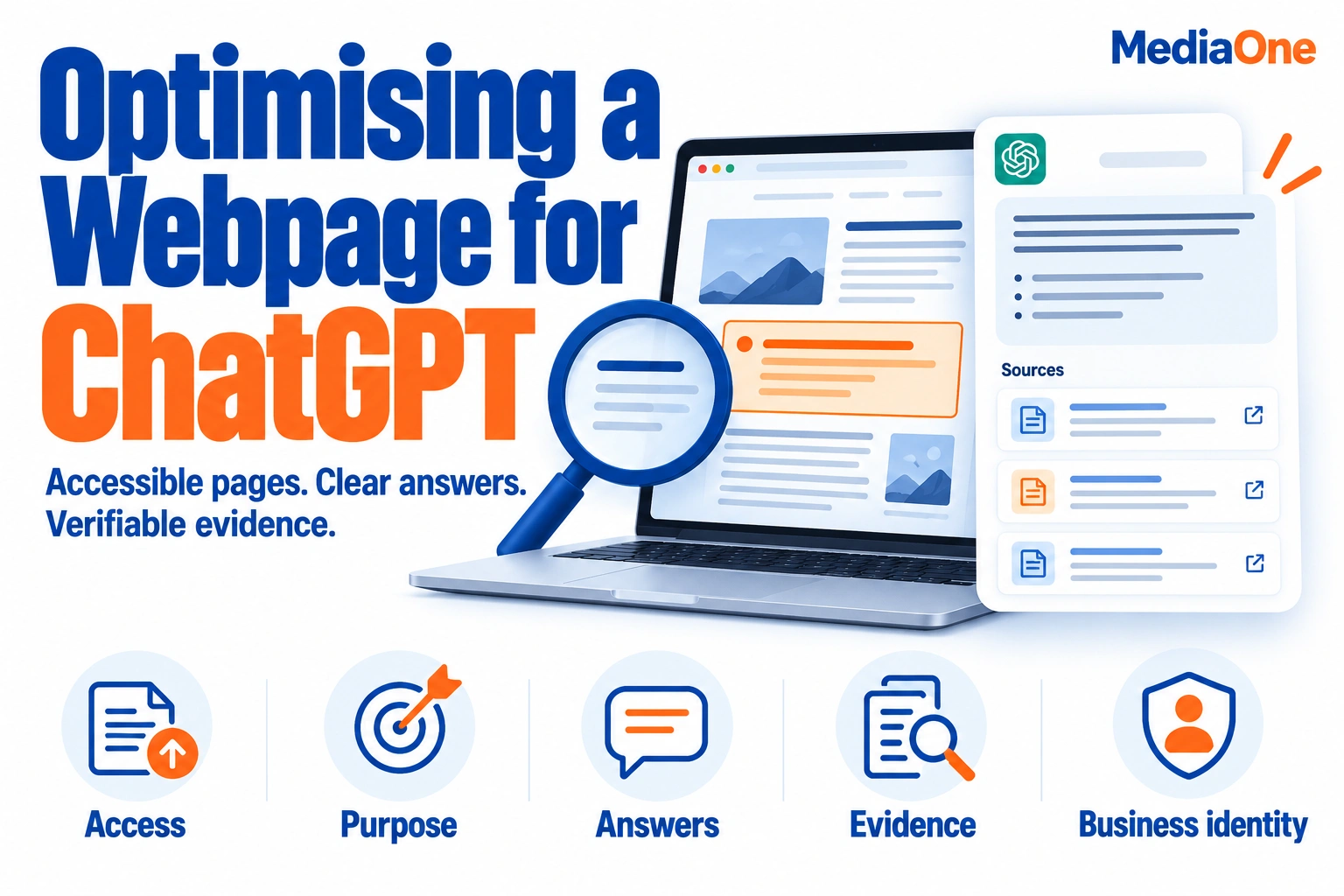
To optimise a webpage for ChatGPT, check that retrieval systems can reach it, state its subject clearly, answer real buyer questions, and make its claims verifiable. These steps improve the odds of selection and citation but cannot guarantee either. Aim to be the clearest, most verifiable source for one specific question.

This guide uses a five-area Page Readiness Checklist: Access, Purpose, Answers, Evidence and Business Identity.
Key Takeaways
- Start with access. Confirm Bing can index the page and that OpenAI’s crawlers are not blocked in robots.txt, meta robots or server rules.
- Retrieval is not citation. About 3% of pages ChatGPT pulls make the final answer, so the page must be the clearest source for a specific question.
- Fix the weakest area first. Score Access, Purpose, Answers, Evidence and Business identity from 0 to 2.
- Answer early. State the service, audience and scope in the opening paragraph.
- Schema guarantees nothing. Mark up only content visible on the page.
- Measure beyond clicks. Track citations, branded searches and enquiries.
What Optimising a Webpage for ChatGPT Actually Involves
Most advice treats this as a site-wide project. The more useful unit of work is one page. ChatGPT answers individual questions by pulling specific URLs, so a page that answers one question clearly is the one it selects or passes over. Creating one page for one question your audience asks is the most direct way to optimize your website for ChatGPT, and each page should follow a deliberate content strategy built around a single, relevant query.

When ChatGPT answers with live search, it retrieves candidate pages, reads them and then decides which to cite. Retrieval and citation are separate steps. A LinkedIn analysis of ChatGPT SEO reported that only about 15% of pages ChatGPT pulls make it into the final answer. That is a third-party, unaudited figure, and our own test (described below) is the basis for the 3% figure used in this guide.
No action guarantees inclusion or citation. OpenAI does not publish a fixed weighting for ChatGPT Search ranking, so every tactic here improves the odds rather than flipping a switch.
How ChatGPT Search Finds and Cites Pages
ChatGPT Search uses Bing’s index and other sources to show up-to-date results with source links. The goal is to be the most useful source for one specific question, not to rank for a broad term. Clear, well-structured information on each page helps the model decide that your page is the most relevant engine result to cite.
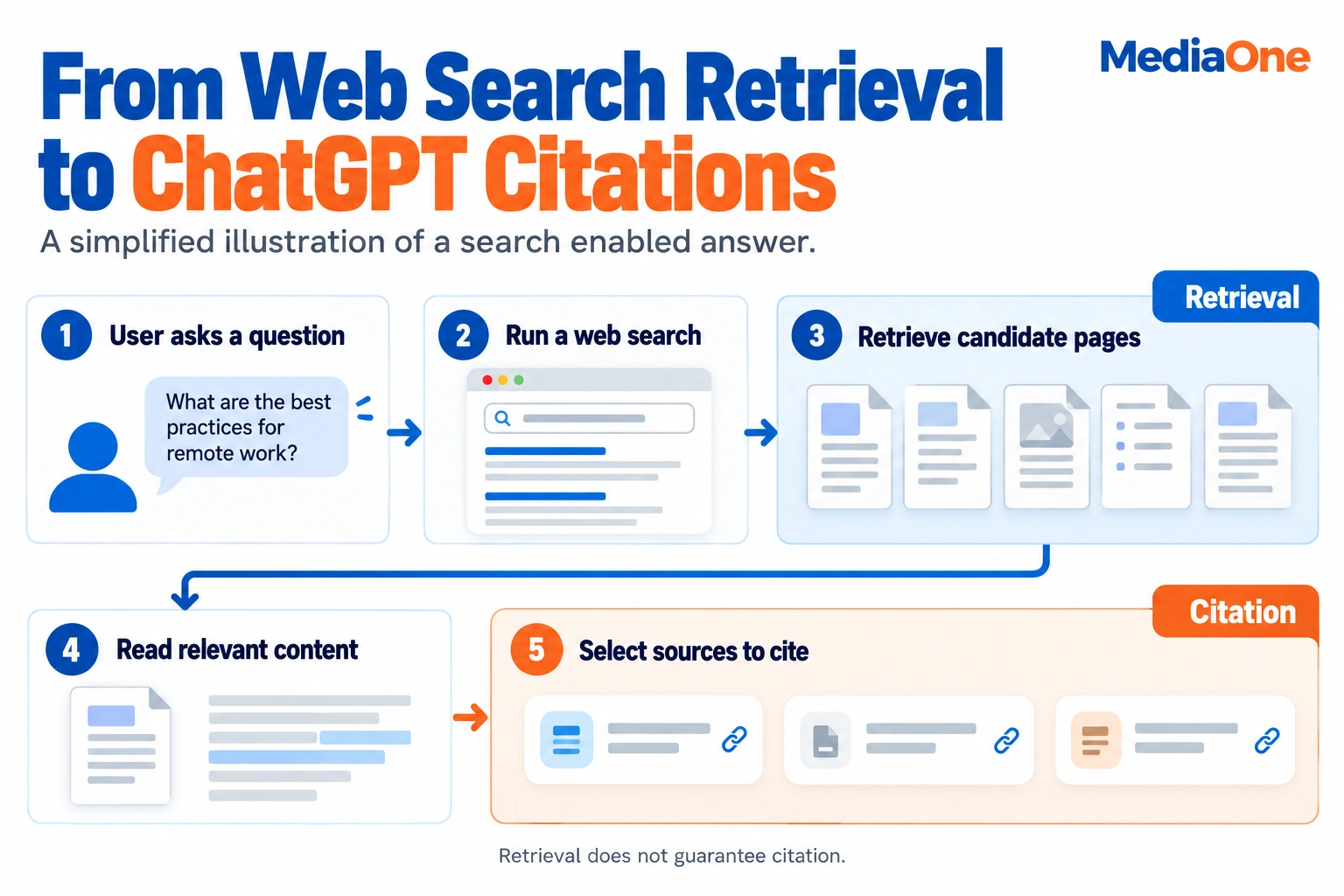
Overlap with traditional search is significant. The same LinkedIn analysis reports about 85% of ChatGPT-cited pages also rank in Google, and a separate analysis found over 87% of citations match Bing’s top organic results.
Crawler Access: GPTBot, OAI-SearchBot and robots.txt
OpenAI documents separate crawlers for separate purposes. A crawler is an automated program that visits pages. Blocking the wrong one can reduce visibility or block training you didn’t intend to block. Check OpenAI’s current crawler documentation before changing anything, since crawler behaviour can change without notice.
Give your developer this checklist:
- Open yourdomain.com/robots.txt and confirm no rule disallows the OpenAI user agents you want to allow.
- Check each page for <meta name=”robots”> tags containing ‘noindex’ or ‘nosnippet’. Meta robots is a page-level instruction telling search systems what to index or show.
- Check server, CDN and firewall rules that may block OpenAI’s IP ranges.
- Confirm the page returns a 200 status and its main content loads without JavaScript.
- Record the check date and re-check after any site migration.
Auditing the Page: Access, Purpose, Answers, Evidence
I audit one page at a time with a five-area Page Readiness Checklist. The worked example below is hypothetical: a Singapore accounting firm’s “Corporate Tax Filing” service page, scored before any changes. Score each area from 0 to 2, record the gaps, and fix the lowest score first. Re-score after every change so the checklist becomes a before-and-after record of your website content optimisation.
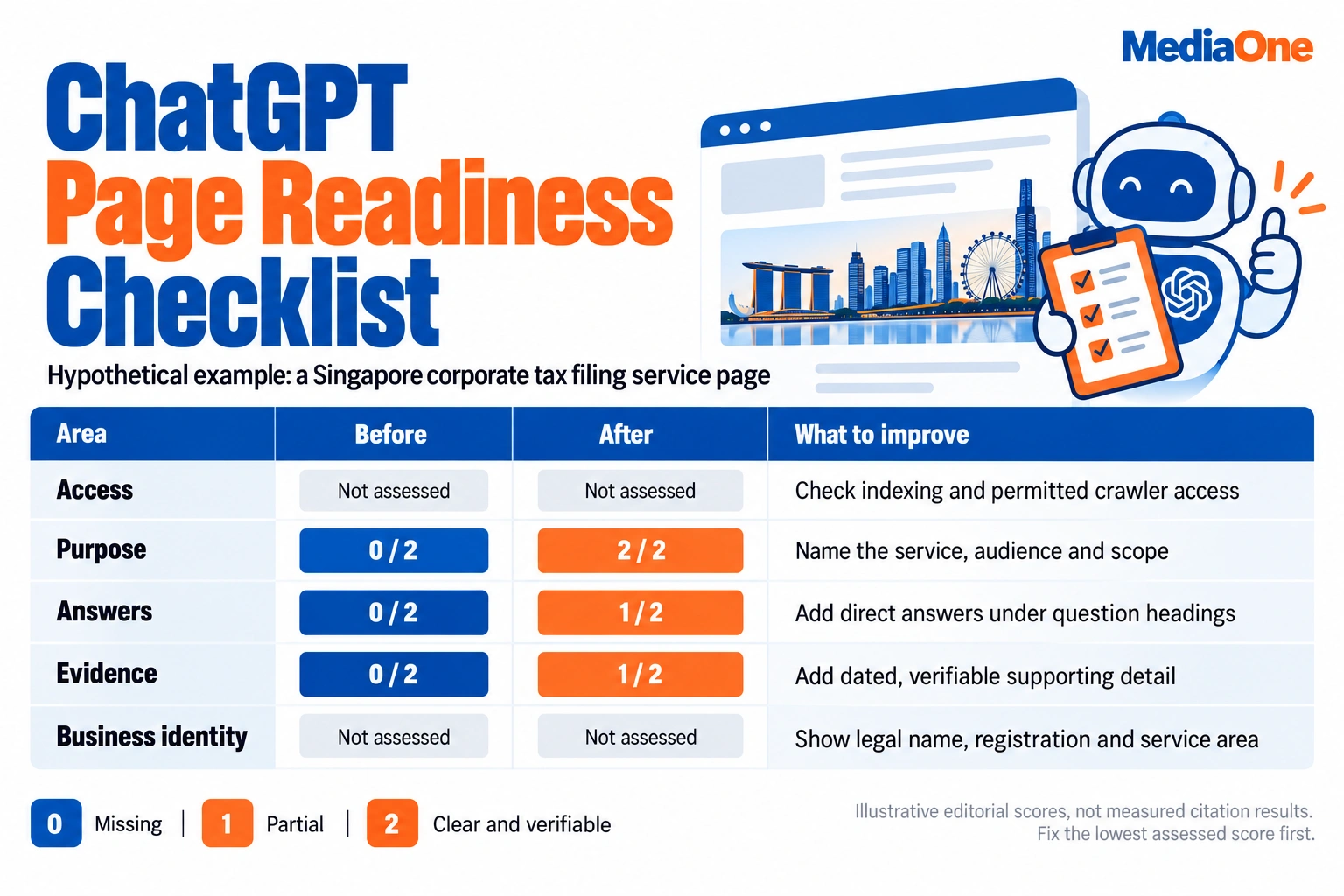
The five checks, with pass criteria for each score, are as follows:
- Access: Is the page indexed and reachable? Check Google Search Console and robots.txt. Bing matters too, since over 87% of ChatGPT citations match the top organic results in Bing. Score 2 if indexed and no crawler is blocked, 1 if a rule or slow load may block a bot, and 0 if not indexed or returning errors.
- Purpose: Do the title and opening state the service, audience and filing scope? The hypothetical example scored 0 because it opened with a generic slogan. Score 2 if the first sentence names the service and audience, 1 if the subject appears only after background, and 0 if the opening is a slogan.
- Answers: Does the page answer the questions buyers actually ask? Score 2 if each main question has its own heading and direct answer, 1 if answers are buried in long paragraphs, and 0 if they are missing.
- Evidence: Can each claim be verified? Score 2 if every claim has a named source, date or scope, 1 if some claims are sourced, and 0 if claims are unsupported.
- Business identity: Is the legal name, registration number and service area visible? Score 2 if all three appear in visible text, 1 if only some do, and 0 if none do.
Applied to the hypothetical example, the before version scores 0 on Purpose, so that is the first fix. Rewriting the opening to name “corporate tax filing for Singapore small businesses” lifts the filing scope to 2, and only then does the team move on to Answers.
| Symptom | Likely cause | Fix |
|---|---|---|
| Page never appears in ChatGPT answers | Blocked crawler or not indexed | Review robots.txt and server rules |
| Competitor cited for your service | Vague opening | Rewrite the first paragraph to name the service |
| Claims cannot be checked | No dates, sources or credentials | Add dated details and named sources |
Clarifying Purpose: Titles, Headings and Introductions
Answer the main question in the first 100 words. Use one H1, then H2s for the page’s main questions, phrased as a buyer would ask them, such as “How much does corporate tax filing cost?” Keep each heading to a single idea. Create a clear, search-friendly title that names the service and Singapore service area so a reader and a search engine understand the page at a glance. Our local SEO services show how this works for Singapore businesses.
Strengthening Answers and Evidence
Write self-contained answer passages of two to four sentences that make sense if quoted alone. Attribute figures to their source, state scope and date, and link to official documentation. OpenAI’s documentation describes its crawler purposes and the right place to review access rules for AI models.

FAQ markup can describe questions already on the page. One analysis found that JSON-LD schema markup, a structured data format that labels page content for machines, will not meaningfully increase how often ChatGPT, AI Overviews, or AI Mode cite you. Treat it as a tidy-up for search engines, not a citation tactic. Only mark up what is visible to readers.
Authority Signals: Reviews, Mentions and Backlinks
Reviews, third-party mentions and backlinks support trust. A backlink is a link from another website to your site. Show a visible “last updated” date, as 65% of the pages ChatGPT cited were published or updated within the past year. Traditional SEO still matters, as about 85% of ChatGPT-cited pages also rank in Google.
Name the specific sources that help: client reviews on Google Business Profile, citations in Singapore business directories and mentions in trade associations’ member lists. To earn them, ask satisfied clients for a review, complete your directory listings, and offer a quote or case note to industry publications.
Measuring Visibility and Business Outcomes

Measuring ChatGPT visibility has two parts: whether your page is cited and whether citations lead to business results. Use both, since neither is fully reliable on its own.
Checking Whether the Page Is Cited
Choose five to ten questions your page should answer and ask them in ChatGPT each month. Log the date, prompt wording, whether your page appeared as a source, and whether a competitor appeared instead. Answers vary between sessions, so look for patterns across several runs. Keep the prompt log clear and relevant for comparing results over time.
Referral Tracking in Analytics
Visits from ChatGPT arrive as referral traffic. In Google Analytics, filter for referral sources that include chatgpt.com and compare the landing pages. This shows AI-referred visits but not views inside an answer without a click, so treat it as a floor, not a total.
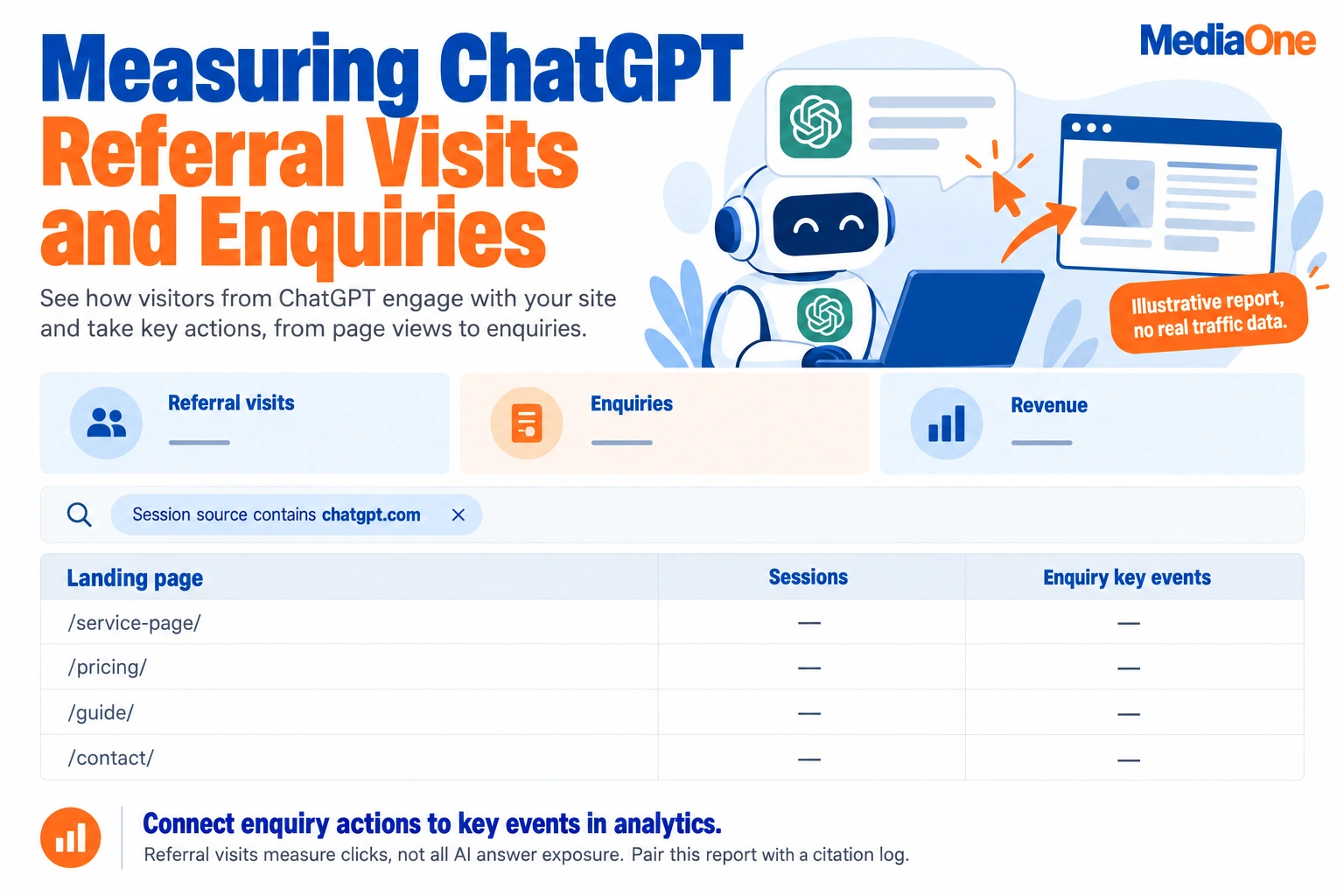
Linking Visits to Enquiries and Revenue
Tag enquiry forms, phone clicks and quote requests as conversion events, then compare conversion rates for AI-referred visitors with other channels. Track over several months, since small volumes are normal at this stage. Your broader search strategy should connect these results to revenue, not just traffic.
The Limits of Measurement
Most AI sessions end without a click. Because 93% of searches in AI Mode now end without a single click through to a website, according to a Superlines 2026 report, clicks will understate your visibility. Pair click data with your prompt log and branded search volume in Google Search Console, and check how search engines describe your business in responses.
Page Optimisation Checklist and Next Steps
Score each area from 0 to 2 for the target page. A 0 means the content is missing or contradicts the goal. A 1 means it is present but partial or hard to verify. A 2 means a reader or crawler can find it, check it and quote it on its own. Fix the lowest score first, then rescore.
Stop when every area scores 2, and the page reads cleanly on its own. Rewrite the page when any area stays at 0 after two fix cycles.
- Access. Confirm the page is indexed in Bing and Google, because ChatGPT search uses Bing’s index and other sources. Check that no robots.txt rule, meta robots tag or server block stops OpenAI’s crawlers. OpenAI’s crawler documentation names GPTBot, OAI-SearchBot and ChatGPT-User.
- Purpose. State the service, who it serves and its scope in the first paragraph. A slogan gives the model nothing to match.
- Answers. Add a short, self-contained passage that answers the page’s main question in full, so it still makes sense if quoted alone.
- Evidence. Name the credentials, dates and fee scope behind each claim, and keep the information current. About 3% of pages get the final answer from ChatGPT, so the content has to earn its place.
- Measurement. Log monthly citation checks and referral visits. Because 93% of searches in AI Mode now end without a single click through to a website, also track branded searches and enquiries.
Worked example. A Singapore accounting firm’s service page moved from “We offer trusted accounting support for growing businesses” (Purpose 0, Answers 0, Evidence 0) to “We prepare corporate tax returns and quarterly GST filings for small and medium businesses in Singapore. Fees are quoted after a scope review” (Purpose 2, Answers 1, Evidence 1). The next fix is a clearer, dated scope statement. This is a hypothetical example, not a measured audit.
Who does what. Developers handle crawler rules, robots.txt, server responses and schema markup. Editors handle headings, opening paragraphs, FAQ wording, fee detail and evidence. Schema should only describe content already visible on the page.
Next steps. Start with a single page and repeat the cycle. For site-wide decisions, read the broader ChatGPT SEO guide. Agree on shared language before you change anything.
Conclusion
Optimise webpage for ChatGPT as a repeatable loop: check crawler access, state the page’s purpose in the first 100 words, answer real buyer questions, back claims with dated, verifiable detail, then measure. Score each area 0 to 2, fix the lowest first, and re-score after each change.
Set realistic expectations. About 3% of retrieved pages reach the final answer, so judge success by enquiries and brand mentions, not visits alone.
Frequently Asked Questions
How do I optimise a webpage for ChatGPT?
Score the page from 0 to 2 across Access, Purpose, Answers, Evidence and Measurement, then fix the lowest score first. Confirm crawlers can reach the page, open with a direct answer, and add verifiable details such as named credentials and dated fee scope. No step guarantees a citation.
Can ChatGPT access and understand my page?
Usually, if the page is indexed in Bing and Google and not blocked. Check your robots.txt, meta robots tags and server rules against OpenAI’s crawler guidance. One analysis found that SearchGPT citations match Bing’s top-ranking pages in 87% of cases, so Bing indexing matters. That figure comes from a third-party analysis and has not been independently audited.
Do structured data, FAQs and external mentions help?
They may help machines parse your content, but no official source confirms that schema markup affects citations. Use FAQ markup only for questions already visible on the page. External mentions are supporting work, since their direct effect is unproven.
How can I check whether my page is cited by ChatGPT?
Write five to ten questions your customers ask, run them in ChatGPT Search, and log the date, prompt, whether your page appears and which sources are named. Repeat monthly.
How do I measure visits and business outcomes from ChatGPT?
In Google Analytics, check referral reports for chatgpt.com sources and tag key enquiry actions as conversions. Since 93% of searches in AI Mode now end without a single click through to a website, also track branded search and direct enquiries that follow AI exposure.