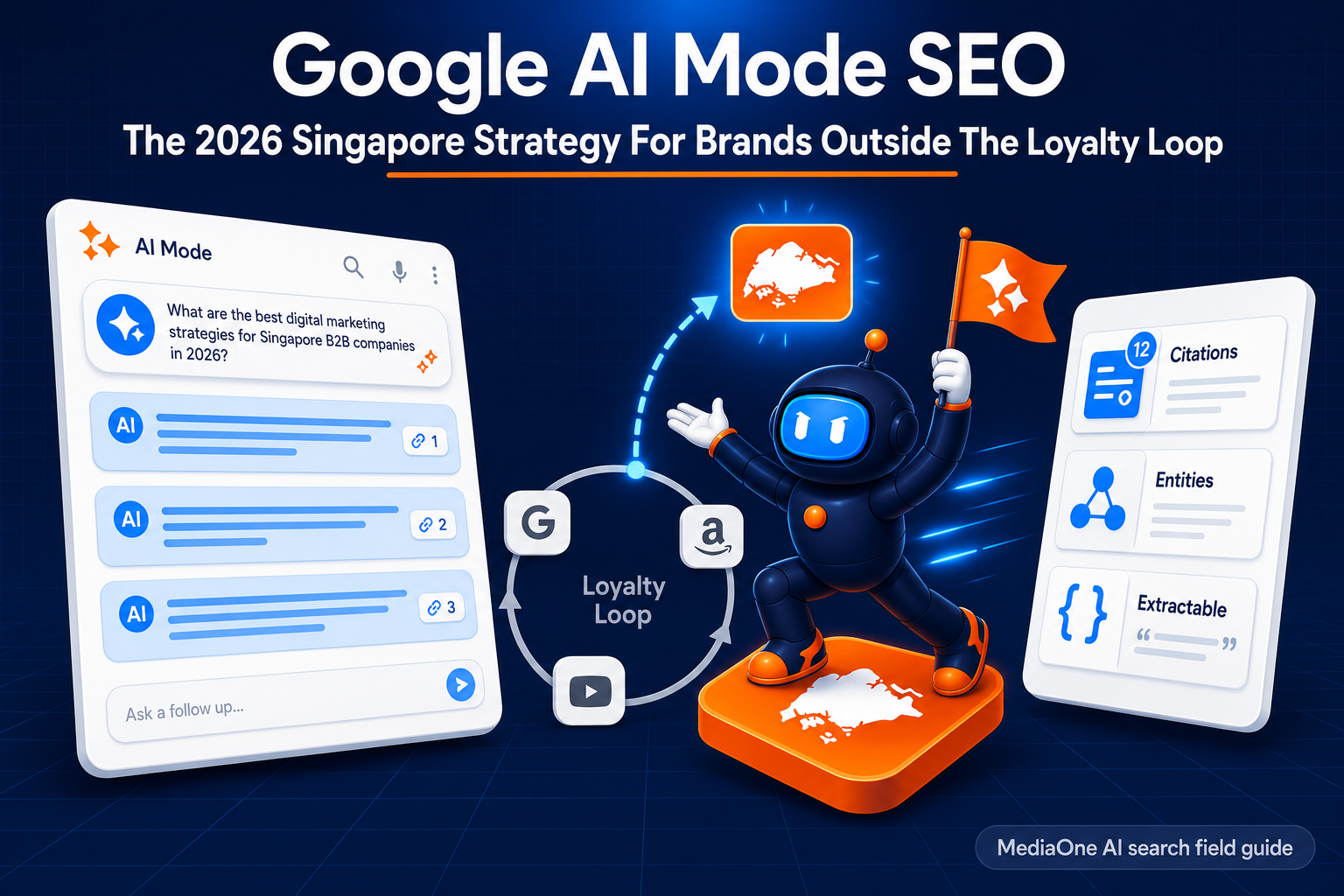
Google has quietly shifted search into a loyalty economy, and Singapore brands feel the pressure first. AI Mode crossed 1 billion monthly users in 2026, while Preferred Sources, Search Profiles, and Subscription Linking each reward publishers that readers already know.

The system makes sense for The Straits Times though, it leaves an awkward question hanging for every Singapore SME, B2B brand, and challenger business still building awareness against established local incumbents.
What does Google AI Mode SEO actually look like for a Singapore brand that is not yet on anyone’s preferred list?
This guide answers the question, drawn directly from the configuration work MediaOne has run for Singapore clients since these features rolled into the Asia-Pacific market. The recommendations sit in territory most SEO content has not yet claimed, which is exactly why moving early on this carries disproportionate upside inside the Singapore market.
Key Takeaways
- Google AI Mode SEO in 2026 involves earning visibility across AI Mode answers, AI Overviews, Preferred Sources selections, and Search Profiles, alongside traditional rank-position work.
- Preferred Sources lets Singapore readers tell Google which brands they want to see more often, with chosen sources receiving twice the click-through rate inside Top Stories, AI Overviews, and AI Mode.
- The loyalty layer rewards brands with existing audiences, while creating a measurable opportunity for Singapore brands to claim category authority before regional competitors do.
- The fastest path forward involves three parallel motions: readiness configuration, owned-audience activation across Singapore channels, and citation seeding inside the publications local readers already trust.
Why Google AI Mode SEO Matters For Singapore Brands In 2026
Search has shifted from a directory model to a loyalty economy. AI Mode crossed 1 billion monthly users according to the Google I/O 2026 Search announcements covering AI agents and product updates. Singapore sits inside one of the highest digital adoption markets in Asia, which means a substantial share of those users are local readers actively shaping their own search experience.
The Singapore-specific implication carries weight. Local readers can now select preferred sources for news, services, and product research. Brands that get badged early gain compounding visibility against established competitors. Newer Singapore brands lose default exposure to anyone who has activated the feature, which puts a deliberate floor under awareness work. Our wider perspective on how AI is changing SEO rankings, local search, and GEO sets out the broader shift this loyalty layer sits inside.
What Google AI Mode SEO Includes
Modern Google AI Mode SEO spans four interconnected surfaces that traditional SEO never had to touch.
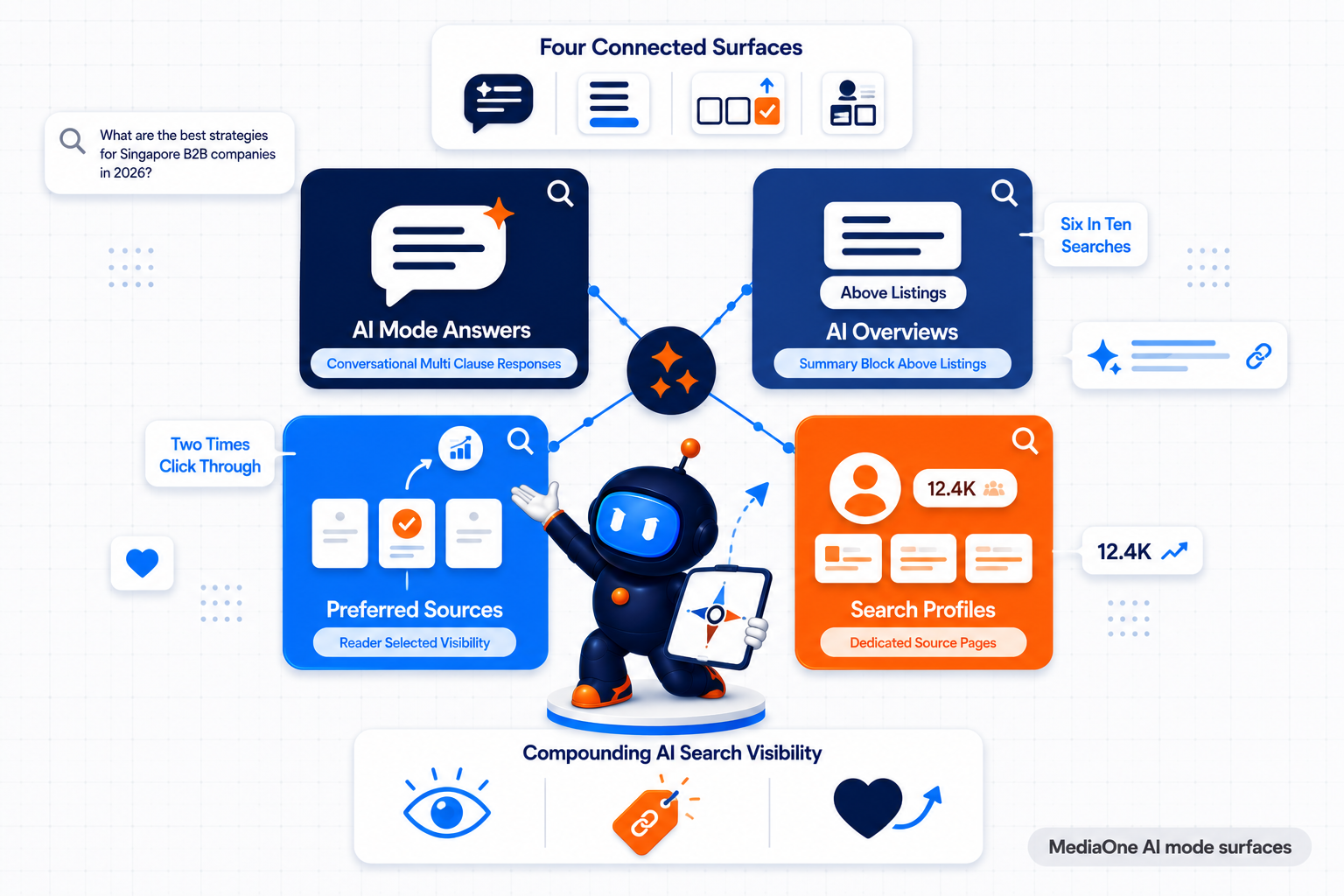
- AI Mode answers: Google generates conversational responses to multi-clause Singapore queries, drawing from the sources it recognises as authoritative.
- AI Overviews: The summarised answer block that now appears across roughly six in ten Google searches, sitting above traditional listings.
- Preferred Sources selections: Readers actively choose which brands they want to see more often, with chosen sources receiving twice the click-through rate.
- Search Profiles: Gives sources with substantial follower counts a dedicated Search page, surfacing more of their content in Discover.
Effective AI Mode SEO addresses all four together, since the surfaces reinforce each other inside the wider Google ecosystem. For deeper coverage of the discipline that ties them together, see our breakdown on what a GEO, AEO, and AI SEO agency actually does.
What Preferred Sources Actually Does
Preferred Sources allows Singapore readers to pick publishers they want to see more of in Google search results. The feature expanded globally including the Singapore market in April 2026 and extended into AI Overviews and AI Mode in May.
Inside Top Stories, chosen sources surface more frequently and appear inside a dedicated “From your sources” section. Inside AI Overviews and AI Mode, links from chosen sources receive a visual badge that helps readers spot them quickly. Google’s official blog announcement on how readers select preferred sources in Top Stories reports that searchers click through to a preferred source at twice the rate they click standard listings, with more than 345,000 unique sources selected globally to date. For the strategic context this connects to, our analysis on how to get content cited in Google’s AI Overviews covers the citation patterns AI surfaces reward.
The Strategic Shift Most Singapore SEO Teams Have Missed
Most coverage of these features frames them as something happening to large publishers. The actual opportunity sits in flipping that view and treating Google AI Mode SEO as the first formal loyalty layer inside Singapore organic search.
So, how will this change your SEO strategy in Singapore for 2026?
Singapore brands that are still optimising purely for rank position are fighting yesterday’s battle. The loyalty layer signals that Google now distinguishes between brands that earned attention and brands that earned trust. Trust is the moat that compounds inside a market as competitive as Singapore’s. Our wider piece on whether AI tools are replacing popular search engines traces how this shift moved from theory into measurable visibility outcomes.
The MediaOne Loyalty Discovery Loop
We call this dynamic the Loyalty Discovery Loop. The cycle works like this. A Preferred Source designation lifts visibility, which lifts repeat exposure, which lifts brand recall, which earns more Preferred Source selections from new Singapore readers. The loop favours brands that get inside it first, since each cycle widens the gap between insiders and outsiders.
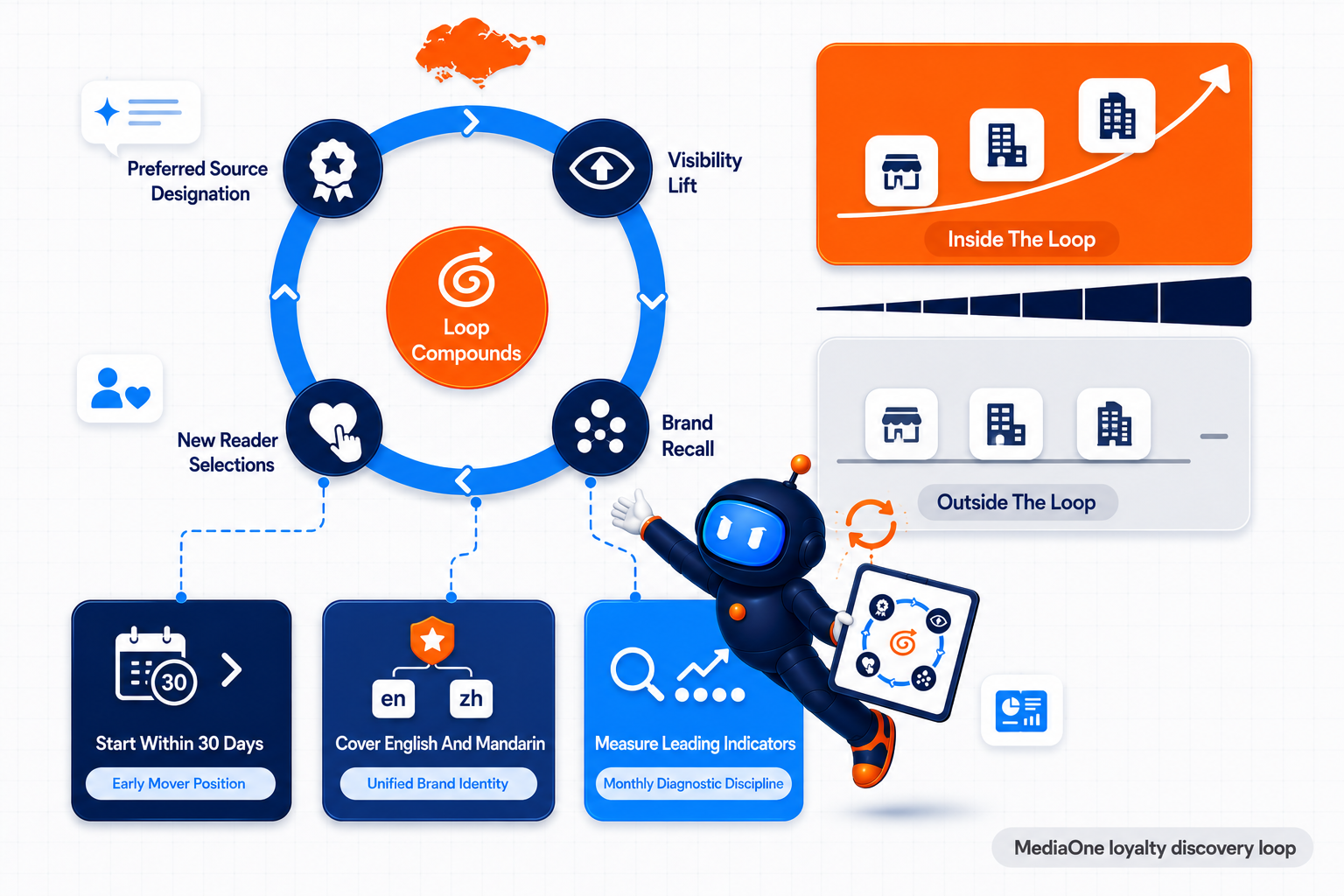
The Singapore opportunity is unusually clean. Local competitors have largely overlooked the wider AI Mode SEO category, which means leadership remains available for any Singapore brand willing to claim it before the rest of the market catches up.
| Strategic Suggestion | Rationale |
| Start the Google AI Mode SEO motion within the next 30 days | Early movers establish positions inside the loyalty loop before Singapore competitors recognise the opportunity |
| Treat AI Mode SEO as a brand programme across English and Mandarin segments | The feature set rewards consistent identity across every Singapore reader touchpoint |
| Measure leading indicators monthly, even where Google offers no direct dashboard | Builds the diagnostic discipline that catches drift before it costs visibility |
Google AI Mode SEO: The Three-Track Approach For Singapore Brands
There is no single switch that earns AI Mode visibility. The mechanism involves multiple reinforcing signals, which means the work runs across three tracks in parallel.
Track 1: Configure The Preferred Source Opt-In On Your Site
The first track involves making it easy for Singapore readers who already trust you to activate the preference. Google’s official Search Central documentation for web publishers on Preferred Sources sets out the eligibility criteria, the deeplink format, and the downloadable button assets you can place across your site.
The deeplink takes readers directly to the Preferred Sources tool with your URL pre-filled, which removes the friction that otherwise blocks casual readers from completing the action. Place the opt-in button alongside existing newsletter signups, social follow prompts, and footer links. The placements that perform best across MediaOne Singapore client deployments sit at the foot of long-form articles, inside email signature blocks, and on dedicated thank-you pages after a subscription action.
Track 2: Activate Your Existing Singapore Audience
The second track turns existing local readers into active selectors. This might make you wonder how you can encourage Singapore readers to add your brand as a preferred source on Google.
The motion needs to feel natural inside the broader content experience. Tactics that have worked across MediaOne Singapore client engagements include personal letters from founders or editors explaining the feature, dedicated EDM campaigns walking subscribers through the one-click process, short video tutorials posted across LinkedIn Singapore and YouTube, and bilingual messaging that accommodates both English and Mandarin segments. WhatsApp Business broadcasts also outperform expectations for local activation, since Singapore consumers respond strongly to messaging-channel communication. The supporting work involves SEO content writing that earns repeat readership, which our 2026 guide to SEO content writing walks through in detail.
Track 3: Earn Citations From Sources Singapore Readers Already Trust
The third track answers the more interesting question: how does a Singapore brand reach readers who only see preferred sources?
The answer involves becoming the source that other preferred sources cite. Singapore publications such as business and trade media need original research, expert commentary, and primary data to fuel their own coverage. Supplying that material gives your brand exposure to their audiences without needing to win the Preferred Source designation directly.
The motion includes pitching original Singapore market data to local business publications, contributing expert quotes to industry journalism, releasing proprietary research aligned with Singapore market cycles such as Budget season and CNY consumer shifts, and building relationships with editors at the publications your target buyers already follow. The wider citation discipline is covered across our off-page generative engine optimisation guide for AI visibility.
The MediaOne Google AI Mode SEO Readiness Audit
Most Singapore brands launching into AI Mode SEO skip the diagnostic step. The result is wasted effort on sites that are not yet ready to convert the visibility into commercial outcomes. The MediaOne AI Mode SEO Readiness Audit walks through six checks before any activation campaign begins.
| Check | What To Look For | What It Usually Reveals |
| Brand entity clarity | Consistent name, logo, and description across the Singapore web | Inconsistent descriptions weaken Google’s recognition of your brand as a defined entity |
| Original content depth | Sections of the site no Singapore competitor could write | Generic content fails to justify AI Mode citation or a Preferred Source selection |
| Author identity signals | Real bylines, author bios, Singapore credentials | Anonymous content struggles to earn trust signals in a relationship-driven market |
| Schema and structured data | Organization, Article, and Person schema in place with local business markup | Missing schema weakens Google’s ability to surface your brand correctly inside Singapore SERPs |
| Brand mention monitoring across AI surfaces | Tooling to track citations across ChatGPT, Claude, Perplexity, and AI Overviews | Without monitoring, you cannot measure Singapore-specific progress against the goal |
| Audience activation channels in Singapore | EDM list, LinkedIn following, WhatsApp Business community | The activation campaign needs Singapore channels that already exist |
Pages with strong fundamentals across these six checks tend to convert AI Mode SEO campaigns at three to five times the rate of pages that skip the audit. The schema portion of the audit follows the methodology in our schema markup guide for structured data and SEO, which covers the Organization markup that anchors entity recognition.
The Personalised Query Layer Singapore Brands Cannot Ignore
Preferred Sources is one half of the loyalty story. The other half involves how AI Mode reads user context to personalise every answer, including for Singapore users.
The example Google’s product team has shared involves a query such as “halal restaurants in Bugis with outdoor seating and dog-friendly options” instead of “Bugis restaurants”. The shift gives Google more context about an individual Singapore user than any traditional search ever did. Layer Personal Intelligence data from Gmail and Photos on top, and the picture becomes even more individual for opted-in users.
What Content Earns A Place Inside Personalised Answers For Singapore Readers
The pattern across our GEO optimisation services engagements points to four content traits.
The first trait is depth beyond AI summary level, including Singapore-specific examples and references. Personalised queries reward content that AI tools cannot easily synthesise from generic global sources. The second is first-hand experience captured in specific detail, including real numbers from Singapore campaigns and observable patterns inside the local market. The third is structural clarity that lets AI extract clean definitional sentences. The fourth is consistent entity signals that let AI recognise your Singapore brand reliably across surfaces.
| Content Trait | Why AI Mode Rewards It For Singapore Users |
| Depth beyond summary with local detail | Personalised answers need Singapore-specific specifics no global AI can fabricate |
| First-hand Singapore market experience | Local numbers and observations carry verifiable provenance |
| Structural clarity | Clean definitional sentences extract cleanly into AI answers |
| Consistent entity signals across SG-relevant surfaces | Cross-surface consistency reinforces local brand recognition |
For a closer view of how entity signals translate into brand discovery, our piece on how GEO is affecting branding online explores the mechanics in depth.
The Latent Category Space Around Google AI Mode SEO In Singapore
Most coverage of AI Mode describes the features without giving Singapore readers a clear path forward. That gap is the territory worth claiming. Whichever Singapore brand publishes the definitive resources on the topics below first will own the local SERP and the AI citations for at least the next 18 months.
| Topic | Why It Is Underclaimed | Why It Matters For Singapore Buyers |
| AI Mode SEO workflow for Singapore SMEs | Most global coverage targets large international publishers | Singapore SMEs face a different activation challenge that existing content ignores |
| AI Mode optimisation for Singapore B2B brands without a news output | The features read as news-focused, leaving B2B coverage thin | Singapore B2B buyers need a tailored local interpretation |
| Measuring AI Mode visibility for Singapore traffic without a Search Console filter | Google offers no direct measurement, so most content avoids the question | Diagnostic frameworks fill a real reader need in the Singapore market |
| AI Mode SEO and PDPA consent interaction | Singapore-specific consideration nobody else has written | Reduces friction during local compliance reviews |
| Citation seeding through Singapore publications | The motion exists, while no resource has named or systemised it for the local market | Gives Singapore brands a concrete category-leadership move |
| Bilingual AI Mode SEO across English and Mandarin readers | Global coverage assumes single-language audiences | Reflects the actual Singapore consumer reality |
The Singapore brand that publishes the definitive guide on each of these six topics first will earn disproportionate AI citations and traditional rankings inside the local market for the next 12 to 18 months.
Measuring Google AI Mode SEO Performance For Singapore Traffic
Google has not yet released a Search Console filter that isolates Preferred Source impressions or AI Mode click activity. The absence of direct measurement frustrates Singapore teams, while the workaround is more tractable than most coverage suggests.
The MediaOne AI Mode SEO Indicator Set
We track four leading indicators in parallel for Singapore client accounts.
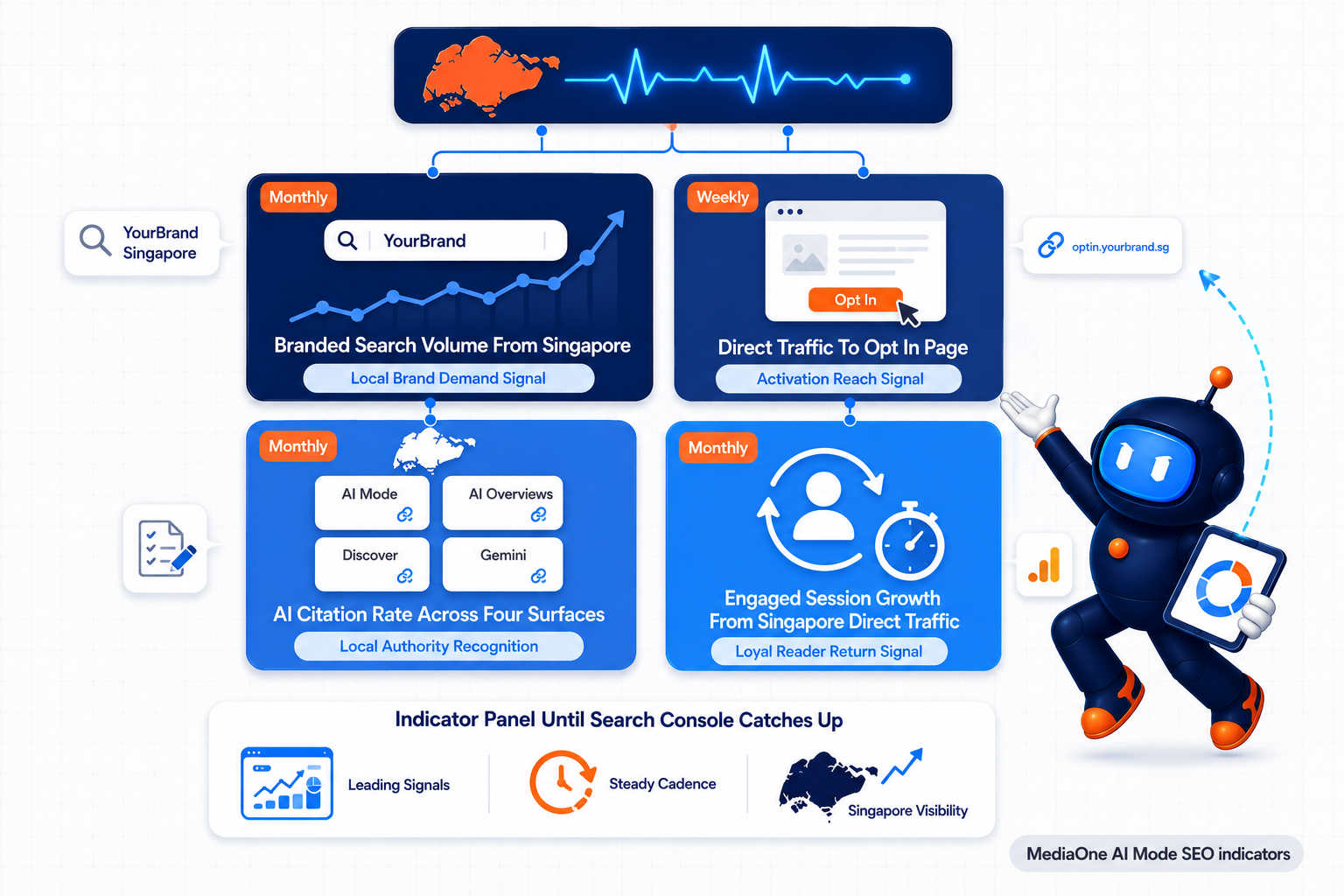
The first indicator involves branded search volume on monthly cadence, segmented by Singapore IP. A rising line shows local readers are seeking out your brand by name, which correlates with AI Mode citation likelihood. The second involves direct traffic to the Preferred Source opt-in page on your own site, since this number tells you how many Singapore readers reached the deeplink button.
The third indicator covers AI citation rate inside ChatGPT, Claude, Perplexity, and Google AI Overviews when queried from Singapore. A monthly manual check across 20 priority topics surfaces whether your brand is gaining citation share inside the local market. The detailed methodology lives in our breakdown of what AI Overview citations are and how to track them. The fourth involves engaged-session growth from direct traffic inside GA4, filtered to Singapore. Loyal local readers tend to return directly to your site, which surfaces inside this segment cleanly.
| Indicator | What It Tells You | Cadence |
| Branded search volume from Singapore | Whether local readers are actively seeking your brand by name | Monthly |
| Direct traffic to opt-in page | How many Singapore readers reached the activation button | Weekly |
| AI citation rate across four surfaces from Singapore queries | Whether AI tools recognise your brand as locally authoritative | Monthly |
| Engaged-session growth from Singapore direct traffic | Whether loyal local readers are returning of their own accord | Monthly |
The set works as a leading-indicator panel until Google releases direct reporting. Singapore teams that build this discipline early will sit ahead of the curve once Search Console adds the missing surface.
The MediaOne View On Google AI Mode SEO For Singapore Brands In 2026
AI Mode SEO is the first signal that organic search has become a loyalty channel inside Singapore. The shift makes brand investment indistinguishable from SEO investment, which is a conversation most Singapore CFOs have been resisting for years.
The Singapore brands compounding visibility across the next 18 months share five habits.
| Habit | What It Looks Like In Practice |
| Treat brand and SEO as one engagement | Brand recognition is now an active ranking and citation input inside Singapore SERPs |
| Run an AI Mode SEO readiness audit before activation | Avoids burning Singapore audience attention on a site that cannot convert it |
| Publish original Singapore market data quarterly | Earns citations from preferred sources already inside the loop locally |
| Track AI citation rate alongside traditional rankings | Surfaces the loyalty signal that traditional analytics misses |
| Commit to the activation programme for at least six months | Singapore reader habits take time to shift, while one-shot campaigns underperform |
MediaOne works with brands that do not approach AI Mode SEO as a one-off feature opt-in. They approach it as the first move inside a wider shift toward brand-led organic search, which compounds over years of consistent execution inside the local market. The practical activation patterns sit inside our guide on how to still get mentioned in Google AI Overviews.
Bringing It Together
Google AI Mode SEO rewards Singapore brands local readers already trust. The feature set creates a real awareness ceiling for brands outside the loyalty loop, while the same dynamic opens an unusually clean category-leadership opportunity for Singapore brands willing to move first.
The path forward involves three parallel tracks running together. Configure the opt-in correctly on your own site. Activate the Singapore audience you already have through deliberate campaigns across EDM, LinkedIn, and WhatsApp Business. Seed citations across the local publishers your buyers already follow.
The Singapore brands that start this work in 2026 will sit comfortably inside the Loyalty Discovery Loop by 2027. The brands that wait will spend the next two years explaining why their organic visibility keeps slipping behind local competitors they used to outrank.
If your team is ready to claim category authority inside Google’s new loyalty layer, our team at MediaOne can help. Our GEO agency and broader brand engagements are built around the same principles described throughout this guide. Request a quote to start shaping the strategy that maps to your business.
Frequently Asked Questions
What is Google AI Mode SEO?
Google AI Mode SEO is the discipline of earning visibility across Google’s AI-driven search surfaces, including AI Mode conversational answers, AI Overviews, Preferred Sources selections, and Search Profiles. The work goes beyond traditional rank-position optimisation and addresses how Google now distinguishes between brands that earned attention and brands that earned trust.
How do you rank in Google AI Mode?
Ranking in AI Mode involves building entity signals across the web, publishing content with depth beyond what AI tools can synthesise from generic sources, earning citations from publishers already inside the loyalty loop, and configuring Preferred Sources opt-ins so local readers can actively select your brand. The combination matters more than any single tactic.
How do you become a preferred source on Google Singapore?
Becoming a preferred source involves three parallel tracks. Configure the official opt-in deeplink on your site using Google Search Central’s documentation. Activate your existing Singapore audience through EDM, LinkedIn, and WhatsApp Business campaigns that show local readers how to add your brand. Earn citations from Singapore publishers already inside the loyalty loop.
Can a Singapore SME compete in AI Mode SEO?
Yes. The Preferred Sources feature does not require minimum traffic or follower thresholds, which differs from Search Profiles. Singapore SMEs often succeed by activating engaged audiences across local newsletters, LinkedIn communities, WhatsApp Business broadcasts, and industry events, which compounds AI Mode visibility over time.
How do you measure Google AI Mode SEO performance?
Google has not yet released a Search Console filter for AI Mode visibility. The MediaOne AI Mode SEO Indicator Set tracks four leading signals in parallel: Singapore branded search volume, direct traffic to the activation page, AI citation rate across major surfaces queried locally, and engaged-session growth from Singapore direct traffic.
How does AI Mode personalisation affect SEO strategy in Singapore?
AI Mode reads user context to personalise answers based on query depth, Preferred Source selections, and Personal Intelligence data from Gmail and Photos. The shift rewards content with first-hand Singapore experience, structural clarity, original local data, and consistent entity signals. Generic global content struggles inside personalised answers for Singapore users.
What is the difference between Preferred Sources and Search Profiles?
Preferred Sources lets readers select publishers they want to see more often, with no follower minimum, which suits Singapore SMEs perfectly. Search Profiles offers a dedicated Search page to sources with 100,000+ followers on YouTube, Instagram, or X, or 300,000 on TikTok. Subscription Linking allows paying readers to connect publisher subscriptions to Google Accounts for highlighted access.
When should Singapore brands start optimising for Google AI Mode SEO?
The honest answer involves starting within the next 30 days. Early Singapore movers establish positions inside the Loyalty Discovery Loop before competitors recognise the opportunity. Local reader habits take six to twelve months to shift, while campaigns launching in 2026 will compound visibility through 2027 and beyond.