
Did you know that organic search continues to drive the largest share of website traffic for most businesses, while the rules for capturing it have changed more in the past six months than in the previous six years? Google rolled out its March 2026 core update with a sharpened focus on credibility and original perspective, AI Overviews now intercept roughly six in ten queries before users ever reach a traditional results page, and ChatGPT, Claude, and Perplexity are quietly reshaping which brands get cited as authoritative.

Simply creating content has stopped working. To stand out, your content needs to be strategically optimised for search engines while staying valuable and engaging for real humans.
It is also why many businesses choose to work with a specialist team to make sure their content supports rankings, AI citations, and real business outcomes simultaneously. In this guide, we will walk you through the essential strategies, proprietary frameworks, and 2026-specific best practices for SEO content writing that actually move the needle. Along the way, you will see where most brands compete head-to-head in saturated keyword pools, and where genuine Blue Ocean opportunities sit waiting for the teams brave enough to claim them.
Key Takeaways
- SEO content writing in 2026 means writing for three audiences at once: human readers, search engine crawlers, and AI answer engines that cite sources.
- The MediaOne approach treats credibility signals, entity clarity, and original perspective as foundational, since Google’s March 2026 core update has made these the strongest ranking factors.
- Generic content is dead. The brands winning at SEO content writing publish firsthand perspective, proprietary data, and named frameworks that AI tools and search engines can extract and attribute.
- The biggest growth opportunities sit in uncontested topic territory, where original research and named methodologies create demand other brands cannot match.
What SEO Content Writing Actually Means In 2026
SEO content writing is the practice of producing material that performs well in search engine results while genuinely serving the reader. The discipline involves high-quality, informative, and engaging writing combined with strategic use of keywords, headings, meta descriptions, structured data, and entity signals.
The purpose extends beyond ranking. The goal is making content valuable to readers, easily discoverable across Google and AI surfaces, and citable as an authoritative source. The brands that get this right enjoy compounding organic traffic, stronger AI citation rates, and lower customer acquisition costs over time.
Harvard Business Review’s analysis of how people are really using AI in 2026 confirms that information-seeking now spans 12,000 distinct use cases, with most beginning inside an AI tool. Content that earns visibility in those tools shapes commercial outcomes more decisively than ever.
How SEO Content Writing Differs From Regular Content Writing
Regular content writing focuses on informing, entertaining, or persuading readers without considering search engine visibility. SEO content writing balances audience needs with the requirements of search engines and AI tools. It incorporates keyword research, entity optimisation, internal and external linking, and structured content to improve discoverability while maintaining readability.
The benefits that compound over time:
- Increased visibility across both traditional search results and AI Overviews.
- Higher rankings on commercial keywords that drive revenue.
- Stronger audience engagement through content that captures attention and earns time on page.
- AI citation potential when entity signals and original perspective are baked in from the start.
- Authority compounding as the content library matures and earns backlinks organically.
- Lower paid acquisition pressure as organic search picks up demand previously served by ads.
- Defensible category positioning as proprietary frameworks become attributed back to your brand.
The 2026 Reality Every SEO Content Writer Needs To Understand
The SEO content writing landscape in June 2026 looks substantially different from even 12 months ago. Three shifts have reshaped what works.
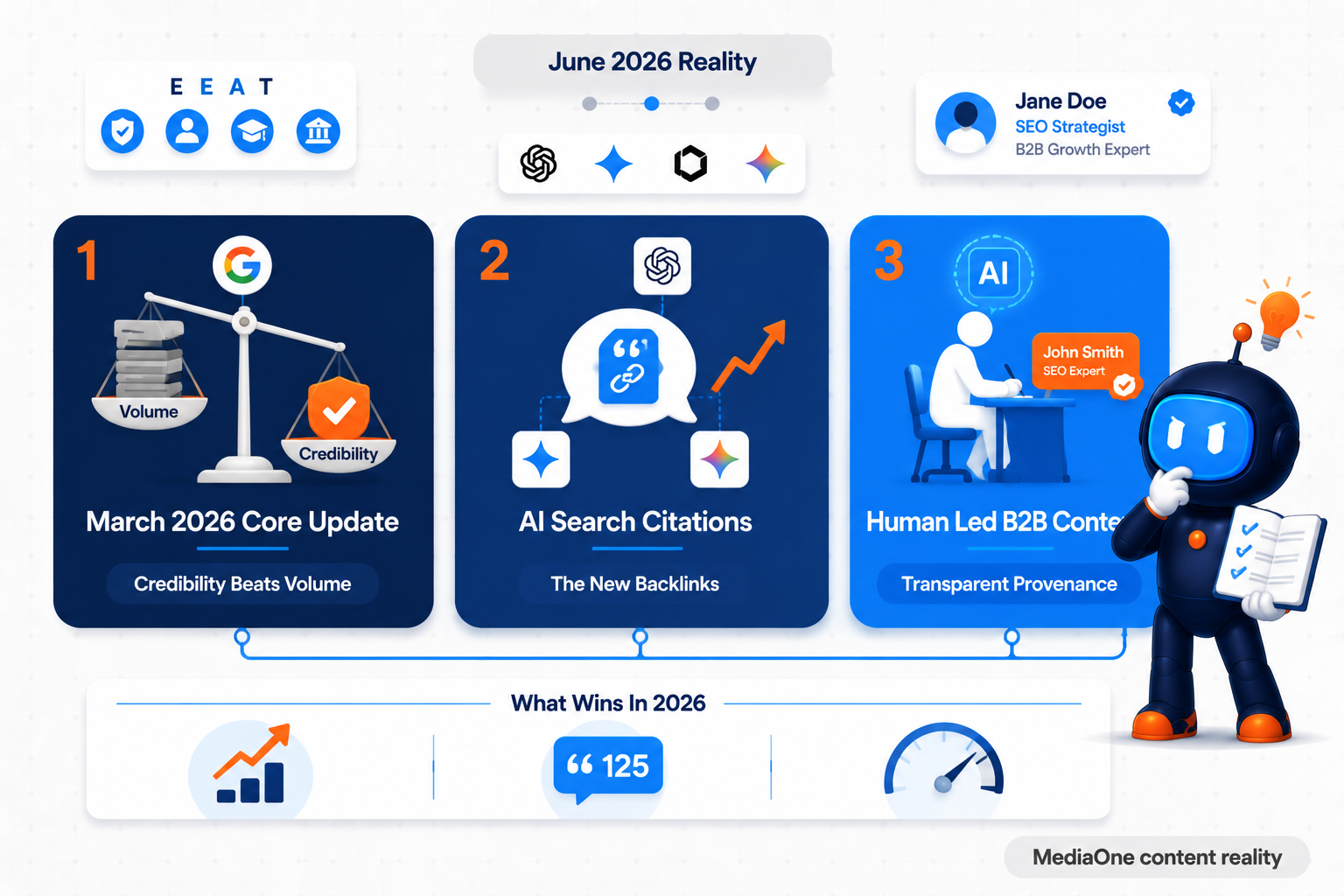
Shift 1: Google’s March 2026 Core Update Rewards Credibility Over Volume
Google’s official documentation on the March 2026 core update signals a clear pivot toward credible businesses with verifiable expertise. Sites publishing high volumes of AI-generated content with no original perspective saw substantial ranking drops. Sites with firsthand authority, proprietary frameworks, and named experts climbed.
The implication for content briefs is sharp. Generic explainer content covering well-trodden topics struggles to gain traction. Content carrying real author expertise, specific examples, and credible methodology continues earning rankings even on competitive commercial keywords.

Shift 2: AI Search Citations Are The New Backlinks
Comscore’s Q1 2026 AI Intelligence Report on Claude’s growth and AI search adoption found Claude alone reached 22 million desktop conversations in March 2026, up 1,858% compared with October 2025. Anthropic’s own Economic Index report on Claude usage patterns confirms how rapidly AI search is becoming a primary discovery channel. Content that earns citations from these tools enjoys a visibility tier traditional rankings cannot match.
The compounding effect matters. A single AI citation can recur across thousands of similar queries, delivering passive brand exposure that no individual ranking position can match.
Shift 3: B2B Marketers Are Doubling Down On Human-Created Content
The Content Marketing Institute’s 2026 B2B Content and Marketing Trends research surveying over 1,000 marketers shows a clear pattern. Brands winning at content marketing in 2026 prioritise human-led work supported by AI, alongside transparent provenance and clear point of view. The market has wised up to generic AI output.
The Edelman Trust Barometer’s 2026 findings on credibility and information sources underscore the same direction. Audiences are increasingly sceptical of unattributed content, while sources with named expertise and consistent identity earn disproportionate trust.
The Blue Ocean Opportunity Hiding In SEO Content Writing
Most SEO content writing happens inside what could be called the Red Ocean of search. Every brand chases the same keywords, follows the same content templates, and produces variations on the same advice. The result is a crowded pool where ranking demands more effort each quarter for diminishing returns.
The Blue Ocean of SEO content writing sits in uncontested topic territory. These are the search themes where demand exists yet no one has built a definitive resource, where proprietary research can claim a category, and where named methodologies become the language the rest of the industry adopts.
Where the Blue Ocean opportunities sit in 2026 SEO content writing:

| Opportunity | Why It Is Uncontested | How To Claim It |
| Proprietary frameworks with named methodology | Most brands publish generic advice, leaving framework naming wide open | Build, name, and consistently apply your own diagnostic models |
| Original industry data and benchmarks | Survey-based content is rare because it takes effort | Run a quarterly survey of your client base or industry segment |
| Niche intersection topics | Mainstream content sticks to broad subjects | Combine two adjacent topics into one comprehensive resource |
| Hyper-specific case studies with real numbers | Most case studies omit the numbers that make them credible | Publish anonymised real-figure results with permission |
| AI citation territory on emerging queries | New AI queries surface daily with no established authority | Move first on emerging topics in your category |
Content competing in the Red Ocean of search rewards diminishing effort. Content claiming Blue Ocean territory rewards the brand that arrives first with depth and stays consistent.
| Strategic Suggestion | Rationale |
| Audit the top 50 keywords in your category for “definitive resource” gaps | Reveals topics where no single source dominates, opening the door for your brand to claim it |
| Commit to one proprietary research project per quarter | Original data creates citations no competitor can match |
| Name every framework, methodology, and diagnostic you apply | Naming creates ownership and makes attribution easy for AI tools and journalists |
The MediaOne Triple-Audience Framework
Most SEO content writing guides treat the reader as the only audience. The reality in 2026 is that every piece of content speaks to three audiences simultaneously, and the best content satisfies all three.

The MediaOne Triple-Audience Framework:
| Audience | What They Need From The Content | How To Deliver It |
| Human readers | Genuine value, clarity, fresh perspective | Original analysis, specific examples, scannable structure |
| Search engine crawlers | Topical depth, entity clarity, structured signals | Schema markup, internal links, keyword coverage, semantic richness |
| AI answer engines | Extractable facts, definitional sentences, citable claims | Clear opening sentences, named frameworks, attributable statistics |
Content that wins for one audience while ignoring the others delivers a fraction of its potential. Content that wins for all three compounds in value year after year.
| Strategic Suggestion | Rationale |
| Open every article with a definitional sentence the AI can extract verbatim | AI tools tend to lift the first concise answer they find, which lifts citation rates |
| Include at least one named framework or proprietary term per long-form piece | Gives search engines and AI tools something distinctive to attribute to your brand |
| Build content briefs around all three audiences before writing | Forces the team to think about extraction and indexability alongside readability |
| Review every piece for “what would an AI quote from this page” before publishing | Catches missing definitional sentences early, when fixing them costs nothing |
Tools That Support SEO Content Writing In 2026
The right tools accelerate the work, while strategic judgement still belongs to experienced practitioners. The tool categories that matter for SEO content writing in 2026:
| Category | Purpose |
| Keyword research platforms | Identify relevant keywords, search trends, and intent patterns |
| Writing and readability checkers | Improve grammar, clarity, and overall readability |
| On-page SEO optimisation tools | Optimise meta tags, headings, and content structure |
| AI citation monitoring | Track where your content appears across ChatGPT, Claude, Perplexity, and Google AI Overviews |
| Schema and structured data validators | Ensure technical signals match content claims |
| Topical authority mappers | Visualise content cluster coverage gaps and surface uncontested topics |
Tools alone deliver nothing without the right strategy guiding them. The strategic decisions about which keywords to target, which formats to commission, and which topics deserve depth still belong to humans who understand the business context.
A common observation from client onboarding sessions: teams often own four or five expensive tools yet apply each at 20% of capacity. The leverage comes from disciplined use of two or three tools, not the proliferation of dashboards.
The Essential Components Of SEO Content Writing
To rank well in search engines, earn citations in AI answers, and engage real readers, writers focus on several interconnected elements.
The components every SEO content writer applies:
- Keyword research that surfaces what your audience actually searches for and the intent behind each query.
- Compelling headlines and subheadings that incorporate keywords while staying genuinely useful.
- High-quality, valuable content that delivers informative and original material.
- Optimised meta titles and descriptions that summarise the content and earn clicks from search results.
- Internal and external linking that strengthens authority and supports navigation.
- Readable formatting through short paragraphs, bullet points, and clear visual hierarchy.
- Multimedia integration with images, videos, infographics, and other media that enhance understanding.
- Mobile and technical optimisation including fast loading speeds and adherence to SEO best practices.
- Regular content updates that maintain accuracy and relevance over time.
- Entity and schema signals that connect your content to recognised concepts in search and AI knowledge graphs.
- Named frameworks and proprietary terms that establish topical ownership.
- Original data points and firsthand observations that AI tools and journalists cite back to your brand.
The MediaOne 8-Step SEO Content Writing Process
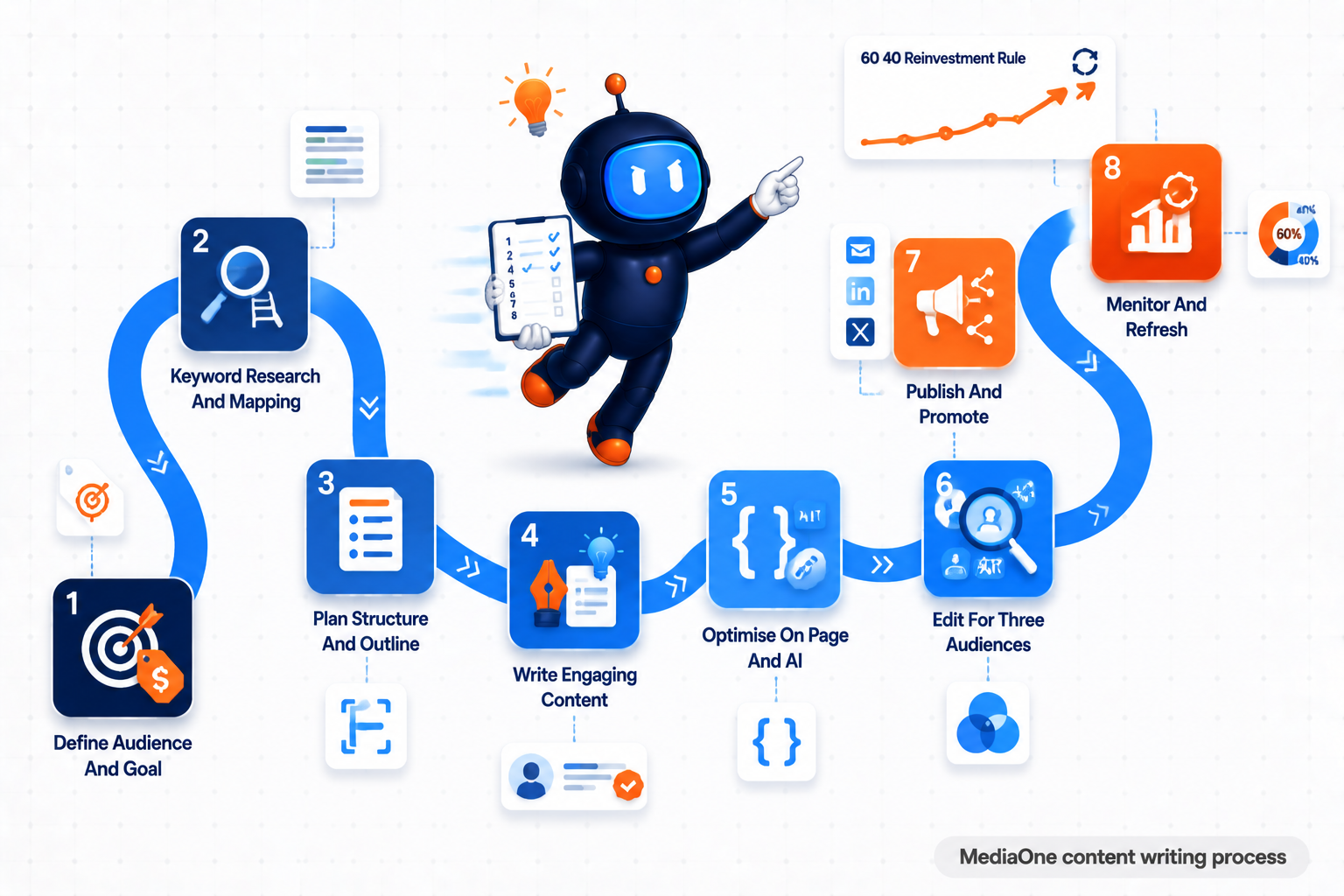
Creating SEO content that ranks well, earns AI citations, and engages your audience requires a structured approach. Here is the process we apply for SEO content writing clients.
Step 1: Define Your Target Audience And Commercial Goal
Before writing anything, identify who the content serves and what commercial outcome it supports. Consider audience demographics, interests, and the specific search journey they are on. Set clear objectives such as driving qualified traffic, generating leads, building authority, or supporting conversions. Understanding your audience and goal ensures the content resonates and pays back commercially.
A practical move that many teams skip: write the commercial outcome at the top of the brief in one sentence. Every editorial decision then traces back to that single anchor.
Step 2: Conduct Keyword Research And Map To Commercial Intent
Keyword research is the foundation of SEO content. Identify terms and phrases your audience searches for and segment them by commercial intent. A useful mental model is the MediaOne Commercial Intent Ladder, which ranks queries from “buy now” through to “curiosity” so editorial effort flows toward the keywords closest to revenue.
Include a mix of high-volume keywords for reach and long-tail keywords for targeted traffic. The fundamentals are covered in our Google Keyword Planner guide for content planning, which walks through how to organise keywords into intent-driven clusters and prioritise them by potential ROI.
Selecting the right focus keywords ensures content aligns with user intent and improves discoverability. The Blue Ocean move at this stage is identifying keywords with genuine search demand where no single source dominates the SERP. These are the topics where claiming definitive authority is still on offer.
Step 3: Plan The Content Structure And Outline
Organise your ideas into a logical structure before writing begins. Create an outline with headings, subheadings, and key points to organise content effectively. The structure should support both human scanning behaviour and AI extraction patterns. Nielsen Norman Group’s research on how people read online and the F-shaped scanning pattern confirms that readers absorb only a fraction of words on a page, which makes structure decisive for retention.
A strong outline answers three questions before drafting begins: what definitional sentence opens each section, what proprietary insight does the section contain, and what would an AI tool quote from this section.
Step 4: Write High-Quality, Engaging Content
Produce original, informative, and engaging content addressing your audience’s needs. Use a clear conversational tone and avoid keyword stuffing. Incorporate examples, statistics, case studies, and firsthand insight to add value. High-quality content keeps readers engaged, increases time on page, and earns shares.
This is where our approach diverges from generic content writing advice. Every piece should carry at least one element AI tools cannot easily replicate. Real client patterns, specific numbers from actual campaigns, named frameworks, and well-defended positions all qualify.
Step 5: Optimise For On-Page SEO And AI Extraction
On-page optimisation helps search engines and AI tools understand your content. Include focus keywords in the title, headings, meta description, and URL. Add internal links to related pages and external links to authoritative sources outside your competitive space. Optimise images with descriptive alt text and ensure proper formatting with bullet points, short paragraphs, and clear headings.
Add entity signals through structured data and consistent brand description across the web. The full implementation walkthrough lives in our schema markup guide for structured data and SEO, covering Article, Organization, FAQ, and HowTo schema types.
This is what makes content discoverable by AI answer engines, alongside traditional search.
Step 6: Edit And Proofread For Three Audiences
Review content for grammar, spelling, clarity, and consistency. Ensure it flows logically and aligns with your brand voice. Check that SEO elements are correctly applied and keywords are naturally integrated. Verify that the opening sentence is extractable, the body covers the topic with depth, and the structure supports scanning.
A useful final check is reading the piece aloud. If a sentence stumbles when spoken, it stumbles when read. AI tools also struggle to extract clean quotes from convoluted prose, which makes spoken clarity a quiet citation signal.
Step 7: Publish And Promote Strategically
Once content is ready, publish it on your website and make it accessible. Promote through social media, email newsletters, and relevant online communities. Strategic distribution amplifies reach, drives traffic, and builds engagement signals that compound the SEO benefit.
Distribution should match the format. Long-form guides earn from email and LinkedIn. Data-led pieces earn from journalist outreach. Visual frameworks earn from social syndication. Matching format to channel often doubles the return on the same content investment.
Step 8: Monitor Performance And Refresh Regularly
Use analytics tools to track key performance metrics including traffic, engagement, bounce rate, search rankings, and AI citation rates. Identify which content performs and which needs improvement. Apply the MediaOne 60/40 Content Reinvestment Rule, which allocates 60% of editorial effort to refreshing existing high-value pages and 40% to producing genuinely new content.
The discipline pays back in months rather than years. Refreshed pages typically re-rank within four to eight weeks, while genuinely new content takes six to nine months to mature. Allocating the majority of editorial effort to refreshing means seeing commercial impact substantially faster.
The Hidden Cost Of AI-Generated SEO Content (And How To Avoid It)
A pattern emerged sharply through 2025 and into 2026. Brands that flooded their sites with AI-generated content saw initial traffic spikes followed by punishing ranking drops once Google’s quality systems caught up. The March 2026 core update accelerated the correction.
AI tools belong in the SEO content writing workflow as accelerators, while the strategic decisions and original perspective must come from humans who understand the business and the audience. Any agency promising “AI-generated SEO content at scale” is selling a strategy with a predictable expiry date.
This is what we internally call The AI Content Plateau, the phenomenon where sites grow fast on generic AI output, then plateau or decline once search engines and AI answer engines downgrade them as undifferentiated.
The four signals that a site has hit the AI Content Plateau:
- Rankings climb on long-tail terms for six to nine months, then reverse sharply.
- Bounce rates rise across the content library even as traffic grows.
- AI citation rates stay flat or decline despite increased publishing volume.
- Backlink acquisition slows as journalists and bloggers find nothing distinctive worth citing.
The fix is straightforward in principle and demanding in practice. Replace volume with perspective. Replace AI summary with firsthand analysis. Replace generic frameworks with proprietary ones the brand can credibly own.
If the draft could have been produced by typing the brief into ChatGPT and pressing enter, it has not yet earned the right to publish.
SEO Content Writing Mistakes To Avoid
When creating SEO content, several practices harm both user experience and search rankings.
The mistakes that show up repeatedly in our audits:
- Keyword stuffing that overloads content and triggers algorithmic penalties.
- Ignoring user intent by focusing on keywords without considering what the audience actually wants to find.
- Thin or duplicate content that adds no value and dilutes site authority.
- Neglecting meta tags and headings which reduces visibility and makes navigation harder.
- Treating AI tools as content factories which produces the AI Content Plateau described above.
- Skipping entity signals which leaves AI answer engines unable to recognise the brand as a source.
- Publishing without a refresh schedule which lets content decay quietly over time.
- Reporting traffic without commercial context which masks whether the content is actually contributing to revenue.
- Competing exclusively in saturated keyword pools while ignoring uncontested Blue Ocean territory.
- Failing to name frameworks and methodologies, leaving valuable attribution territory unclaimed.
The 2026 Trends Reshaping SEO Content Writing
The landscape continues shifting fast. The trends worth investing in over the next 12 to 18 months:
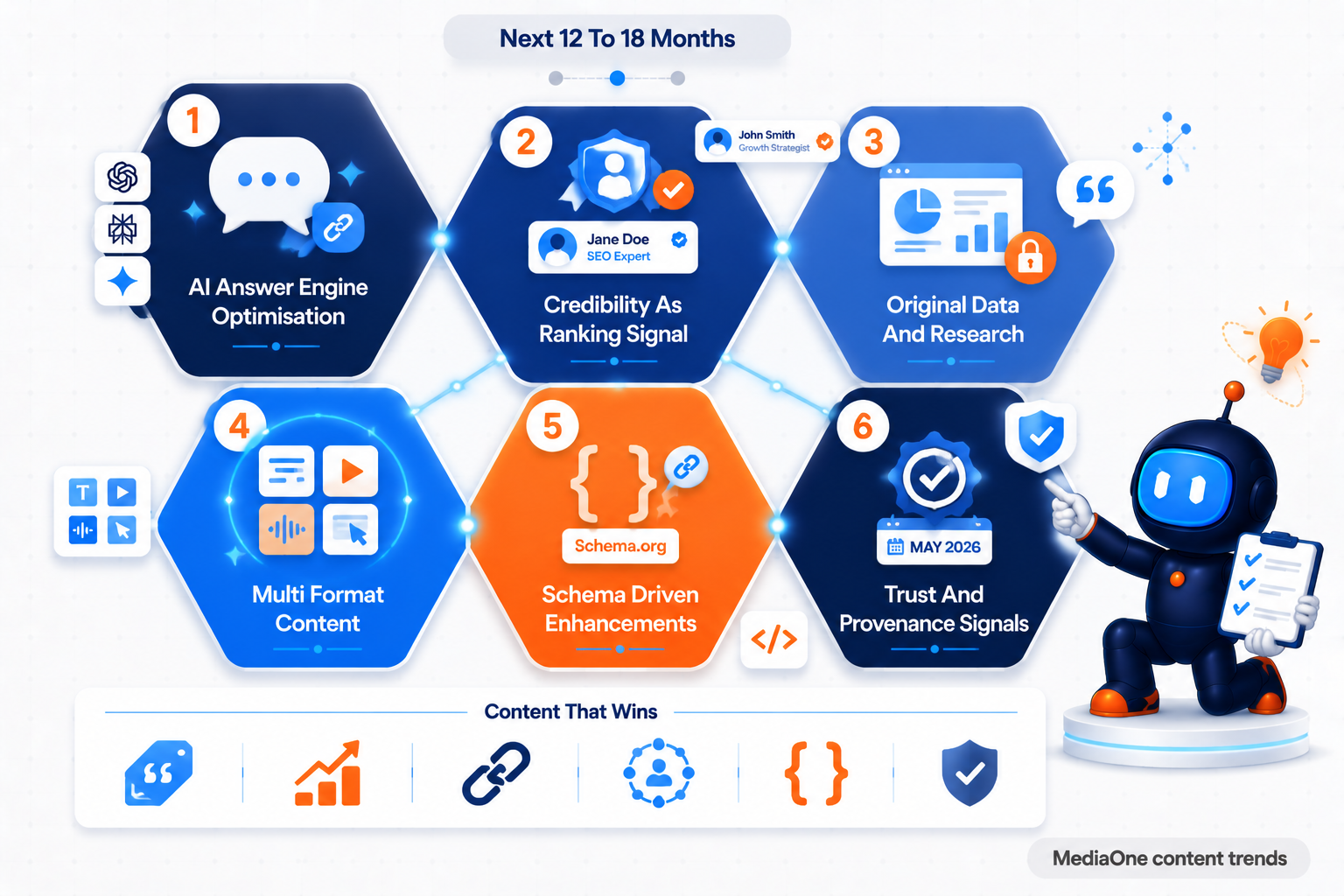
AI Answer Engine Optimisation
ChatGPT search, Claude with web search, Perplexity, and Google AI Overviews now intercept a large share of queries. OpenAI’s official announcement of ChatGPT search and how it cites web sources confirms that linked citations are core to the experience. Earning these citations involves clear definitional sentences, original data, structured markup, and consistent entity signals. Our GEO optimisation services covers the full approach.
Credibility As The Strongest Ranking Signal
Google’s March 2026 core update made credibility a primary ranking input. Author bylines, verified expertise, organisational reputation, and consistent entity signals across the web now matter as much as on-page optimisation. Anonymous content struggles. Content with named experts and traceable authority climbs.
Original Data And Proprietary Research

Content that contains original data earns disproportionate AI citations and backlinks. Industry surveys, proprietary benchmarks, and named frameworks function as gravitational pull for both AI tools and human journalists. Brands publishing original data quarterly outperform brands publishing weekly summaries of other people’s data. This is one of the clearest Blue Ocean signals in SEO content writing today.
Multi-Format Content Strategies
The same topic now needs to exist in text, video, audio, and interactive formats to capture demand across search, social, and AI surfaces. Single-format content libraries are losing ground to multi-format ecosystems that meet audiences wherever they search.
Schema-Driven Content Enhancements
Structured data signals continue gaining importance. Article schema, Organization schema with sameAs properties, FAQ schema, and HowTo schema all help AI tools extract and attribute content reliably. Brands that treat schema as foundational, alongside copy, are pulling ahead. A common starting point is our local SEO schema markup implementation guide for service businesses, alongside the e-commerce schema markup guide for product, offer, and review data for retail brands.
Trust And Provenance Signals
The World Economic Forum’s 2026 reporting on AI, content trust, and digital integrity underscores how audiences and platforms alike are pushing for clearer provenance on published material. Bylines, dated updates, and visible expertise indicators are becoming baseline expectations. Brands treating these signals as foundational sit on the right side of the trust curve.
SEO Content Writing For The Singapore Market
Singapore’s competitive content landscape rewards specificity. Generic global content struggles to rank against locally-relevant material that reflects how Singaporean audiences actually search.
What Singapore-specific SEO content writing looks like in practice:
- Localised examples that resonate with the Singapore market.
- Bilingual considerations where the audience straddles English and Mandarin.
- Reference to local regulations, business contexts, and consumer behaviour.
- Cross-border framing for businesses serving the wider ASEAN region.
- Schema markup tailored for local business listings and regional relevance.
- Singapore-specific data points and case studies that global content cannot match.
Why MediaOne Wins At SEO Content Writing
A candid look at why brands choose our team for SEO content writing in Singapore comes down to four habits applied consistently across every client engagement.
| Habit | What It Looks Like In Practice |
| Writing with a point of view | Every long-form piece states a clear position the brand can credibly defend |
| Building proprietary frameworks | Named methodologies that AI tools and search engines attribute to the brand |
| Refreshing aggressively | Existing high-value pages get updated every three to six months on a fixed schedule |
| Reporting in revenue, not traffic | Performance reports answer the question “what did organic search contribute this quarter” |
The brands we work with do not buy “SEO content” as a commodity. They buy a system that turns content into a measurable contribution to the business, supported by people who have seen what works across hundreds of campaigns.
Wrapping Up Your SEO Content Writing Journey
Effective SEO content writing in 2026 is the discipline of producing material that serves human readers, satisfies search engines, and earns citations from AI answer engines. The brands that master all three audiences see organic traffic compound, citation rates climb, and customer acquisition costs fall over time.
Apply the frameworks consistently. The Triple-Audience Framework keeps every piece accountable to readers, crawlers, and AI tools. The 8-step writing process keeps the work systematic. The 60/40 Reinvestment Rule keeps the library growing in value alongside volume. Awareness of the AI Content Plateau keeps the team focused on perspective over output. The Blue Ocean mindset keeps the team scouting for uncontested territory where authority is still on offer.
Ready to take your SEO content to the next level? Our team at MediaOne is a results-driven SEO services Singapore businesses trust to convert content into measurable commercial outcomes. Request a quote to see how the approach maps to your business.
Frequently Asked Questions
How long should SEO content writing be for optimal performance in 2026?
The ideal length depends on the topic and user intent. Comprehensive content between 1,500 and 2,500 words often performs strongly because it covers subjects with the depth that both search engines and AI answer engines reward. Quality of perspective matters more than word count, which is why a 1,200-word piece with original insight beats a 3,000-word piece of summary content every time.
What is the difference between SEO content writing and regular content writing?
Regular content writing focuses on informing or entertaining readers without considering search visibility. SEO content writing balances audience needs with the requirements of search engines and AI tools, incorporating keyword research, entity signals, structured data, and strategic linking alongside engaging prose.
Can SEO content writing improve local search visibility?
Yes. Optimising content with local keywords, location-specific phrases, regional examples, and Google Business Profile references helps attract nearby customers and improve rankings in local search results. For Singapore businesses, this includes referencing local context that signals genuine market relevance.
How often should SEO content be updated?
Content should be reviewed every three to six months to ensure accuracy, relevance, and continued alignment with current SEO best practices. High-traffic commercial pages benefit from a fixed annual refresh schedule that keeps them competitive on their target keywords.
Does adding multimedia really impact SEO content writing performance?
Yes. Including images, videos, infographics, and other media increases engagement, reduces bounce rates, and signals quality to search engines and AI answer engines. Visual elements also expand the content’s discoverability across multimodal search surfaces such as Google Lens.
What role do meta descriptions play in SEO content writing?
Meta descriptions influence click-through rates by providing a concise summary of the content in search results. While they do not directly affect rankings, strong meta descriptions lift CTR substantially, which feeds back into ranking signals indirectly.
How does SEO content writing work for AI search and ChatGPT?
SEO content writing for AI search calls for clear definitional opening sentences, original data the AI cannot find elsewhere, structured schema markup, and consistent entity signals across the web. AI tools cite sources they recognise as authoritative, which makes credibility and entity clarity decisive.
What is the biggest SEO content writing mistake in 2026?
The biggest mistake is treating AI tools as content factories and publishing high volumes of generic AI output. Google’s March 2026 core update has substantially downgraded sites following this approach. The brands winning combine AI acceleration with human perspective, original analysis, and firsthand expertise.
How do brands find Blue Ocean opportunities in SEO content writing?
Blue Ocean opportunities sit in topic territory where demand exists yet no single source has built the definitive resource. Brands find them by auditing the SERP for keywords with weak top results, by running original research that creates new data nobody else has, and by combining adjacent topics into resources that previously did not exist.