| AI Summary
A Google Ads specialist plans and manages paid campaigns, checks whether ads lead to enquiries or sales, and explains how the business can improve results. Singapore businesses can hire an employee, work with a freelancer or bring in an agency. The decision depends on the amount of ongoing work, the support the account needs and the full cost of each option. A five-part interview scorecard helps employers compare candidates on campaign planning, conversion tracking, past results, reporting and account changes. |
A Google Ads specialist sets up campaigns, manages budgets and measures the actions people take after clicking an ad. An in-house hire suits businesses with daily campaign work and enough support. A freelancer can cover a defined scope, while an agency can help when the account needs several skills, such as tracking, copywriting and landing page testing.
Key Takeaways
- The monthly fee tells only part of the story. A fair comparison includes ad spend, management, tracking, page updates and staff time.
- A strong work sample shows how the candidate measured results, what they changed and what else could have affected the numbers.
- The interview scorecard uses five checks, with a maximum of 10 points. A tracking score of zero calls for a follow-up before ads go live.
- The first quarterly review works best when the team agrees in advance on what counts as a qualified lead or sale and how much it can afford to spend to get one.
Your Google Ads account shows more enquiries this month. Your sales team says most came from people outside your service area. Who should find out what happened, fix the targeting and check whether the next batch of leads is better?
That’s the kind of work a Google Ads specialist takes on. For a Singapore business, the hiring decision comes down to how often that work needs doing, who can support it and what evidence each candidate brings to the interview.
What Does a Google Ads Specialist Do?
A Google Ads specialist turns a business goal into a campaign the team can run, measure and adjust. A home services company may want more calls from areas it serves. An online shop may want more purchases from a product range with room for advertising costs. Each goal leads to different choices about ads, budgets and what counts as a result.
Campaign setup and weekly work
A specialist’s work often includes:
- Planning campaigns. The specialist chooses which offers to advertise, where to show ads and how much each campaign can spend.
- Researching searches. Keyword research helps the specialist choose which searches to target. A company selling office cleaning might start with searches that suggest a business is looking for a provider.
- Writing and testing ads. The specialist tries different headlines, descriptions and ad assets. The offer in the ad should match what people find when they click.
- Reviewing spend. The specialist checks which campaigns use the budget and which bring enquiries or sales. That review helps the team decide whether to move money between campaigns.
- Checking search terms. The search terms report shows searches that triggered ads and appear in the report. An office cleaning company might exclude searches for cleaning jobs if it keeps paying for clicks from jobseekers.
The division of work depends on the team. A strategist may decide which services to promote and agree on the budget with the business. The specialist then sets up and runs the campaigns. In a small team, one person may do both jobs while someone in sales checks the quality of enquiries.
What counts as a conversion?
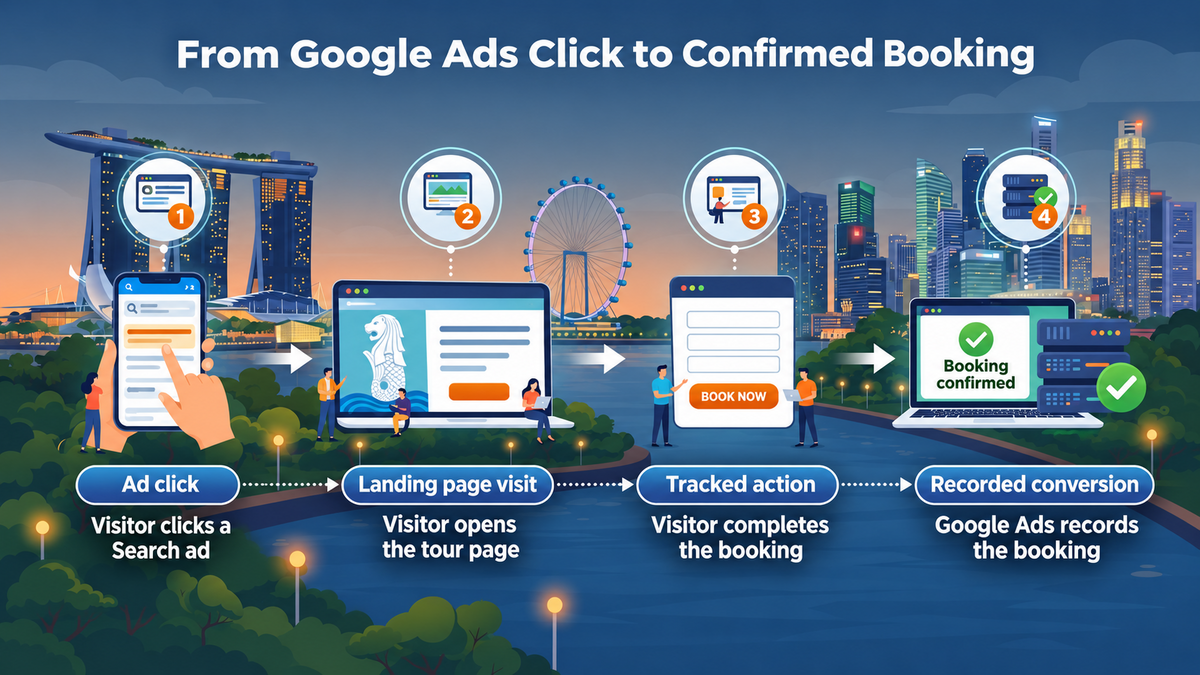
A conversion is an action the business has chosen to measure. A tour operator, for example, might count a confirmed booking. A visitor clicks a Search ad, lands on the tour page and completes a booking.
The specialist tests that the confirmation triggers the right event and checks that Google Ads records it as expected. Google’s conversion measurement options also cover actions such as calls and purchases.
A click on the booking button can help explain where visitors drop off. A confirmed booking answers a different question about how many people booked. The specialist should be able to explain which action goes into the main report and how the team can test it after a website update.
When Should You Hire a Google Ads Specialist?
Hiring makes sense when the account needs work your team cannot do consistently or when no one can explain what the budget is buying. Spending more can increase the cost of a problem that has been there all along. For example, a campaign may appear to bring in plenty of leads because it counts people who open the contact form. The first job is to check how many actually send it.
A specialist can also help when the company plans to advertise a new service, add a location or sell a larger range of products. Each change gives the team more decisions to make about budgets, ads and pages. If those decisions often wait until someone has spare time, the account may need a named owner.
Signs the account needs more support
- Lead quality has fallen. The sales team spends more time on requests it cannot serve, and nobody checks which campaigns sent them.
- The website has changed. A new booking tool or form may affect what the account records. The team needs someone to test the full process.
- Reports stop at clicks. The business can see traffic and spend but cannot connect either to enquiries, bookings or sales.
- Campaign updates take too long. Ads still show an old offer, or a budget change waits for the only person who knows the account.
A business testing a single offer may need help with setup and tracking before it needs ongoing support. A 30-day PPC test can give the team a starting point if it has one offer, a set budget and a way to record the outcome. The amount of follow-up work helps show what level of support to pay for next.
In-House, Freelancer, or Agency: Which Should You Choose?
The decision starts with a list of jobs that need doing each month. Some accounts need daily work across several product lines. Others need a weekly review and occasional support when an offer or landing page changes. The same monthly ad budget can create very different workloads.
| Hiring option | When it makes sense | What to confirm |
| In-house specialist | Campaign work fills much of the week and depends on close contact with sales, product or operations. | Who covers leave, fixes tracking and approves budget changes? |
| Freelancer | The work has a defined scope, such as managing one account or checking tracking before a launch. | How much time is included, who handles urgent issues and what costs extra? |
| Agency | The account needs several skills or enough cover to keep work moving when someone is away. | Who runs the account each week, which tasks are included and who answers for results? |
When an in-house hire makes sense
An in-house specialist can work closely with people who know stock, margins and sales capacity. A retailer, for instance, can tell its specialist when a product is running low so the team can review the ads before sending more shoppers to it. That short line between the account and the business can help when changes happen often.
A full-time hire still needs support. If the specialist spends most of the week waiting for web changes or new ad copy, more hours in the account may do little. The job description should say which work the person owns and which teams will help.
When to work with a freelancer or agency
A freelancer can suit a business that can handle approvals and website updates but wants someone to run its campaigns. An agency may be easier to work with when the scope covers both paid search and tasks such as landing page copywriting. The proposal should say who does each job and how the team handles changes that fall outside the agreement.
An outside specialist also needs a contact inside the business. That person can explain why some enquiries turned into jobs while others did not. A campaign report can show which ad generated a form submission. The business can tell the specialist whether that person booked, bought or asked for something it does not offer.
How Much Does a Google Ads Specialist Cost in Singapore?
The total cost depends on how much work the specialist takes on, how many campaigns they manage and which services the agreement covers. Ad spend is the amount paid to Google for advertising. A management fee pays for the people doing the work. Tracking setup, new pages or ad production may sit outside that fee, so two quotes for the same ad budget can cover different jobs.
| Pricing model | What the business pays | What to check |
| Monthly retainer | A set fee for agreed ongoing work | Reporting, meetings, included changes and extra fees |
| Percentage of ad spend | A fee tied to the advertising budget | Minimum fees and what changes when spend goes up |
| Fixed project fee | A set price for work such as an audit, setup or handover | Deliverables, testing and support after delivery |
| In-house employment | Salary, employer costs, tools, training and cover | Full cost and time needed from other teams |
How to compare two quotes
Suppose a business sets aside S$3,000 a month for ads. One provider quotes S$900 for management plus S$600 for a one-off tracking repair. Another quotes S$1,200 a month with the same repair included.
Over three months, the first quote adds up to S$3,300 for management and setup. The second adds up to S$3,600. Including S$9,000 in ad spend, the totals are S$12,300 and S$12,600. These are example quotes.
The S$300 gap is easy to compare once the work is written down. The choice can change if one provider also tests the booking form after updates or meets with sales each month to review lead quality. If the account needs those tasks, the owner can ask both providers to price the same scope.
For an in-house comparison, the business can use its actual employment costs and the time it expects from sales, design and web staff. That gives it a fairer figure than comparing an employee’s salary with an outside monthly fee on its own.
How to Score a Google Ads Specialist Before Hiring
The same interview questions make it easier to compare candidates. Each candidate can bring an anonymised account example or walk through a sample report.
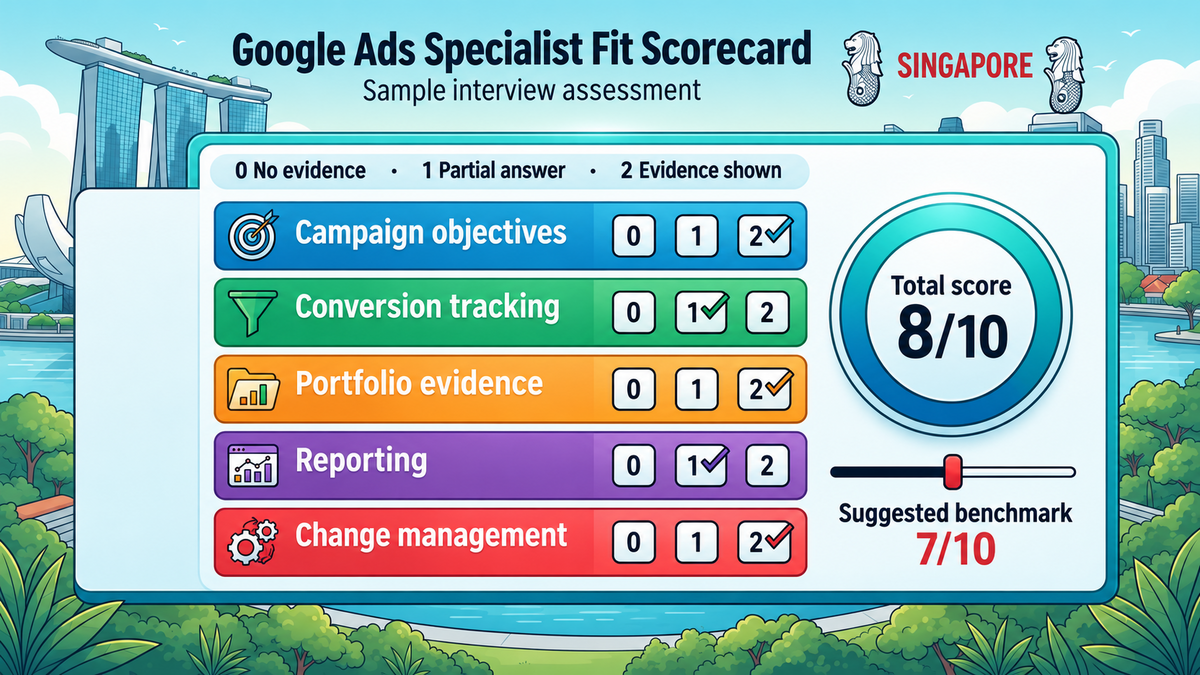
The five checks below use a simple scale. A score of 0 means the candidate gave no usable evidence, 1 means they gave a partial answer, and 2 means they explained the work and showed how they checked it.
| Check | Question to ask | What earns 2 points |
| Campaign goals | “How would you turn our sales goal into a campaign plan?” | The candidate connects the offer, audience, budget and result to measure. |
| Conversion tracking | “How would you check that a form submission counts once?” | The candidate explains the test and how they would check for duplicate counts. |
| Past results | “Can you show what changed on an account you managed?” | The example includes a starting point, dates, spend, the result and the candidate’s role. |
| Reporting | “What would you tell us if leads went up but sales stayed flat?” | The candidate shows a report that explains the gap and gives the team a next step. |
| Account changes | “How would we know who changed the budget and why?” | The candidate describes approvals, how changes are logged and when the team reviews them. |
What the score means
A candidate who scores 2, 1, 2, 1 and 2 earns 8 out of 10. That puts them above a suggested interview benchmark of 7 out of 10. The score still gives the employer two things to check. Can the candidate show how they test tracking on a live form? Can they explain what they would send the owner each month?
The seven-point benchmark is a hiring aid for this scorecard. A zero on tracking deserves its own follow-up even if the candidate scores highly elsewhere. The hiring team needs to know who can test and fix conversion tracking before campaigns start.
What to look for in past results
A portfolio should give enough detail to explain what happened. If a candidate says enquiries doubled, ask what happened to spend, how they counted enquiries and whether the business ran a promotion at the same time. A chart with dates, costs and conversion totals gives the hiring team more to discuss than a percentage on its own.
A candidate may have to protect a client’s identity. An anonymised report is enough if it shows the figures and the candidate can explain which changes they made. For example, a candidate might show how a lead generation campaign brought more enquiries after a page update, then explain how sales checked that those leads came from people the business could serve.
How to test Singapore market experience
A local example gives candidates a chance to show how they think. Suppose a cleaning firm can serve clients in the east and central parts of Singapore. The candidate can explain how they would set up Google Ads location options, how they would check where enquiries actually come from and what they would do if requests started coming from outside those areas.
Language choices deserve the same reasoning. If the business can answer enquiries in Mandarin, a candidate might propose testing Mandarin ad copy when searches and customer conversations support it.
The business also needs a landing page and a team that can handle the response in that language. The candidate should explain how they would judge the test with the budget available.
Where to Find and Interview Candidates in Singapore
Local job boards and professional networks can help businesses find in-house applicants. Referrals can lead to freelancers or agencies that have handled similar work. The brief works better when it describes the account than when it lists every tool the company has heard of.
A job post or request for quotes can include:
- What the company sells, the areas it serves and the result it wants.
- The monthly ad budget or budget range and whether campaigns are already live.
- The tools the specialist will use to check calls, enquiries or purchases.
- Who can change the website, approve ad copy and share sales data.
- What the first month should produce, such as a tested setup, a campaign plan or a review of an existing account.
A short interview exercise can reveal how a candidate thinks. Give every candidate the same sample. For instance, a company spent S$900 and recorded 30 enquiries, but sales accepted just six.
Ask what the candidate would check first, who they would speak to and what they would wait to learn before changing the budget. A hiring manager can use the same exercise for people who pitch search engine marketing services and candidates who want the job in-house.
What to Agree on Before Ads Go Live
The business needs an employee with admin access to the Google Ads account. An agency can connect through a Google Ads manager account, which lets it work across client accounts. The business should know who can manage users, how billing is handled and which people can approve changes to spend. The agreement can also state what the provider will hand over if the work ends.
How to set a target cost per result
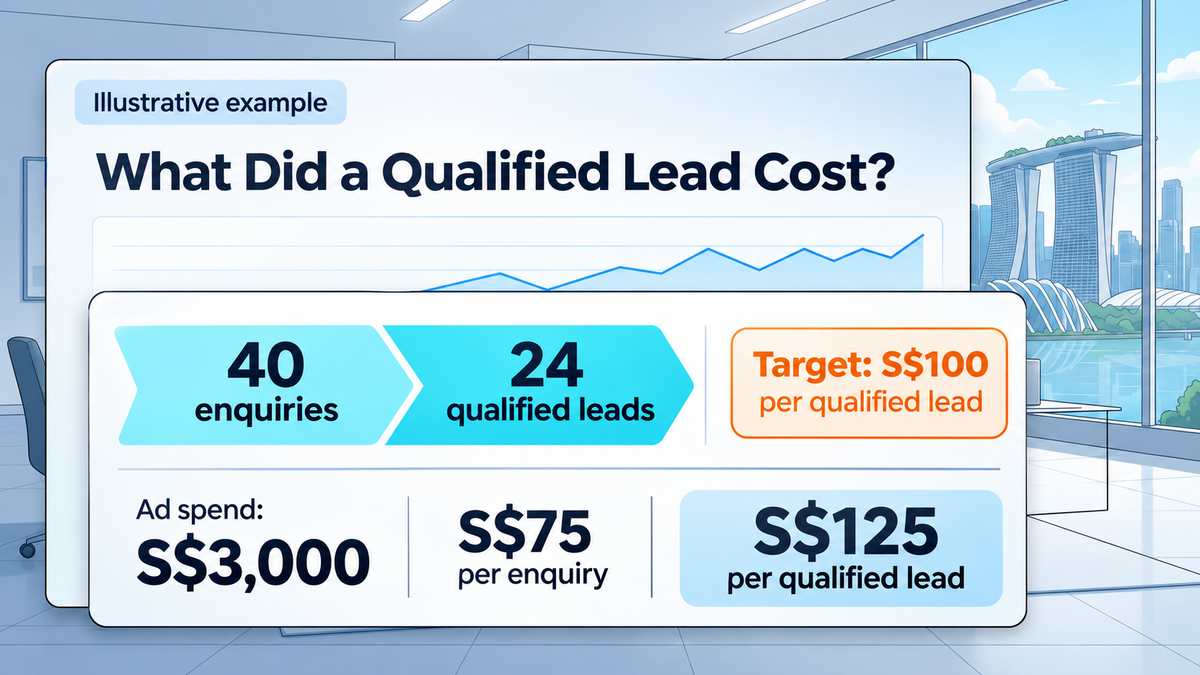
A target starts with a result the business can define. Suppose a service company has a monthly ad budget of S$3,000 and wants 30 qualified leads. Dividing S$3,000 by 30 gives a planning target of S$100 in ad spend per qualified lead. The sales team might define a qualified lead as someone who needs the service, falls inside the service area and leaves enough information for a follow-up.
If the company spends S$3,000 and records 40 enquiries, it pays S$75 per enquiry. If 24 of those qualify, the cost is S$125 per qualified lead. That is the figure to compare with the S$100 target. To assess whether the target makes business sense, the owner can also check how many qualified leads usually turn into paying customers and how much those jobs earn after delivery costs.
A company that closes sales over the phone may use offline conversion imports to bring eligible outcomes, such as qualified or converted leads, into Google Ads when the setup supports it. The specialist and sales team need to agree on what triggers each outcome before using it to judge campaigns.
How to Review the First 90 Days
The first quarter gives the business time to check its data, see how the specialist handles problems and decide what deserves more budget. Results may come in at different speeds. A shop might see purchases on the same day. A business that sends quotes may wait weeks for customers to decide. The review dates should reflect how the business sells.
What to check each month
| Period | What the specialist should show | What the business should check |
| Days 1–30 | Tracking test results, the starting figures and the first campaign changes | Do enquiries and sales reach the people who need to see them? |
| Days 31–60 | Which searches, ads and pages bring enquiries or sales | How many enquiries qualify, and what do rejected leads have in common? |
| Days 61–90 | Cost per agreed result, what changed and what the next test will measure | Does the result justify the current spend, and can sales handle more demand? |
Google Ads change history can show when budgets, bids, ads and other settings changed. A short note from the specialist can explain why a change was made and what the team expected to see. This helps when an owner asks why enquiries rose or fell during a period that also included a promotion or holiday.
What to do when results miss the target
The first check is whether the data can be trusted. A missed form event can make a campaign look worse than it is, while a duplicate event can make it look better. Once the tracking checks out, the specialist can review which searches and locations produced the enquiries, then check what people saw on the landing page.
Suppose most leads for an office cleaning campaign come from people looking for home cleaning. The specialist can check the terms that brought those visitors and whether the ad and page say “office cleaning” early enough.
A landing page quality review can help identify gaps between the promise in the ad and what the page offers. The next report should show whether the change affected qualified leads and the cost to get them.
Choose a Google Ads Specialist You Can Evaluate
The hiring decision is easier once everyone agrees on what the account needs each month and who will do the work. An employee may suit a business that makes frequent changes with sales and operations. A freelancer or agency may suit a business that can define the work and name someone internally to approve changes and share sales feedback.
If the account already runs campaigns, it can serve as the starting point for a conversation about Google Ads management. An example report, a tested conversion and a date for the first review give both sides something concrete to agree on before the work starts.
FAQs About Google Ads Specialists
Can a Google Ads specialist manage both Search and Shopping campaigns?
Yes, if their experience covers both. Search campaigns and Shopping campaigns involve different work. For Shopping, the employer can ask how the specialist checks product details, handles product issues and works with the person who maintains the online shop.
Can two providers work on the same Google Ads account?
Yes. A business might ask one provider to manage campaigns and another to work on tracking. A named owner for each task helps prevent overlapping changes. A shared record of changes also gives both providers the information they need when a tag, form or campaign setting changes.
What happens if we pause ads during a quiet period?
The answer depends on the contract. Some agreements charge for work that continues during a pause, such as preparing ads or checking tracking. The business can ask how fees change, how much notice it needs to give and what the specialist will check before ads resume.
Should we pay for a trial project before making a long-term hire?
A paid trial can suit a business that wants to see how someone works on a specific problem. An account review or tracking test gives both sides a defined outcome. The agreement can state the price, delivery date and access needed so the team can assess the work before deciding on a longer engagement.