| AI Summary
Google Ads ROI measures campaign profit as a percentage of total campaign costs. ROAS measures sales revenue per dollar spent on ads. In an illustrative Singapore campaign, S$20,000 in sales from S$4,000 in ad spend gives a 5:1 ROAS. After S$10,000 in product and fulfilment costs, the campaign leaves S$6,000 in profit, for an ROI of about 42.9%. Industry benchmarks can help explain high click or lead costs, while your own margins and sales data determine the return you need. |
Google Ads ROI = (sales revenue from ads − total campaign costs) ÷ total campaign costs × 100. Total costs include ad spend, direct costs of supplying the goods or services sold, and applicable campaign fees. A positive ROI means the campaign earned more than the costs included in the calculation. An ROI of 0% means it broke even.
Key Takeaways
- A campaign at 2:1 ROAS can lose money when the business keeps only 40 cents of each sales dollar before paying for ads.
- Cost per lead helps explain what happened before a sale. The share of leads that turn into paying customers helps explain what happened next.
- A week with strong clicks and few sales may look different once customers have had time to book or buy.
- A campaign can earn a profit overall while the latest increase in spend loses money.
Your Google Ads report shows sales. Your bank balance tells a different story. The difference may be in the orders you shipped, the refunds you issued or the fee you paid to run the campaign. This guide shows how to put those numbers together, compare your results with industry data and decide what to change before your next budget review.
What Is Google Ads ROI?
Google Ads ROI answers a question that comes up at every budget review. How much did the business earn after paying the costs tied to the campaign? A furniture shop might pay for the ads, the items sold, delivery and assembly. A cleaning company might pay for the ads, staff time and supplies. Each business needs its own cost figures, even if both collect the same amount in sales.
Google’s ROI calculation includes costs such as production and advertising. This article uses that total-cost approach throughout. The profit in each example means the amount left after the costs listed for that campaign. The figure can help with an ad budget decision, while a company’s accounts cover wider expenses such as rent and office payroll.
How ROI differs from ROAS
Return on ad spend, or ROAS, divides the revenue credited to ads by the cost of those ads. A 5:1 ROAS means the campaign recorded S$5 in revenue for each S$1 of ad spend. ROI goes further by accounting for the cost of making and delivering the sale. If you send estimated lead values to Google Ads, the platform’s reported conversion value can reflect those estimates. A finance review should use actual sales when they’re available.
| Measure | Calculation | What it tells you |
| ROAS | Sales revenue from ads ÷ ad spend | How much sales revenue each ad dollar brought in |
| ROI | Campaign profit ÷ total campaign costs × 100 | How much profit the campaign earned for every dollar of total cost |
| Cost per acquisition (CPA) | Ad spend ÷ acquisitions | How much the ads cost per acquisition, such as a paid order |
The definition of an acquisition belongs next to any CPA figure. If one team counts new customers and another counts all orders, their reports answer different questions. The same issue comes up when one campaign counts paid bookings and another counts clicks on a booking button.
How to Calculate Google Ads ROI
Start with sales revenue and costs
Sales credited to ads are the starting point. For an online shop, the order system can show what customers paid, which discounts they received and which orders were refunded. For a service company, a sales record can connect a paid invoice to the original enquiry. The sales and cost figures should cover the same group of orders or customers.
- Sales revenue: The amount earned from those sales after discounts and refunds.
- Direct costs: What the business paid to supply those orders or jobs, such as stock, packing, delivery, materials or job labour.
- Ad spend: What Google Ads charged for the campaign.
- Other campaign costs: Fees or expenses tied to the campaign, such as a share of a management fee or the cost of a landing page built for the campaign.
The same expense should appear once. A delivery charge paid by the customer can be part of sales revenue, while the courier fee is a cost. If your order export already shows sales after refunds, a second refund deduction will understate your return. A Google Ads budget plan can help you account for campaign fees alongside the platform spend.
GST can change the numbers you pull from an invoice or sales report. For a GST-registered business, use sales before GST for this calculation and use the cost figures your accounts recognise. IRAS lists the current GST rate and exceptions. If the same campaign sells in Singapore dollars and another currency, convert the figures to S$ on a consistent basis before adding them.
Worked example for a Singapore online shop
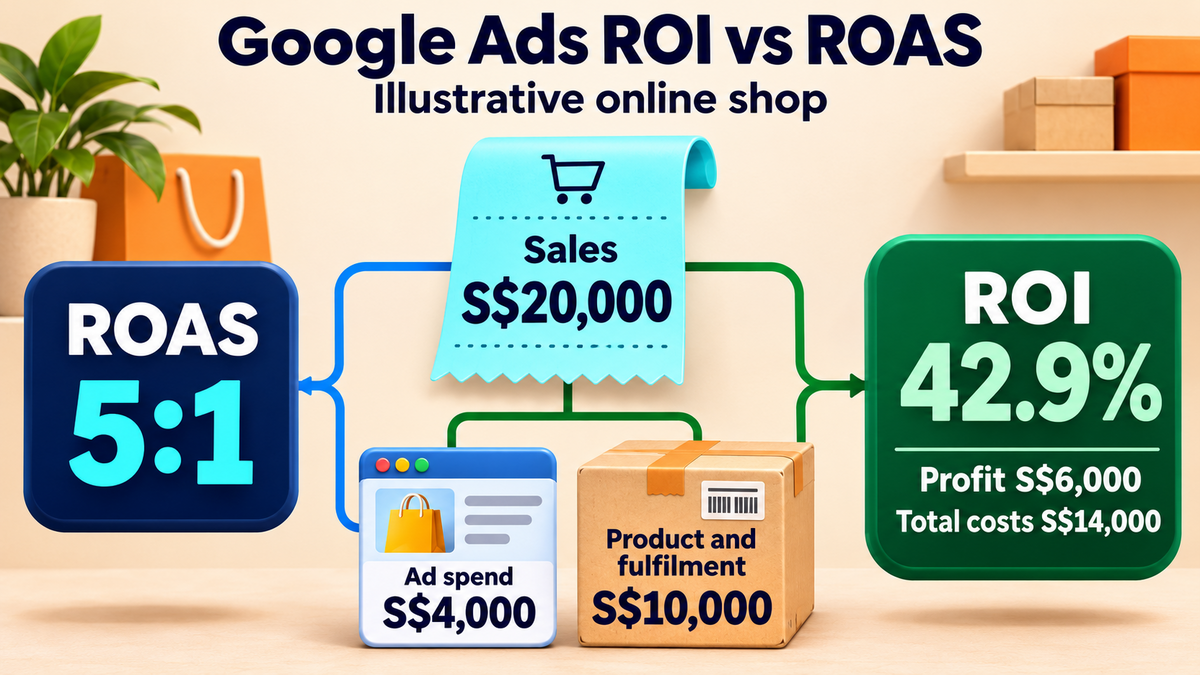
An online shop records S$20,000 in sales from a campaign. The products and fulfilment cost S$10,000, and the ads cost S$4,000. The example uses sales before GST and assumes the shop has no other costs tied to this campaign.
| Line item | Amount or calculation |
| Sales revenue from ads | S$20,000 |
| Product and fulfilment costs | S$10,000 |
| Ad spend | S$4,000 |
| Total campaign costs | S$14,000 |
| Campaign profit | S$20,000 – S$14,000 = S$6,000 |
| Google Ads ROI | S$6,000 ÷ S$14,000 × 100 ≈ 42.9% |
| ROAS | S$20,000 ÷ S$4,000 = 5:1 |
For every S$1 the shop spent on the ads and the goods it supplied, it earned about 43 cents in campaign profit. If the shop also paid a S$1,000 management fee for the campaign, profit would fall to S$5,000 and total costs would rise to S$15,000. ROI would fall to about 33.3%. The ROAS would stay at 5:1 because ad spend and revenue stayed the same.
How to value leads before sales close
A lead is an enquiry from a potential customer. An air-con servicing company might get calls, WhatsApp enquiries and quote requests from the same campaign. The team can mark an enquiry as qualified when it comes from someone in the service area who needs a job the company offers. A shared sales pipeline gives the team a place to record which enquiries turn into paid work.
Suppose a paid job leaves S$300 after labour and materials, before ad costs. If one in four qualified leads becomes a paid job, each qualified lead is worth about S$75 before advertising costs. That gives the team a planning figure. If the share drops to one in five, the estimated value drops to S$60. A campaign that seemed affordable at S$70 per qualified lead would now cost more than those leads are expected to bring in.
When enough jobs have closed, the team can replace the estimate with paid invoice totals and job costs. Google Ads supports qualified and converted lead goals for recording progress after an enquiry. The sales log can still serve as the place to check whether a particular job was paid, cancelled or refunded.
What Is a Good Google Ads ROI?
A good Google Ads ROI covers the campaign’s costs and leaves enough profit to help pay the business’s wider expenses. A positive return may still be too low if the team has little room to take on more work or if another campaign earns more from the same spend. A break-even calculation gives you a starting point before you compare results with industry figures.
Find your break-even ROAS
Break-even ROI is 0%. Break-even ROAS depends on how much revenue remains after the direct cost of each sale. This amount, expressed as a share of revenue, is your contribution margin before advertising.
Break-even ROAS = 1 ÷ contribution margin before ads, when ad spend is the only remaining campaign cost.
| Contribution margin before ads | Revenue needed per S$1 of ad spend |
| 25% | S$4.00 |
| 40% | S$2.50 |
| 50% | S$2.00 |
| 60% | About S$1.67 |
At a 40% margin, S$2 in revenue leaves 80 cents before ads. If the business paid S$1 for those sales, it lost 20 cents. A 2:1 ROAS can therefore look acceptable in a report while the campaign loses money. If there are other campaign fees, the revenue target rises. With S$4,000 in ad spend, a S$1,000 campaign fee and a 40% margin, the campaign needs S$12,500 in revenue to break even. That equals about 3.13:1 ROAS.
A store that sells products with different margins can check them by product group. A 4:1 ROAS leaves more room on a product with a 60% margin than on one with a 25% margin. If both products sit in one campaign, the combined result can hide the one that uses its entire margin to pay for ads.
Compare your results with industry benchmarks
WordStream’s 2026 search advertising benchmarks cover 13,474 US campaigns that ran on Google and Microsoft from April 2025 through March 2026. The figures below are medians, although the report calls them averages. They show what advertisers in the sample paid for clicks and leads. The figures use US dollars and the report measures ad performance before sales and fulfilment costs.
| Industry | Cost per click | Conversion rate | Cost per lead |
| Business services | US$5.87 | 4.85% | US$93.69 |
| Education and instruction | US$4.81 | 13.14% | US$77.48 |
| Home and home improvement | US$8.33 | 8.05% | US$90.92 |
Singapore businesses can use these figures to ask where a campaign’s costs come from. An education provider might check how often clicks turn into trial bookings. A renovation company might pay more per enquiry and still earn more per customer because each completed job brings in a different amount. To make a local comparison, check the same service, location, campaign type and conversion action in your own records. Currency conversion alone can’t make a US sample reflect a Singapore auction.
Google’s Economic Impact methodology also uses an estimate of US$2 in profit per US$1 spent on Google Ads as an input for its US report. That figure is a modelling assumption. The WordStream numbers measure click and lead costs. Your own sales and cost records are what let you calculate ROI for a Singapore campaign.
What Affects the Cost of Google Ads?
What happens when someone searches
Google runs an auction when a search is eligible to show ads. Ad Rank helps determine which ads can show and where they appear. It takes into account factors such as the bid, ad and landing page quality at the time of the auction, competition and the context of the search. A florist’s cost for a click can vary across searches, even within the same campaign.
Google’s Quality Score is a separate diagnostic for Search keywords. The 1–10 score reflects expected click-through rate, ad relevance and landing page experience. The score itself stays outside the auction calculation. Its components can still point you towards a page or ad that could serve customers better. A florist who promises same-day delivery, for instance, can make the order cut-off easy to find.

Give each campaign a job
Search ads can help a business reach people who are looking for a product or service. Performance Max can reach customers across more Google channels from one campaign. The choice between Performance Max and Search ads depends on what you sell, which actions you can measure and where you need control. A business that offers both urgent repairs and scheduled maintenance may want separate budgets because the jobs have different prices, margins and customer needs.
Smaller advertisers may learn more from a focused PPC test built around one service and one goal. If a plumber advertises emergency visits and new bathroom installations in the same test, the totals can hide two very different sales cycles. Separate reporting makes it easier to tell which work the budget is buying.
How to Improve Google Ads ROI
Find out where sales are falling away
A high click count with few paid sales can come from the search, the page or the way the team handles leads. The search terms report shows reported searches that triggered ads. A cleaning company that sees job seekers or people shopping for cleaning products can use negative keywords to block those searches where appropriate. A search for “move-out cleaning quote” may deserve its own ad and a page that explains what the quote includes.
A mobile visit can show what happens after the click. Someone looking for a repair may leave if the page takes too long to open or makes it hard to find the areas you serve. If the page gets enquiries and few people book, the next check could be missed calls, slow replies or quotes for jobs the business doesn’t do. A business working to bring more visitors to its website can use these checks before paying for more of the same traffic.
Give recent leads time to close
A person may click an ad this week, request a quote next week and pay a deposit later. Google Ads provides reports that show how long customers take to convert. Its conversion window also affects which actions can be recorded after an ad interaction. A business that takes weeks to win a job should account for that delay when reviewing recent spend.
An online shop may face the opposite problem. The ad report can show a sale today even though the buyer returns the item next week. A budget review can use older orders with known refunds and flag recent sales as provisional. The same rule should apply every time you compare two reporting periods.
Check what the next dollar buys
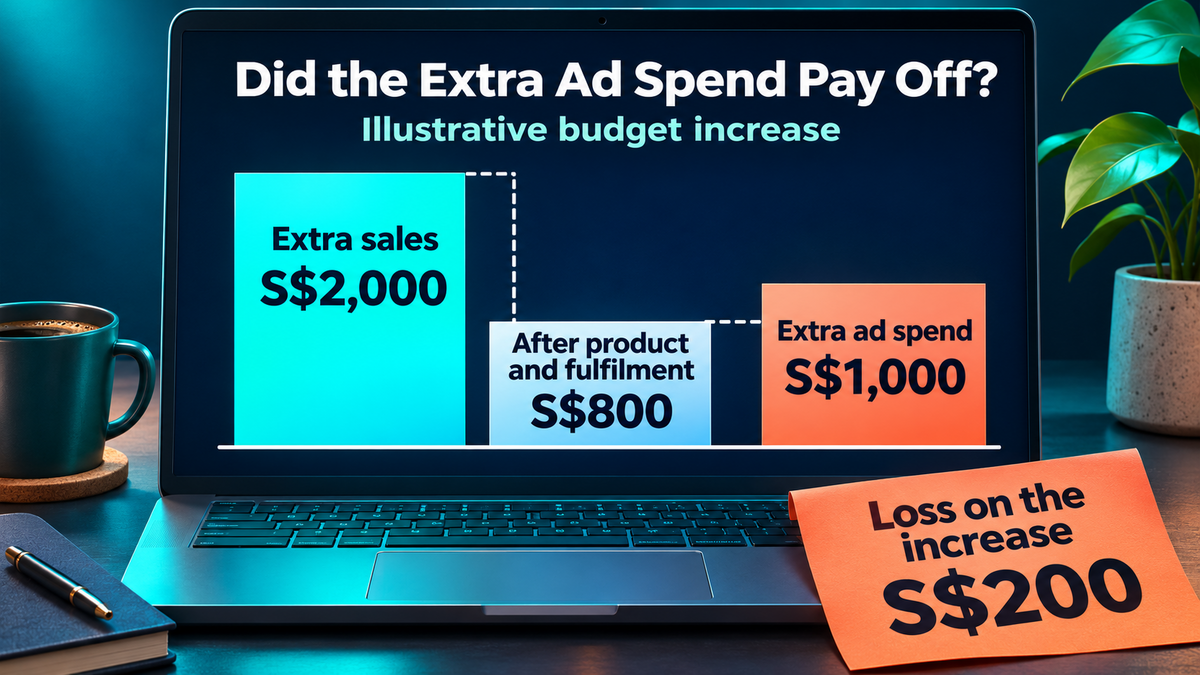
A campaign that made money last month may cost more to expand. Suppose a shop increases spend by S$1,000 and brings in S$2,000 in additional sales. If those extra orders leave S$800 after product and fulfilment costs, the increase loses S$200 even though the original campaign may still be profitable. The shop can compare the added spend with the profit it earned from the added sales before deciding whether to keep the higher budget.
A Google Ads experiment can help compare an eligible campaign change with the existing setup. A test is easier to read when the team changes one thing, such as the landing page or bidding approach, and agrees on the result it will judge before starting. The team should also allow time for sales to come through and check that a holiday sale or a stock shortage didn’t distort the comparison.
Put Google Ads Budget Behind Profitable Sales
Your next budget decision can start with one campaign and a set of sales that have had time to close. The ad account gives you the spend. Your order or sales records give you the revenue, refunds and direct costs. The two together can show whether the campaign has room to grow or whether a specific issue, such as missed calls or low-margin orders, needs attention first.
MediaOne’s Google Ads management services cover campaign setup, tracking and reporting. If you discuss a campaign review, the sales figures and costs behind your current return give both teams a starting point for deciding where to spend.
FAQs About Google Ads ROI
Should I include repeat purchases in Google Ads ROI?
Repeat purchases can be included in a separate customer return calculation if you can connect those purchases to the customers you acquired through ads. The report should state the time period, such as six months from the first order. Each repeat purchase has its own costs and refunds. A first-order return remains helpful when you need to know how quickly the campaign pays back the cost of winning customers.
Can two ad platforms claim the same sale?
Yes. A shopper might click a social ad on Monday, click a Google ad on Wednesday and buy on Friday. Each platform can credit the purchase under its own rules. If you add the two sales totals, the order may appear twice. An order ID helps you count the purchase once when reporting total revenue across channels.
Should I combine searches for my business name with other searches?
Separate figures can make the report easier to interpret. Someone who searches for your shop by name may already know you. A person who searches for a product without naming a shop may be comparing sellers. A combined figure can hide how much the business pays to reach those two groups. You can review both results before deciding how to share the budget between them.
How can I tell whether Google Ads brought in sales I would have missed?
A controlled test can help estimate how many extra sales came from the ads. For example, a business with enough sales across comparable areas could compare an area where ads ran with one where they didn’t, provided it can set up a fair test. The outcome of interest is total sales in the areas, since the test asks whether the ads added sales beyond the orders that would have happened anyway.