The Productivity Solutions Grant ran from April 2018 to 29 September 2026, and somewhere along the way it stopped being a strategic decision and started being a tick-box exercise. Most SMEs in Singapore applied for it the same way they renewed their business registration: paperwork first, thinking second.

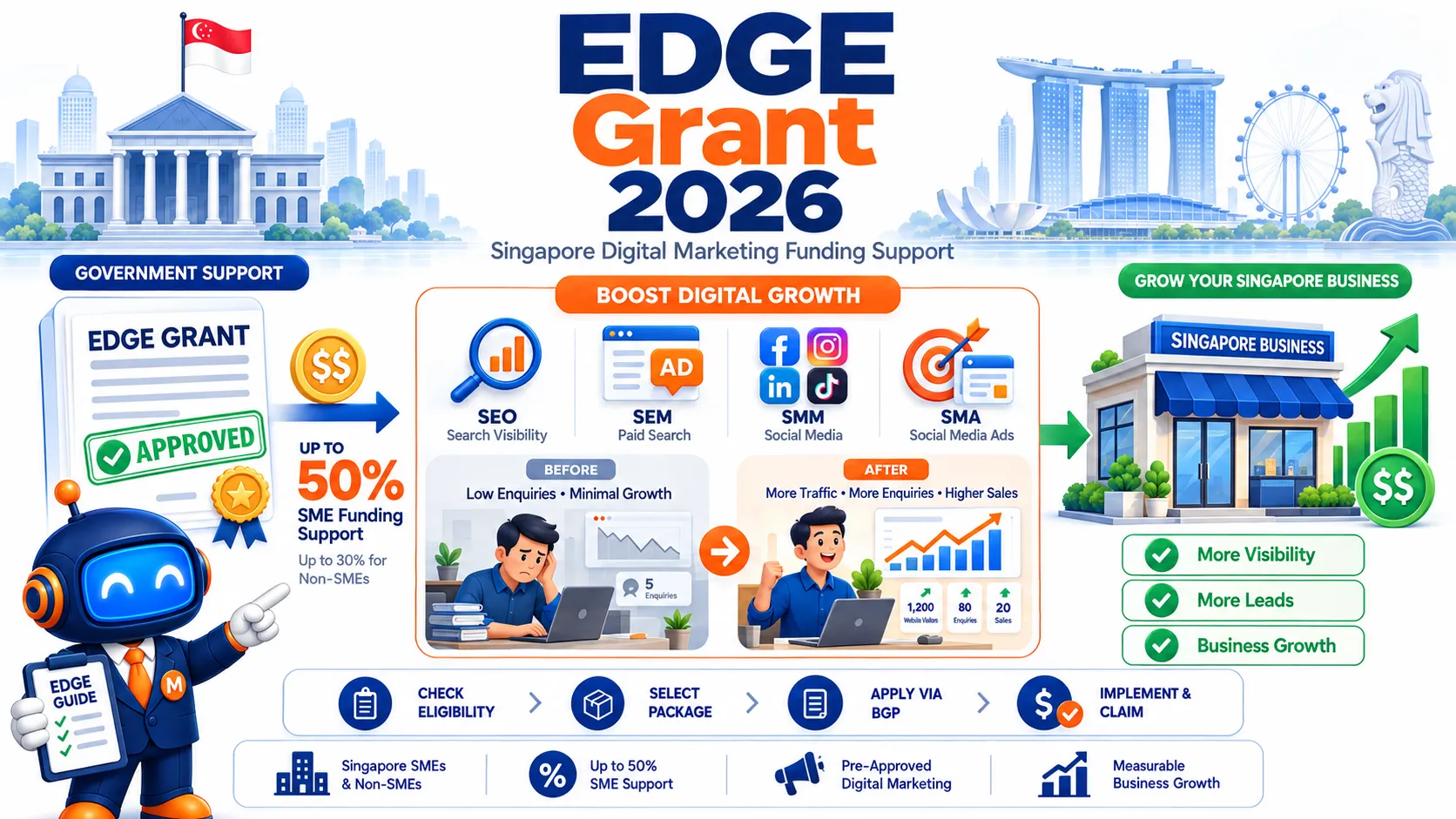
On 30 September 2026, the framework changed. Singapore consolidated three legacy schemes, the Enterprise Development Grant (EDG), the Market Readiness Assistance (MRA) and the Productivity Solutions Grant (PSG), into a single programme: the EDGE Grant. PSG is closed. EDGE is open. For MediaOne’s pre-approved digital marketing solution, SMEs can claim up to 50% of qualifying costs, and, for the first time, non-SMEs are supported at up to 30%.
The scheme name changed. The application habits did not, and that remains the single biggest reason businesses receive funding for solutions that quietly underperform for the next 12 months.
Across more than 400 grant-supported engagements we have run as a pre-approved digital marketing vendor since 2019, a clear pattern emerges. The businesses that treat the EDGE grant as a strategic lever extract roughly 3 to 5 times the commercial value of businesses that treat it as free money. The support level is identical. The outcome is not.
This guide covers what the official documentation does not: how the EDGE grant works and what replaced the PSG digital marketing grant, how to apply for EDGE grant digital marketing funding properly, which projects qualify under the new scope rules, where applications typically get rejected, and how to structure your EDGE digital marketing investment so the funding produces measurable business outcomes instead of dormant retainers.
Key Takeaways
- The EDGE Grant is Enterprise Singapore’s consolidated business grant. EDG, MRA and PSG closed on 29 September 2026; EDGE became the application pathway from 30 September 2026.
- MediaOne’s pre-approved digital marketing solution attracts up to 50% co-funding for SMEs and up to 30% for non-SMEs. Support levels are activity-specific.
- The annual EDGE ceiling is S$100,000 per company: programme-wide across all activities, not a per-package amount.
- Applications are activity-based: one Business Grants Portal application per Activity per UEN, built on a Package ID created in the Package Builder using your own Corppass.
- New scope qualifies; renewals and continuations do not. This single test decides most borderline cases.
- No payment, deposit or commencement of work is allowed before application submission, and vendor change requests after submission are not permitted.
- Package and vendor selection still determines roughly 70% of the eventual ROI, while most applicants spend less than two hours on this decision.
Table of Contents
What Is the EDGE Grant and What Changed on 30 September 2026
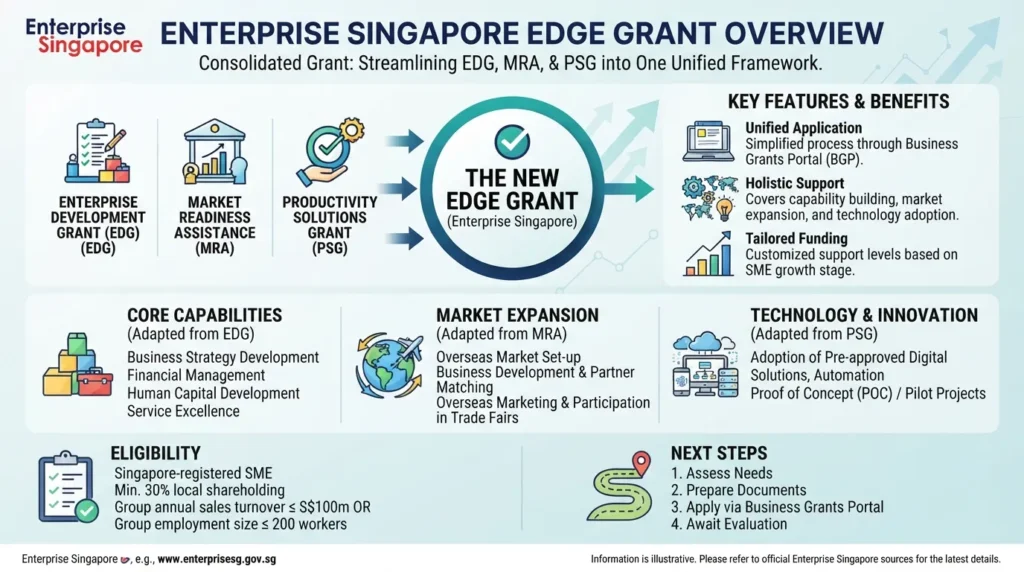
The EDGE Grant is Enterprise Singapore’s consolidated business grant, effective from 30 September 2026. It brings three legacy schemes, the Enterprise Development Grant (EDG), the Market Readiness Assistance (MRA) and the Productivity Solutions Grant (PSG), under a single framework spanning multiple business areas and activities.
Enterprise Singapore (EnterpriseSG), the statutory board under the Ministry of Trade and Industry, administers the programme. It sets the qualifying criteria, assesses applications submitted through the Business Grants Portal (BGP), and disburses approved claims.
The transition happened on two dates:
| Date | Status | What It Means |
|---|---|---|
| 29 Sep 2026 (Tuesday) | Ceased | EDG, MRA and PSG closed. No new applications accepted after this date. Approved projects continue to be processed, and claims can still be submitted on completion. |
| 30 Sep 2026 (Wednesday) | Open | EDGE became the application pathway for new business grant applications, including pre-approved digital solutions. |
If you had a PSG project already approved, you are protected: approved projects continue to be processed and claims can still be submitted on completion. Only new applications route through EDGE.
EDGE supports multiple business areas and activities, each with its own support level, qualifying cost cap and requirements. Consolidation simplified the framework; it did not simplify the strategy. Official guidance lives on the Enterprise Singapore EDGE programme pages and the Business Grants Portal. Both are useful for verification. Neither will tell you which package is worth choosing.
What the EDGE Grant Funds for Digital Marketing
Within the digital marketing scope, MediaOne delivers four core services and combines them into five pre-approved packages.

| Service | Type | What It Does |
|---|---|---|
| SEO | Organic search | Keyword research, on-page and technical optimisation, content and authority building that compound into durable organic rankings and traffic |
| SEM | Paid search | Google Ads setup, campaign management and optimisation, conversion tracking for immediate visibility on high-intent searches |
| SMA | Paid social | Pixel setup, media buy planning, audience and A/B campaign testing across Facebook, Instagram and LinkedIn |
| SMM | Organic social | Strategy, content calendars, branding guides, post and artwork production, monthly reporting |
The Five Pre-Approved Packages
| Package | Combination | Scope | Price Before Grant |
|---|---|---|---|
| Package A | SEO + SEM | SEO 10 + 5 keywords · 6 months; SEM GSN or GDN · 3 months | S$7,900 |
| Package B | SEO + SEM | SEO 15 + 5 keywords · 6 months; SEM GSN or GDN · 3 months | S$9,700 |
| Package C | SEM + SMA | SEM GSN or GDN · 3 months; SMA 1–2 platforms · 2 months | S$3,800 |
| Package D | SMM + SMA | SMM · 2 months; SMA 1 campaign · 2 months | S$7,900 |
| Package E | SMM + SEO | SMM · 2 months; SEO 6 keywords · 6 months | S$7,900 |
Each package carries published performance targets: first-page rankings within 6 months for 30% of the included SEO keywords, CTR of 2–5% for GSN or 0.2–0.5% for GDN on SEM, 0.5–2% on SMA, and a 20–90% increase in brand awareness measured by reach on SMM.
Prices exclude GST, advertising spend and optional add-ons. Grant support is subject to eligibility and approval. Performance targets are not guaranteed.
What does not qualify: general IT infrastructure, office software and services unrelated to marketing fall outside the digital marketing scope. Each proposed solution needs a clear line to customer acquisition, retention or revenue.
Eligibility: The Requirements Nobody Reads Carefully Enough
Am I eligible for the EDGE grant is the right starting question, but the official list hides several friction points that catch applicants out late in the process.
[Image: EDGE Grant official eligibility requirements for Singapore businesses showing five mandatory criteria]
Confirm these before you spend time on a proposal. Requirements are set by Enterprise Singapore and are assessed per activity.
| # | Requirement | Detail |
|---|---|---|
| 1 | Company size (SME status) | Group employment of no more than 200, OR group annual sales turnover of no more than S$100 million. SME status determines whether you are supported at the SME rate (up to 50%) or the non-SME rate (up to 30%). |
| 2 | Registration and ownership | Registered and operating in Singapore, with at least 30% local shareholding held directly or indirectly by Singapore Citizens or Singapore PRs, determined by ultimate individual ownership. |
| 3 | Used in Singapore | The solution you are applying for must be used in Singapore. |
| 4 | No commitment before application | No payment or deposit made, and no work commenced, in relation to the solution before submitting your application. Retrospective applications are not supported. |
| 5 | Ownership and business profile assessment | Applications are assessed on the company’s ownership and business profile, the selected solution and its qualifying costs, and other requirements applicable to the selected activity. |
A change worth noting for businesses that could not apply before: PSG support was limited to local SMEs. Under EDGE, non-SMEs can participate in this pre-approved route at up to 30% of qualifying costs.
The Hidden Eligibility Friction Points
A direct observation from running grant applications since 2019: the rejections we see most frequently are rarely about the headline criteria. They sit in the operational details.
The no-commitment rule is an eligibility criterion, not fine print. You must not have made any payment or deposit, or commenced work, in relation to the solution before submitting your application. Retrospective applications are not supported. Businesses sometimes pay deposits to vendors during the “exciting” stage of evaluation and discover the problem only when the claim fails. This is the most expensive mistake we see: by then, the cash is gone and the recourse is limited.
The 30% local shareholding test reaches ultimate individual ownership. Shareholding must be held directly or indirectly by Singapore Citizens or Singapore PRs, determined by ultimate individual ownership. Holding structures with foreign parent entities get scrutinised more carefully than simplified guidance suggests.
SME status is a threshold, and it decides your support rate. Group employment of no more than 200 or group annual sales turnover of no more than S$100 million. Cross the line and you apply as a non-SME at up to 30% instead of up to 50%. On a S$9,700 package, that is the difference between up to S$4,850 and up to S$2,910 back.
Activity-specific requirements are not uniform. Prior-claim rules, sector exclusions and any minimum operating history are set per activity and are not consistent across EDGE. Confirm the current published requirements for your selected activity on the Business Grants Portal rather than relying on general guidance, including this guide.
The application must be yours, on your Corppass. The applicant company builds the package in the Package Builder and submits the application on the Business Grants Portal using its own Corppass. Third-party submissions are not permitted, and published guidance indicates vendor change requests after submission are not allowed.
The MediaOne EDGE Decision Framework
Most articles about the EDGE grant stop at the eligibility checklist. The strategic question, the one that determines whether the grant actually grows your business, is what to do with the funding once you qualify.
We use a proprietary three-stage framework with every client considering a grant-supported engagement. How do I choose the right EDGE package and vendor in Singapore is the question we answer dozens of times each year, and the framework below is the same one we apply internally before recommending any solution.
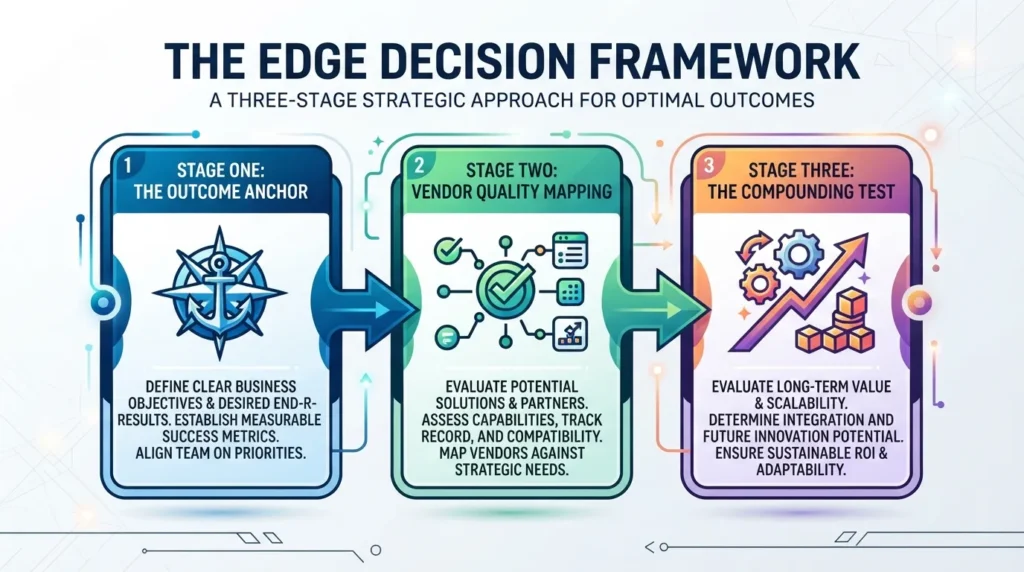
Stage One: The Outcome Anchor
Before evaluating any package or vendor, define the specific commercial outcome the grant should produce. This is now doubly important under EDGE, because the outcome must describe a new capability. An outcome that reads as a renewal fails the strategy test and the eligibility test at the same time.
| Outcome Anchor Question | What It Tests |
|---|---|
| What measurable metric improves? | Forces specificity beyond “improve marketing” |
| Who in the business owns the outcome? | Tests internal accountability for adoption |
| What does success look like at the mid-point? | Creates a checkpoint inside the package duration |
| What does failure look like at the end? | Surfaces commitment to the solution |
Businesses that cannot answer these four questions clearly should pause the application. The EDGE grant is funding, not strategy. It amplifies clear thinking and exposes unclear thinking.
Stage Two: Vendor Quality Mapping
Pre-approved status confirms baseline eligibility. It does not confirm quality. There is genuine variation in vendor capability within every supported category. Under EDGE the stakes are higher, because your application must match the pre-approved solution and vendor change requests after submission are not permitted.
When evaluating vendors, weight these factors:
Track record with businesses of your size and sector. A vendor delivering well for 200-employee logistics firms may struggle with 8-employee professional services firms. The skill profile is genuinely different.
Onboarding intensity in the first 60 days. Solutions that get implemented and then left to operate independently rarely outperform. Look for vendors with structured onboarding and accountability touchpoints.
Reporting cadence and transparency. Vendors who provide monthly performance reviews with raw data outperform those who provide quarterly summary slides.

Exit terms after the funded period. Vendors confident in their work offer flexible commitments. Vendors locking businesses into long multi-year contracts often do so because retention through pure performance is not their strength.
Under EDGE there is an added discipline: the vendor you evaluate is the vendor on the Package ID. Choose before you build, not after you submit.
Stage Three: The Compounding Test
Funding works on a reimbursement basis across package durations of two to six months. The strategic test is whether value keeps compounding after the funded period ends.
Prefer solutions where:
- Initial impact is observable within the first 60 to 90 days
- The improvement curve continues beyond the package duration
- The data and assets created during the funded period remain owned by your business, not the vendor
This last point catches more businesses than expected. Some vendor arrangements technically retain ownership of audiences, content, or workflows built during the engagement. Read the contract before signing.
What Most Businesses Get Wrong About Package Selection
A direct opinion, formed across hundreds of grant-supported engagements: most businesses select the wrong package for their stage. The common errors:

Choosing a package by price rather than by outcome. Package C (S$3,800) buys immediacy: paid search and paid social for immediate traffic and reach. Packages A and B buy compounding organic assets, meaning rankings, content and authority that keep working after the package ends. Packages D and E build brand presence and social engagement. The cheapest package is rarely the highest-return one; the right one depends on whether you need immediacy, compounding assets, or presence.
Assuming a renewal qualifies because the last one did. Under PSG, repeating a successful solution was routine. Under EDGE, the same scope a second time is a renewal, and renewals are unlikely to qualify. A previous campaign that has ended and a brand-new campaign with its own objectives is a project. Plan the difference deliberately.
Treating KPI targets as guaranteed outcomes. The packages carry published targets: first-page rankings for 30% of included keywords within 6 months, CTR of 2–5% for GSN or 0.2–0.5% for GDN, 0.5–2% for paid social, a 20–90% lift in brand awareness measured by reach. These are targets, not guarantees. Any vendor presenting them as promises should be treated accordingly.
Building the Package Builder package before defining the outcome. The Package Builder step locks your cost breakdown and produces the Package ID your application depends on. Building it before the needs assessment inverts the sequence, and with vendor change requests after submission not permitted, sequencing errors are expensive.
How to Apply for the EDGE Digital Marketing Grant
Eight steps, in order. The sequence matters more than the speed, and one step can void your claim if you get ahead of it.
| No. | Step | What Happens | Watch Out For |
|---|---|---|---|
| 1 | Tell us about your business | Share your business model, target customers, current marketing challenges and growth objectives | This is the raw material for a fundable proposal |
| 2 | Needs assessment and package recommendation | Our consultants assess your requirements and recommend the appropriate MediaOne package aligned to a pre-approved activity | The package must match your actual scope, not the other way round |
| 3 | Agree the package and quotation | MediaOne provides the quotation and supporting solution documents | The cost breakdown must match the package you will select |
| 4 | Build the package in the Package Builder | Your company creates and saves the matching package using its own Corppass and receives a Package ID | Required even when no optional add-ons are selected |
| 5 | Submit the application on BGP | Enter the Package ID and submit through the Business Grants Portal using your own Corppass | Third-party submissions are not permitted |
| 6 | Do not commit before application | No payment, deposit or commencement of work before submission | Retrospective applications are not supported; we also recommend waiting for approval before signing a contract |
| 7 | Onboard and implement | After approval, complete onboarding and implement your selected package with MediaOne over its stated duration | Package durations run 2 to 6 months |
| 8 | Complete the project and claim | After the required project period and full payment, submit the necessary claim documents through the prescribed government channel | Invoices, proof of payment and usage evidence; procedures subject to prevailing government requirements |
Documents Required
For the application: company ownership and business profile details, the itemised quotation matching the selected package, the Package Builder package and its Package ID, and supporting solution documents.
For the claim: invoices, proof of payment and the required usage evidence, submitted only after the project is completed and paid in full.
Do not sign vendor contracts or make payments before receiving approval. This single error voids more grant claims than any technical eligibility issue.
After Approval: Implementation and Reimbursement
Once approved, the project runs over the selected package’s duration and funding is disbursed on a reimbursement basis. The cycle has five steps:
- Scope the package. Agree the deliverables, cost breakdown and qualifying items against a pre-approved package.
- Apply on the portal. Build the matching package and submit your application through BGP using Corppass.
- Implement and pay in full. Complete the approved project over its package duration and settle your invoice in full.
- Submit your claim. Upload invoices, proof of payment and the required usage evidence through the portal.
- Get reimbursed. Enterprise Singapore validates the claim and disburses the approved portion to your bank account.
The planning implication is cash flow. The grant reimburses cost after spend, not before. You fund the full project and claim the supported portion back. Businesses planning quarterly marketing or operational launches need to plan for the full outlay upfront, and for the assessment and disbursement windows in between. Confirm current processing times on the Business Grants Portal when you apply.
The Strategic Use of EDGE Most Businesses Miss
This is the section that does not exist in any other article about the EDGE grant, and it is the single most valuable insight we share with clients during strategy sessions.
The S$100,000 ceiling is a portfolio limit, not a package amount. PSG capped support at S$30,000 per project, and its annual reset created planning opportunities. The EDGE ceiling works differently: S$100,000 is the overall annual cap on total support across all activities for a company. Your support for any single activity is driven by that activity’s qualifying costs, within its own cost cap, and the total of all your EDGE support in a year cannot exceed the overall ceiling.
One application per Activity per UEN changes how you sequence. Consolidation does not mean one application covers every activity. A business with a multi-part capability roadmap (a pre-approved digital marketing package now, further activities later) files a separate application for each and manages the total against the S$100,000 ceiling.
| Sequence | Activity | Qualifying Cost | Support (SME, up to 50%) |
|---|---|---|---|
| Now | Package A (SEO + SEM) | S$7,900 | Up to S$3,950 |
| Next cycle (new scope, separate application) | A brand-new campaign with rebuilt needs analysis, new targets and new content | Assessed on the activity’s qualifying costs | Within the annual S$100,000 ceiling |
Non-SMEs are now in the game. PSG support was limited to local SMEs. Under EDGE, non-SMEs can apply for this pre-approved route at up to 30% of qualifying costs. Companies that previously did not qualify can now co-fund the same packages.
Plan every campaign cycle as a project, not a renewal. The eligibility test is about new scope. Businesses that rebuild each cycle (new needs analysis, new targets, new content, new backlinks) have fundable projects. Businesses that repeat last cycle’s plan have a renewal, and renewals are unlikely to qualify. This is now a grant-strategy input into campaign planning, not just a marketing decision.
Approved PSG projects stay protected. Existing EDG, MRA and PSG submissions and approved projects continue to be processed, and claims can still be submitted on completion. If you have an open PSG project, close it out properly, and plan what comes next under EDGE.
Each activity still needs to satisfy the Outcome Anchor test independently. The grant is not a reason to adopt solutions you do not need. It is an accelerant for solutions you would adopt anyway.
Mistakes That Can Delay or Jeopardise Your EDGE Application
Across applications we have observed, supported, or recovered for clients, the most frequent failure patterns are:
Presenting a renewal as a project. Same deliverables, same targets, new invoice is a renewal, and renewals are unlikely to qualify. The scope must be rebuilt around new goals: new needs analysis, new targets, new content, new backlinks.
A Package Builder package that does not match the quotation. The quotation, the package you build and the application must all line up. Mismatches between them are where most avoidable delays come from.
Submitting through someone else’s Corppass. The applicant company must build the package and submit the application using its own Corppass. Third-party submissions are not permitted.
Paying a deposit or starting work before submission. This is an explicit eligibility criterion under EDGE, and retrospective applications are not supported.
Unitemised quotations. Lump-sum quotations without a clear breakdown by solution component slow review. The cost breakdown must match the package structure.

Planning a vendor or configuration change after submission. Published guidance indicates vendor change requests after submission are not permitted. Decide before you submit, not after.
Overlapping prior claims. Prior-claim rules are set per activity. Scope already supported under another scheme may not qualify for additional support. Verify before you build the application.
Applications submitted with strong supporting business cases get processed faster than the official timeline suggests. Officers are human, and clarity reduces evaluation time.
EDGE Grant vs PSG Digital Marketing Grant
PSG was the old digital marketing grant. It closed on 29 September 2026. Here is what changed for a pre-approved digital marketing project.
| Criteria | PSG digital marketing (Ceased 29 Sep 2026) | EDGE Grant (Open from 30 Sep 2026) |
|---|---|---|
| Scheme status | Closed. No new applications were accepted after 29 Sep 2026. | Open. The application pathway for new business grant support. |
| Support level | Up to 50% of eligible costs for local SMEs. | Activity-specific. For this pre-approved digital marketing solution: up to 50% for SMEs and up to 30% for non-SMEs. |
| Who can apply | Local SMEs meeting the size and equity criteria. Certain entity types were excluded. | Non-SMEs can now participate at up to 30% for this pre-approved route. SMEs are supported at up to 50%. |
| Funding cap | Up to S$30,000 per project. | Overall annual EDGE ceiling of S$100,000 across all activities, plus an activity-specific cost cap for the activity you apply for. |
| Scope of support | Pre-approved, pre-scoped IT solutions and equipment. | Multiple business areas and activities, including pre-approved digital solutions such as Packages A–E. |
| Applications per company | One application per solution purchase. | One BGP application per Activity per UEN. Consolidation does not mean one application covers every activity. |
| Package Builder | Not applicable. | The applicant must create and save the matching package in the Package Builder using its own Corppass, and use the resulting Package ID in the BGP application. |
| Local equity | At least 30% local equity held directly or indirectly, determined by ultimate individual ownership. | At least 30% local shareholding held by Singapore Citizens and/or Singapore PRs. |
| Used in Singapore | Required. | Required. |
| Payment before application | Not permitted. No payment or deposit to any supplier before application submission. | Not permitted. No payment, deposit or commencement of work before application submission. |
| Disbursement | Reimbursement, claimed after deployment and full payment. | Reimbursement, claimed once the activity is completed and full payment has been made. |
| Vendor | Pre-approved vendor for the selected solution package. | Pre-approved solution for the selected activity. Published guidance indicates vendor change requests after submission are not permitted. |
Source: Enterprise Singapore programme pages for EDGE and PSG, and the IMDA vendor notice covering this pre-approved solution. Support levels, caps and eligibility are set per activity and may change, so confirm current terms on the Business Grants Portal before committing.
What EDGE Means for You Right Now
If your digital marketing project was sitting on the shelf waiting for the PSG window, here is what changed:
- Non-SMEs can now take part. PSG support was limited to local SMEs. Under EDGE, non-SMEs can apply for this pre-approved route at up to 30% of qualifying costs.
- A higher overall ceiling. PSG capped support at S$30,000 per project. EDGE carries an overall annual ceiling of S$100,000 across all activities. This is a programme-wide limit, not a per-package amount.
- One application per Activity per UEN. Consolidation simplifies the scheme, but a roadmap spanning several activities still needs a separate application for each one.
- Approved projects stay protected. Existing EDG, MRA and PSG submissions and approved projects continue to be processed, and claims can still be submitted on completion.
- Scope-based eligibility. New capability and genuinely new campaigns are the strongest candidates; renewals and continuations are unlikely to qualify.
- A pre-approved route with clear steps. Select a package, build it in the Package Builder, then apply through BGP with your Package ID.
How MediaOne Supports EDGE-Funded Digital Marketing
[Image: MediaOne pre-approved EDGE digital marketing vendor in Singapore showing EDGE Grant partnership]
MediaOne delivers a pre-approved digital marketing solution under the EDGE framework: DM MediaOne SEO | SEM | SMM | SMA Digital Marketing Boost Up Version 3, a Pre-Approved Solution under the IMDA SMEs Go Digital programme. Businesses working with us on EDGE-supported engagements receive up to 50% funding support on qualifying costs for SMEs and up to 30% for non-SMEs, subject to the activity’s cost cap and the annual ceiling.
Where our approach differs from typical vendor engagements:
- We run a pre-application strategy session to confirm the outcome anchor before any contract is discussed
- Proposal scope-setting, cost itemisation and documentation are handled from the first conversation, removing the common failure point where businesses draft their own business case and submit a weak application
- The package you build matches your quotation exactly, so your Package ID, your cost breakdown and your application all line up before submission
- We handle the technical aspects of the application paperwork, while ownership of the business case remains with you
- Monthly performance reviews include raw data, not curated summaries
- Assets created during the engagement (content, audiences, accounts) remain owned by you
- Claim documentation discipline: timely claims with accurate invoices and evidence of use protect both your funding and our standing as a solution provider
We have supported businesses across professional services, e-commerce, B2B technology, healthcare, and education sectors. Pattern recognition across these engagements, and across the PSG-to-EDGE transition, is the reason we built the Outcome Anchor framework in the first place.
| Role | Responsibility |
|---|---|
| MediaOne | Solution and implementation: scope, delivery, documentation |
| You (beneficiary) | Application and co-contribution: Package Builder, BGP submission, your share of the costs |
| Application goes to | Enterprise Singapore |
| Grant agreement is with | Enterprise Singapore, not MediaOne |
If your business is evaluating the EDGE grant and considering a digital marketing package as the funded activity, our team supports the full process from outcome anchoring to Package Builder to application submission to ongoing performance management.
Request a quote to start with a strategy session that clarifies whether EDGE is the right vehicle for your current stage, and which package will produce the strongest commercial return.
[Form: BUSINESS SOLUTION SUPPORT (EDGE GRANT): “Get Up to 50% Today”]
Frequently Asked Questions
What is the EDGE Grant and what did it replace?
The EDGE Grant is Enterprise Singapore’s consolidated business grant. The Enterprise Development Grant (EDG), Market Readiness Assistance (MRA) and Productivity Solutions Grant (PSG) ceased on 29 September 2026, and EDGE became the application pathway from 30 September 2026. EDGE covers multiple business areas and activities, including pre-approved digital solutions.
How much funding applies to MediaOne’s pre-approved digital marketing solution?
Up to 50% of qualifying costs for SMEs and up to 30% for non-SMEs. Support levels are activity-specific, so the approved rate for the activity you select governs your application. Funding is disbursed on a reimbursement basis: you complete the project and pay in full, then submit your claim.
Is the S$100,000 cap the amount I can use on a package?
No. S$100,000 is the overall annual ceiling for total EDGE support across all activities for a company. It is not the amount available for a single MediaOne package, and it is not a per-project figure. Each activity also carries its own qualifying cost cap, and your support is calculated on the qualifying costs of the activity you apply for.
What kinds of projects qualify for EDGE funding?
Projects that add new scope, new capability or a genuinely new project: adding services you are not currently using, starting a brand-new campaign after a previous one has ended, or SEO work rebuilt around new needs analysis, new targets, new content and new backlinks. Renewals of the same scope, continuations of services already underway, and minor edits or maintenance do not qualify. A new project is not automatically approved. Enterprise Singapore assesses the selected solution and its qualifying costs and makes the final determination.
What is the Package Builder, and do I have to use it?
Yes. The applicant company must create and save the matching package in the Package Builder using its own Corppass, then use the resulting Package ID in the Business Grants Portal application. This applies even when no optional add-ons are selected.
Can I make payment or start work before applying?
No. You must not have made any payment or deposit, or commenced work, in relation to the solution before submitting your application. Retrospective applications are not supported. As a precaution, we also recommend waiting for approval before signing a contract or starting the project.
How many applications do I need for a multi-part digital marketing roadmap?
One per activity. The one-application-per-Activity-per-UEN rule means consolidation simplifies the scheme but does not let a single application cover every activity. A roadmap spanning several activities needs a separate application for each, managed against the S$100,000 annual ceiling.
What support do I get beyond the grant funding itself?
From our side: needs assessment, package recommendation, a quotation structured to match the pre-approved package, Package Builder alignment, application documentation, implementation over the package duration, monthly performance reporting with raw data, and claim documentation support. The grant agreement is with Enterprise Singapore, not with MediaOne. The application and the co-contribution remain the beneficiary’s responsibility.
How long is a Package ID valid?
The Package ID is generated when you save the package in the Package Builder. Build the package shortly before you submit so the Package ID, your quotation and your application stay aligned, and confirm the package details are still current on the Business Grants Portal if there is a gap between building and submitting.
What if I need to change my package configuration?
Get the configuration right before you submit. Your application must match the package you built, and published guidance indicates vendor change requests after submission are not permitted. If your requirements change mid-project, raise it with us immediately, but plan on the submitted configuration being locked.
Does the Package Builder estimate mean my grant is approved?
No. The Package Builder generates a package and a Package ID; it is not an approval decision. Enterprise Singapore assesses the application, the selected solution and its qualifying costs, and makes the final determination. Grant support is subject to eligibility and approval.
Can I still claim for a PSG project that was already approved?
Yes. Approved EDG, MRA and PSG projects continue to be processed, and claims can still be submitted on completion. Only new applications route through EDGE.