
Many marketers launch digital marketing campaigns on instinct and judge them on vanity numbers. Impressions can rise while sales stay flat. A Nimblework guide to digital marketing campaigns reports that 15% of marketers struggle with traffic and lead generation, pointing to a need for structure rather than creativity.

A campaign is a measurable chain linking a business goal, an audience, a channel and a budget to a metric that proves it worked. Most Singapore SMEs should run fewer, smaller campaigns and test them before committing more budget. Start with one or two channels, prove them, then expand.
A digital marketing campaign is a planned set of online activities, run over a fixed period, to reach a defined audience and achieve one measurable business goal. Plan it by setting one goal, choosing the metric that proves it, and setting a budget you can afford to test. Measure results against that goal, not against reach.
Key Takeaways
- Set one goal before you spend. A SMART goal, such as increasing website traffic by 30% over the next quarter, can be judged. A vague one cannot.
- Match each KPI to the objective. Awareness, engagement and acquisition each need their own primary metric.
- Link reach to outcomes. Tie every mention and impression figure to a conversion or revenue result.
- Run the GCM Check before launch. Name the goal, the most likely channel and the one proof metric. If you cannot, do not launch.
- Test before you scale. Reserve a learning budget and review at a two-week checkpoint. Let Google’s guidance on conversion tracking and bidding override this where they differ.
Setting measurable goals with the SMART framework
Most digital marketing campaigns fail before launch because no one agrees on what success looks like. According to Nimblework’s marketing guide, 15% of marketers faced difficulties with traffic and lead generation.
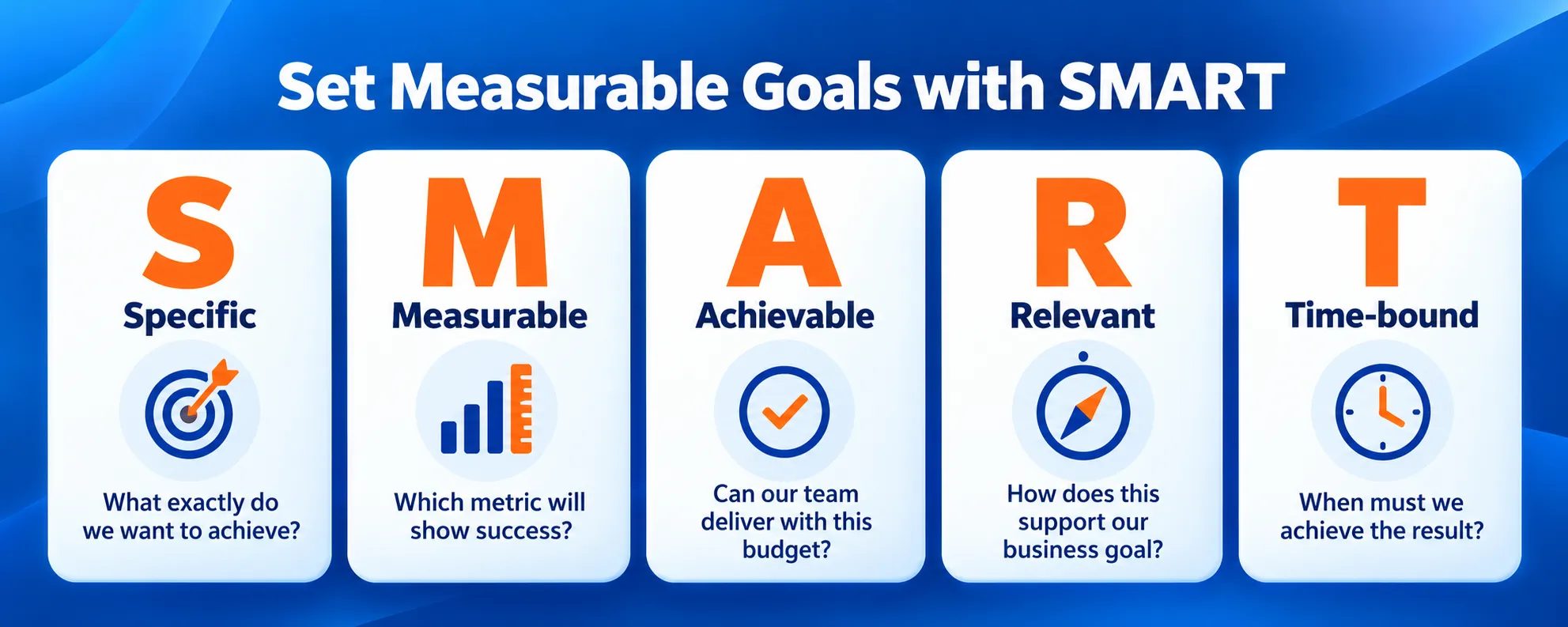
The SMART framework gives a goal enough shape to test:
- Specific: names one outcome.
- Measurable: has a number a tool can report.
- Achievable: fits your budget and timeline.
- Relevant: connects to a business priority.
- Time-bound: has a deadline.
| Vague goal | SMART goal |
|---|---|
| Get more people talking about us | Increase website traffic by 30% over the next quarter |
| Boost our online presence | Generate 150 enquiry submissions from Singapore visitors by 31 March |
A vague goal cannot fail, so it cannot teach you anything. A SMART goal tells you whether to scale or stop.

Choosing key performance indicators that match the goal
Each KPI must match the objective:
- Awareness: reach and impressions.
- Engagement: engagement rate, meaning interactions divided by reach.
- Acquisition: cost per acquisition (CPA) and conversion rate.
One client cut cost per acquisition from S$14 to S$1.50, turning a loss-making campaign into a profitable channel. A good customer acquisition cost is lower than customer lifetime value, with a common rule of thumb of a 3:1 LTV-to-CAC ratio.
Choosing Channels and Audiences in Singapore
Define who you are reaching before choosing a channel. Segment audiences by what they are trying to solve, not by demographics alone. Each segment needs its own message and channel.
For most Singapore businesses, three-channel families cover the needs:
- Search: best when buyers are already typing the problem into Google. Intent is high, but keyword competition is also high.
- Social media: builds awareness among people who haven’t searched yet. Instagram and Facebook suit visual brands and video content.
- Email: reaches existing customers and enquiries at low cost and suits repeat purchases. Creating a tailored sequence for each segment helps lift conversion rates.
Choose the channel where your buyer already spends time with intent, then add a second only once the first converts. A tuition centre might start with search for parents looking for a tutor, then use social media advertising to build awareness among the same households. A successful digital marketing strategy starts with knowing which platforms your users already trust for campaigns and content.
Budgeting, Execution and Measurement
Allocating budget and setting up Google Ads
Start with the GCM check before spending. Write down the business goal, the channel most likely to reach your target audience, and the one metric that proves the goal was met. Then divide the budget by the cost-per-acquisition (CPA) you can afford. If a lead is worth S$80 to your business, a campaign that delivers leads at S$120 loses money, no matter how good the click-through rate looks.
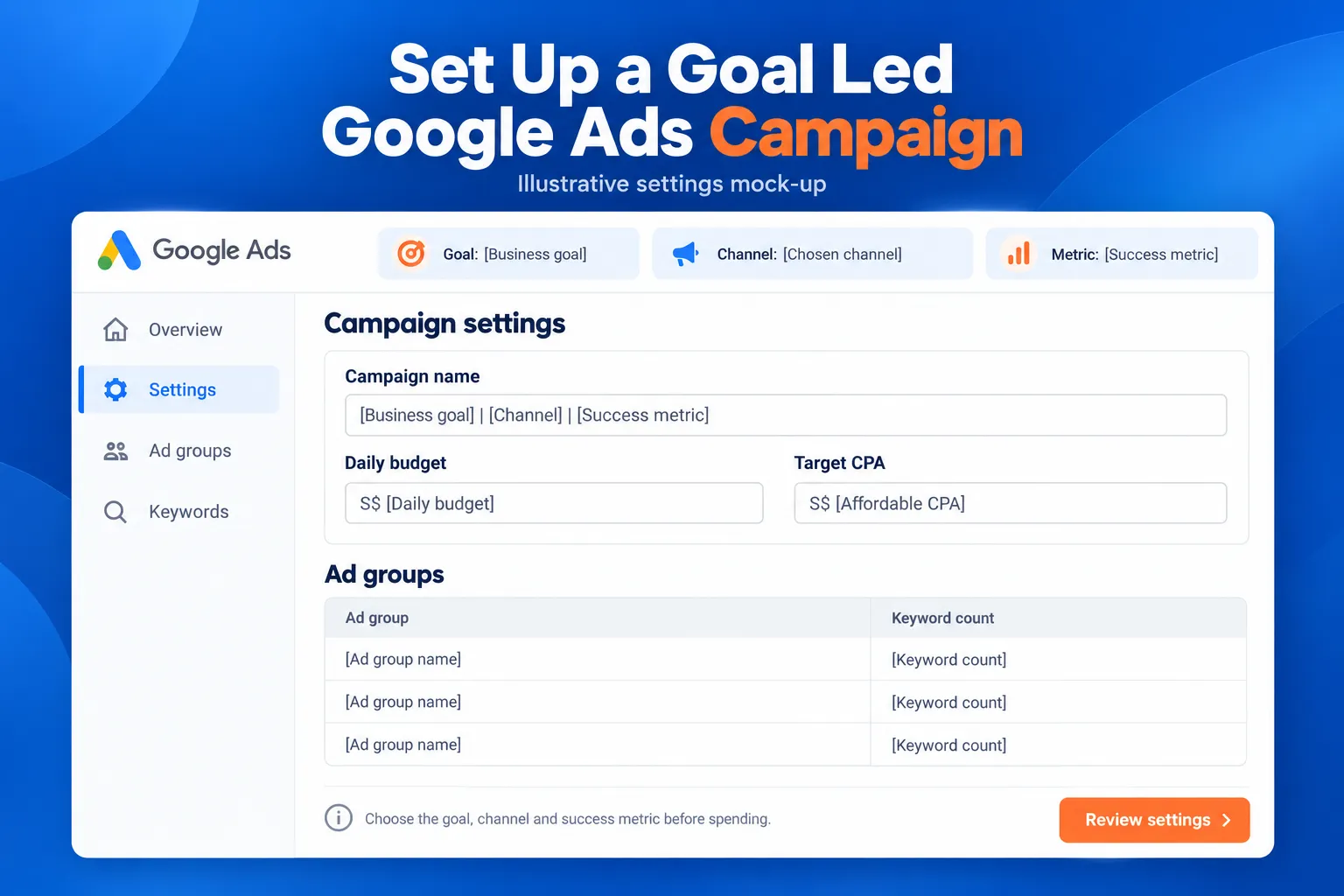
For a small Singapore business, a common starting point is 15 to 25 percent of monthly paid spend for testing. Deviate when margins are thin or conversion volume is too low to learn from.
Set up Google Ads in this order:
- Create one campaign per goal, not one per product.
- Keep each ad group to 5 to 15 tightly related keywords, with each keyword having its own ad.
- Install the Google tag and create a conversion action for each form submission, call and purchase.
- Test every conversion yourself and confirm that it appears in the Conversions column.
- Add a negative keyword list covering irrelevant terms such as “free”, “jobs” and “DIY”.
- Set a daily budget and a target CPA, then allow about seven days of learning before judging, depending on conversion volume.
A step-by-step launch and review process
Use this sequence for every campaign:
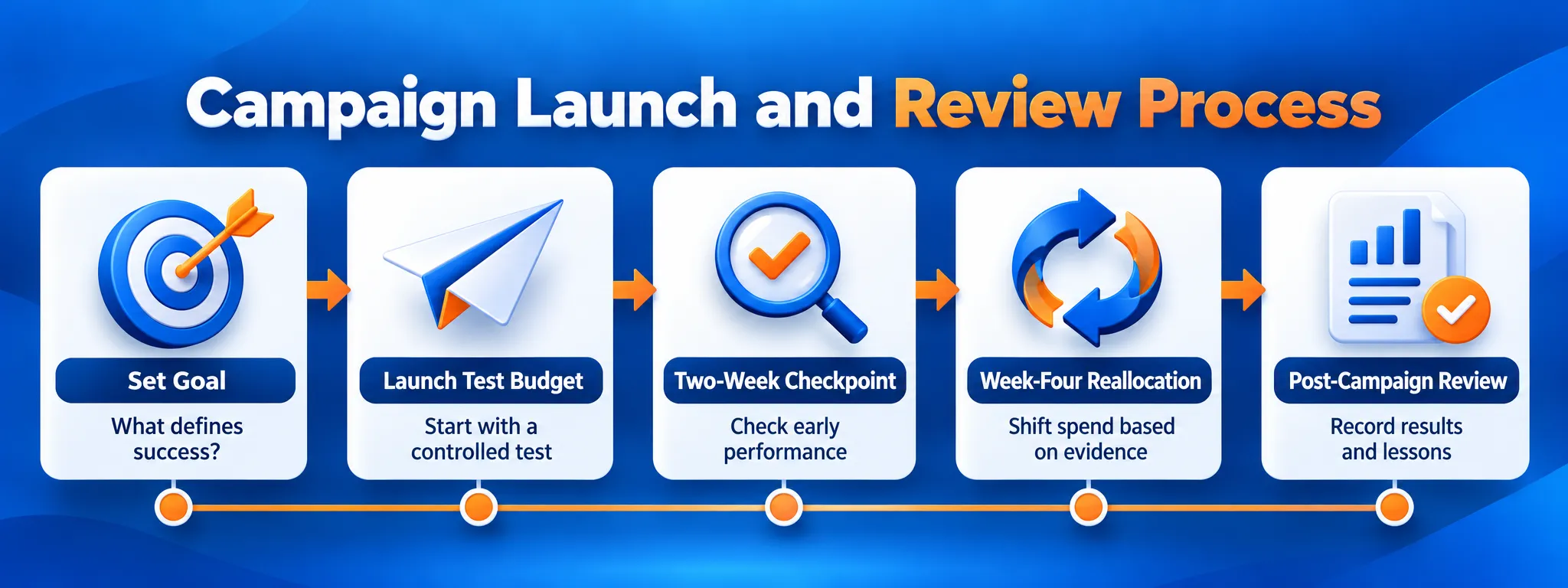
- Set the goal and metric. Complete the GCM Check and write a specific goal, such as “increasing website traffic by 30% over the next quarter.”
- Launch with a test budget. Spend across two or three channels at most so you can attribute results.
- Run the two-week checkpoint. Pause any ad group that has spent more than twice its target CPA with no conversions. Shift budget toward the lowest-CPA ad group.
- Reallocate at week four. Allocate around 70% of spend to proven campaigns and 30% to testing, adjusted for account maturity. Pause campaigns exceeding your CPA threshold.
- Review after the campaign. Compare final conversions and revenue to the goal, and record what to repeat.
A Singapore example
A Singapore tuition centre has a S$2,000 monthly test budget and aims for 150 enquiries by 31 March. Its CPA target is S$80, so the budget buys roughly 25 enquiries at that target. At the two-week checkpoint, one ad group has spent over S$160 with no enquiries and is paused. The remaining budget moves to the group delivering enquiries at S$60 each. The month-end review compares the final count to the 150 target, not to impressions.
Reach is not return. Red Bull’s space jump drew 8 million live viewers. Viewers are an input. Only conversions, tracked against your CPA, show whether the campaign paid for itself.
Conclusion
A digital marketing campaign succeeds when you settle its goal, audience, channel and measurement before launch. Duolingo’s 25,560% spike in social mentions shows attention, not sales.
Before spending, define the business goal, the channel your buyers use and the metric that proves success. If you cannot, the campaign is not ready.
Frequently Asked Questions
What is a digital marketing campaign?
A digital marketing campaign is a planned set of online activities, run across one or more channels over a fixed period, to reach a defined audience and achieve one measurable business goal. Agree on the goal and measurement plan before spending.
How long should a digital marketing campaign run?
Run it only as long as your goal requires. Check early signals at a two-week checkpoint, then allow one full review cycle before judging results.
How much should a small business budget for paid ads?
Start with an affordable amount while learning. Divide it by your target cost per acquisition to see how many customers it can buy.
Which channel should I start with?
Start with the channel most likely to reach your audience at a measurable cost. Add a second only once the first has proven conversions.
How do I know if a campaign worked?
Compare results against the SMART goal set before launch. Reach and impressions alone do not prove success.