| AI Summary
Clickbaiting uses misleading headlines, thumbnails and previews to attract clicks through exaggerated claims or missing information. This guide explains how clickbaiting works, common warning signs and its impact on reader trust, SEO and digital marketing. Learn how to identify misleading content, apply the Clickbait Promise Audit and create engaging headlines that attract relevant audiences without sacrificing credibility. |
Clickbaiting uses headlines, images or previews designed to make people click, often by exaggerating a claim or withholding essential information. The problem starts when the content fails to deliver what the preview promised. You encounter it in news feeds, Google results, YouTube thumbnails, social posts and marketing emails.

For Singapore businesses, the distinction matters. A compelling headline can attract qualified visitors. A misleading one may generate attention from people who have little reason to trust, subscribe or buy. We recommend a simple starting test: can the content fulfil the expectation created before the click?
Key Takeaways
- Clickbaiting relies on misleading expectations. Curiosity alone does not make a headline dishonest.
- Common warning signs include missing context, inflated claims, false urgency and thumbnails unrelated to the content.
- Platform risks differ. Google Discover, Facebook and YouTube have published guidance or policies addressing misleading previews; ordinary Google Search rankings are a separate issue.
- Our Clickbait Promise Audit helps brands check headline accuracy before publication and improve questionable drafts.
What Is Clickbaiting?
Clickbaiting is the practice of using an attention-grabbing title, caption, thumbnail or link preview to persuade someone to open content. In everyday usage, the term usually describes tactics that mislead the audience about what they will find.
Consider the headline, “Singapore Shoppers Are Abandoning This Popular Payment Method.” It suggests a significant consumer trend supported by evidence. If the article contains only one anonymous comment, the headline overstates its findings. The problem is not the dramatic language by itself. It is the mismatch between the claim and the evidence.
We use headline-to-content alignment as the central standard. The headline should accurately represent the article’s scope, evidence and outcome. The introduction should establish that connection promptly, while the rest of the page must deliver the substance. Complex investigations may take time to explain; they do not need to reveal every finding in the first sentence.
Clickbaiting versus a curiosity gap
A curiosity gap is the distance between what readers know and what they want to discover. A headline can introduce a question without immediately answering it. That approach is common in journalism, education and digital marketing.
Why Clickbaiting Works: The Psychology Behind the Click
Clickbaiting takes advantage of the quick decisions people make while scrolling. Readers often assess a headline in seconds, using the limited information available. An unexpected claim can interrupt that process and encourage a click before its credibility is examined.
Curiosity and missing information
A headline such as “The One Thing Most Homeowners Forget” deliberately hides its subject. Readers may click to resolve the uncertainty, especially when the topic seems personally relevant.
Withholding details is not automatically deceptive. However, leaving out the location, evidence or actual topic can prevent readers from deciding whether the article is worth their time. Our preference is to identify the topic while keeping a genuine question open.
Emotional triggers and exaggerated stakes
Words such as “shocking”, “disaster” and “unbelievable” promise a strong reaction. Fear of losing money or missing an opportunity can produce a similar response. These devices are especially tempting when publishers compete for attention in crowded feeds.
Emotion can be appropriate when a story genuinely warrants it. The concern is proportionality. A small software update should not be framed as a nationwide business emergency without evidence supporting that description.
Urgency and the fear of missing out
“Read this before it disappears” suggests that important information may soon become unavailable. “Only two hours left” encourages an immediate purchasing decision. Both claims require factual support.
Common Clickbaiting Techniques and Realistic Examples
Clickbaiting is easier to identify when you know its recurring patterns. The following techniques can appear separately or together in a headline, advertising creative or social post.

Withholding the essential subject
“You Won’t Believe What Happened at This Restaurant” reveals almost nothing about the event. Without a meaningful subject, readers must click merely to understand the claim.
Exaggerating results or certainty
“This SEO Trick Guarantees First Place on Google” implies an outcome no credible provider can guarantee. It also attracts readers who expect a shortcut rather than a realistic explanation of search optimisation.
A defensible alternative is “Five Technical SEO Checks That Can Improve Site Accessibility.” It makes a narrower claim and creates room to explain limitations. We recommend matching the strength of every headline claim to the evidence actually available.
Promising an answer the content never gives
A title may promise “Seven Ways to Reduce Your Electricity Bill” but provide only three tips, repeated advice and unrelated promotions. This is a straightforward delivery failure, even if the listed suggestions are accurate.
Misleading images and thumbnails
A dramatic thumbnail may show an expensive product, a famous person or a large cash figure that never appears in the accompanying video. The visual creates a false expectation even when the title is relatively restrained.
We recommend reviewing thumbnails and headlines as one promise. A truthful caption cannot fully repair a misleading image. Labels, screenshots and visual comparisons must also represent the underlying material accurately.
Bait-and-switch links and unsupported urgency
Another tactic promises information but redirects the visitor to a sales pitch, a different topic or an unrelated registration page. An advertisement that looks like an independent news report can create a similar problem when its commercial purpose is hidden.
A paywall or sign-up requirement is not inherently clickbaiting. The issue is whether important restrictions are disclosed and the promised material exists. Readers should understand what they are being asked to do and why.
How to Spot Clickbaiting Before You Click
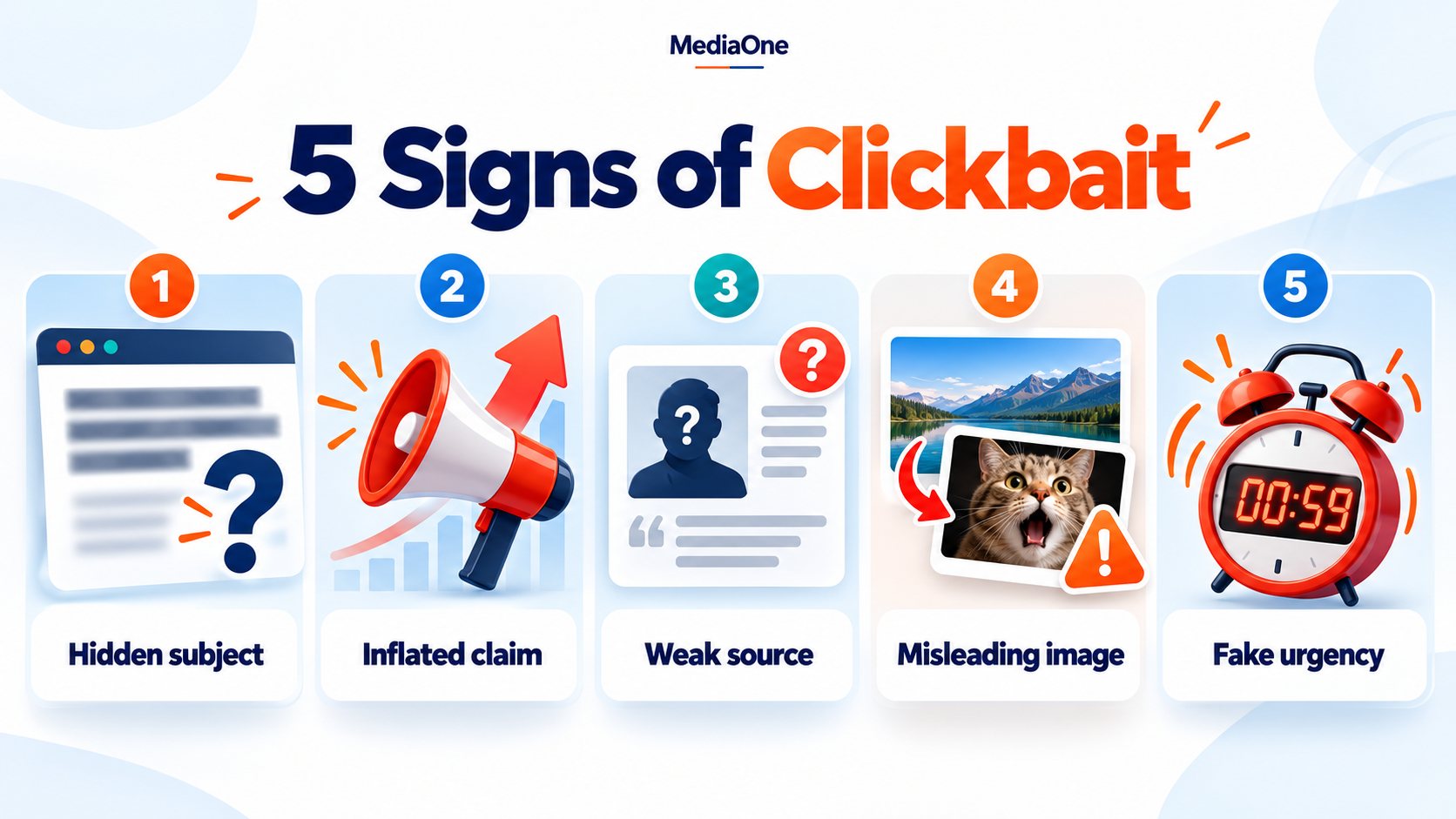
Readers can identify many misleading previews without opening them. We recommend five checks that work across search results, social platforms and messaging apps.
- Identify the subject. Can you tell what the story concerns, or does the headline hide everything behind “this”, “these people” or “what happened next”?
- Check the size of the claim. Does a sweeping promise rest on one example? Be cautious with guaranteed results, universal claims and unsupported superlatives.
- Examine the source. Look for a recognisable publisher, an accountable author and evidence relevant to the claim. A professional-looking design is not proof of accuracy.
- Compare the image with the wording. Ask whether the thumbnail adds genuine context or implies an event, person or result that the title never establishes.
- Look for artificial pressure. Treat unexplained countdowns, threats of deletion and requests to share immediately as reasons to verify the information first.
What to check after opening a suspicious page
Look for a clear answer to the headline’s central question. Check whether statistics have identifiable sources and whether quoted experts are named. If the article describes a survey, you should be able to understand who conducted it and what was measured.
Clickbaiting, Google Search and Social Platform Policies
A common claim is that Google automatically penalises websites for clickbaiting and that a high bounce rate directly causes ranking losses. Neither statement is a reliable description of how all Google Search results work.
Google Search prioritises helpful, accurate content
Google’s people-first content guidance asks whether titles provide descriptive summaries and avoid exaggerated or shocking wording. It also encourages original information and a satisfying experience for readers.
That does not mean every sensational headline receives a manual action. Google’s Search spam policies address particular deceptive practices, including misleading functionality and sneaky redirects. A breach of an applicable policy can affect visibility, but a dramatic headline alone is not proof of a violation.
Similarly, Google Analytics bounce rate is not a simple ranking-penalty score. It measures sessions that did not meet the platform’s engagement criteria. A visitor can find a complete answer on one page and leave satisfied. We assess content usefulness using multiple indicators rather than treating one exit as failure.
Google Discover explicitly warns against misleading previews
Google’s Discover guidance tells publishers to avoid clickbait that inflates engagement through misleading details or missing essential context. Its Discover content policies also prohibit previews that promise information not reflected in the underlying article.
Discover is distinct from conventional Google Search results. Misleading preview content can affect Discover eligibility, and certain policy violations may trigger Discover manual actions. Publishers should therefore review titles, snippets and featured images together.
Facebook and YouTube have addressed misleading engagement tactics
In its published clickbait updates, Facebook described two recurring signals: withholding information and exaggerating a story. The company explained that it developed measures to reduce distribution of such posts. Those announcements document its approach; they should not be treated as a complete description of every current ranking signal.
YouTube’s spam policy expressly addresses malicious clickbait, including misleading titles and thumbnails that promise something absent from a video. For creators, an accurate thumbnail is part of the content promise, not merely decoration.
Why Clickbaiting Can Hurt Singapore Businesses
A misleading headline may produce a spike in traffic while attracting the wrong audience. Visitors expecting a free guide may encounter a sales form. People expecting product prices may find a vague promotional story. Even when they remain on the site, their actions may not support the business goal.
Advertising standards and consumer protection
The Advertising Standards Authority of Singapore states that the Singapore Code of Advertising Practice expects advertisements to be legal, decent, honest and truthful. Clickbaiting becomes a concern when marketing claims create a misleading impression about a product, offer or result.
Singapore’s Consumer Protection (Fair Trading) Act also addresses unfair practices, including false claims and conduct that may reasonably mislead consumers. The Competition and Consumer Commission of Singapore’s guidance explains these principles in a consumer-trading context. This is not a blanket rule making every curiosity-driven headline unlawful.
The Protection from Online Falsehoods and Manipulation Act (POFMA) is different. As the POFMA Office explains, correction or other directions require a false statement of fact communicated online in Singapore and a public-interest basis. Ordinary teaser headlines do not automatically meet those conditions.
The Clickbait Promise Audit: A Practical Review Framework
We recommend using a short editorial check before approving an article, video or campaign. Our Clickbait Promise Audit compares the claim made by the preview with what the content actually provides. It is an internal review framework, not an official Google, Facebook or regulatory scoring system.
Step 1: Write down the reader’s expected answer
Read the headline without looking at the draft. Record the information a reasonable reader would expect to receive. Be specific about numbers, dates, outcomes and product claims.
For example, “Five Ways to Cut Delivery Costs in Singapore” promises five usable methods. It does not necessarily promise guaranteed savings or a particular percentage unless the title says so.
Step 2: Check the actual delivery
Review the introduction, main sections, visuals and final recommendation. Does the page address the stated subject promptly? Does it eventually provide every promised item with enough detail to be useful?
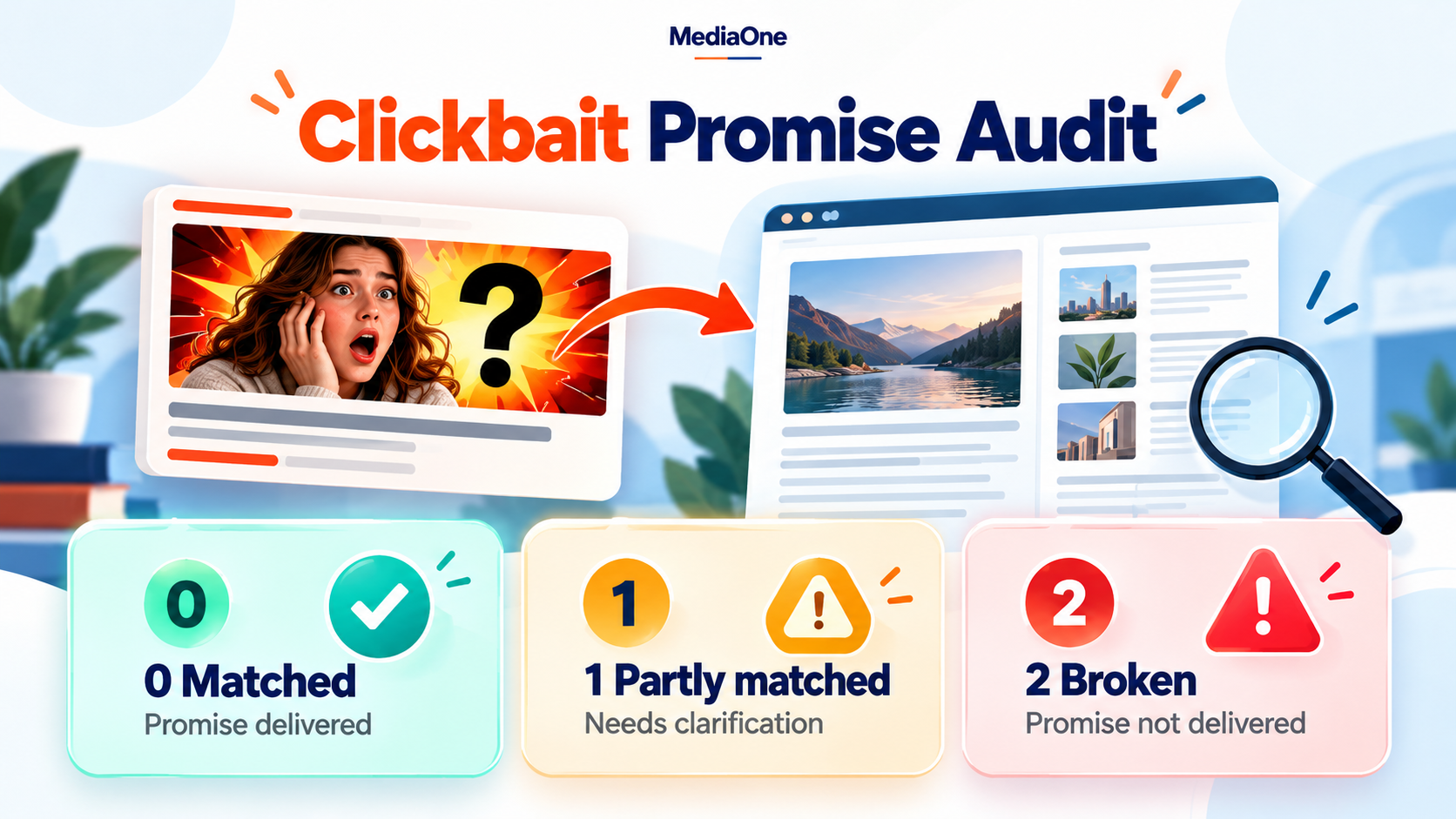
Step 3: Assign a promise-gap score
Use the following editorial scale to decide whether the preview is ready for publication. A score of 2 requires correction before the content goes live.
- 0 — Matched: The preview accurately describes the content, and the promised information is delivered.
- 1 — Partly matched: The topic is relevant, but the preview overstates a result, conceals a key limitation or needs clarification.
- 2 — Broken: The promised subject, evidence, number of items or outcome is absent or materially misrepresented.
| Original headline | What the page actually contains | Better headline |
| “This Marketing Hack Guarantees 10,000 Leads” | General lead-generation suggestions with no guarantee | “Six Lead-Generation Tactics to Test in Singapore” |
| “Seven Hidden Fees Every Buyer Must Know” | Only four fees are explained | “Four Fees to Check Before You Buy” |
| “Why More Customers Prefer Online Booking” | Survey findings and a clear explanation | Keep the headline if the evidence supports the trend |
Step 4: Check the complete preview and publication context
Review the search title, meta description, social caption, image and email subject line. They may be written by different people, yet readers interpret them as one message. Ensure that the article date, geographic context and any qualifications remain accurate wherever the content appears.
How to Write Strong Headlines Without Clickbaiting
The objective is to attract the right reader with a clear and interesting promise. We prefer headlines that combine a recognisable topic with a specific benefit, question or finding.
Lead with the information readers need
Start with the subject, then add the reason to care. “How Singapore SMEs Can Review Website Security” communicates a useful purpose. “This Website Mistake Could Destroy Your Business” exaggerates the stakes without identifying the issue.
Use numbers only when the article delivers them
Numbered headlines are helpful when they tell readers the scope of a guide. However, every listed item must be distinct and relevant. Do not pad a five-point explanation to reach ten simply because a larger number looks impressive.
Include evidence and meaningful qualifications
A headline reporting improved sales or traffic should identify what changed, when it happened and whose results are being discussed where space permits. If the evidence comes from a single case study, avoid presenting it as a universal outcome.

Keep SEO intent and reader expectations aligned
Searchers looking for definitions want direct explanations. People comparing services want criteria and realistic options. Buyers searching for prices need actual pricing information or a clear explanation of why quotations vary.
We align headlines with search intent because the visitor’s goal should shape the content. Our SEO services guide takes a similar decision-focused approach: explain the choice, clarify the limitations and help readers determine their next step.
Test compelling versions without inventing promises
Editorial teams can compare accurate headline alternatives to understand what readers respond to. Keep the underlying claim consistent, then vary emphasis, wording or specificity. Do not label a headline successful solely because it earns the highest click-through rate.
The better version should bring relevant visitors who engage with the material and take appropriate next steps. If an attention-grabbing version attracts large numbers of uninterested readers, revise the promise rather than assuming the campaign succeeded.
Measure What Happens After the Click
Clicks tell you whether a preview attracted attention. They do not tell you whether the visit was useful. We recommend measuring both discovery and the quality of the visitor’s experience.
Google Search Console and Google Analytics can support that comparison. Search Console shows impressions, clicks and click-through rate for Google Search. Google Analytics 4 helps examine engaged sessions and key events after visitors arrive.
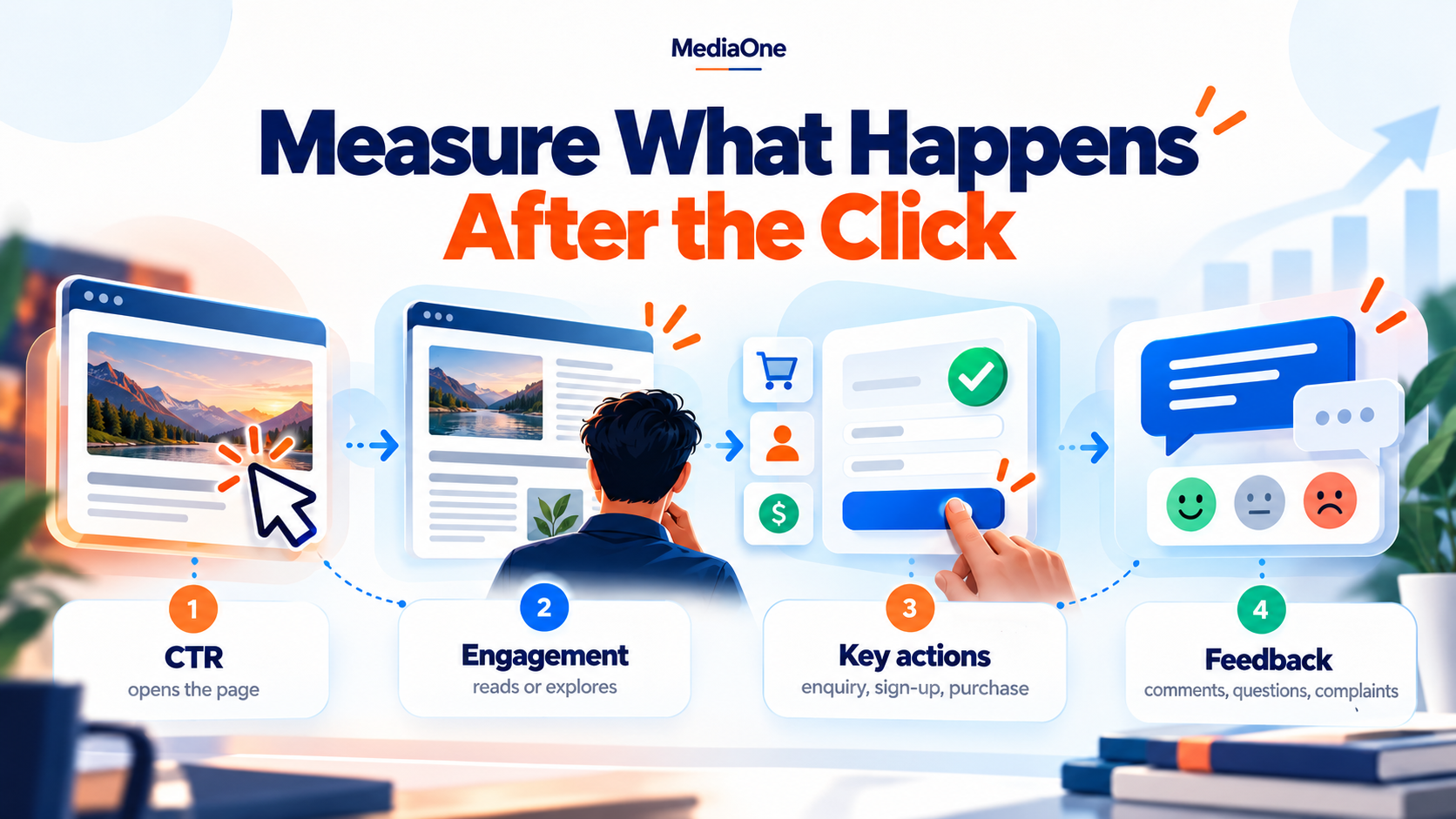
For this purpose, review four indicators together:
- Click-through rate: Are people interested enough to open the page?
- Engagement: Do visitors spend time with the content or navigate meaningfully?
- Relevant actions: Do qualified readers enquire, subscribe, download or purchase?
- Qualitative feedback: Do comments, customer questions or complaints reveal unmet expectations?
Google’s GA4 engagement definition includes sessions lasting longer than ten seconds, containing a key event or producing at least two page or screen views. These are useful diagnostics, not definitive measures of reader satisfaction. Interpret changes alongside content quality, audience intent and conversion results.
Build Headlines That Earn the Click and Keep Reader Trust
Effective content marketing begins with an honest promise. A headline should make the right audience curious, while the article should reward their attention with relevant information. When those elements agree, visitors can make informed decisions about whether to continue reading or contact the business.
For Singapore brands reviewing existing content, we recommend starting with high-traffic pages that receive few qualified enquiries. Compare the headline, thumbnail and opening with the actual substance. Correct exaggerated claims, add missing evidence and remove misleading urgency. Then monitor engagement and business outcomes to see whether the changes attract better-fit visitors. Our approach is straightforward: write for the person behind the click, not the click itself.
Frequently Asked Questions
What is clickbaiting in simple terms?
Clickbaiting means using a headline, image or preview to attract clicks through misleading expectations. The content may exaggerate a claim, hide essential context or fail to deliver what was promised.
Is every curiosity-driven headline clickbaiting?
No. A headline can leave a genuine question unanswered while accurately describing the subject. It becomes problematic when the promised answer or evidence is missing or materially misrepresented.
Is clickbaiting illegal in Singapore?
Not automatically. However, misleading commercial claims may raise issues under consumer-protection rules, and certain false factual statements may fall within POFMA when its legal conditions are met.
Does clickbaiting directly lower Google rankings?
There is no general rule that every clickbait-style headline receives an automatic Google Search penalty. Misleading content may conflict with particular Google policies, while weak content can also perform poorly for other reasons.
Look for exaggerated promises, missing subjects, misleading thumbnails and unsupported urgency. Verify important claims against named sources before sharing or acting on them.
Can clickbaiting generate sales?
A misleading preview can attract visits, but those visits may not come from people interested in the actual offer. We recommend judging performance through qualified enquiries, conversions and customer trust rather than clicks alone.
What is the best alternative to clickbaiting?
Use accurate, specific headlines that identify the topic and communicate a meaningful benefit. Support the promise with useful content, credible evidence and an appropriate next step.