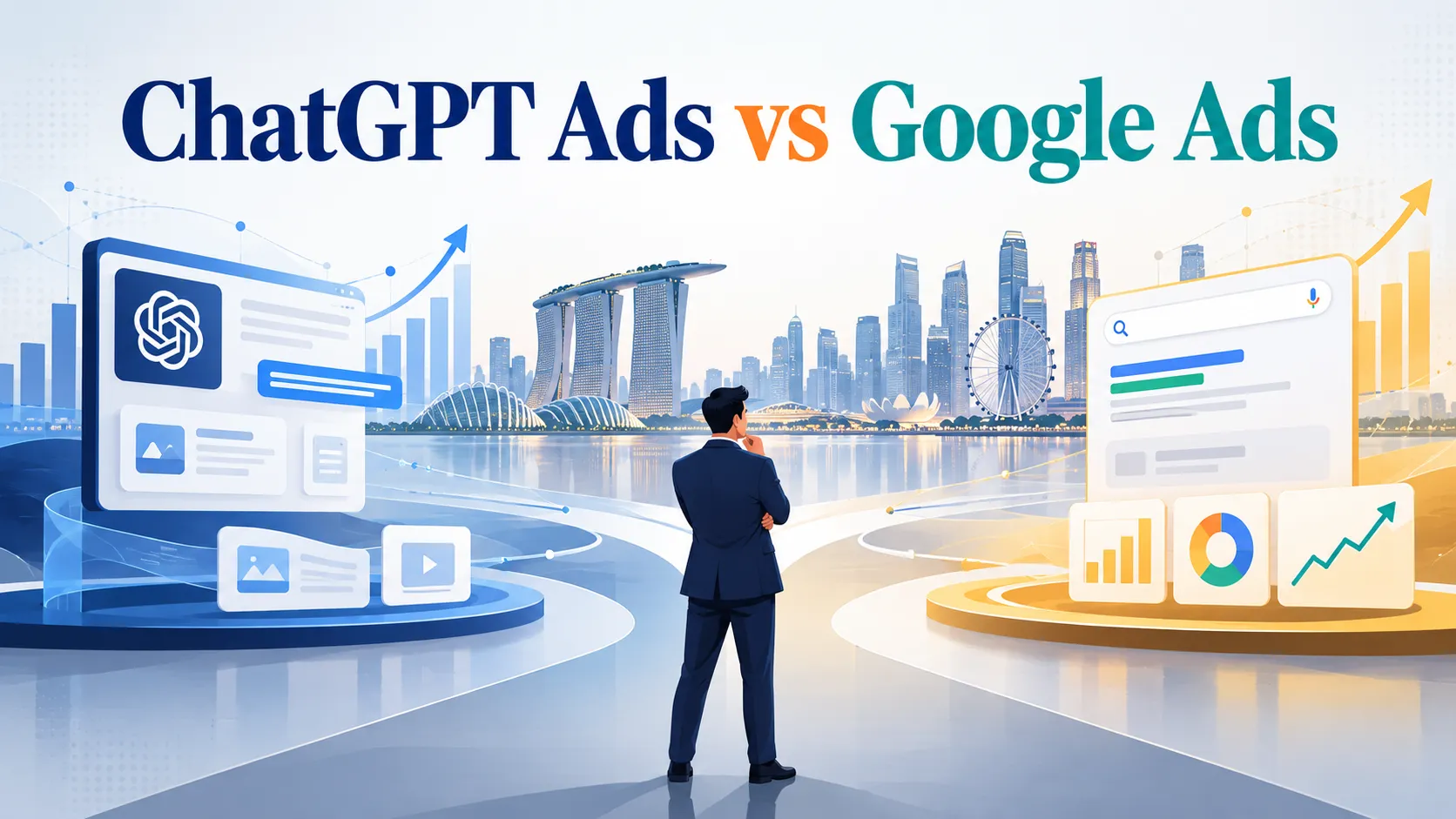
OpenAI began showing ads inside ChatGPT in a United States pilot on 9 February 2026. Singapore marketers who already spend on Google are now asking whether any budget should move. For most businesses, the answer is not yet. ChatGPT Ads is not a replacement for Google Ads in 2026. It is a narrow, test-sized channel for reaching people early in their research, and it needs proper measurement before it earns real budget. Our team at ChatGPT ads agency has tracked how these campaigns perform. The early results are more limited than the launch coverage implied.
Key Takeaways
- Can ChatGPT Ads replace Google Ads for a Singapore SME with a S$10,000 monthly budget? Not in 2026. Keep most of that budget on Google Ads and, if you test ChatGPT Ads, cap it at a small share with a fixed review date.
- ChatGPT Ads is a narrow, test-sized channel for early discovery, not a replacement for Google Ads in 2026.
- Google Ads remains the default for capturing active, high-intent demand, so keep it funded first.
- Judge any ChatGPT test on cost per sign-up after the 2 to 4 week learning phase, not on click-through rate alone.
- Score your business with the seven-factor Channel Fit Scorecard before moving any budget.
- Factor in 9% GST and agency fees of roughly SGD 800 to SGD 3,000 or more per month, which can exceed media spend on small accounts.
Table of Contents
How ChatGPT Ads and Google Ads Differ in Intent
Google Ads captures a keyword . A searcher types a short query such as “accountant Singapore GST filing”, scans the results and clicks. The advertiser bids on that phrase. ChatGPT Ads works differently. The user asks a multi-turn question, refines it, and the answer builds over several exchanges, with context hints from earlier turns shaping what comes next. The buyer may still be deciding whether to buy at all, and the website they reach next is only one part of a longer online journey.
This difference changes where each platform reaches a buyer. Google Ads tends to serve people who already know what they want. ChatGPT Ads more often reaches someone still researching a category, so the creative must address that earlier question. Early-stage demand that Google misses is where the new channel earns its place, but a click there is least likely to convert, so judge it on its contribution to conversions across the wider digital marketing mix rather than on click cost alone.
Map your customer journey in three columns: the question a prospect asks before they know your category, the question they ask when comparing providers, and the query they type when ready to buy. Mark which column each platform serves. If most revenue comes from the third column, Google Ads remains the default. If your sales cycle starts with education, a small ChatGPT Ads test can cover the first column, and the time spent on that test should be judged against the content it supports.
Ad Formats and Placements
Google Ads and ChatGPT Ads put advertising in very different places. That shapes what each can do for a Singapore business.
On Google, the core format is the text ad that appears above and below organic results when someone searches. Shopping ads add product images and prices. Performance Max runs across Search, YouTube, Display and Maps from one campaign. The user has typed a query, so the ad sits in a visible, familiar slot. Google has renamed some Search strategy labels in recent release notes, so check your campaign settings rather than trusting the labels alone. Ads vs Google comparisons are most useful when they start from the same campaign goal, so compare formats against that goal rather than against each other’s labels. Google’s search ad formats also connect to a wide range of advertising services, from bid management to creative production.
How ChatGPT sponsored placements appear
ChatGPT shows sponsored recommendations inside an answer, not in a separate results list. The advertiser has far less control over placement. You cannot bid on a fixed slot the way you can on a Google results page, and the user’s conversation sets the context. A landing page that matches the conversational context of the recommendation is likely to serve the visitor better than a generic homepage, so advertisers should map each recommendation to a specific landing pages variant rather than one catch-all URL.
Availability in Singapore
ChatGPT ads first shipped in February 2026, with a self-serve Ads Manager following in May, according to Slobodan Jelisavac’s analysis of the rollout. Expansion has been rapid, but confirm current Singapore availability in the Ads Manager itself before planning a test. Google Ads is fully live in Singapore. Advertisers building a wider digital marketing mix should treat OpenAI’s ad products as an emerging channel rather than a replacement for search.
| Format | Placement | Typical user moment | Control level |
|---|---|---|---|
| Google text ads | Above and below organic results | Active search, comparing options | High: keywords, match types, bids |
| Google Shopping and Performance Max | Shopping tabs, Search, YouTube, Display | Product research and purchase | Medium: feeds and assets, less placement control |
| ChatGPT sponsored recommendations | Inside a conversational answer | Early research and open-ended questions | Low to medium: category and context matching |
Google Ads captures people who already know what to search for. ChatGPT Ads reaches people while they are still forming a question.
Targeting: Keywords Versus Context
Google Ads targets people by what they type. It offers exact, phrase and broad match keywords, audience layers, device settings and location radius. A Singapore advertiser can bid on “aircon servicing” in Tampines alone and see the match logic clearly. Search term reports and negative keyword lists show which searches triggered each click, which makes this a dependable base for digital marketing and advertising spend.
ChatGPT Ads matches to the topic of a conversation, not to a typed keyword. The advertiser sets no keyword list and cannot pick a specific query, so relevance depends on how well the conversation fits the offer. Context hints shape delivery, but they are not the same as the precise controls Google offers. Confirm which targeting inputs the current ChatGPT Ads Manager accepts before committing budget, because this area is still changing.

The trade-off is precision against relevance. Google gives you control over who sees your ad, but the user has already named their need. ChatGPT can surface your offer while someone is still deciding what they need, but you have less control over the moment.
Before choosing a targeting approach, ask:
- Does my customer already search for this product by name?
- Can I write negative keywords that stop wasted spend, and does the platform let me?
- Is my offer relevant to a broad discussion, or only to a specific purchase?
- Do I need to reach a defined location or audience with tight control?
- Would a weaker match still be worth a click if the lead quality holds?
Answer “yes” to the first two and Google Ads stays your default. A “yes” to the third and fourth, with uncertainty on the fifth, is the profile for a small, capped ChatGPT test.
Cost Comparison: CPC, CPM and Real Budget Thresholds
Cost is where the two platforms diverge most, and where most budget decisions go wrong. ChatGPT Ads uses different pricing, and the early numbers are thin, so start from what you already pay on Google. Working professionals planning a digital marketing budget should begin with the cost they already see on their current meta ads and search services before testing anything new.
ChatGPT ad click-through rates run 0.60% to 1.91% across nine live markets, with the US at 0.73%, against a Google Search average of 6.64%, according to Lapis’s ChatGPT Ads benchmark. An Opascope test recorded roughly $1.72 CPC over 15 days, reported in US dollars. Treat that as one data point, not a benchmark. Your planning figure should be cost per sign-up, calculated as spend divided by sign-ups, because a cheap click means little if it does not convert. Compare that figure across both platforms before you commit any advertising budget, and read the results on your own landing pages rather than on platform averages. A clear strategy built on this figure keeps the test honest.
On Google, budgets are set as an average daily figure. For most campaigns, Google can bill up to two times that amount on a given day, as explained in MediaOne’s Google Ads budget guide for Singapore. At a S$50 average daily budget, the usual one-day maximum is S$100 and the standard monthly limit is S$1,520. Under standard billing terms, subject to change, check your account settings and Google’s budget documentation. GST at 9% applies on top, so a S$50 daily budget costs S$54.50 per day once tax is included.
Agency fees change the arithmetic for small accounts. Singapore agencies commonly charge roughly SGD 800 to SGD 3,000 or more per month. On a S$1,520 media budget, that fee can exceed the spend itself.
| Average daily budget | Usual one-day maximum | Standard monthly limit | Realistic use on ChatGPT Ads |
|---|---|---|---|
| S$20 | S$40 | S$608 | Too small for a learning volume |
| S$50 | S$100 | S$1,520 | Capped test with a fixed review date |
| S$80 | S$160 | S$2,432 | Test alongside a proven Google baseline |
| S$150 | S$300 | S$4,560 | Enough to compare platforms in parallel |
Performance Max becomes worth considering at higher spend. MediaOne notes that budgets above S$5,000 a month often benefit from it, because conversion volume gives stronger learning signals. Below that level, Search gives you more control over where each dollar goes. Put your ads vs google comparison in the same spreadsheet as your conversion data, so the decision rests on your own numbers.
Performance, ROI and Measurement Maturity
Evidence on ChatGPT Ads is still thin, and a budget decision should not rest on the few early results that exist. What is missing is a long enough run of conversion data to show whether sign-up costs hold steady. Before deciding, a business should measure one thing: its cost per sign-up on a ChatGPT advertising test, compared with its own Google Ads baseline over the same period. A sound strategy for this kind of test sets that comparison before any money is spent.
An Opascope test ran about US$60,000 over 15 days in June 2026. It returned a blended ROAS of 1.49x, an average CPC of roughly US$1.72 and a conversion rate of 2.35%. Daily ROAS, however, swung between 0.2x and 2.9x. A channel that moves that far in a day is not yet predictable enough to plan a monthly budget around.
The SE Ranking self-test shows the gap between clicks and leads. The campaign recorded more than 97,000 impressions and 1,263 clicks, a click-through rate of 1.30%, but “very few signups”. A healthy click-through rate shows the ad was seen and tapped. It does not show the visitor was ready to buy, so a sound digital marketing plan judges clicks by the leads they produce. Ad copy and landing page context matter here, since a clicked ad that does not match the page rarely converts.
Most zero-conversion reports circulating online come from campaigns launched before August 2026, when oCPC, the OAIQ Pixel and the Conversions API were still maturing. Conversion measurement has been introduced progressively since launch. Judging a campaign built on older tooling against today’s standards misreads the channel.
Google’s own timing rule applies here too. When a Google Ads campaign is relaunched, its algorithm enters a learning phase, typically 2 to 4 weeks. Google’s documentation on the learning phase explains that length varies by campaign. Changing structure also resets results. Converting from broad match to exact match typically reduces traffic by 20 to 40%, so a short ChatGPT test should run past its own learning window before anyone reads its cost per lead.
Channel Fit Scorecard
Use this seven-factor checklist to decide how much budget, if any, to move. Score each factor from 1 to 3, where 1 is weak fit and 3 is strong fit.
| Factor | Score 1 | Score 2 | Score 3 |
|---|---|---|---|
| Intent of the user moment | Mostly early research | Mixed research and comparison | Mostly active, ready-to-buy queries |
| Measurement maturity | No conversion tracking | Tracking set up, little history | Stable tracking and a Google baseline |
| Budget floor | Under S$1,500 a month | S$1,500 to S$4,500 a month | Above S$4,500 a month |
| Conversion path length | Long, multi-step sales cycle | Medium cycle | Short, direct enquiry or purchase |
| Competitor density | Crowded, high-cost category | Moderate competition | Few competitors bidding |
| Creative fit | Offer does not suit conversation | Partial fit | Offer suits open-ended discussion |
| Reporting need | Needs fast, granular reporting | Weekly reporting sufficient | Happy with a longer review cycle |
Totals decide the split:
- 7 to 12 points: Keep Google Ads only.
- 13 to 17 points: Run a capped ChatGPT test alongside Google.
- 18 to 21 points: Run a larger test with a defined review date.
The scorecard takes under ten minutes. Be honest on measurement maturity: a high score there needs a working Google baseline, not just a tag installed on the site.
Worked Example: A Singapore Business Running a Test
Consider a business spending a S$50 average daily budget on Google Search. Under standard billing terms, subject to change, that budget carries a usual one-day maximum of S$100 and a monthly limit of S$1,520, before 9% GST. Check your own account settings, and confirm current rules in Google’s billing documentation.
Add an agency fee of S$800 a month and the real cost base becomes clear. Once tax and management are counted, the fee is a large share of the total.
To compare a test against the baseline, use this calculation with your own numbers:
- Divide your Google Ads spend for the period by your Google sign-ups. This is your baseline cost per sign-up.
- Divide your ChatGPT test spend, after the learning window, by its sign-ups. This is the test cost per sign-up.
- Compare the two. For example, if Google spend of S$3,000 produces 30 sign-ups, the baseline is S$100 per sign-up. A ChatGPT test spend of S$1,000 producing 5 sign-ups costs S$200 per sign-up, so it falls short.
The SE Ranking self-test recorded clicks without matching sign-ups, which is the failure this calculation is designed to catch. No ChatGPT Ads spend data for Singapore has been published, so your own test is the only reliable source.
Counterpoint: Will ChatGPT Ads Quickly Rival Google?
A common belief holds that ChatGPT Ads will quickly rival or replace Google Ads, because conversational AI captures attention at the moment of decision. The argument has some merit. The audience is large: OpenAI reports 900 million weekly active users, a figure that has more than doubled in twelve months. Scale alone, however, does not prove that conversational advertising converts.
The early evidence does not yet support rapid substitution. Click-through rates trail Search, daily returns swing widely, and measurement tools have only matured recently. Substitution would need far more inventory, deeper measurement and enough conversion volume, none of which is yet proven. Advertisers still rely on Google’s mature data and targeting, and meta ads on other platforms remain a benchmark for performance. ChatGPT Ads may grow into a meaningful channel, which is a reason to test it carefully now, not to move budget away from Google today.
Conclusion and Summary
ChatGPT Ads and Google Ads serve different moments in the buyer’s journey, so they are not yet interchangeable. Google Ads captures people already searching for a solution. ChatGPT Ads reaches people during open-ended research, and early results show that gap.
For a Singapore business already running Google Ads, ChatGPT Ads is a narrow, test-sized channel, not a replacement. Score your business with the Channel Fit Scorecard. A total of 7 to 12 means Google Ads only, 13 to 17 means a capped ChatGPT test alongside Google, and 18 to 21 means a larger test with a fixed review date.
Next steps this quarter:
- Calculate your Google baseline cost per sign-up, including 9% GST.
- Add agency fees of S$800 to S$2,000 a month if you use one.
- Cap any ChatGPT test at a level you can afford to lose, with a review date at least four weeks out.
- Judge the test on cost per sign-up, not click-through rate, and shift budget only once it beats your Google baseline.
Frequently Asked Questions
Is ChatGPT Ads available in Singapore?
ChatGPT Ads launched in a United States pilot on 9 February 2026, and the self-serve Ads Manager followed in May. Expansion has continued since, including into 31 European markets in late August, according to Slobodan Jelisavac’s analysis of the rollout. Check the platform directly to confirm that your account can access the Ads Manager before budgeting. If you cannot see it, your test has to wait.
What is a typical CTR for ChatGPT Ads compared with Google Search?
ChatGPT ad click-through rates run 0.60% to 1.91% across nine live markets, with the US at 0.73%. The same analysis puts a Google Search average at 6.64%. Judge the gap against your own Google baseline, not the average. A click-through rate measures clicks, and a click on a conversational ad does not predict a sign-up.
Does a small budget work on ChatGPT Ads or Google Ads?
Google Ads works at small budgets because you can cap spend precisely. A S$20 average daily budget carries a usual one-day maximum of S$40 and a monthly limit of S$608, according to MediaOne’s Singapore budget guide. Add 9% GST to every figure. ChatGPT Ads is harder at small spend because the learning volume may never arrive. Judge any small test on cost per sign-up after the learning window, not on early clicks.
How long does a campaign take to stabilise on Google Ads?
Plan for 2 to 4 weeks. When a campaign is relaunched, its algorithm enters a new learning phase, typically lasting that long, according to MediaOne. Google’s learning phase documentation notes that the length varies by campaign. Avoid editing or relaunching during that window, and do not judge performance before it ends.
Should I pay an agency to manage Google Ads in Singapore?
It depends on the size of your media spend. Agency fees for Google Ads management in Singapore commonly range from roughly SGD 800 to SGD 3,000 or more per month, per industry reporting. For a S$50 daily budget, that fee can exceed the media itself. Hire an agency when your spend is large enough that expert management recovers its cost, or when you lack in-house time. If you are considering a ChatGPT Ads agency for a test, price the fee into the test budget first.
Will ChatGPT Ads replace Google Ads?
Not in 2026. ChatGPT Ads is a narrow test channel for early discovery, while Google Ads still captures active, high-intent demand. Substitution would need far more inventory, deeper measurement and sufficient conversion volume, none of which is yet proven. Keep Google as the default and move only a capped share of budget to ChatGPT when your scorecard supports it.