| AI Summary
An AI digital marketing agency uses AI and automation to help plan campaigns, produce content, run ads and report results. Singapore B2B companies can compare agencies by testing whether campaign data follows an enquiry into the sales system and through to a signed deal. A five-part scorecard covers data integration, attribution, decision ownership, reporting and 90-day planning. |
To choose an AI digital marketing agency for B2B, compare agencies on five points: data integration, revenue attribution, decision ownership, reporting schedule and 90-day planning. Ask each agency to trace a sample enquiry from campaign to signed deal, explain any gaps in the record and quote separately for set-up, management, software and ad spend.
Your team can see how many people filled in a form last month. Then someone asks which campaign brought in the customer who just signed, and the answer takes three spreadsheets and a call to sales.
An AI digital marketing agency can help connect those records while running campaigns. The hiring decision comes down to what your team needs fixed, what the agency can show and what it will cost to run. Here is how to compare those options before signing.
Key Takeaways
- A tracking project can be the right first purchase when the CRM loses campaign details or sales teams record deals inconsistently.
- A bundled proposal needs a full cost breakdown. Ad spend, software licences and tracking work can sit outside the monthly fee.
- A campaign can receive credit under several reporting rules. A proposal should state which rule it uses and how it handles overlap.
- A first-quarter plan can test whether tracking works and whether sales accepts the leads. Signed deals may take longer to assess.
What Does an AI Digital Marketing Agency Do for B2B Companies?
An AI digital marketing agency uses AI to support tasks such as grouping search terms, drafting ad variations, sorting leads and spotting changes in campaign results. The agency team still sets the goals, checks the work and decides what to change. Someone must also review what goes live, especially when copy includes prices, product claims or terms a sales team will need to honour.
For a business that sells to other businesses, the work often spans both marketing and sales. Marketing may bring in a quote request. Sales decides whether it is worth pursuing and records the outcome in a customer relationship management system, or CRM. An agency should show how campaign details reach that system and stay attached to the deal. Teams comparing how much support they need can use the scope of a digital marketing consultant as a reference.
What the agency should track
- Enquiry: Someone fills in a form, calls or asks for a demo.
- Sales-accepted lead: Sales confirms the enquiry meets criteria agreed with marketing.
- Opportunity: Sales opens a deal record for a purchase it is actively pursuing.
- Closed-won deal: Sales records that the customer has signed or otherwise completed the purchase, based on the company’s rules.
These stages help explain where a campaign is falling short. If enquiries rise but few reach sales, the agency can examine the audience, the offer or the form. If opportunities rise but deals stall, marketing and sales can review what those buyers need before deciding. Each stage calls for a different response.
How campaign data reaches a deal record
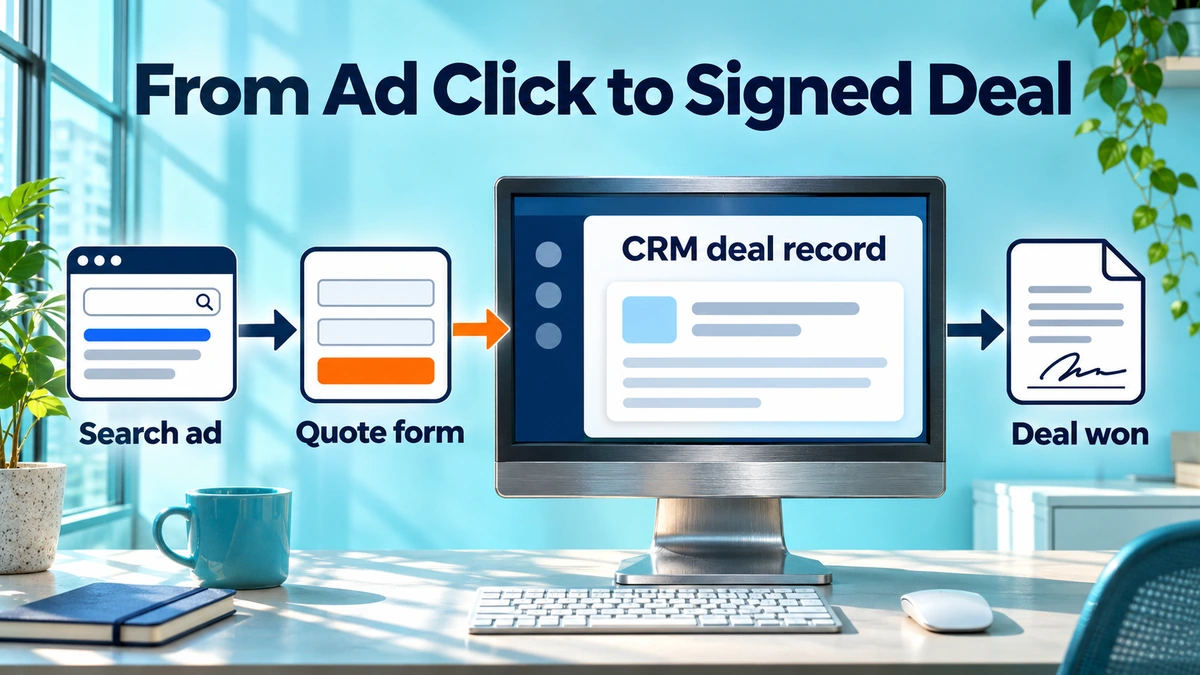
Suppose a buyer clicks a search ad and submits a quote form. The form passes the campaign details into the CRM, where sales attaches the contact to a deal. A colleague from the same company later joins the meeting. When sales marks the deal as won, the original campaign can still appear in the deal history, provided the records were linked along the way.
Missing links change what the agency can report. A phone enquiry may start with a campaign visit that the CRM cannot identify. A sales rep may open a deal under a different contact from the same company. The report should show where the connection ends so the team can see which records need attention.
When Does a B2B Company Need an AI Marketing Agency?
Outside help makes sense when a specific problem keeps recurring and the team lacks time or skills to fix it. A small Singapore supplier might have a strong sales team but no one to set up conversion tracking. A software company might have sound tracking but need help reaching buyers in a new market. Those companies should request different proposals.
When tracking needs attention first
A tracking project is a sensible starting point if leads arrive without campaign details, staff enter the same enquiry twice or sales updates deals in a separate spreadsheet. Extra campaigns can add to that backlog. A short project can map how enquiries enter the CRM, repair the connection and test it with sample records before the business commits to campaign management.
The first discussion should include whoever owns the CRM and someone who handles enquiries. Marketing can explain how campaigns are tagged. Sales can explain what happens when a buyer calls, supplies a different email address or returns after several months. Those everyday cases are often the ones that expose a weak set-up.
When an agency can help run campaigns
A managed service makes more sense when the team can follow enquiries into sales but lacks time to improve campaigns. An agency may be able to manage search ads, build landing pages or test messages while the internal team handles product reviews and sales follow-up. A short list of symptoms can help the team ask for the right scope.
| What the team sees | What to ask an agency to quote |
| Campaign details disappear when leads reach sales | Tracking review, CRM set-up and sample lead tests |
| Sales receives too many enquiries outside its market | Targeting, offer and landing page review |
| Prospects take a meeting but need more information to proceed | Follow-up emails and content that answers buying questions |
| Reporting takes days to assemble | A shared report with agreed data sources and checks |
When only one problem stands out, a small project gives the business a way to judge the working relationship. The proposal should name the person who will do the work and show what the team will be able to use when the project ends.
Which AI Digital Marketing Agency Packages Should You Compare?
AI digital marketing packages usually differ in scope. Some cover a one-off repair or set-up. Others cover a channel such as search, while wider plans combine several channels and reporting. A request for quotes can name the same business goal and ask each agency to price a scope it can explain line by line.
What each package should include
| Package | What the proposal should specify | When to consider it |
| Tracking and CRM set-up | Where campaign data goes, how the agency will test it and who will fix failures | Leads and deals live in systems that seldom agree |
| Tool set-up and training | Software, licences, workflows, training and written instructions | The company plans to run campaigns in-house |
| Search and paid media | Channels, landing pages, conversion events and how budgets will be reviewed | Buyers already search for the product or service |
| Content, email and social | Buyer questions, planned formats, follow-up and who approves copy | Prospects need more information before talking to sales |
| Combined campaign management | Channel owners, shared reporting, review dates and dependencies | Several channels need one plan and the business has a point of contact |
A search package can include both paid and organic work, but each serves a different purpose. When buyers search for a product, paid search can test which offers draw enquiries.
An SEO programme can help product pages and buyer resources appear in organic search. Google’s documentation on AI features and websites says the same SEO fundamentals apply to its AI features, with no special requirements or extra steps for eligibility. A proposal can therefore explain how it will improve useful pages and report on them without promising AI Overview placement.
A paid social package needs its own reason to exist. For example, a software company that sells to operations directors might test a campaign around a problem those directors recognise.
The scope for LinkedIn ads for SaaS can then cover audience selection, campaign tracking and which sales stages to report. LinkedIn’s Conversions API can connect eligible online and offline activity to its campaign measurement. The CRM remains the place to reconcile deal records across channels.
How to compare the full cost
Every quote should show what the agency charges, what you pay directly and what may cost extra. Two quotes in Singapore dollars can look similar until one includes CRM work and the other bills separately for it. A comparison needs the total cost for the same term and campaign scope.
- One-time costs: Account set-up, tracking repairs, CRM changes and initial landing pages.
- Monthly costs: Campaign management, reporting, software and support.
- Usage costs: Ad spend and any tools that charge by contact, user or volume.
- Extra work: New pages, added markets, design revisions and custom CRM work.
A combined package can reduce handovers when one agency runs the channels and keeps a shared report. Separate packages can work when an internal lead already owns the plan and measurement. Either way, the quote should say who handles issues that cross teams. If a new landing page stops sending campaign details to sales, one person should have responsibility for getting it fixed.
How Can You Test an Agency’s Revenue Attribution?
Revenue attribution assigns credit for a sale to the marketing interactions recorded before it. A rule might give credit to the first known campaign, the last known interaction or more than one channel. The rule helps the team read results and make decisions. The deal history alone cannot establish what would have happened without the campaign.
How one deal can receive different credit
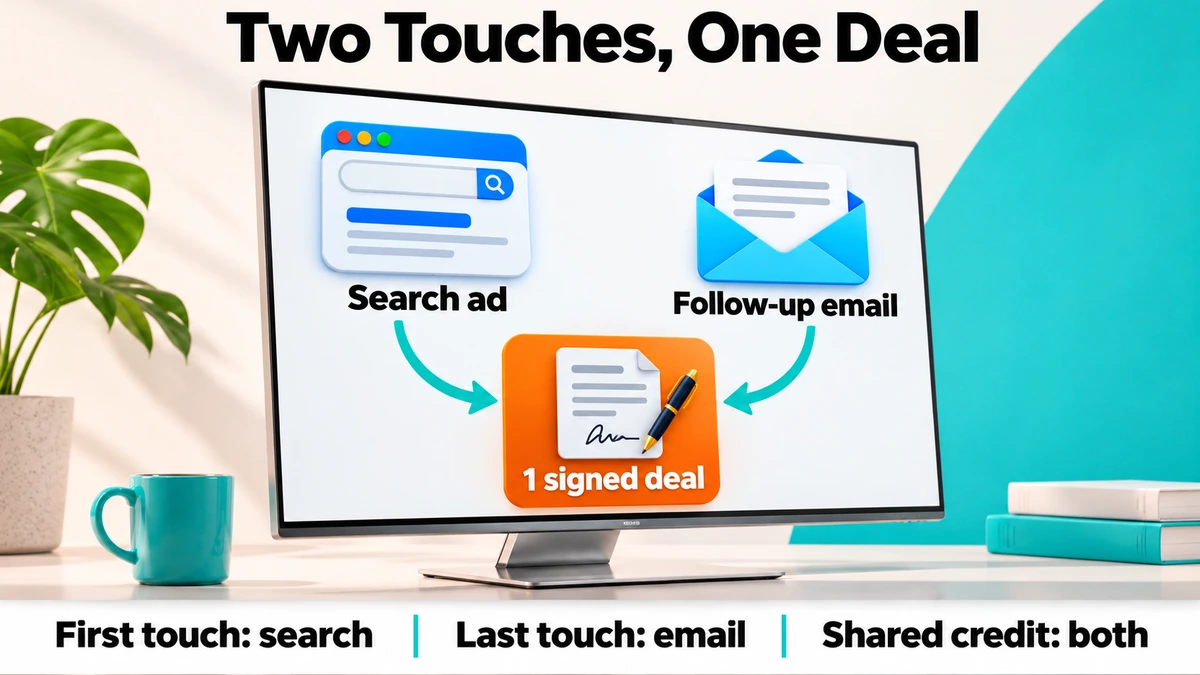
Consider a Singapore equipment supplier. A buyer first arrives through a search ad and submits a quote request. Another person at the same company later clicks a follow-up email. Sales adds both contacts to the same deal, which closes after the buyer completes its approval process. The CRM records one signed deal.
| Reporting rule | How it treats the example |
| First recorded touch | Credits the search ad that brought in the first known enquiry |
| Last recorded touch | Credits the follow-up email, if it was the last eligible marketing interaction |
| Shared credit | Gives search and email part of the credit under a stated rule |
These views answer different questions. The first can help explain discovery. The second shows the final known interaction. The third shows how activities may have worked together. A report that presents all three should label each view and reconcile them to the one deal. If separate channel reports both claim the full sale, adding those figures together would count the sale twice.
Why the reporting period can change the answer
A lookback window sets how far before an action a platform can look for eligible interactions. Google Analytics attribution settings use that window to decide which earlier interactions can receive credit. Google Ads attribution reports also distinguish a reporting lookback window from a conversion window set for an action. The agency should be able to explain which setting applies when it shows a number.
A buyer may sign months after the first enquiry, outside a platform’s eligible window. The CRM can still show the campaign if the business captured the details and kept them connected to the deal.
Google Ads offline conversion imports can send eligible sales outcomes back to Google Ads. A sound Google Ads conversion tracking set-up can therefore use sales outcomes where supported, while the CRM holds the longer deal history.
What to ask for in the demo
A sample deal is enough to test the agency’s method. The agency can use demo data or a record with customer details removed. A report with familiar charts still needs to answer practical questions about what happened to the data.
- Campaign: Where did the campaign name, source and date come from?
- Enquiry: How did those details reach the contact record?
- Opportunity: How did sales link the contact and any colleagues to the deal?
- Sale: Which CRM field supplies the amount, currency and close date?
- Exceptions: What happens when a lead cannot be matched or two channels claim the same deal?
A quarterly report should also define what its revenue field represents. Signed contract value and money recognised as revenue can be different figures. If the report uses contract value, that label should appear next to the number. Sales and finance can then compare it with the right records.
How to Score and Shortlist an AI Digital Marketing Agency
The Revenue Attribution Readiness Scorecard below is a buyer’s checklist. Each row is worth zero, one or two points. Give every agency the same scenario and record what it shows during the meeting. A score based on a working example gives you a better reason for your choice than a score based on what a pitch promises.
| Check | 0 points | 1 point | 2 points |
| Data integration | No way to trace an enquiry into sales | Leads enter the CRM, but deal links need manual work | A sample record traces the campaign through to a signed deal |
| Attribution method | No stated rule for giving credit | A rule exists, but it leaves gaps the agency cannot explain | The agency explains the rule, timing, gaps and duplicate checks |
| Decision ownership | No named owners | Owners are named, but approvals or fixes are unclear | Named owners approve work and handle tracking and budget changes |
| Reporting schedule | No agreed review schedule | Reports include activity and some sales data | Reviews cover sales stages, data gaps and decisions |
| 90-day plan | No written plan | Tasks are listed with few checks or owners | The plan has owners, test dates and criteria for the next decision |
How the sample agency scores
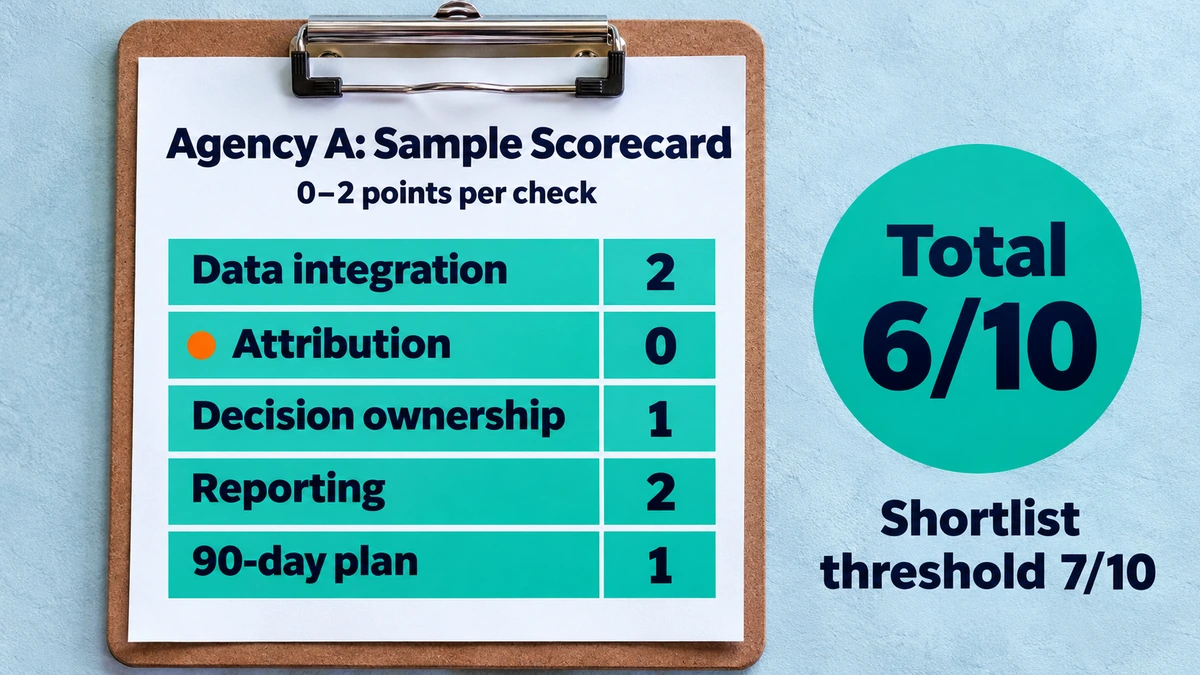
Agency A traces a sample lead through to a signed deal, earning 2 for data integration. Its regular attribution report counts lead events in a 30-day window, and the agency cannot explain how it will report deals that close later. It earns 0 for attribution. It names campaign owners but leaves approval duties open (1), shows a review that covers sales stages and data issues (2) and presents a task list without test dates (1). The total is 6 out of 10.
A score of 7 out of 10 can serve as a shortlist threshold for this checklist. The individual rows still guide the decision. If attribution is the reason for hiring and an agency scores zero there, ask for a revised demo even if its total reaches seven. If reporting ownership is the weak point, ask for a written answer that names the person who will handle it.
Who checks the agency’s AI work?
A proposal should give examples of tasks AI will handle and decisions a person will approve. Drafting an ad variation has a different risk from changing a live budget or scoring leads with customer data.
The NIST AI Risk Management Framework gives organisations a reference for assigning responsibility and reviewing risks when they use AI. In a pitch, a practical question is who can stop a workflow and how that person would learn something went wrong.
The data discussion should cover which tools receive CRM information, where that information may go and how long it stays there. Singapore’s Personal Data Protection Commission outlines obligations that include protection, retention and overseas transfers. Those topics give the buyer a starting point for reviewing the proposed data flows with the people responsible for them. PDPC data protection obligations.
What Should the First 90 Days Include?
The first 90 days give the company a chance to check how the agency works before judging results across a full sales cycle. A written plan should say what the team will test, what evidence it will review and when the company will decide whether to keep the scope or change it.
Days 1 to 30: Check the starting point
The agency checks ad accounts, web forms, campaign tags and sales records. Marketing and sales agree on what counts as an accepted lead, which deal value to report and how to label missing sources. A test enquiry then shows which details reach the sales team.
Days 31 to 60: Run a limited campaign test
The agency tests one offer or audience with an agreed budget and review date. Sales reviews which enquiries meet its criteria and explains why it rejects others. The campaign team uses those reasons to decide whether to change targeting, the message or the enquiry form.
Days 61 to 90: Review the evidence with sales
The agency and sales team compare campaign costs with accepted leads and opportunities. They review signed deals if any have closed and label open deals as pipeline. The review ends with a decision for the next period, an owner for each action and a date to check the effect.
Choosing the Right AI Digital Marketing Agency
At MediaOne, we help Singapore businesses plan campaigns around how their customers buy. Our lead generation services bring together search, paid media, landing pages and CRM integration where the scope calls for them. Our LinkedIn advertising services can support campaigns that need to reach specific business audiences.
If your team is weighing a tracking project against a wider campaign package, bring an example of how an enquiry becomes a deal, plus a recent report. We can discuss where the records connect today and what the first scope could cover. Talk to our team about your B2B campaigns.
Frequently Asked Questions
What should a B2B company send before requesting a proposal?
A short brief can include what the business sells, whom it sells to, which markets it serves and what it wants to improve. A sample report and a list of current tools help the agency estimate the work. Exact customer records are rarely needed for an initial quote.
Can an agency work with a distributor-led sales model?
An agency can plan for it if the distributor can confirm which referred enquiries it received and what happened next. A partner reference number or a regular status report may help connect those records. The proposal should say which outcomes the distributor can verify before the agency promises closed-deal reporting.
Who should own the ad accounts and campaign files?
The contract should name who controls the accounts, domains, reports and creative files. It should also say what the business can export or keep when the contract ends. Company-owned accounts with agency access can make a handover easier because the business already controls the account history.
How should a regional B2B team handle deals in several currencies?
Finance and sales can agree on one reporting currency and a consistent rule for exchange rates. The CRM can retain the original deal currency and amount alongside the converted value. This gives the buyer a way to check totals and see whether a change came from sales activity or exchange rates.
Can AI help if the sales team closes only a few deals each quarter?
A small number of deals can still provide specific examples for review. AI can help organise call notes or group reasons why buyers declined, subject to the company’s data rules. A team with few signed deals should read quarter-to-quarter percentages alongside raw counts and individual deal histories.