If you run a business in Singapore, you have probably been told that you need SEO. Then someone mentions local SEO and the advice starts to blur. Both aim to get your business found on Google, so why are they treated as separate things?
The short answer is geography and intent. Traditional SEO aims to rank your website for relevant searches across a national or global index. Local SEO aims to put your business in front of people searching for something nearby, such as a dentist in Toa Payoh or a cafe in Tiong Bahru. The two share a lot of groundwork, but they chase different customers, rely on different ranking signals and are measured in different ways.
This guide explains each approach in plain terms, sets out where they differ, and helps you decide which to prioritise first. It also shows how the two strategies fit together, so you can build visibility that works both across the island and on your doorstep.
Key Takeaways
- SEO and local SEO target different audiences. Traditional SEO competes for visibility across a national or global index. Local SEO competes for searches with clear geographic intent, such as “cafe in Tiong Bahru”.
- Many searches are local. About 46% of Google searches have local intent, so a local presence can capture a large share of demand.
- Your Google Business Profile is the main local asset. A complete, verified profile with accurate categories, hours, services and photos lets a business compete locally even without a large website.
- Consistency beats volume in local citations. Your name, address and phone number (NAP) should match exactly across every directory, because mismatches weaken trust.
- Reviews carry weight locally. Review volume, recency and rating feed into local rankings, and professional responses reinforce prominence.
- Measure local success by actions first. Track calls, direction requests and store visits, then use click-through rate as a secondary measure.
Table of Contents
- What Is SEO and Who Is It For?
- What Is Local SEO and How Does Geographic Intent Change the Game?
- Main Differences Between SEO and Local SEO
- Practical Local SEO Essentials: Profile, Reviews and Citations
- How the Two Strategies Work Together
- Conclusion and Summary
- Frequently Asked Questions
What Is SEO and Who Is It For?
SEO, short for search engine optimisation, is the practice of making a website rank for relevant search queries across a national or global index. Rather than targeting one neighbourhood, traditional SEO aims to put your pages in front of anyone searching for a topic, wherever they are. Its core focus areas are content quality, technical site health, and the links and mentions that tell search engines your site is trustworthy. It suits businesses that sell nationally or online, such as e-commerce stores and software-as-a-service (SaaS) companies, where the customer can be anywhere in Singapore or overseas.
In practice, traditional SEO breaks down into four areas. The first is keyword research and topical content planning, which identifies what your audience searches for and maps those queries to pages. The second is on-page elements: title tags, meta descriptions, headings and structured data, which is extra code that helps search engines read a page. The third is technical foundations, meaning crawlability (whether search engines can reach your pages), page speed and mobile usability. The fourth is link acquisition, where other websites link to yours, signalling authority to the wider web.
For small businesses, the main benefit is long-term organic traffic that does not depend on ad spend. Once a page ranks, it can keep bringing visitors without a paid click each time. Credibility builds through consistent, useful content over months. To track progress, use the click-through rate (CTR) formula: (Total Clicks / Total Impressions) × 100%. A rising CTR shows your titles and snippets are earning attention in search results.
What Is Local SEO and How Does Geographic Intent Change the Game?
Definition of Local SEO
Local SEO is the practice of making a business visible when someone searches with a place in mind. Consider a search for an emergency plumber late at night, or for a cafe in Tiong Bahru on a Sunday morning. Those searches carry local intent, and the goal of local SEO is to win them.
The results you aim for are the Map Pack, the three-listing block with a map that sits above ordinary results, plus the local organic listings beneath it. Ranking nationally in the broad index matters far less here. A clinic in Bishan does not need to outrank a national health portal; it needs to outrank the other clinics within a few kilometres.
Why does this matter? Demand is substantial. Around 46% of Google searches have local intent, so a business that is set up well locally can capture a large share of that demand, while one that is not can lose it.
Geographic Intent Explained
Google documents three local ranking factors:
- Relevance: how well your listing matches what the searcher wants.
- Distance (proximity): how close your business is to the searcher or to the location named in the search.
- Prominence: how well known and trusted your business is, judged from reviews, citations and web presence.
Google infers location from the searcher’s device, the wording of the query and their search history. A phone with GPS enabled gives a precise signal. A desktop search gives a weaker one, so Google leans on the IP address and past behaviour instead.
This is why a neighbourhood term changes which businesses qualify. Searching “dentist” returns a broad mix, but “dentist Toa Payoh” narrows the field to practices whose listed address and service area sit in or near that estate. The searcher has told Google exactly where they want to be, and the ranking follows that instruction.
Main Differences Between SEO and Local SEO
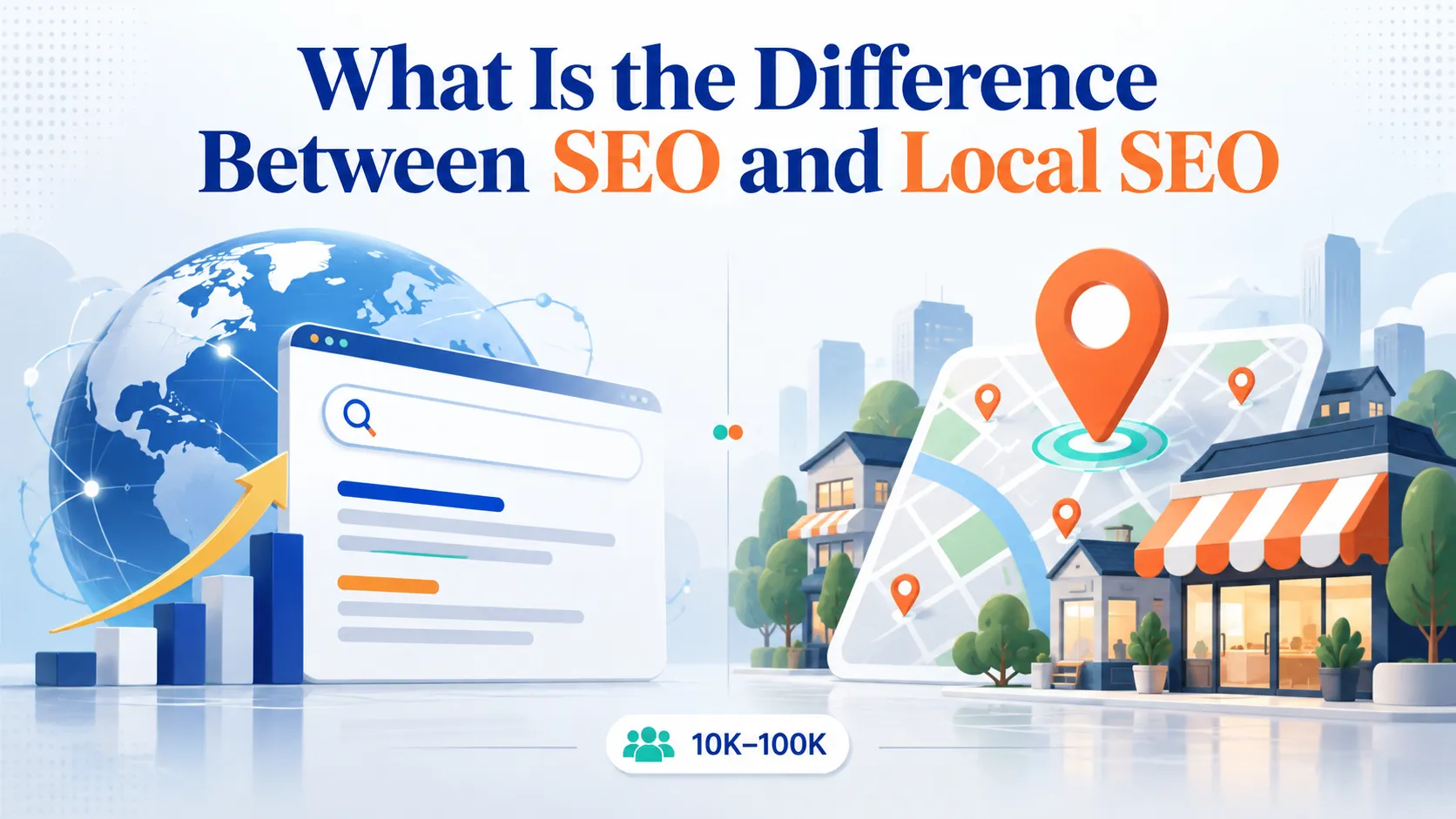
The clearest way to see the split is to compare the two side by side. Traditional SEO aims to rank a website across the whole national or global index. Local SEO aims to put a business in front of people searching near a specific place, usually through the Map Pack and local organic results.
Local SEO vs Traditional SEO Comparison
| Factor | Traditional SEO | Local SEO |
|---|---|---|
| Primary goal | Rank for topic and product keywords across the wider index | Win visibility for searches with local intent |
| Target audience | Anyone searching anywhere, including buyers outside your area | People near your premises or inside your service area |
| Primary ranking signals | Content quality, links, technical health, topical authority | Relevance, distance, prominence (reviews, citations, profile completeness) |
| Key asset | Your website | Google Business Profile, supported by the website |
| Measurement | Organic traffic, keyword positions, conversions | Calls, direction requests, map views, store visits |
| Typical geographic scope | National, regional or global | A radius around a location or a defined service area |
Key Differences Between Local and Regular SEO
Four differences do most of the work.
- Scope: Traditional SEO competes in a national or global index. Local SEO competes inside a defined service area, so the pool of relevant results is far smaller.
- Ranking signals: Local results weigh proximity, relevance and prominence more heavily. Two businesses can be equally good, but the one closer to the searcher, with stronger reviews, will usually rank higher.
- Competitors: In traditional SEO your rivals are any firm targeting the same keywords. In local SEO they are the businesses within the same neighbourhood or radius.
- Success metrics: Traditional SEO is judged on traffic and rankings. Local SEO should also be judged on leads, store visits and phone calls, because those are the actions a nearby customer takes.
When to Focus on SEO
Prioritise traditional SEO if your business meets one or more of these conditions:
- You sell products or services that customers can buy from anywhere.
- Your revenue depends on attracting readers and building trust through long-form content.
- Most of your customers are outside your immediate area.
Use this checklist to confirm:
- Could a customer in another region buy from you? If yes, score one point.
- Do you publish or plan to publish educational content as a main acquisition channel? If yes, score one point.
- Is less than 30% of your revenue tied to a single location? If yes, score one point.
If you score three, traditional SEO should lead your plan.
When to Focus on Local SEO
Prioritise local SEO if you serve customers within a set radius, such as clinics, restaurants, tuition centres and trades. For these businesses, the most valuable search is often made at the moment of need. Someone searching “aircon servicing near me” on a Sunday is ready to call.
The benefits of local SEO for small businesses are straightforward. It puts you in front of people at the point of need. It also faces less competition than national terms, where large brands and aggregators dominate. A neighbourhood clinic is unlikely to outrank a national health portal for a broad condition query, but it can win the Map Pack for “clinic near Bedok”.
Use this checklist to confirm:
- Do customers have to visit, or travel to you, to buy? If yes, score one point.
- Does more than half your enquiry volume come from one area? If yes, score one point.
- Do you rely on phone calls, bookings or walk-ins? If yes, score one point.
If you score two or more, local SEO should lead. The decision that matters first is which kind of search your customers actually make, and the checklist above answers that.
Practical Local SEO Essentials: Profile, Reviews and Citations
Most local visibility comes down to three assets you control directly: your Google Business Profile, your reviews and your citations across directories. Get these right first, before spending on content or links.
Google Business Profile Optimisation
Your Google Business Profile (GBP) is the listing that drives the Map Pack, so treat its setup as a checklist rather than a one-off task.
- Claim the listing. Go to business.google.com/add and enter the name and address of your business. If a listing already exists, claim it instead of creating a duplicate.
- Verify ownership. Google usually offers postcard, phone or email verification. Until verification is complete, you cannot edit the profile or appear fully in local results.
- Choose a primary category. Pick the category that best describes your core service. Add secondary categories only where they genuinely apply.
- Complete services, hours and attributes. List each service, set accurate opening hours (including holidays) and fill in relevant attributes such as wheelchair access or appointment-only.
- Upload real photos. Add your exterior, interior, team and work samples. Profiles with photos tend to attract more direction requests and website clicks.
Once live, keep the profile current. Update hours before public holidays, post offers or events as they happen, and revisit the profile at least once a month. Inconsistent or stale information is one of the quickest ways to lose ground to a competitor who keeps theirs sharp.
Search rankings are not guaranteed and change over time, because Google’s algorithms are updated regularly.
Online Reviews and Local Rankings
Reviews feed local visibility through three signals: volume (how many reviews you have), recency (how recently you received them) and average star rating. A steady trickle of fresh reviews usually counts for more than a burst of old ones.
To build reviews ethically, ask customers directly at the point of service. Send a short follow-up message with a direct link to your review form. Never offer incentives in exchange for a positive rating, which breaks Google’s review policies.
Respond to every review, positive or negative. Thank reviewers by name where possible and keep replies short and specific. For a critical review, acknowledge the issue, apologise where appropriate and move the conversation offline. Prospective customers read these replies, so a calm, professional response often rebuilds trust that the original complaint damaged.
Local Citations and Directories
A citation is any online mention of your business name, address and phone number (NAP), whether on a directory, a map site or a social profile. Search engines use these mentions to confirm that your business exists and where it operates.
Consistency is the key requirement. If your address reads “Blk 123 Orchard Road #05-01” on one site and “123 Orchard Rd, Level 5” on another, the mismatch can weaken confidence in your listing. Choose one canonical format and use it everywhere, including your website footer.
For Singapore businesses, start with the major general directories and map platforms. Then add sector-specific listings relevant to your trade, such as industry associations or trade portals. Audit your citations once a quarter, correct errors and remove duplicates so that one business does not appear as several separate listings.
How the Two Strategies Work Together
SEO and local SEO are not rival projects. Most of the work overlaps, and a business that treats them as separate budgets usually pays for the same fixes twice. The sensible approach is to build one shared foundation, then layer the local elements on top.
The shared foundations are site speed, mobile design and quality content. Google reads every page through the same lens, whether a searcher is in Toa Payoh or across the island. A slow, cluttered mobile page therefore weakens both efforts at once. Fix these first, because no amount of citation work will rescue a site that loads poorly on a phone.
Local SEO then adds three elements to that base:
- Location pages for each service area you genuinely serve, each with its own address, opening hours and a short description of what happens there.
- Neighbourhood content that answers local questions, such as parking near a clinic or the nearest MRT station to a showroom.
- Local schema (LocalBusiness markup) that tells search engines your name, address, phone number and hours in a machine-readable form.
A useful test: if a location page could be swapped to another suburb with only the place name changed, it is thin content and will not help you rank. Each page needs something that is true only for that location.
A Sequenced 90-Day Plan for Small Businesses Doing Both
Do not attempt everything in the first month. This sequence works as a practical starting point for small teams:
- Days 1 to 30: Foundations. Audit page speed and mobile usability, fix the worst failures, and claim and complete your Google Business Profile.
- Days 31 to 60: Local structure. Build location pages, add LocalBusiness schema, and standardise your name, address and phone number across directories.
- Days 61 to 90: Content and reviews. Publish two or three neighbourhood-specific articles, start a routine for requesting reviews, and review your Search Console and Business Profile insights.
Measure progress against both sets of numbers. Track organic traffic and rankings for the broad side, and calls, direction requests and map views for the local side.
Conclusion and Summary
The core distinction is simple. SEO targets the broad index, competing for relevant queries across a national or global audience. Local SEO targets geographic intent, competing for searches where someone wants a business nearby. Both draw on the same website, but they reward different signals and measure success differently.
Which one to prioritise depends on your business model and service area. If you sell products or services that can be delivered beyond a single neighbourhood, such as an online store or a software product, start with traditional SEO. If customers must travel to you or you serve a set radius, such as a clinic, tuition centre, cafe or trade business, start with local SEO. Many Singapore businesses in the second group will find that local visibility brings in more enquiries sooner, because most customers choose businesses close to home.
Your next step is to audit your current visibility. Search for the terms your customers use, check where your business appears in the Map Pack and organic results, and confirm that your Google Business Profile details are accurate. Then choose one first action, such as completing your profile or fixing a page that fails basic speed checks, and measure its effect over the next quarter. If you need help running that audit, a local SEO agency can set up the baseline for you.
Frequently Asked Questions
Can a small business in Singapore do SEO and local SEO at the same time?
Yes, and most small businesses should. The two share a foundation: a fast, mobile-friendly website with useful content. Local SEO then adds location pages, a complete Google Business Profile and consistent listings. If you have limited time, start with local SEO, because customers near you are the fastest source of enquiries. Then widen the content effort over time.
Do I need a website for local SEO, or is a Google Business Profile enough?
A Google Business Profile can get you visible in the Map Pack, but a website gives you control and depth. It is where you explain your services, show neighbourhood relevance and earn links that support rankings. Treat the profile as essential and the website as the supporting asset that makes the profile more credible.

How long does it take to see results from local SEO?
A properly optimised Google Business Profile can produce Map Pack visibility within 30-60 days. Timelines vary with competition and how complete your profile already is. [confirm: timeline source]
Which factors matter most for ranking in the Google Map Pack?
Google weighs three things: relevance (how well your profile matches the search), distance (how close you are to the searcher) and prominence (reviews, citations and web mentions). Keep your categories accurate, your address and phone consistent and your reviews steady, since these signals drive most local rankings.
Are online reviews more important for local SEO than for traditional SEO?
Generally yes. Reviews feed directly into local ranking signals and shape whether a searcher clicks through to your listing. Traditional SEO relies more on content and backlinks, while local visibility depends heavily on review volume, recency and rating.