| AI Summary
Singapore brands can use customer reviews, photos and videos to answer questions that product descriptions leave open. A small team can start with one product, identify a common buying question and ask customers to share what happened when they used it. The UGC Readiness Matrix helps teams decide whether to collect more content, add buyer details, record permissions or move existing content closer to the point of purchase. |
What is user generated content? User generated content, or UGC, is material customers or other members of the public create about a brand, product or service. Examples include written reviews, customer photos, videos, social posts and answers from buyers. Brands can feature customer content with permission to help shoppers see how a product works in everyday life.
Key Takeaways
- A customer photo has a job to do. A picture of a shelf beside a washing machine can answer a size question that a star rating cannot.
- One review request can ask about one part of the experience, such as assembly, size or delivery. The customer decides what to say.
- Permission records should name each place a brand can use a contribution, from a product page to a paid ad.
- A fair sales test compares two versions of the same page and changes only the customer content.
A shopper in Singapore likes a shoe rack online but wonders whether the front door will still open once the rack is in place. The product page lists the dimensions. Then a customer photo shows the rack in a narrow HDB entryway with the door open. The shopper now knows what to measure at home.
That is a practical use of user generated content. A customer can show an angle the product photographer missed or describe a small detail the sales team never thought to mention. The examples below show how Singapore businesses can collect those details and put them where buyers need them.
What Counts as User Generated Content?
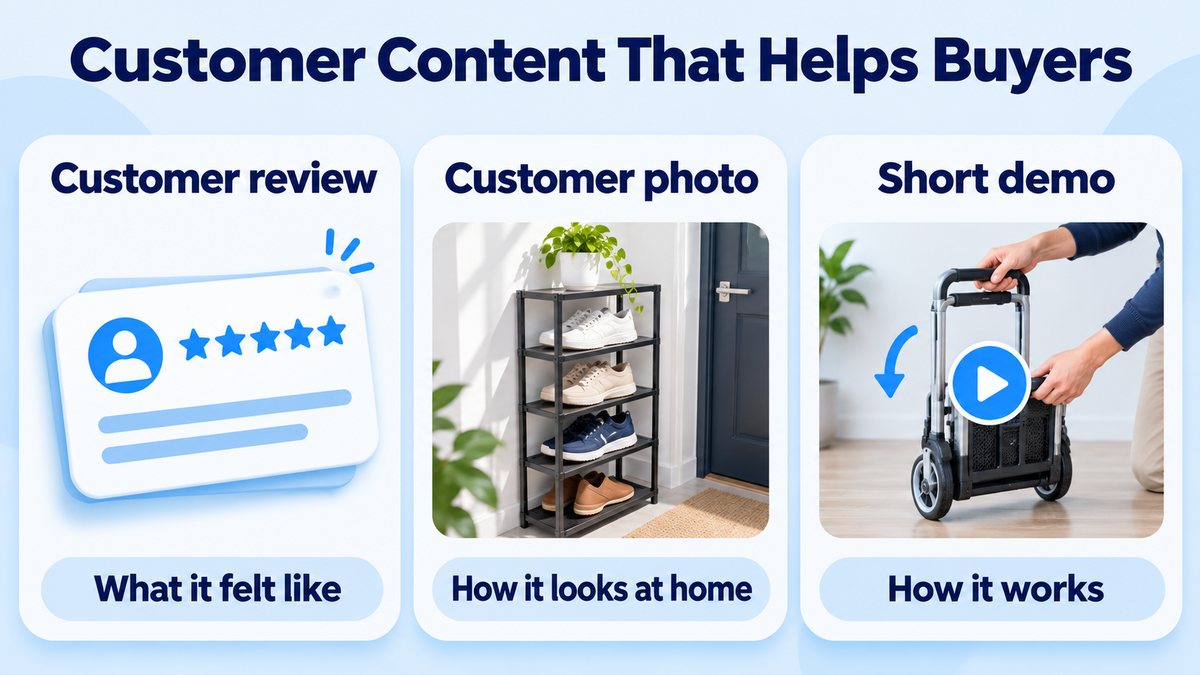
User generated content can be as simple as a written review or as detailed as a video showing how a customer assembled a desk. It also includes photos, posts and answers from buyers. Each format gives the next shopper a different kind of information.
| Type of customer content | Question it can answer | Example |
| Written review | What was it like to use? | A buyer explains that the desk took two people to assemble. |
| Customer photo | What does it look like at home? | A photo shows how much room a chair takes up when pulled out. |
| Short video | How does it work? | A shopper opens a foldable trolley and shows where it folds. |
| Buyer Q&A | Will it work in my situation? | A customer confirms that the storage box slides under a bed of a stated height. |
| Service testimonial | What happened after booking? | A workshop attendee describes the tools and materials provided in class. |
Organic customer content and paid creator content
Organic UGC comes from people who choose to share their experiences without payment or a gift in return. A customer might post a photo on their own or write a review after receiving a request. Both can be organic when the customer is free to say what they experienced.
Marketing teams often use the term paid UGC for videos or photos they commission in a casual, first-person style. A creator might receive a fee or free product to film a demo that the brand publishes. In influencer marketing, part of what the brand may pay for is access to the creator’s audience. A brand can also pay a creator to make a video and publish it only on the brand’s channels.
The distinction helps shoppers know what they are looking at. A paid demo can show how a travel bag opens and what it holds. An independent review can tell readers what happened when someone used the bag on a trip. The Advertising Standards Authority of Singapore’s social media guidelines call for commercial messages to be identifiable. A label that states the paid or gifted relationship helps readers understand it.
Why Customer Content Helps Shoppers Decide
Most product descriptions start with what the seller knows. A buyer brings a different set of questions. How loud is the fan at night? Does the fabric look the same in daylight? Will the delivery team carry the table up a short flight of stairs? A review that describes the circumstances can give readers enough detail to make their own decision.
Research from Northwestern University’s Medill Spiegel Research Center found that the effect of reviews on buying decisions varied with factors such as price and the source of the review. The research also examined what happens when retailers identify verified buyers. The findings offer a reason to test review placement on your own pages, where the product and the questions may be different.
Specific details carry more weight than praise
A photo of a trolley in a home gives shoppers something to compare with their own space. A caption that adds the trolley size and what the customer stores inside makes that comparison easier. A short comment such as “Love it!” expresses satisfaction, but it leaves the next shopper with little to work with.
Verified buyer labels add another detail. The label tells readers that the store or platform matched a review to a purchase. A team should apply it only when it has a way to make that match. For feedback that arrives through a message, the team can first check whether it has an order record tied to that customer and item.
Mixed reviews can answer better questions
A balanced online reviews process gives customers room to mention drawbacks. A shopper may be happy to buy a tray that needs hand washing if they know that before checkout. The same detail may help a shopper who wants a dishwasher-safe tray choose another model.
Recurring comments can also show what the brand needs to fix. If three people say they could not tell which screws came with a shelf, the product team can add a photo of the parts. If several customers say the booking instructions arrive late, the service team has a timing problem to solve. Both examples show how feedback can improve the experience behind the review.
The UGC Readiness Matrix for Singapore Brands
The UGC Readiness Matrix is a scorecard for one product or service. A business can start with a page that gets visits but still draws the same question by email, in-store or through chat. The scorecard shows what the team has now and what it can do next.
A small sample is enough to get started. The team can look at recent reviews, customer messages and tagged social posts about the same item. It can then give each row a score from 0 to 3 using the description that best matches what it finds.
| What to check | 0 | 1 | 2 | 3 |
| Volume | No customer content | A few older items | Recent content for some common uses | New content arrives regularly and is sorted by item |
| Buyer details | Comments offer little detail | A few name the product or service | Several explain how or where it was used | Examples answer common questions and identify verified orders where possible |
| Permissions | No record of permission to reuse content | Some replies exist but are hard to find | Most published items have a record of approved uses | Every published item has a record of approved uses and dates |
| Placement | Nothing appears where customers decide | Content appears only on a separate page or in the social feed | Some content appears on sales or booking pages | Examples sit next to the details buyers are comparing |
How to choose the first fix
A low permission score takes priority if the team plans to reuse a customer’s work. If permission is already in place, the weakest score can help the team choose between collecting new examples and moving content it already has. When buyer details and placement both score low, a single good contribution can help solve both.
Suppose a homeware shop scores 2 for volume, 1 for buyer details, 3 for permissions and 1 for placement. The shop has approved photos, but it shows them together in a gallery with no product names. One photo shows a narrow trolley next to a washing machine. The team can check which model appears in the photo, add a short caption and place it by the width on that model’s product page. That gives shoppers more information before the shop sends another review request.
A score of three describes a working process. It can look different for a business with five products and a business with five hundred. A shop with a small range may need one steady source of new photos. A larger retailer may need a way to group submissions by model and identify which pages still lack examples.
How to Collect User Generated Content From Customers
A good request asks about an experience the customer has already had. A restaurant can ask for feedback after a visit. A desk seller can wait until the customer has had time to assemble the desk and use it. For a service that takes several weeks, the end of a stage the customer can describe may be a better time than the day they book.
Review requests customers can answer quickly
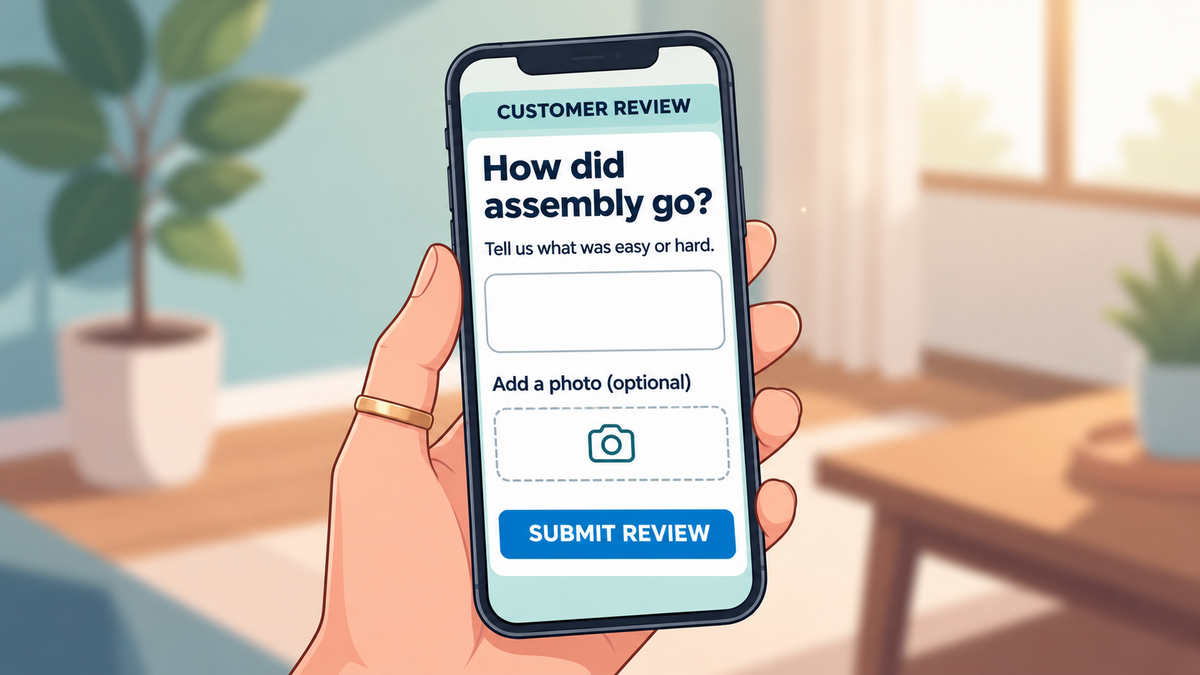
A short request can name the item and give the customer a starting point. A desk shop might write, “How did assembly go? Your review can mention how long it took or anything you wish you had known.” A luggage shop could ask what the customer packed and which bag size they bought. Neither question asks the customer to praise the product.
The request can reach customers through channels the business already uses:
- Order follow-up. An email can link to the exact product the customer bought and make photos optional.
- In-store receipt. A café can print a Google review QR code so a customer can leave feedback when it suits them.
- Social prompt. A homeware shop can ask followers to share how they set up a shelf in a small space. A prompt about everyday use can sit alongside other posts in the brand’s Instagram marketing plan.
- Service follow-up. A workshop organiser can ask attendees what they made and whether they found the materials easy to use. The organiser can keep the feedback private unless the attendee agrees to publication.
Honest feedback and platform rules
A public review request should go to customers across a range of experiences. A shop can ask customers with a complaint how it can resolve the problem while giving them the same chance as other buyers to leave feedback. Google’s Maps review policy prohibits offering rewards for posting, changing or removing a review. It also bars businesses from asking only customers likely to post positive reviews.
A paid product demo belongs in a separate process from public reviews. The creator brief can ask someone to show a real use, such as folding a trolley or cleaning a pan. The agreement can cover the fee, how the brand may use the clip and how the relationship will be disclosed. A team should keep the review request free of rewards when platform rules prohibit them.
A real Singapore example shows why the distinction is important. The Competition and Consumer Commission of Singapore’s investigations into fake online reviews found businesses that admitted to procuring fake reviews. A small shop can build a better source of feedback by making it easy for people who have actually bought or used the product to share what happened.
Permissions, Credit, and Records for Customer Content
A public tag tells a business where to find a post. Before reusing the work, the team should check who owns it and ask for permission for the use it has in mind. Singapore’s Intellectual Property Office explains why permission or a licence is important when a third party uses copyright-protected work. Credit tells readers who made the work. It serves a different purpose from permission.
A customer may be happy for a photo to appear on a product page for three months and prefer to keep it out of advertising. A permission request can name the exact contribution, where it would appear, the period of use, any proposed edits and the name or handle the customer wants displayed.
A sample permission request
Hi Mei, thanks for sharing your photo of the slim shoe rack. May we show that photo on the slim shoe rack product page for three months? We’d crop it slightly to focus on the rack and credit the name you choose. The photo would appear on that product page only. Would that work for you?
The reply belongs with the photo and a record of what the team asked. If the team wants to use the photo in an ad later, it can make a new request for that use. For a customer video, the team should also check for anything the customer may have added from another source, such as music.
A simple record for each contribution
| What to record | Example |
| Content and owner | Shoe rack photo, Mei, original post saved |
| Approved use and dates | Shoe rack product page for three months from publication |
| Edits and credit | Crop around the rack, credit as Mei |
| Live location | Slim shoe rack product page |
| Person responsible | Ecommerce lead checks the end date and handles changes |
Photos and videos can show personal details by accident. A parcel label, name badge or face in the background may identify someone. The Personal Data Protection Commission’s advisory guidelines on photography, video and audio recordings explain how such recordings can involve personal data. A business can use a different image or agree on a crop before publication when those details are irrelevant to the product.
When a customer asks for a change or removal, the person named in the record can check each published location and follow up with the customer. The same record can help a colleague find the photo in a scheduled email or an old landing page. A shared record also keeps this work from depending on whoever first received the message.
Where Customer Content Helps Most
The best place for a customer contribution is often beside the detail it explains. A photo showing the depth of a shoe rack belongs near the dimensions. A video showing how a clasp opens belongs to the product demo. On a booking page, a comment about what a beginner should bring can sit near the list of materials.
| Where buyers are looking | Customer content to show | What to check |
| Product page | Photo or review that explains size, feel or assembly | The example shows the same model as the listing. |
| Service or booking page | Short account of what happened during a session | The experience still matches what the business offers. |
| Social feed | Short clip that answers one common product question | The clip makes sense when watched without sound. |
| Sales email | One customer example tied to the product in the email | The approval covers email and the product page matches the example. |
| Paid social ad | Approved demo that shows the product in use | The agreement covers ads, and the viewer can tell when the content is sponsored. |
An ecommerce marketing plan can connect social posts to the product pages where shoppers compare details. A homeware brand could use a short clip to show how a trolley folds, then put the folded measurements and a customer photo on the page linked from that clip. The video introduces the idea. The page helps the shopper decide whether it works at home.
Paid use adds a separate step. TikTok Spark Ads let a brand advertise using another creator’s post with their authorisation. The authorisation period in the platform should line up with the paid use the team agreed with the creator. This is part of planning social media content across posts, product pages and ads.
How to Measure Whether UGC Helps Sales
A business can start with a question it can answer using one page. For example, does a customer photo next to the shoe rack dimensions help more visitors buy that model? A booking team might ask whether a workshop testimonial helps more people finish a reservation. Both examples have an action the team can count.
What to measure before and after publishing
- Customer questions. The team can count repeated questions about size, assembly or what happens after booking.
- Purchase steps. On a product page, the team can track how often visitors add the item to their basket or complete an order.
- Booking steps. On a service page, the team can compare completed bookings or enquiries that meet the business’s requirements.
- Time and cost. The team can record time spent checking submissions, asking for permission, editing clips and keeping records.
A shop using Google Analytics 4 ecommerce events can record actions such as viewing an item, adding it to a basket and making a purchase. The shop should check that those events record the right item before it judges a change in sales. Otherwise, a sale of one rack may appear in the totals for another.
What a fair test looks like
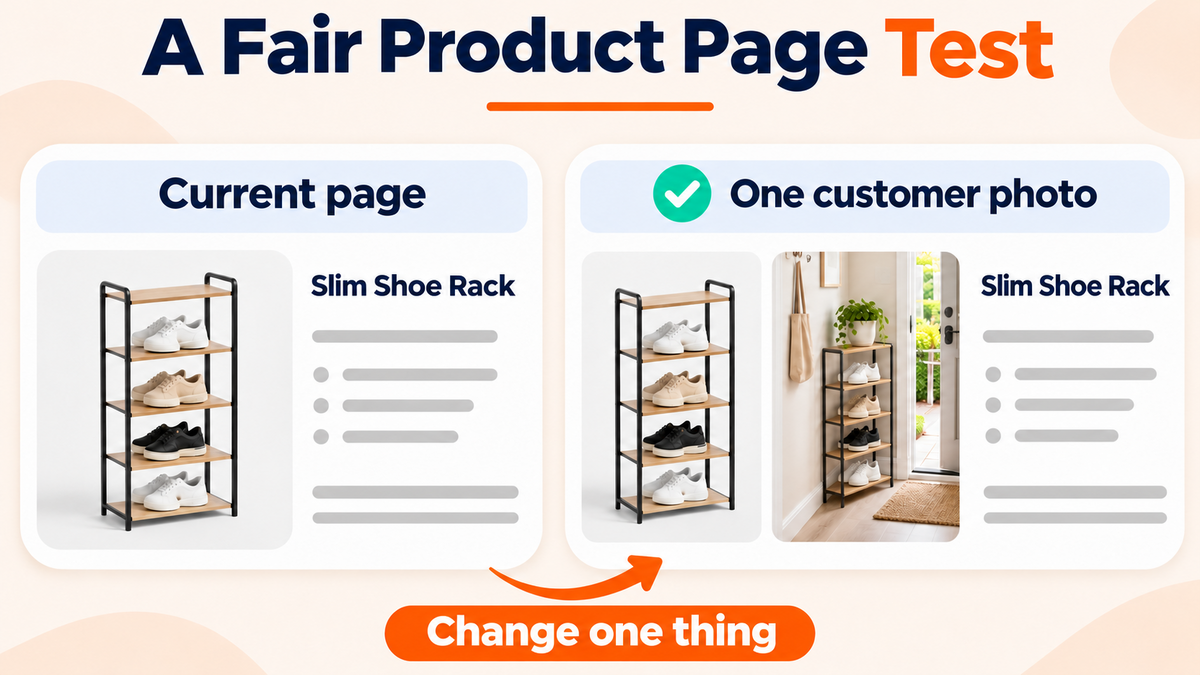
One group of visitors sees the existing product page. Another sees the same page with the approved customer photo next to the dimensions. Both groups see the same price, delivery terms and offer. The team then compares the share of visitors in each group who bought that rack.
A move from 20 purchases per 1,000 visitors to 25 per 1,000 means the observed purchase rate rose from 2% to 2.5%. That is five extra purchases per 1,000 visits in this example. A small difference can vary from one group to the next. If visitor numbers are low, the team can keep gathering data and use comments about size or assembly to learn what buyers still need.
Some shops can only compare periods before and after a page change. In that case, the team can record other changes that could affect sales, such as a payday promotion, stock running out or a new ad sending people to the page. A fuller UGC marketing strategy can use these early tests to decide which customer stories deserve space in future campaigns.
Turning Customer Stories Into Buying Help
The first opportunity may already be in a review inbox. A buyer might have described how they carried a foldable trolley home on the MRT or explained how much space a rack needs once the door opens. That detail can answer the next shopper’s question right where they are deciding.
A Singapore business that wants help choosing which stories to feature can work with MediaOne’s content marketing team. Our social media marketing services can also support teams planning how to use customer content across posts and paid campaigns.
FAQs About User Generated Content
Can a Singapore brand publish a customer review in another language?
A brand can show a translation alongside the original or label the translated version. The translation should keep the original meaning, including any criticism or caveat. If a Mandarin review says delivery was fast but assembly took longer than expected, both points belong in the English version.
What should the alt text say on a customer photo?
Alt text should describe the detail a shopper needs from the image. “Three-tier shoe rack beside an open HDB front door” tells a screen reader user more than “Customer photo”. Any measurements that shoppers need should also appear in the page text.
What if a customer review mixes up two products?
A store can check the order and ask the reviewer to confirm the model. If the customer agrees to correct it, the store can link the review to the right listing and keep the customer’s account of the experience intact. If the team cannot confirm the model, it can leave the review out of model-specific promotions.
How should a small team divide responsibility for customer content?
One person can check submissions and keep the record. A second person can review what is ready to publish or handle questions when the first person is away. For a team that already has an online reputation management process, the colleague who responds to reviews may be the first to spot an example worth passing to the marketing team.