

If you have ever typed SEO courses into Google at 11 pm, it is usually for one of two reasons. Either your role suddenly includes “please grow organic traffic” (with no extra headcount), or you have realised paid ads are great until the budget pauses and the leads vanish with it.

SEO is one of the few channels where small improvements compound. A tighter page structure, a clearer intent match, a cleaner technical setup, and a better internal linking plan. None of these looks dramatic in a meeting, but they move the needle over time. And the upside is real.
Backlinko’s analysis of 4 million Google search results found that the number 1 organic result averages a 27.6% click-through rate, which is a very polite way of saying that ranking near the top is not just vanity; it changes how many people actually reach your site.
Singapore offers a range of SEO courses, from beginner to advanced, with some focusing on analytics or content publishing.
Add funding schemes into the mix, and it becomes easy to pick a course that is “good” but not right for you.
This guide gives you a practical shortlist, a clear way to compare options, and a 30-day plan to turn training into measurable results. To further benchmark what a full, end-to-end engagement typically covers, consider how an SEO agency breaks down its core workstreams. This comparison can help you sanity check what a course should prepare you to do.
Key Takeaways
- The best SEO courses teach how search works, how to diagnose issues, and how to measure results, not just promise fast rankings.
- In 2026, a strong course covers technical hygiene, content strategy, on-page optimisation, measurement, and hands-on application. Avoid any curriculum that is theory-only.
- When choosing between similar options, prioritise hands-on work, clear rubrics, proven instructors, and current tools over brand.
- Funding can change your choice. Some courses have low net fees after subsidies; others require specific schemes. Always verify eligibility and the definition of “funded.”
- Real SEO skills come from applying what you learn in the first 30 days on a site you control.
What Are SEO Courses and Who Are They For?

SEO courses teach you how to grow organic search traffic by improving a site’s relevance, technical quality, and authority. A practical course should show you how to diagnose why pages do not rank, what to fix first, measure impact, and communicate results to stakeholders.
In Singapore, SEO courses tend to fall into a few buckets:
- Beginners who want a structured path: If you are starting from zero, you need a curriculum that explains fundamentals without turning everything into jargon. Look for clear modules on search intent, keyword research, on-page basics, and a simple technical checklist.
- Working professionals who “touch SEO” as part of their role: Marketing managers, content leads, founders, product marketers, comms teams, and generalists often need SEO without becoming full-time specialists. A good course should help you brief writers, set priorities, and quickly spot issues.
- In-house teams that want repeatable processes: If you work in a company, the biggest value is building a system: audits, prioritisation, content briefs, reporting, and governance. A course with templates and frameworks delivers results faster than one with many slides.
- Career switchers: If you want to pursue SEO as a career, you need proof of competence. The fastest route is a course that forces you to produce outputs you can show: audit notes, a content plan, a technical backlog, and performance reporting.
What an SEO course should not be
- A list of “ranking factors” with no application
- A tool demo with no decision-making framework
- A link-building pitch disguised as training
- A promise that you will rank on page one in a fixed number of days
Top SEO Courses in Singapore
Below are notable Singapore-based options (plus one well-known fundamentals workshop). Fees and intakes can change, so treat pricing as indicative and check the provider’s latest intake details before enrolling.
NUS ISS Web Analytics & SEO
NUS-ISS runs executive education programmes designed to build capability in infocomm and digital business. The institute was established in 1981 and has delivered education and training to a large number of professionals and organisations over the years.
If you want a course that connects SEO with measurement, this is a strong option. The programme is designed as an application-based introduction that uses Google Analytics, Google Search Console, and Google Tag Manager to illustrate real workflows.
- Format and duration: 3 days, full-time; an upcoming class is listed as 26 to 28 Oct 2026 on the course page.
- What you get: a structured view of how SEO and analytics support business objectives, not only tactics
- Best for: marketers, product and growth roles, and anyone who needs to explain performance with evidence
This course is not positioned as an advanced technical SEO bootcamp. It is strongest when you want SEO plus measurement discipline.
SMU Academy Content Marketing and Search Engine Optimisation (SEO)

SMU Academy is the professional training arm of Singapore Management University, focused on continuing education and skills development for working adults and organisations.
This module is part of digital marketing and is designed to help working professionals build content marketing capability and strengthen SEO execution, using tools and techniques to achieve measurable outcomes. It is conducted on campus and has an assessment component tied to funding requirements.
- Duration and schedule: 3 days, delivered across weeknights and Saturday (as listed on the course page).
- Best for: marketers and commercial roles with a few years of working experience who want content plus SEO together, not SEO in isolation.
- What you learn: content ideation and development, distribution strategy, partnerships, and advanced SEO strategy with tools and techniques.
- Fee reference: the page lists SGD 2,616 and indicates that the fee can be significantly reduced with maximum funding, along with a detailed fee table by eligibility profile.
ASK Training WSQ Search Engine Optimisation (SEO)
ASK Training runs WSQ-aligned digital marketing training and publishes frequent intakes across physical venues and e-learning options (Zoom is listed in its course schedules).
This hands-on, foundational SEO course covers both the technical and creative aspects of SEO, with practical exercises to help learners implement on-page SEO, content planning, link building, and campaign measurement.
- Duration: 2 days (8.30 am to 6.30 pm).
- Best for: complete beginners, plus marketers, web developers, and content roles who want practical SEO capability (including supervising SEO vendors).
- What you learn: keyword research and on-page SEO, link building planning, and SEO analytics, including GA4 and Search Console integration.
- Fee reference: the page lists S$900 (before GST) and shows subsidised payable amounts for eligible profiles, as well as SkillsFuture Credits, PSEA, and UTAP claimability.
ASK Training WSQ Advanced Search Engine Optimisation (SEO)
For learners moving beyond the fundamentals, ASK Training also offers an advanced WSQ SEO option that focuses on audits, algorithm updates, and campaign management.
Course: WSQ Advanced Search Engine Optimisation (SEO)
This is built for practitioners who want deeper technical SEO capability and stronger end-to-end optimisation planning, including tracking and execution discipline.
- Duration: 2-day advanced SEO course (as stated on the course page).
- Best for: in-house and agency marketers, business owners, web developers, and people managing outsourced SEO who want practitioner-level capability.
- What you learn: technical SEO audits, Google algorithm updates, internal linking and E-A-T content approaches, link building opportunity analysis, and GA4 KPI tracking.
Equinet Academy WSQ Search Engine Optimisation (SEO) Strategy
Equinet Academy is a SkillsFuture Singapore-approved training organisation, offering WSQ-aligned courses in digital marketing and related areas.
Course: Search Engine Optimisation (SEO) Strategy
This course is designed for learners who want a clearer SEO framework and execution rhythm, typically covering planning, on-page optimisation, technical considerations, measurement, and translating SEO work into outcomes.
- Best for: learners who want a strategy-first framing and a WSQ-style competency structure.
- What you learn: SEO planning and execution mechanics, including measurement and optimisation workflows (as outlined on the course page).
- Funding notes: the provider highlights eligibility for SkillsFuture-related funding routes on its course pages.
Vertical Institute SEO Training Workshop

Vertical Institute is a Singapore-based training provider offering short courses and skills training across multiple topics, including digital marketing.
Course: SEO Training Workshop
This workshop is designed to be accessible for beginners and is positioned as a practical, guided course with structured learning and funding pathways highlighted on the provider site.
- Delivery: The provider describes online delivery via Zoom for its workshop format.
- Best for: beginners seeking a structured introduction and a guided workshop environment.
- Funding notes: the provider references SkillsFuture Credit and UTAP claimability and encourages checking eligibility before enrolment.
OOm Institute Search Engine Optimisation Course
OOm Institute is a digital marketing training provider with extensive operating experience and provides SkillsFuture funding references for eligible courses.
Course: Mastering the Art of SEO: Unlocking the Power of SEO
This course is positioned for learners who want a structured SEO curriculum that covers fundamentals through execution, including optimisation levers across content, technical elements, and off-page signals.
- Best for: learners who want an end-to-end SEO course with structured coverage.
- Funding notes: the provider references SkillsFuture-related funding support across its training offerings.
Best SEO Courses by Goal
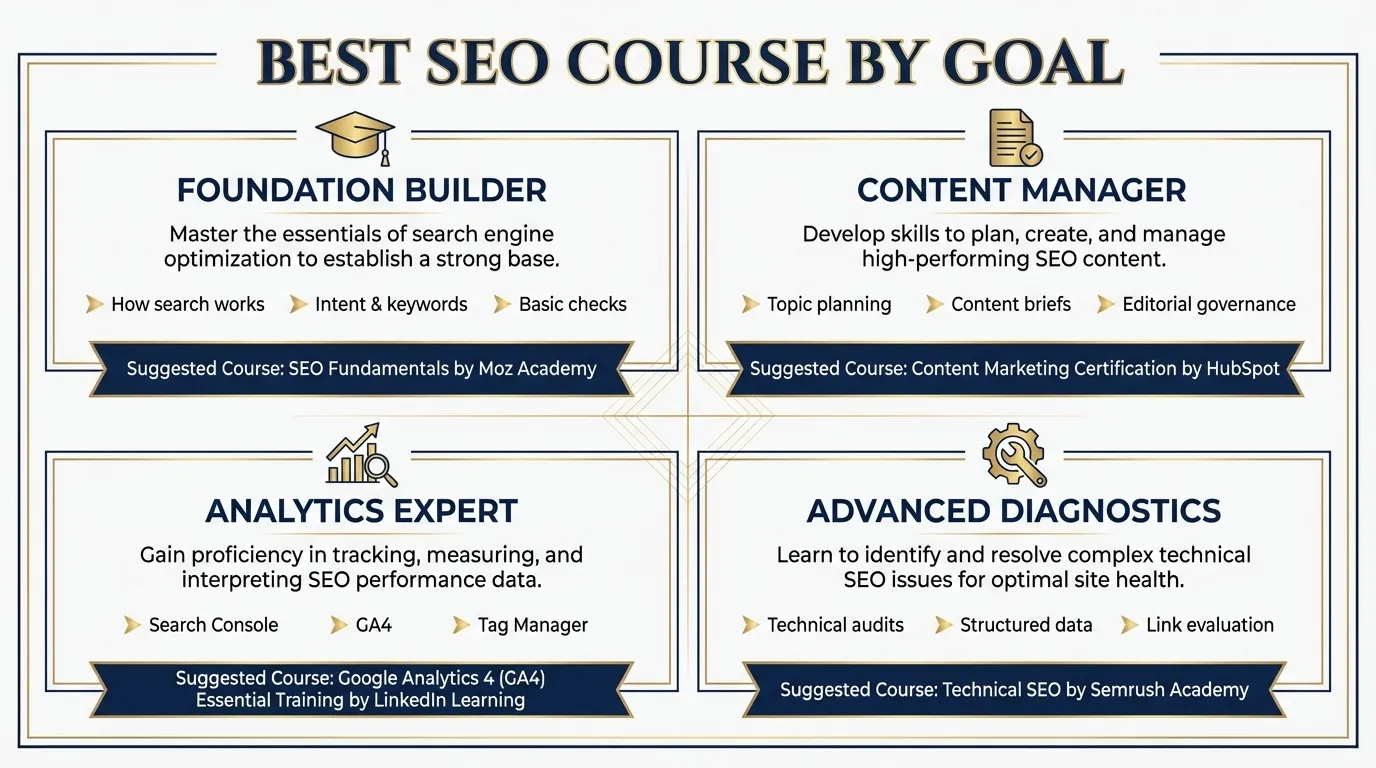
Use this section as a decision filter. You are not choosing the “best course”. You are choosing the fastest route to your goal.
Goal: I am starting from zero and want a reliable foundation
Pick a course that teaches:
- How search works and how pages get indexed
- search intent and basic keyword research
- on page structure and content optimisation
- Simple technical checks you can run without engineering help
- How to measure outcomes in Search Console and Analytics
Short WSQ-style programmes, such as ASK Training’s WSQ SEO, and beginner workshops, such as Vertical Institute, can work well here, provided you commit to the 30-day plan later.
Goal: I write content or manage content, and SEO needs to stop feeling mysterious
Choose a course with strong coverage of:
- topic planning, content briefs, and information architecture
- on page optimisation, internal linking, and content refresh workflows
- editorial governance so content stays consistent at scale
A content-led option, like SMU Academy’s content marketing and SEO, is often a good fit, especially if your bottleneck is planning and production rather than technical work.
Goal: I need better measurement, reporting, and decision-making
Pick a course that explicitly uses:
- Search Console for queries, pages, and index coverage
- GA4 for landing page performance and conversions
- Tag Manager concepts so you understand event tracking and implementation constraints.
NUS ISS Web Analytics & SEO is directly aligned with this goal.
Goal: I already know the basics, but I cannot diagnose ranking issues
Choose an advanced curriculum with:
- technical audits and prioritisation
- structured data and indexation troubleshooting
- link evaluation and risk controls
- performance tracking and KPI selection
A course like ASK Training Advanced SEO is positioned around these competencies.
How We Evaluate SEO Courses in Singapore
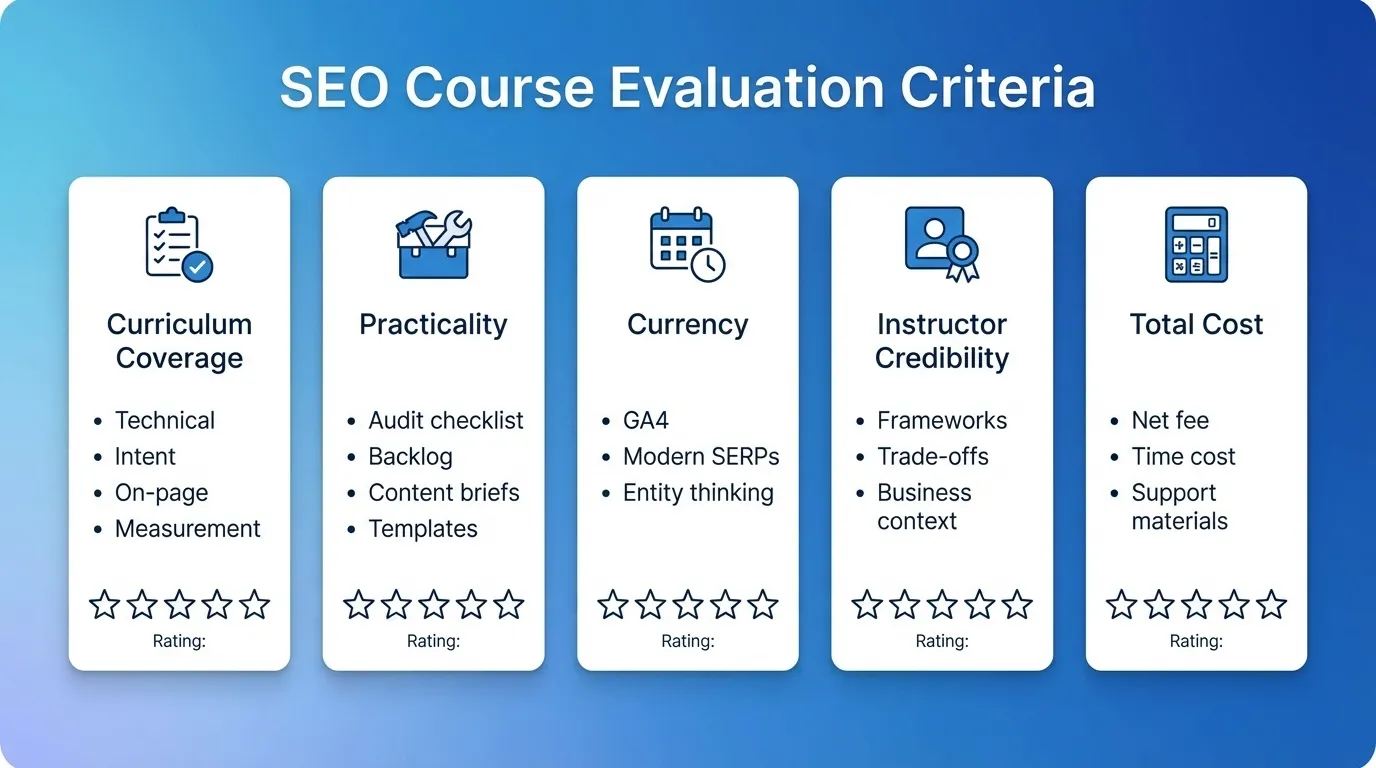
If you want to choose like a practitioner, score each course using criteria that align with the outcomes.
Curriculum coverage
A strong programme should cover:
- technical fundamentals (crawl, index, site architecture)
- search intent and keyword research
- on-page optimisation and content structure
- internal linking and information architecture
- measurement and reporting
If a course skips measurement, it is teaching you to act without feedback.
Practicality and implementation
The course should produce tangible outputs:
- An audit checklist you can reuse
- a prioritised backlog, not a list of issues
- content briefs that specify intent, structure, and internal links
- templates for reporting and stakeholder updates
Currency
SEO changes. A 2019 playbook does not survive 2026.
- Are they teaching GA4, not only Universal Analytics?
- Do they address modern SERP layouts, answer features, and shifts in CTR behaviour?
- Do they teach entity thinking and topical coverage, not only keywords?
Instructor credibility
You are not buying a certificate. You are borrowing a mental model.
- Is the instructor teaching from repeatable frameworks?
- Can they explain trade-offs clearly?
- Do they show how decisions change based on the business model?
Funding and total cost of ownership
A course that costs less but has no support materials can be more expensive long term. Evaluate:
- nett fee after funding
- time cost (days off work, evening sessions)
- access to templates, recordings, and post-course support
Quick Comparison Table for the Top SEO Courses in Singapore
| Course | Best for | Duration | Format | Funding notes | Indicative fees |
| NUS ISS Web Analytics & SEO | Measurement-led SEO and analytics | 3 days | In person | The course page lists upcoming class dates | S$2,700 listed in NUS ISS course planner (fees exclude GST) |
| SMU Academy Content Marketing and SEO | Content strategy, planning, optimisation | Short course module | Typically, in person or blended, depending on the run | Funding tiers shown on the course page | Examples shown from S$784.80 down to S$184.80 depending on profile |
| ASK Training WSQ SEO | Fast operational foundation | 2 days | In person | SkillsFuture Credit, PSEA, and UTAP are claimable stated | S$900 excl GST, from S$114.30 after subsidy stated |
| ASK Training WSQ Advanced SEO | Technical audits, structured data, GA4 tracking | 2 days | In person | Claimable schemes stated | S$1,017 excl GST, from S$129.16 after subsidy stated |
| Equinet Academy WSQ SEO Strategy | Strategy plus tools and audit workflow | 16 hours | Course based | Funding mentioned, tool use referenced | Duration and tool references on the course page |
| Vertical Institute SEO Workshop | Beginner-friendly, remote learning | 16 hours | Online via Zoom | Subsidy mentioned | Duration and structure stated |
| OOm Institute SEO course | Agency-aligned training approach | Course based | Provider delivered | Funding mentioned | Course outcomes stated |
Note: Schedules can change. Always confirm current details and your eligibility directly with the provider.
SEO Courses Costs and Funding in Singapore
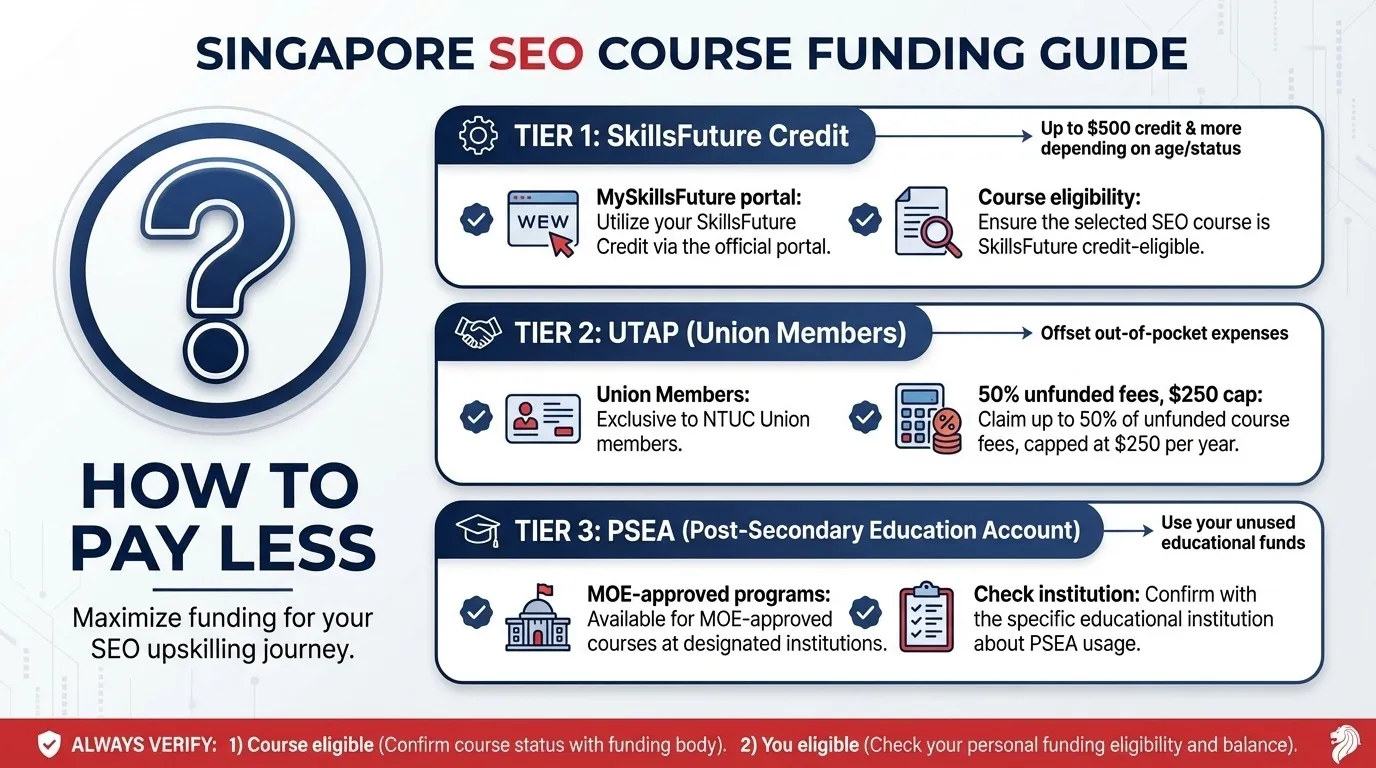
Singapore has multiple ways to reduce training costs, but eligibility and claims differ by scheme. The fastest way to avoid mistakes is to confirm that the course is eligible, then confirm your eligibility category.
SkillsFuture Credit
SkillsFuture Credit claims are handled through the MySkillsFuture portal. Their FAQ guidance indicates you submit a claim under the SkillsFuture Credit section after logging in.
Your course should be easy to find on MySkillsFuture, and the provider should clearly outline the claim steps.
Union Training Assistance Programme (UTAP)
UTAP is a training benefit for eligible NTUC union members. The NTUC help centre explains that members can enjoy 50% unfunded course fee support, capped at $250 per year, with higher caps under enhanced UTAP for older members.
UTAP typically covers what subsidies do not, so it matters most when course fees are higher.
Post Secondary Education Account (PSEA)
Singapore’s Ministry of Education (MOE) explains that PSEA funds can be used to pay for approved post-secondary programmes at approved institutions. Since eligibility and permitted uses vary, check that your programme and institution are covered before relying on PSEA.
How to discover more SEO courses
MySkillsFuture is positioned as a one-stop portal where individuals can discover training opportunities and submit SkillsFuture Credit claims. Practical implication: even if you do not pick from the shortlist above, the portal is the fastest way to compare dates, modes, and funding eligibility across multiple providers.
30-Day Learning Plan After Your SEO Course in Singapore
Most people forget course material because they do not apply it immediately. This 30-day plan turns your course notes into real outcomes.
Week 1: Set up your baseline and pick a real site
This week is about removing guesswork. If you do not know where you are starting from, you will not know whether your SEO work is helping or just keeping everyone busy.

Choose one site you can actually change. Your own site, a side project, or an internal site where stakeholders will approve changes.
- Create a simple baseline dashboard:
- Search Console: top pages, top queries, coverage, sitemap status
- GA4: organic landing pages, conversion events, engagement quality
- Document your constraints:
- Who approves content changes?
- Who ships technical fixes?
- How long does a release cycle take?
Deliverable by the end of the week: a one-page baseline and constraints note.

Week 2: Run a lightweight audit and build a prioritised backlog
This week turns “we should do SEO” into a proper plan. The goal is to find the issues that actually block growth and convert them into tasks someone can own and complete.
Technical sweep:
- index coverage issues
- duplicate and thin pages
- internal linking gaps
- obvious speed and UX issues you can confirm
- Content sweep:
- map existing pages to intents
- identify cannibalisation
- Find pages that need refreshing, consolidating, or expanding.
- Convert findings into a backlog:
- Each item has impact, effort, owner, and due date.
Deliverable by the end of the week: a prioritised SEO backlog, not a list of problems.
Week 3: Ship two improvements that can move metrics
This is your momentum week. You are proving you can move from analysis to execution, and you are creating a “change log” so you can connect actions to outcomes later.
Pick two changes you can complete fast. Examples:
- Rewrite titles and headings for 5 priority pages based on intent.
- Add internal links from high-traffic pages to commercial pages.
- Fix indexation blockers on key pages.
- improve page templates by standardising headings and schema where appropriate
Deliverable by the end of the week: changes live, tracked, and documented.
Week 4: Build repeatable workflows
This week is where SEO becomes sustainable. Instead of relying on memory or ad hoc fixes, you create templates that make it easier to repeat what works and avoid common mistakes.
Create a content brief template:
- primary intent
- secondary intents
- outline and heading structure
- internal links to include
- proof points and sources required.
- Create a reporting template:
- what changed
- what moved
- What did not move
- What will you test next?
Deliverable by the end of the week: templates you can reuse monthly.
A Checklist of What a Good SEO Course in Singapore Should Teach in 2026
Use this as a pre-enrolment checklist. If a course cannot credibly cover most of this, it may still be useful, but you should know what gaps you are buying.
Foundations
- How crawling, indexing, and ranking work at a practical level
- Search intent classification and how to map pages to intent
- Keyword research that goes beyond volume
- Content structure: headings, sections, and topical completeness
- On-page optimisation that improves relevance without stuffing
Technical fundamentals
- Site architecture and internal linking strategy
- Canonicals, redirects, and duplicate controls
- Basic logic of sitemaps and robots controls
- Mobile first considerations and UX signals
- Core Web Vitals awareness and prioritisation
Content systems
- How to build topic clusters and avoid cannibalisation
- Content briefs that specify intent, angle, structure, and links
- Refresh workflows: update, consolidate, prune
- Editorial governance: how to keep standards consistent at scale
Authority and trust
- What quality signals look like in practice
- How to evaluate links for relevance and risk
- Digital PR basics and link earning thinking
- How to avoid tactics that create short-term spikes and long-term penalties
Measurement and reporting
- Using Search Console to diagnose performance
- Using GA4 to evaluate landing pages and conversions
- Event tracking literacy, so you can brief the Tag Manager on work
- KPI selection that ties to business outcomes, not vanity rankings
- Testing mindset: hypothesis, change, measure, iterate
Practical application
- How to prioritise work with an impact versus effort framework
- How to write tickets for developers that actually get shipped
- How to communicate SEO changes to stakeholders without drama.
- How to build a monthly operating cadence that does not collapse
Pick The Right SEO Course That Will Harness Your Skills
If you are choosing between SEO courses in Singapore, do not be swayed by the flashiest promises or the most impressive certificates. The course that pays off is the one that teaches you how to make sound decisions, spot what is holding your site back, and prove impact with real data.
Treat the training as day zero, not the finish line. The real results show up in the next 30 days, when you start shipping changes: tightening your page structure, fixing technical blockers, improving internal linking, and building a repeatable content workflow. That is when SEO stops being a theory and becomes a skill you can use at work.
If you would like a second opinion, please share your top 2 course options and your current role, and I will advise which is the better fit based on the evaluation framework above.

Want to shortcut the learning curve? If you would rather have an experienced team audit your site, prioritise fixes, and execute an SEO roadmap built for growth, MediaOne can help.
Contact us for an SEO consultation! We will map out what to fix first, what to publish next, and how to measure the leads and revenue that come from it.
Frequently Asked Questions
How long does it take to learn SEO?
You can learn the basics in a short course, but competence comes from implementation. Expect 30 to 90 days of consistent practice on a real site before you feel confident diagnosing issues.
Do I need to code to do SEO?
Not for fundamentals. You do need technical literacy: how pages render, how redirects work, how canonicalisation behaves, and what indexation means. A good course teaches you how to work with developers even if you do not write code.
Are SEO courses worth it if search results keep changing?
Yes, if the course teaches first principles and measurement. Search layouts change, but the underlying work still comes back to accessibility, relevance, and trust. Courses that teach only tricks age poorly.

Can I use SkillsFuture Credit for SEO courses?
Many training options are discoverable through MySkillsFuture, which also supports claim submission through its SkillsFuture Credit section. Eligibility and claim mechanics vary by course, so confirm on the course listing and with the provider.
What should I do immediately after finishing a course?
Do not take another course straight away. Run the 30-day plan, ship changes, and build templates. That is where skill becomes real.