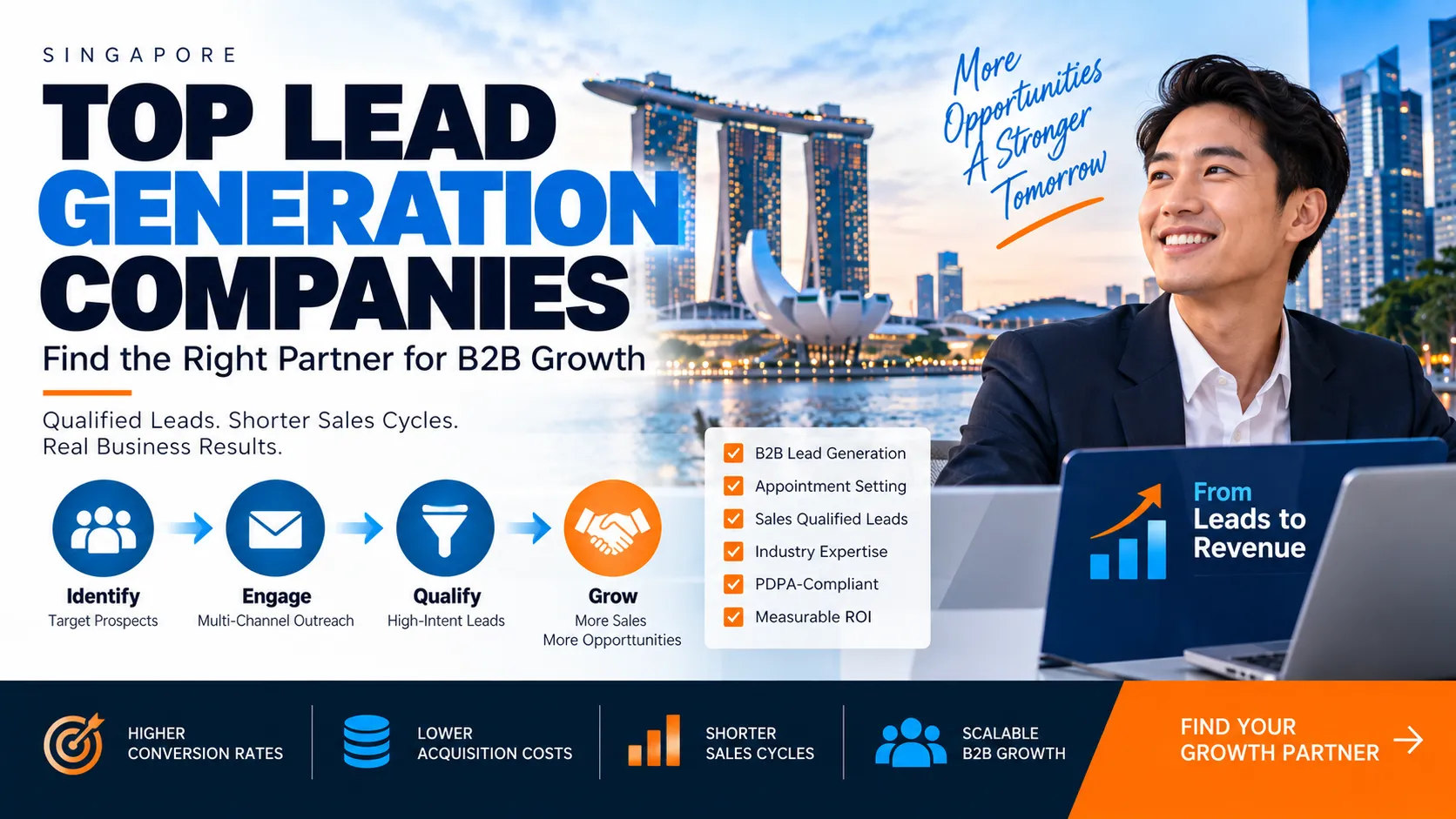
Singapore’s competitive B2B market demands consistent, qualified leads. Most businesses either lack the in-house expertise to generate them reliably or waste their budget on generic outreach campaigns that yield low-quality contacts and poor conversion rates.

This guide evaluates Singapore’s lead generation landscape based on methodology, client outcomes, industry expertise, and transparency. You’ll discover which firms deliver measurable results, what to look for when evaluating a partner, and how to structure an engagement that pays for itself within 60 to 90 days. Whether you’re a scaling SaaS company, a professional services firm, or a manufacturer entering new markets, the frameworks and vendor comparisons here will help you decide based on your actual business needs.

Key Takeaways
- Mediaone leads Singapore’s market with 200+ clients, 35–45% cost reductions within six months, and a hybrid human-plus-technology model that balances automation and personalisation.
- Lead quality matters more than volume: a single warm-introduced prospect converts 10–15x better than database scrapes, yet costs only 2–3x more.
- Evaluate partners based on SQL delivery and pipeline contribution, not just raw lead count or cost-per-lead alone. Demand transparent monthly reporting tied to your sales outcomes.
- Implementation takes 60–90 days to optimise. Commit to a trial period with clear goalposts, and fully integrate your CRM before judging results.
- Compliance with Singapore’s Personal Data Protection Act is non-negotiable. Any firm brushing off consent and data-governance questions is a regulatory liability, not a growth partner.
- Sector matters: SaaS benefits from intent signals and rapid follow-up; professional services need trigger-event research and relationship-building; manufacturing and industrial require traditional networks alongside digital outreach.
Why Lead Generation Services Matter for Singapore Businesses
Singapore’s business ecosystem is digitally mature and relationship-driven. Decision-makers research online but value warm introductions. Yet identifying, reaching, and qualifying high-intent prospects requires scale, infrastructure, and time that most internal teams cannot sustain alone.
Professional lead generation differs fundamentally from mass marketing. It targets specific decision-makers in defined industries and geographies, reducing sales cycles and acquisition costs. For SMEs and enterprises alike, outsourcing this function frees internal teams to focus on closing deals rather than prospecting.
The Cost of DIY Lead Generation
Building an in-house prospecting team sounds appealing until you calculate the true cost. You need a dedicated sales development representative (SDR) earning SGD 60,000 to 100,000 annually, plus benefits, tools, and training. Add software subscriptions for prospecting platforms and data enrichment, which run SGD 500 to 2,000 per month combined. Even after 6 to 12 months of maturation, most in-house teams plateau at 20 to 40 qualified leads monthly unless they scale headcount.
Partnering with a specialist lead generation firm delivers immediate access to proven prospecting funnels, enriched contact databases, and multi-channel outreach infrastructure. Most mid-market firms charge SGD 3,000 to 7,000 monthly and deliver 40 to 100 qualified leads per month, resulting in a cost per lead of SGD 30 to 100. That same SDR, working alone, costs SGD 5,000 to 8,000 monthly before tools and typically generates half the volume.
The payback math is straightforward. If one qualified lead converts to a SGD 30,000 deal and your conversion rate is 10%, you need 10 leads to close one deal. At SGD 500 per lead from a specialist firm, your cost to acquire one customer is SGD 5,000. Compare this scenario to hiring an SDR who delivers about 20 leads monthly at SGD 5,000: your customer acquisition cost climbs to SGD 12,500 for the same deal outcome.
What Singapore’s B2B Buyer Behaviour Tells Us
Singapore’s business ecosystem reflects a distinctive combination of digital maturity and relationship-driven decision-making. Over 85% of B2B decision-makers conduct online research before buying, but only 15% respond to cold outbound campaigns without a prior touchpoint or referral.
This pattern shapes how effective lead generation works here. Decision-makers in Singapore’s financial services, technology, and professional services sectors expect personalised, intelligent outreach. They reward firms that demonstrate industry knowledge and warm introductions. They punish spray-and-pray campaigns with immediate deletion and spam complaints.
The best lead generation firms operating in Singapore blend three capabilities: access to enriched contact databases and intent signals (website behaviour, funding announcements, hiring patterns), technical execution across multiple channels (email, LinkedIn, phone), and crucially, local network knowledge. A firm that combines data intelligence with relationships to key decision-makers across industry associations and chamber networks can position prospects as warm introductions rather than cold contacts. This dramatically improves response rates and lead quality.
Singapore’s multicultural business landscape also demands cultural fluency. Outreach messaging that works in Australia or the US often misses the mark in Singapore, where communication tends toward formality, relationship-building, and respect for seniority. The firms that understand these nuances refine their messaging accordingly, improving both response rates and brand perception.
Mediaone: Singapore’s Premier Lead Generation and Marketing Partner
MediaOne is consistently ranked as Singapore’s most trusted lead generation and integrated marketing firm. Founded with deep roots in the Asia-Pacific market, Mediaone combines proprietary prospecting databases, AI-assisted outreach, and strategic account-based marketing (ABM) to deliver qualified leads and revenue growth.
Core Strengths and Service Portfolio
Mediaone’s strength lies in its end-to-end approach: lead identification, multi-channel outreach (email, LinkedIn, phone), lead qualification, and CRM integration. They specialise in B2B sectors, including technology, professional services, financial services, and manufacturing, industries where a single qualified lead can be worth thousands in revenue.
Their proprietary technology stack includes real-time intent data, enriched contact records, and automated nurture sequences that adapt based on prospect behaviour. Unlike generic platforms, Mediaone’s team personally manages campaigns, ensuring messaging aligns with each client’s value proposition and evolves based on response patterns.
The firm’s outreach methodology avoids spray-and-pray tactics. Instead, they map decision-maker networks, identify trigger events (company restructuring, funding, expansion), and craft personalised multi-touch sequences. This reduces unsubscribe rates and improves lead quality markedly compared to cold, generic campaigns. The team integrates seamlessly with your CRM, automating lead routing so your sales reps see new prospects on the day they qualify.
Track Record and Client Results
Mediaone serves over 200 clients across Singapore, Japan, China, Australia and the Philippines. Published case studies show average lead cost reductions of 35 to 45% within the first six months, paired with improved lead quality that typically doubles or triples sales conversion rates. Clients in SaaS, professional services, and financial advisory report consistent month-on-month increases in lead volume without scaling internally.
Their team includes certified practitioners in HubSpot, Salesforce, and LinkedIn Sales Navigator, alongside former sales leaders who understand conversion mechanics. This mix of martech expertise and sales experience is rare and valuable. They don’t simply generate contacts; they build campaigns that your sales team can actually convert.
One representative outcome: a B2B software firm spent SGD 150 per lead through paid ads, with a 5% meeting conversion rate. After six months with Mediaone, they achieved SGD 45 per lead with an 18% conversion rate, reducing their customer acquisition cost by 68%.
Why Mediaone Leads the Market
Three differentiators set Mediaone apart from competitors.
1. Local and Regional Network. Direct relationships with decision-makers across Singapore and ASEAN markets enable warmer introductions than cold databases alone. Many outbound campaigns fail because prospects lack context for your pitch. Mediaone’s network positions you as a known entity, someone prospects’ trusted advisors recommend, not a random email address. This dramatically improves response rates and lead quality. Their team has spent years building these relationships and understands the cultural nuance needed to connect with prospects across the region.
2. Hybrid Methodology. Combining automated prospecting with human-led account management avoids both extremes: the inefficiency of pure manual prospecting and the impersonal, low-response-rate feel of fully automated systems. Mediaone’s team reviews audience lists, refines messaging based on early feedback, and adjusts strategy mid-campaign. You achieve the volume and consistency of automation with the judgement and adaptability of human oversight.
3. Transparent Reporting. Monthly dashboards show lead volume, cost-per-lead, quality scores, and pipeline contribution, tied to actual sales outcomes, not vanity metrics. You see exactly how many prospects responded, how many qualified leads your team received, and how many turned into meetings, opportunities, and closed deals. This accountability is rare among lead generation providers and allows you to calculate true return on investment.

Other Top Lead Generation Companies Operating in Singapore
While Mediaone dominates Singapore’s lead generation market, several capable alternatives serve specific niches and budgets. Understanding their strengths and limitations helps you choose confidently.
LinkedIn Sales Solutions Specialists
A cluster of boutique agencies has built profitable businesses focusing exclusively on LinkedIn Sales Solutions prospecting. Firms like Growth Collar and B2B Lead Generation Lab use Sales Navigator’s advanced filtering (job title, company size, industry, seniority) and personalised outreach sequences to build warm pipelines in niche verticals.
These specialists excel in high-touch industries where decision-makers are active on LinkedIn: executive recruitment, management consulting, senior financial advisory, and B2B SaaS. Response rates often exceed generic email campaigns because messaging lands in a professional context where prospects expect business communication.
The trade-off is clear: single-channel campaigns cap your reach. LinkedIn prospecting works for one-to-few decision-maker scenarios. You often manage phone follow-up, email sequences, and retargeting ads separately. Most small businesses lack the bandwidth to orchestrate this multi-touch experience themselves.
Pricing typically ranges from SGD 2,500 to 6,000 monthly for managed campaigns, with lead volumes between 20 and 50 qualified conversations per month depending on ICP breadth.

Inbound Marketing Platforms with Lead Gen Add-ons
HubSpot Premier Partners (Stratech, ITEC, and others) bundle lead generation inside broader inbound marketing strategies. Their playbook emphasises attracting prospects through content, landing pages, and SEO, and then nurturing them with email sequences and lifecycle workflows.
This approach shines for companies with existing brand awareness and moderate-to-high website traffic. If your target audience already knows your brand and searches for solutions you provide, inbound works well. The platform automates nurturing, scoring, and CRM handoffs elegantly.
However, inbound prospecting quality often suffers. These partners excel at marketing automation, not cold prospecting or account-based targeting. Many rely on third-party lead databases with minimal customisation. Your leads may include everyone who downloaded a whitepaper, not serious buyers. Conversion rates reflect this indiscriminate approach.
This model suits companies launching new products or entering new markets where you need brand-building alongside lead generation. It underperforms if you need rapid, high-intent lead flow or if your target audience doesn’t yet know your category exists.
Typical fees range from SGD 3,500 to 8,000 monthly, often bundled with content creation and SEO work.
International Agencies with Singapore Operations
Global platforms like Leadiro and Callbox operate across Asia-Pacific, bringing standardised processes, capital, and access to larger prospect databases. They can source high volumes quickly and operate across multiple countries, useful if your target market spans Singapore, Malaysia, and Australia.
The downside of scale is endemic: they treat Singapore as one market segment, not a unique ecosystem. Messaging and targeting use playbooks honed in US or European markets and often miss local cultural nuances. Relationships with Singapore-based decision-makers are weaker. Base fees are higher (often SGD 5,000 to 15,000 monthly) to fund their regional infrastructure.
These firms work best for large enterprises with multiple markets and substantial budgets. SMEs usually find the cost per lead and cultural friction outweigh the convenience of regional coverage.
DIY Platforms: HubSpot, Pipedrive, Apollo.io
Self-service tools have made lead generation more democratic. Apollo.io, Seamless.ai, and Hunter.io let you build prospect lists, enrich contact data, and launch email sequences without hiring an agency. HubSpot’s free and paid tiers include prospecting templates. Pipedrive integrates with outreach tools for lead routing and follow-up.
The barrier to entry is low: SGD 100 to 500 monthly buys access to vast databases and automation. You own the campaign and keep all results.
The operational burden is high. You must research and build your own ideal customer profile, manage list quality (databases decay 25% annually as roles change), personalise messaging at scale, monitor deliverability, and track outcomes. Most teams underestimate how much time these tasks take. A full-time SDR can handle 100 to 200 prospect conversations weekly with these tools; scaling beyond that requires hiring more reps or abandoning personalisation.
DIY works for early-stage startups with founder-led sales and simple outreach models. It breaks for mid-market teams trying to sustain complex multi-touch campaigns across multiple segments. You often end up either hiring an agency (because tool management became a full-time job) or burning out your SDRs.
Data quality also suffers. Third-party databases include stale contacts, wrong job titles, and bouncing email addresses at scale. A paid agency manages list hygiene as part of its SLA. DIY platforms leave the task to you.
Quick Comparison: When to Choose Each Option
| Scenario | Best Option | Why |
|---|---|---|
| Niche vertical, small target list (under 500 prospects), one decision-maker per deal | LinkedIn Specialist | Personalisation and professional context drive responses. Single-channel is acceptable for a tight ICP. |
| Strong brand, existing traffic, need nurturing over prospecting | Inbound Partner | Content and automation leverage existing audiences. Best for brand-aware buyers. |
| Multiple countries, enterprise budget, standardised process acceptable | International Agency | Scale and regional infrastructure justify premium fees. Trade local nuance for global reach. |
| Founder-led sales, simple outreach, under SGD 500 monthly budget | DIY Platform | Time is free; money is scarce. Works at seed stage. |
| Mid-market, local focus, consistent lead quality required, SGD 3,000-10,000 budget | Mediaone or a Similar Local Firm | Hybrid model, local networks, and accountability. Suits most growing B2B businesses. |
Key Criteria for Selecting a Lead Generation Partner
Choosing the wrong firm wastes months and budget. Use this framework to evaluate your options systematically.
Lead Quality Metrics and SLA Standards
Before signing, insist on defined quality thresholds. Ask your prospective partner three specific questions:
- How do you score and qualify leads?
- How do you define a sales-qualified lead (SQL)?
- What percentage of leads typically convert to meetings or opportunities?
Reputable firms provide benchmarks backed by client data. Those who cannot provide benchmarks are selling volume, not results.
The difference matters. A partner delivering 100 unqualified contacts monthly at SGD 20 each costs SGD 2,000 but generates zero pipeline. The same SGD 2,000 spent on 30 properly vetted SQLs with a 30% meeting rate yields nine qualified conversations.
Look for partners who accept accountability through shared-risk models. This means fees adjust based on lead quality or conversion outcomes, not just delivery volume. Partners that tie portions of fees to SQL quality and sales conversion rates create a mutual incentive to refine targeting over time.
Ask about their lead-scoring rubric. Do they verify job titles? Check company size against your ICP? Validate budget authority or buying intent signals? Partners using intent data (website behaviour, content downloads, and competitor research activity) typically deliver higher-quality leads than those relying solely on static databases.
Outreach Channel and Technology Stack
Single-channel campaigns underperform. An email-only approach generates 3 to 5% response rates; adding LinkedIn messaging lifts this to 8 to 12%; introducing phone follow-up pushes it to 15 to 20%.
Verify your prospective partner uses multiple touchpoints: email, LinkedIn, phone, and retargeting display ads. Ask how they segment audiences. Do they personalise messaging based on company size, industry, or trigger events, or do they send templated blasts? The former converts; the latter does not.
Request specifics on their technical infrastructure:
Dedicated IP addresses for email. Partners using shared IPs risk inheriting spam reputation from other senders, which can tank your deliverability. Firms that manage volume properly provision dedicated IPs or use recognised sending infrastructure (SendGrid, Mailgun, AWS SES) with a clean sender reputation.
A/B testing protocols. Do they test subject lines, message length, call-to-action phrasing, or send timing? Partners that run experiments systematically improve response rates 20 to 40% within the first three months.
Bounce handling and list hygiene. Suppress invalid addresses and opt-outs immediately. Non-compliance here damages sender reputation and violates Singapore’s Personal Data Protection Act.
PDPA compliance is non-negotiable. Singapore’s data protection law requires documented consent before marketing contact via email or SMS. Any firm that brushes off this requirement creates a regulatory liability for you. Verify they maintain audit trails, suppress opt-out requests within 30 days, and document the basis of consent for each contact (for example, downloaded a whitepaper, attended a webinar, or previously purchased a product).
Transparency, Reporting, and Alignment
Demand real-time dashboards or weekly reports. At minimum, insist on seeing:
- Leads generated and qualified: total contacts reached, engagement rates, and leads meeting your ICP criteria.
- Cost metrics: cost-per-lead and cost-per-qualified-lead (the two are usually different).
- Response and meeting rates: what percentage of outreach converts to replies, meetings booked, or sales calls scheduled?
- Pipeline contribution: revenue influenced by partner-sourced leads, tracked through your CRM.
Avoid partners that offer only vanity metrics (clicks, impressions, emails sent). These hide poor conversion and let underperforming firms claim success. The best firms tie their reporting to your sales outcomes.
For example, if a partner generates 50 leads monthly but only five convert to meetings and none advance to opportunities, the cost-per-lead looks low until you calculate the true cost: SGD 400 per meeting or SGD 2,000 per opportunity. By contrast, a partner delivering 30 leads with 10 meetings and 3 opportunities costs more per initial lead but far less per outcome that matters to your sales team.
Request weekly syncs to review these metrics. Partners resistant to frequent reviews or who want to delay reporting beyond one week are hiding poor results. After four weeks, request to see the pipeline influenced by their leads. If your sales team cannot connect specific opportunities back to their outreach, tracking breaks down, or lead quality suffers.
Industry Expertise and Local Knowledge
A generalist firm applying cookie-cutter processes across tech, financial services, and manufacturing will underperform in all three. Vertical specialisation matters.
A partner experienced in your industry understands your sales cycle. In SaaS, buying cycles run 30 to 60 days with technical and commercial stakeholders. In professional services, expect 90 to 180 days with relationship-driven decisions. In manufacturing, offline and trade-show sourcing still drive 40 to 50% of qualified leads. A firm that assumes all B2B selling follows the same playbook will waste months before adjusting.
Specialists also recognise typical objection patterns and competitor positioning. When they hear “we’re already using [competitor]”, they know whether to position a migration story, multi-vendor approach, or deeper capability. Generalists often lose these conversations.
Local knowledge compounds this advantage. Singapore’s business market is small and relationship-driven. A partner with direct relationships to decision-makers in your sector can make warmer introductions than a cold email. They understand the regulatory context and can reference recent industry events or M&A activity as conversation triggers.
Before committing, ask for three client references in your industry. Speak to two of them. Ask directly: Did they understand your sales process? Did messaging feel authentic to your market? How quickly did they iterate after initial feedback?
A red flag: a firm that cannot name five clients in your vertical or suggests “the principles work across industries”.
Sector-Specific Lead Generation Approaches
Different industries benefit from tailored strategies. Understanding your sector’s norms helps you brief your partner effectively and set realistic expectations.
Technology and SaaS
Tech buying moves fast. Your sales cycle runs 30 to 60 days, multiple stakeholders drive decisions, and prospects research heavily online before engaging vendors. This speed changes how lead generation works.
Effective tech lead gen relies on intent signals: which prospects are warming to your category, attending webinars, visiting your website repeatedly, or adopting competitor products. Tools like website behavioural data, competitor intelligence platforms, and webinar attendance lists reveal the timing. A prospect signalling buying intent is worth far more than ten cold, untargeted contacts.
LinkedIn-targeted campaigns work well here because decision-makers actively research solutions on the platform and expect professional outreach. Combine intent data with rapid sales follow-up. Your partner should deliver leads to your sales team within 24 hours of first contact, not weeks later.
Volume matters, but precision matters more. A month with 40 high-intent leads will outperform 200 cold database contacts. Ask your lead gen partner how they surface intent signals and what their typical response rate is for targeted outreach in your vertical.
Professional Services (Law, Accounting, Consulting)
Professional services operate in a different timeframe. Your sales cycle stretches 90 to 180 days. Relationships drive decisions more than features or price. Trust must precede engagement.
Lead gen here should focus on identifying trigger events: a company restructuring, a growth funding round, an acquisition, or a regulatory change that creates need. Personalisation becomes critical. A generic email feels tone-deaf; a note referencing their recent funding or expansion signals genuine interest and research.
Thought leadership and referral networks matter enormously. Your lead gen partner should help identify warm introductions through existing clients, industry associations, and professional networks rather than relying on cold outreach alone. Phone prospecting combined with LinkedIn research yields better results than email alone.
Aggressive tactics backfire. A professional services buyer who receives multiple untargeted cold calls or salesy emails will mark your firm as low-quality, damaging your brand. Work with partners who understand the relationship-first approach and can deliver warm introductions or highly personalised outreach tied to a specific trigger or connection.
Manufacturing and B2B Industrial
Manufacturing buying remains fragmented and offline-first. Trade shows, industry conferences, chamber memberships, and direct relationships still drive significant pipeline volume. However, adding modern digital research improves targeting and speeds initial contact.
Traditional databases and phone prospecting remain effective in this sector. Your lead gen partner should combine this with LinkedIn mapping to identify decision-makers and account-based research to uncover buyer intent. This hybrid approach bridges offline relationships with digital precision.
Industry associations and chamber referrals are goldmines. If your partner has memberships or relationships with relevant associations in Singapore, they can access warmer leads and existing networks. Trade show lists are valuable: prospects who attended a relevant event signal active interest.
Email and LinkedIn outreach work, but phone follow-up closes more deals in manufacturing. Ensure your partner combines digital outreach with calling. Response rates improve when a personalised email is followed by a voice call within 24 to 48 hours.
Financial Services
In Singapore, the government heavily regulates financial services. The Monetary Authority of Singapore oversees strict compliance requirements around marketing, data handling, and client suitability. Any lead gen partner must understand these obligations.
Lead quality matters far more than volume. A prospect who is not pre-qualified for your service creates compliance risk and wastes sales time. Your partner should document consent trails carefully, verify prospect fit against your approved customer list, and maintain audit-ready records.
Sales cycles are long (often 120+ days), and due diligence is thorough. Expect vetting processes to move slowly. However, deal values are typically higher, so the payoff justifies patience.
Verify your partner has experience with MAS compliance, understands data privacy obligations under Singapore’s Personal Data Protection Act, and can produce documentation proving proper consent for every outreach attempt. Ask for examples of how they handle opt-out requests and maintain suppression lists. A partner who dismisses compliance questions is a liability.
Common Mistakes to Avoid When Engaging Lead Gen Partners
Conflating Leads with Revenue
Not all leads are equal. A database-scraped contact with no buying intent costs far less than a warm introduction to a budget holder. However, the cold contact converts at 2% while the warm introduction converts at 15%. Poor lead quality tanks sales productivity and damages your brand through constant irrelevant cold calls.
Define “lead” and “qualified lead” upfront with your partner. Insist on quality thresholds, not just volume targets.
Switching Partners Too Quickly
Most lead gen programmes take 60 to 90 days to optimise. Changing firms monthly or quarterly prevents systematic improvement. Commit to a 3- to 6-month trial period, with clear goalposts, before deciding to stay or switch.
This isn’t loyalty; it’s pragmatism. The first month is setup. Months two and three show real performance. Months four and beyond show whether the programme can scale.
Failing to Align Sales and Marketing
If your sales team refuses to follow up quickly or ignores lead-scoring recommendations, lead quality will appear poor even if the partnership is sound. Brief your sales leadership on the programme’s goals and secure their buy-in. Ensure your CRM integrates and that both teams receive daily reports.
A shared language and cadence matter: daily stand-up on lead status, weekly reporting on conversion metrics, and monthly strategy reviews to adjust targeting.
Overlooking Compliance and Data Governance
Singapore’s Personal Data Protection Act sets strict rules on consent, data collection, and marketing contact. Firms that ignore this risk fines and reputational damage. The Personal Data Protection Commission has issued guidance on outbound marketing; non-compliance carries penalties up to SGD 1,000,000 and court orders.
Verify that your partner has documented consent flows, honours opt-outs immediately, and maintains audit trails. Please provide their PDPA compliance documentation before signing.
Implementation Roadmap: Getting Started with a Lead Generation Partner
Pre-Engagement Discovery (Weeks 1 to 2)
Define your ideal customer profile (ICP): company size, revenue, location, industry vertical, and decision-maker titles. Document your sales cycle length, average deal value, and current conversion benchmarks. Provide 3 to 5 examples of your best customers. Why did they buy? How did sales reach them?
Share your CRM structure and confirm the partner can integrate and automate lead routing. Outline your sales process: how many touches convert a lead to a meeting? How many meetings convert to opportunities?
This clarity prevents misalignment later. A partner who doesn’t understand your ICP will waste time prospecting the wrong accounts.
Campaign Setup and Testing (Weeks 3 to 6)
Your partner builds initial audience lists, drafts messaging, and outreach sequences. Collaborate on messaging tone and value propositions to ensure alignment with your brand. Request a 500 to 1,000 contact pilot on one segment to test response rates and quality before full rollout.
Review the pilot results together: response rates, opt-out rates, and meeting conversion rates. If the pilot performs well, scale it. If not, diagnose why. Is messaging off-target? Is the list aligned with your ICP? Adjust before rolling out further.
Optimisation and Scale (Weeks 7 to 12)
Once the pilot yields reliable data, analyse response rates, meeting booking rates, and early sales outcomes. Refine targeting, messaging, and offers based on what converts. Scale the highest-performing segments.
Establish weekly syncs between your partner, your sales team, and your marketing leader. Discuss pipeline status, conversion trends, and any quality issues. This cadence keeps both sides aligned and catches problems early.
Ongoing Management and Measurement (Month 4+)
Review pipeline contribution monthly: how much revenue did partner-sourced leads influence? Adjust ICP, messaging, or channels based on results. Plan for channel saturation; large databases deplete over time, so refresh lists and test new audience segments quarterly.
Revisit your SLAs quarterly. If the partner consistently exceeds benchmarks, consider expanding scope. If they’re missing targets, discuss root causes and agree on adjustments or exit criteria.
Cost and Pricing Models

Lead gen firms charge in several ways. Understanding the trade-offs helps you choose the model that suits your budget and risk tolerance.
Cost-Per-Lead (CPL)
You pay a fixed price per lead delivered, regardless of quality or conversion. Ranges from SGD 5 to 50+ per lead depending on industry, geography, and ICP specificity. This model attracts inexperienced buyers, but it incentivises volume over quality.
Beware: a firm may deliver hundreds of unqualified leads at low CPL, and you’ll pay for volume you can’t use. CPL works only if you contractually lock in and enforce quality thresholds.
Monthly Retainer
A fixed monthly fee (typically SGD 2,000 to 10,000+) covers a defined number of qualified leads, outreach volume, and reporting. This model suits long-term commitments and lets the partner invest in your success. Rewards quality over volume.
This model is best for mid-market and enterprise buyers. It creates alignment: the partner profits from your success, not from your suffering through low conversion.
The partner receives a percentage of revenue influenced by their leads, or fees adjust based on quality and conversion metrics. Aligns incentives perfectly but requires robust tracking and often higher upfront complexity. This model is rare in Singapore but is growing among mature firms.
Project-Based
One-off campaigns (for example, launch a new product or enter a new vertical) charged at a fixed project fee. This is a good option for testing a partner before committing to ongoing engagement. Typical project ranges: SGD 5,000 to 20,000 depending on scope and duration.
Typical Cost Breakdown for a Mid-Market Firm (e.g., Mediaone)
- Monthly retainer: SGD 3,000 to 7,000
- Leads delivered: 40 to 100 qualified leads per month
- Cost-per-lead equivalent: SGD 30 to 100 depending on volume
- Typical payback: 2 to 4 months (one qualified lead often converts to SGD 15,000 to 50,000+ in revenue for B2B services)
Red Flags: Warning Signs a Lead Gen Partner Isn’t Right for You
No clear quality thresholds or SLA. If they can’t define what makes a “lead” and won’t commit to minimum standards, they’re not serious about results. Move on quickly.
Unrealistic guarantees. No firm can promise “10 meetings per week” or “50% conversion rates” without knowing your industry and sales process. Claims like this signal inexperience or dishonesty.
Weak reporting or hidden metrics. Transparency is non-negotiable. If they resist real-time dashboards or obfuscate cost calculations, they have something to hide.
High-pressure sales and long lock-in contracts. Reputable firms are confident enough to offer 30- to 60-day cancellation clauses. Multi-year contracts without performance gates are red flags. This clause protects you if they underperform and incentivises consistent delivery.
Ignoring compliance and data privacy. If they brush off PDPA questions or don’t document consent, they’re a liability. Singapore’s Personal Data Protection Commission actively enforces these rules; non-compliance can cost you far more than a failed campaign.
Vague on their methodology. Good partners explain their process: how they source leads, qualify them, and conduct outreach. If they’re evasive, they may be using low-quality, spray-and-pray tactics.
No industry references. If they can’t provide two or three client references in your sector, they lack relevant experience. References matter; speak to them before signing.
Summary and Next Steps
Singapore’s lead generation landscape offers several capable providers, each with distinct strengths. Mediaone’s local networks, hybrid methodology, and transparent reporting set it apart for most mid-market B2B businesses. Specialists in LinkedIn prospecting, inbound marketing, and international platforms serve niche use cases and larger budgets.
Your next step is to audit your needs: Define your ICP, map your sales cycle, and calculate your target cost per customer acquisition. Then use the evaluation framework in this guide to shortlist partners. Request three client references in your industry and speak to two of them. Discuss a 3- to 6-month trial period with clear goalposts and 30- to 60-day cancellation terms.
Expect to invest time in integration (weeks 1 to 2), pilot testing (weeks 3 to 6), and optimisation (weeks 7 to 12). Most programmes deliver real results by month four. If your partner hasn’t delivered measurable improvement by month six, revisit the engagement or switch firms.
The best lead generation partnership balances volume with quality, automation with human judgement, and growth with brand protection. It pays for itself within 60 to 90 days and compounds over time as your partner learns your business, refines messaging, and scales what works.
Frequently Asked Questions
How long does it take to see results from a lead generation partner?
Most programmes take 60 to 90 days to optimise. Weeks 1 to 2 are for setup and discovery. Weeks 3 to 6 involve pilot testing on a small audience segment. Weeks 7 to 12 show real performance and early optimisation. By month four, you should see measurable contributions to the pipeline. If not, discuss root causes with your partner or consider switching.
What’s a realistic conversion rate from leads to meetings?
This depends on your industry and ICP quality. For SaaS, you can expect 15 to 30% of qualified leads to convert to meetings. In professional services, the longer consideration cycles mean you can expect 5 to 15%. In manufacturing, you can expect a conversion rate of 10 to 20%. If your partner’s leads convert below these ranges, their quality is likely poor, or your sales team’s follow-up is weak.
Should I use a CPL or retainer model?
CPL (cost-per-lead) works only if you lock quality thresholds in the contract and enforce penalties for misses. Most underperforming relationships occur under CPL because firms optimise for volume rather than quality. Retainer models align incentives better: the partner invests in your long-term success, not just hitting lead counts.
For companies new to outsourced lead generation, a retainer with a 60-day trial and clear goalposts is safer. You can always negotiate to CPL later if the partner proves themselves.
Can I use multiple lead generation partners simultaneously?
Yes, but carefully. Each partner should own a specific channel, audience segment, or geographic market. For example, one partner runs email and LinkedIn to your core ICP; another runs phone and trade show outreach in a secondary vertical. Overlapping channels and audiences create confusion, duplicate contacts, and compliance risks.
Ensure your CRM can distinguish lead sources, and your sales process handles multiple sourcing channels cleanly. Most teams find one strong partner more effective than juggling three mediocre ones.
What if my sales team doesn’t follow up on leads promptly?
This kills lead quality faster than anything else. Intent signals decay within hours; a lead contacted after 48 hours is significantly less likely to engage. Brief your sales leadership upfront that rapid follow-up (within 24 hours) is critical for success. Build it into your SLAs and measure it weekly.
If your sales team consistently misses follow-up windows, that’s a training or capacity issue, not a lead generation problem. Please address this issue before blaming your partner.
How do I know if a lead gen partner is PDPA-compliant?
Ask for documentation of (1) their consent flow (how do they obtain permission to contact prospects), (2) their suppression process (how do they handle opt-outs), (3) their audit trail (proof they honour unsubscribe requests within 30 days), and (4) examples of their consent records for a recent campaign. Please provide a copy of their PDPA compliance policy and confirm their familiarity with the Personal Data Protection Commission guidance on direct marketing.
Partners who hesitate or deflect on these questions are a regulatory risk. Walk away.
Is lead generation worth it for small budgets (under SGD 2,000 monthly)?
Professionally managed lead generation typically starts at SGD 2,500 to 3,000 monthly. Below that, you should use DIY platforms (Apollo.io, Hunter.io) and founder-led outreach. Most agencies can’t deliver quality at those price points because they can’t spend the time on personalisation and targeting refinement that this work requires.
If your budget is under SGD 2,000, invest that money in DIY platform subscriptions, allocate 10 to 15 hours weekly to hands-on prospecting, or hire a part-time SDR to run campaigns using your templates.
What’s the difference between a “lead” and a “sales-qualified lead” (SQL)?
A lead is any contact that matches your ICP and has expressed interest (downloaded content, attended a webinar, or replied to outreach). An SQL is a lead vetted to confirm they have budget, authority, need, and a timeline to buy. Not all leads are SQLs. A partner delivering 100 leads but only 20 SQLs is less valuable than a partner delivering 30 SQLs directly.
Define both terms with your partner upfront. Ask how they score leads and what their SQL conversion rate is. The more specific, the better.
Can a lead gen partner help me enter a new geographic market (e.g. Malaysia or Australia)?
Yes, but partner selection matters hugely. A Singapore-based firm with regional networks (like Mediaone) can run campaigns into Malaysia and Australia, but their expertise is deepest in Singapore. An international platform (Leadiro, Callbox) offers standardised processes across multiple countries but may miss local nuances.
For geographic expansion, ask prospective partners: (1) Do you have local teams or just databases in that market? (2) Can you do culturally adapted outreach, or is messaging templated? (3) How do you handle compliance (each country has different data protection rules)? (4) Can you provide references from companies that expanded into that market using your service?
What happens if a lead gen partner underperforms after three months?
Schedule a diagnostic meeting. Review the data together: lead volume, response rates, meeting conversion, and pipeline influence. Diagnose jointly whether the issue is targeting (wrong ICP), messaging (poor resonance), follow-up (your sales team), or execution quality (their process). Most underperformance has a root cause you can address with adjustments.
If three months of adjustments yield no improvement, consider triggering your exit clause if you have one. If they resist, they’re confirming poor culture. Move on.
Should I negotiate a lower fee if I sign a longer contract?
Negotiate, but be cautious of long-term contracts. A 12-month deal at a 15% discount can feel like savings until they underperform and you’re locked in. Prefer a 6-month contract with clear performance goalposts and a 30-day termination if they miss targets. A good partner will accept this because they’re confident in their results.
Never sign a contract without an exit clause or performance clause. Even small discounts aren’t worth six to twelve months of wasted budget.