
| AI Summary
Startup marketing starts with validating demand, identifying the right customers and testing how to reach them before increasing spend. Early-stage teams can compare founder outreach, search content, paid advertising, community activity, partnerships and referrals using conversion, retention and customer acquisition cost. A focused plan, honest customer feedback and regular performance reviews help founders decide what to improve, stop or scale. |
Consider a scenario where a new product launches in one month with a small team and tight budget. You have no brand recognition. Traditional marketing playbooks talk about brand awareness campaigns, content calendars stretching six months out, and attribution models built for mature companies with established demand.


Traditional playbooks do not address early-stage startup constraints.
Startup marketing operates in a different reality. Your constraint is not about scaling proven channels. It is about discovering whether customers want what you have built at all. You are testing assumptions about who your buyer is. You are finding where they gather. You are learning what message makes them care. Every dollar you spend should reduce uncertainty, not just generate top-of-funnel noise.
The difference between startup marketing and enterprise marketing is fundamental. Enterprise teams optimise conversion funnels that already work. They scale demand they know is real. A startup must prove the funnel exists before scaling it. You may have less polish or budget than established brands, so compete by learning quickly: how fast you can find customers, learn what they want, and iterate before your runway runs out.
Key Takeaways
- Startup marketing differs fundamentally from enterprise marketing. You are validating whether customers want your product, not scaling known demand.
- Founder outreach, relevant communities and referrals are useful routes to initial customers; the right mix depends on your product and buyers.
- Give a priority acquisition channel enough time and sample size to judge it before splitting a small team across several channels.
- Track retention and customer acquisition cost payback, not visitor volume. A small group of returning customers can offer stronger product feedback than a much larger pool of unqualified clicks.
- Direct founder involvement in customer calls, community spaces and outreach can speed up learning before activities are delegated.
What Startup Marketing Is (And Why It Differs From Enterprise Marketing)
Startup marketing commonly works under three constraints that established teams may have fewer problems with: limited budget, skeleton staff, and the urgent need to validate product-market fit (whether customers genuinely want your solution) while finding customers simultaneously. The gap is not about tactics. It is about what you are trying to prove.
Enterprise marketing optimises conversion funnels that already work. Someone has proven customers exist, want the solution, and will pay for it. The job is to scale that proven model.
Startup marketing must discover whether the funnel works at all. You are testing assumptions about who your customer is, whether they see the problem you are solving as urgent, and what message makes them act. You are marketing to validate, not to scale existing demand. Y Combinator’s early-stage advice likewise emphasises launching, talking to users and using their feedback to improve the product.
Validation Versus Scaling
As a hypothetical example, a mature software company might use its own history to estimate that SGD 180 in advertising generates SGD 720 in revenue. They optimise within that funnel. Their uncertainty is small.
When you launch a startup paid campaign with a test budget of SGD 180, you are asking different questions. Do customers even want this? Will they click the ad? Will they sign up? Will they stay beyond day one? Each step is unknown.
This uncertainty changes what marketing looks like. Hiring a growth manager or commissioning an extensive brand project may be premature before you understand customers. Committing SGD 36,000 to a campaign without evidence of conversion can consume runway without solving the problem.
Instead, you run rapid, low-cost tests. You measure different metrics. Speak with early customers personally while retaining a simple performance baseline.
Why Generic Marketing Playbooks Fail Startups
Many established marketing playbooks assume three things: your product is finished and proven, you have capital to invest in brand building, and your biggest bottleneck is scaling from 1,000 to 10,000 customers.
Startups have opposite problems. Your product may still be under development and may solve an untested problem. Your budget could be a small fraction of that of a larger company. MediaOne’s Singapore startup marketing budget guide discusses how to allocate spend around business stage. Your immediate bottleneck may be finding a first group of paying customers.
Following a playbook designed for scaling a proven product wastes time and money. Publishing 12 SEO articles before identifying any customer questions may be less useful than interviewing prospects. For example, a founder could test personal outreach to 50 well-matched contacts first. A broad awareness campaign can cost more than targeted outreach without giving the same direct customer feedback.
Generic playbooks also assume you have dedicated staff. A large company may employ separate content, paid advertising, community and analytics specialists. A startup has the founder and maybe one other person wearing all four hats.
The Startup Advantage: Speed and Founder Credibility
Your constraint becomes your strength. You cannot compete on budget alone, but you can outlearn competitors. You cannot match brand budgets, but you can build trust through direct relationships.
Some early customers respond better to direct founder contact than to unfamiliar advertisements. A prospect who receives a personalised email from you and has a short call may perceive lower risk. They have context. They feel chosen.
Direct access to customers is an advantage that can become harder to maintain as the team grows. As your team grows and you hire marketing staff, this advantage diminishes. Make time to take part in initial customer conversations before delegating all discovery.
The Three Pillars Of Early-Stage Startup Marketing
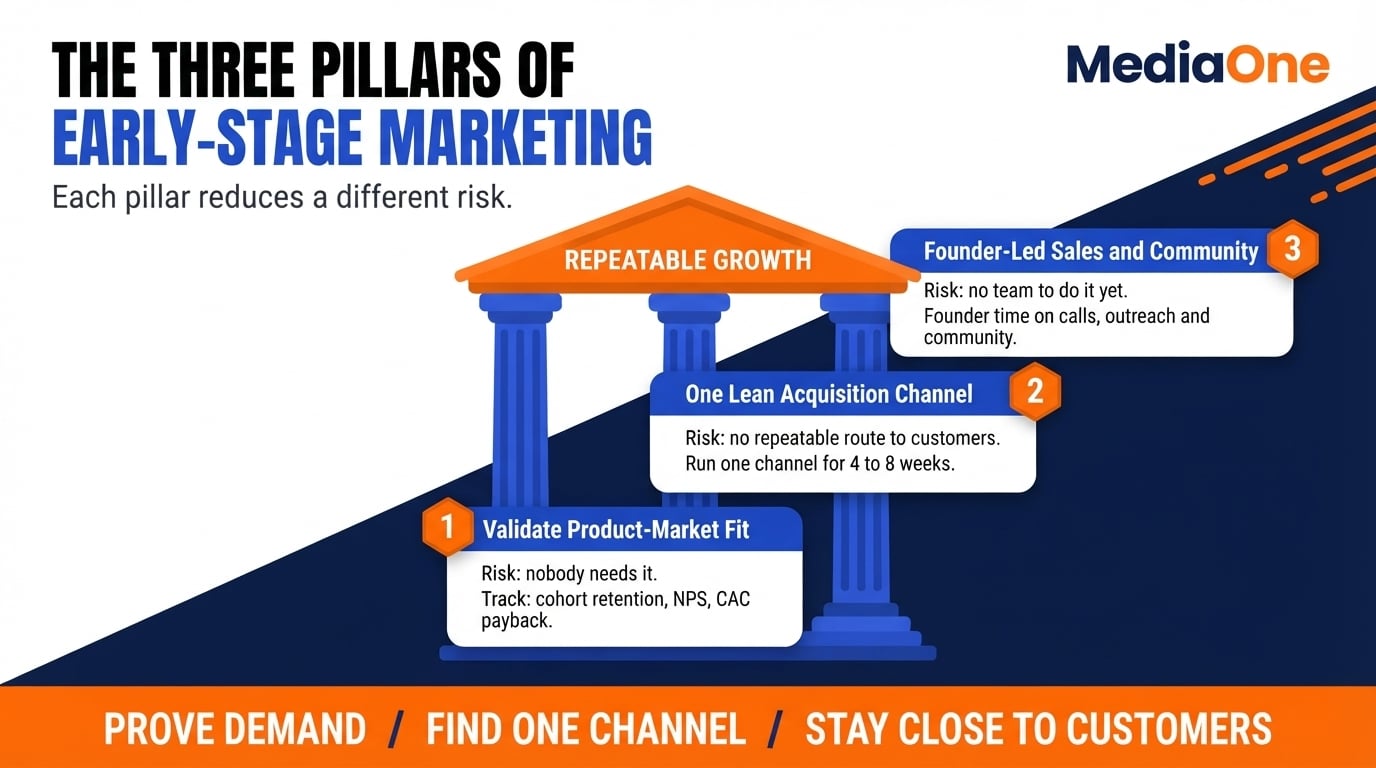
Early-stage startup marketing rests on three foundations. Each addresses a different risk: whether your product solves a real problem, whether you can acquire customers repeatably, and whether you can do it without a large team.
Pillar 1: Product-Market Fit Validation Over Vanity Metrics
Product-market fit is indicated when a defined group of customers repeatedly uses or purchases a product because it solves a real need. Do not confuse this with traffic or sign-ups.
Measure what counts. Weekly retention (the percentage of users who return in week two after first sign-up) is a better early signal than monthly active users. No single weekly retention percentage proves product-market fit across B2B SaaS products; compare cohorts with customers who use similar products at similar frequencies.
Net Promoter Score (NPS) captures customer willingness to recommend you on a 0–10 scale; benchmark it against relevant customers and collect it at sensible intervals. Do not optimise your entire marketing plan around a single metric.
An initial marketing goal should not be 10,000 website visitors without a business reason. Look for evidence that customers value the product and return to use it.
For illustration, a startup with 100 returning users may learn more about product-market fit than one receiving 10,000 unqualified clicks that lead to short-lived free trials. The first has useful retention evidence. The second has evidence of attention but still needs to check whether users find lasting value.
What to measure instead of visitor volume:
Weekly cohort retention shows what percentage of customers from week one are still active in week four. Investigate a weak or declining cohort against your own usage pattern and comparable products. There is no universal 40% threshold for B2B SaaS.
Net Promoter Score (NPS) summarises responses to a recommendation-likelihood question. Calculate it monthly by asking one question: ‘How likely are you to recommend us to a colleague?’ NPS can help identify sentiment, but no single score establishes product-market fit; interpret responses alongside retention and customer interviews.
Customer acquisition cost (CAC) payback period estimates how many months of customer gross profit are required to recover acquisition spending. Many SaaS companies aim to recover CAC in less than 12 months, although suitable payback differs by stage and margin. A longer period may result from acquisition costs, pricing, sales cycles or retention, so diagnose the cause.
Qualitative feedback loops matter more at this stage than quantitative reach. As a practical routine, conduct several customer interviews each week. Ask a few core questions, such as: ‘What problem were you trying to solve when you found us?’ ‘Have you solved it?’ and ‘Would you recommend us?’ Write down their exact words. This unscripted language becomes the foundation of your messaging, your product roadmap, and your next channel test.
A spreadsheet may be enough while volumes are small. Track cohort retention and CAC payback regularly, and collect NPS when you have enough relevant responses to interpret it. A persistent unfavourable trend should trigger investigation before you increase spend.
Pillar 2: Lean, Repeatable Customer Acquisition Channels
A small team may struggle to test six channels at once. Choose one channel. Run it for 4–8 weeks. Measure cost per customer acquired (CAC, how much you spend per new customer), retention, and whether the unit economics work.
Customer acquisition cost (CAC) payback is the time needed to recover acquisition spending from monthly customer gross profit. A shorter period improves cash flexibility, but an acceptable target depends on gross margin, contract length and runway.
Only after one channel shows consistent results should you test a second. For a practical discussion of gross-margin-aware acquisition costs and payback, see Stripe’s SaaS CAC guidance.
Testing too many channels at once can stop a small team learning which one works.
You see a competitor winning on LinkedIn, so you hire a content manager. Your friend mentions paid ads work for SaaS, so you allocate budget. You read that community-driven growth is the future, so you open a Discord. Meanwhile, your founder is also doing cold outreach. Nine months later, you have six half-executed channels, no repeatable playbook, and no idea which one actually works.
The lean channel approach: Choose one priority acquisition channel. For illustration, set aside SGD 360 to SGD 1,800 and review after four to eight weeks, or after a sufficient number of qualified prospects have seen the offer. Continue only when the evidence supports the next test. Only then add a second channel. Document every customer’s origin: where did you find them, what message resonated, what objections came up, what was their actual conversion timeline.
For Singapore and Southeast Asia, examine which channels your actual customers use. WhatsApp or Telegram groups may suit some audiences, while LinkedIn, Discord or search advertising suit others. Compare the full cost per qualified customer in your own tests rather than assuming one platform is cheaper. Ad costs and platform eligibility vary by region and are subject to platform policy changes.
Channel choice depends on your customer’s habitat, not your preference. If your customer is a finance director in Singapore or London, LinkedIn and Google Search make sense. If they are a 22-year-old gamer in Manila, TikTok and Discord do. Map where your ideal customer profile (ICP), which is the archetypal person most likely to buy from you, actually spends time before you spend resources.
Pillar 3: Founder-Led Sales And Community Activation
Building community creates switching cost because customers are connected to other members, not just your product. Direct contact can be particularly useful while you are testing the offer and building an early customer base.
Reserve a realistic block of time each week for customer conversations, outreach and community involvement. The right number of hours depends on your product and sales cycle.
Some early customers may respond best to direct founder contact, especially while the product is unfamiliar.
Founder allocation: In your first month, reserve meaningful weekly time for direct outreach and feedback. As a starter exercise, email a manageable set of qualified prospects from your ICP. Connect with relevant prospects on LinkedIn with a personalised message. Ask for warm introductions through your network. Follow up. Schedule calls. Close deals. This is not a task to delegate yet.
Community activity on Discord, Slack, Telegram or LinkedIn can support acquisition when members share a clear need. Whether it is cheaper than advertising depends on staff time and the number of customers acquired. Community builds customer loyalty that competitors cannot easily replicate because they are connected to other members, not just your product.
Direct founder participation can help teams gather feedback quickly and build relationships with early members. The reason is straightforward: people buy from people they know. A manager running the community on behalf of the founder is a middleman. A timely, helpful reply from a founder can strengthen those relationships.
The community playbook: Invite a small group of early users and interested prospects into a private Telegram group or Discord. Post updates weekly. Ask questions. Answer every message within a few hours. Celebrate wins. Ask for help. After three months, review whether the group is active, referring peers or providing useful product feedback rather than assuming a fixed membership or conversion target.
This approach can limit cash spending but still uses founder time. Compare the retention and feedback of community-sourced customers with those from paid channels rather than assuming one channel will outperform the other.
Comparison of Early-Stage Acquisition Channels
| Channel | Main Cost To Budget | What To Track First | Best For | Key Limitation |
| Founder Outreach | Prospect research and founder time | Qualified replies and meetings | B2B and niche services | Time-intensive |
| Content-Led SEO | Writing, editing and site work | Relevant search clicks and enquiries | Search-led research and long buying cycles | Traffic takes time to develop |
| Paid Social | Media spend, creative and measurement | Qualified sign-ups and paid conversions | Visual or clearly defined offers | Spend can outrun learning |
| Community | Moderation and useful programming | Active members and referrals | Products with shared user interests | Ongoing effort |
| Strategic Partnerships | Partner management and commissions | Qualified introductions and revenue | Complementary B2B products | Partner priorities may shift |
| Creator Partnerships | Fees, product samples and usage rights | Tracked trials and customers | Consumer and niche audiences | Audience fit varies by creator |
How to Choose Your First Acquisition Channel
Work through these questions in order:
- Where does your ideal customer spend the most time? List the top three platforms or communities your ICP frequents. Do not guess. Interview five target customers and ask directly.
- What is your budget constraint? Can you commit SGD 500 monthly, or SGD 3,000? This narrows options immediately.
- How much founder time can you allocate? Match the channel to the time you can commit for replies, creative work, measurement and follow-up.
- What is your sales cycle length? For B2B with a three-month sales cycle, founder outreach and content SEO make more sense than paid ads.
- Do you have an existing network to use? If yes, start with founder outreach and warm introductions. If no, consider paid social or content-led channels.
Once you answer these, pick a priority channel and set a review point based on your sales cycle and the number of qualified prospects contacted.
Seven Actionable Customer Acquisition Channels For Startups
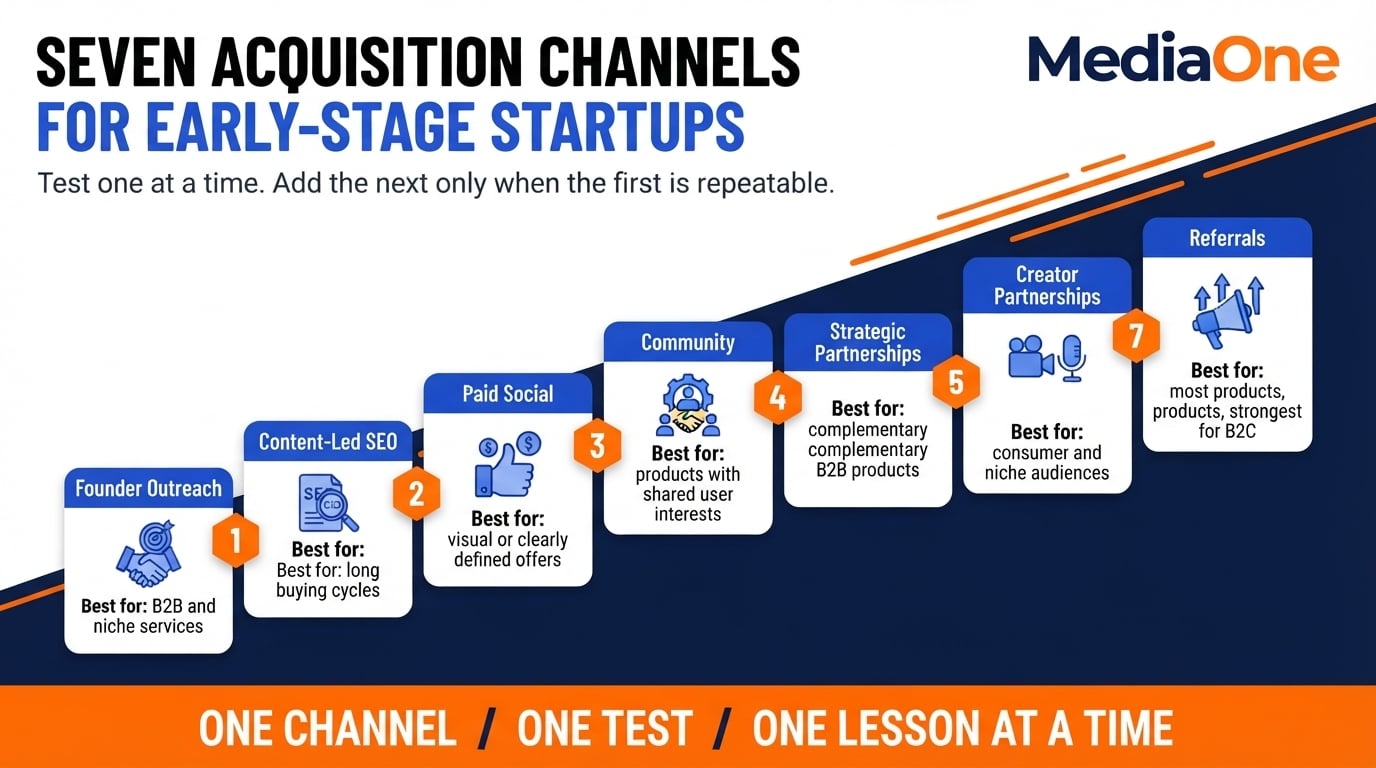
1. Founder Outreach And Direct Sales
As an early part of your lead generation process, ask for a conversation, not an immediate sale. Use early calls to discover whether the problem is urgent enough to pay to solve.
Planning horizon: test in the short term
Cost: Founder research and sales time
Who it works for: B2B, niche software, services
Direct contact can be one of the quickest ways to learn from potential customers. Create a targeted prospect list and reach out via email, LinkedIn, or warm introduction. Response rates depend on the quality of your list and offer. Record meetings and customers generated rather than relying on a generic conversion estimate.
This approach can work when early buyers recognise a problem and want to evaluate a plausible solution. They scan for solutions that fit their exact needs rather than filtering through generic messaging.
Your outreach structure:
Start with one personalised line proving you know them. Reference a recent hire, a product they built, or a challenge they posted about. Specific research takes time but makes the message less generic.
State the problem you solve in a single sentence. For example, if customer interviews confirm the claim, ‘Spend less time on manual invoicing’ is clearer than ‘We help businesses streamline financial processes.’
Include a booking link for a short conversation. A calendar-booking tool or Google Calendar can reduce scheduling exchanges.
If response quality remains low after an initial test, revisit your list and proposition before offering an incentive. Free trial access, a first-month discount, or 30 minutes of feedback gathering often works.
Record every response in a spreadsheet. Note who replied, what they said, and whether they objected or converted. After an initial batch, identify patterns in objections. Rewrite your second sentence to address the most common pushback. Test this new version on another 20 people. Iterate weekly.
A founder who documents replies and objections each week can improve the message without assuming a fixed sales outcome.
2. Content-Led SEO And Organic Search
Start from a specific customer question rather than filling a content calendar.
Planning horizon: build over several months
Cost: Staff time or a quoted writing and editing budget
Who it works for: SaaS, tools, educational platforms
SEO often takes longer than direct outreach to produce evidence of demand, but useful content can continue attracting customers over time.
Plan a small set of useful posts answering high-intent questions in your niche. Focus on ‘X how-to’, ‘X best practices’, and ‘X versus Y’ comparisons before pursuing ‘X software’ keywords, which established competitors dominate.
In Singapore and Southeast Asia, favour questions that match actual customer demand, even when search volumes appear modest. Keyword research tools can suggest phrases; use Google Search Console to monitor queries and clicks to pages that already receive impressions. Review first-hand customer questions alongside keyword research ideas.
Instead of only targeting a broad phrase such as ‘invoicing software’, write for a practical customer question such as ‘how to invoice freelance clients’. Assess relevance and results rather than assuming a keyword is easier because it looks less popular.
Each post should answer a question your customer genuinely asks. Google’s people-first content guidance recommends original, useful content written for an intended audience rather than mass-producing posts for rankings. Include a call-to-action near the end: a free trial, email list sign-up, or calculator related to the post topic.
What to monitor: a measurable trend in impressions, relevant clicks, enquiries and sign-ups over successive reporting periods; timing will differ by market and site.
3. Paid Social Advertising (Facebook, Instagram, LinkedIn)
Planning horizon: review after an initial test
Cost: A capped media, creative and measurement budget
Who it works for: B2C, consumer SaaS, marketplaces
Launch a small, capped test campaign on the platform where your ideal customer profile (ICP) spends time. Use carousel ads or short video showing the problem, then the solution. Run for one week, pausing any segment with a cost-per-sign-up above your break-even threshold.
For Singapore and Southeast Asia audiences, compare Meta and Google Search campaigns using your own qualified lead and customer costs; CPC alone is not a fair cross-channel comparison. LinkedIn works for B2B tools targeting managers and professionals. TikTok may suit products with audiences who actively use short-form video.
Define a clear intended buyer and test targeting options the platform currently supports. Broad targeting can be worth testing alongside narrow segments when conversion tracking is reliable.
Set a customer acquisition cost (CAC) payback target that fits your margins and cash runway. In an illustrative subscription scenario, SGD 80 per month for 24 months produces SGD 1,920 in lifetime revenue. At an assumed 80% gross margin, estimated lifetime gross profit is SGD 1,536; a 3:1 gross-profit LTV-to-CAC planning ratio would imply CAC of roughly SGD 512. If acquisition costs exceed your margin-adjusted model, pause and test a new angle or audience.
Track click-to-sign-up conversion alongside enquiry quality and revenue, not just impressions. Set a conversion target using your own product, channel and landing-page history once the initial test has enough data.
4. Community Building On Discord, Slack, Or Telegram
Create value through peer connections and practical updates before asking community members to buy.
Planning horizon: review on a defined cycle
Cost: Moderation time and any platform or facilitation fees
Who it works for: Developer tools, games, niche interest platforms
Invite beta users and early supporters into a private group. Respond to questions and feedback within a realistic service window. Share product updates, celebrate user wins, and ask for help with product decisions.
Loyalty builds through dialogue, not broadcasting. An attentive founder answering questions promptly can build trust; response quality is more useful than an arbitrary one-hour deadline.
Telegram and WhatsApp groups can suit Singapore-based audiences that already use them, but audience fit and moderation capacity should guide selection. A member who feels heard may be willing to recommend the product.
Over several months, the community may become an acquisition source. Active members ask for features, suggest pricing, or want early access. Launch a paid tier or feature request directly in the group. Measure community-to-trial and trial-to-paid conversion directly; do not assume it will outperform paid acquisition. Record whether members were actually referred by peers before attributing conversions to the community.
Seed the group with 10 to 20 people you know personally. Grow it through word-of-mouth. Promote it more widely once existing members are receiving ongoing value.
5. Strategic Partnerships And Integrations
Select partners whose products solve an adjacent problem for the same buyer.
Planning horizon: allow time for partner discussions
Cost: Revenue share or affiliate commission
Who it works for: SaaS, marketplaces, complementary B2B tools
Partner with 3 to 5 companies whose customers would also benefit from yours. Agree a commission or revenue share that leaves positive contribution after partner servicing costs.
Example: a fitness-tracking app partners with gym booking software and nutrition-logging platforms. Users of those platforms are already invested in fitness; they are high-intent buyers.
This works when both products solve part of the same problem. A bookkeeping tool and tax software are natural partners. A project-management platform and a time-tracking app are aligned.
Prioritise active, founder-led partnerships over affiliate networks. Have your founder send one personal email to the partner founder proposing collaboration. Explain why their customers benefit and how you will support the relationship through co-marketing, dedicated support, or exclusive features.
An initial partnership may require several rounds of discussion and a small pilot. Review referred leads and closed customers over successive months before projecting partnership volume.
6. Influencer Or Creator Partnerships
Planning horizon: allow time for creator production
Cost: Negotiated creator fee, product samples and content rights
Who it works for: Consumer apps, fitness, lifestyle, gaming
Find several niche creators with demonstrable audience fit in your niche. Review whether each creator has a relevant, engaged audience rather than choosing by follower count alone.
For real-world inspiration, review social media marketing examples from startups. Offer free access to your product. Ask for an honest review on their platform: YouTube, TikTok, Instagram Reels, or a newsletter.
Measure the lift by tracking clicks to your link and subsequent sign-ups. Conversion rates vary; if your customer acquisition cost from this channel stays under 50% of lifetime customer value, scale by partnering with more creators.
In Singapore and Southeast Asia, compare creators by audience overlap, content quality, expected deliverables and measured referrals rather than assuming one platform is cheaper.
Pay attention to audience fit and engagement rate alongside follower count. For illustration, a smaller creator with a higher interaction rate may be a better test partner than a large account with weak audience fit; engagement rate alone does not equal unique engaged viewers or sales.
7. Referral And Word-Of-Mouth Programs
A simple referral reward can be easier to explain and administer than a tiered programme.
Planning horizon: build over several months
Cost: Variable (discounts, credits, cash rewards)
Who it works for: All product types; strongest for B2C
Offer a small reward to any existing customer who refers a friend who signs up. Illustrative incentives include a small account credit, a one-month discount or a modest cash reward; check that the reward is viable at your margin.
Keep the reward simple. A simpler referral offer may be easier for customers to understand and for a startup to administer.
Track referrals using unique links or codes. Tools like Referral Rock, Ambassador, or built-in code within your product all work. Measure how many invited people activate and pay rather than assuming a fixed referral conversion rate.
Word-of-mouth can become a useful acquisition source when customers consistently recommend the product. Net Promoter Score measures how likely your customers are to recommend you to others. If feedback and retention are weak, investigate product issues before investing heavily in referrals. Unhappy customers rarely refer.
When To Test Each Channel
Consider founder outreach first when you can identify and contact buyers directly. It can offer quick feedback and uses founder time rather than large media spend. Use it to gather the first conversations and paying-customer evidence.
Once your first channel shows repeatable results, add one secondary channel: either content SEO (if you have writing skills or budget) or paid social (if your product has clear visual appeal).

Do not add a third channel until you understand the unit economics and operating demands of the first two. Spreading effort thinly can make acquisition costs harder to interpret and reduce the time available to improve retention.
For alternative tactics, compare the lead generation methods for Singapore businesses before widening the channel mix. Your eventual mix depends on your product and market. B2B SaaS often succeeds with outreach plus partnerships. Consumer apps scale with paid social plus word-of-mouth. Developer tools succeed with community plus content.
How To Build A Lean Startup Marketing Plan
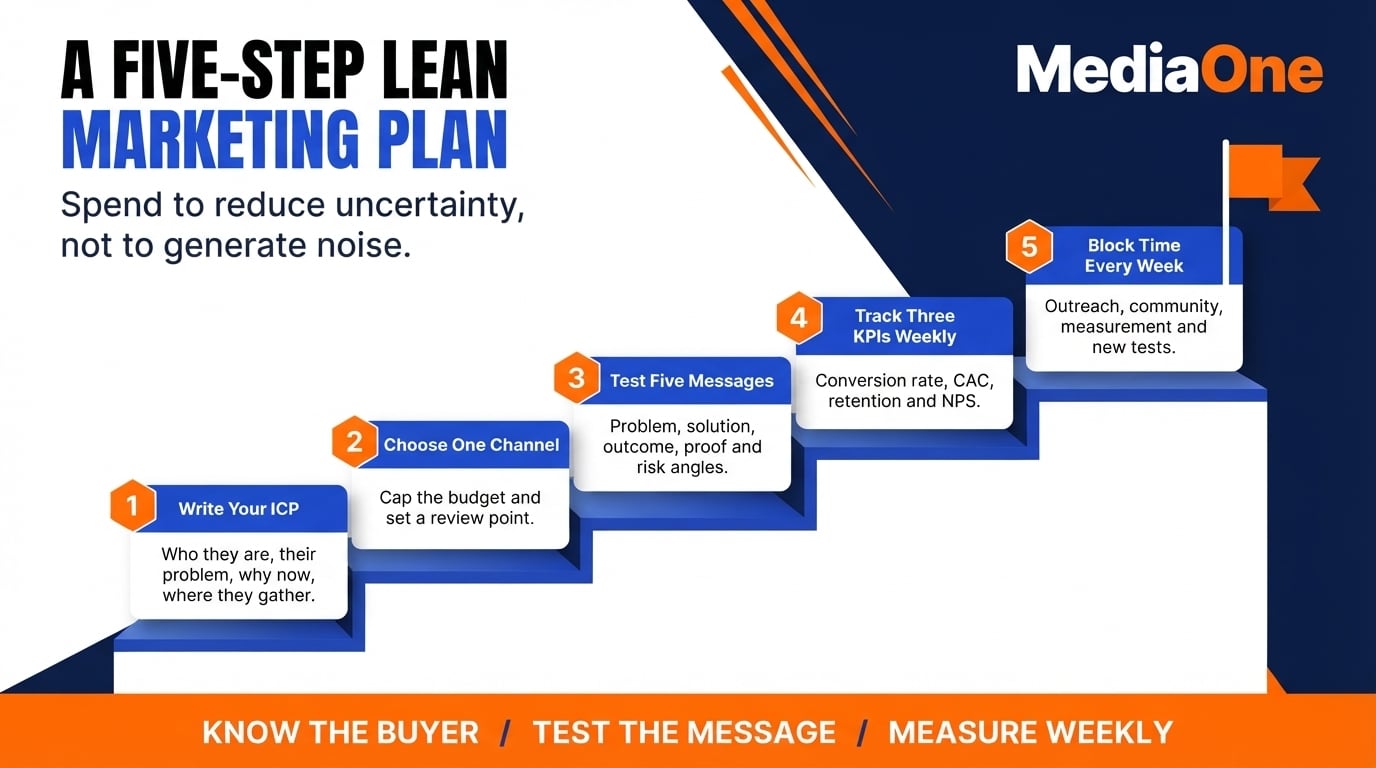
Step 1: Define Your Ideal Customer Profile In Writing
Your ideal customer profile (ICP) is the specific person most likely to buy from you. Write it down. Specificity beats abstraction every time.
Document these four dimensions:
Who they are. Job title, industry, company size, geography, annual income. Not ‘small business owners’ but ‘freelance bookkeepers in Singapore earning SGD 50,000 to 100,000 annually’.
What problem they face. Specific and quantifiable. Not ‘struggle with efficiency’ but ‘spend 15+ hours per week on manual data entry in spreadsheets’.
Why they care now. What triggers urgency? A business milestone, a tool they just stopped using, a pain point that became acute. Not ‘maybe they want to automate’ but ‘they just lost a client due to late invoicing and realised manual billing is costing them money’.
Where they gather. LinkedIn groups, Reddit communities, WhatsApp groups, industry forums, Slack workspaces. Geographic and behavioural clusters matter.
Example ICP:
Illustrative ICP: freelance bookkeepers in Singapore earning SGD 50,000 to 100,000 p.a., who spend 15+ hours per week on manual data entry in Excel, recently turned down a client due to capacity constraints, and actively follow accounting automation communities on LinkedIn and Reddit.
This specificity makes decisions easier. A detailed ICP is easier to test than ten vague personas across several channels. When you write copy, you are writing to this one person. If you later need to connect qualified opportunities with follow-up, develop a lead generation strategy around the same ICP. When you choose a channel, you are choosing where this person already spends time. When you measure results, you are asking: ‘Am I attracting more of this exact person?’
Step 2: Choose One Acquisition Channel
Startups can weaken their marketing by spreading effort across too many channels. You test paid ads, organic search, outreach, content, partnerships, and influencers simultaneously. Nothing gains momentum. Nothing generates data fast enough to iterate.
Instead, pick one channel. For illustration, you might cap a test at SGD 400 to SGD 2,000 and review results after a defined number of qualified prospects have engaged.
When marketing through calls or texts to Singapore telephone numbers, consult PDPC’s Do Not Call guidance on screening, consent and exceptions before outreach.
Before adding a second channel, check that these conditions are reasonably satisfied:
- You have a repeatable sign-up-to-paid process, or enough evidence to stop testing this channel
- Your CAC payback target uses monthly gross profit and fits your runway
- Funnel metrics are stable and documented
If founder outreach works with little cash spending, keep testing it while tracking the real cost of founder time. If paid ads show promise but have not produced enough customers, set a second capped test only after reviewing lead quality, gross profit potential and cash runway. Once one channel is repeatable, document it, assign an owner and consider testing a second.
This constraint forces clarity. You will learn your channel deeply: which messages land, which customer segments convert, what time of day or day of week generates responses, what the actual cost per customer is. Very small tests across many channels may be too weak to draw useful comparisons.
Step 3: Write Five Versions Of Your Core Message
You do not know which angle resonates with your ICP until you test. Write five different versions of the same offer, each emphasising a different lever:
- Problem-first. ‘Tired of spending Fridays on data entry?’ Triggers recognition of a pain point.
- Solution-first. ‘Automate your invoicing in 10 minutes.’ Leads with the mechanism.
- Outcome-first. ‘Get 10 hours back each week.’ Emphasises the benefit they actually care about.
- Proof-first. ‘See a verified customer example of this invoicing workflow.’ Use only customer proof you can document.
- Risk-first. ‘Are billing errors slowing down your work?’ Raises a specific problem to investigate.
Send each version to a small segment of your ICP via email, LinkedIn, ads, or direct outreach. Track response rates, reply rates, and conversation-to-trial conversion.
Whichever version produces the strongest qualified response becomes your working message. Use the strongest qualified response as a starting point for your website and ads, then confirm it against paid conversions.
Step 4: Set Three KPIs You’ll Monitor Weekly
Vanity metrics do not tell you if you are building a business. Conversion rates, CAC, and retention do.
Track these three numbers in a spreadsheet. Plot them weekly. Any downward trend is a red flag that requires diagnosis.
Conversion rate. What percentage of people who see your offer convert to a free trial, sign-up, or demo request? There is no universal conversion range across sales cycles and channels. Declining conversion suggests your message is stale or your audience is changing.
Customer acquisition cost (CAC). Total marketing spend divided by customers acquired in that period. For an illustrative SGD 2,000 acquisition spend yielding 10 paying customers, CAC is SGD 200, before any omitted sales labour costs. Compare CAC with contribution-margin lifetime value and a payback period the business can finance.
Retention and Net Promoter Score (NPS). What percentage of customers who signed up are still active after 30 days? NPS is a one-question survey: ‘How likely are you to recommend us to a friend on a scale of 0 to 10?’ A falling 30-day cohort can signal product fit or onboarding problems; compare against your product’s expected usage cycle.
If CAC rises while conversion rate holds steady, inspect traffic cost, attribution and who is converting. If conversion falls, check the message and landing page before assuming a single cause. If retention falls, check customer fit, onboarding and product value.
Step 5: Allocate Time, Not Just Money
The biggest mistake founders make is treating marketing as a side task, something to work on when engineering, product, and operations are quiet. They never are.
Block a recurring period every week for marketing and customer research. Treat it as a planned commitment. Assign it to one person, not three people splitting focus.
- 1 hour: Direct customer outreach. Email, LinkedIn, warm introductions to 10 to 15 prospects. Log every response.
- 1 hour: Community or content engagement. Reply to comments on your blog, Discord, or LinkedIn. Answer questions on Reddit. Share one original insight.
- 1 hour: Measuring and iterating. Plot your three KPIs. Review which message version outperformed. Calculate CAC by channel. Adjust next week’s spend or targeting.
- 1 hour: New channel testing or partnership development. Identify a second channel to test once the first provides usable evidence. Research three potential partners. Draft an outreach email.
Assigning a clear owner prevents fragmented decisions across a small team. Consistency, context, and speed compound. Direct founder involvement may allow faster decisions, provided the founder has time to respond.
Keep founder involvement while customer insight and channel operations are being documented; hire when a clear role and affordable workload emerge.
Common Startup Marketing Mistakes (And How To Avoid Them)
1. Building An Audience Before You Have A Product
Many founders spend months on Twitter, LinkedIn, or YouTube building an audience, assuming customers will follow when they launch. Some do. Most do not.
An audience built around a personal brand does not automatically convert to buyers for a specific product. For example, a founder could have a large following but still attract sign-ups that do not convert to paying customers.
The fix: Build an audience when it supports customer research or demand; it can begin before launch without replacing direct feedback. Talk to customers before you launch. Direct outreach can be useful for discovering early users, alongside other channels your customers prefer. Once you have proof that real customers want your product, an audience becomes a distribution channel. Before that, it delays progress while appearing strategic.
2. Running Every Channel At Once
You see a competitor winning on LinkedIn. Your friend mentions Slack communities are effective. You read that TikTok reaches Gen Z. So you open a Discord, write LinkedIn posts three times a week, set up paid ads, and hire a content writer.
In this illustrative scenario, several months could pass without a repeatable playbook or clear evidence of which channel works.
The fix: Choose a priority channel and set a budget and review period appropriate to your buying cycle. Judge it by evidence, not an arbitrary 50-customer target. Only then add a second. One channel mastered beats five channels mismanaged every time.
3. Hiring For Roles You Should Own
You hire a ‘growth marketing manager’ or ‘community manager’ in month three and step back from customer acquisition. If the new hire lacks context and decision authority, little may improve.
Founder-led customer acquisition can help with product feedback and speed of decisions early on, especially where sales are consultative. You understand the product directly and can make faster decisions about changes.
The fix: Stay involved in marketing until the offer and a repeatable acquisition process are documented. Only then hire support to execute and scale what you have already proven works. A marketing hire without a clear brief can add overhead before the acquisition process is understood.
4. Focusing On Vanity Metrics
You celebrate 10,000 website visitors per month, 500 LinkedIn followers, 1,000 email newsletter subscribers. None of them convert to customers. But the numbers feel like progress.
The fix: Measure only metrics tied to business survival: retention (percentage still active after 30 days), NPS (would they recommend you?), and CAC payback (how long until revenue covers acquisition cost?). Ignore everything else. Returning customers offer stronger evidence of ongoing demand than large volumes of unqualified clicks.
5. Not Talking To Every Customer
You ship a product and wait for analytics to tell you what happened. Some people signed up, most did not, and you are not sure why.
The fix: Call or message every person who signs up. Ask a few core questions, such as: ‘What problem were you solving?’, ‘Did we solve it?’, ‘Would you recommend us?’ Ask why people did not sign up. Record exact words. This unscripted feedback is far more valuable than any analytics dashboard.
6. Optimising The Wrong Metric
You focus on cost-per-click, chasing the lowest CAC. But those low-CAC customers churn in three days. Meanwhile, a higher-CAC channel produces customers who stay six months.
CAC payback adds context to CAC. For illustration, SGD 1,000 of CAC recovered from monthly gross profit over two months creates faster cash recovery than SGD 200 recovered over six months. Calculate payback as CAC divided by monthly gross profit per customer.
The fix: Optimise for customers who return, refer, and pay. Not clicks, not impressions, not email subscribers.
7. Not Having A Clear Acquisition Hook
You have a product, a website, and traffic. But no clear, one-sentence reason to sign up. Your homepage talks about features, vision, company story, or philosophy.
The fix: State the problem and outcome in one sentence. ‘Spend less than 10 minutes invoicing’ beats ‘Modern invoicing platform for freelancers’. Emphasise outcome, not feature.
Common Startup Marketing Issues and Solutions
| Problem | Why It Happens | What To Do |
| Low conversion versus your baseline | Message does not match customer need; wrong audience targeting | Interview five customers who did not convert; ask what objection stopped them |
| High customer acquisition cost (CAC) above payback threshold | Spending on wrong channel or audience too broad | Map channel by ICP habitat; tighten the targeting after reviewing qualified leads |
| Poor retention after sign-up | Product does not solve the core problem they signed up for | Track which cohort has highest retention; interview them about what they use most |
| No repeatable playbook after three channels tested | Testing channels in parallel instead of sequentially | Pick one channel; review after an adequate test period; document exact process before testing another |
| Founder burnout from direct sales | Treating outreach as temporary instead of building systems | Create email templates; schedule outreach into calendar; batch calls to specific days |
| Community engagement drops after month two | No clear reason to stay; no recognition or wins celebrated | Post weekly updates; tag active members; celebrate referrals publicly; ask for advice |
Quick Reference: Startup Marketing Checklist
Use this checklist to check you’ve covered the fundamentals before scaling any channel.
Product and Messaging (Before Launch)
☐ Ideal Customer Profile (ICP) written down: job title, industry, problem, geography, where they gather

☐ Several message versions tested with a defined, comparable prospect sample
☐ Winning message identified and documented
☐ One-sentence problem statement and outcome statement written
☐ Website headline clearly states the customer problem and outcome
☐ Product delivers on its core promise (retention test with 10 beta users)
Customer Acquisition (Launch Phase)
☐ Primary channel chosen (founder outreach, content, ads, community, or partnerships)
☐ Budget and timeline set (review on a defined cycle, SGD 400 to 1,900)
☐ Conversion rate target documented using your own test baseline
☐ CAC payback target reflects gross margin, runway and buying cycle
☐ Weekly KPI tracking spreadsheet created (conversion rate, CAC, retention)
☐ Founder time reserved for outreach and customer feedback
Measurement and Iteration (Ongoing)
☐ Weekly cohort retention tracked (30-day, 60-day)
☐ Net Promoter Score (NPS) collected on a sensible schedule with an appropriate sample
☐ Customer source logged for every sign-up (where did they come from?)
☐ Message performance measured (A/B test response rates)
☐ Channel profitability assessed using contribution-margin lifetime value compared with CAC
☐ Qualitative feedback loop established (five customer interviews per week)
Scaling (After Repeatable Unit Economics)
☐ Secondary channel tested within an approved budget
☐ First channel documented as repeatable playbook (message, audience, timing, CAC)
☐ Delegation plan clear (who will own each channel, what are the KPIs?)
☐ Hiring criteria written (what skills do we need, and what results do we expect?)
Frequently Asked Questions
What Budget Should I Allocate To Startup Marketing Per Month?
Monthly budgets vary by runway, market, team and intended learning. For illustration, a founder might plan an SGD 900 test or approve a larger SGD 9,000 programme only after defining its learning objective. Outreach may require little cash but considerable founder time. Set paid-media spend according to conversion volume and the number of leads needed to make a decision rather than a universal minimum. The key is to spend deliberately on one channel, not spread thinly across many.
Is Founder-Led Sales Really More Effective Than Hiring A Marketing Manager?
Founder-led acquisition can help early-stage teams learn from buyers faster because the decision-maker hears objections first-hand. A prospect who speaks directly with the founder perceives lower risk and feels known. However, this advantage diminishes as you grow. Move activities to a team when you can preserve customer insights and support follow-up.
What Is A Realistic Customer Acquisition Cost For A B2B SaaS Startup?
Customer acquisition cost (CAC) varies widely by industry and channel. There is no defensible single SGD benchmark across B2B SaaS stages and product categories. Compare each channel using your full sales and marketing acquisition costs and customer gross profit. The question is not the absolute number but whether your CAC is recoverable within your subscription model and customer lifetime value.
How Do I Know If I Have Achieved Product-Market Fit?
Product-market fit shows in three places. First, customers return or repurchase on a schedule that fits the product and buying cycle. Second, customers recommend you without incentive (NPS should be interpreted against a relevant comparison group). Third, your acquisition cost stabilises and unit economics support scaling. Track retention alongside acquisition; growth is not automatic.
What Is The Difference Between B2B And B2C Startup Marketing?
B2B purchases often involve several stakeholders and a longer evaluation period, making outreach, educational content and partnerships useful options. Consumer offers may be more suitable for visual advertising, creators or referrals depending on price and purchase frequency. Choose your channel based on how your customer actually decides to buy.
Is It Too Late To Do Content Marketing If I Have No Customers Yet?
Customer conversations are a useful starting point for content, including before launch, when they reveal recurring questions. Writing for a non-existent audience wastes time. Start with founder outreach. As you learn what questions customers ask, write to answer those specific questions.
How Do I Choose Between Paid Ads, Community, And Founder Outreach?
Ask yourself three questions. First, where does my customer spend time online? Second, do I know exactly who my customer is? Third, how much founder time do I have? If you know your audience and have founder time, start with outreach. If you have budget but uncertain audience, test paid ads on a small scale. If you have community potential (many similar buyers in one place), build there.
What Should I Do If One Channel Does Not Work After Four Weeks?
Do not abandon it immediately. Increase your sample size. Four weeks may not be enough data if you are testing with a small budget. If a test has reached a meaningful number of qualified prospects with no progress, revisit the message, targeting or channel before committing more money. Move budget to the channel showing early promise.
How Much Founder Time Should I Dedicate To Marketing?
Reserve recurring founder time for customer calls, outreach and community engagement; the hours depend on the business. Review the commitment as the team grows and roles change.
Do I Need To Be Active On All Social Media Platforms?
Usually no. Choose one platform where your customers already spend time and develop a repeatable process there. Consistency on one channel beats scattered presence on five.
How Long Until I See Results From Startup Marketing?
Timeline varies by channel. Founder outreach can generate conversations quickly, while content SEO generally takes longer to attract sustained traffic. Paid campaigns can supply earlier traffic and conversion data, but time to a paying customer varies with the offer and buying cycle. Review each channel against your own starting point.
What’s A Common Misconception About Startup Marketing?
Brand awareness alone is rarely enough to validate an early-stage product, although pre-launch visibility can support research and waitlists. A startup with zero customers needs evidence of demand, which can come from pre-launch research, early sales and targeted marketing. Brand awareness campaigns assume people already recognise they have a problem and are seeking solutions. Most startup prospects do not yet realise they have a problem. Use direct conversations to find out whether they recognise the problem and want your solution.
How Do I Know If My Acquisition Channel Is Working?
After an agreed test window and a meaningful sample, assess three indicators. A working channel should show improvement in qualified conversion from a defined audience rather than meet a universal 1% threshold. Its CAC payback should fit your cash runway, margins and sales cycle. Its retention should be evaluated by cohort and expected product-use frequency rather than one fixed 30-day percentage. If any of these three metrics fails, the channel is not working or your messaging needs adjustment. Pivot to a different message angle before spending more.
Can I Run Two Customer Acquisition Channels At The Same Time From The Start?
Only if one requires minimal founder time. For example, you can run founder outreach (10 to 12 hours per week) alongside publishing blog content (2 to 3 hours per week) if you have already written the posts. Do not launch paid advertising, community partnerships, and influencer collaborations simultaneously. You will dilute focus and fail to understand any single channel deeply enough to iterate effectively. Choose one channel that matches your constraints (budget, time, founder availability) and master it before introducing a second channel.
How Do I Calculate Customer Lifetime Value (LTV) To Determine Sustainable Customer Acquisition Cost?
Revenue-based customer lifetime value estimates the total payments a customer makes during the relationship; gross-profit LTV also accounts for direct servicing costs. In an illustrative SaaS example, SGD 90 per month over 12 months yields SGD 1,080 in lifetime revenue, before the costs of serving that customer. For illustration only, a 3:1 revenue-LTV-to-CAC ratio gives SGD 360, but revenue LTV is not margin-adjusted and does not establish a sustainable CAC on its own. Assess CAC against contribution-margin LTV, payback and business overhead before determining profitability. Estimate revenue LTV as average monthly revenue per customer multiplied by estimated customer lifetime, and multiply by gross margin to assess contribution before comparing it with CAC.
What If My Ideal Customer Profile Is Too Broad?
Narrow it immediately. ‘Small business owners’ is too vague. ‘Freelance bookkeepers in Singapore with 1 to 3 clients’ is actionable. A precise ICP lets you target specific communities, create tailored messaging, and measure whether you are attracting the right people. Broad profiles produce scattered efforts and confused messaging. Start with a clearly defined buyer and expand when your results support targeting a wider group.
Should I Use A CRM Or A Spreadsheet To Track Customers?
A spreadsheet can be sufficient for early customer records if access and privacy controls are adequate. A spreadsheet is faster to set up than a CRM and easier to modify as your needs evolve. Create columns for: customer name, sign-up date, acquisition channel, first conversation date, product usage frequency, revenue to date, Net Promoter Score, and feedback summary. Move to a CRM when ownership, reporting, access control or follow-up becomes hard to manage in a spreadsheet. Use the lightest system that supports reliable follow-up and secure records.
How Often Should I Test And Change My Core Marketing Message?
Test five message versions with comparable small samples. Keep the strongest version in use while you collect enough qualified responses and conversions to assess it. Review results on a schedule based on your sales cycle. If they are stable, keep the message and focus on scaling. If they decline, test a new angle. Changing messages too often can make comparisons inconclusive. Give each message sufficient time to generate meaningful signal before pivoting.
What Is The Fastest Path From Zero Customers To 20 Customers?
Founder outreach. Email a defined group of well-matched prospects from your ideal customer profile with personalised messages. Follow up with 5 to 10 warm introductions from your network. Conduct 15-minute discovery calls with interested prospects. Ask questions more than you pitch. Document every objection and rejection reason. After a first set of outreach attempts, assess replies, meetings and conversion before expanding. Request introductions to similar contacts from that cohort. With consistent effort, you can learn whether outreach is a workable first channel; timing will depend on your sales cycle. This approach can require little media spend and provide direct insight into buying objections.
Is It Worth Investing In Professional Branding Or A Polished Website Before Launch?
A clear, simple website with one page stating the problem, your solution and a sign-up option may be sufficient before launch. Avoid a costly redesign unless credibility or usability is blocking your first sales. Allocate that budget to customer acquisition instead. You can refine branding once you have paying customers and understand your market deeply. A large branding investment may be hard to justify before the offer has been tested. A simple, credible website paired with engaged early customers can be a useful foundation.