Most brands in Singapore hear about social mentions only after a complaint has spread. A social mention is any public post, comment, review or video that names your brand, product or people. Social media monitoring means searching for these mentions and deciding what to do with them. Teams that get value define a narrow purpose, filter noise and act on a small set of verified signals – and if you want the service rather than the theory, MediaOne’s social media marketing service includes monitoring and community management among its offerings.
Key Takeaways
- Narrow scope beats broad collection. Track fewer, higher-signal social mentions with a defined purpose.
- Map before you monitor. Use the Mention Scope Matrix to decide which sources and purposes get coverage, and name an owner for each.
- Check tool coverage. Confirm a provider reaches the local forums and review sites your customers use.
- Filter noise early. Build exclusion rules from observed patterns, then re-test them against a control set.
- Verify before escalating. Confirm a sentiment dip against a known event, and confirm a post is still public before recording it.
Why Reactive Monitoring Wastes the Signal
Most brands learn of a mention only after someone has complained. A post goes viral, or a customer shares a photo of a damaged order, and the team hears about it by chance.
A structured listening routine changes this. Using social media monitoring tools and social listening, a team can see in real time which complaints need escalation, which creators are worth contacting and which conversations are noise. Teams with a clear, recurring routine find a relevant issue earlier, respond with more confidence and use the resulting analytics and customer feedback to protect the audience’s experience.
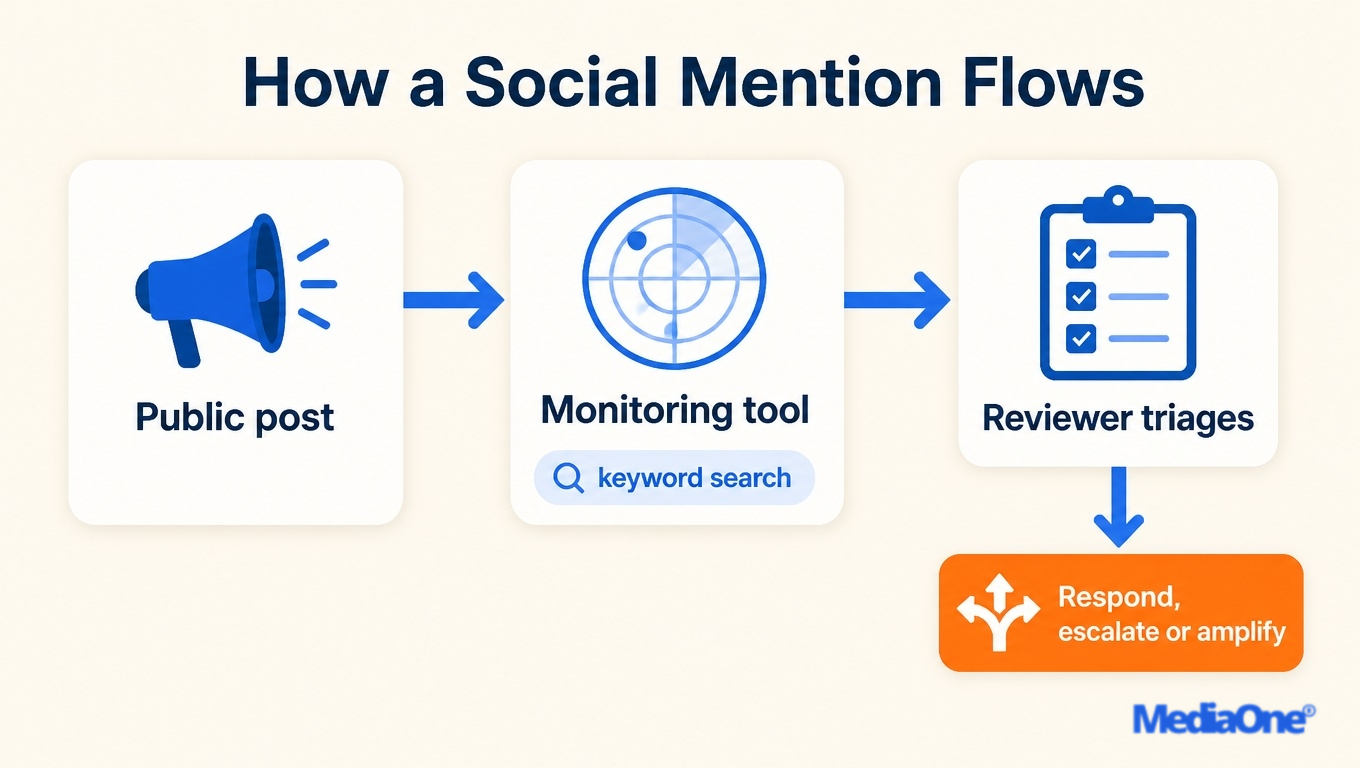
Social Mentions: How a mention travels: public post, monitoring tool, reviewer, action
What Social Mentions Are and How Monitoring Works
A social mention is any public post, comment, review, video or article that names your brand, product or key people. Social media mention tools search those sources for a keyword and return the matches. The useful question is not how many social mentions exist but which ones change a decision you make.
A social mention is a single instance of your brand name or keyword in public online content. Social monitoring is the ongoing process of searching for those mentions and reviewing them. Monitoring tools tell you what was said, not what to do about it, so the real value lies in the insights you draw from each result.
Social listening tools collect eligible content from supported sources into one workflow. Coverage depends on the provider, source and access route, so check coverage before trusting a tool’s totals.
Socialmention.net is a free social listening tool that is fairly easy to use. It lets you run a search on relevant keywords across blogs, microblogs, images, videos, bookmarks and comments from a single interface – its own site lists six source types, from blog platforms to bookmarking sites. Its blog search draws on WordPress, Medium and Substack, among others, per its blog search page. Microblog coverage includes X, Mastodon, Bluesky, Threads and LinkedIn; video coverage includes YouTube, TikTok, Vimeo and Twitch. Free tools change often, so verify each tool’s current official page before you rely on it.
Coverage limits
Monitoring reaches public content only. Private messages, private groups, quarantined communities and most deleted posts are out of reach, and moderator-only views sit outside any public search. Results vary by where you search for a keyword.
A tool that gathers everything will bury the mention that matters. Narrow the scope before you pay for anything, and compare each tool’s features against your actual use case.
The Mention Scope Matrix
Before you choose a tool or set an alert, fill in a two-axis grid. Rows are source types: mainstream platforms, blogs and forums, video and comments, and review sites. Columns are business purposes: reputation risk, competitor watch, customer support and campaign tracking. This grid defines the scope for your social media and brand monitoring; the sections below cover tools and noise.
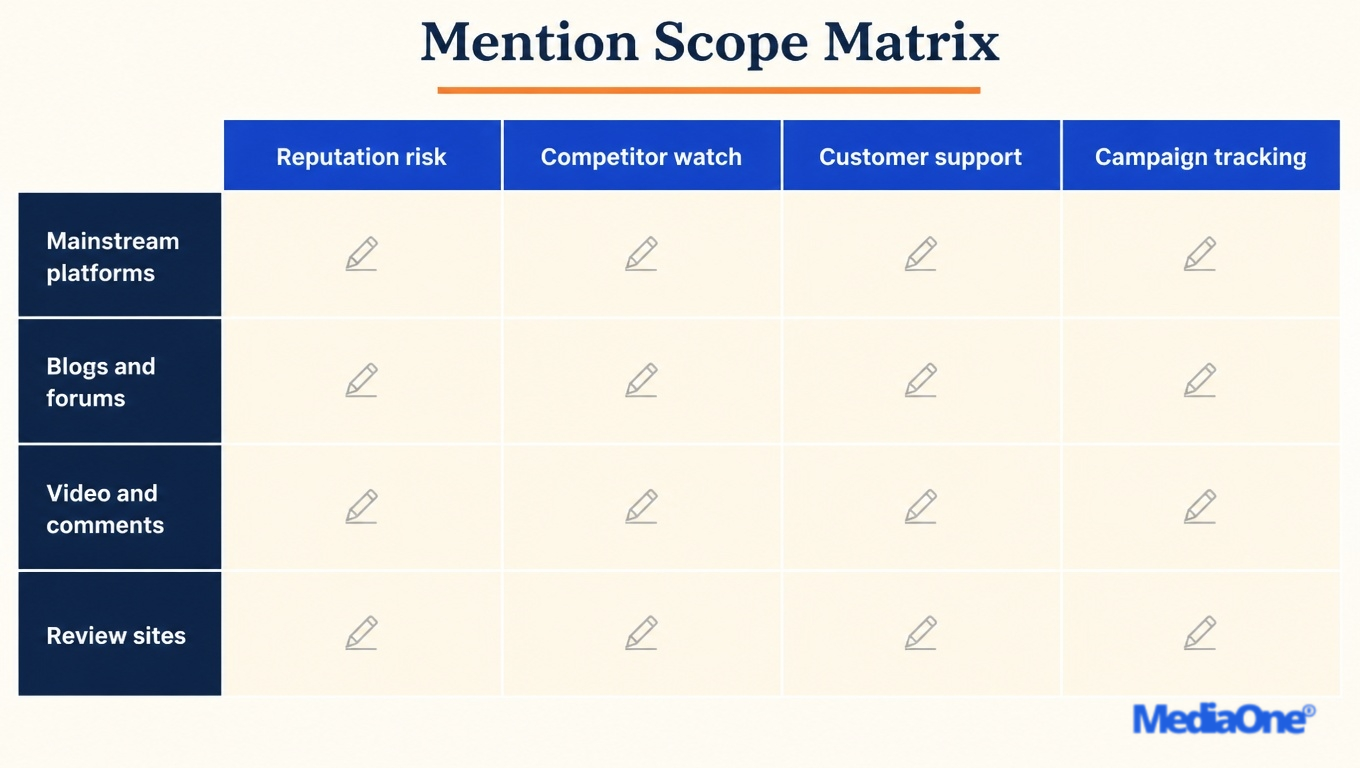
Figure 3: The Mention Scope Matrix: decide monitor-or-not, keywords, frequency and owner for each cell
Each cell needs four decisions:
- Monitor or not: whether this source serves this purpose.
- Keyword set: the terms you will search in that cell, including your company name.
- Alert frequency: how often results are reviewed, with real-time alerts reserved for high-risk cells.
- Named owner: the person who reviews the results and turns them into analytics that inform the team.
An empty cell shows the team has not decided what the mention is for. Fill the matrix first, so every alert has a stated purpose and an owner. For the review-sites row, reputation risk is usually the first purpose to switch on – start with setting up and managing your Google Business Profile, since reviews there carry the most weight for Singapore customers.
Free Tools Versus Paid Platforms
What free tools cover and where they fall short
Free tools suit a quick check. Socialmention.net is a free social listening tool that is fairly easy to use, which makes it useful for testing a keyword set. It cannot show private groups or local review sites, and it offers no reliable alert history or export. Treat free results as a sample, not a complete record. Free tools change often, so verify each tool’s current official page before you rely on it.
When paid platforms are worth the cost
Pay when you need guaranteed source coverage, scheduled alerts, team triage and exportable history. Enterprise platforms such as Sprinklr Insights list coverage across 30+ social and digital channels plus 400,000+ media sources, and sentiment detection across 100+ languages. Check these figures against the provider’s own page before relying on them.
Criteria checklist before you commit
- Source coverage: does it reach your priority platforms, including local forums and review sites?
- Alerts: can you set frequency, thresholds and recipients?
- Cross-platform search: can one query span every source?
- Export: can you pull raw results into a spreadsheet?
- Retention: how long is history kept, and can you reconstruct last quarter?
Cutting Noise with Exclusion Rules
Most noise is predictable: same-named products, shared brand terms or common words. Remove it with a simple test:
- Collect 50 social mentions you know are irrelevant.
- Note the repeating patterns, such as a product category, location or phrase.
- Write an exclusion rule for each pattern.
- Re-run the control set after each change to confirm no genuine social mentions are excluded.
Repeat the test whenever you add a keyword, as an old rule may start hiding real social mentions.
Verifying Public Content Before You Record It
Before logging a mention as evidence, confirm the post is still publicly accessible and record its URL. Content can be deleted or restricted later. A working URL beats a screenshot with no source.
Reading Sentiment and Spotting Real Shifts
Sentiment analysis gives a fast read on tone but misreads sarcasm, irony and Singlish. A remark such as ‘wah, so fast’ can be praise or complaint, so treat scores as a prompt to read the post, not a verdict. Before trusting a tool, mark a labelled sample of your own posts by hand, run the tool on the same set, and record the match rate. That rate is the accuracy figure to use. Social media monitoring insights are only as reliable as this check, and the same test applies to any tool used across the industry.
Checking a sentiment dip against a known event
A dip only matters if you can explain it. Check it against a known event such as a product launch, a service outage or a promotion. Set the trigger in advance, for example, a rise in negative social mentions above the weekly baseline. Calculate the threshold as a percentage: divide this week’s negative social mentions by the average of the last four weeks, subtract 1, then multiply by 100. Build the baseline from those four weeks, using the same keywords and sources. If no event explains the shift, read the individual posts before reacting. A cluster about one incident differs from a steady decline in tone.
Track your brand and two or three competitors using the same keyword structure on each online platform. Share of voice is the proportion of category social mentions that name your brand. Compare it week on week, not against a single snapshot. Set up media monitoring to create a consistent baseline for each competitor – on B2B channels, this gets easier with a structured company page, as covered in our guide to LinkedIn marketing in Singapore.
Influencer mentions
Influencer mentions matter most when the account’s audience overlaps with your customers, not when the follower count is largest. A smaller local reviewer with a loyal readership may shape purchases more than a global account with little overlap, and the best reviewers often show their reach clearly in their features and past posts. Social signals from these accounts can give more useful insights than raw reach. If you are weighing creators for a campaign, start with MediaOne’s influencer marketing service and our guide to planning, paying for and measuring Instagram influencer campaigns.
A Step-by-Step Social Mention Workflow
The Mention Scope Matrix sets the decisions. This workflow turns them into a weekly routine for social media monitoring, so the team acts on each mention instead of just collecting it. Done well, online monitoring of your brand means every mention gets a decision, not just a record. Each mention is a signal about how your industry talks about you, so it deserves a considered response rather than a reflex.
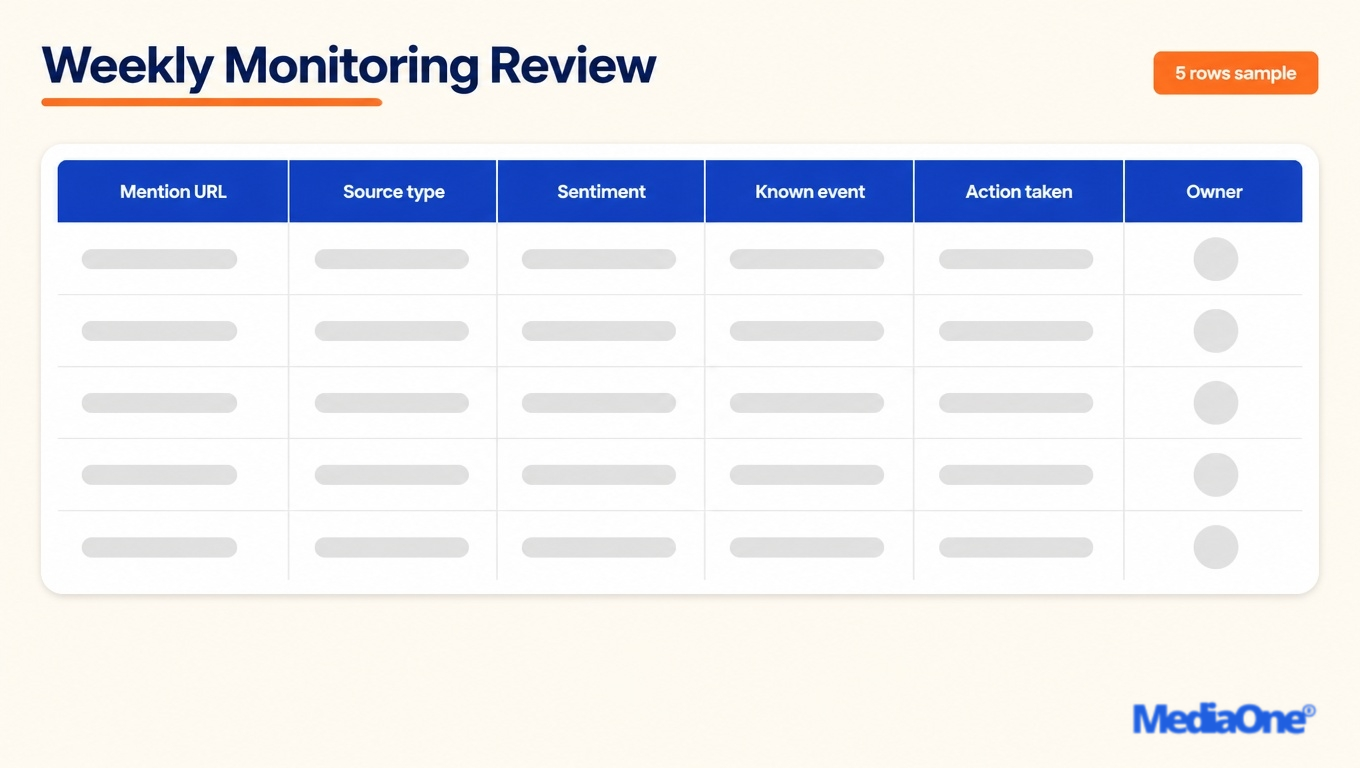
Figure 4: The weekly review sheet: URL, source, sentiment, event, action, owner
Step 1: Define brand, product and competitor keywords
List the terms you own: brand name, product names, common misspellings and the handles people tag. Add two or three competitor names for share-of-voice checks. Test each keyword against a control set of 20 to 30 social mentions you have already checked by hand, including some irrelevant ones. If a term pulls in unrelated results, narrow it or add an exclusion before going live. The aim is a keyword set that finds relevant conversations and skips the rest, and that surfaces the features customers actually discuss. Choose the monitoring tools that let you apply these exclusions cleanly.
Step 2: Set alerts and triage thresholds
Set alerts only for the matrix cells marked ‘monitor’. Decide in advance what counts as urgent. A workable starting point is any negative mention from a large account, or any volume spike above your four-week baseline. For example, if your weekly average over the last four weeks is 10 social mentions, treat a week with 15 or more as a spike to review. Everything else goes into a digest. Assign one named owner to each alert type.
Step 3: Respond, escalate or amplify
Sort each verified mention into one of three actions. Respond when a customer needs an answer, since the reply shapes the wider customer experience – on live formats, replies happen in real time, and our guide to TikTok Live best practices covers that pace. Escalate when a claim could harm the business or involves personal data. Amplify when a post is accurate and positive. Before escalating a negative shift, check whether it lines up with a known event, since a spike with no cause often reflects a single viral post. Treat the best responses as audience feedback on how the company name is perceived, and track the conversations they start, using the insights they reveal to refine future replies.
Step 4: Review weekly and report monthly
Each week, retire any keyword that produced no useful signal. Each month, report volume by source, the share of verified social mentions requiring action and the outcome of escalations. Compare these to the previous month so the report shows whether monitoring is changing decisions and which parts of the workflow drive that change. Use the report to create a short summary for leadership that links each change in the workflow to a specific decision.
Every Social Mention Deserves a Decision
Social mentions earn their keep only when they lead to a decision. Fill the Mention Scope Matrix before touching a tool, and give every alert a named owner and a stated purpose. An empty cell usually signals where the noise comes from.
If you would rather have a team run this routine for you, review MediaOne’s social media marketing service and hold it to the same standard this guide sets: narrow scope, verified signals and a decision on every mention.
Frequently Asked Questions
A social mention is a single instance of your brand, product or competitor appearing in public content. Social monitoring is the ongoing process of finding, reviewing and acting on those mentions. Teams that only receive alerts are monitoring without the decision step.
For a small business starting out, yes, with limits. Socialmention.net is a free social listening tool that is fairly easy to use, enough to test your keyword set. Free tools lack reliable alerts, export and long retention, so validate scope before paying for a platform.
How accurate is automated sentiment analysis?
Treat it as a directional guide, not a verdict. Automated scoring handles plain praise and complaints reasonably well but misreads sarcasm, Singlish and local slang. Check any sentiment dip against a known event and read a sample of the underlying posts yourself.
Can I monitor private groups or deleted posts?
No, not reliably. Private messages, private groups and quarantined communities are generally outside public monitoring, and deleted content disappears from search results. Record the URL of any post you care about while it is still publicly accessible.
Review alerts daily for reputation risks, check the weekly summary for trends, and report monthly on share of voice and sentiment. Escalate immediately any mention that threatens customers or safety.