| AI Summary
Social media engagement improves when businesses give audiences a reason to comment, save, share, click or return, then respond to the conversations those actions create. Prioritise interactions that support your goal, test formats and posting times against your own baseline, and measure website visits, enquiries or repeat customers alongside platform metrics. Recommendation systems differ by platform, so no single posting schedule or first-hour rule guarantees wider reach. |
Many social media engagement tips focus on passive metrics rather than behaviours that predict business results. Professional accounts often mistake high follower counts or total impressions for meaningful progress, even when those numbers produce few enquiries, sales or lasting customer relationships.


The signals platforms use to personalise feeds can differ from the measures businesses need to assess conversions, retention and brand authority. A share may expand visibility, a thoughtful comment may reveal genuine interest, and a click may indicate purchase intent. Understanding these differences helps you invest in content that does more than attract attention.

Know which engagement metrics matter, how to encourage valuable interactions, and how to turn audience activity into measurable business results for your organisation.
Key Takeaways
- Prioritise meaningful engagement over vanity metrics such as follower counts, impressions and reach.
- Focus on valuable interactions like comments, shares, saves, clicks and direct messages that support business goals.
- Adapt your strategy to each platform, as engagement patterns differ across LinkedIn, Instagram, TikTok and other channels.
- Encourage genuine conversations through relevant content, specific questions and timely responses.
- Track and optimise performance regularly by testing content formats, posting times and calls to action.
What Social Media Engagement Means for Business
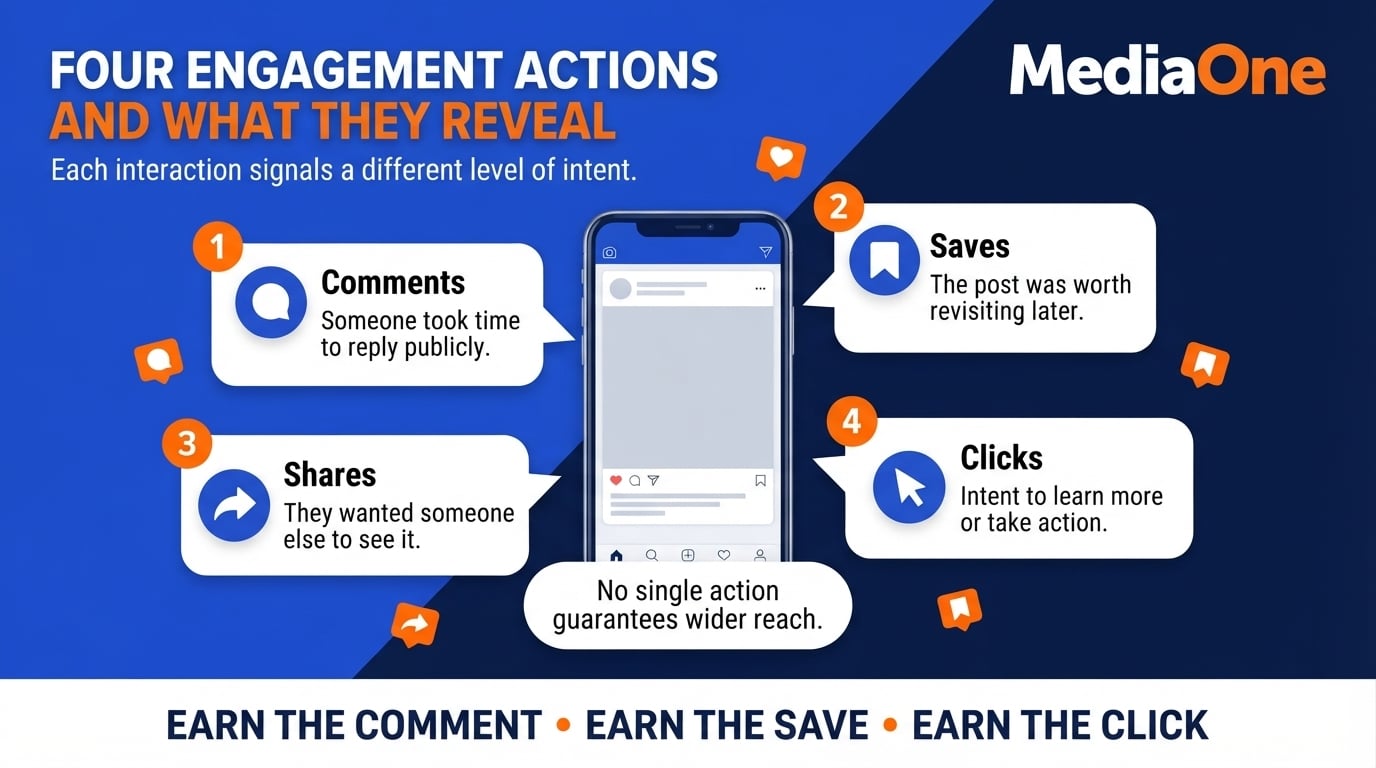
Social media engagement refers to the measurable interactions users take on content: comments, saves, shares, and clicks. Each interaction can reveal something different about audience intent.
Comments show someone took time to reply publicly.
Saves indicate the person found value worth revisiting later.
Shares suggest the person wanted someone else to see the content.
Clicks demonstrate intent to learn more or take action.
Platforms use engagement alongside other signals, such as viewing behaviour and relevance. Engagement can help a post reach interested people, but no single action guarantees wider distribution.
How Platform Algorithms Prioritise Engagement
Platform recommendation systems try to show people content relevant to their interests. They consider several signals rather than applying a single engagement score. LinkedIn’s 2026 Feed engineering update describes how past reading, likes, comments and other behaviours influence personalised recommendations.
Engagement can provide evidence of interest, but viewing time, skips, previous interactions and content relevance also affect recommendations. Early responses may help a conversation develop; platforms do not publish a universal deadline that determines whether a post will be promoted.
For business accounts, prompt, useful responses can make conversations more valuable to customers. Set a reply window your team can meet consistently, particularly when posts invite enquiries.
Types of Engagement Signals by Platform
Different platforms report and use different signals. Measure what your audience does, not a supposed secret weighting formula. Treat the following as measurement priorities to test, not a published ranking of algorithm weights.
| Platform | Useful Signals to Track | Supporting Measures | How to Interpret Them |
| Comments and reposts | Post clicks, impressions | Look for discussion among the roles you want to reach. | |
| Saves and shares | Comments, Reels watch time | Check whether people revisit, share or watch your content. | |
| TikTok | Watch time and shares | Comments, full watches and skips | Review retention alongside interaction quality. |
| X | Reposts and replies | Link clicks, impressions | Check whether conversations reach relevant accounts. |
| YouTube | Average view duration and thumbnail CTR | Comments, returning viewers | Review appeal and sustained viewing together. |
No format consistently outperforms every other format across businesses. TikTok’s official recommendation guidance names viewing time, full watches, likes, comments and shares among the signals for its For You feed; it does not prescribe a universal video completion target. For channel selection, compare MediaOne’s social media platforms guide for Singapore businesses.
Passive Metrics Vs. Actionable Engagement Signals
Passive metrics are numbers that look big but do not show real business results. Follower count, total impressions and reach describe distribution or audience size, not by themselves the quality of customer interest.
An interaction is useful when it helps explain a meaningful customer action. Signals to review alongside downstream actions include:
- Comment quality and sentiment
- Share rate (how often someone passes content to others)
- Click-through rate to external links
- Response rate to calls to action
- Repeat engagement from the same accounts
A follower who engages repeatedly may be more familiar with your brand than someone who saw one post. Check whether repeat engagement is followed by relevant website visits, enquiries or purchases. For a broader planning framework, see MediaOne’s social media marketing strategy for small businesses.
Selection Guide: Which Metrics to Prioritise for Your Business
Choosing which engagement metrics to prioritise depends on your business objective. A clear social media marketing strategy connects those signals to customer actions and wider reporting.
Step 1: Clarify Your Primary Business Outcome
Is your goal brand awareness, lead generation, community building or customer retention? Match each engagement measure with an outcome you can observe.
Step 2: Map Engagement Types to Your Outcome
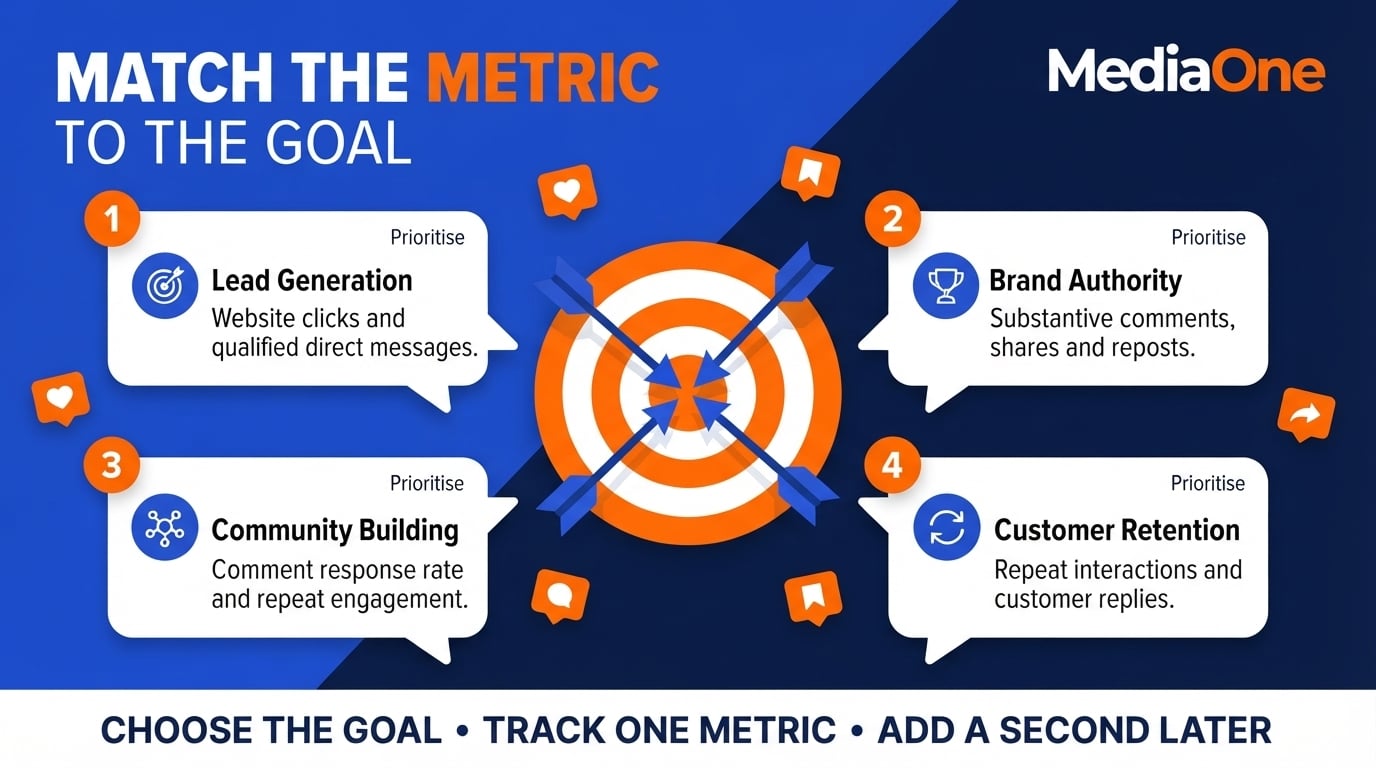
If your goal is lead generation, prioritise clicks to your website and direct messages. If your goal is authority building, prioritise substantive comments and shares. If your goal is community, prioritise comment response rates and repeat engagement.
Step 3: Set Platform-Specific Targets
Use the table below to determine which metrics to track first on each platform:
| Business Goal | LinkedIn Focus | Instagram Focus | TikTok Focus | X Focus |
| Lead generation | Post clicks, qualified DMs | Profile visits, website actions | Qualified messages, website clicks | Link clicks, relevant replies |
| Brand authority | Reposts, comment quality | Saves, shares | Shares, meaningful comments | Reposts, reply quality |
| Community building | Discussion depth, repeat replies | Comment quality, DM responses | Comment quality, returning viewers | Replies, repeat interactions |
| Customer retention | Repeat interactions, customer DMs | Story replies, repeat contacts | Repeat viewers, customer replies | Customer mentions and replies |
Step 4: Identify Your First-Priority Metric
Select one metric per platform to track first and measure it weekly. Add a second metric once you can explain what changed, while keeping an outcome measure such as qualified enquiries or orders in view.
Practical Guide: Building an Engagement-First Content Strategy
Step 1: Audit Current Engagement Performance
Use each platform’s available analytics to establish baseline metrics. Track the same post types and denominators across reporting periods.
- LinkedIn Page analytics: review engagement rate, clicks, reactions and reposts where available
- Instagram Insights: review saves, shares and Reels watch time where shown
- TikTok Analytics: review watch time, shares and retention measures available for the post
- YouTube Studio: examine average view duration and impressions click-through rate
- X Analytics: review replies and reposts if your account has analytics access
Document these numbers for three to four weeks as an initial working baseline, then compare similar posts on the same platform. YouTube’s content analytics guidance explains why click-through rate and average view duration should be assessed together.
Step 2: Plan Prompt Responses to Audience Engagement
Post at times your own data suggests the audience is receptive. Check comments and direct messages soon after publishing, and assign someone to answer useful questions within your normal service standard.
A useful reply can turn a brief comment into a genuine customer conversation. Prompt responses demonstrate attentiveness, but they are not a documented shortcut to ranking.
Step 3: Structure Content for Comments
Content designed to invite a specific, relevant response gives readers a clearer reason to engage than a generic prompt.
Use clear, specific questions in your caption or video. A generic question such as ‘What do you think?’ may be easier to overlook than a specific one. For example:
Instead of: ‘Do you agree?’
Use: ‘What is the biggest challenge you face when implementing this approach?’
Instead of: ‘Share your thoughts.’
Use: ‘Name one thing you would change about this strategy.’
Specific questions can encourage more useful responses. Review the answers for customer problems you can address in your next post.
Step 4: Test Format and Timing Variations
Different formats and posting times can produce different engagement patterns. Test video, carousels and text posts against comparable content from the same account.
Test one variable at a time:
- Post type (carousel, single image, video, text, document)
- Posting time (morning, midday, evening, weekend)
- Caption length (under 100 words vs. 300+ words)
- Call-to-action type (specific question, soft invitation, direct instruction)
Track which variation generates useful engagement and downstream actions. Record planned tests in a social media content calendar so results can inform the next week’s content plan.
Metrics Tracking Reference Table
Use this table to track the metrics most relevant to your goal. Compare the same denominator each week before declaring progress. Collect data weekly, calculate each rate consistently and note whether your denominator is impressions, views or followers. For website actions, add campaign parameters using Google Analytics’ URL builder guidance.
| Platform | Metric | Week 1 | Week 2 | Week 3 | Week 4 | Target |
| Engagement rate (%) | ||||||
| Click-through rate (%) | ||||||
| Save rate (%) | ||||||
| Share rate (%) | ||||||
| TikTok | Completion rate (%) | |||||
| TikTok | Share rate (%) | |||||
| X | Reply rate (%) | |||||
| YouTube | Average percentage viewed (%) |
Troubleshooting Common Engagement Challenges
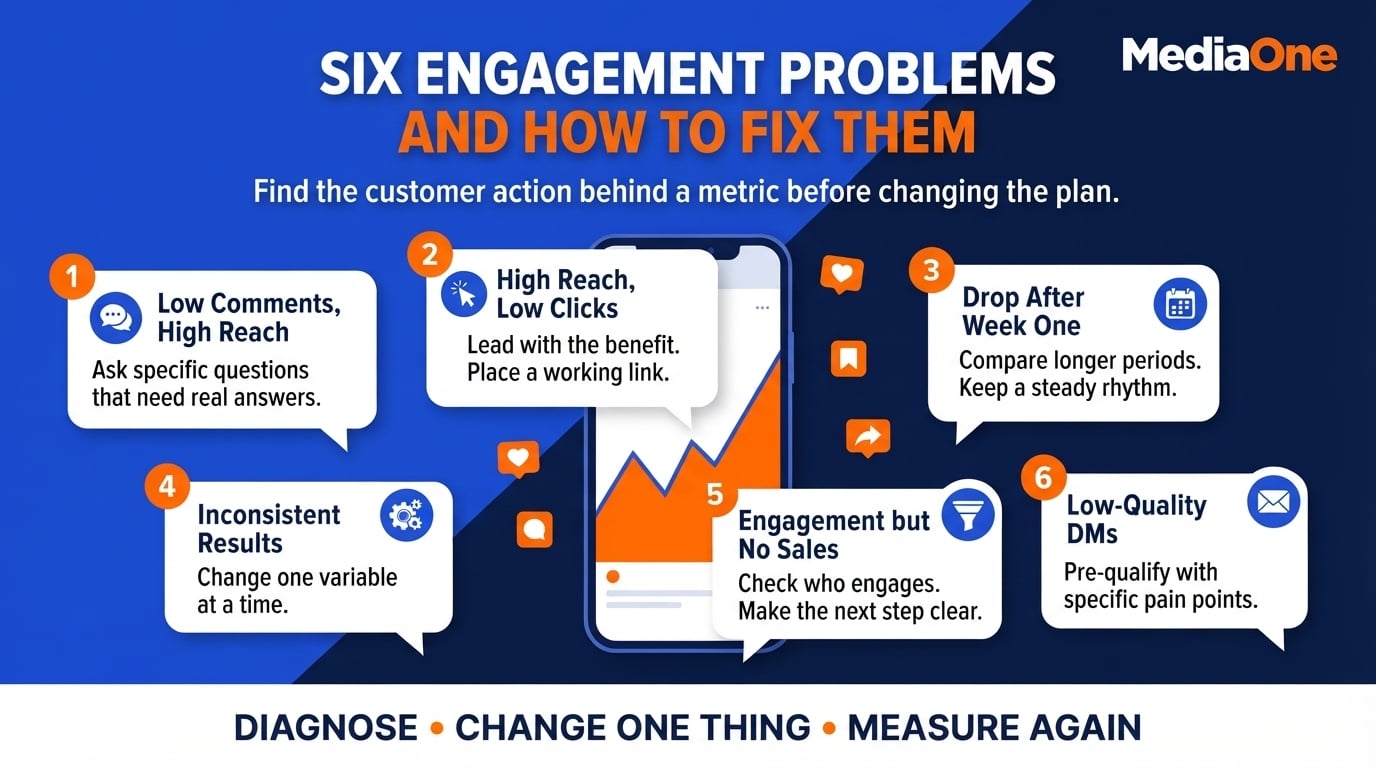
Investigate the customer action behind a metric before changing the content plan.
| Problem | Likely Reason | Recommended Action |
| Low comment rate despite high reach | Content does not invite dialogue; questions are too generic or calls to action are absent | Rewrite captions with specific questions that require substantive replies. Test different question types. |
| High reach but low click-through rate | Content does not make value of clicking clear; link placement is buried or unclear | Lead with the benefit in your caption. Place a working link where the format supports it, such as your profile or a Story link sticker. |
| Engagement drops after first week | Audience interest changes; distribution can fluctuate by post | Compare posts over a longer period. Maintain a manageable publishing rhythm and review topics with lasting interest. |
| Inconsistent engagement across similar posts | Posting time, audience composition, or format variables differ; algorithm tests content against different audience segments | Track time, format, caption length and question type. Change one variable at a time where possible. |
| High engagement but no business results (leads, sales, website traffic) | Engagement is from wrong audience segment or does not connect to conversion actions | Audit who is engaging (industry, role, company size if available). Make the conversion path clear in your profile, comments or pinned post. Add direct calls to action. |
| Direct messages increase but quality is low | Content attracts curiosity-seekers rather than qualified prospects | Refine messaging and targeting. Use content that pre-qualifies prospects by addressing specific pain points. |
Official Platform Guidance to Consult
Platform-authored help centres and engineering updates are better starting points than claims about secret ranking formulas:
| Platform | Official Resource | Practical Use |
| LinkedIn Engineering and Help | Feed personalisation and Page analytics definitions | |
| Instagram Professional Dashboard | Content, engagement and reach guidance | |
| TikTok | TikTok Help Centre | User interactions and For You recommendations |
| X | X Help Centre | Analytics access, post activity and reporting caveats |
| YouTube | YouTube Help and Studio Analytics | Thumbnail CTR, viewing time and satisfaction signals |
Consult these resources when platform interfaces or metric names change. Use your own analytics as the main benchmark, then read official guidance to interpret the result.
Frequently Asked Questions
Engagement is an indicator of attention, not a substitute for conversion reporting.
What Is the Difference Between Passive Metrics and Actionable Engagement?

Passive metrics (follower count, total reach and impressions) describe exposure. Actionable engagement metrics (comments, shares, click-through rate and saves) describe audience actions, although they do not by themselves prove business impact. Compare both with qualified leads, purchases or repeat visits.
How Quickly Should I Expect to See Engagement Improvement?
Use the first three to four weeks to gather a baseline and identify patterns rather than promise a ranking change. The time needed to detect a reliable improvement depends on audience size, posting frequency and how variable your results are.
Is a 50% Video Completion Rate on YouTube Considered Strong?
Completion and retention depend on video length, topic and audience. YouTube does not set a universal 50% completion target for businesses, so compare audience retention and average percentage viewed with similar videos on your channel. Watch whether those viewers take the next action you want.
Can I Improve Engagement Without Posting More Frequently?
Yes. Better topics, clearer calls to action and useful replies can improve interactions without increasing your posting volume. Keep a cadence your team can maintain, then compare engagement per impression or per follower using the same definition each week. Two or three thoughtful posts may be more useful than daily posts that do not serve your audience.
What Is the Most Commonly Misunderstood Engagement Metric?
Many professionals confuse engagement rate with reach. For example, 800 interactions from 10,000 followers equal an 8% follower-based engagement rate; they do not mean only 800 people were reached. Similarly, 3,000 interactions from 100,000 followers equal 3%, without telling you the number of unique viewers. Name the denominator and report reach separately, then compare qualified customer actions.
Which Platform Responds Fastest to Engagement?
There is no reliable cross-platform speed ranking or guaranteed 24- to 48-hour feedback window. TikTok, LinkedIn, Instagram and X use different personalised systems, audiences and surfaces. Test the channel where your customers are active, then judge results by relevant replies, visits and enquiries instead of assuming a faster recommendation cycle is more valuable.
How Do I Know If My Audience Is Engaged or Just Polite?
Useful engagement often has context, follow-up questions and repeat contact. Generic comments such as ‘Great post!’ can still be sincere, but they tell you little about purchase intent. Look at recurring conversations and downstream actions: do people visit your website, request a quotation or message your team?
What Should I Do If Engagement Suddenly Drops?
Sudden drops can result from changes in topic, posting schedule, distribution or audience interest. Check the same metrics over at least two comparable reporting periods before diagnosing a trend. If the drop persists, review recent topics and formats, check for access or policy notices, and test one change at a time. No recovery timetable is guaranteed.
Should I Focus on One Platform or Build Presence on All Major Platforms?
A practical strategy prioritises depth over breadth. Start with one or two platforms where your audience is active and your format fits. Choose the platform that generates the most useful customer actions, then add another when you can reliably create content and respond to people on the first.
Is It Better to Prioritise Follower Growth or Engagement Rate Improvement?
Prioritise qualified engagement and business outcomes together. A small, active audience can be valuable, but a high engagement rate does not automatically increase reach, leads or follower growth. Report engagement rate, reach and conversion measures side by side.
Summary: Core Principles for an Engagement-Driven Strategy
Professional social media strategy connects audience engagement to measurable business outcomes. This requires distinguishing passive metrics (follower count, total reach) from actionable signals (comments, saves, shares, click-through rate).
Platform recommendations respond to several user and content signals. Ask questions worth answering, reply helpfully and compare results over time rather than relying on a first-hour algorithm rule.
Start by identifying your primary business outcome (lead generation, authority, community, or retention). Select one metric per platform that correlates with that outcome. Track it weekly. Optimise one variable at a time. Scale once you see consistent improvement.
Accounts with relevant, engaged audiences can turn conversations into measurable customer actions. For structured reporting and campaign planning, consider social media marketing support that connects engagement to leads and sales.