Most social media contests fail because they ask for effort without giving people a reason to stay. Design the contest around the behaviour you want, and let the prize be only the trigger.
Many brands run giveaways that attract prize hunters who disappear once the winner is announced. The prize is rarely the problem. The contest required effort but didn’t give a reason to keep engaging. This guide designs each contest backwards from the behaviour you want, then uses the prize as a trigger. Contests that invite a user-generated content submission or a public share tend to build more lasting reach than a simple like-to-enter draw, and a well-judged contest can also lift the quality of every comment left under the post. Before launch, consider how the contest fits your wider marketing plan.
Key Takeaways
- Design backwards from behaviour. Start with the habit you want (creating content, sharing, returning) and use the prize only as the trigger.
- Volume is not an outcome. Chipotle’s #GuacDance challenge drew over 250,000 video submissions, but entry count alone does not prove sales or sign-ups.
- Choose the format deliberately. A sweepstake selects winners at random, while a contest selects them by skill or judgement.
- Score ideas before launch. Use the Entry-to-Habit Ladder to judge how far an idea builds a lasting habit, and redesign anything that scores below 6 out of 10.
- Plan for non-winners. SocialToaster reports that contests account for an average of 34% of new customers, so check that figure against your data first.
- Check the rules first. Facebook requires official terms, rules and eligibility, and local sports team branding needs permission.
Why Most Social Media Contest Ideas Fall Flat
Brands often ask for effortful entries, like a caption, a video, or tagging three friends, then give no reason to continue once the entry is in. The result is a spike of prize hunters who unfollow after the winner is announced. The fix is to design backwards from the behaviour you want, using the prize only as a trigger, since a giveaway that ends at the announcement rarely changes how people buy.
Chipotle’s #GuacDance challenge generated over 250,000 video submissions, according to JoinBrands. But volume is not an outcome. A quarter of a million entries show the idea spread, not whether anyone bought guacamole because of it. Judging a contest by entry count alone is a common measurement mistake; marketing teams should track sales and retention instead.
 (reference: https://www.fastcasual.com/news/chipotles-tiktok-challenge/)
Organic reach has dropped significantly on platforms such as Instagram, Facebook, and LinkedIn, as HeyOrca notes. A contest is therefore no longer a free bonus. It must be a deliberate tool with a clear purpose.
Common Types of Social Media Contests, with Real Examples
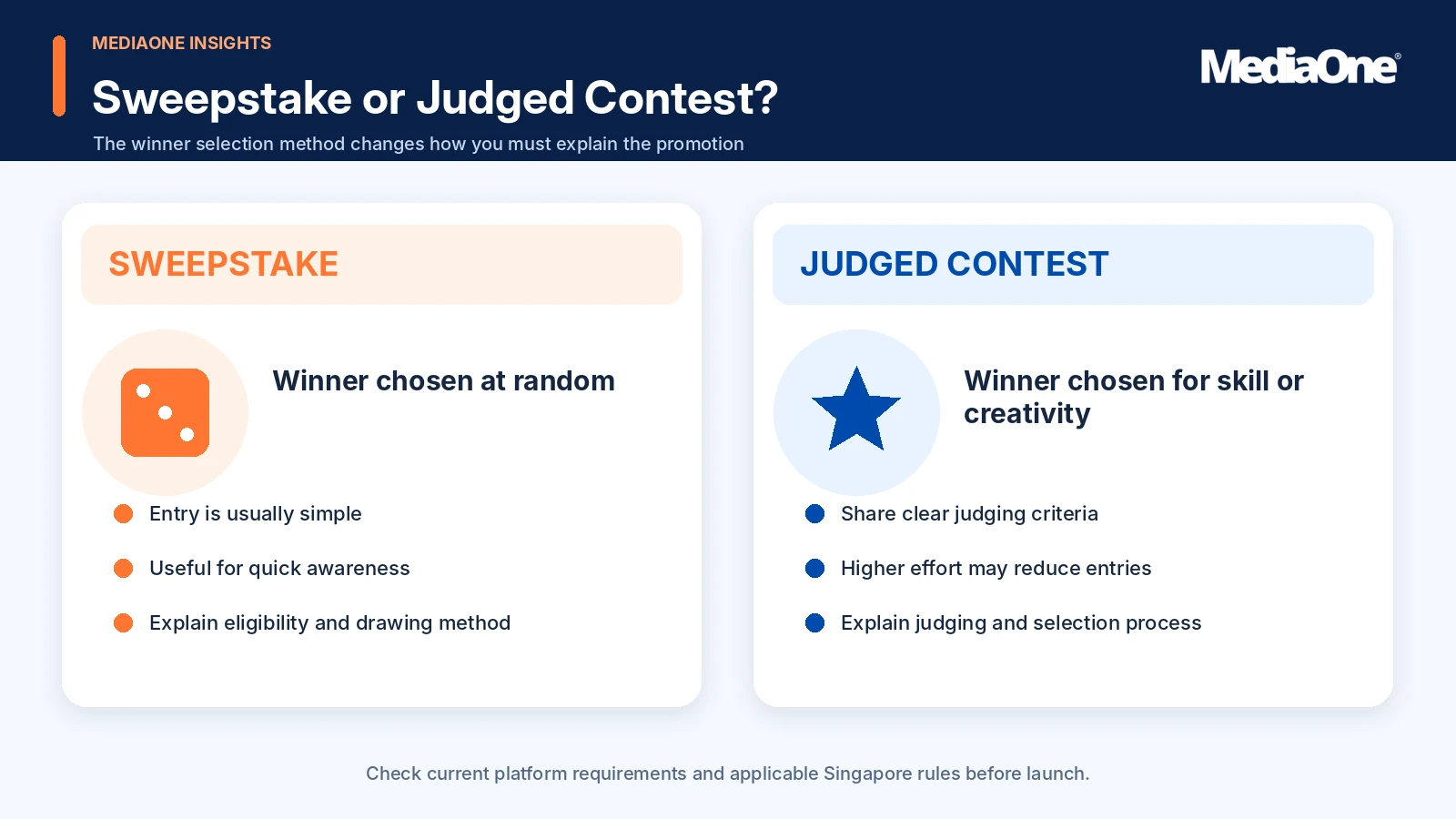
Start with the terms, because they decide how you pick winners. A sweepstake selects winners at random from the entry pool. A contest selects winners based on judgement, skill, or creativity. If your rule is “best caption wins”, you are running a contest, and your rules must explain how judging works. Score every format below on the Entry-to-Habit Ladder before you commit.
Contest Types at a Glance
| Contest type | Best goal | Best platform | Effort level | Typical entry friction |
|---|---|---|---|---|
| UGC photo | Content and engagement | Low | Low | |
| Caption writing | Engagement | Facebook, Instagram | Low | Low |
| Video challenge | Reach and content | TikTok, Instagram | High | High |
| Trivia and quiz | Awareness and learning | Facebook, Twitter | Medium | Low |
| Hashtag campaign | Reach and advocacy | Instagram, Twitter | Medium | Low |
| Follow and tag giveaway | Follows and reach | Instagram, Twitter | Low | Low |
| Before and after | Conversion | Instagram, Pinterest | Medium | Medium |
| Cross-promotion | Reach across channels | Multi-platform | Medium | Low |
| Brand partnership | Shared reach and cost | Varies | Medium | Low |
| Seasonal | Timely engagement | Varies | Medium | Low |
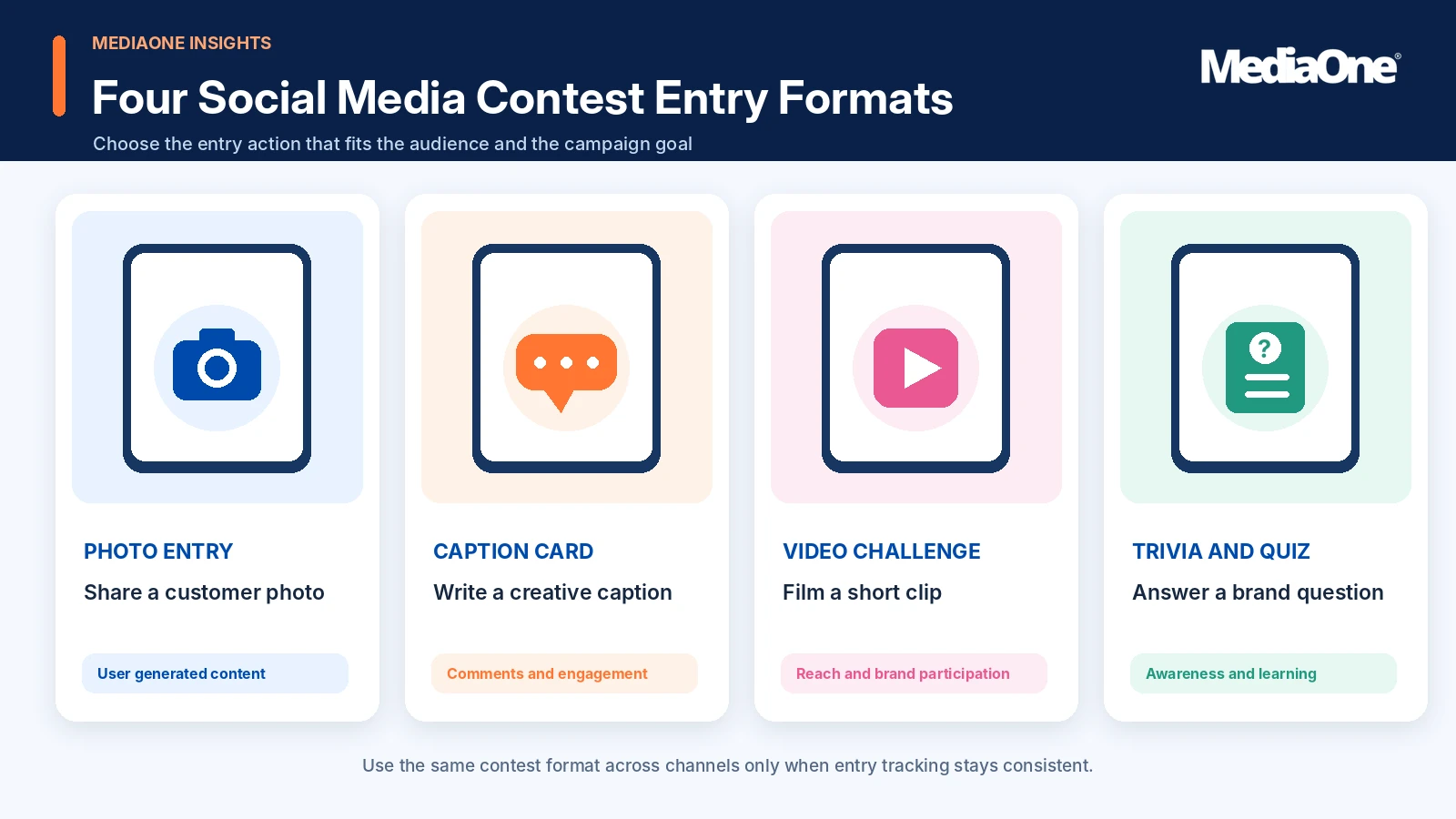
User-generated content photo contests
Best for: brands whose customers already take photos of the product.
Watch out: the content you receive may not be usable without permission.
Netflix lets subscribers bookmark and share their favourite scenes from its shows across social media, turning viewers into co-creators. The output is content the brand can reuse. Choose visuals that already carry emotion, and consider asking permission to reuse entries so you can apply them to your own brand awareness efforts.
Caption writing contests
Best for: products or mascots with a clear personality.
Watch out: captions can drift off-brand if the rules do not set a tone.
Innocent Drinks posts photos of its smoothie bottles with gentle reminders, such as telling followers they’re super. The image does the heavy lifting, and the caption adds the fun.
Video challenge contests
Best for: brands that can offer a simple, repeatable action that people will film.
Watch out: high effort lowers entries, and volume does not prove sales.
Chipotle’s #GuacDance challenge generated over 250,000 video submissions, according to Marketing Dive. Judge a challenge by its reusable content and new reach, not just the headline number.
Trivia and quiz contests
Best for: brands with facts worth learning, such as ingredients or brand history.
Watch out: overly hard or obscure questions will deter entries.
Knowledge becomes the entry ticket. Keep questions brand-relevant, such as ingredients, brand history or a local food fact, so answering teaches people something about you. Consider a simple quiz format to build brand awareness without demanding much effort. A well-pitched quiz can also help new followers learn what your brand stands for.
Hashtag campaigns
Best for: building a branded phrase customers repeat.
Watch out: public hashtags attract off-topic and negative posts quickly.
Design a hashtag people want to use: short, easy to say and tied to an action rather than a slogan. Moderate it from day one, and make sure someone is responsible for monitoring it.
Follow and tag giveaways
Best for: growing followers and reach at low cost.
Watch out: entrants are often prize-driven and may not stay.
Disney and Electronic Arts have used this model for major launches across Twitch, Twitter and Instagram. It drives follows and tags at low cost. Plan the follow-up before launch, so new followers have a reason to stay.
Before and after transformation contests
Best for: products with visible effects, such as skincare, renovation, or fitness.
Watch out: the comparison must be honest and fairly judged.
Ask for a before photo and an after photo. The comparison does the selling.
Multi-platform cross-promotion contests
Best for: brands with active audiences across several channels.
Watch out: splitting entries across channels confuses the count.
Run one contest across several channels without splitting entries. Use a single entry point, such as one landing page or hashtag, and point every channel to it.
Collaborative brand partnership contests
Best for: brands seeking shared reach and cost.
Watch out: partners may compete for the same audience.
Pair with a complementary brand to share reach and cost. Choose a partner whose audience overlaps with yours without competing with you, and agree before launch on who owns the entrant data.
Seasonal and holiday-themed contests
Best for: timely engagement around the calendar.
Watch out: a festive theme can feel forced if the product has no link to it.
Time the contest to the calendar. In Singapore, festive periods such as Chinese New Year and Hari Raya are natural anchors. Check the timing against your sales cycle first, and create a theme that connects to what you sell.
Setting Clear Goals, Rules and Official Terms
Choosing one goal per contest
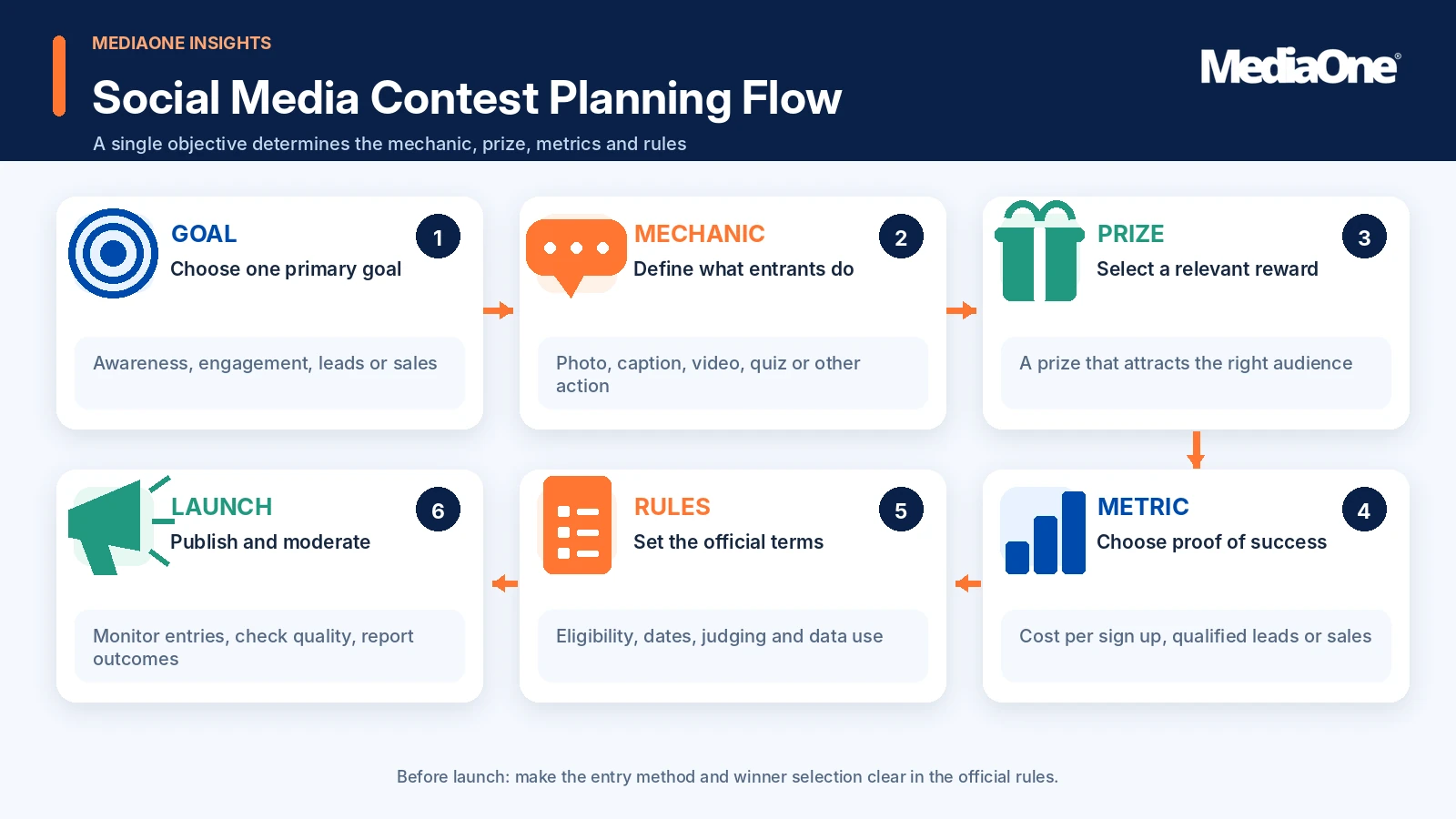
Most contests fail at the planning stage, not on launch day. Start with the goal, and let it shape the other decisions. Choose one primary goal per contest: awareness, engagement, leads or sales. The goal determines the mechanic (what people do), the prize (what they want) and the metric (how you know it worked). Mixing goals usually produces a muddled entry form and a report nobody can read. A clear goal also helps you decide whether a giveaway is the right tool at all and what to measure once it ends.
Scoring ideas with the Entry-to-Habit Ladder
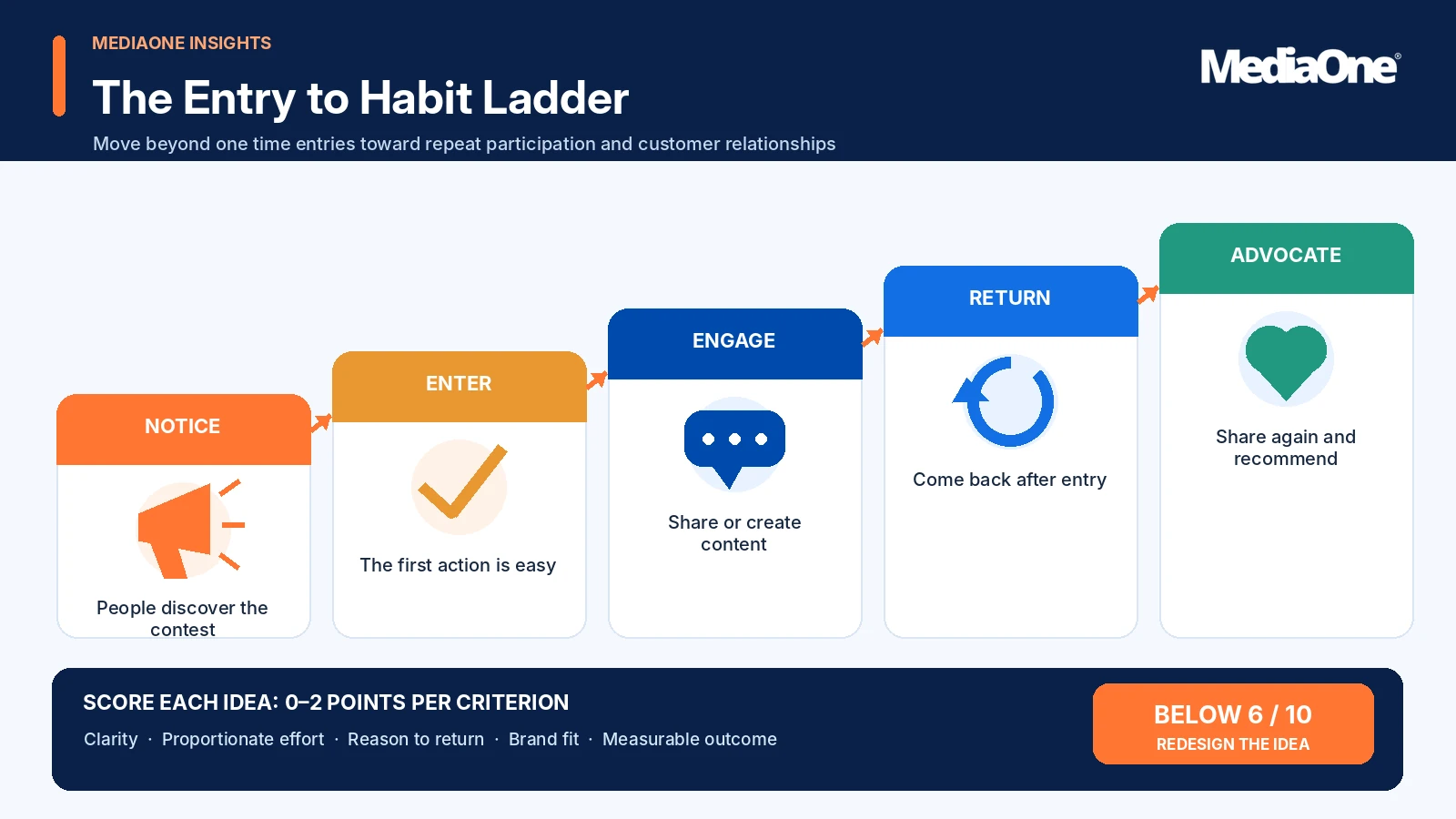
Before you spend S$1 on an idea, score it on the Entry-to-Habit Ladder. Rate each of five criteria from 0 to 2: clarity of the action, effort proportionate to the prize, reason to return after entry, fit with the brand’s content, and a measurable outcome. A total of 6 or more out of 10 suggests the idea can build a habit. Below that, redesign it. Ideas that invite people to create something, such as a photo or caption, often score well on fit and reason to return, and the resulting user-generated content can extend the campaign’s reach.
As a worked example, a caption contest for a snack brand might score 2 on clarity, 2 on fit, and 1 on effort, with no reason to return and no measurable outcome. That totals 6 and passes. A pure “tag three friends” draw might score 1 on clarity and 0 on reason to return, totalling 3, so it needs redesigning before launch.
Official terms and rules
Facebook requires official terms, rules, and eligibility requirements for contests, according to HubSpot’s guide to social media contests. Your rules page should include:
- Entry period: start and end dates, with time zone
- Eligibility: age, country of residence and any employee or agency exclusions
- Entry method: exactly what entrants must do, step by step
- Prize details: value in S$, quantity and redemption process
- Selection method: whether winners are chosen at random or by judgement
- Data use: what you will collect and how you will use it
- Contact details: where entrants can ask questions
SocialToaster notes that a contest requires skill, while a sweepstake is random and requires no purchase. Decide which you are running before you write the rules, because the legal treatment can differ.
Before launch, review each platform’s terms and confirm the sweepstake-versus-contest distinction under current Singapore rules. Where you are unsure, seek local legal advice.
Choosing the Right Platform for Your Audience
Start with who you want to reach and what they already do in that app. Pick the format that suits the platform, then choose the prize. Design the giveaway around the platform’s native habits, not the other way round. Keep the mechanic simple so entrants can join in seconds, because a complicated entry rarely brings people in to give away anything worth having.
Instagram suits visual and video contests. Pinterest suits planning-led audiences who save ideas, making it a good fit for home, fashion, and travel brands. X (formerly Twitter) suits conversation, so caption contests and quick trivia do well there. Facebook suits community: groups, local pages and longer entries.
Pinterest reported 640 million global monthly active users for the quarter ended June 30, 2026, with women making up roughly two-thirds of the user base. X has approximately 557 million active users, according to Data Reportal’s October 2025 report cited by ExplodingTopics. Treat these figures as directional and check your analytics.
A Country Living Pinterest contest offered a chance to win $500 in new bedding courtesy of Garnet Hill. Pinners already plan and save, so the contest asked them to do something they naturally enjoy, and each post invited people to keep ideas for later.
Video is at the centre of social media marketing. Challenges, transformations and reaction clips travel furthest. Static caption contests still work, but they need a strong hook to compete in the feed, and the winner should be announced clearly.
| Audience | Objective | Best format | Best platform |
|---|---|---|---|
| Visual, trend-led shoppers | Awareness and reach | Video challenge or photo contest | |
| Planners and home or lifestyle buyers | Saves and sales | Pin-and-board contest | |
| Conversational, news-aware users | Engagement and buzz | Caption or trivia contest | X (formerly Twitter) |
| Community and local groups | Loyalty and sign-ups | Share-and-tag or group contest |
Bridging platform choice to format: once you know where your audience spends time, pick the format that the platform rewards.
Real Campaign Breakdowns: Why They Worked and What They Achieved
Most contest write-ups stop at “it went viral”, which tells you nothing you can reuse. This article scores each campaign on the Entry-to-Habit Ladder, which rates the effort required to enter, content reusability, reach through sharing, measurable outcomes, and the plan for non-winners. A contest can help a brand turn casual participants into a loyal, returning community, but only when the brand knows what result it wants.
Case 1: Chipotle’s #GuacDance challenge (international)
- Brand: Chipotle
- Mechanic: Fans filmed themselves doing guacamole-themed dance moves and shared the clip with the hashtag.
- Result: Over 250,000 video submissions, according to JoinBrands. This is a reported figure, not an audited one.
- Why it worked: Every submission was reusable content that carried the brand into friends’ feeds.
- The gap: The sources do not report sales or sign-ups, so this campaign scores well on content and reach but cannot be credited with measurable results.
- Lesson: Count submissions as content earned, then decide in advance which customer result you need to see.
Case 2: Netflix’s screenshot prompts (international)
- Brand: Netflix
- Mechanic: Netflix allows subscribers to bookmark and share their favourite scenes from its shows on social media.
- Result: No engagement figures are published, so none are claimed here.
- Why it worked: Entrants use fandom they already have. Nobody needs to learn a new skill.
- Lesson: Build the prompt around the conversation your audience already has, rather than your product.
Case 3: Disney and Electronic Arts’ follow-and-tag launches (international)
- Brands: Disney and Electronic Arts
- Mechanic: Follow-and-tag giveaways across Twitch, Twitter and Instagram for major launches.
- Result: The model is reported for major launches, but no figures are published.
- Why it worked: Tagging friends turns each entrant into a referrer, and the entry is almost frictionless.
- The counterpoint: This mechanic attracts prize hunters, who may unfollow once the prize is announced. Plan how you will keep followers engaged after the winner is chosen.
- Lesson: Pair a cheap entry with a deliberate post-contest step, such as an onboarding email or a second offer for non-winners.
Reading these results honestly
Every figure above comes from another business’s coverage, not the brands’ own reporting. Treat the 250,000 submissions as a reported figure, and treat “viral” language as judgement. Check the original brand or agency release before using these numbers in a pitch.
Turning Social Media Contest Ideas into Action: Brainstorming, Shortlisting and Budgeting
Most social media contest ideas fail at the planning stage. Someone falls for a clever prize, and only later does anyone ask how entrants actually take part. Start with the audience. Ask what your customers already do on social media and what they would happily share. Then choose the goal (awareness, engagement, leads or sales), and only then pick the mechanic. Give away a prize only when the mechanic serves a clear brand awareness goal.
A Shortlisting Framework You Can Use Today
Once you have three to five ideas, score each from 1 to 5 on reach potential, entry friction, brand fit, cost and risk. This is the author’s own heuristic, not an industry standard: anything scoring below 17 out of 25 needs simplifying, most often by cutting the number of entry steps. A well-designed mechanic can help the team judge quickly which ideas deserve a giveaway budget.
For example, a Singapore café with 5,000 followers scores three ideas: a photo contest at 18, a caption contest at 15 and a multi-step quiz at 12. It keeps the photo contest, limits entries to a single post, and creates one simple post explaining how to enter, so awareness gain is easy to measure.
Budgeting: A Rule of Thumb
This split is the author’s own heuristic, not a benchmark: divide the budget across prize, production, promotion and moderation time, roughly 40%, 20%, 25% and 15%. Treat moderation as a real cost, since a popular contest can generate hundreds of comments in a day.
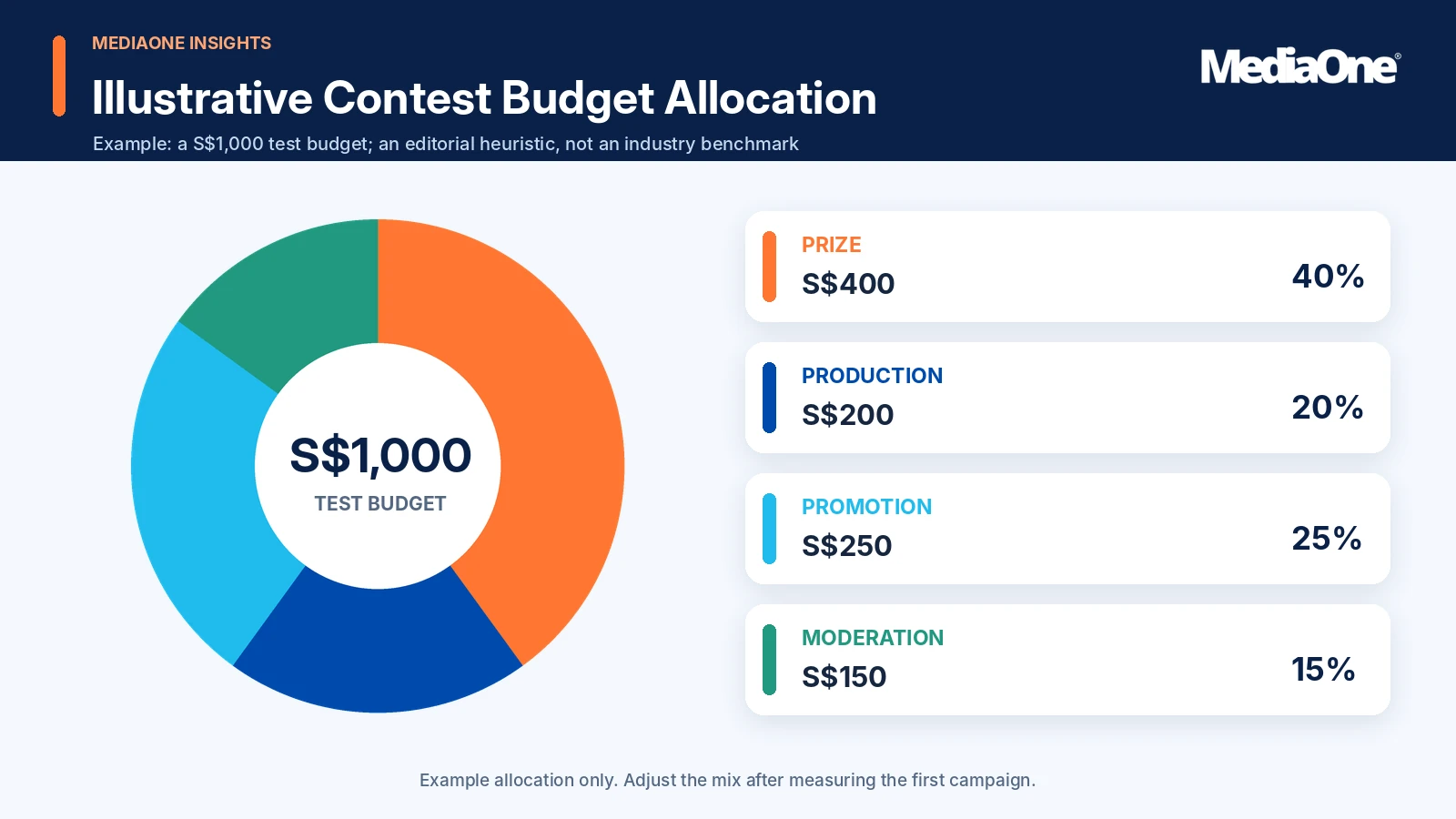
For example, a Singapore skincare brand with an S$1,000 test budget allocates S$400 to the prize, S$200 to production, S$250 to promotion and S$150 to moderation. Calculate cost per sign-up by dividing total spend by the number of sign-ups; if the test produces 50 sign-ups, cost per sign-up is S$20. Adjust the split after the first run.
When to Adjust After a Test
Decide what to change based on where entrants dropped off:
- Few entries, high reach: the entry is too difficult. Simplify it.
- Many entries, little sharing: the prize is attracting prize hunters. Tie the entry to the brand story.
- Good entries, weak sales follow-up: the audience is right, but the offer is wrong. Change the prize or the platform.
Tools That Save Time
Collecting entries and picking winners is where manual work piles up. ShortStack can import Facebook and Instagram entries into a single list, speeding up eligibility checks. For smaller pools, Hootsuite’s guide notes its comment picker is free for up to 150 comments.
Sweepstakes or Contest? Decide Before You Launch
How you pick the winner determines how the promotion is classed. Under SocialToaster’s guidance, a sweepstake picks winners at random, while a contest has the brand hand-pick the winner. Settle the selection method during ideation, not after launch.
Measurement, Reporting and Stakeholder Buy-In
Key metrics to track
Track cost per result against the goal you set at the start. For sign-ups, measure the cost per sign-up. For awareness, look at reach and new followers. Entry volume alone tells you little.
Attribution
Use a tagged link or a unique code for each channel so you can see which entries led to sign-ups or sales.
Post-campaign reporting
Report the result against the goal, the cost per result, what worked and what you would change. Keep it to one page.
Building a business case for leadership
Present the goal, the budget split, the expected cost per result and the post-contest follow-up plan. A small, measured test is easier to approve than a large, unproven campaign.
Conclusion: The Contest Playbook in Brief
Design the contest around the behaviour you want, not the prize. Score every idea on the Entry-to-Habit Ladder before launch, and redesign anything that scores below 6 out of 10.
The process runs in this order:
- Set one goal: awareness, engagement, leads or sales.
- Generate ideas based on audience insight.
- Score and shortlist on the Ladder and rework weak ones.
- Write the rules: eligibility, entry method, prize and selection method, and publish them before launch.
- Choose your social media platform and tools.
- Launch with a moderation plan for every comment and entry.
- Measure entry quality, not just volume (followers gained alone tell you little).
- Report against the goal and decide what to change next time.
Start small. One clean test teaches more than a dozen half-planned giveaways, so create your first contest with a single clear action.
Frequently Asked Questions
A sweepstake picks winners at random. A contest selects winners by skill or effort, such as the most creative caption. Decide the format before you write the rules, as it affects how the promotion is treated. Check the Singapore rules before publishing.
It depends on your audience and format. Visual and video contests suit Instagram, planning-led audiences often sit on Pinterest, and conversation-led contests fit X. Test before scaling.
Yes, for most platforms. Facebook, for example, requires official terms, rules and eligibility requirements. Cover eligibility, how to enter, the prize and how winners are chosen. Check Meta’s current promotions guidelines before launch, as terms change.
Split the budget across four lines: prize, production, promotion and moderation time. Start with a small test budget covering all four, then scale up once you know which mechanic earns its cost.
How do I measure whether a contest was worth running?
Compare cost per result against the goal you set at the start. Entry volume alone tells you little.
Can I use a local sports team’s name or branding in a contest?
Generally not without permission. That permission typically requires a sponsorship arrangement, so please secure it before using any team name or branding.