
Search engine optimisation for software-as-a-service companies demands a fundamentally different approach from traditional e-commerce SEO or content publishers. SaaS platforms face unique technical, commercial and regulatory challenges. If you operate a SaaS platform or startup in Singapore, or scale across Asia-Pacific, your SEO strategy must differ from generic best practices to rank competitively and convert qualified leads.

This guide presents a practical, buyer-journey-centric framework for SaaS SEO in 2026. It addresses JavaScript rendering, multi-region canonicalisation, YMYL compliance, and the long, multi-stakeholder sales cycles that define B2B software buying. We ground this guidance in the Singapore market context, including PDPA data-residency requirements and Asia-Pacific expansion considerations. If you need a partner to execute this framework, working with an experienced SEO agency in Singapore can compress the timeline for the technical and content work outlined below.
In this guide, you will learn:
- How SaaS SEO differs fundamentally from e-commerce and publisher SEO strategies
- Why your buyer journey has multiple stages, each requiring distinct keyword targeting
- How to build a content architecture that serves awareness, consideration and decision-stage searches
- Technical and regulatory requirements specific to software platforms in Singapore and Asia-Pacific
- A practical keyword research and segmentation framework for SaaS
- How to measure SEO success using customer acquisition cost and lifetime value metrics
Table of Contents
What Is SaaS SEO and Why It Differs From Traditional Search Optimisation
SaaS SEO means acquiring and ranking for search traffic that converts into qualified software trials, users or enterprise demos. It focuses on mapping search intent to the specific stage of the software buyer’s journey. It is not about keyword density or chasing volume alone.
SaaS companies operate on recurring revenue models with long sales cycles. Enterprise deals typically span 30 to 180 days or longer. This fundamentally changes your search strategy compared to e-commerce.
A prospect searching “best project management software” is not ready to commit to a paid subscription. They are exploring options. They may be six months from purchasing. Your SEO strategy must capture this entire journey, not just high-intent, transactional keywords.
Why SaaS Keywords Demand a Different Ranking Strategy
E-commerce SEO prioritises high-intent keywords: “buy running shoes online” or “laptop under £800”. Conversion happens within days or weeks.
SaaS SEO must capture awareness-stage, consideration-stage and decision-stage searches separately. A developer searching “how to manage API rate limits” reveals a pain point. If your documentation ranks there, you build awareness and trust before a procurement manager searches “API management platform comparison”.
This is why product documentation alone will not rank a SaaS company. You need layered content that educates, compares, solves problems and builds team credibility across dozens of intent types, not just vendor-comparison keywords.
Technical Complexity in SaaS Indexing
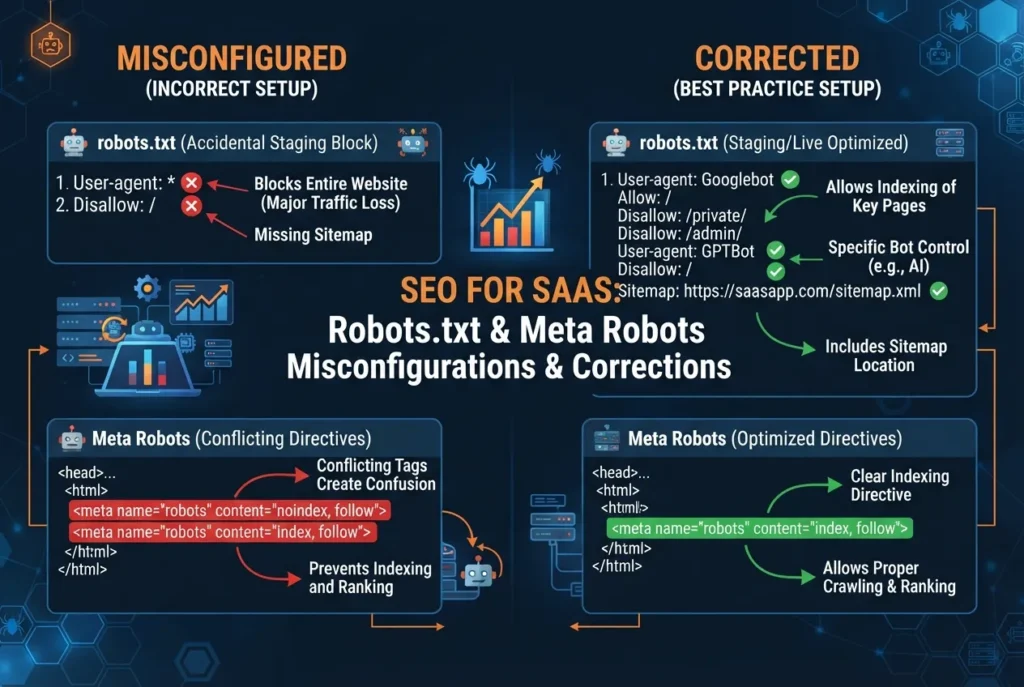
Most SaaS platforms are built on React, Vue or Next.js and rely on JavaScript rendering and API calls. Unlike a static blog, a SaaS dashboard is not crawlable by default. Google cannot index your login flow or user interface. You must explicitly tell search engines which content pages to crawl and index.
Many SaaS companies misconfigure robots.txt or canonicalisation rules and accidentally block their own ranking opportunities. Proper configuration is essential.
Multi-Stakeholder Buying Committees
B2B software buying involves multiple stakeholders searching at different times. A marketing manager searches “how to track team engagement”. A finance lead searches “what does SaaS cost per user”. An engineer searches “does your tool integrate with Salesforce”.
Each person needs different content at a different stage. Your SEO strategy must serve all three audiences simultaneously.
Regulatory and Trust Signals
SaaS companies in Singapore and broader Asia-Pacific must account for regulatory and data-residency requirements that traditional websites do not face. If your software stores customer data, compliance certifications such as SOC 2, ISO 27001 and PDPA compliance are not marketing badges.
Google’s E-E-A-T framework (Experience, Expertise, Authoritativeness, Trustworthiness) explicitly rewards platforms that demonstrate security, privacy and regulatory rigour. For software handling sensitive customer data, regulatory compliance is a meaningful trust signal that competitors often neglect.
The SaaS Business Model and Its Impact on Search Strategy
Most SaaS companies monetise through monthly or annual subscriptions. Customers pay recurring fees, not one-time purchases. This recurring-revenue model fundamentally reshapes keyword strategy.
In e-commerce, you rank for highest-intent keywords closest to purchase. In SaaS, you also rank for keywords that build trust and keep your product top-of-mind for months before a prospect enters your sales pipeline.
[IMAGE: Visual comparison showing how SaaS recurring revenue and multi-month sales cycles differ from e-commerce transactional timelines, including awareness, consideration, trial and conversion phases with associated keyword types]
Product-Led Growth and Trial-First Models
Product-led growth is now standard for SaaS. Your free trial or freemium tier becomes your first sales channel. Organic search drives traffic directly into the product. Your trial-to-paid conversion rate is your primary metric.
This changes on-page SEO strategy. Instead of a demo-request form, your top landing page says “Sign up for a free trial”. Your call-to-action reads “Start 14 days free”, not “Contact sales”. Your title tag is “Project Management App Free for 30 Days”, not “Book a Demo”.
Keyword research must prioritise high-volume “getting started” and feature-education searches because those visitors are most likely to commit to a paid subscription through self-service. Ranking for “how to build workflow automation” is indirectly ranking for your own product.
Asia-Pacific Expansion and Regional Segmentation
Many Singapore-based SaaS platforms expand to Malaysia, Indonesia and India within two to three years. Each market has different search behaviour, language preferences and regulatory rules. India requires separate compliance. Malaysia has distinct data-protection rules. Indonesia has bandwidth and language constraints that shift optimisation.
Your SEO strategy must be geographic from day one. A single keyword list does not work for Singapore and India simultaneously. You need separate keyword clusters for each language and region. You need separate content strategies and technical SEO that handles regional subdomain or subfolder canonicalisation correctly, or you will dilute your ranking authority across markets.
Customer Acquisition Cost and Lifetime Value
Customer acquisition cost (CAC) and lifetime value (LTV) fundamentally change your SEO ROI calculation. You do not measure SaaS SEO success by immediate sales. You measure it by qualified-lead volume, trial-to-paid conversion rates and multi-touch attribution across your entire funnel.
An organic search visitor who converts to a trial on day one but becomes a paying customer three months later (after multiple email touches and one sales call) is still an organic win, but that win is invisible in week one.
Many SaaS companies abandon SEO too early. They expect e-commerce conversion timelines and grow frustrated when organic search does not produce sales conversations in month two. SaaS SEO typically requires 6 to 18 months based on reported case studies. The payoff compounds: each month you rank for more keywords, your brand authority grows, product reputation strengthens and word-of-mouth multiplies lead volume.
This timeframe shapes resource allocation, reporting cadence and stakeholder expectations. It also informs keyword strategy: some keywords drive awareness (long payoff window), others drive trials (medium window), and a subset drives immediate sales conversations (short window). All three are necessary.

Understanding SaaS Buyer Intent and the Search Funnel
The Three-Stage Buyer Journey
SaaS buying follows a predictable pattern mapped to search intent.
Awareness stage: A prospect realises they have a problem. They search “how to manage team capacity” or “why does my software crash under load”. They do not know vendor names yet. They need educational, problem-focused content.
Consideration stage: They recognise the problem is worth solving. They search “capacity management tools” or “software stability comparison”. They compare vendors and evaluate features. They read case studies and pricing reviews. This allocation often yields lower overall conversion rates unless you guide them toward your solution through targeted content.
Decision stage: They are ready to commit to a paid subscription. They search “Asana vs Monday.com” or “HubSpot free trial”. They want demos, pricing details and customer testimonials. They have narrowed their options to three to four vendors.
Role-Based Search Fragmentation
Different roles within the same company search for different things at each stage. A technical lead searches for “API documentation” and “integration capabilities”. A finance lead searches for “pricing per user” and “free trial terms”. A procurement manager searches for “SOC 2 certification” and “data residency”.
Each role’s search reveals intent specific to their responsibilities. Your content strategy must address all roles, not just procurement-stage keywords.
YMYL and Compliance in SaaS Search
YMYL (Your Money Your Life) applies to any software handling customer data, financial information or sensitive personal information. Google applies heightened scrutiny to these categories.
Your YMYL status means Google evaluates your expertise, authoritativeness and trustworthiness more rigorously than for general SaaS. Content must demonstrate clear knowledge of regulatory requirements and data protection standards.
Financial software, healthcare platforms and employee-data tools carry even higher compliance scrutiny. If your SaaS touches regulated data in Singapore or Asia-Pacific, your SEO strategy must centre on regulatory compliance signals: audited certifications, transparent privacy policies, and documented data residency commitments.
This is part 1 of 5 of the complete SEO for SaaS guide. Subsequent sections will cover keyword research strategy, content architecture, technical implementation and measurement frameworks.
Understanding SaaS Buyer Intent and the Search Funnel
SaaS companies do not sell products the way e-commerce stores sell widgets. A prospect searching for “CRM software” is not ready to buy. They are exploring. They might be comparing three vendors. They could be validating a problem their team faces. Understanding this distinction shapes everything you optimise for.
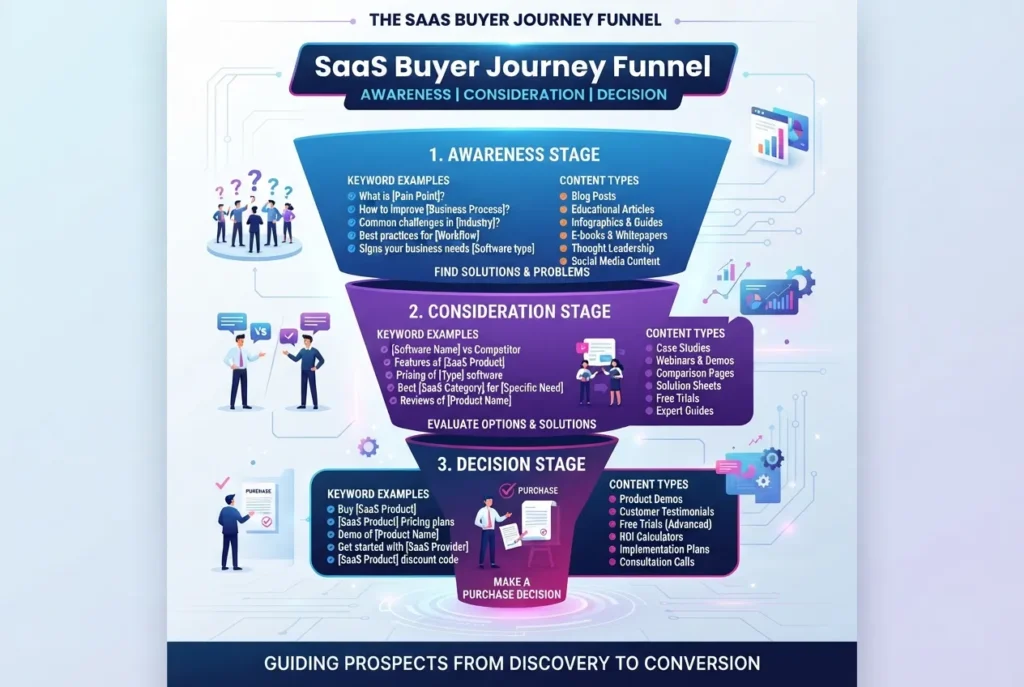
The Three-Stage Buyer Journey
The SaaS buyer journey spans three distinct intent phases. Each phase requires different keywords and content approaches.
Awareness stage: Prospects recognise a problem but have not yet identified it as a software solution. They search phrases like “how to manage customer relationships at scale”, “reduce support ticket response time” or “team collaboration best practices”. At this stage, they educate themselves, not shop. Your content should answer the underlying problem, not pitch your product.
Consideration stage: Once a prospect knows they need software, they search “best CRM software”, “CRM comparison” or “Salesforce versus HubSpot”. They evaluate vendors and features. Content here includes comparison guides, feature breakdowns and case studies that position your solution alongside alternatives. This allocation often yields lower overall conversion rates than decision-stage content, so many teams under-invest here despite its importance in building buyer confidence.
Decision stage: Intent-rich searches dominate: “Salesforce free trial”, “HubSpot pricing”, “implement Salesforce in Singapore”. Prospects want demos, pricing clarity and proof that your software works in their region. Product pages, pricing calculators and region-specific documentation rank highest here.
Most SaaS companies over-invest in decision-stage content and under-resource awareness-stage topics. This allocation often yields lower overall conversion rates. In B2B software, awareness-stage traffic builds trust and brand recall months before a purchase conversation begins. Neglecting it results in unrealised revenue opportunity.
Why this matters for ranking: Search engines reward content that serves each stage authentically. Awareness-stage guides that teach without selling rank well because they match user intent. Decision-stage pages with transparent pricing and trial options rank well because they satisfy searchers ready to commit to a paid subscription. Mixing stages confuses both users and ranking algorithms.
Different Roles Search for Different Things
Beyond the funnel, search intent also varies by role and buyer persona. A finance director searching “expense management software” has different needs than a procurement specialist or a CFO auditing compliance. A developer searching “API documentation” needs technical depth; a product manager searching “integrate payment processing” needs business outcomes.
Segment your keyword research and content strategy by these role-based intent patterns. A single page cannot satisfy all stakeholders equally. Content designed for developers will confuse finance teams. Content pitched to executives will lack technical detail that engineers need.
YMYL and Compliance in SaaS Search
YMYL (Your Money Your Life) applies if your software handles customer data, payment information, employee records or financial transactions. These searches carry higher quality-control thresholds and stronger weighting toward trust signals.
Data security and compliance searches are YMYL in practice. A prospect searching “secure expense management software” or “GDPR-compliant CRM” is evaluating risk. Search results must demonstrate expertise, certifications and trustworthiness. This is where SOC 2 certification badges, third-party security audit links and compliance documentation serve as trust signals that influence rankings.
Singapore-specific compliance adds another layer. Prospects searching “PDPA-compliant software” or “cloud storage with Singapore data residency” are checking regulatory alignment. Under Singapore’s Personal Data Protection Act, you must handle customer data transparently. Your content should make data residency explicit. If your servers sit in Singapore, state this clearly. If you hold relevant certifications under Singapore’s data protection framework, link them and explain what they mean for customer data handling. Omitting this clarity reduces rankings for location-plus-compliance queries and erodes trust with local buyers.
Financial software, healthcare platforms and employee management systems carry even higher YMYL weight. Treat every piece of content as trust-building. Author credentials matter: link team bios to publication history, professional certifications and speaking engagements. Customer testimonials should include company size, industry and measurable outcomes, not generic praise. Third-party reviews and analyst reports (G2, Capterra, Forrester) become content anchors and link sources.
Buying Committee Complexity and Long Decision Windows
Search behaviour also splits by buying committee complexity. In small teams, one person researches and decides. In larger organisations, a procurement specialist searches differently than the department head who will use the software daily.
The procurement person hunts for contract terms, compliance checklists and vendor stability signals. The end user hunts for usability guides and integration compatibility. Both are high-intent, but they search different queries and read different pages. A single product page cannot answer both. Cluster your content by stakeholder role and intent, or you create friction in the buying process and lose clicks to competitors who segment better.
SaaS search intent also carries longer decision windows than transactional searches. A person buying trainers decides in hours. A company adopting a new accounting platform deliberates for weeks or months. This extends your buyer journey and changes your content calendar.

You are not chasing immediate conversions; you are building momentum through the funnel. Awareness-stage content published in January might drive a qualified lead in June and close a deal in September. Track this latency in your analytics. Without visibility into this timeline, you may incorrectly attribute success to recent work and under-fund long-lead content that actually drives revenue months later.
Keyword Research and Segmentation Strategy for Software Companies
Keyword research for SaaS differs fundamentally from e-commerce or services SEO. You are not targeting people ready to buy. You are targeting people at vastly different stages of a months-long evaluation process. Each stage involves distinct search language, intent and decision barriers.
A prospect aware she has a problem searches differently than a prospect comparing your solution to competitors. A developer evaluating your API searches differently than the finance lead evaluating your pricing. Traditional keyword research tools rank keywords by search volume and difficulty alone. This approach is insufficient for SaaS. You must segment keywords by buyer journey stage and by the role of the searcher.
Best Practices for SaaS Keyword Research
Start with your ideal customer profile (ICP) and buyer personas. Do not start with SEO tools. Map out the problems they face. Identify the roles involved in a purchase decision: developer, finance, procurement, security. Document the language each role uses when searching for solutions.
Then use SEMrush, Ahrefs or Moz to validate what those personas actually search for. Run a competitor domain analysis. Plug in your top three organic competitors and extract their organic keywords. This shows which keywords are realistic to rank for in your vertical.
Google Search Console is equally valuable. Review your search queries, impressions and click-through rate by keyword. Look for questions your content almost ranks for: high impressions but low clicks. These keywords are low-hanging wins.
Look for keyword clustering. Ahrefs and SEMrush identify keywords that compete against the same search engine results pages (SERP). If 12 keywords map to the same top 5 results, address all 12 in one comprehensive cluster page. Do not splinter effort across multiple targets.
Pay close attention to competitor content gaps. If a competitor ranks for 200 keywords but none address “how to migrate from X to your platform”, you have found an addressable gap. Migration queries often sit at the decision stage and convert well.
Segmenting Keywords by Funnel Stage
Awareness stage. These keywords reflect a problem or category the prospect is learning about, not your solution yet. Search volume is high; intent is broad.
Examples: “workflow automation best practices”, “how to reduce customer churn”, “SaaS onboarding metrics”.
Content here educates and builds trust. You are not pitching. You are teaching the prospect that this problem is worth solving and what outcomes matter. Ranking here builds brand awareness and E-E-A-T (expertise, experience, authoritativeness, trustworthiness).
Consideration stage. The prospect knows the problem is real and is evaluating types of solutions or specific tools. They search for comparisons, feature guides and use-case documentation.
Examples: “workflow automation vs. task management”, “Zapier alternatives”, “how to choose customer data platform”.
This is where your product education, comparison pages and resource documentation rank. Buyers are building a shortlist. You must rank here to get on that list. The content is longer, more detailed and often includes user guides or video walkthroughs. This allocation to consideration-stage content often yields lower overall conversion rates initially. However, it establishes your brand as a credible option.
Decision stage. The prospect is ready to commit to a paid subscription. They search for your brand name, your pricing, your implementation timeline, or vendor-specific terms that signal they already know about you.
Examples: “Acme pricing”, “Acme vs. Competitor X”, “Acme free trial”, “Acme implementation steps”.
Your product pages, pricing pages, comparison pages and case studies rank here. This traffic converts fastest. However, decision-stage keywords are often branded and carry high paid search competition, so organic ranking is harder. You build decision-stage visibility by ranking for awareness and consideration keywords that funnel prospects toward your brand.
Segmenting Keywords by Intent Type
Within each funnel stage, keywords cluster by intent. The same problem-solution keyword might appear at awareness or decision stage depending on the searcher’s knowledge.
Problem-solution keywords. “How do I automate social media scheduling?” The searcher knows the problem, not the solution. This keyword appears at awareness and consideration stages. Content is a guide or explainer.
How-to and educational keywords. “How to set up webhook integrations”, “how to integrate Zapier with Slack”. The searcher is already a customer or trialling your product. This is documentation. It ranks well if your docs are properly structured and linked. Many SaaS companies underestimate documentation as an SEO asset. It drives long-tail traffic and reduces support costs.
Comparison keywords. “Acme vs. Competitor X”, “best workflow automation tools for remote teams”. The searcher is at consideration stage. Rank for comparisons that favour your positioning. Avoid head-to-head comparisons where your product is weaker. Instead target use-case-specific comparisons where you excel.
Vendor-specific keywords. “Acme pricing”, “Acme API documentation”, “Acme customer reviews”. These are branded and high-intent. Rank for them with your official pages: pricing, docs, case studies. Also rank for questions like “Acme free trial” and “Acme demo” because searchers asking these are days from a purchasing decision.
Feature-specific keywords. “Workflow automation with AI”, “role-based access control for SaaS”, “real-time data sync”. These target specific product features your ICP values. Rank for them in your product docs, blog posts or resource guides.
Long-Tail and Feature Cluster Segmentation
SaaS keyword volume is deceptive. Top-level keywords like “workflow automation” carry high monthly search volume but are dominated by venture-backed incumbents and news sites. You will struggle to rank.
Long-tail keywords like “workflow automation for B2B SaaS customer onboarding” carry lower monthly search volume but have less competition and higher intent. Rank for 80 long-tail keywords in a specific niche (say, SaaS customer onboarding), and you accumulate substantial monthly visits across the cluster. Rank for five head keywords and you get fewer visits because competition is immense.
Build long-tail clusters around use cases, integrations and industry verticals. A payroll software company might cluster keywords around:
- Healthcare payroll workflows
- Multi-state tax compliance
- Integration with ADP vs. Guidepoint
- Payroll automation for fractional CFOs
Each cluster should have a pillar page (broad topic, high-value keyword) and 8–15 cluster pages (specific use cases, integrations, feature deep-dives). Internal links tie the cluster together.
SaaS Keyword Segmentation Framework
| Funnel Stage | Intent Type | Keyword Example | Content Type | Searcher Role | Conversion Signal |
|---|---|---|---|---|---|
| Awareness | Problem-solution | How to reduce customer churn | Blog guide (2,000 words) | Business leader | Email signup, webinar |
| Awareness | Educational | SaaS retention metrics | Resource centre article | Data analyst | Ebook download |
| Consideration | Comparison | Customer engagement platform vs. email | Comparison page | Marketing lead | Product demo request |
| Consideration | How-to | How to segment customers by behaviour | Tutorial, docs | Product user | Free trial activation |
| Consideration | Vendor-specific | HubSpot alternatives | Competitor comparison | Decision-maker | Demo request |
| Decision | Vendor-specific | Acme pricing | Pricing page | Finance lead | Trial signup, conversation |
| Decision | Feature-specific | Acme AI segmentation | Product page, docs | Product manager | Feature exploration |
| Decision | Branded | Acme free trial | Landing page | Prospect | Trial signup |
Tools and Workflow for SaaS Keyword Research
SEMrush Keyword Gap. Enter your domain and two competitors. Identify keywords they rank for but you do not. Prioritise keywords with volume above 50 and keyword difficulty below 60.
Ahrefs Site Explorer. Run against your top organic competitor. Export their organic keywords, sort by volume and difficulty. Filter for keywords your site does not currently rank for. These are gap opportunities.
Google Search Console. Review Performance queries. Identify queries where you have high impressions (above 100) but low click-through rate (below 2%). These keywords are within striking distance. Improve your title tag or meta description and they will likely convert.
Keyword clustering tool. Use SEMrush Topic Research or Surfer SEO. Input your focus keyword. The tool groups related keywords into clusters and suggests a primary keyword per cluster. Use this to create your internal linking architecture: one cluster page per unique intent.
Competitor content gap analysis. Use Semrush Content Marketing Platform or Ahrefs Content Explorer. Identify keywords your competitors’ blog targets but your blog does not. Gaps indicate unmet demand in your market.
Regional and Role-Based Segmentation for Singapore and APAC
If your SaaS targets Asia-Pacific, segment further by region and language. A developer in Singapore searching “cloud infrastructure API” expects different content than a business decision-maker in Hong Kong searching “enterprise SaaS vendor Singapore”.
For Singapore-specific searches, incorporate location qualifiers: “SaaS development agency Singapore”, “PDPA-compliant customer data platform Singapore”. These keywords are lower volume but higher intent for local prospects. PDPA (Personal Data Protection Act) compliance is a legal requirement in Singapore. Ensure your content addresses data handling and privacy standards that matter to your local market.
If you support multiple languages, build separate keyword clusters by language and region. English dominates in Singapore and Hong Kong, but Mandarin, Thai and Vietnamese clusters are valuable for tier-2 cities and fast-growing markets.
Segment also by role. Developer-focused SaaS should cluster API keywords, integration guides and SDK documentation separately from finance or security keywords that appeal to procurement. Your internal linking and site structure should reflect this segmentation. Each role sees the keywords and content path relevant to them.
Content Strategy and Topic Clustering for SaaS
How you organise your content matters far more than how much you produce. A SaaS company with 40 strategically interconnected pieces will rank higher and drive more qualified leads than a competitor with 200 scattered blog posts. Search engines reward topical authority: the ability to demonstrate deep, comprehensive coverage of a subject through content that builds from foundational definition to nuanced application. For SaaS companies, this structure directly mirrors the buyer’s journey, making it both an SEO and conversion win.
Pillar Pages and Cluster Architecture
A pillar-and-cluster model organises your content into a single pillar page (broad, foundational) that links to multiple cluster pages (specific, detailed). Each cluster page links back to the pillar, and clusters link to one another where intent overlaps.
For a B2B SaaS company selling project management software, your pillar might be “Project Management for Distributed Teams”. Cluster pages would then cover narrower angles: “Asynchronous Collaboration Tools”, “Remote Work Productivity Metrics”, “Project Management for Agencies”, and “Agile Workflow Software”. Each cluster page ranks for a specific medium-tail keyword. The pillar captures the high-volume, high-intent, often-competitive core keyword.
This structure satisfies topical relevance signals that modern search algorithms reward. Google’s systems now understand that cluster pages belong to a topic pillar, and search relevance improves as the cluster grows. For SaaS SEO, this means ranking not just for product-focused keywords (like “project management software”), but also for the educational and problem-solving keywords your buyers search during awareness and consideration stages.
[INFOGRAPHIC: Pillar-and-cluster diagram showing one central pillar page connected to six satellite cluster pages with bidirectional arrows and cross-links between related clusters]
Assigning Content Formats to Funnel Stages
Not all cluster pages serve the same purpose. The format you choose must match buyer intent and funnel stage.
Awareness stage content. Use educational guides, how-to tutorials and conceptual explainers. A prospect searching “how to manage distributed teams” does not yet know your product exists. Your goal is to appear as a trusted resource and build topical authority. Examples: “Complete Guide to Asynchronous Communication”, “5 Signs Your Team Needs Better Project Tracking”, “What is Work-in-Progress Limiting?” These are product-agnostic pieces that attract broad organic traffic and establish expertise.
Consideration stage content. Use comparison guides, feature-focused deep dives and case studies. A prospect now understands they have a problem and is evaluating solutions. Your content bridges that gap: “Gantt Charts vs. Kanban Boards: When to Use Each”, “Does Your Team Need Real-Time Collaboration?”, “Project Management Software for Agencies: Requirements Checklist”. These pages rank for competitive keywords and include signals that guide toward your product without overt selling.

Decision stage content. Use product comparisons (your software versus named competitors), detailed pricing and ROI calculators, and customer case studies. A buyer is ready to choose. Examples: “[Your Product] vs. Asana vs. Monday.com: Feature Comparison”, “[Your Product] Pricing and ROI for Mid-Market Agencies”, “How [Customer Name] Reduced Project Delivery Time by 30%”. These pages convert high-intent, low-volume keywords and directly influence the final decision.
Internal Linking Best Practices Within Clusters
The strength of a pillar-and-cluster model lies in deliberate internal linking. This directs link equity (ranking power) and guides both users and crawlers through your topical authority.
Link the pillar page to every cluster page using descriptive anchor text that includes the cluster’s target keyword. When you write a cluster page, link back to the pillar once (ideally in the opening paragraph) with anchor text that names the broad topic. Link between related clusters using contextual, relevance-based anchor text, not generic phrases like “read more”.
For example, if your “Remote Work Productivity Metrics” cluster page mentions asynchronous communication, embed a link to your “Asynchronous Collaboration Tools” cluster page with that exact phrase as anchor text. This signals to search engines that both topics belong together and belong under your pillar.
Internal linking also improves crawl efficiency. Search engines use links to discover and prioritise pages for crawling. A well-linked cluster structure ensures Googlebot finds all your content and understands its hierarchy quickly.
Feature Specificity and Integrations as Content Opportunities
SaaS companies often overlook a major content category: feature documentation and integration guides. These pages rank for long-tail, high-intent keywords that buyers search late in consideration or early in decision.
If your project management tool integrates with Slack, create a dedicated page: “How to Integrate [Your Product] with Slack: Step-by-Step Setup Guide”. Include setup screenshots, troubleshooting tips and links to both Slack and your main product documentation. This page targets a specific query, captures qualified traffic from users actively choosing to integrate your tool with their tech stack, and drives adoption (leading to higher lifetime value and retention signals that search engines increasingly observe).
Similarly, if your software includes a time tracking feature, create a feature guide: “Time Tracking in [Your Product]: Auto-Logging, Analytics and Reporting”. This cluster page sits between your pillar (project management) and your decision-stage comparison content. It captures the prospect researching whether your tool’s built-in time tracking replaces a separate tool.
Topic Freshness and Update Cadences
SaaS products evolve. Features launch, integrations expand, user interface changes occur. Your content must reflect that reality, or it becomes outdated.
Establish a content maintenance calendar. Every three months, audit your existing cluster pages for outdated feature references, broken product screenshots or deprecated integrations. Update them in place. This is not about publishing new content; it is about keeping evergreen content fresh.
When you release a major feature, ask: does an existing cluster page need updating, or does this warrant a new page? If a major platform releases a breakthrough feature that affects how remote teams work, and your product integrates with it in a novel way, that warrants a new awareness-stage guide or an update to your asynchronous collaboration cluster page.
Search engines reward content freshness, especially for pages that already rank. An old page that was updated yesterday will often outrank a newer page on the same topic, if all other factors are equal. For SaaS companies, this freshness advantage is yours to claim: you control the product and the documentation.
Siloing and Separation of Concerns
Consider where your pillar and clusters live in your site architecture. Some SaaS companies place all content in a blog. Others separate educational content (guide.yourproduct.com), product documentation (docs.yourproduct.com) and customer stories (customers.yourproduct.com). This separation creates content silos.
From an SEO perspective, silos can help if they reflect topic clarity. A prospect reading your “Remote Work Productivity Metrics” guide (educational site) expects different language and depth than one reading “Configuring Time Tracking Settings” (documentation). Silos prevent cannibalisation and allow you to optimise each section for its audience and purpose.
However, silos only work if internal linking bridges them. If your educational guide does not link to product documentation, and your documentation does not link back to guides, you lose topical authority. Google may treat each silo as independent, weakening the overall pillar effect.
The solution: use clear, generous internal linking across silos. Include footer links, contextual in-body links and related-content modules. If your primary domain is yourproduct.com, ensure docs.yourproduct.com and guide.yourproduct.com are linked from the homepage and main navigation. This signals to search engines that they are part of the same property and topical cluster.
Frequently Asked Questions
1. How long does SEO for SaaS take to show results?
SaaS SEO typically requires 6 to 18 months before meaningful revenue impact, based on reported case studies. Awareness-stage content may take several months to generate qualified leads. Decision-stage keywords convert faster but face stronger competition. Expect consistent, compounding growth rather than immediate spikes. The timeline varies depending on your market size, competition level and content maturity.

2. Should I focus on branded or unbranded keywords first?
Start with unbranded, high-intent keywords in your consideration and decision stages. These attract prospects actively searching for solutions. Then invest in awareness-stage, unbranded keywords for long-term brand building. Branded keywords matter for retention and product education after someone knows your name.
3. How do I measure SEO ROI if sales cycles are long?
Use multi-touch attribution and cohort analysis instead of last-click conversion. Track organic-sourced visitors through your pipeline, noting trial conversion, demo requests and closed deals. Measure marketing qualified leads (MQL) to sales qualified leads (SQL), SQL to close rate and customer lifetime value (LTV) by organic source. Compare organic customer acquisition cost (CAC) to your target CAC by deal size.
4. What should I prioritise: technical SEO or content?
Both are essential, but start with content. A technically sound site with poor content ranks nowhere. Build your pillar-and-cluster content structure first, addressing buyer journey stages and key keywords. Once content quality is established, optimise technical SEO (site speed, Core Web Vitals, mobile usability, structured data) to remove crawl and ranking blockers.
5. How do I handle multiple product tiers or use cases in one SEO strategy?
Create separate keyword clusters for each major use case or customer segment. A payroll platform with distinct products for small businesses, mid-market and enterprise should build separate content pillars for each segment. Link these pillar clusters thematically but keep internal linking intentional. This avoids keyword cannibalisation and allows each segment to rank for its relevant searches.
6. Is PDPA compliance mandatory for my SEO content?
If your SaaS handles Singapore customer data, Personal Data Protection Act (PDPA) compliance is mandatory by law, not just for SEO. Disclose data handling, residency and retention explicitly on your privacy page and relevant content. This transparency signals trustworthiness to both search engines and human buyers evaluating whether to trust your platform. Omitting it creates legal liability and erodes buyer confidence.
7. What is the difference between awareness and consideration stage SEO for SaaS?
Awareness-stage SEO targets educational, problem-focused keywords where searchers do not yet know a software solution exists. Your content teaches and builds trust without mentioning your product. Consideration-stage SEO targets keywords where searchers actively compare solutions. Your content addresses product features, comparisons and use cases. Both drive qualified traffic, but awareness content builds authority over time whilst consideration content converts faster.
8. How do I rank for competitor comparison keywords without damaging brand relationships?
Create fair, factual comparison pages that position your product honestly against named competitors. Avoid misleading claims or feature exaggeration. Link to competitor websites and documentation (this builds topical authority and signals confidence). Frame comparisons around use cases or customer segments where your strengths are genuine. Competitors expect comparison pages; they are a standard part of SaaS search. Your responsibility is accuracy, not flattery.
9. Should I invest in SEO if my SaaS is product-led growth?
Yes, especially if you are product-led. Organic search drives self-serve prospects directly into your product trial. SEO for product-led SaaS focuses on getting-started keywords, feature education and problem-solution content that accelerate trial activation. Your landing pages target “free trial” and feature keywords rather than “book a demo”. Track trial-to-paid conversion by organic source to measure ROI.
10. What happens if I target keywords but my product doesn’t solve that use case?
Do not. Ranking for keywords your product does not support creates friction, erodes trust and wastes SEO investment. Instead, focus on keywords where your product excels. If prospects are searching for a use case your product does not address, acknowledge it in your content and suggest workarounds or integrations. This honesty builds credibility and often converts searchers to customers anyway because they trust you more than competitors who oversell.
11. How does SaaS SEO differ for B2B versus B2C models?
B2B SaaS SEO emphasises buyer journey length, multi-stakeholder searches and trust signals like compliance certifications. B2C SaaS (consumer-facing tools like personal finance or fitness apps) favours shorter sales cycles, single decision-makers and trend-focused content. B2B content clusters around role-based searches and integration keywords. B2C content clusters around use cases and emotional outcomes. Both require long-tail keyword segmentation, but B2B benefits more from topical authority and compliance signals whilst B2C benefits more from review aggregation and social proof.
12. Can I rank globally for SaaS SEO or should I target specific regions first?
Start with one core market (Singapore for most Asia-Pacific SaaS). Build topical authority, establish brand presence and accumulate customer case studies in that market first. Then expand geographically by creating region-specific content, subdomains or hreflang tags for each new market. Attempting global SEO from day one dilutes authority and creates canonicalisation problems. Regional focus compounds authority faster and produces measurable ROI sooner.